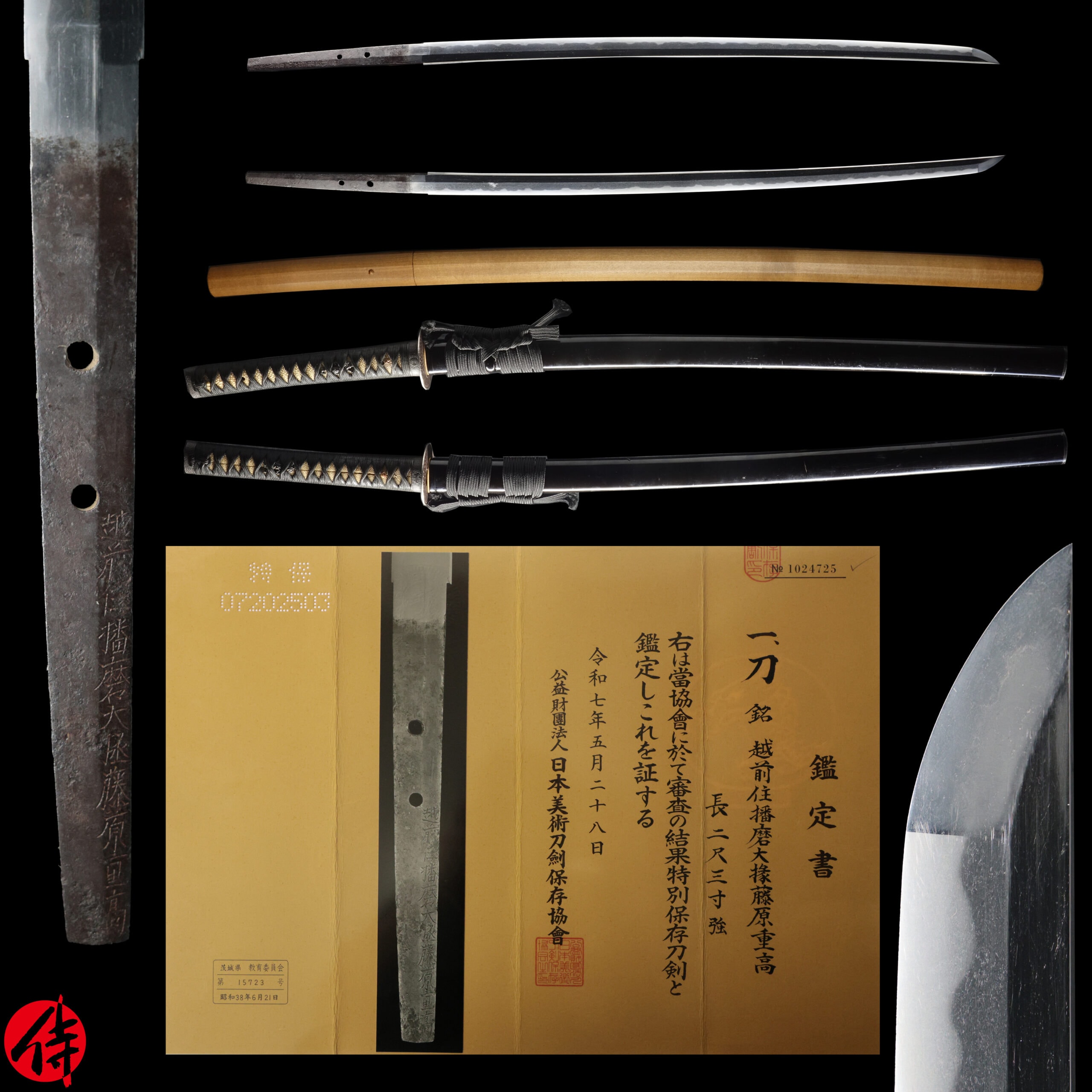
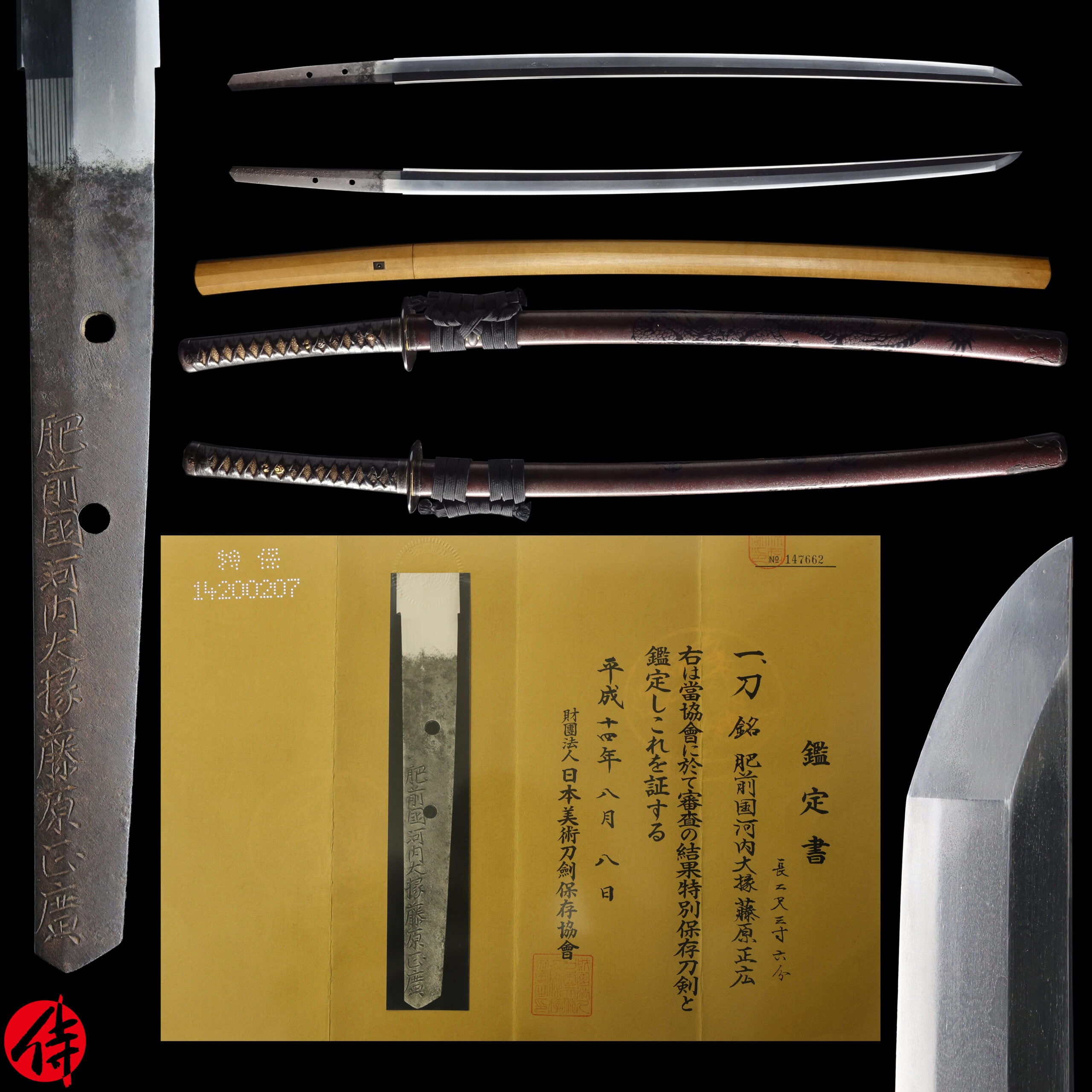
説明
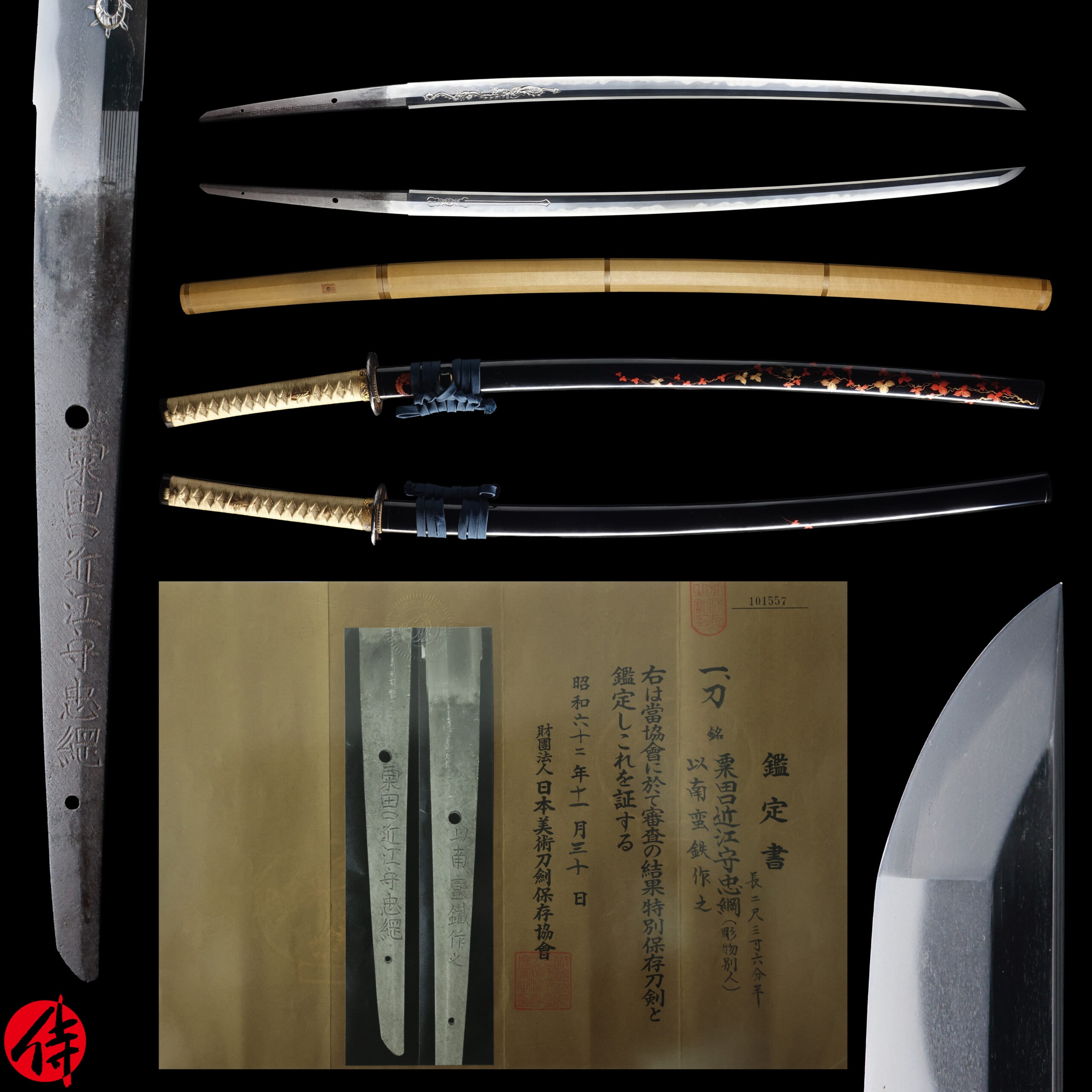
Antique Japanese Sword Katana Signed by Awataguchi Omi no Kami Tadatsuna with
Tokubetsu Hozon
Certificate
【Description】
This blade was signed by Awataguchi Omi no Kami Tadatsuna (粟田口近江守忠綱). The maker’s name Tadatsuna lasted two generations, and we believe it was forged by the first gen, judging from the characteristics of the blade. He was one of the top-tier swordsmiths during the early Edo period. He was especially active in sword-forging during the Kanei-Manji era (1624-1661).
Also, the signature also says that this blade was made from western carbon steel called Nanban Tetsu (南蛮鉄: mixed with traditional Tamahagane). Foreign carbon steel was very expensive back then and either swordsmith or the person who ordered it wanted to be proud of the social status by inscribing this fact.
Tadatsuna was born in the 14th year of the Keicho era (1609) as the son of Asai family in Himeji city, Harima province (Today’s Hyogo prefecture). It is said that he called himself an offspring of Awataguchi Kunitsuna, one of the most famous swordsmiths in Yamashiro province (Today’s Kyoto) during the late Heian-early Kamakura period. This is why Tatasuna signed Awataguchi at the beginning of his signature.
According to available records, the earliest work the first-gen Tadatsuna created is from the 6th year of the Kan-Ei era (1629). And he started to forge swords in Yamashiro province in the 14th year of the Kan-Ei era (1637). Eventually, he moved to Osaka in the first year of the Keian era (1648). The latest work signed by the first-gen Tadatsuna is in the 4th year of the Enpo era (1676), when he was 67 years old.
His son, the second-gen Tadatsuna, is also known as Ikanshi Tadatsuna, and he is one of the most renowned swordsmiths in Osaka during the early Edo period. He mastered excellent sword-forging techniques from his father, the first-gen Tadatsuna.
Osaka Shinto
The blades forged by Tadatsuna are categorized as Osaka Shinto. Shinto is Japanese Sword terminology that refers to the swords forged during 1596-1781. The blades made in the Osaka area during this period are called Osaka Shinto. There are many famous swordsmiths in this Osaka Shinto era. After Hideyoshi Toyotomi built Osaka castle, Osaka city flourished as a castle town and became the business center. Many swordsmiths moved to Osaka to look for better opportunities. They not only forged swords for those Samurai who lived in Osaka but also for feudal lords nationwide. Ikanshi Tadatsuna(Awataguchi Omi no Kami Tadatsuna), Inoue Shinkai, and Tsuda Sukehiro are the most famous among many swordsmiths.
One of the most notable characteristics of Osaka Shinto is its beauty in Jigane. Jigane is a visible steel surface pattern created by folding and hammering during the forging process), which made it possible by the location of Osaka. Osaka had close access to the Tamahagane(special carbon steel to make Japanese swords) production sites. The swordsmiths residing in Osaka were able to get high-quality carbon steel from these sites.
Horimono (Engraving)
*Please keep in mind that although Awataguchi Tadatsuna was also famous for his carvings, the carvings on this blade were done by a different artisan according its NBTHK certificate.
This blade features exquisite engravings (Horimono, 彫り物) on both sides of the blade.
On one side, an intricate carving of Fudō Myō-ō riding a dragon (倶利伽羅不動, Kurikara Fudō) is depicted. Fudō Myō-ō is a guardian deity in esoteric Buddhism, known as the “Immovable One.” He is revered for his role in repelling evil and guiding people toward the righteous path, making him especially venerated by samurai warriors.
The dragon depicted in this engraving is known as Kurikara Ryū-ō (倶利伽羅龍王), a dragon deity considered an incarnation of Fudō Myō-ō himself. Kurikara Ryū-ō is believed to be a divine protector, enveloped in blazing flames that burn away all obstacles and evil. While dragons are traditionally seen as powerful mythical creatures, Kurikara Ryū-ō embodies the very po