NihontoWatch MonNihontoWatchBETA
MarketEncyclopedia
NihontoWatch Mon

NihontoWatchBETA

マーケット
事典
概要·流派
概要流派
  1. 流派
  2. 大坂新刀
  3. 照包

照包

Shinto Terukane

照包

Shinto Terukane

国摂津時代Enpo (1673–1681)時代区分江戸流派大坂新刀伝法Shinto藤代Jo-jo saku刀工大鑑900(上位10%)種別刀工コードTER17

概要

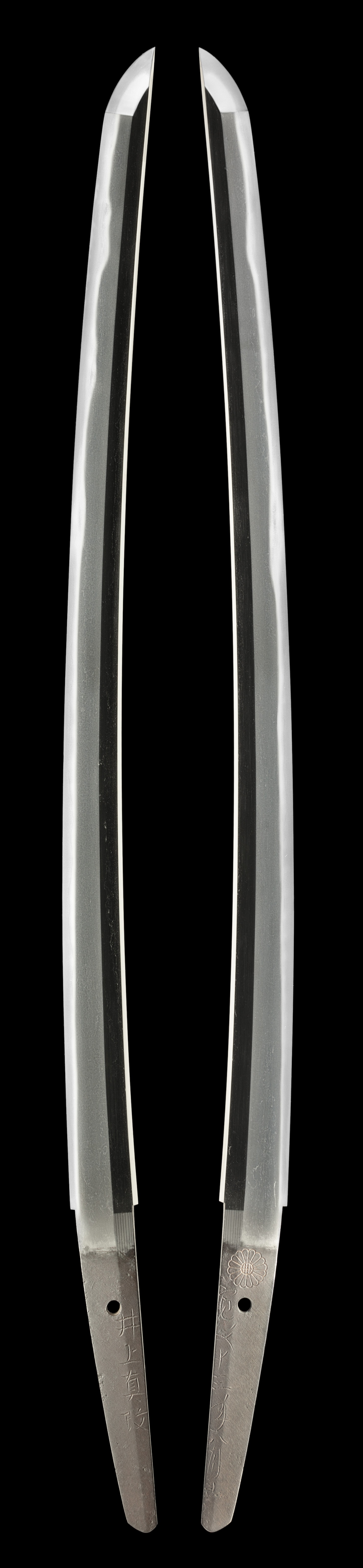
Sakakura Gon'noshin Terukane was the second-generation Echigo no Kami Kanesada. He studied under the first-generation Echigo no Kami Kanesada, succeeded to his position, and at first signed under that name. However, when the first generation's biological son Iwamatsu came of age, he yielded the Kanesada name and thereafter signed "Sakakura Gon'noshin Terukane." The change is documented by an extant work inscribed "Sakakura Gon'noshin Terukane; Echigo no Kami Kanesada, retired" with a reverse date of "an auspicious day in the second month of Enpō 8" (1680). Among the Osaka shintō smiths, the setsumei consistently place him as possessing "excellent technical ability," with workmanship that is "notably free of unevenness or coarseness." His technical skill "has long been regarded as ranking immediately after Sukehiro and Shinkai."

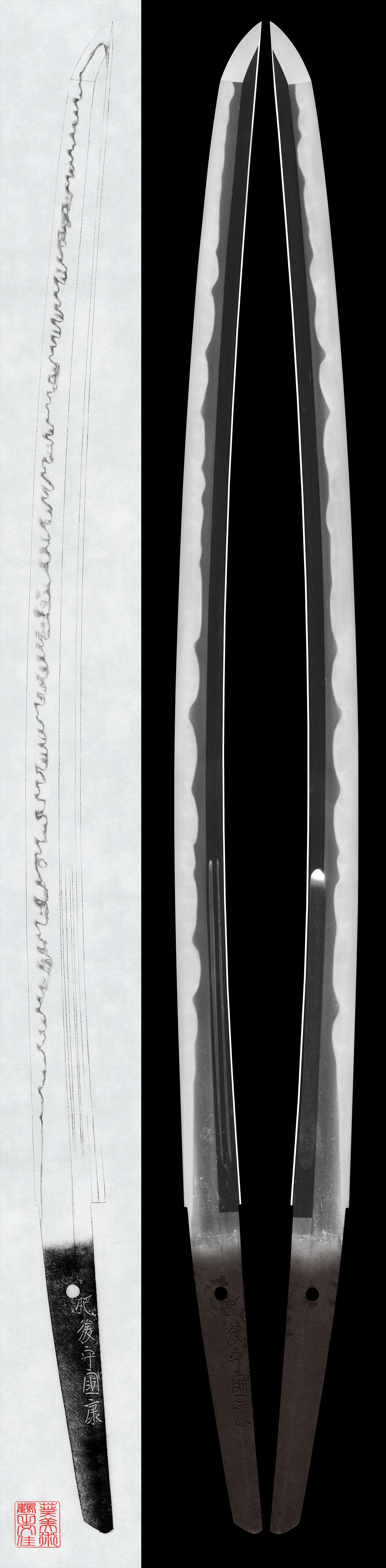
Terukane's dominant mode is the tōran-midare -- the billowing-wave temper modeled after Tsuda Sukehiro -- yet the NBTHK descriptions identify several features that distinguish his interpretation from its prototype. The large ō-gunome-midare characteristically incorporates yahazu-like (arrow-nock) forms and a distinctive hamon shape referred to as katayama-midare, unique to this smith. A habitual mannerism appears below the yokote, where "about three gunome appear in succession." The forging is invariably a tightly packed ko-itame-hada with extremely fine ji-nie adhering thickly and fine chikei entering well. Whatever the chosen pattern -- and more rarely he produced works in large notare, suguha, or even a rosary-bead-like (juzu-ba) temper recalling Nagasone Kotetsu -- "it is typical that the nioi is deep, the nie adheres well, and the nioiguchi is bright." His construction also bears distinctive marks: a steeply formed iori-mune (mune-oroshi), comparatively little hiraniku, and a high shinogi -- features that the NBTHK repeatedly notes as "points of interest" particular to Terukane. The hamon begins consistently with a suguha yakidashi, after which thick, long ashi enter well; sunagashi runs broadly throughout the temper; and kinsuji and nie-suji appear with a frequency that one setsumei notes exceeds "his usual works." In his most accomplished pieces, rounded bead-like tobiyaki "resembling spray" (shibuki) are tempered within the tōran-like pattern, harmonizing with the wave-like rhythm to striking aesthetic effect.

Across nearly twenty Juyo designations spanning three decades, the evaluative consensus is emphatic: Terukane was a master of the Osaka shintō tradition whose output was "consistently high in quality, without marked unevenness." His range extended from the bold tōran-midare that constituted his greatest forte to rarities modeled on Go Yoshihiro and the Sōshū-den, each "finished with consummate skill." The deep nioi, thickly adhering ko-nie, the conspicuous activities of kinsuji and sunagashi, and above all the brightness and clarity of the nioiguchi are cited in every assessment as the hallmarks by which his work may be identified, securing his place as "a solid mainstay within the Osaka shintō tradition" and the foremost heir of the Kanesada line.

販売中

大坂新刀派

大坂新刀派の他の刀工

  1. 1.真改Shinkai13 販売中79指定
  2. 2.忠綱Tadatsuna2 販売中53指定
  3. 3.包貞Kanesada9 販売中78指定
  4. 4.國助Kunisuke5 販売中10指定
  5. 5.包貞Kanesada4 販売中10指定
  6. 6.國康Kuniyasu1 販売中7指定
  7. 7.國輝Kuniteru4指定
  8. 8.貞則Sadanori3指定
  9. 9.兼道Kanemichi2指定
  10. 10.國輝Kuniteru1指定
  11. 11.宗綱Munetsuna1指定
  12. 12.真了Shinryo2 販売中1指定

照包

照包(Terukane)は、摂津の大坂新刀派の刀工です。

Enpo (1673-1681)に活動しました。

作風はShintoに属します。