NihontoWatch MonNihontoWatchBETA
MarketEncyclopedia
NihontoWatch Mon

NihontoWatchBETA

Market
Encyclopedia
Overview·Kantei·Honors·Designations·Provenance·Blade Forms·Signatures·Lineage·School
OverviewKanteiHonorsDesignationsProvenanceBlade FormsSignaturesLineageSchool
  1. Schools
  2. Rai
  3. Kunitsugu

Rai Kunitsugu

國次

Tokujū
Vol. 3, No. 7 · Katana

Rai Kunitsugu

國次

65 ranked works

享保名物帳正宗十哲
ProvinceYamashiroEraOcho (1311–1312)PeriodKamakuraSchoolRaiTraditionYamashiro-denGeneration1stTeacherMasamuneFujishiroJo-jo sakuToko Taikan1,500(top 5%)TypeSwordsmithCodeKUN1544
1Kokuhō
4Jūyō Bunkazai
6Jūyō Bijutsuhin
14Tokubetsu Jūyō40Jūyō Tōken

Overview

On the recorded in the -cho as the Torikai Kunitsugu (鳥養国次), the writes that the work of Kunitsugu shows "the strongest of and within the whole school" (来一派の中では地刃の沸が一番強い), and that single judgment carries the essence of the smith. The published sources place him at the very end of the period, his activity reaching into the first years of , where he stands beside Kunimitsu, his slight senior, as one of the two masters who bring the mainline to its close. His genealogy is unsettled across the published record: the usual account makes him a pupil of Kunitoshi, one account a cousin of Kunimitsu, others the son of Kunitoshi or Kunimitsu's younger brother. From of old he has been counted among the Ten Brilliant Pupils of Masamune (正宗十哲) and carries the name "-" (鎌倉来), a name the published sources explain by the manner of the work itself.

That manner is a the earlier never showed: a -dominant temper of mixed with , the thick and bright, and sweeping through the , drifting along the . The sets thick over and weaves in frequent , in places standing slightly. The recurring verdict of the published sources is that this is a workmanship "strongly shaped by the influence of -" (相州伝の影響を多分に受けた出来口), and the comment of Honma recorded against another of his Bijutsuhin holds the line, that within the school the of his and is conspicuously strong. Even an absence points the way: compared with general work, his shows fewer of the soft - patches typical of the school. The of this register runs or with a pointed tendency, often swept with .

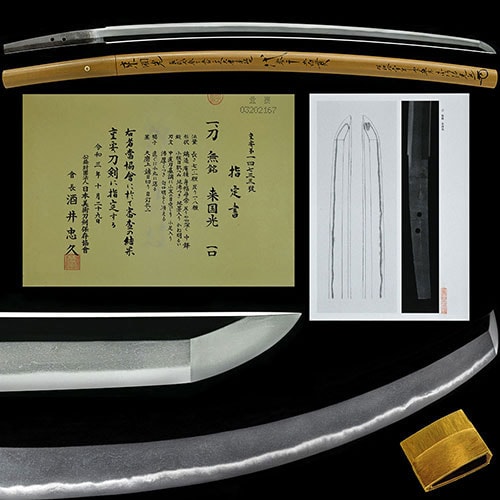
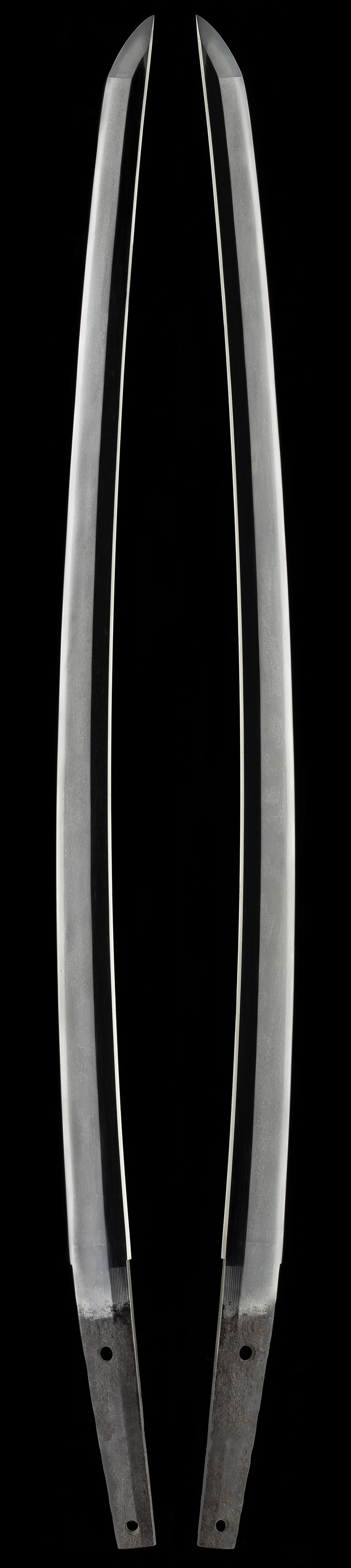
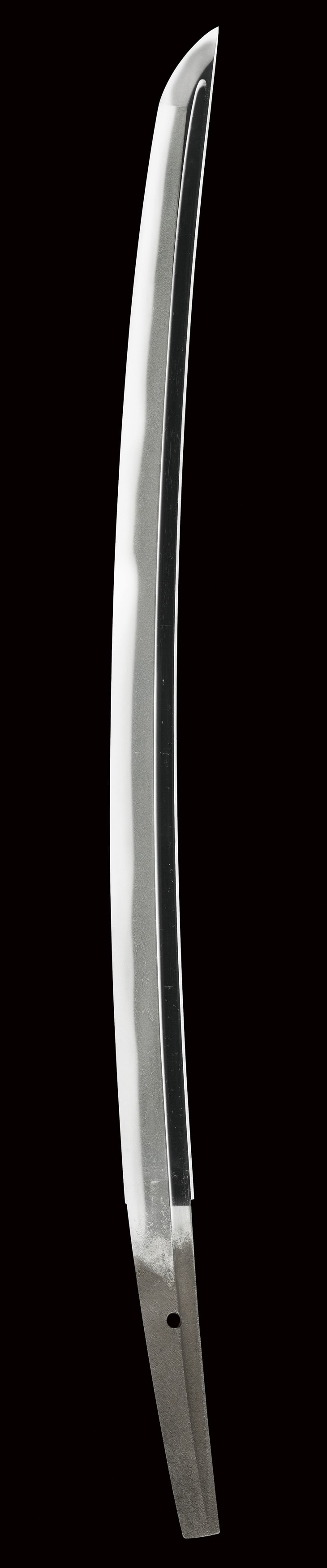
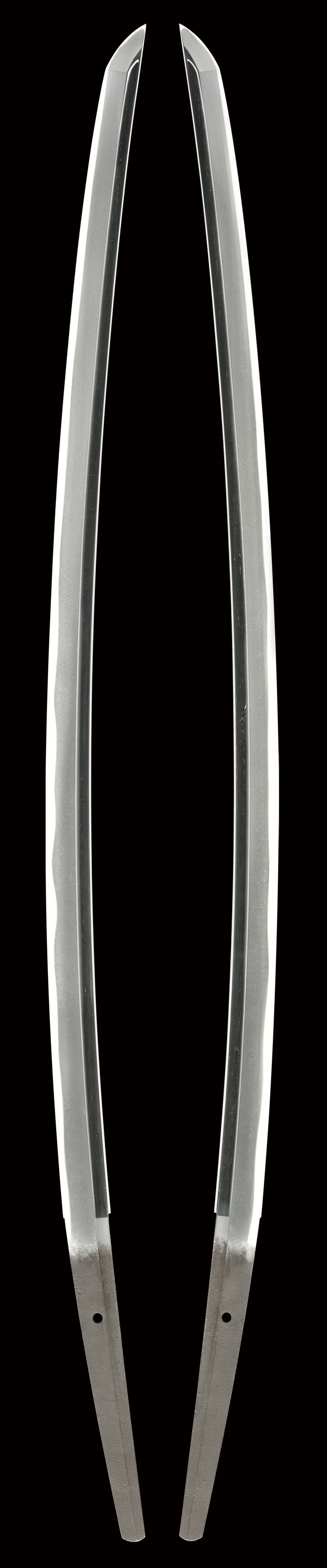
Beneath the color the stays . The forging in his finest pieces is a packed , the fine and thick, entering finely, and a pale rising over the , the anchors that keep the work Kyoto. His most numerous surviving class is the wide , often in a deep wa-zori with the extended. On these blades a -toned base mixes and ; and enter long, thick and without pause; the sits deep into the , and run, and -like plays at the edge. The deciding point is stated outright in the published sources: where the and are unusually bright and the strong, "if one fixes on the point that the stand out within the , an attribution to Kunitsugu is judged proper" (刃中の沸足が目立っている点に着眼すれば来国次と鑑するのが妥当). One is described as reading "just as though the he tempers on his had been rendered on a long blade" (宛ら同工の短刀に焼く乱れを太刀にあらわした感).

His signed work is nearly all and ; the published sources repeat that surviving are scarce, and that and survive only in the rarest examples. The are signed below the at the center of the with a large, thick-chiseled three-character , while the slender signed with high carry an elongated, finely chiseled, smaller signature that the reads as his early hand, valued for showing the change of his manner over time. A minority of works keeps the older style unaltered, a quiet with , the at ordinary strength; the handed down in the Uesugi house is called "a calm register that holds faithfully to the tradition" (来派の伝統を墨守した穏やかな作域), and such work is noted as extremely rare for him. Dated pieces are nearly absent: the of Karyaku 2 (1327) is his earliest surviving date, worked, as with other smiths of the period, in ; a of Shokei 1 (1332) also survives, and Gentoku dates are known only from the old sword albums. On the tradition that he studied under Masamune the itself is careful: since Kunimitsu too at times shows the -strong manner, it writes, to affirm the pupil legend from the style alone would be "premature" (早計).

The comparison that fixes his place is drawn against Kunimitsu. Kunimitsu also left work beside his traditional , but in his case, the published sources observe, the far outnumber the , and "Kunitsugu is the opposite" (来国次はそれとは反対). One text goes further, judging that he carries the even beyond the -emphasized of his senior, a manner the earlier never had. Among the forebears of the line, Kuniyuki, Niji Kunitoshi, Kunitoshi and Kunimitsu, he is the one who retains the least of the traditional Kyoto style, which is exactly why the old Masamune-pupil account drew attention. The judges also leave him room: various atypical pieces (変り出来) are acknowledged within his work, and his few signed differ among themselves. With Kunimitsu he carries the mainline to its close in early , and the - name marks his position as the school's -facing edge.

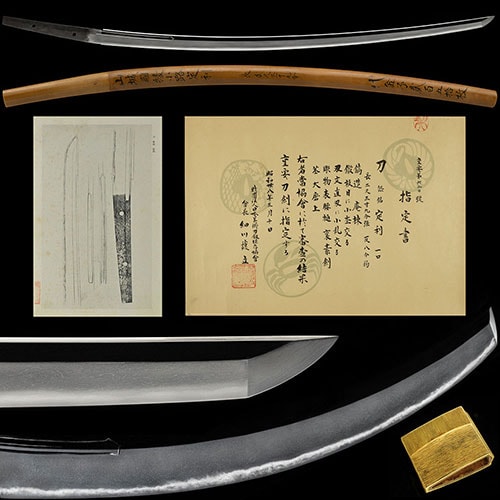
Fujishiro grades him Jo-jo . One of his blades is a National Treasure and four are Important Cultural Properties, patrimony preserved wholly outside the market; beneath them stand fourteen and forty , fifty-four blades in those two tiers, out of sixty-five designated works on record, twenty-nine of them signed against thirty-six unsigned. The Torikai Kunitsugu itself was certified Bijutsuhin in 1933. The provenance roll is of the first rank: the published sources single out the famous handed down in the former shogunal house and in the Maeda house; another , recorded in the Tokugawa Jikki, was presented by the shogun Tokugawa Tsunayoshi to Yanagisawa Yoshiyasu in Genroku 15 (1702); a passed from Matsudaira Nobuyasu, Ieyasu's eldest son, to his retainer Hiraiwa Chikayoshi; and descended in the Uesugi, Asano, Okubo, Nabeshima and Ikoma houses and in the Yamauchi of Tosa, whose blade went to the shogunal house as a memorial gift in Kyoho 5 (1720). Of recorded whereabouts today, examples rest in the Tokyo National Museum, the Sano Art Museum and the Hikone Castle Museum. For the collector the picture is that of a major master whose designated works are held far more often than they move: a or of the tier appears from time to time, a signed only rarely, and a piece of the order of the Torikai Kunitsugu can only be awaited as an event.

Kantei

2 main manners (the nie-strong 'Kamakura-Rai' midare, purest on the signed sunnobi tanto; the suguha-cho osuriage katana register with dense long ashi under unusually strong nie) + a rare classic-Rai conservative register (the slender signed tachi read as early work) + rare forms (ken and yari worked in Yamato-den)

Kunitsugu, by tradition a pupil of Kunitoshi (some papers make him Kunitoshi's son, or a cousin or younger brother of Kunimitsu), works from the end of into early (dated pieces of 1327 and 1332) and stands with Kunimitsu, his slight senior, at the close of the mainline. Counted of old among the Ten Brilliant Pupils of Masamune and called '-': a -dominant, -strong over a thick in and laced with , the strongest of the whole school, while the packed and the stay true to . Signed work is nearly all and ; signed number only a handful.

Diagnostic discriminators

86% of his works

53% of his works · 1.8× vs Rai Kunimitsu

37% of his works · 5.3× vs Masamune (the Soshu pole)

tanto are signed below the mekugi-ana at center with a large, thick-chiseled three-character mei; the early hand is elongated, finely chiseled and small; dated works nearly absent (the Karyaku 2 = 1327 ken, a Shokei 1 = 1332 tanto, Gentoku dates only in the old sword albums)

Observation by phase

The 'Kamakura-Rai' manner: nie-strong midare with Soshu color (the defining phase)

the signed oeuvre: wide sunnobi tanto and ko-wakizashi, mostly ubu (sunnobi on 6/16 tanto; notare on 9/17 of the signed short pieces)

The manner that earned the name: a -dominant the earlier never showed, mixed with in thick, bright , and sweeping through, drifting at the , at times a wide . The is with thick and frequent , in places standing slightly. The judges call the of and the strongest in the whole school and read the color in it; the Torikai Kunitsugu is its exemplar. The runs or with a pointed tendency, often swept with .

Jigane 地鉄
Hamon 刃文
Bōshi 帽子

Suguha-cho on the osuriage katana: dense long ashi under unusually strong nie

osuriage mumei katana (suguha-cho on 29/37 of katana vs 3/16 of tanto; wa-zori on 10/37)

His most numerous surviving class: wide , often in a deep wa-zori with the extended. Over packed with dust-fine and fine , a or base mixes and ; long, thick and enter relentlessly, sits thick into the , and run, and -like plays along the edge. What carries the attribution is that the of and is a step stronger and brighter than other work, with conspicuous and ; the is with a turnback, often swept.

Sugata 姿
Jigane 地鉄
Hamon 刃文
Bōshi 帽子

The classic Rai register: traditional suguha, nie subdued (rare; the slender tachi read as early work)

the signed slender tachi with the elongated, finely chiseled small early mei (hosomi on 4/12 tachi); an occasional conservative tanto

A minority of works keep the traditional manner unaltered: a quiet or with and , the of and at an ordinary strength, the whole dignified. The slender, elegant signed with high and fubari carry an elongated, finely chiseled, small that the reads as his early hand, prized for showing the change of his manner over time. A conservative of this class, like the Uesugi heirloom, is called extremely rare for him.

Sugata 姿
Jigane 地鉄
Hamon 刃文
Bōshi 帽子

Rare forms: ken and yari, worked in Yamato-den

the dated Karyaku 2 (1327) ken, recorded at both Juyo and Tokubetsu Juyo; yari are also noted

and survive only in the rarest examples. The dated Karyaku 2 (1327), his earliest surviving date, flows -leaning overall under dust-fine with a ; the is a low, quiet with fine and small and , the and in feeling. The notes that, as with other smiths of the period, these forms are worked in , distinct from his manner.

Jigane 地鉄
Hamon 刃文
Bōshi 帽子
Scholarship

Dated works are nearly absent: the Karyaku 2 (1327) ken is the earliest surviving date, a tanto of Shokei 1 (1332) also survives, and Gentoku dates are known only from the old sword albums.

His genealogy is unsettled: pupil of Kunitoshi, son of Kunitoshi, cousin or younger brother of Kunimitsu, the accounts vary across the papers.

On the Masamune-pupil legend the NBTHK itself cautions that to confirm it from the style alone would be premature, since Kunimitsu too at times shows the same nie-strong manner.

A signature chronology is sketched: the elongated, finely chiseled, small mei is read as the early hand, valued for showing the change of his manner over time.

Honors

享保名物帳Kyōhō Meibutsu Chō (Catalog of Celebrated Blades)

Catalog 2 · burned 4 · addenda 1 (7 total)

The family's catalog of celebrated blades (名物) presented to shogun Tokugawa Yoshimune in Kyōhō 4 (1719). Records ~274 blades of – manufacture (168 extant + ~80 burned + ~26 later additions), grouped by smith with valuations and provenance. This honor tags smiths whose work is recorded in the catalog; the detail field carries per-smith counts where the published tally is exact, or 所載 + named blades where only inclusion is verified.

正宗十哲Masamune Juttetsu (Ten Brilliant Students of Masamune)

One of the Ten — called the "Kamakura Rai"

The Ten Brilliant Students of Masamune — an -period construct first attested in the Shōsan (刀剣正纂, 1862), which itself already disclaims the grouping as later conjecture. Several members cannot have been actual students on chronology (Kanemitsu, Chōgi, Kinjū, Naotsuna), and Norishige is now considered a fellow student under Kunimitsu — yet invoke the roster constantly, and it remains core collector vocabulary. Roster variants exist (Sadamune in place of Naotsuna; Kongōbyōe Moritaka swapped in for Kunitsugu or Naotsuna); this honor tags the standard ten.

Designations

Kokuhō1
Jūyō Bunkazai4
Jūyō Bijutsuhin6
Gyobutsu—
Tokubetsu Jūyō14
Jūyō Tōken40

Elite Standing

0.82 across 65 designated works

Top 3% among smiths

Provenance

26 documented provenances across certified works by Kunitsugu

Provenance Standing

17 works held in elite collections across 26 documented provenances

Top 3% among smiths

Raw score: 3.42 / 10

Blade Forms

Distribution across 65 ranked works

Signatures

Signature types across 65 ranked works

Currently Available

Lineage

TeacherMasamune
Kunitsugu
Students (2)
  1. 1.Kunihide國秀7designated
  2. 2.Kunitsugu國次1 for sale1designated

Rai School

Other artisans of the Rai school

  1. 1.Kuniyuki國行1 for sale125designated
  2. 2.Kunitoshi國俊84designated
  3. 3.Kunitoshi國俊5 for sale208designated
  4. 4.Kunimitsu國光4 for sale269designated
  5. 5.Mitsukane光包15designated
  6. 6.Kunizane國眞1 for sale26designated
  7. 7.Kunihide國秀7designated
  8. 8.Tomokuni倫國5designated
  9. 9.Kunisue國末1designated
  10. 10.Mitsushige光重2designated
  11. 11.Kunitake國武1designated
  12. 12.Kunimune國宗1designated