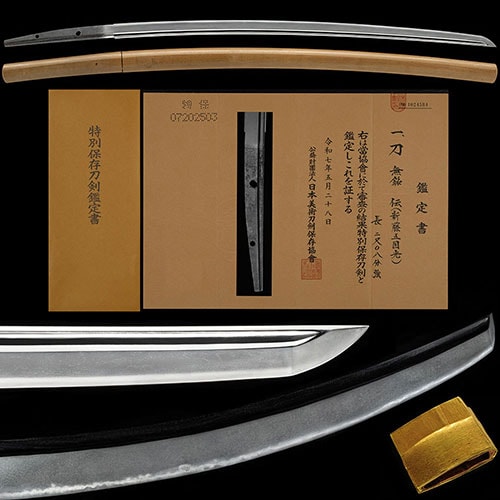
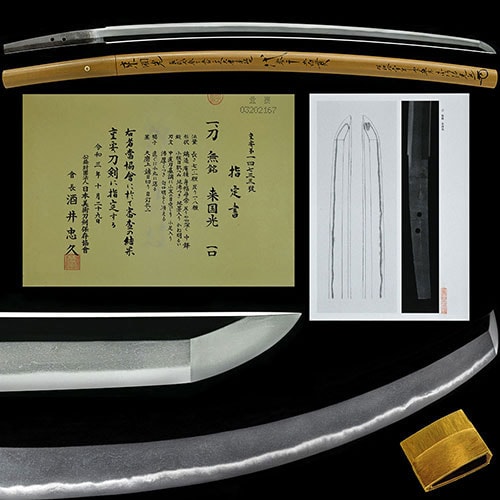
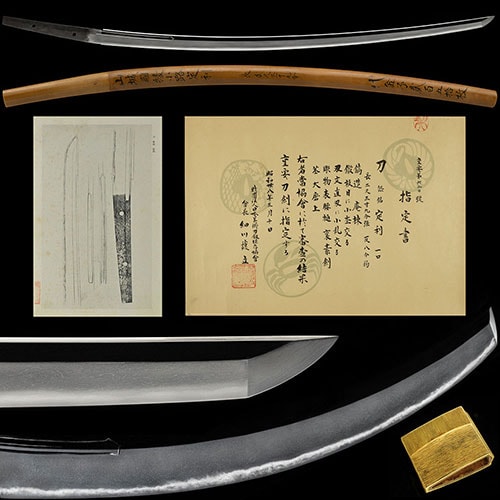
Kunikiyo was the fourth of the six brother-masters of the early school in Yamashiro, working in the opening years of the period. The published sources set him in that celebrated company: a son of Kuniie, his elder brothers Kunitomo, Hisakuni and Kuniyasu and his younger brothers Arikuni and Kunitsuna, the six of whom all served as appointed swordsmiths to the Retired Emperor Go-Toba. Of his own work very little survives in signature. One entry states plainly that 'extant signed pieces are few, numbering only two', so his name is carried today chiefly by a small group of , judged to him, alongside the rare signed .
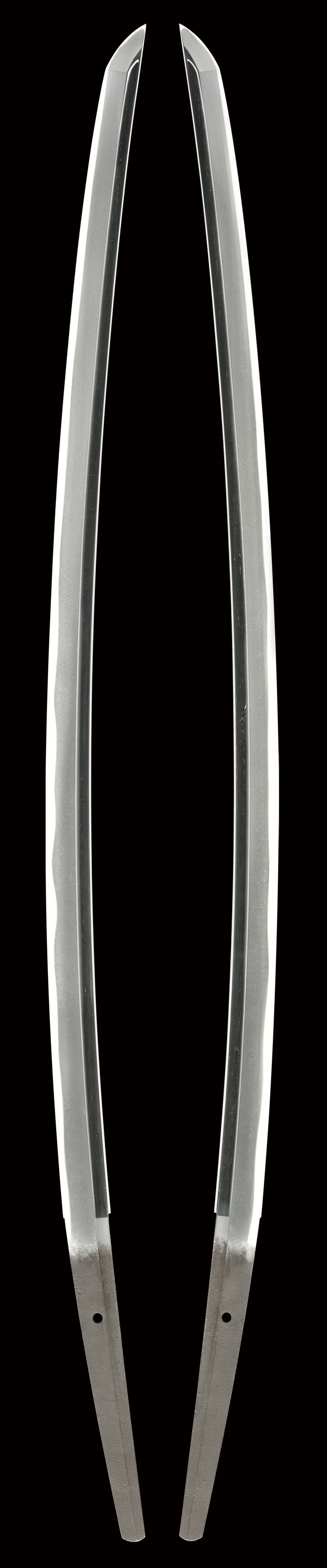
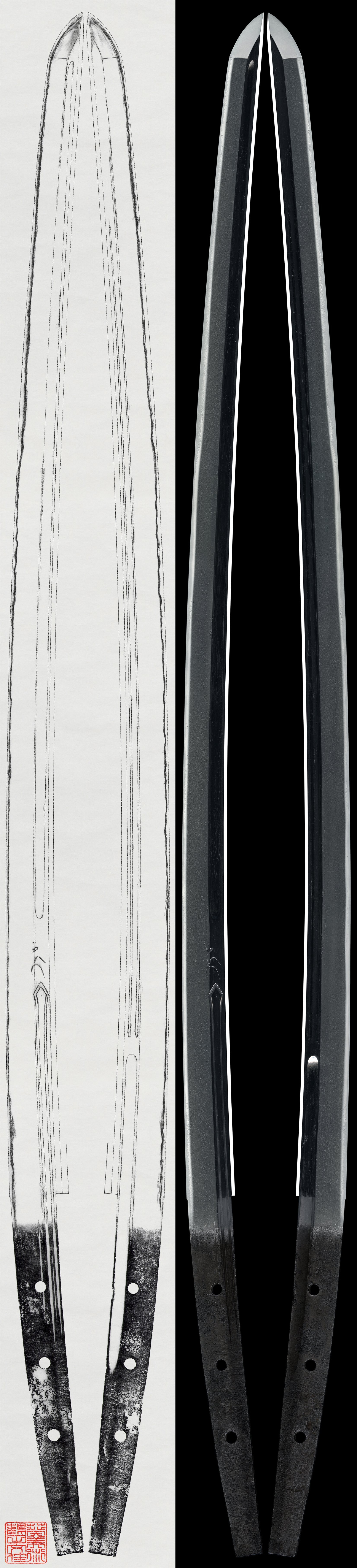
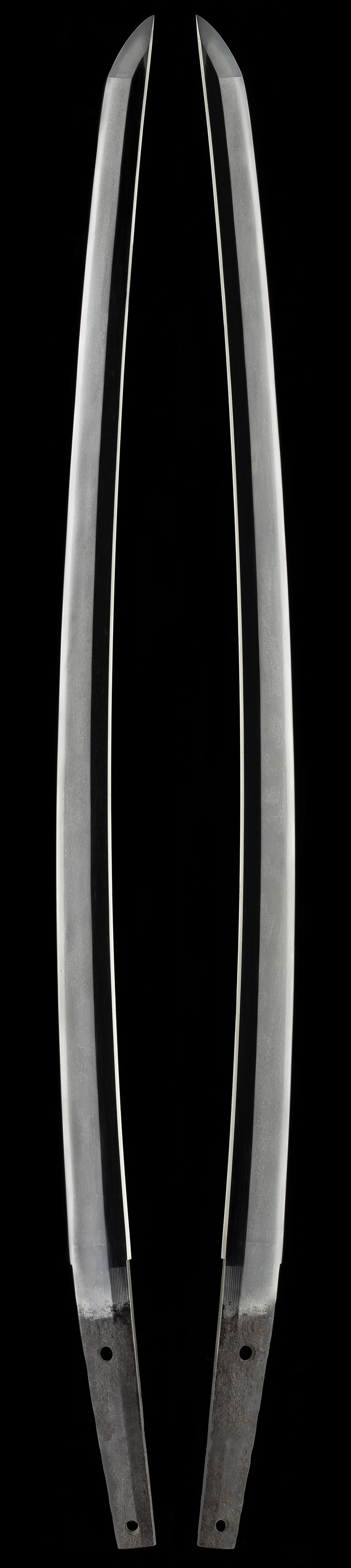
His hand is the bright, quiet manner of early . The is a closely forged , in places running a little or mixed with larger grain, carrying abundant and, on the finest blade, frequent ; the published sources call the steel notably bright, with a faint standing in places. Over that he sets not the flamboyant of but a -toned , shallowly and worked with , and , entering, the deep and bright, well adhered, with fine and running through. The goes straight to a or and returns.
Within that -based edge the judges single out one piece of scenery: patches of toward the that gather into a -like double line, a feature the published commentary notes on more than one of the blades. It is a restrained tell, in keeping with a smith whose whole character is calm rather than showy.
The published sources read Kunikiyo closest to his brother Kuniyasu. On the signed transmitted in the Unshū Matsudaira house, the commentary finds the temper 'on the whole resembling Kuniyasu'; on one of the the tightly packed intervals of the and an tendency of the are held to share 'a thread of affinity with Kuniyasu'. It is exactly this affinity, set on the characteristic bright , that carries the attribution where the signature is gone, and the sources affirm such blades as work that 'at a glance can be appraised as of the early '. He stands within the early mainstream, before the school's later flowering, the quiet -toned and the the marks of the family hand.
For the collector Kunikiyo is a rare early name, graded sai-jō by the Fujishiro appraisers. He has no National Treasures; his record runs through one work designated Important Cultural Property, the Aoyama-family signed , together with the prewar Bijutsuhin signed from the Unshū Matsudaira house, and a small group of reaching the and tiers, only five works carrying an official designation in all. The descended through the Sakai house of Himeji, and the published sources call it a superior blade whose 'glittering within the temper is especially magnificent'; among recorded whereabouts a blade is held by the Fukuyama Art Museum, and his provenance runs through old and imperial collections. With so few works on record and most of them long held, a signed Kunikiyo comes to light only rarely, and a privately held example of either his signed or his attributed is among the more notable things a collector of early Yamashiro could hope to encounter.