NihontoWatch MonNihontoWatchBETA
MarketEncyclopedia
NihontoWatch Mon

NihontoWatchBETA

Market
Encyclopedia
Overview·Kantei·Designations·Blade Forms·Signatures·Lineage·School
OverviewKanteiDesignationsBlade FormsSignaturesLineageSchool
  1. Schools
  2. Hizen Tadayoshi
  3. Tadakuni

Hizen Tadakuni

忠國

Jūyō
Vol. 24, No. 476 · Katana

Hizen Tadakuni

忠國

32 ranked works

ProvinceHizenEraKeian (1648–1652)PeriodEdoSchoolHizen TadayoshiTraditionShintoGeneration1stFujishiroJo sakuToko Taikan600(top 21%)TypeSwordsmithCodeTAD80
32Jūyō Tōken

Overview

Tadakuni is the first-generation smith who signed Harima Daijō, and later Harima no Kami, Fujiwara Tadakuni. His earliest name was Hironori; in 'ei 11 (1634), at the age of thirty-seven, he received the title Harima Daijō and changed his name to Tadakuni, the earliest title-bearing work on record being dated 'ei 13. He was a pupil of the first-generation , the founder of the school, and the son of Sōemon Yoshiie of the Hashimoto family; since he shared the founder's Hashimoto surname, the published sources judge him likely of the lineage, and note that he received his title considerably earlier than the second-generation Ōmi Daijō Tadahiro of the main house. He was retained by the Ogi domain, one of the three Nabeshima branch houses of Saga, and was active as an Ogi-domain smith. In old age he took the tonsure under the name Kyūtetsu, and his work extends into the Tenna era.

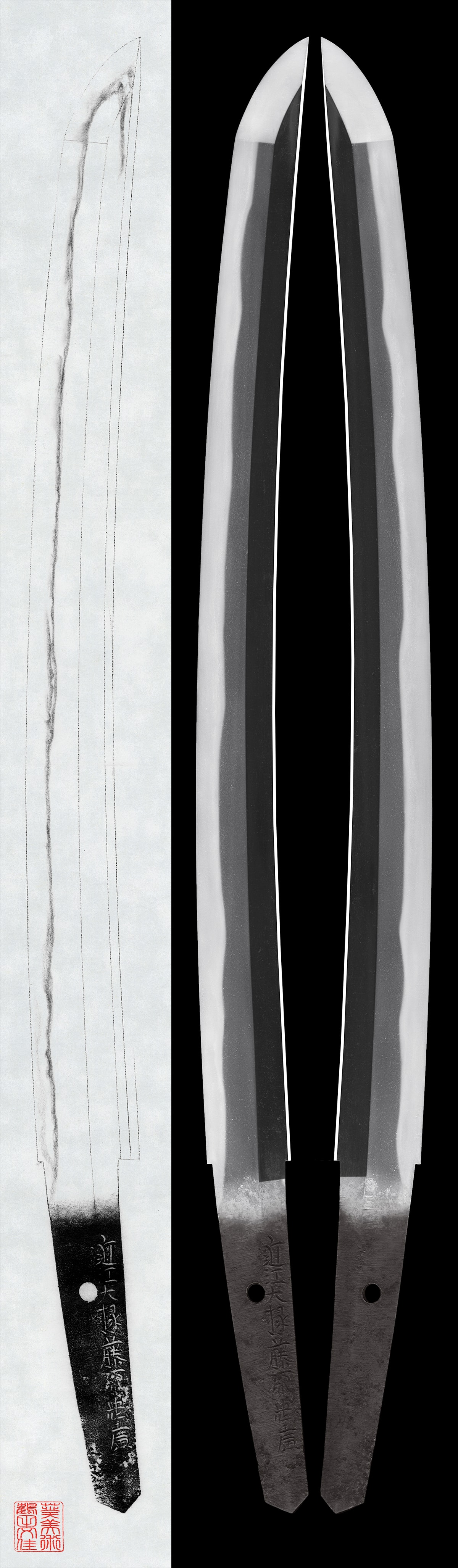
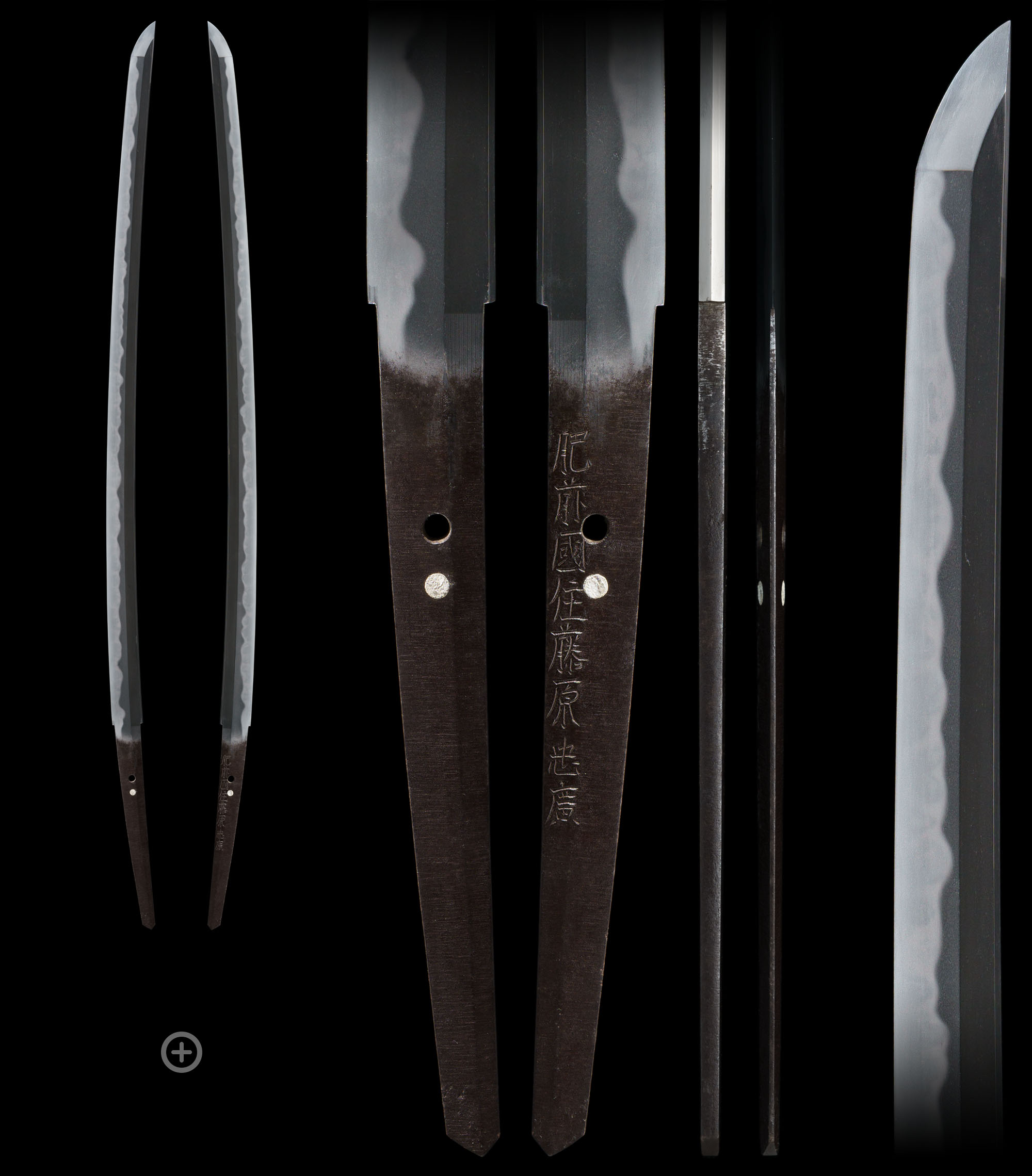
The published sources read his hand in two manners and call him highly skilled in both, but they place his true strength in the flamboyant . His is a gunome-chōji and , the temper often broad, the clove heads at times round, mixing in , angular elements and -like forms with scattered . Long enter frequently, with , the deep and well adhering. Above all it is the that names him. The sources say of one blade that runs vigorously through the , and that among his school he is the one in whom it is most conspicuous: 「刃中に砂流しがさかんにかかり」, 「一派の中でも最もそれが目立つ」. With it run , and the is bright and clear. The other recurring note of his clove work is the reach of its : in , the published record holds, his distinctive feature is a with long , 「足長丁子に特色がある」.

The beneath both his manners is the tightly forged with , the steel the school is known for. On his finest pieces it becomes the dust-fine laid thickly with entering, the bright and clear, and several blades carry the slight toward the edge that the sources note in his late work. Over that his second face is the calm one. He tempers a , at times a broad , deep in , and entering well, with fine and and at the a -like effect. The published sources record him plainly as skilled in both registers, 「直刃、乱刃ともに上手」, and on one late they observe that, against his usual habit, here the is not especially prominent, 「さまで砂流しが目立たず」, the whole finished in a quiet, restrained that shows this comparatively small body of straight-temper work. The in both manners runs straight to a , frequently with .

His record divides less by period than by manner, though the dated pieces let the late years be read. The Harima Daijō signature carries the body of his work; the Harima no Kami signature, used after his promotion and running through the , Enpō and into the Tenna years, marks the later blades. One Enpō 2 (1674) takes as its principal tone a varied large - mixed with -like elements and , deep in and , which the sources call a manner brimming with vigorous spirit. On his most ambitious clove work the temper widens a further degree into an ō-chōji-midare with and even slight , so high-tempered, the published commentary remarks, as to be rare among his blades, and they ask whether the first-generation Tadakuni was here aiming at the old : 「古作の一文字あたりを狙ったものであろうか」. The record places the difficulty of his oeuvre squarely on the table. Because the second generation was likewise appointed Harima no Kami, the first and second are hard to tell apart, and the sources note a view that much now called second-generation work may in fact be the first's.

What sets Tadakuni apart within his own school is exactly what the judges name. His and his bright are the shared inheritance, the komenuka-fine and the clear temper that every -line smith owes to the founder. His own signature is laid over that inheritance: the long- and, within it, the that runs more conspicuously in his than in any other hand of the school. On one the published sources read the workmanship as at first glance recalling Naoe , 「一見直江志津などの風を見せて上手である」, the Yamato-tinged streaming temper a measure of how far his reaches from the calm standard. He stands as the school's most accomplished maker of the flamboyant clove temper, the branch hand who carried the into a brighter, more active than the main line pursued.

For the collector he is a signed and well-documented name whose work survives entirely at the level. Fujishiro grades him Jō . He has no National Treasures and no Important Cultural Properties; his record runs instead through the ranks, where his appear across many sessions and the published sources repeatedly call them representative or typical examples by this smith, both and clear and bright. One they single out as 「傑出の一口であり、典型作でもある」, an outstanding and typical piece of his work. Several carry Yamano Ka'emon cutting-test inscriptions in gold inlay, documents of the edge as well as the hand, and a number bear chrysanthemum and crab-peony crests on the tang. The thirty-some designated blades on record are held in private and long-kept collections, their owners largely unrecorded, so a signed Harima Daijō or Harima no Kami Tadakuni is not beyond reach in the way a National Treasure is; it comes to the serious collector from time to time, with patience, and a fully realized flamboyant example, in which his runs at its most vigorous, is a thing to be sought out when it appears.

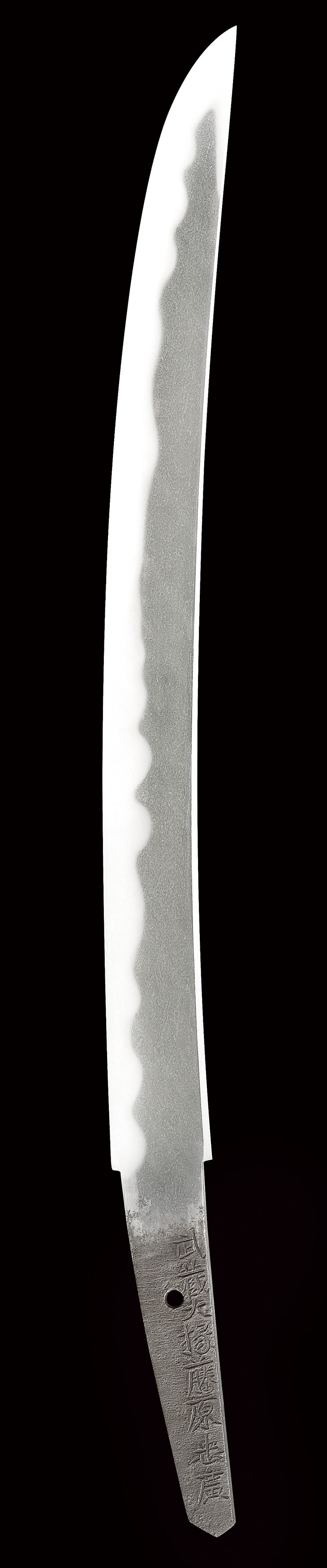
Kantei

the shodai Hizen Tadakuni read by manner: his forte the long-ashi gunome-choji and choji-midare in which sunagashi runs most conspicuously of the whole school, the calmer suguha register he was equally skilled in, and the late vigorous o-notare/o-choji-midare of his Harima no Kami and Kyutetsu years, all over the tight Hizen ko-itame

Tadakuni is the first generation of the branch master who signed Harima Daijo, later Harima no Kami, Fujiwara Tadakuni: a pupil of the first-generation and son of Soemon Yoshiie of the Hashimoto family, retained by the Ogi domain, one of the three Nabeshima branch houses of Saga. The published sources read his hand in two manners and call him highly skilled in both, but his forte is the flamboyant : a - and , the temper often broad, with long entering frequently, deep and , and above all the that runs so vigorously through his that the sources name him the smith in whom this feature is most conspicuous within the whole school. The clove pattern mixes , angular and -like elements and scattered , the bright and clear; on his most ambitious pieces it rises into an - the published sources suspect was aimed at the old . The ground beneath is the tightly forged with , at times the finest dust-like with . His other face is , a calm or broad of deep and fine , the manner the sources say he commanded with equal skill but worked comparatively rarely. The runs straight to a , frequently with . He first held Harima Daijo, his earliest titled work dated 'ei 13, and later transferred to Harima no Kami; in old age he took the tonsure as Kyutetsu, his work extending into the Tenna era.

Diagnostic discriminators

91% of his works

the gunome-choji and choji-midare with long ashi, often broad and at his most ambitious rising into an o-choji-midare the sources suspect was aimed at the old Ichimonji, is the manner the published sources call his true forte

the calm suguha, a naka-suguha or broad suguha of deep nioi and fine kinsuji, is the second manner the published sources say he commanded with equal skill though worked comparatively rarely

25% of his works

Observation by phase

His forte: the long-ashi gunome-choji and choji-midare with conspicuous sunagashi

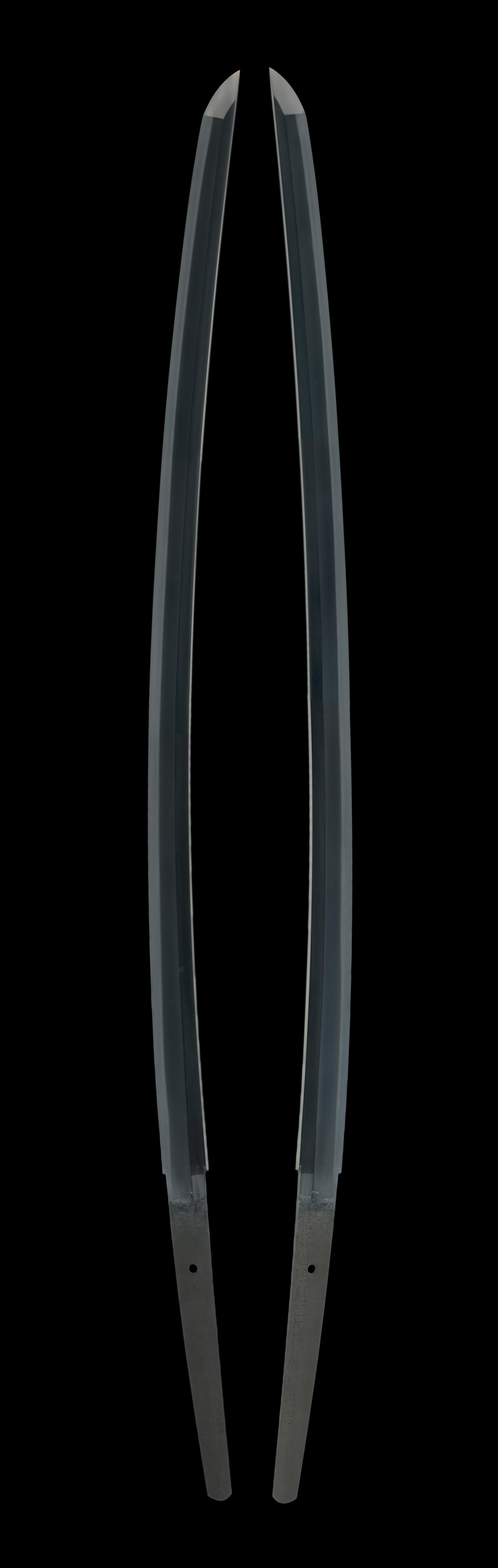
The prime of the corpus is the flamboyant the published sources call this smith's true strength. Over a tightly forged with he tempers a - and , the often broad, the clove heads sometimes round, mixing in , angular and -like elements and scattered . Long enter frequently with , the deep and well adhering, and above all runs vigorously throughout the , with , the bright and clear; the sources single him out as the smith in whom this conspicuous is most striking within his own school. On his most ambitious pieces the temper widens into an - with , which the published sources suspect was aimed at the old . The runs straight to a , frequently with . Several pieces carry cutting-test inscriptions by Yamano Ka'emon, and some bear chrysanthemum and crab-peony crests on the tang.

Sugata 姿
Jigane 地鉄
Hamon 刃文
Bōshi 帽子

The suguha register (the calmer manner, equally skilled, comparatively rare)

Against the flamboyant runs his , the manner the published sources say he commanded with equal skill though worked comparatively rarely. Over the tightly forged with , at times with a slight toward the edge, he tempers a or a broad , and entering well, the deep and adhering, with fine and and at times a -like effect at the , the bright and clear. One late piece the sources note for keeping its unusually quiet, the whole finished in a calm, restrained that displays this small body of work. The is straight to a , often with or a deeper turnback.

Jigane 地鉄
Hamon 刃文
Bōshi 帽子

The late Harima no Kami and Kyutetsu years: the vigorous o-notare and o-choji-midare

The dated late work, signed Harima no Kami and from the , Enpo and into the Tenna years, shows the manner at its most spirited. One Enpo 2 takes as its principal tone a varied large - mixed with -like elements and , deep in and , which the published sources call a manner brimming with vigorous spirit. Another late piece widens its a further degree into an - with and , the boldest and most forceful of his record. The ground remains the dense with fine and ; the runs straight to a with . This is the late face of his forte, where and are both clear and the workmanship described as forceful and full of spirit.

Jigane 地鉄
Hamon 刃文
Bōshi 帽子
Scholarship

The published sources record that Tadakuni was a pupil of the first-generation Tadayoshi and the son of Soemon Yoshiie of the Hashimoto family, his early name Hironori; that he received the title Harima Daijo in Kan'ei 11 at thirty-seven, his earliest titled work dated Kan'ei 13, and later transferred to Harima no Kami; that he was retained by the Ogi domain of the Nabeshima house, took the tonsure in old age as Kyutetsu, and worked into the Tenna era, dying at an advanced age. They hold his style to fall into both suguha and midareba, with the long-ashi choji-midare in which sunagashi is most conspicuous his particular strength.

The published sources note the difficulty of distinguishing the first and second generations, since the second was likewise appointed Harima no Kami, and record a view that the majority of works now ascribed to the second generation may in fact be the first's. On one piece they read the workmanship as at first glance recalling Naoe Shizu, and on his most ambitious o-choji-midare they suspect he was aiming at the old Ichimonji.

Designations

Kokuhō—
Jūyō Bunkazai—
Jūyō Bijutsuhin—
Gyobutsu—
Tokubetsu Jūyō—
Jūyō Tōken32

Elite Standing

0.15 across 32 designated works

Top 14% among smiths

Blade Forms

Distribution across 32 ranked works

Signatures

Signature types across 32 ranked works

Currently Available

Lineage

Tadakuni
Students (2)
  1. 1.Tadakuni忠國1 for sale3designated
  2. 2.Kunihiro國廣3 for sale

Hizen Tadayoshi School

Other artisans of the Hizen Tadayoshi school

  1. 1.Tadayoshi忠吉8 for sale125designated
  2. 2.Tadayoshi忠吉4 for sale60designated
  3. 3.Tadahiro忠廣7 for sale169designated
  4. 4.Masahiro正廣3 for sale32designated
  5. 5.Masahiro正廣4 for sale24designated
  6. 6.Yukihiro行廣1 for sale16designated
  7. 7.Yoshinobu吉信4designated
  8. 8.Muneyasu宗安4designated
  9. 9.Yoshiie吉家4designated
  10. 10.Tadakuni忠國1 for sale3designated
  11. 11.Tosa no Kami Tadayoshi忠吉3designated
  12. 12.Yoshifusa吉房3designated