NihontoWatch MonNihontoWatch
Market
Encyclopedia
Kantei
Overview·Historical importance·Designations·Kantei·Dated Works·Provenance·Blade Forms·Signatures·Lineage·School
OverviewHistorical importanceDesignationsKanteiDated WorksProvenanceBlade FormsSignaturesLineageSchool
  1. Schools
  2. Nobukuni
  3. Nobukuni

Nobukuni

信國

Tokujū
Vol. 6, No. 9 · Tachi

Nobukuni

信國

33 ranked works

Major smith
ProvinceYamashiroEraShitoku (1384–1387)PeriodMuromachiSchoolNobukuniTraditionYamashiro-denGeneration2ndTeacherNobukuniToko Taikan800(top 14%)TypeSwordsmithCodeNOB307
1Jūyō Bijutsuhin
1Gyobutsu
2Tokubetsu Jūyō29Jūyō Tōken

Overview

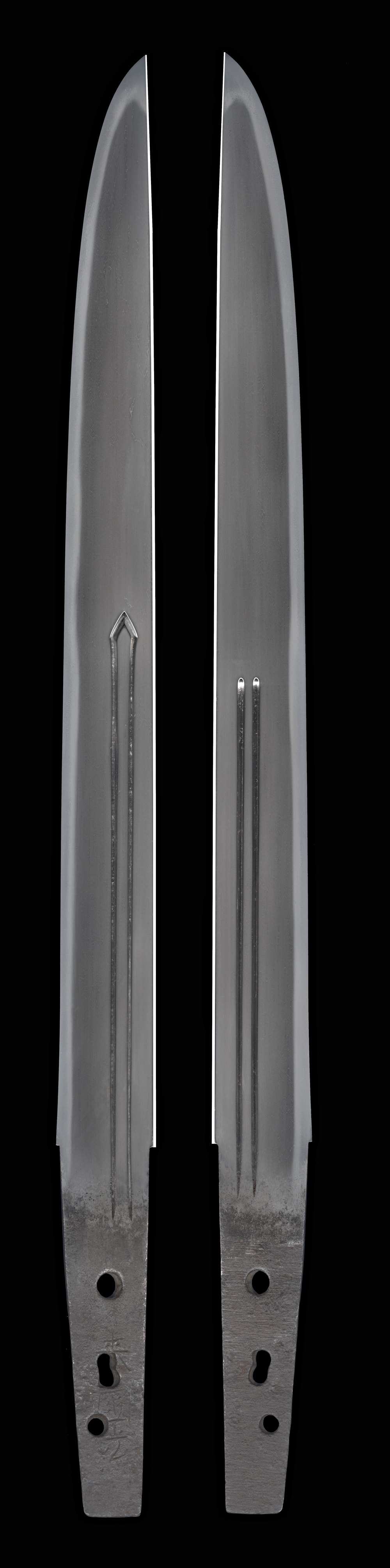
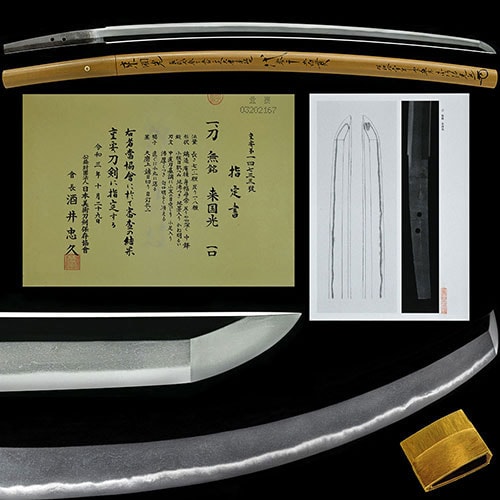
of the late is the second generation of the Yamashiro line in the 's own numbering, the smith whose dated work carries the Eitoku, Shitoku and Meitoku years. The published sources set out the line plainly: a first generation of the Enbun and Jōji years, a Ryōkai-descended Kyō smith who, they write, "is said to have studied under Sadamune of as well"; after him, in the late , "the of the next generation"; and in the early the Ōei , Saemon-no-jō and Shikibu-no-jō. The 's older Kenmu founder is set aside because no work of that date survives. Several blades in this record are appraised in exactly that position, as "a standing between the mid- first generation and the Ōei ".

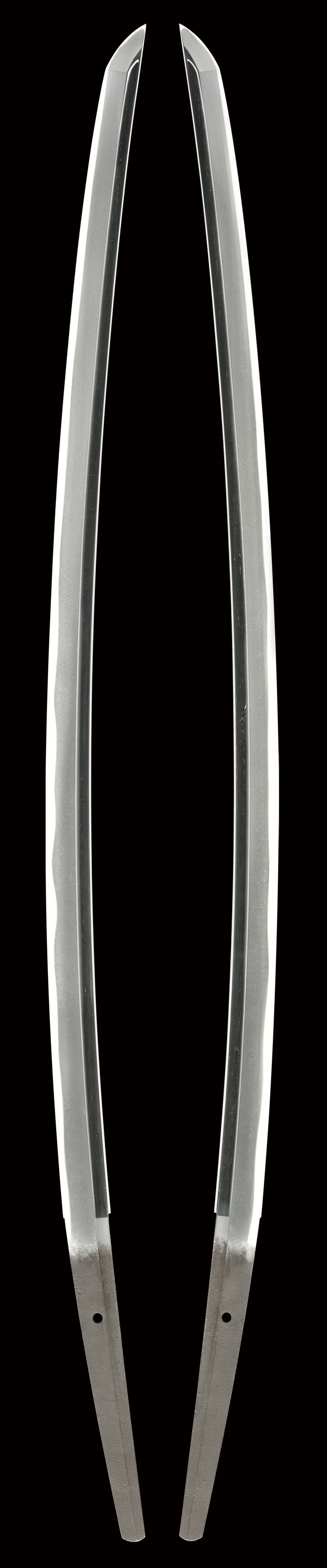
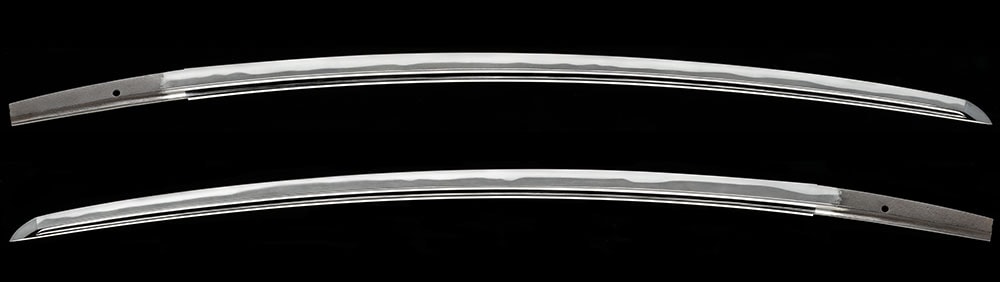
He works in three manners. Two he carries forward from the first generation. The first is a refined of , the tight and clear, with fine and a faint , most at home on the , and . On a dated Shitoku 2 the published sources call it an elegant straight temper that "faithfully inherits the manner of the ancestors", and a dated Meitoku 1 is read the way. The second, and the one most often met in his corpus, is a mixed with , laid thickly in , with , and conspicuous . The sources name the two together, as a straight temper in the Kyō tradition and a inheriting the manner of Sadamune.

The third manner is his own, and it arrives with the , which his generation makes in number. It is a lively -based mixing , and -like heads, and its tell is named again and again: pairs of "linked by a low, small ", taking on a , arrow-notch, profile. A dated Eitoku is described as showing " set two side by side", a work that "well shows the character of the of this period". On the most animated blades , and enter, and the runs with .

Under every temper the is an that stands and flows, at times with , with thick and frequent , the trace of the study his line inherits. The hereditary carving goes with it. , , , and the invocation of recur across the corpus, and the published sources call this "carving that could be called the family art, and skilful as one would expect". A small habit of the signature belongs to this generation as well: the date is cut low on the tang, well below the smith's name, which the sources describe as "seemingly a habit of the of this period".

The published sources keep him distinct on both sides. Against the first generation, the dated late- and are prized as reference material, since the founder's signed work survives only as and . Against the Ōei , they note that the late- hand breaks the down in a more cursive manner, and they use this point to separate the generations. They are also candid that the name was shared: "there appear to have been several smiths of the signature in the period as well". A Meitoku 3 signed Genzaemon-no-jō is by a different hand from the two-character of the year.

His record holds two and twenty-nine , thirty-one blades in the and tiers, with a prewar Jūyō Bijutsuhin and Kōchū attached to several. He has no National Treasures and no Important Cultural Properties. Of recorded whereabouts, a is held in the Samurai Art Museum in Berlin, and provenance runs to the Hisamatsu Matsudaira family, the Ōta collection and, for one blade, the Imperial Family. None of his work is locked away as designated patrimony, so a signed example does pass into private hands from time to time; it comes only seldom, and a dated, carved of the late- is a landmark when it does.
Historical importance

Where Nobukuni stands among comparable artisans: across all of nihontō, and within tradition, era, and period. The tiers (Foremost · Leading · Major · Notable) weigh official designations from the NBTHK and Japan's Agency for Cultural Affairs, together with historical honors of lasting repute such as the Sansaku and Meibutsu-chō.

随一
Foremost
屈指
Leading
有数
Major
著名
Notable

Select a lens to see how it's measured.

Designations

Kokuhō—
Jūyō Bunkazai—
Jūyō Bijutsuhin1
Gyobutsu1
Tokubetsu Jūyō2
Jūyō Tōken29

Elite Standing

Kantei

Dated Works

Provenance

Blade Forms

Distribution across 33 ranked works

Signatures

Signature types across 33 ranked works

Currently Available

Lineage

TeacherNobukuni
Nobukuni
Student
  1. 1.Nobukuni信國1 for sale44designated

Nobukuni School

Other artisans of the Nobukuni school

  1. 1.Nobukuni信國1 for sale70designated
  2. 2.Nobukuni信國1 for sale44designated
  3. 3.Yoshikane吉包1 for sale7designated
  4. 4.Masanobu正信4designated
  5. 5.Shigekane重包1 for sale4designated
  6. 6.Yoshimasa吉政3 for sale2designated
  7. 7.Nobusada信貞2designated
  8. 8.Nobukuni信國1 for sale2designated
  9. 9.Nobukuni信國1 for sale2designated
  10. 10.Masakane正包1designated
  11. 11.Shigekuni重國1designated

More from the Yamashiro tradition

View all →
Eirakudo
Jūyō
Katana - Jūyō - by Rai Kunitoshi - Niji-Kunitoshi - Juyo TokenKatana - Jūyō - by Rai Kunitoshi - Niji-Kunitoshi - Juyo Token

Katana

ByRai Kunitoshi
Ask
Hyozaemon
Jūyō
Tachi - Jūyō - by Ayanokoji Sadatoshi - Ayanokoji SadatoshiTachi - Jūyō - by Ayanokoji Sadatoshi - Ayanokoji Sadatoshi

Tachi

ByAyanokoji Sadatoshi
¥4,800,000
Eirakudo
Jūyō
Katana - Jūyō - by Rai Kunimitsu - Rai Kunimitsu - Juyo TokenKatana - Jūyō - by Rai Kunimitsu - Rai Kunimitsu - Juyo Token

Katana

ByRai Kunimitsu
Ask
Katanahanbai
Jūyō
Tanto - Jūyō - by Rai Kunimitsu - Juyo Token Tanto: Rai KunimitsuTanto - Jūyō - by Rai Kunimitsu - Juyo Token Tanto: Rai Kunimitsu
Koshirae

Tantō

ByRai Kunimitsu
Ask
Samurai Nippon
Tokujū
Katana - Tokuju - by Awataguchi Kuniyoshi - Mumei (Den Awataguchi Kuniyoshi)Katana - Tokuju - by Awataguchi Kuniyoshi - Mumei (Den Awataguchi Kuniyoshi)

Katana

ByAwataguchi Kuniyoshi
Ask
Yazawa Shokai
Tokuho
Tachi - Tokuho - by Rai Kuniyuki - Consignment: Rai Kuniyuki Mid-Kamakura Period, Blade Length 69.7cm, Sori 1.9cm, in Shirasaya with Tachi KoshiraeTachi - Tokuho - by Rai Kuniyuki - Consignment: Rai Kuniyuki Mid-Kamakura Period, Blade Length 69.7cm, Sori 1.9cm, in Shirasaya with Tachi Koshirae

Tachi

ByRai Kuniyuki
¥3,000,000
Choshuya
Jūyō
Tanto - Jūyō - by Rai Kunitoshi - Rai Kunitoshi - O WazamonoTanto - Jūyō - by Rai Kunitoshi - Rai Kunitoshi - O Wazamono
Koshirae

Tantō

ByRai Kunitoshi
Ask
Eirakudo
Jūyō
Katana - Jūyō - by Rai Kunimitsu - Rai Kunimitsu - Juyo TokenKatana - Jūyō - by Rai Kunimitsu - Rai Kunimitsu - Juyo Token

Katana

ByRai Kunimitsu
Ask

Nobukuni

Nobukuni(信國) was a Japanese swordsmith of the Nobukuni school in Yamashiro province, active during the Shitoku (1384-1387) ND period.

The work follows the Yamashiro-den tradition.

Designated works by Nobukuni include 2 Tokubetsu Jūyō, 29 Jūyō.