Hizen swords were a domain enterprise: the Nabeshima sent Tadayoshi to study under Umetada Myōju around 1596, then built a licensed school around him. Nine generations carried its famously consistent konuka-hada work into the Meiji era.
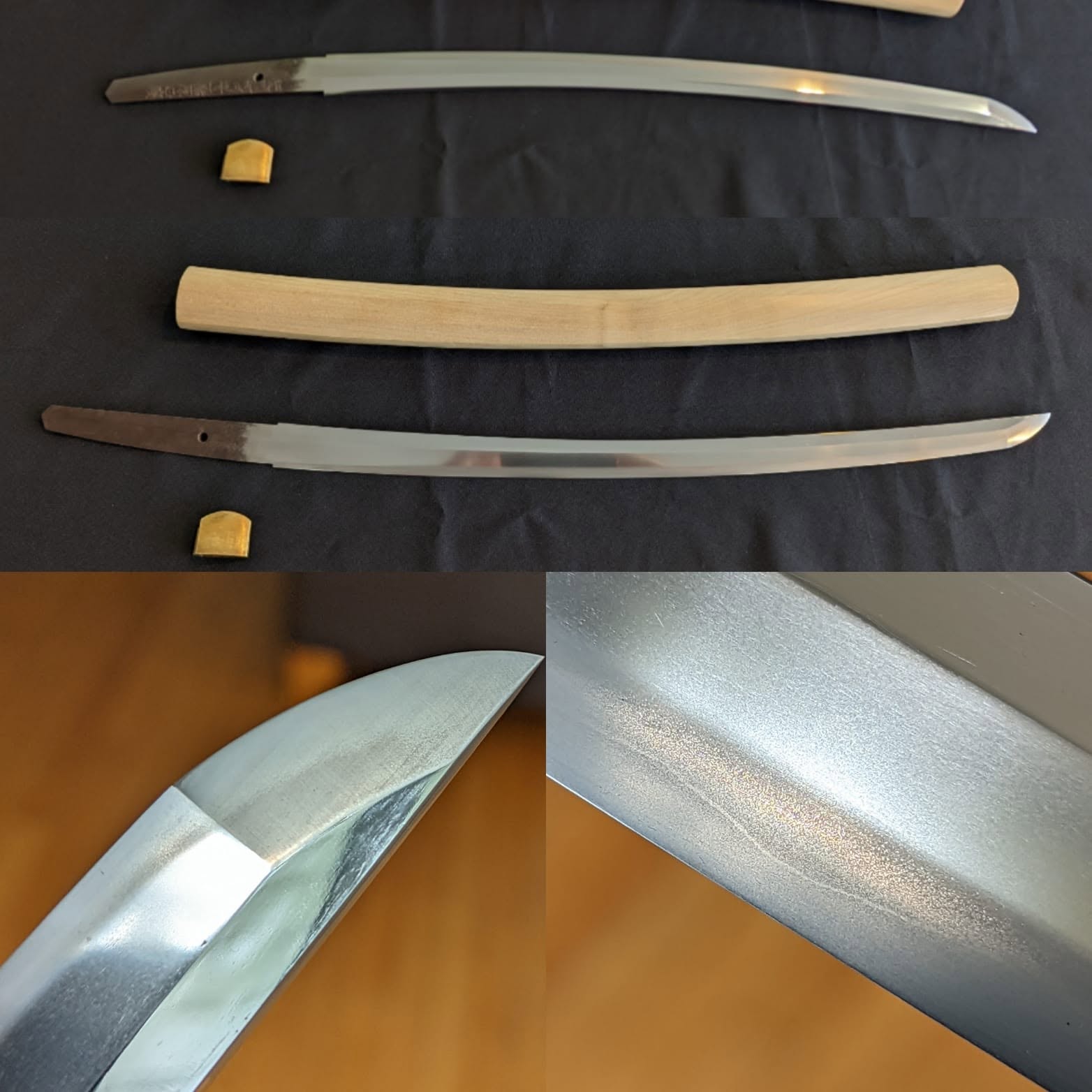
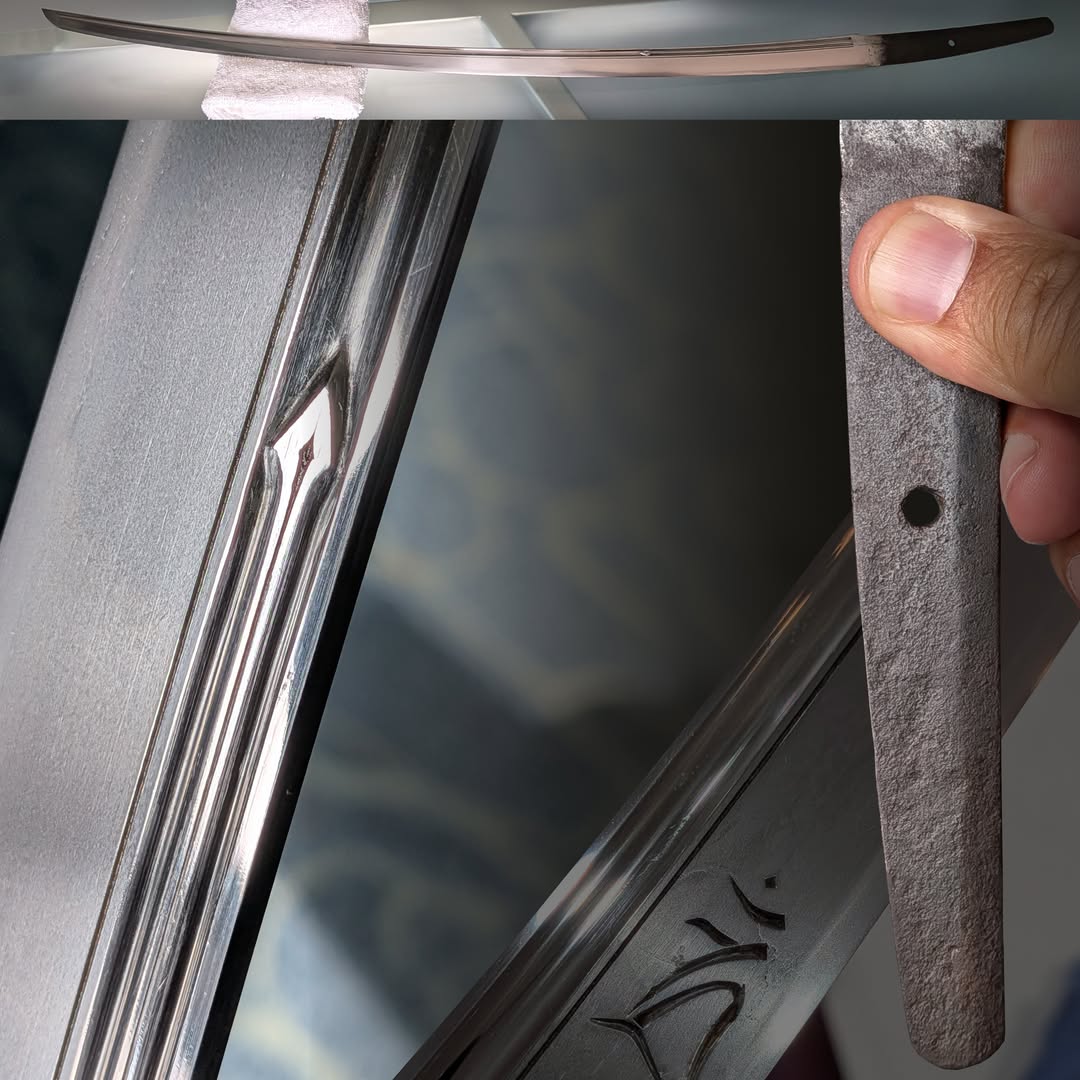
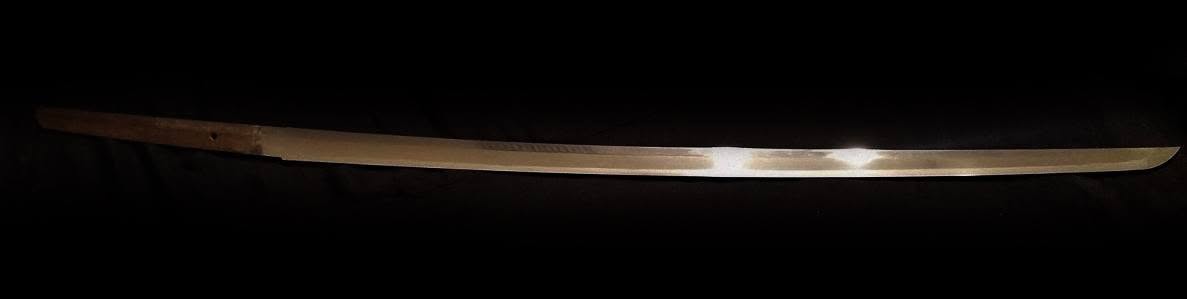
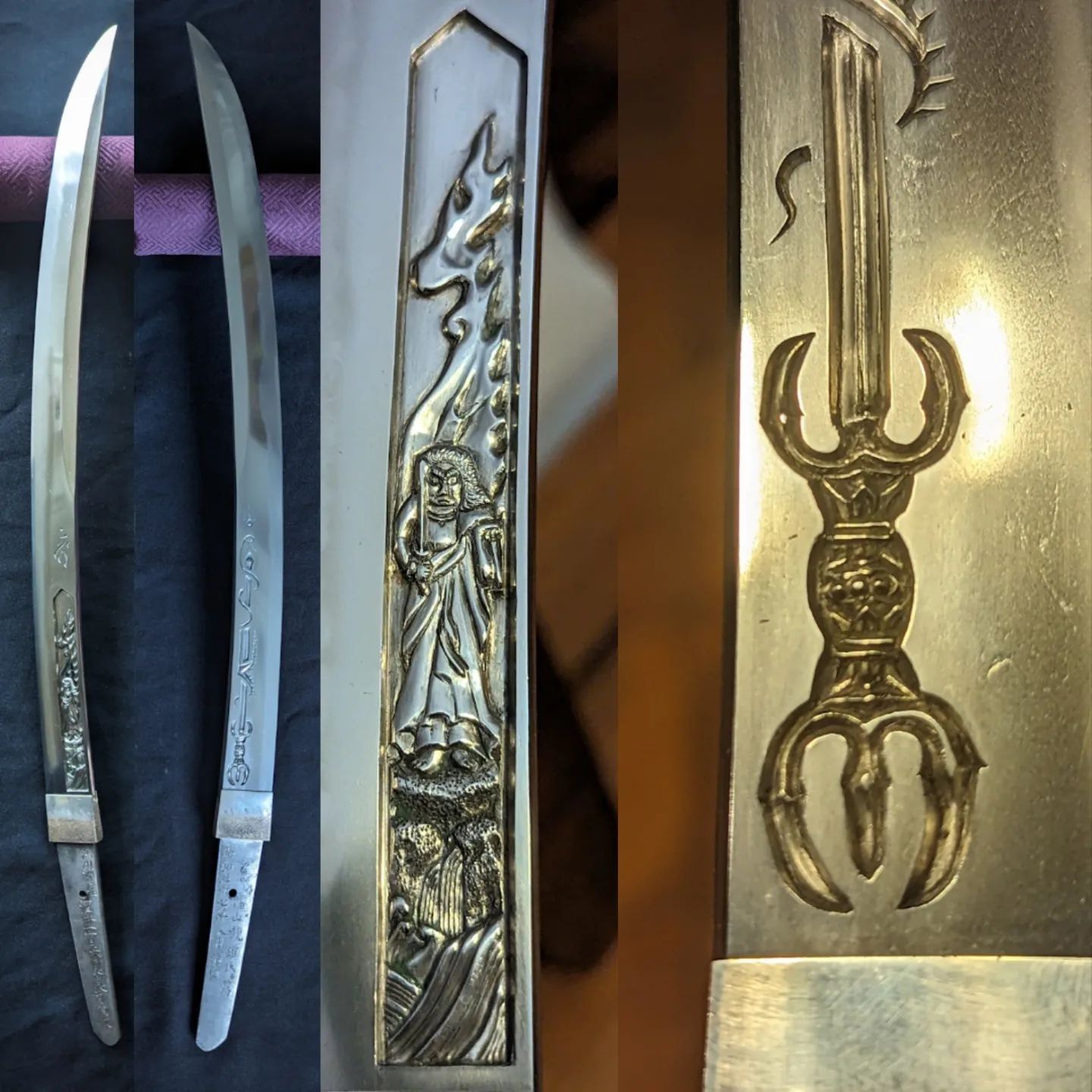
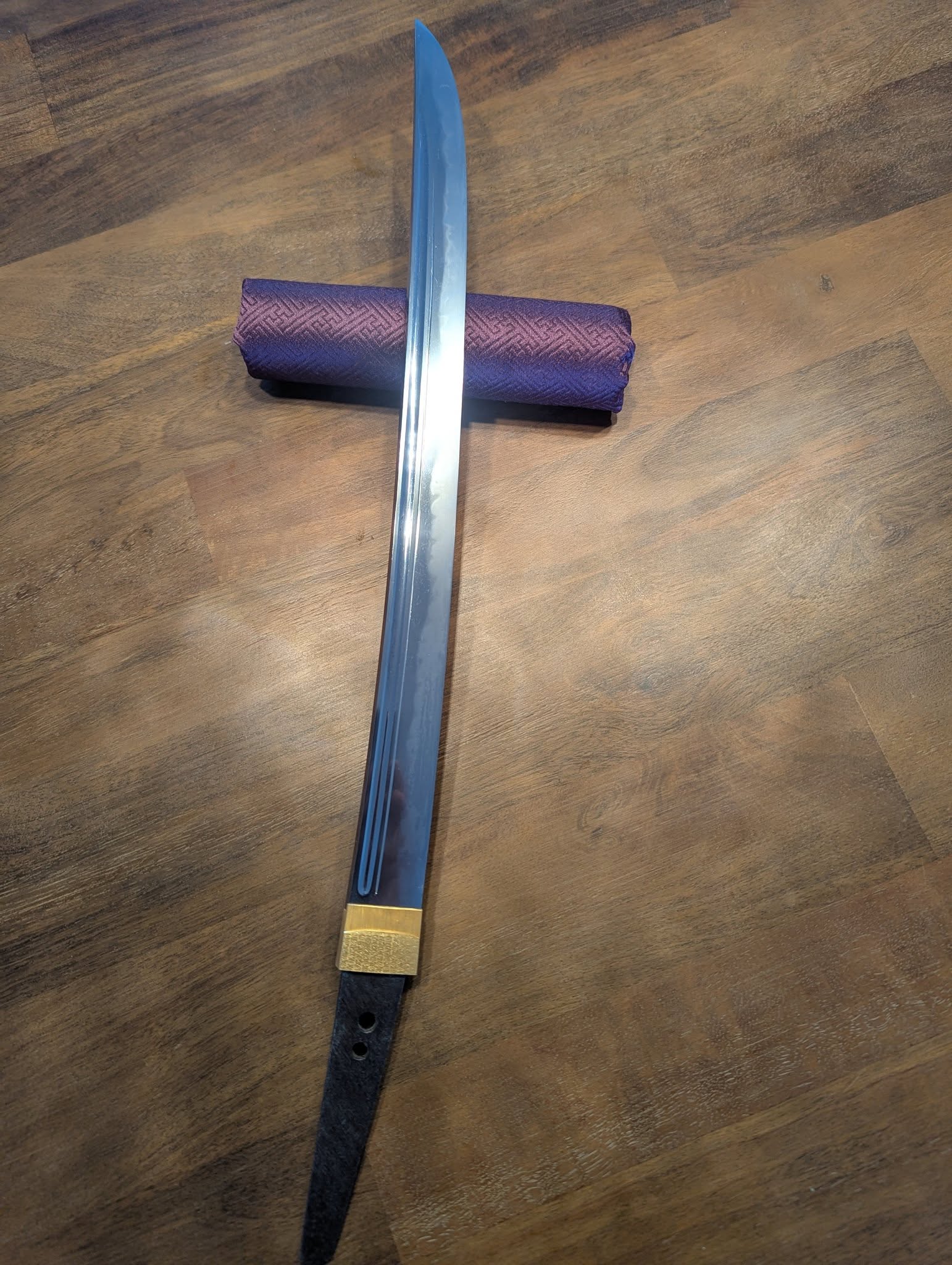
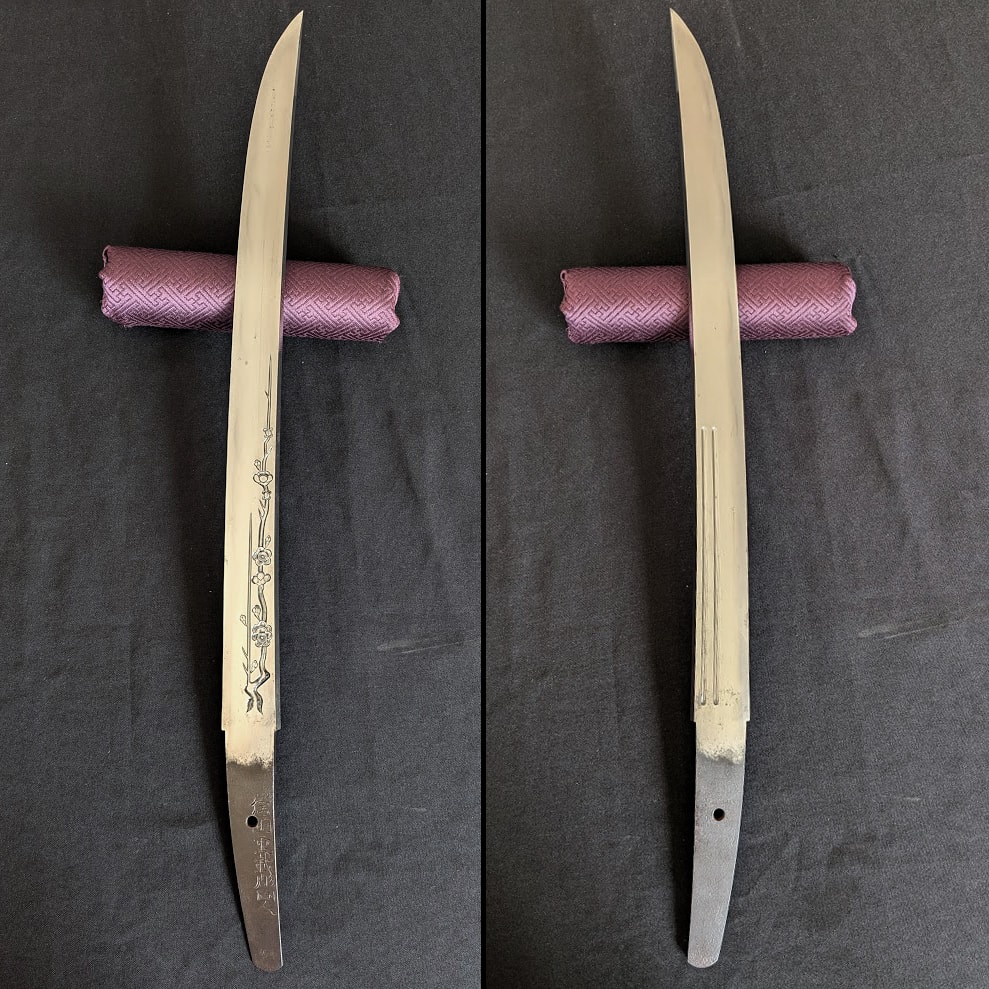
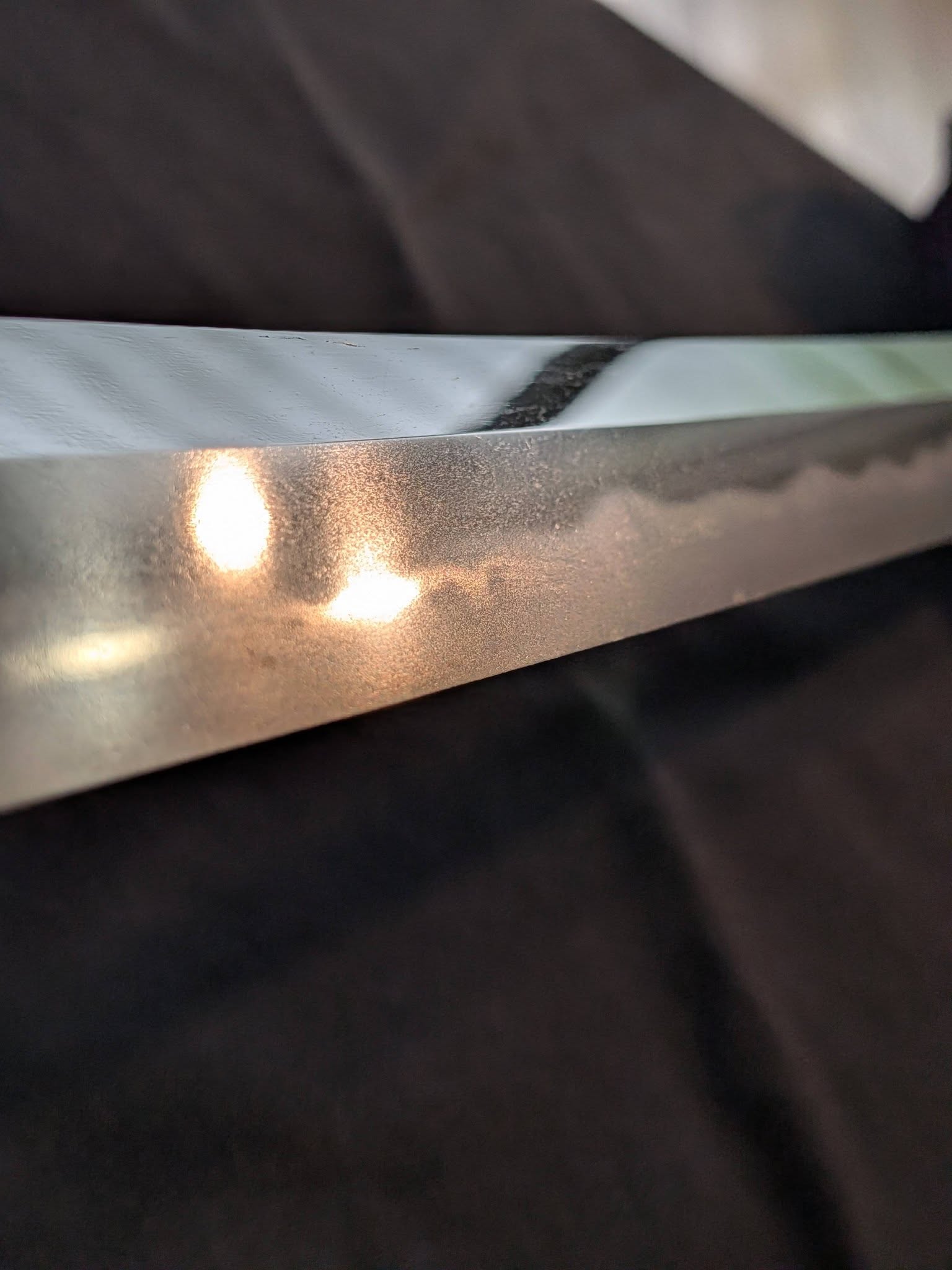
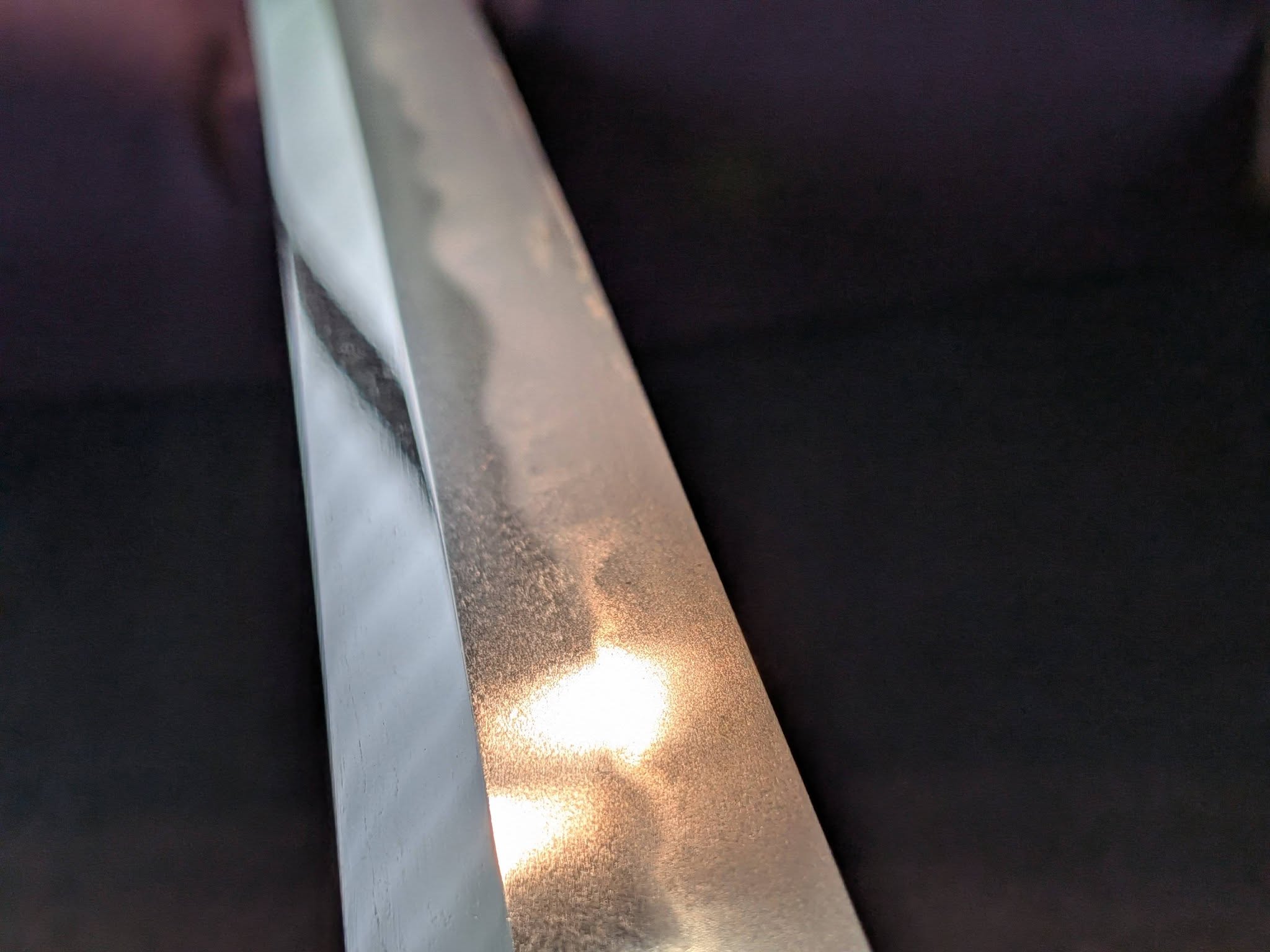
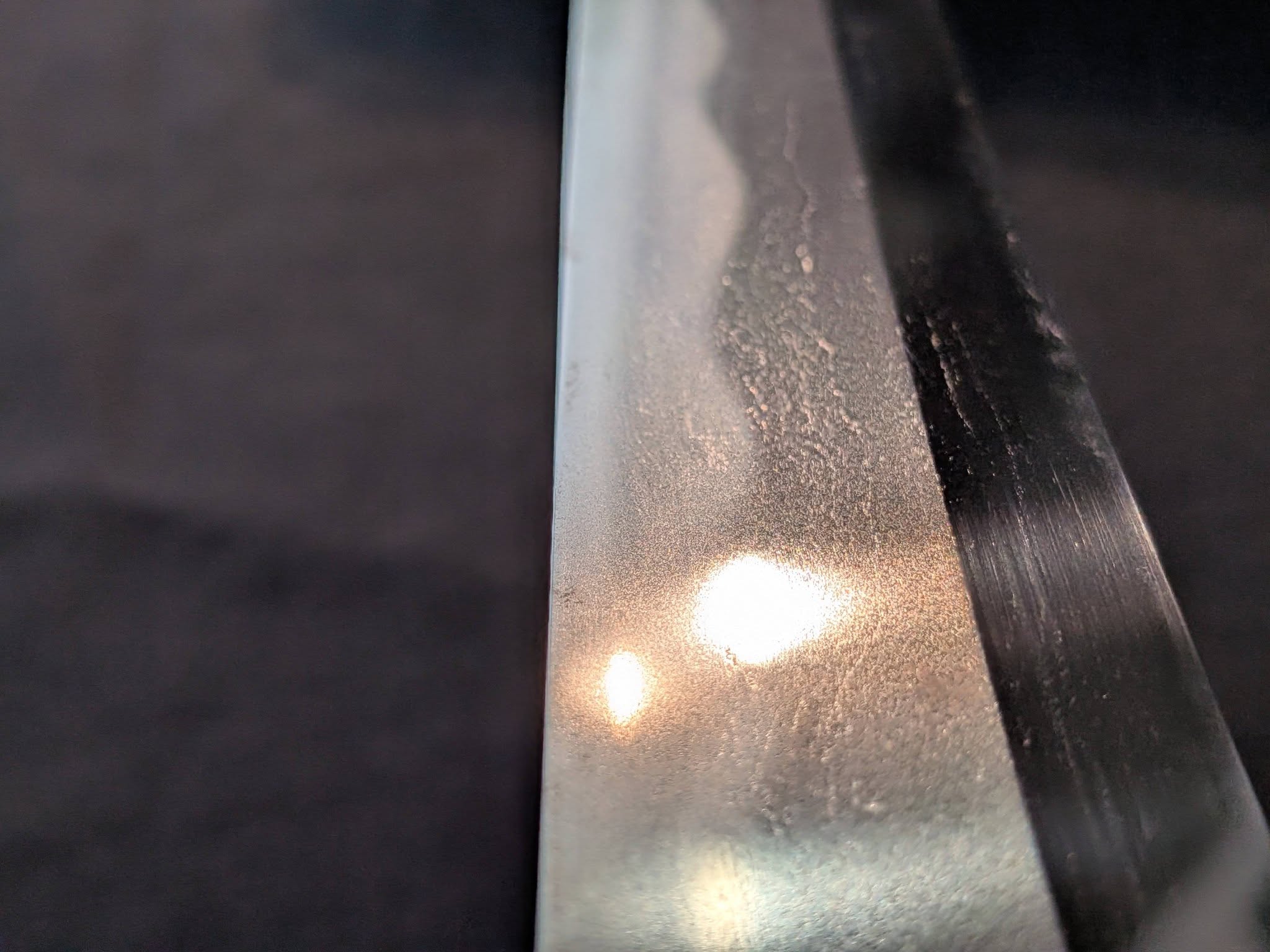
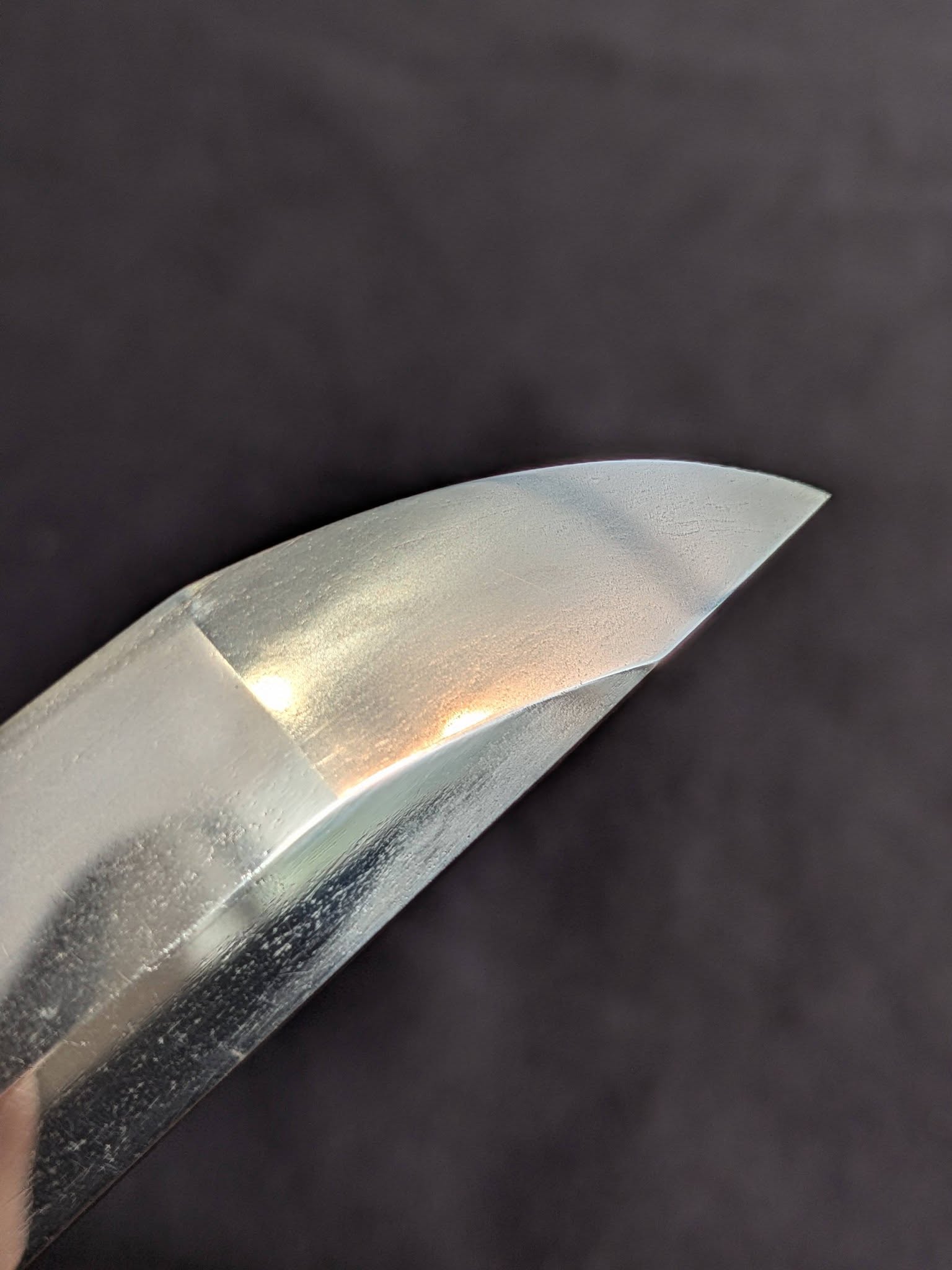
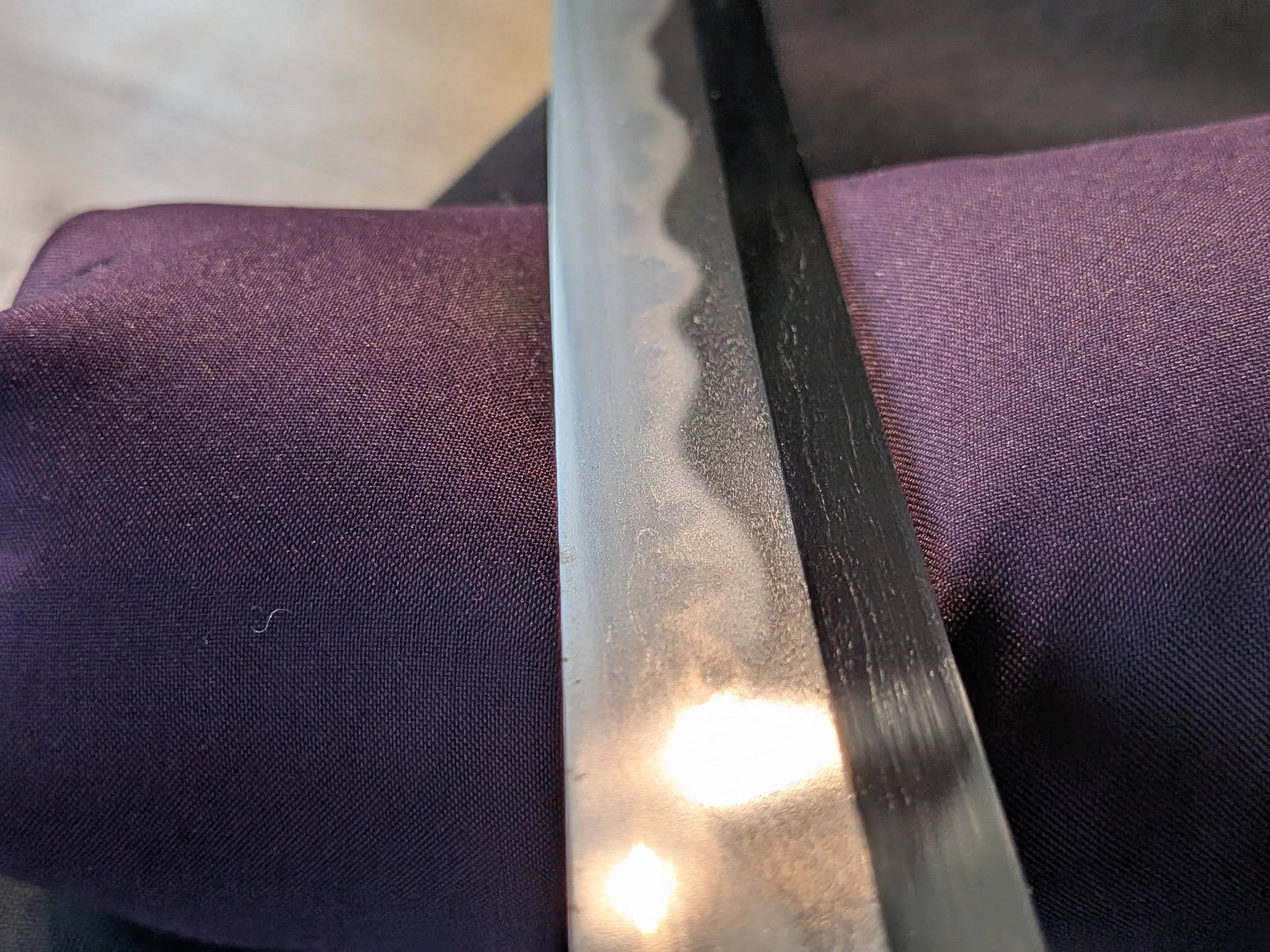
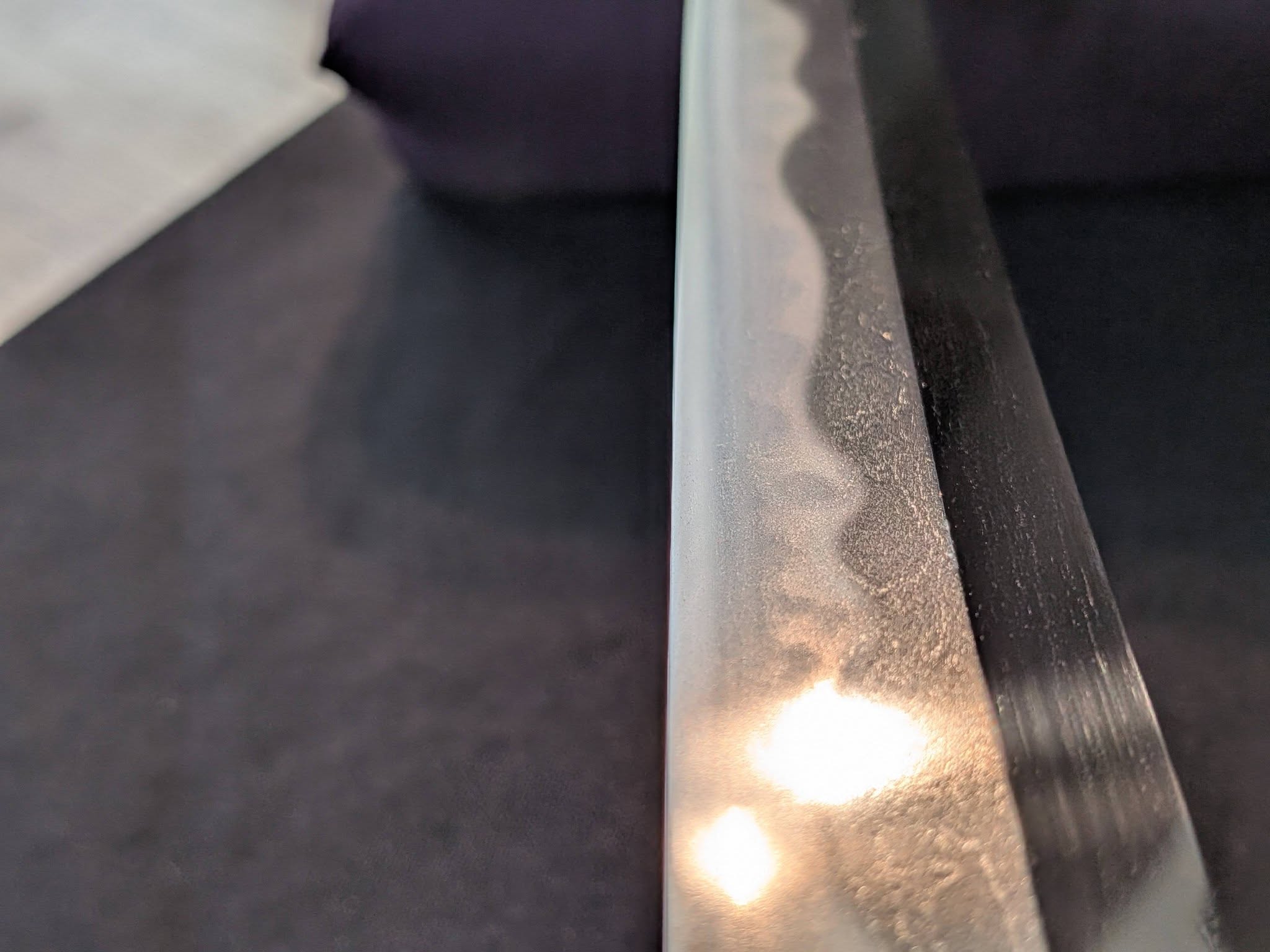
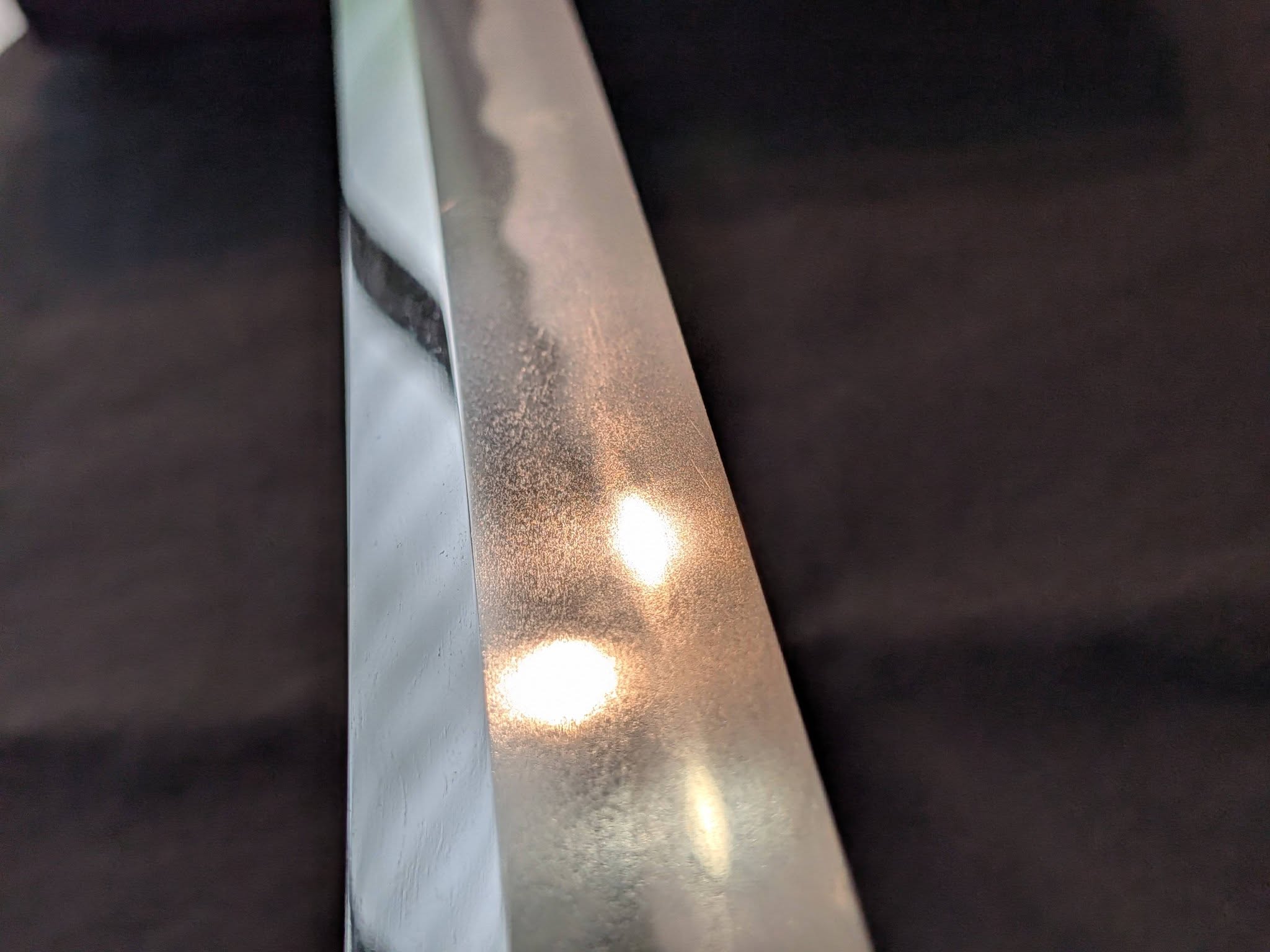
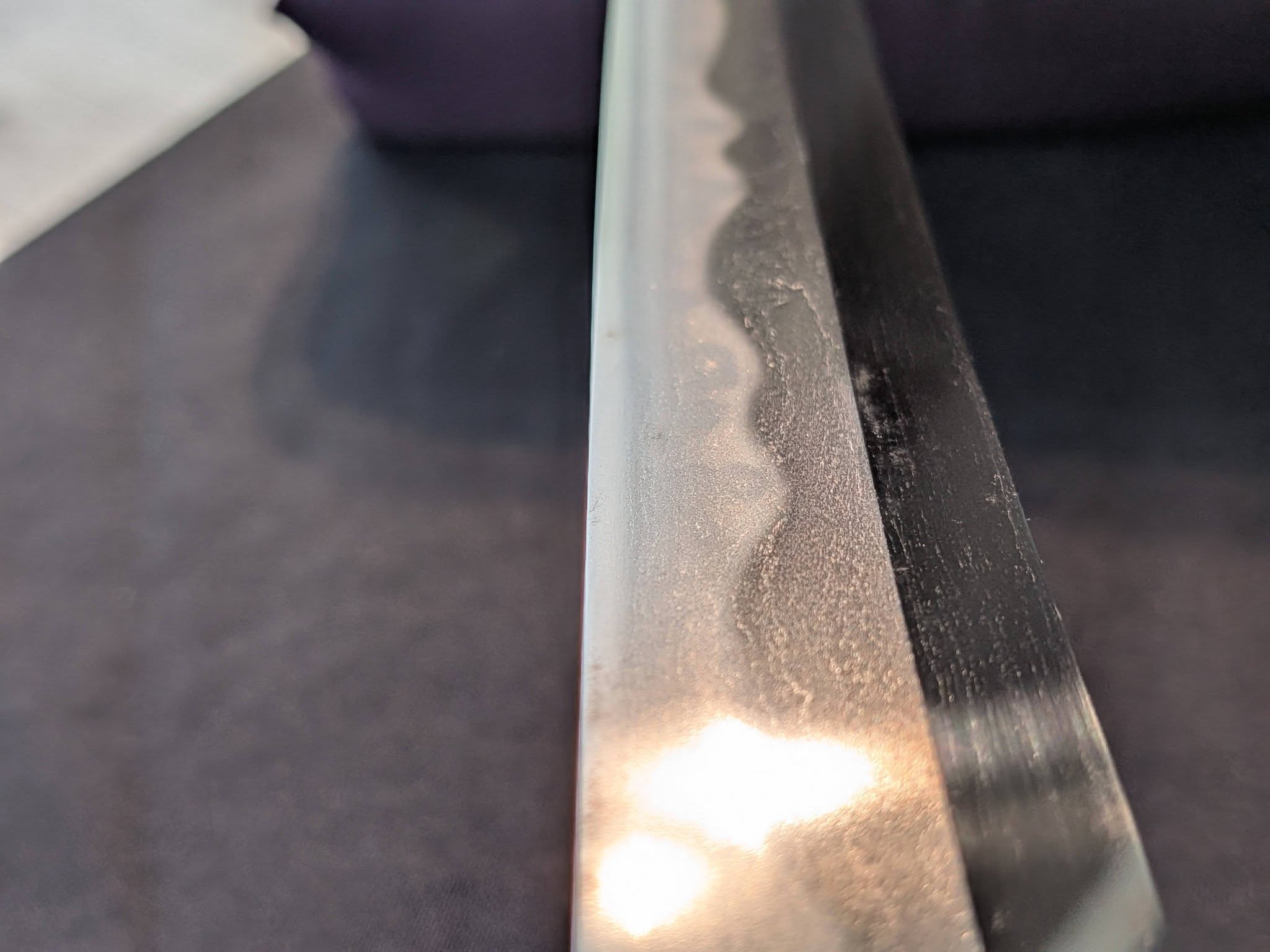
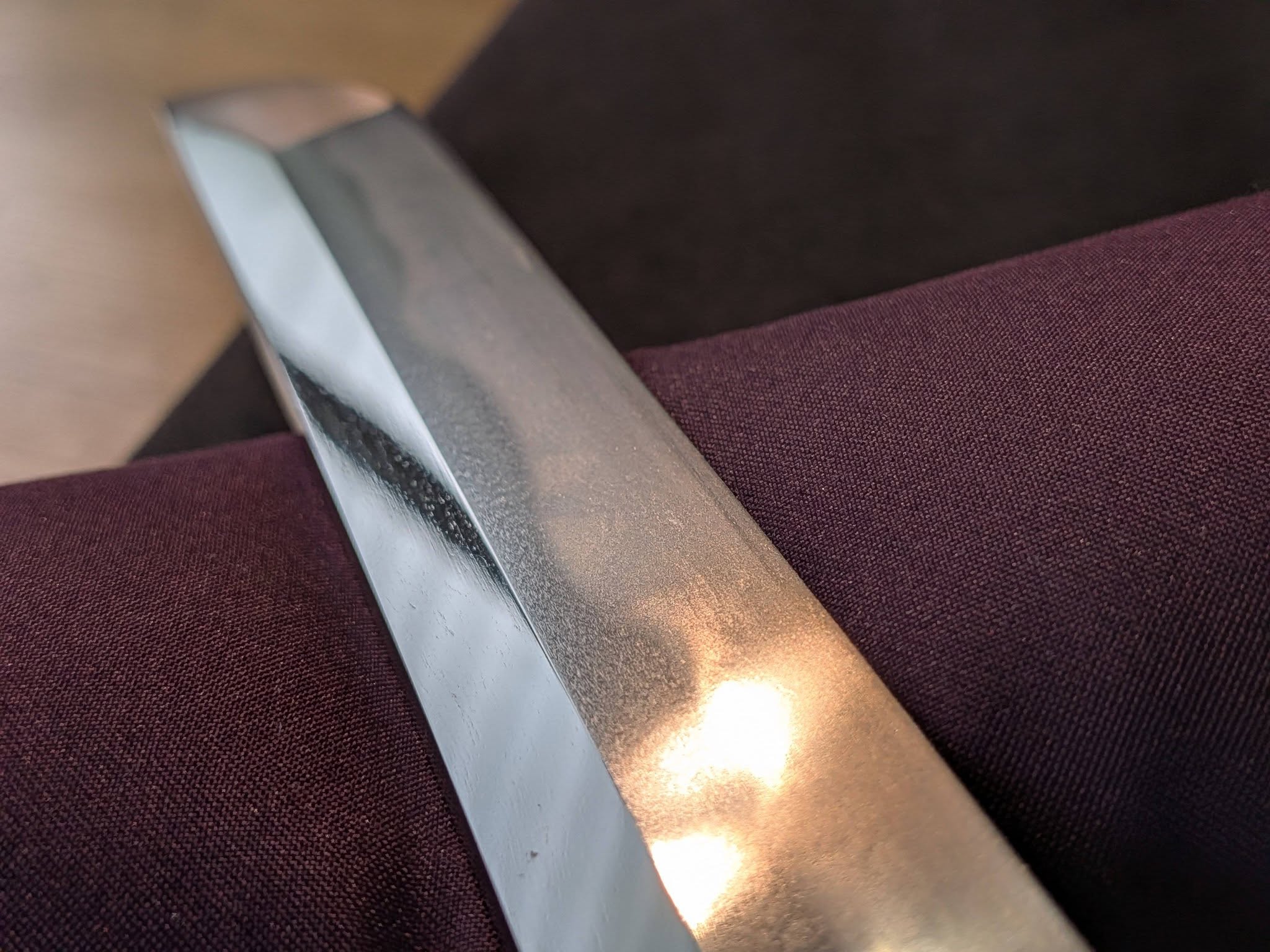
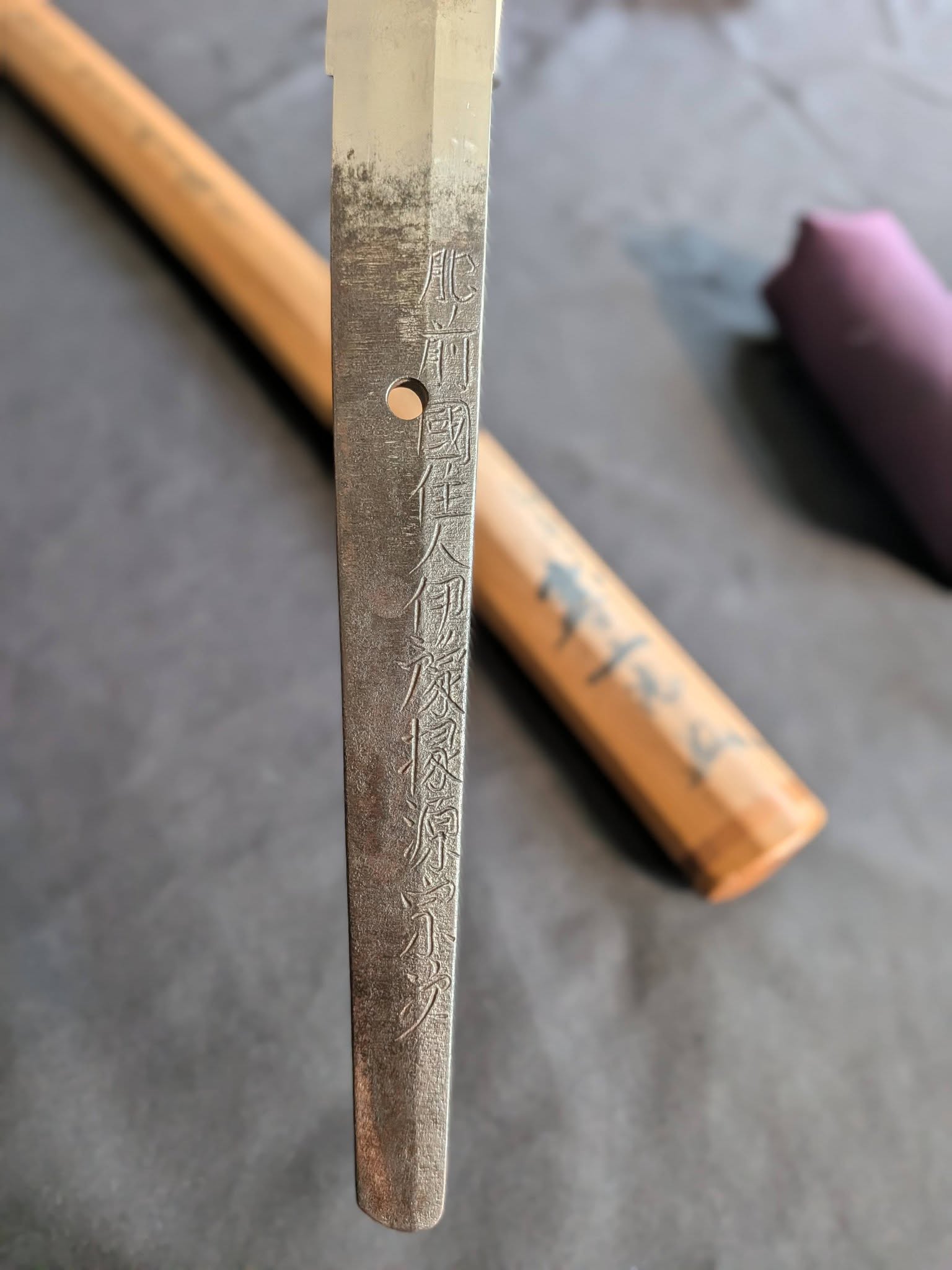
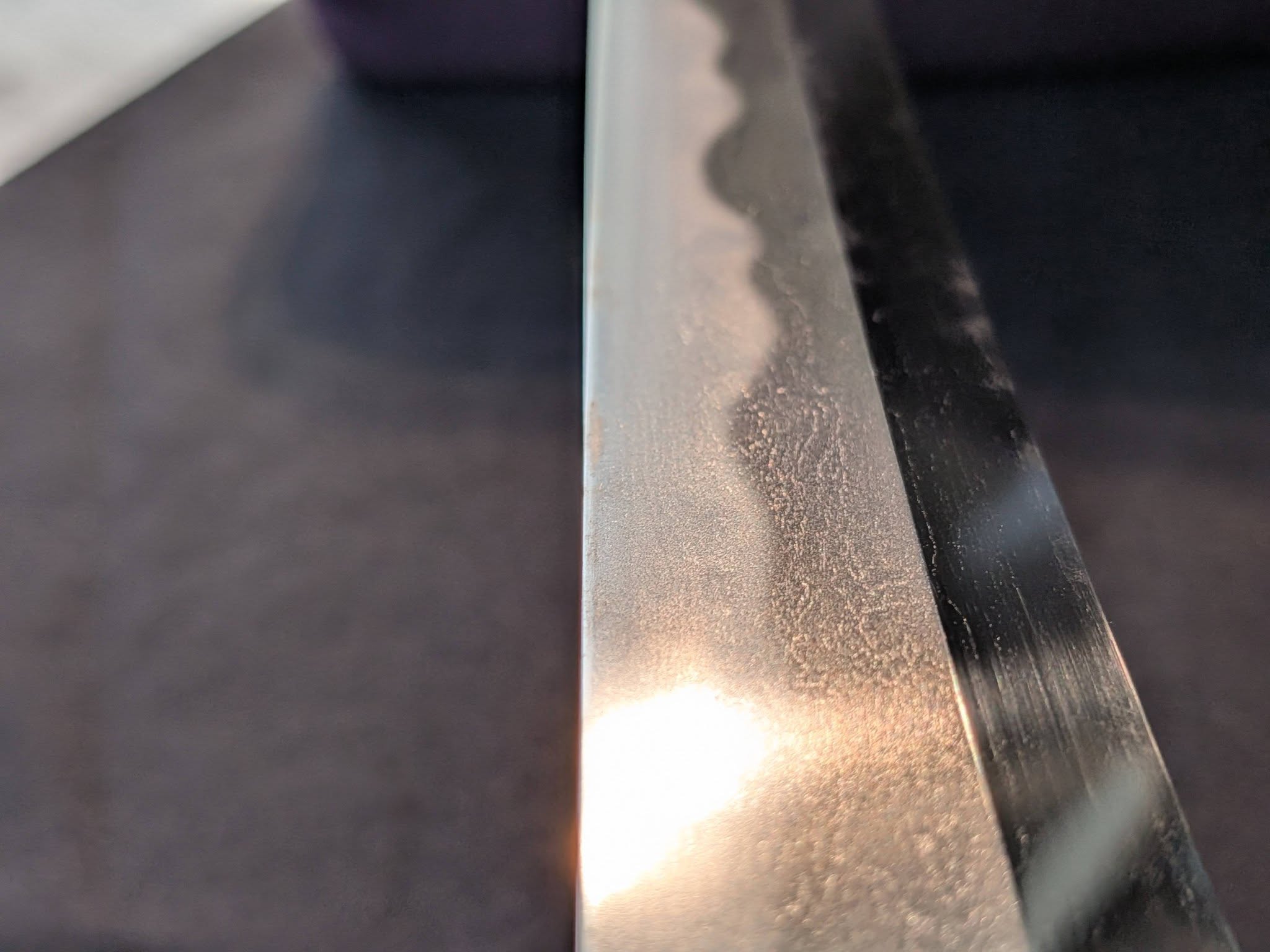
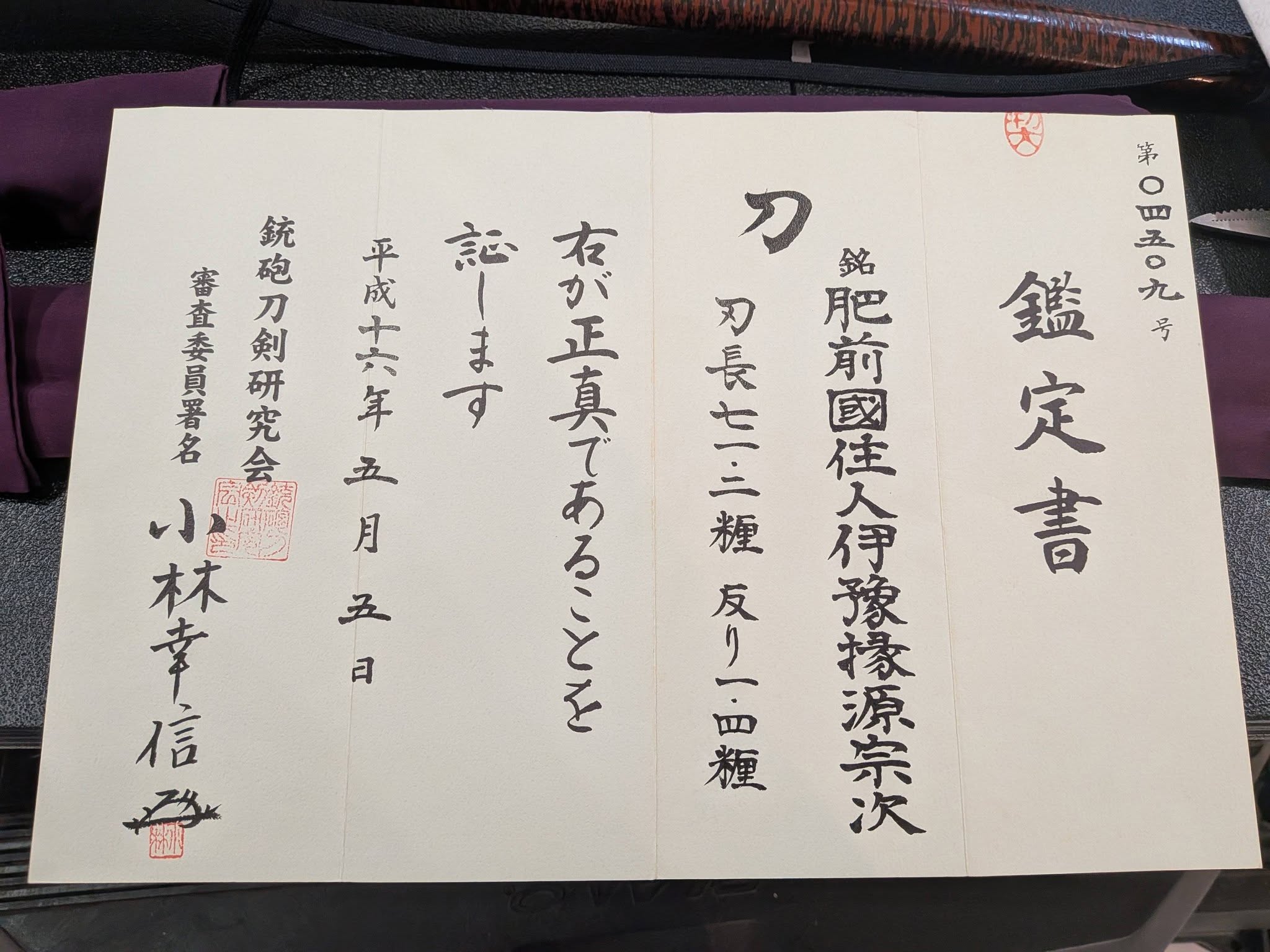
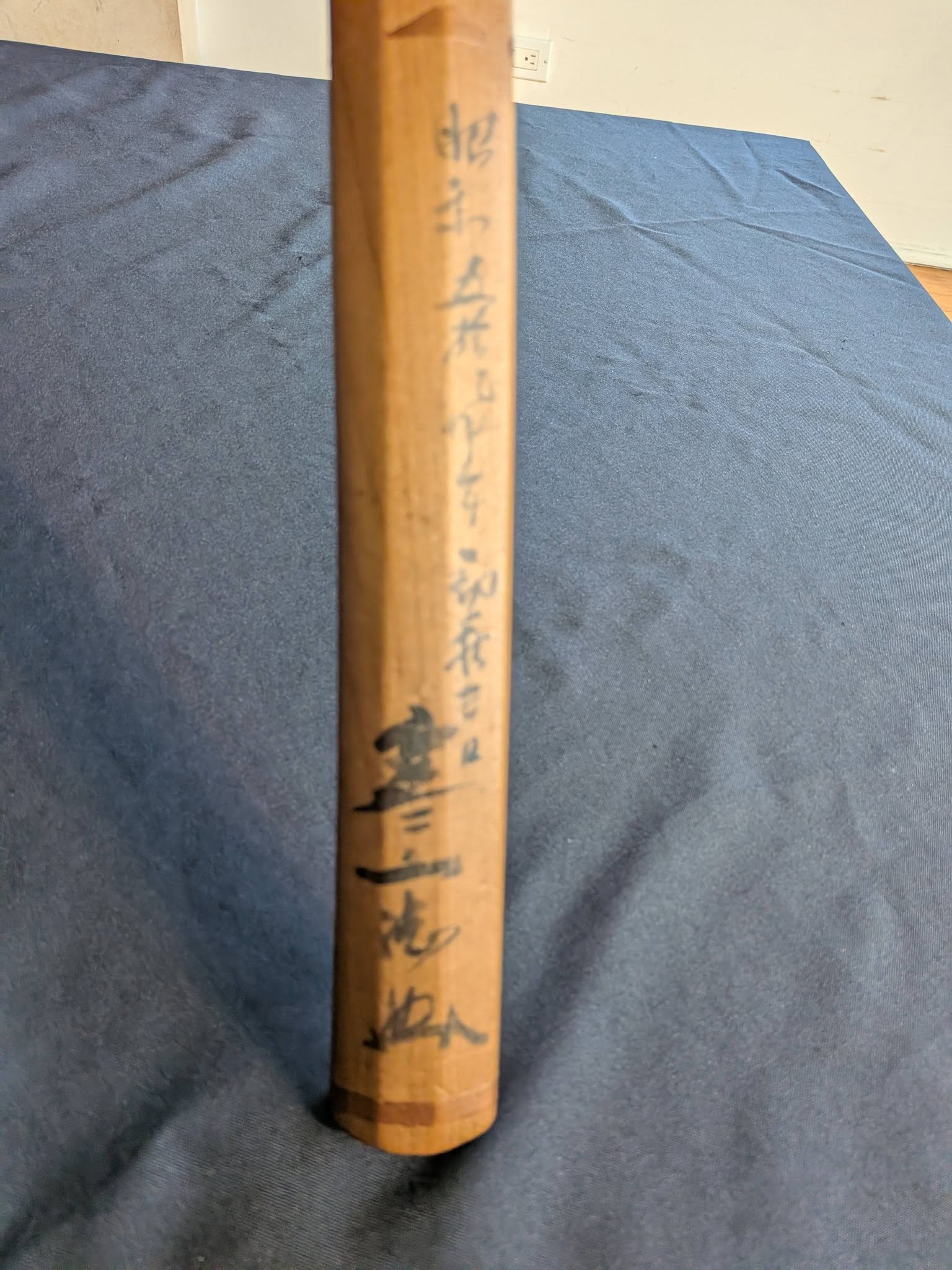
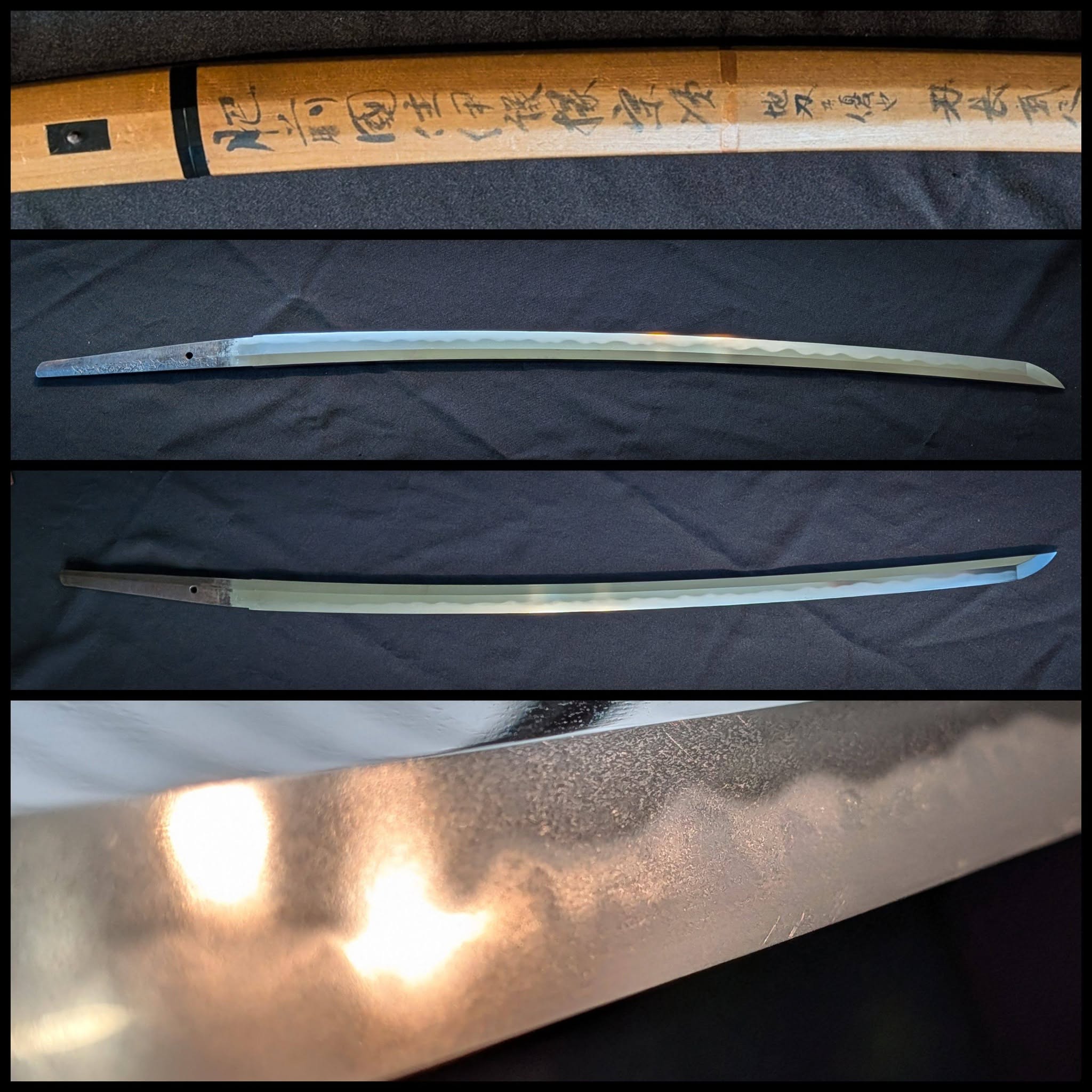
This is a katana by Iyo no Jo Minamoto Munetsugu, a first-generation smith from Hizen province active during the Keichō era (1596-1615). Munetsugu was known for focusing on the Sōshū tradition, producing blades with a standing-out itame jigane and a gunome-midare hamon. The tang is noted for its bulbous shape, reminiscent of Muramasa.
 NihontoWatch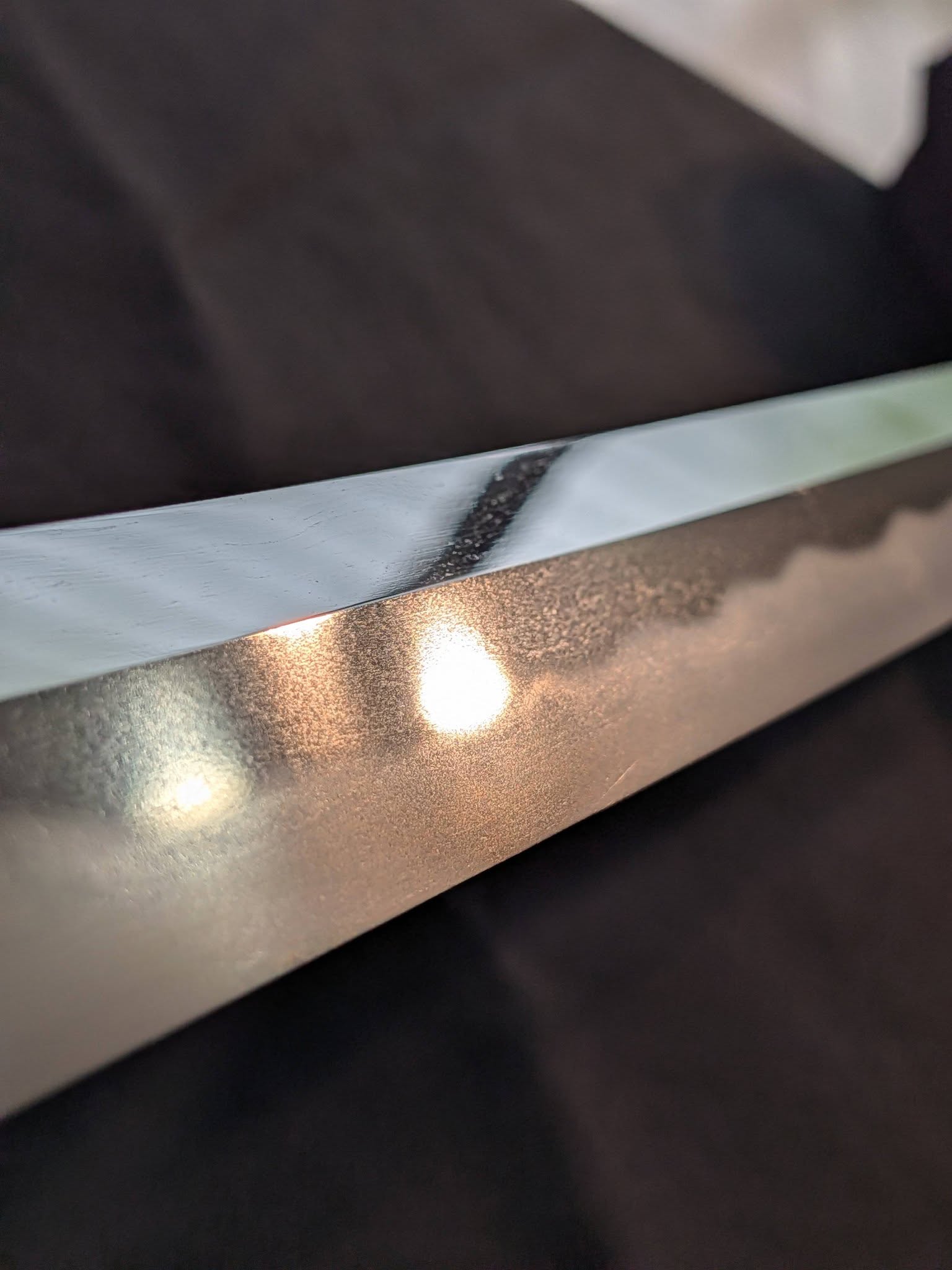
Shinto · Hizen · around 1596-1615
Fujishiro Jo saku · Tōken Taikan top 26%
4 pieces on the market now
The first-generation Iyo no Jo Munetsugu is said to have borne the name Sakai San'emon, and tradition holds that his family served for generations as Shinto priests at the Tenmangu shrine in Nagase Village, the birthplace of Tadayoshi. He later moved to Nagase-machi in the castle town of Saga, where he forged swords, and is further said to have relocated to Isahaya in Hizen. According to the "Iyo no Jo Munetsugu Genealogy" preserved among old documents transmitted in the Sakai family, he received the court title of Iyo no Jo in Keicho 11 (1606), a dating supported by extant works of Keicho 12 that already bear the title. Active in the Momoyama through early Edo period, Munetsugu occupies a distinctive position among the group of Hizen smiths, standing apart from the mainstream lineage descended from Tadayoshi.
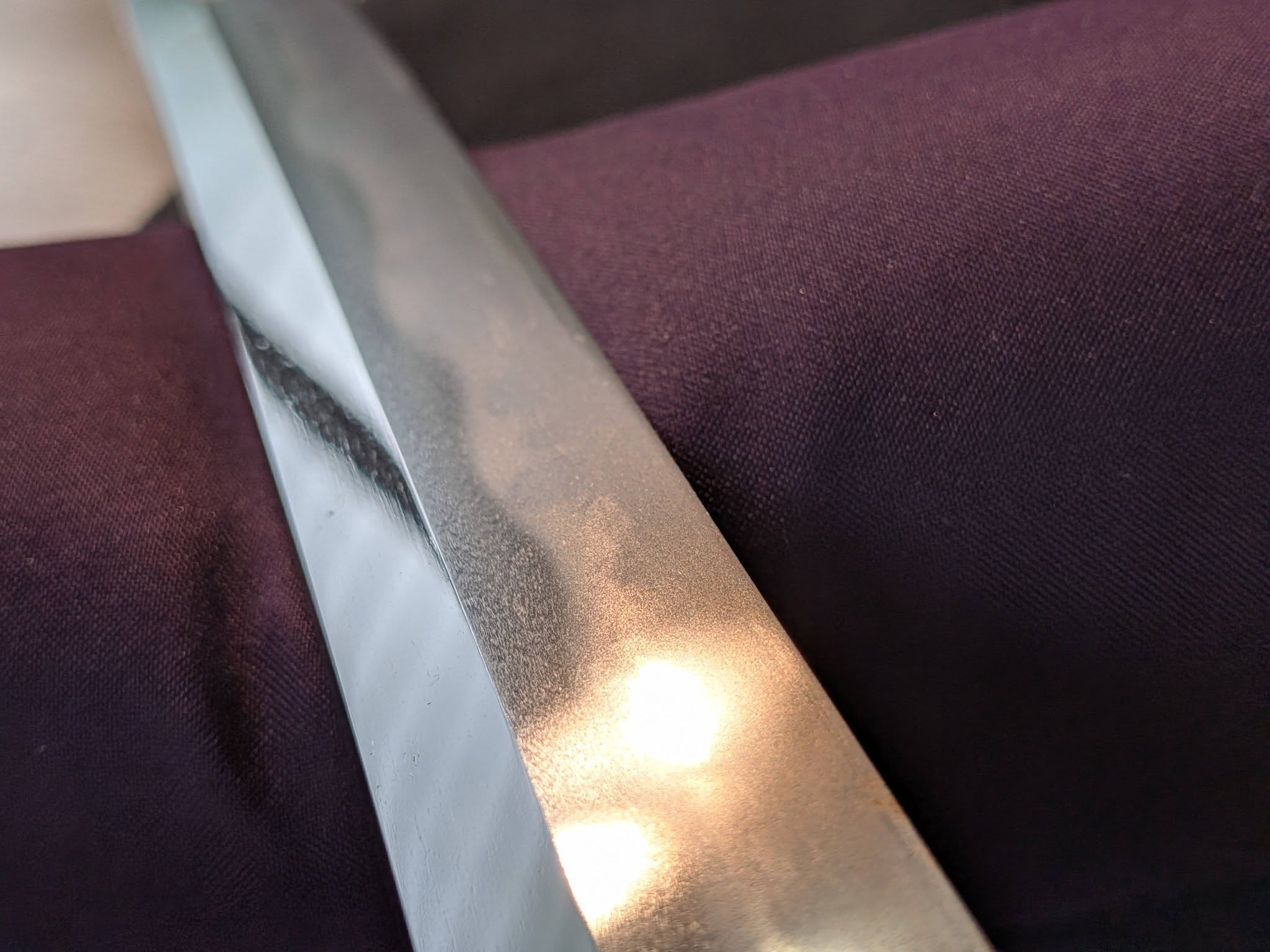
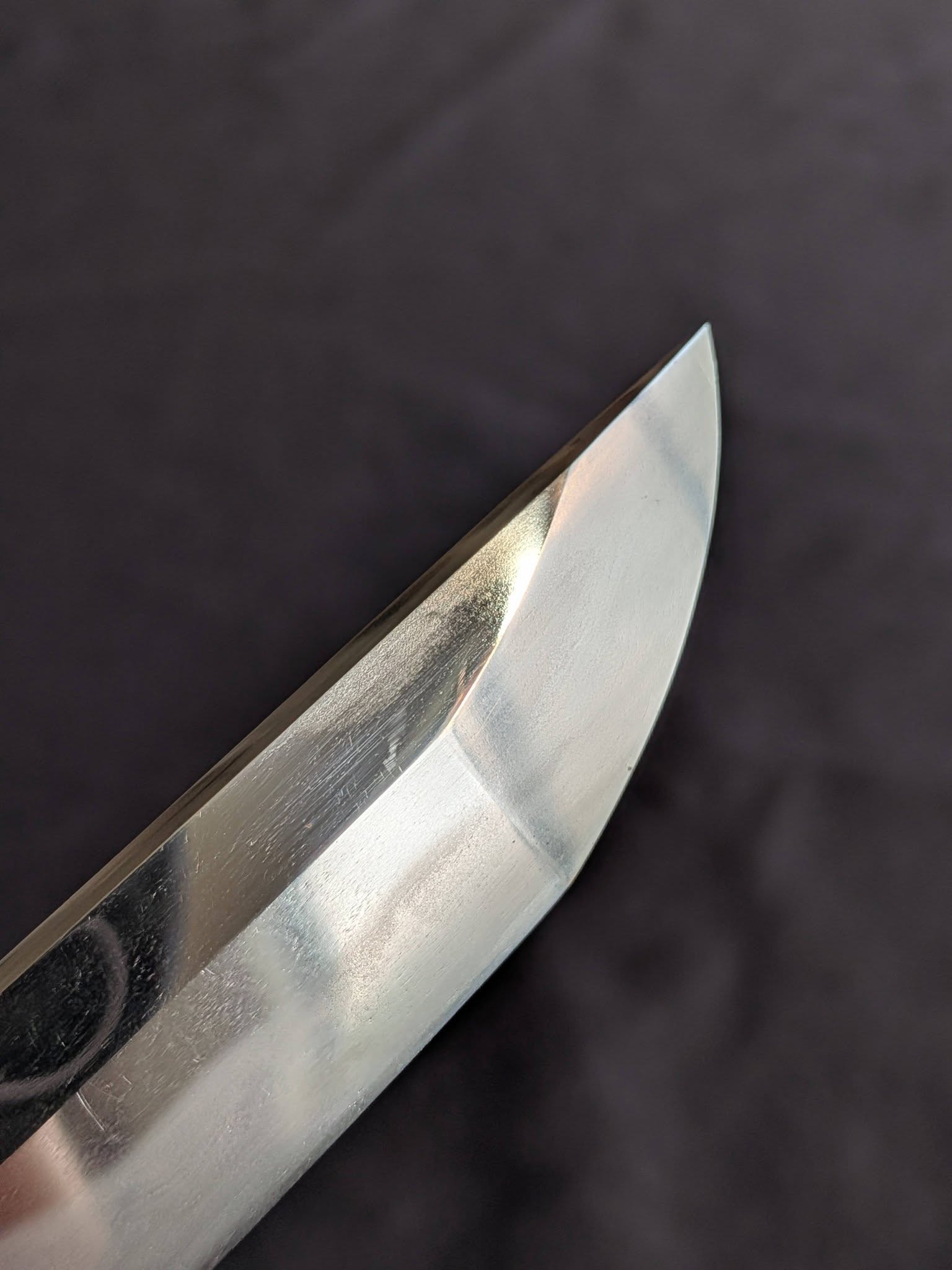
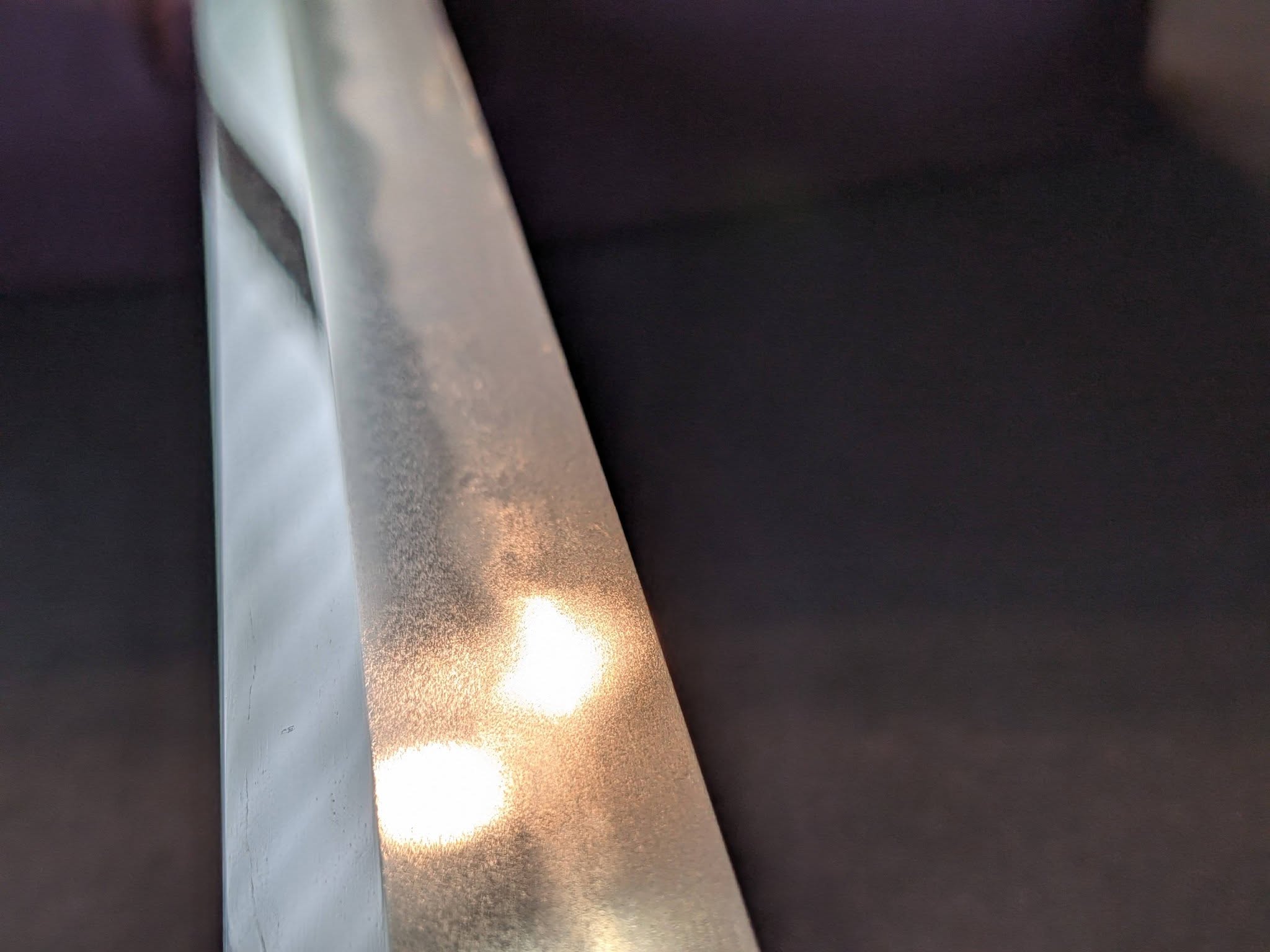
His workmanship reveals an approach in the manner of the Soshu tradition, particularly a Shizu-like sphere of work. Both ji and ha are richly covered in nie; he tempers vigorous midare incorporating togariba, with kinsuji and sunagashi appearing conspicuously and in abundance. His jihada characteristically displays itame tending toward standing grain, mixed with mokume, with fine ji-nie thickly applied and chikei well formed, while the steel takes on a slightly blackish tone. Whereas Hizen swords in general temper the boshi straight into ko-maru, in Munetsugu's work the great majority show midare-komi, often with vigorous hakikake becoming flame-like at the tip. His nakago construction likewise reflects a conscious attention to Soshu-den practice, taking on a tanago-bara-like form with the edge-side flesh reduced, and he customarily cuts a distinctive long signature on the sashi-omote in large, bold strokes.
Across the body of his designated work, the NBTHK consistently recognizes Munetsugu as "a distinctive presence among the group of Hizen smiths" who "devoted himself with particular passion to recreating Soshu-den." His blades are praised for their abundant activities in ji and ha, for a brilliant and showy tempered edge "brimming with force," and for the robust, powerfully built sugata that is "bold and magnificent." In works of calmer patterning, the appearance of tobiyaki and yubashiri-like effects above the temper line is noted as conveying an "antique flavor." Munetsugu's range extended beyond the habitual Shizu-like domain to encompass broader Soshu influences, as evidenced by ambitious pieces of "great documentary value for understanding the range of his work." His finest examples are characterized as works that "fully display the true strengths of the first-generation Iyo no Jo Munetsugu."
Where Munetsugu stands among comparable artisans: across all of nihontō, and within tradition, era, and period. The tiers (Foremost · Leading · Major · Notable) weigh official designations from the NBTHK and Japan's Agency for Cultural Affairs, together with historical honors of lasting repute such as the Sansaku and Meibutsu-chō.
Select a lens to see how it's measured.
Shinto · Hizen
130 pieces on the market now
The Hizen Tadayoshi school began with a single domain commission. In Keicho 1 (1596) the Nabeshima of Hizen ordered Hashimoto Shinzaemon, the smith who would sign Tadayoshi, up to Kyoto with the carver Munenaga; there he entered the gate of Umetada Myoju and studied forging while Munenaga learned the chisel. The two returned to the province in Keicho 3 (1598), and Tadayoshi settled in the castle town below Saga, where under the domain's patronage the line grew into the dominant sword-making house of Kyushu. His own work runs from Keicho 5 (1600) to his death in Kan'ei 9 (1632); in Genna 10 (1624) he received the court title Musashi Daijo, changed his name to Tadahiro, and shifted his clan name from Minamoto to Fujiwara, so that the late Musashi Daijo blades are the founder under a second name. From him the house became a true generational institution: his son the second-generation Omi Daijo Tadahiro carried it forward as its most prolific hand, the third-generation Mutsu no Kami Tadayoshi returned its highest finish, and a Tosa no Kami branch took the founder's signature when he set it aside. Around this main line grew a circle of disciples and collateral hands, the waki-Hizen or Soba-Hizen smiths, several of them, like Yoshiie and Hironori, working as daisaku substitute makers whose own signed pieces are therefore scarce. The school's signature is its steel. Over a ko-itame forged so tightly it shows no slackness, fine ji-nie gathers in minute particles until the surface takes on the rice-bran konuka-hada (also written komenuka-hada) that no other school produces, fine chikei entering throughout and the ji notably clear and bright.
The orthodox temper laid upon it is a chu-suguha or hiro-suguha, sometimes tinged with a shallow notare and ko-gunome, the nioiguchi deep with finely clustered ko-nie and tightened to a bright clarity, the boshi running straight to a quiet ko-maru. The founder aimed this suguha toward the Rai school yet departed from it, his nioiguchi tighter and his forging carrying more vigor; the third generation refined it to what the published sources call the strongest and most precise hand of the first three generations. Against that calm register the house also worked a showier one, the Hizen choji-midare mixing gunome, long ashi, kinsuji and sunagashi, ordered clove the founder himself had not attempted but the second generation made his own. The branches pushed further from the suguha standard: Tadakuni of the Ogi domain ran sunagashi more conspicuously than any other Hizen hand and reached toward old Ichimonji in his o-choji; Masahiro and Yukihiro favored a flamboyant long-ashi choji over the calm main line; and the Iyo no Jo Munetsugu line worked apart in the Soshu-den, building a midareba on notare with a pointed togariba and a jihada that tends to stand and tone slightly blackish. A collector seeks Hizen-to first for that steel, and reads it the same way the appraiser does: a bright suguha lying over a clear, tight konuka-hada identifies the school before the signature is consulted, and the quiet ko-maru boshi on the ura-signed tang confirms the main-line practice. Generation and branch are then told within that frame, the third generation's powerful sugata recalling not his father but his grandfather, the waki-Hizen hands set apart by their irregular temper, their sujikai file marks and a sashi-ura signature, the Munetsugu line by its Soshu togari. The main line, made in real numbers across so long a span, reaches the market more readily than any Kamakura master, so a papered example is within reach of a patient collector, while the founder's own work and the finest konuka-suguha of the third generation come to open hands only from time to time. Provenance runs back through the house the school served, blades recorded to Nabeshima Katsushige and Nabeshima Naomoto and passing onward to the Owari Tokugawa, the Satake and the Imperial families; documentary inscriptions sharpen the picture further, a Myoju soemei attesting the founder's discipleship, Umetada carving adding flowers to brocade on his late blades, and the gold-inlaid cutting tests of Yamano Kanjuro and Yamano Ka'emon, rare on Hizen work, naming the edge as well as the hand. Learn more →
| Smith | Era | Designated |
|---|---|---|
| Tadayoshi忠吉 | 1596-1632 | 123 |
| Tadayoshi忠吉 | 1662-1681 | 58 |
| Tadahiro忠廣 | 1624-1693 | 169 |
| Masahiro正廣 | 1624-1655 | 32 |
| Tadakuni忠國 | 1648-1652 | 32 |
Hizen swords were a domain enterprise: the Nabeshima sent Tadayoshi to study under Umetada Myōju around 1596, then built a licensed school around him. Nine generations carried its famously consistent konuka-hada work into the Meiji era.
We could not find an authenticity certificate on the seller’s listing. Japanese swords and fittings are normally papered by the NBTHK (or the NTHK). Without one, the attribution is the seller’s own assessment and has not been independently verified — treat it with caution and ask the dealer about certification before buying.
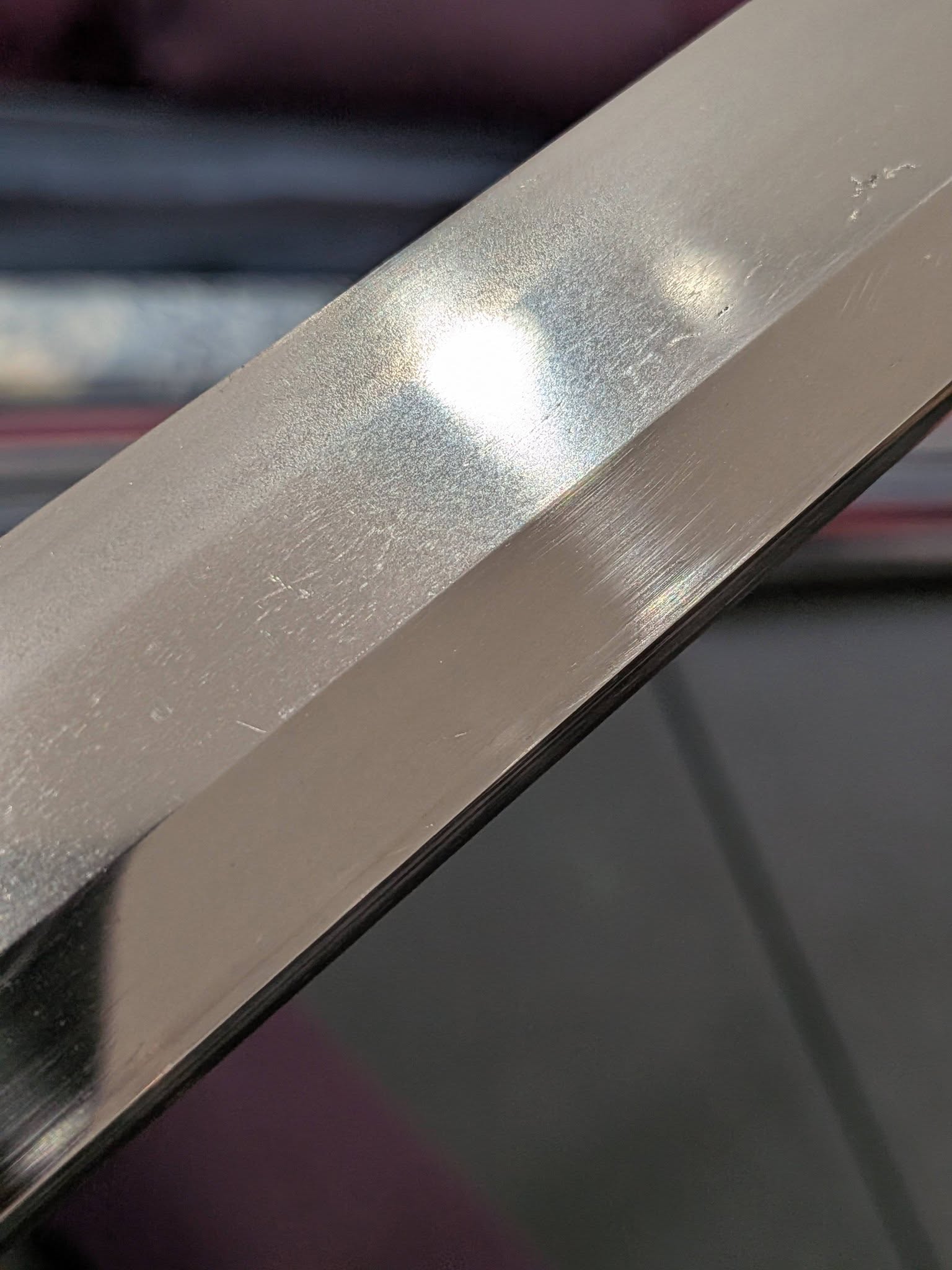
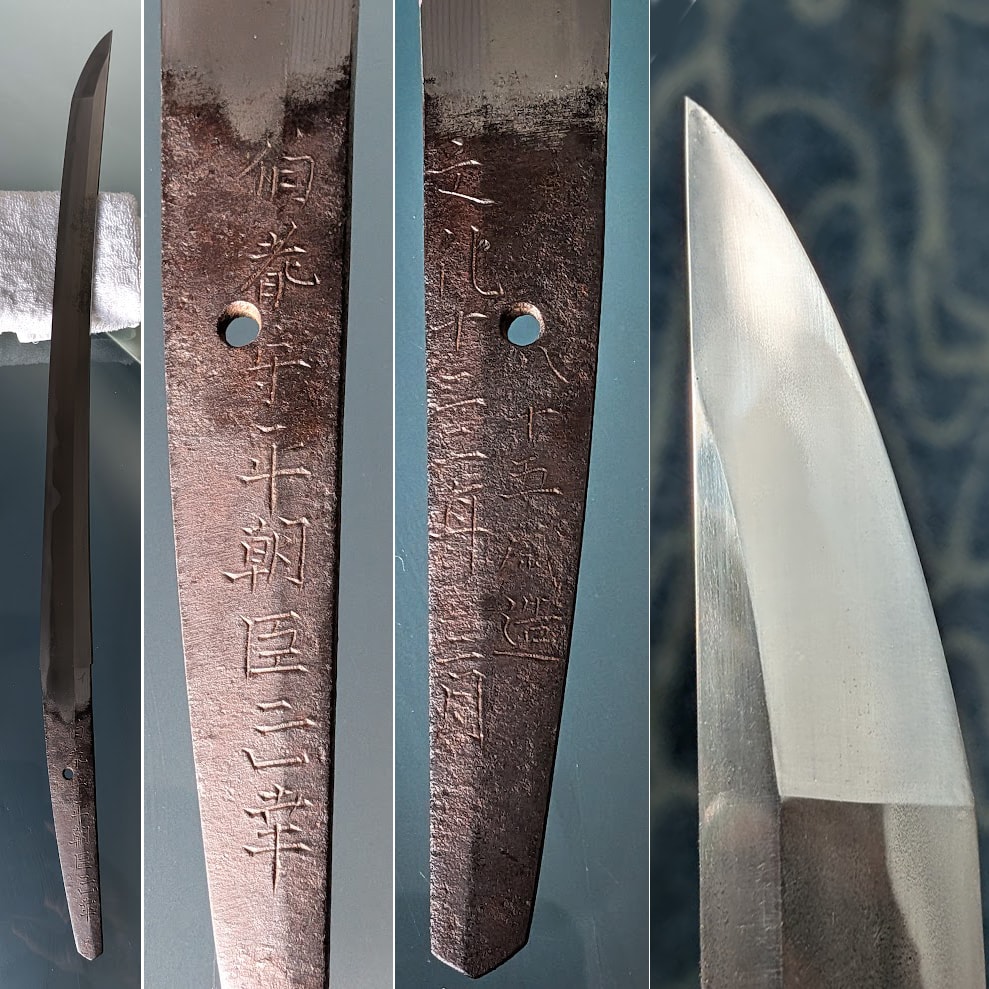
This is a katana by Iyo no Jo Minamoto Munetsugu, a first-generation smith from Hizen province active during the Keichō era (1596-1615). Munetsugu was known for focusing on the Sōshū tradition, producing blades with a standing-out itame jigane and a gunome-midare hamon. The tang is noted for its bulbous shape, reminiscent of Muramasa.
NihontoWatchShinto · Hizen · around 1596-1615
Fujishiro Jo saku · Tōken Taikan top 26%
4 pieces on the market now
The first-generation Iyo no Jo Munetsugu is said to have borne the name Sakai San'emon, and tradition holds that his family served for generations as Shinto priests at the Tenmangu shrine in Nagase Village, the birthplace of Tadayoshi. He later moved to Nagase-machi in the castle town of Saga, where he forged swords, and is further said to have relocated to Isahaya in Hizen. According to the "Iyo no Jo Munetsugu Genealogy" preserved among old documents transmitted in the Sakai family, he received the court title of Iyo no Jo in Keicho 11 (1606), a dating supported by extant works of Keicho 12 that already bear the title. Active in the Momoyama through early Edo period, Munetsugu occupies a distinctive position among the group of Hizen smiths, standing apart from the mainstream lineage descended from Tadayoshi.
His workmanship reveals an approach in the manner of the Soshu tradition, particularly a Shizu-like sphere of work. Both ji and ha are richly covered in nie; he tempers vigorous midare incorporating togariba, with kinsuji and sunagashi appearing conspicuously and in abundance. His jihada characteristically displays itame tending toward standing grain, mixed with mokume, with fine ji-nie thickly applied and chikei well formed, while the steel takes on a slightly blackish tone. Whereas Hizen swords in general temper the boshi straight into ko-maru, in Munetsugu's work the great majority show midare-komi, often with vigorous hakikake becoming flame-like at the tip. His nakago construction likewise reflects a conscious attention to Soshu-den practice, taking on a tanago-bara-like form with the edge-side flesh reduced, and he customarily cuts a distinctive long signature on the sashi-omote in large, bold strokes.
Across the body of his designated work, the NBTHK consistently recognizes Munetsugu as "a distinctive presence among the group of Hizen smiths" who "devoted himself with particular passion to recreating Soshu-den." His blades are praised for their abundant activities in ji and ha, for a brilliant and showy tempered edge "brimming with force," and for the robust, powerfully built sugata that is "bold and magnificent." In works of calmer patterning, the appearance of tobiyaki and yubashiri-like effects above the temper line is noted as conveying an "antique flavor." Munetsugu's range extended beyond the habitual Shizu-like domain to encompass broader Soshu influences, as evidenced by ambitious pieces of "great documentary value for understanding the range of his work." His finest examples are characterized as works that "fully display the true strengths of the first-generation Iyo no Jo Munetsugu."
Where Munetsugu stands among comparable artisans: across all of nihontō, and within tradition, era, and period. The tiers (Foremost · Leading · Major · Notable) weigh official designations from the NBTHK and Japan's Agency for Cultural Affairs, together with historical honors of lasting repute such as the Sansaku and Meibutsu-chō.
Select a lens to see how it's measured.
Shinto · Hizen
130 pieces on the market now
The Hizen Tadayoshi school began with a single domain commission. In Keicho 1 (1596) the Nabeshima of Hizen ordered Hashimoto Shinzaemon, the smith who would sign Tadayoshi, up to Kyoto with the carver Munenaga; there he entered the gate of Umetada Myoju and studied forging while Munenaga learned the chisel. The two returned to the province in Keicho 3 (1598), and Tadayoshi settled in the castle town below Saga, where under the domain's patronage the line grew into the dominant sword-making house of Kyushu. His own work runs from Keicho 5 (1600) to his death in Kan'ei 9 (1632); in Genna 10 (1624) he received the court title Musashi Daijo, changed his name to Tadahiro, and shifted his clan name from Minamoto to Fujiwara, so that the late Musashi Daijo blades are the founder under a second name. From him the house became a true generational institution: his son the second-generation Omi Daijo Tadahiro carried it forward as its most prolific hand, the third-generation Mutsu no Kami Tadayoshi returned its highest finish, and a Tosa no Kami branch took the founder's signature when he set it aside. Around this main line grew a circle of disciples and collateral hands, the waki-Hizen or Soba-Hizen smiths, several of them, like Yoshiie and Hironori, working as daisaku substitute makers whose own signed pieces are therefore scarce. The school's signature is its steel. Over a ko-itame forged so tightly it shows no slackness, fine ji-nie gathers in minute particles until the surface takes on the rice-bran konuka-hada (also written komenuka-hada) that no other school produces, fine chikei entering throughout and the ji notably clear and bright.
The orthodox temper laid upon it is a chu-suguha or hiro-suguha, sometimes tinged with a shallow notare and ko-gunome, the nioiguchi deep with finely clustered ko-nie and tightened to a bright clarity, the boshi running straight to a quiet ko-maru. The founder aimed this suguha toward the Rai school yet departed from it, his nioiguchi tighter and his forging carrying more vigor; the third generation refined it to what the published sources call the strongest and most precise hand of the first three generations. Against that calm register the house also worked a showier one, the Hizen choji-midare mixing gunome, long ashi, kinsuji and sunagashi, ordered clove the founder himself had not attempted but the second generation made his own. The branches pushed further from the suguha standard: Tadakuni of the Ogi domain ran sunagashi more conspicuously than any other Hizen hand and reached toward old Ichimonji in his o-choji; Masahiro and Yukihiro favored a flamboyant long-ashi choji over the calm main line; and the Iyo no Jo Munetsugu line worked apart in the Soshu-den, building a midareba on notare with a pointed togariba and a jihada that tends to stand and tone slightly blackish. A collector seeks Hizen-to first for that steel, and reads it the same way the appraiser does: a bright suguha lying over a clear, tight konuka-hada identifies the school before the signature is consulted, and the quiet ko-maru boshi on the ura-signed tang confirms the main-line practice. Generation and branch are then told within that frame, the third generation's powerful sugata recalling not his father but his grandfather, the waki-Hizen hands set apart by their irregular temper, their sujikai file marks and a sashi-ura signature, the Munetsugu line by its Soshu togari. The main line, made in real numbers across so long a span, reaches the market more readily than any Kamakura master, so a papered example is within reach of a patient collector, while the founder's own work and the finest konuka-suguha of the third generation come to open hands only from time to time. Provenance runs back through the house the school served, blades recorded to Nabeshima Katsushige and Nabeshima Naomoto and passing onward to the Owari Tokugawa, the Satake and the Imperial families; documentary inscriptions sharpen the picture further, a Myoju soemei attesting the founder's discipleship, Umetada carving adding flowers to brocade on his late blades, and the gold-inlaid cutting tests of Yamano Kanjuro and Yamano Ka'emon, rare on Hizen work, naming the edge as well as the hand. Learn more →
| Smith | Era | Designated |
|---|---|---|
| Tadayoshi忠吉 | 1596-1632 | 123 |
| Tadayoshi忠吉 | 1662-1681 | 58 |
| Tadahiro忠廣 | 1624-1693 | 169 |
| Masahiro正廣 | 1624-1655 | 32 |
| Tadakuni忠國 | 1648-1652 | 32 |
Hizen swords were a domain enterprise: the Nabeshima sent Tadayoshi to study under Umetada Myōju around 1596, then built a licensed school around him. Nine generations carried its famously consistent konuka-hada work into the Meiji era.
We could not find an authenticity certificate on the seller’s listing. Japanese swords and fittings are normally papered by the NBTHK (or the NTHK). Without one, the attribution is the seller’s own assessment and has not been independently verified — treat it with caution and ask the dealer about certification before buying.