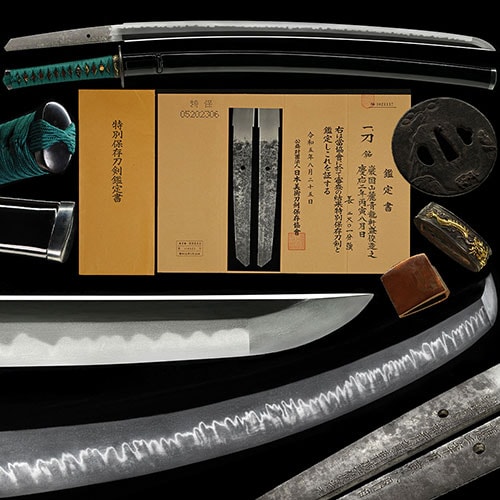
青龍軒盛俊 岩国藩士為 佐々木長隆造之 慶応二丙寅冬 Seiryuken Moritoshi
¥450,000
Tracked across 76 dealers worldwide · price history · sold archive
Specifications
Nagasa
31.4 cm
Sori
0.2 cm
Motohaba
2.93 cm
Sakihaba
1.78 cm
It has appeared! A sun-nobi tanto made for Mr. Sasaki Nagataka, a retainer of the Iwakuni Domain of the Choshu Clan and a descendant of the Amago clan (the former overlords of the Chugoku region), created during the height of tension during the Second Choshu Expedition by the Tokugawa Shogunate at the end of the Edo period. In the year of its production, Keio 2 (1866) (159 years ago), while the Choshu Clan was bolstering its defenses, the Satcho Alliance had been concluded between the long-conflicting Satsuma and Choshu Clans in the previous year, Keio 1 (1865), through the efforts of Sakamoto Ryoma and others. On June 7, Keio 2 (1866), combat between the Shogunate forces and Choshu forces began with the bombardment of Suo-Oshima by Shogunate warships. The Iwakuni Domain joined the battle at the Geishu-guchi front. Alongside the Choshu Yugekitai (commando units), they intercepted the Shogunate army; with Choshu maintaining the advantage, a truce was signed the following year, Keio 3 (1867), at Miyajima in Aki. On October 14 of that same year, the 15th Shogun Tokugawa Yoshinobu returned political power to the Emperor (Taiseihokan), and on December 9, the Restoration of Imperial Rule (Oseifukko) was proclaimed. In January of the following year (1868), the Boshin War began with the Battle of Toba-Fushimi, concluding in September 1869 with the Battle of Hakodate Goryokaku. The era name changed to Meiji 1 on September 8, 1868. This sun-nobi tanto was crafted in the winter of Keio 2 (1866) (159 years ago), in the very midst of the Second Choshu Expedition, for the Iwakuni retainer Sasaki Nagataka, who was prepared for certain death. Sasaki Nagataka of the Choshu Clan was a high-ranking retainer of the Iwakuni Domain; the Sasaki surname originates from the prestigious lineage of the Amago clan, the former rulers of the Chugoku region. The maker, Seiryuken Moritoshi, was born Iwamoto Seizaemon. He first studied under the Iwakuni katchushi (armorer) Takesuke Rinto and was permitted to use the Iwamoto name. In Tenpo 8 (1837) (188 years ago), he went to the capital and entered the school of Chounsai Tsunatoshi, and later became a student of Koyama Munetsugu, who is famous for his wazamono (sharp swords) at the end of the Edo period. He returned home to become a hanko (official domain swordsmith) for the Iwakuni Domain in Choshu. This sun-nobi tanto is a work from Moritoshi’s 65th year, crafted with his very soul to protect his country in its time of crisis. The sugata shows a thick moto-kasane with little sori, presenting a long and sharp tanto form. The jigane is a well-tightened itame-hada. The horimono is magnificent, featuring a koshi-hi with soe-hi on the omote, and gomabashi on the ura. The hamon is a ko-nie laden gunome-midare, reminiscent of his master Koyama Munetsugu. It is a work that intensely conveys the power to cut through anything in its path and repel any danger to the wearer. As this is the first time this piece has appeared on the market in its raw state, we are offering it at a special low price. Please enjoy this famous tanto by Seiryuken Moritoshi—the leading swordsmith of the Iwakuni Domain at the end of the Edo period—which protected the life of the Amago descendant and Iwakuni retainer Sasaki Nagataka through numerous battles.
 NihontoWatchBETA
¥450,000
Tracked across 76 dealers worldwide · price history · sold archive
31.4 cm
0.2 cm
2.93 cm
1.78 cm
¥450,000
It has appeared! A sun-nobi tanto made for Mr. Sasaki Nagataka, a retainer of the Iwakuni Domain of the Choshu Clan and a descendant of the Amago clan (the former overlords of the Chugoku region), created during the height of tension during the Second Choshu Expedition by the Tokugawa Shogunate at the end of the Edo period. In the year of its production, Keio 2 (1866) (159 years ago), while the Choshu Clan was bolstering its defenses, the Satcho Alliance had been concluded between the long-conflicting Satsuma and Choshu Clans in the previous year, Keio 1 (1865), through the efforts of Sakamoto Ryoma and others. On June 7, Keio 2 (1866), combat between the Shogunate forces and Choshu forces began with the bombardment of Suo-Oshima by Shogunate warships. The Iwakuni Domain joined the battle at the Geishu-guchi front. Alongside the Choshu Yugekitai (commando units), they intercepted the Shogunate army; with Choshu maintaining the advantage, a truce was signed the following year, Keio 3 (1867), at Miyajima in Aki. On October 14 of that same year, the 15th Shogun Tokugawa Yoshinobu returned political power to the Emperor (Taiseihokan), and on December 9, the Restoration of Imperial Rule (Oseifukko) was proclaimed. In January of the following year (1868), the Boshin War began with the Battle of Toba-Fushimi, concluding in September 1869 with the Battle of Hakodate Goryokaku. The era name changed to Meiji 1 on September 8, 1868. This sun-nobi tanto was crafted in the winter of Keio 2 (1866) (159 years ago), in the very midst of the Second Choshu Expedition, for the Iwakuni retainer Sasaki Nagataka, who was prepared for certain death. Sasaki Nagataka of the Choshu Clan was a high-ranking retainer of the Iwakuni Domain; the Sasaki surname originates from the prestigious lineage of the Amago clan, the former rulers of the Chugoku region. The maker, Seiryuken Moritoshi, was born Iwamoto Seizaemon. He first studied under the Iwakuni katchushi (armorer) Takesuke Rinto and was permitted to use the Iwamoto name. In Tenpo 8 (1837) (188 years ago), he went to the capital and entered the school of Chounsai Tsunatoshi, and later became a student of Koyama Munetsugu, who is famous for his wazamono (sharp swords) at the end of the Edo period. He returned home to become a hanko (official domain swordsmith) for the Iwakuni Domain in Choshu. This sun-nobi tanto is a work from Moritoshi’s 65th year, crafted with his very soul to protect his country in its time of crisis. The sugata shows a thick moto-kasane with little sori, presenting a long and sharp tanto form. The jigane is a well-tightened itame-hada. The horimono is magnificent, featuring a koshi-hi with soe-hi on the omote, and gomabashi on the ura. The hamon is a ko-nie laden gunome-midare, reminiscent of his master Koyama Munetsugu. It is a work that intensely conveys the power to cut through anything in its path and repel any danger to the wearer. As this is the first time this piece has appeared on the market in its raw state, we are offering it at a special low price. Please enjoy this famous tanto by Seiryuken Moritoshi—the leading swordsmith of the Iwakuni Domain at the end of the Edo period—which protected the life of the Amago descendant and Iwakuni retainer Sasaki Nagataka through numerous battles.
NihontoWatchBETA¥450,000
Tracked across 76 dealers worldwide · price history · sold archive
31.4 cm
0.2 cm
2.93 cm
1.78 cm
¥450,000