
Description

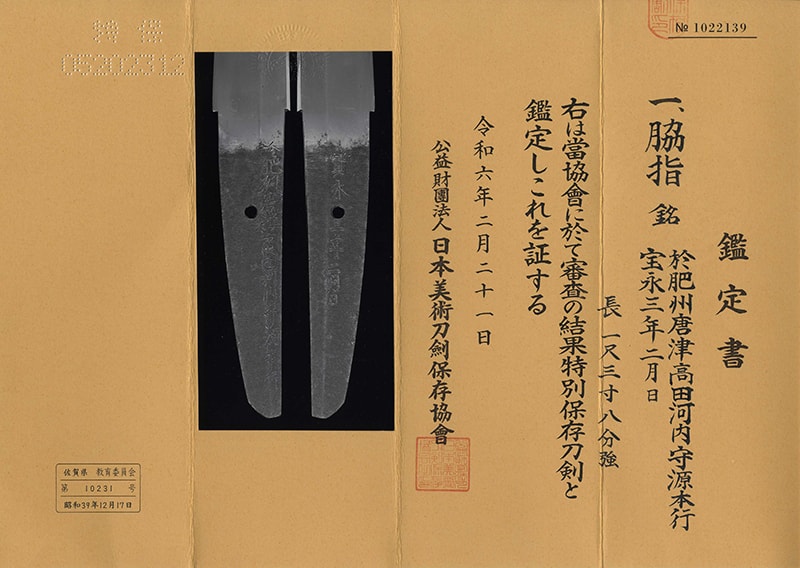
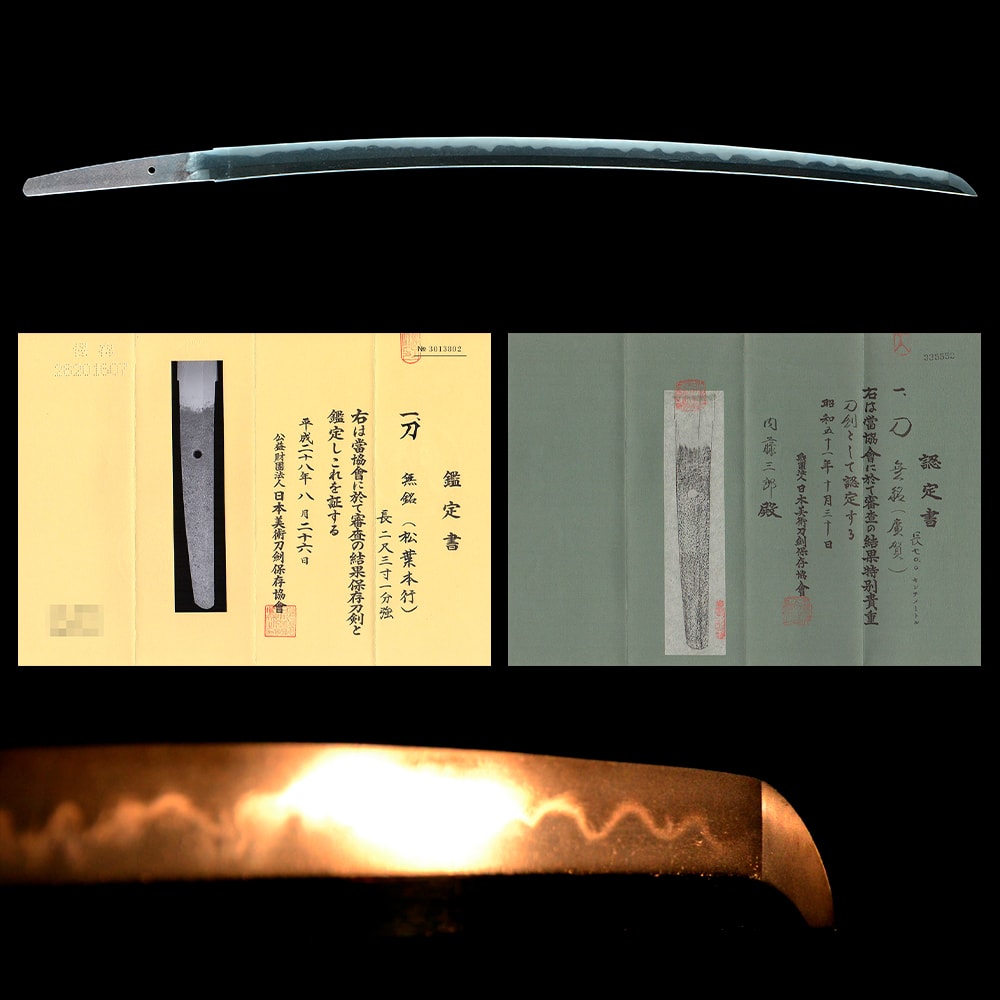
It has appeared, it has appeared! A masterpiece by the famous Matsuba Motoyuki (so named because the character for "Moto" resembles a pine needle), who is well-known in the sword world despite few of his swords remaining extant. This is a precious sword bearing the earlier *mei* of Takada Kawachi no Kami Minamoto Yukihira. Motoyuki was born in the early Edo period in Kanei 19 (1642) (380 years ago). He was a master smith who claimed to be a descendant of the legendary Bungo Kishindayu Yukihira—a disciple of the Heian period monk Sadahide from Bungo, Oita, who was active around the early Kamakura period in Genkyu (1204) (818 years ago). In Enpo 5 (1677) at the age of 35, he moved to the Karatsu castle town in Hizen. On June 17th of Enpo 5, he received the title of Kawachi no Daijo and signed his *mei* as Kawachi no Daijo Yukiharu; shortly thereafter, he changed his name to Yukihira after his ancestor. In Genroku 7 (1694) at the age of 52, he went to Edo and was granted the character "Moto" (本) by the Hon'ami family, leading him to change his name from Yukihira to Motoyuki. Because the shape of the "Moto" character in his *mei* is unique and looks like a pine needle (*matsuba*), he became world-famous as "Matsuba Motoyuki." This sword exhibits a *Kanbun Shinto* style *sugata* similar to Kotetsu, with a difference between the *moto-mihaba* and *saki-mihaba* and a shallow *sori*. The *jigane* is a finely packed *ko-itame hada*. The *hamon* is a *gunome-ba* with deep *nioi*, tempered consistently from the *moto* to the *saki* with great vigor, making it truly magnificent. The luxurious Edo-period *koshirae* further adds splendor to this precious sword from Motoyuki’s earlier Yukihira period. Regarding the *torokusho* (registration certificate), the characters for "Kishindayu Sue" (descendant of Kishindayu) from the *ura-mei* were omitted; please accept this as a simple clerical oversight by the Okayama Prefecture Board of Education. On this occasion, an old connoisseur has entrusted us with this sword—a historically precious Yukihira-signed piece by the famous descendant of Bungo Yukihira, Matsuba Motoyuki—with the request that it be passed on affordably to the next generation for research purposes. Therefore, we are offering it at a special bargain price. Please enjoy this sword by Matsuba Motoyuki, which is rarely seen and highly valuable as historical material.

高田河内守源行平作 紀新大夫末(松葉本行前銘) Takada Kawachinokami Minamoto Yukihira

高田河内守源行平作 紀新大夫末(松葉本行前銘) Takada Kawachinokami Minamoto Yukihira

Katana

¥680,000

Tracked across 76 dealers worldwide · price history · sold archive

Specifications

Nagasa

67.9 cm

Sori

1.2 cm

Motohaba

3.13 cm

Sakihaba

2.03 cm

About the maker

Motoshige Motoyuki本行

1 Tokubetsu Jūyō2 Jūyō Tōken

Kawachi no Kami Minamoto Motoyuki (本行), commonly known as Matsuba Motoyuki, was a swordsmith of Karatsu in Hizen Province active during the mid-Edo period. His era of activity is recorded as Tenna (1681--1684), and reference works list him as the first generation bearing this name. Motoyuki worked within the broader tradition of Hizen swordsmithing, a lineage celebrated for its refined forging and disciplined temperlines. He received the court title Kawachi no Kami and signed with the full *mei* "Hizen no Kuni Karatsu-jū Kawachi no Kami Minamoto Motoyuki saku." He is rated *chū-jō saku* (above average) by Fujishiro and carries a Hawley rating of 55. Motoyuki's workmanship is characterized by a tightly forged *ko-itame-hada* with fine *ji-nie*, producing a steel of notably clear *kana-iro* tone. His *hamon* typically begins with a *suguha*-based *yakidashi* before developing into a wide, gentle *ō-notare* mixed with *gunome*, exhibiting deep *nioi* with *ko-nie* and a bright, clear *nioiguchi*. His blades tend toward wide *mihaba* with shallow *sori* and an elongated *chū-kissaki*, reflecting the robust proportions favored in the Genroku era. The *bōshi* is rendered *sugu* with a rounded turnback, and the *nakago* is characteristically finished with *kiri* filemarks and a long signature placed near the *mune* side. Motoyuki's finest surviving work -- a katana dated Genroku 11 (1698) -- is described in the designation records as his greatest masterwork, with both *ji* and *ha* praised as bright and clear and the overall state of preservation deemed exceptionally *kenzen*. This blade was mounted with fittings by Tsuchiya Yasuchika, one of the celebrated Nara sansaku, in a commission for the daimyo Matsudaira Daigaku no Kami Yoritsada. The pairing of Motoyuki's blade with Yasuchika's metalwork in a unified *uchigatana* mounting testifies to the esteem in which his work was held among discerning patrons of the period.
Dealer

Nipponto

nipponto.co.jp

¥680,000

View on Nipponto




