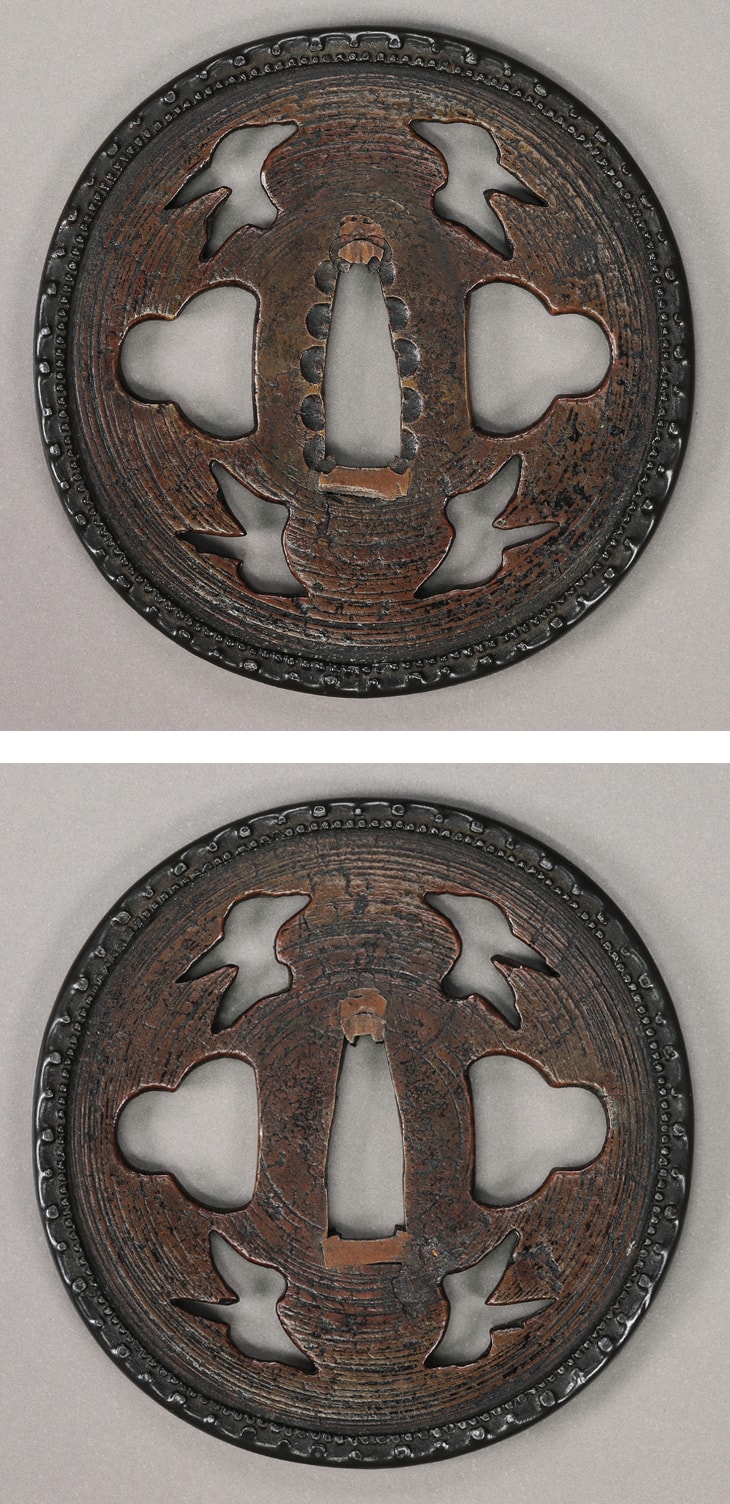
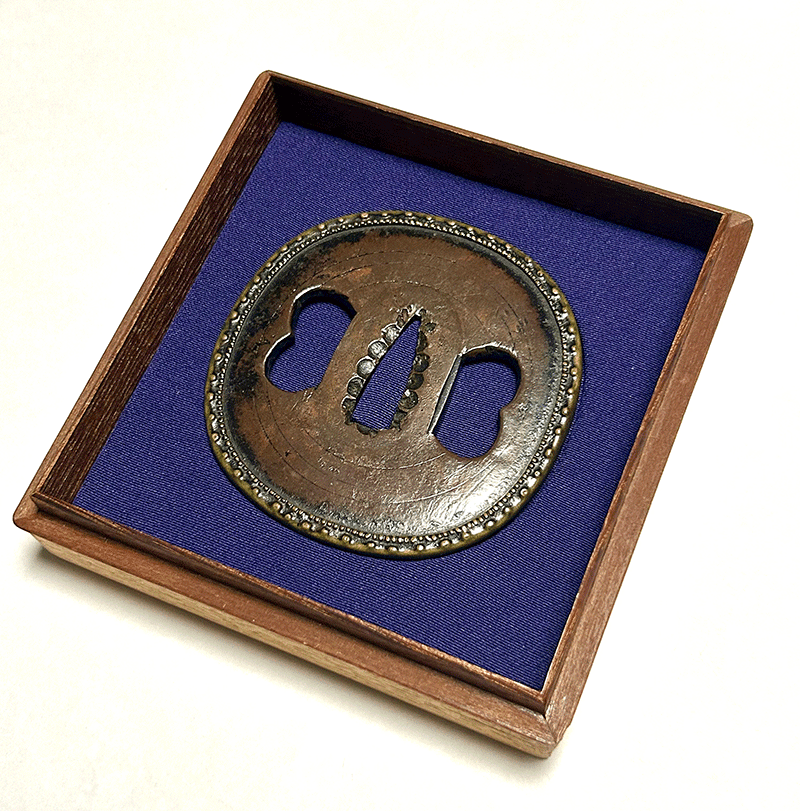
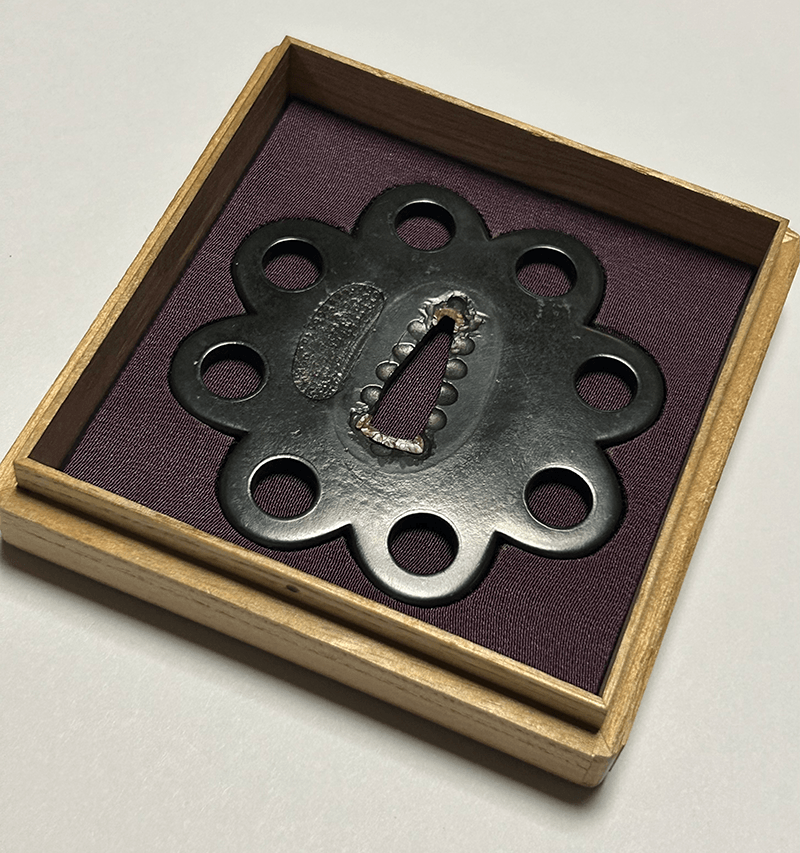
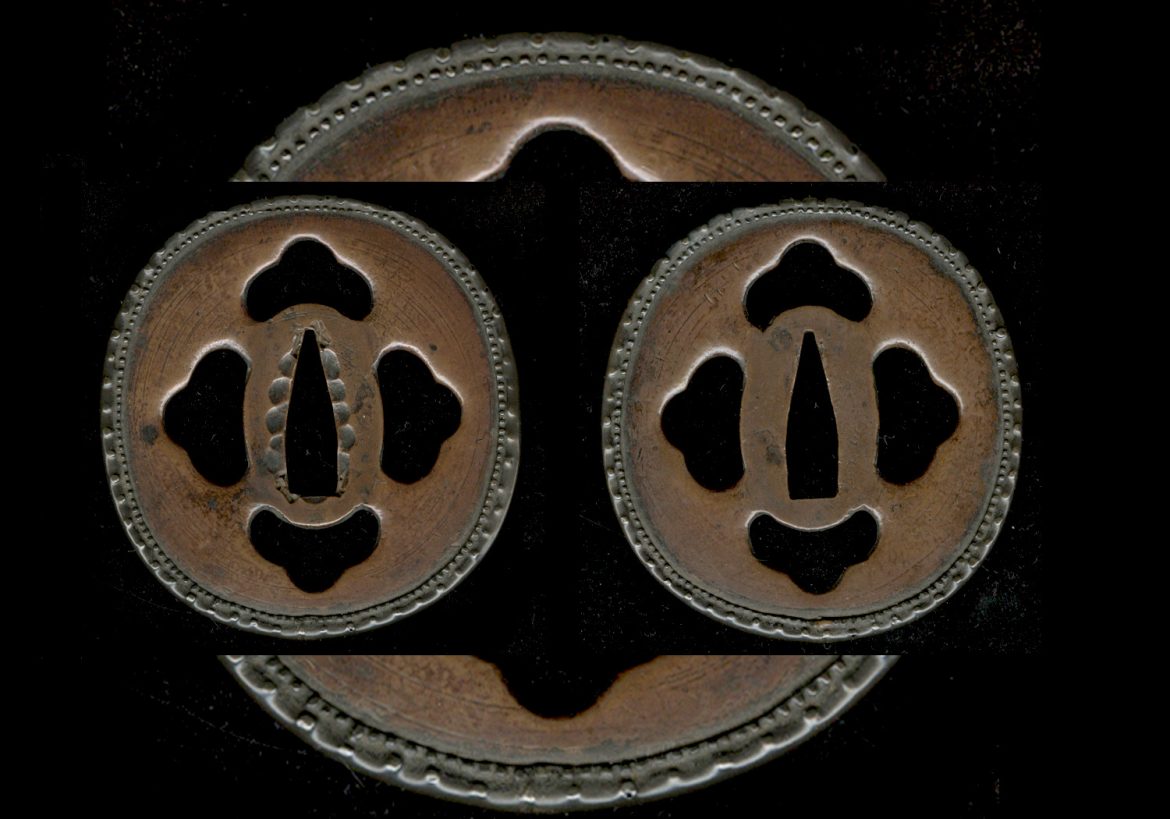
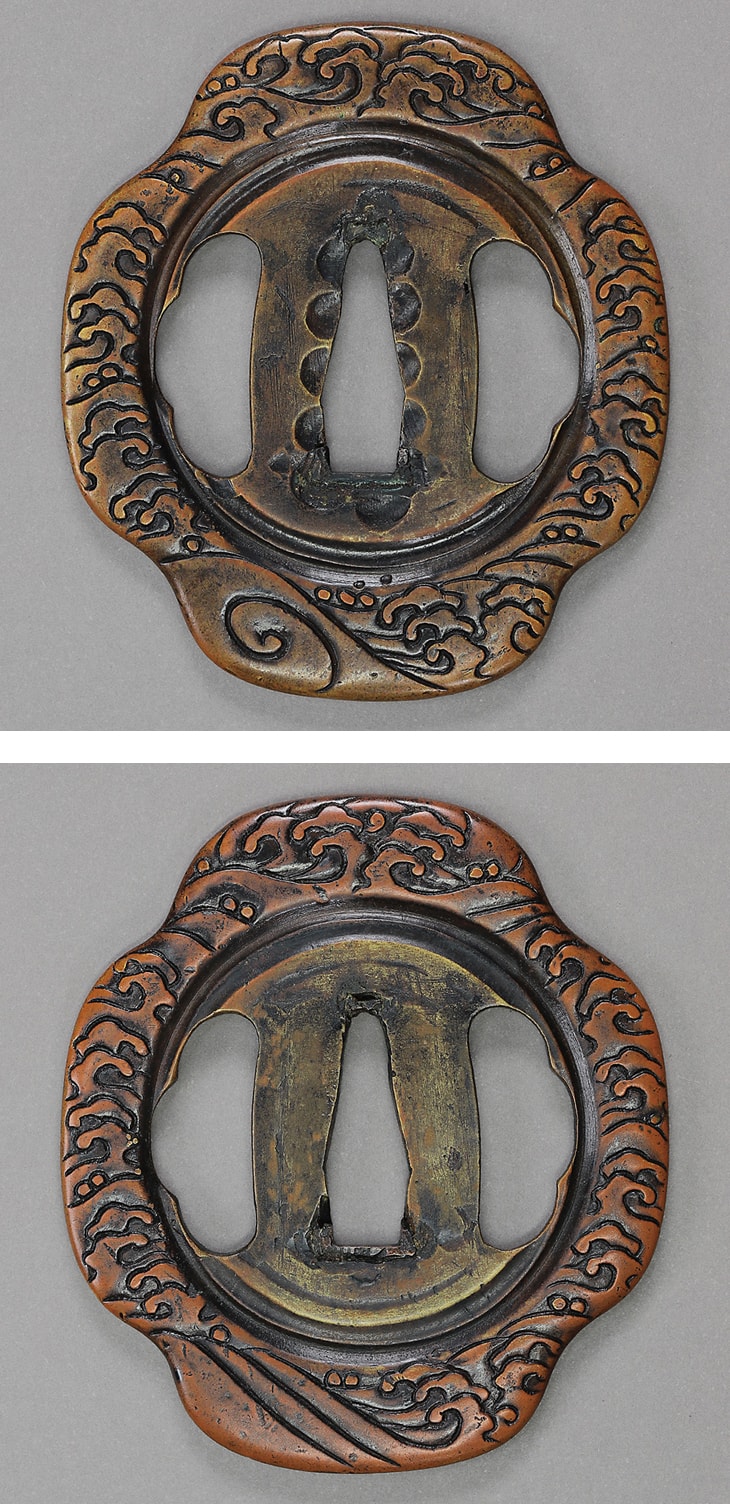
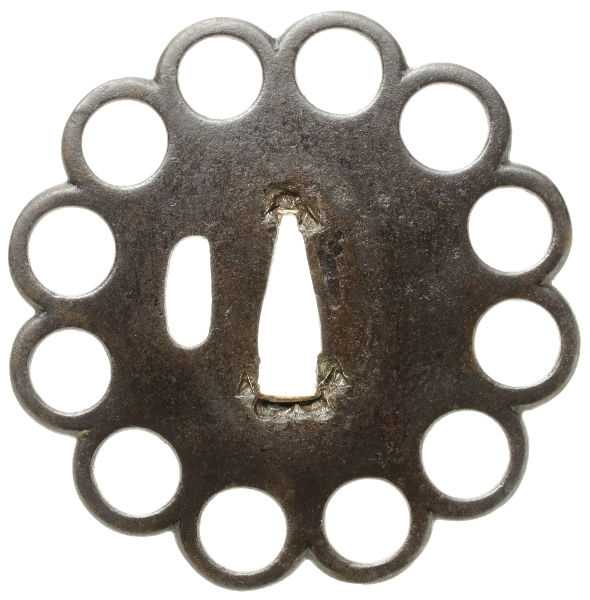
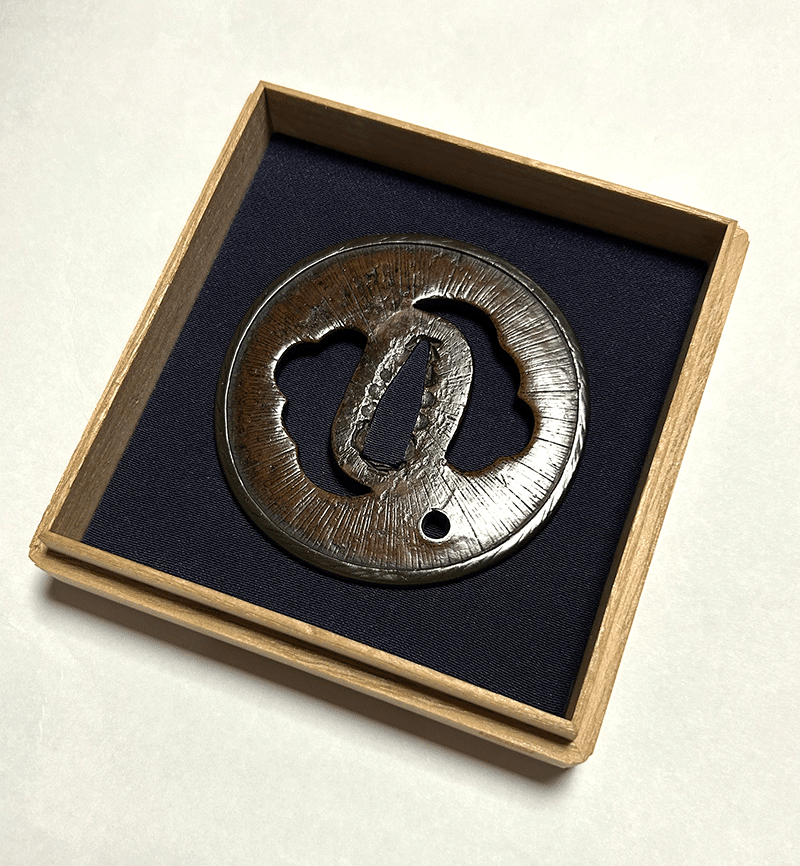
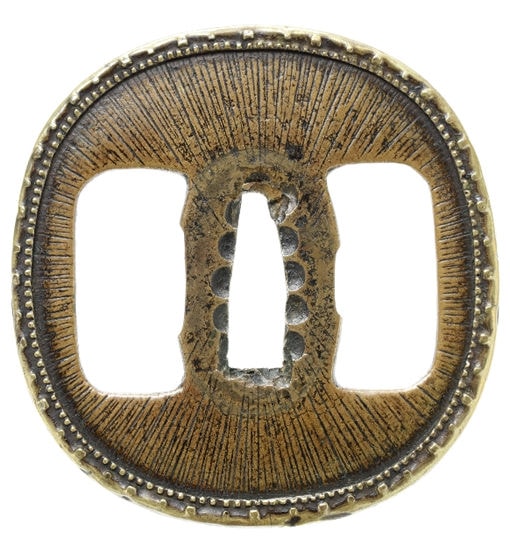
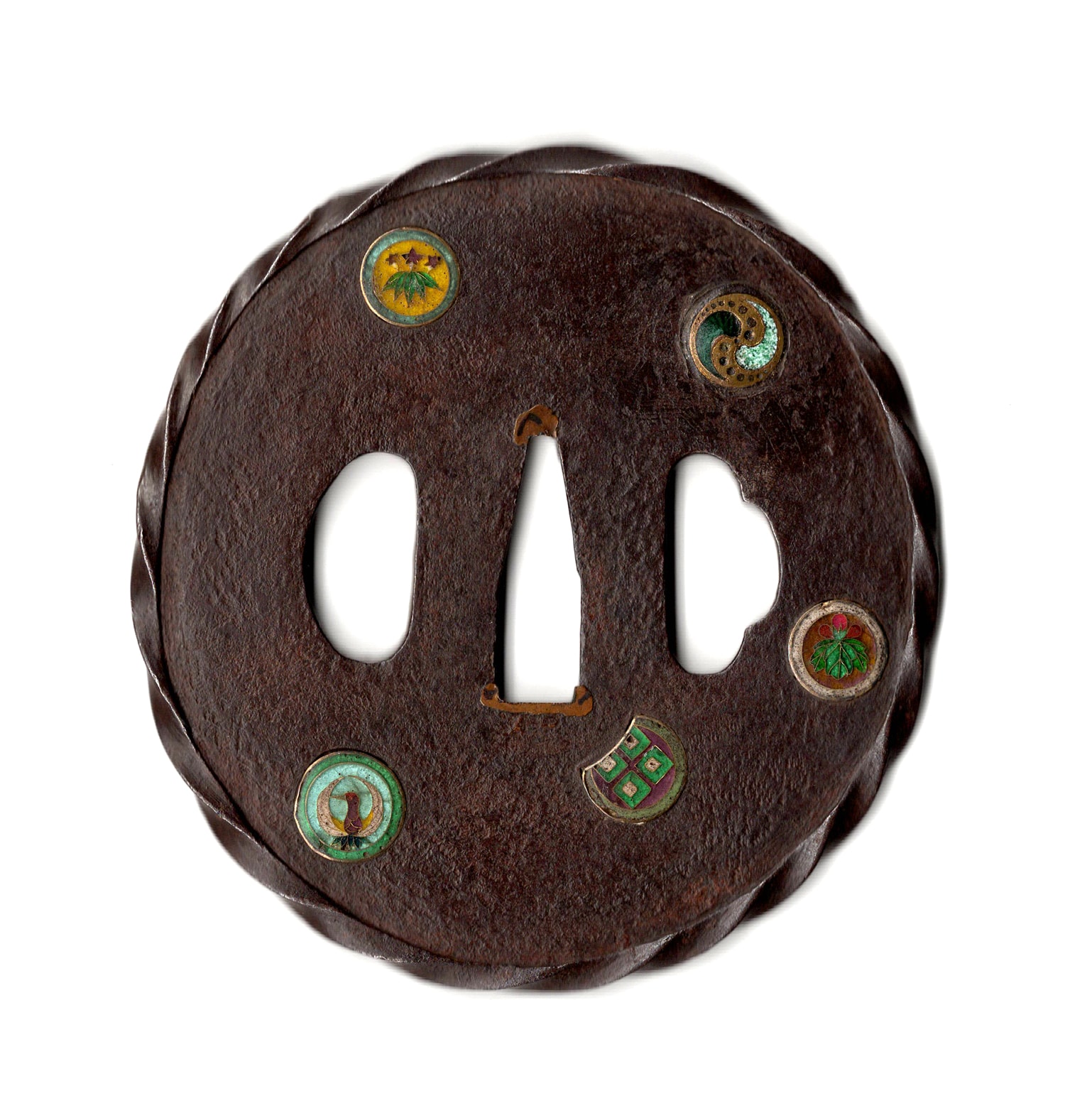
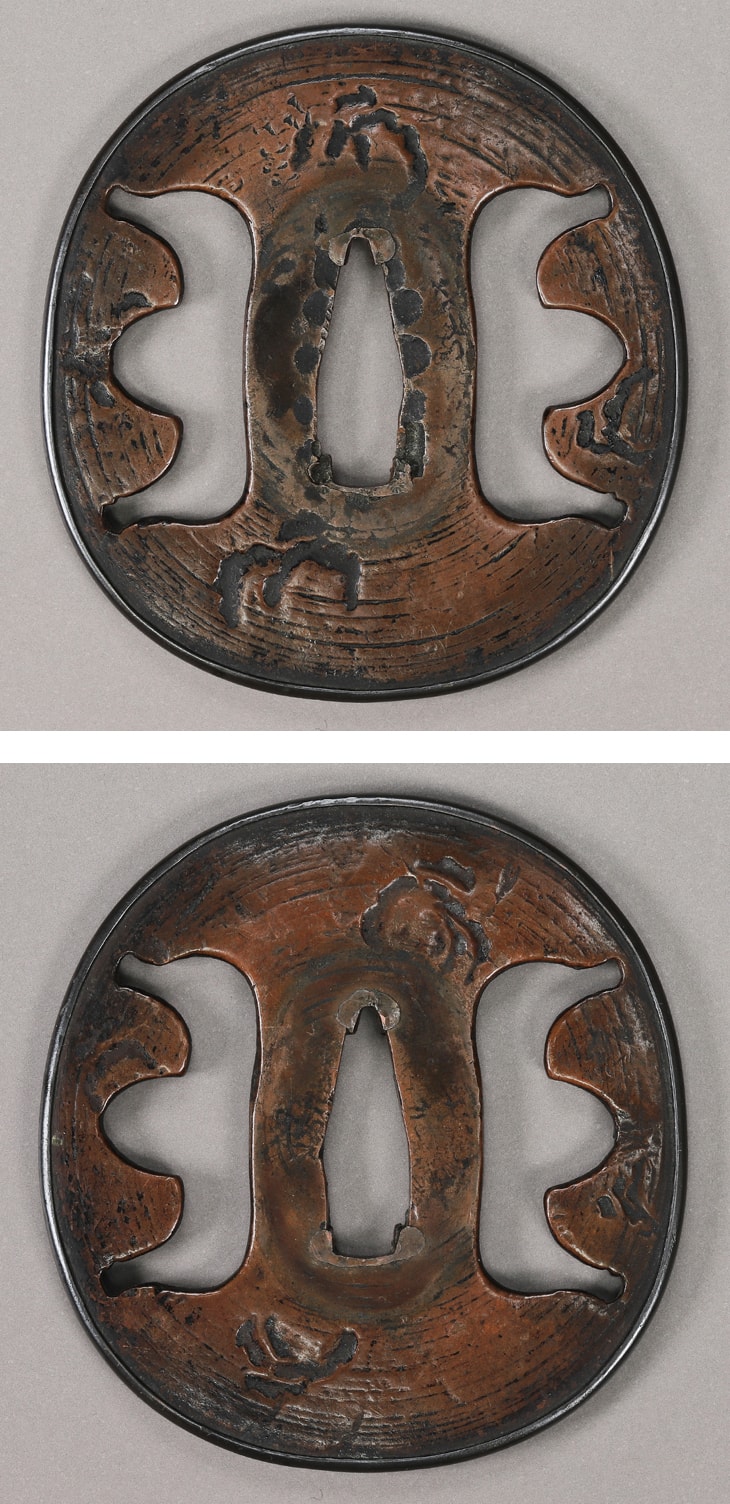
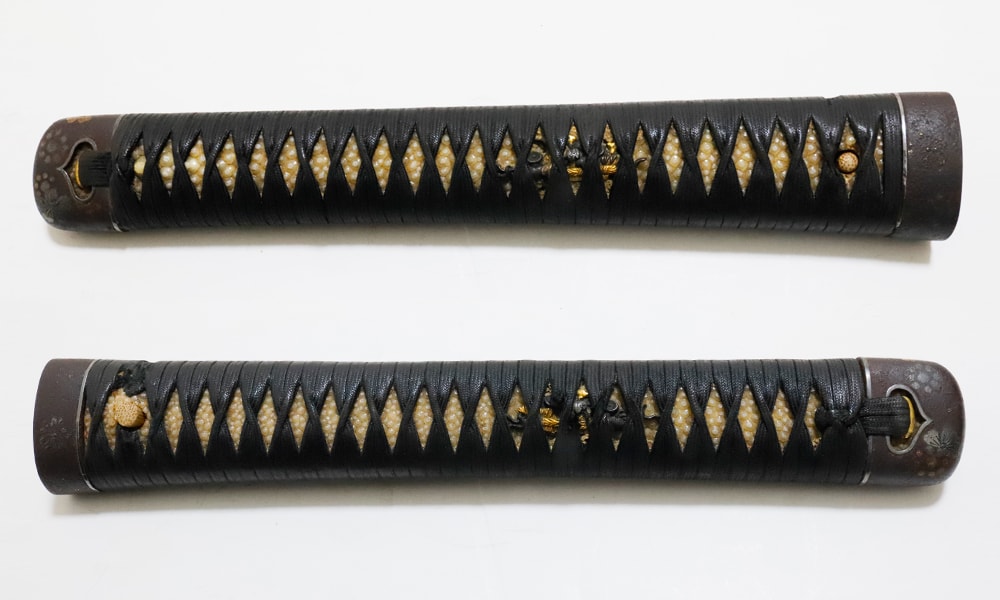
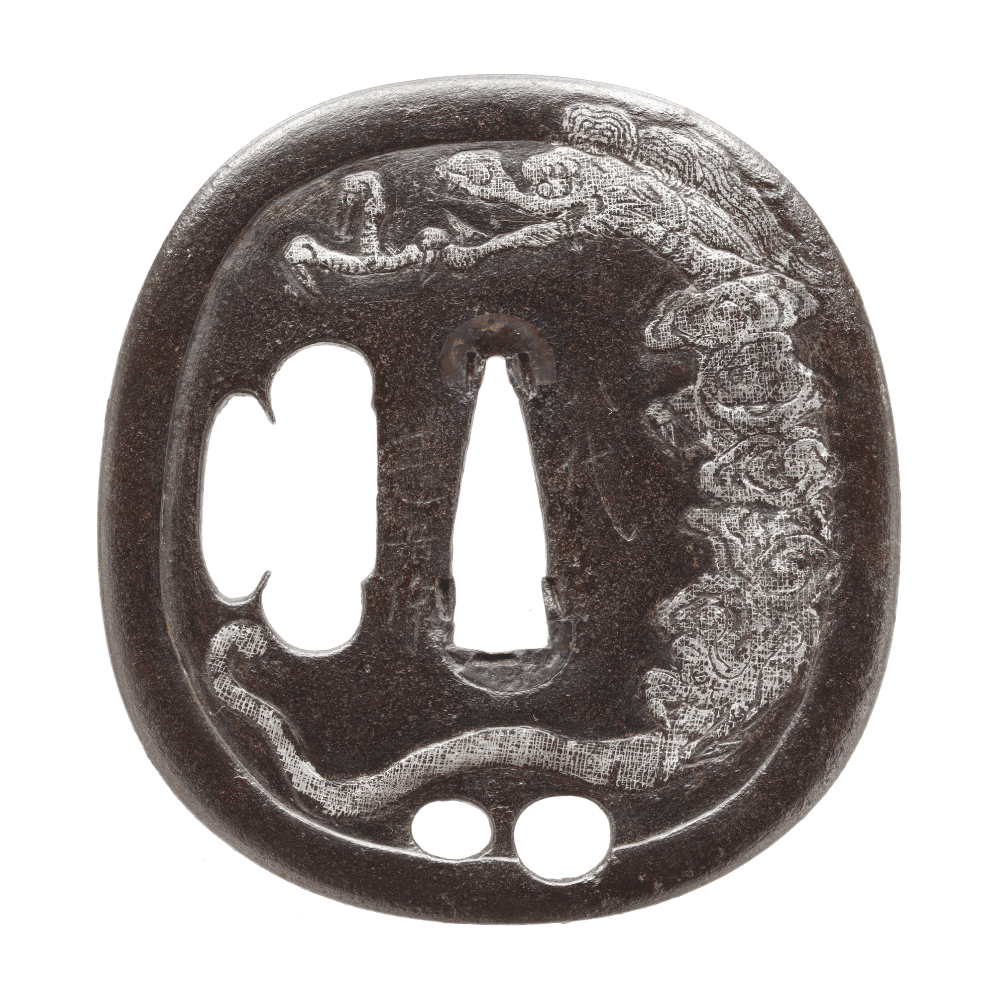
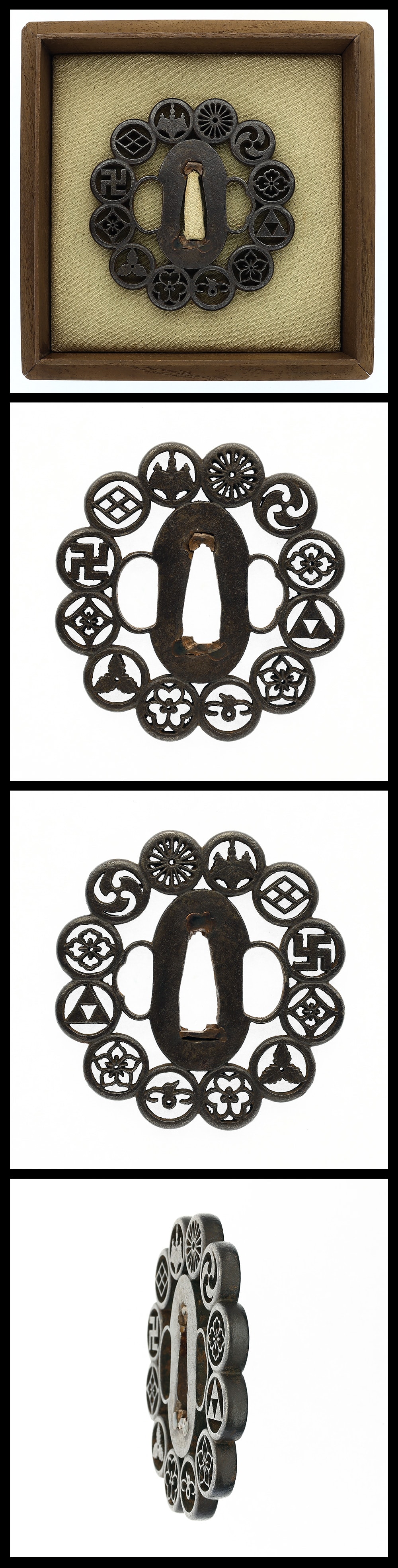
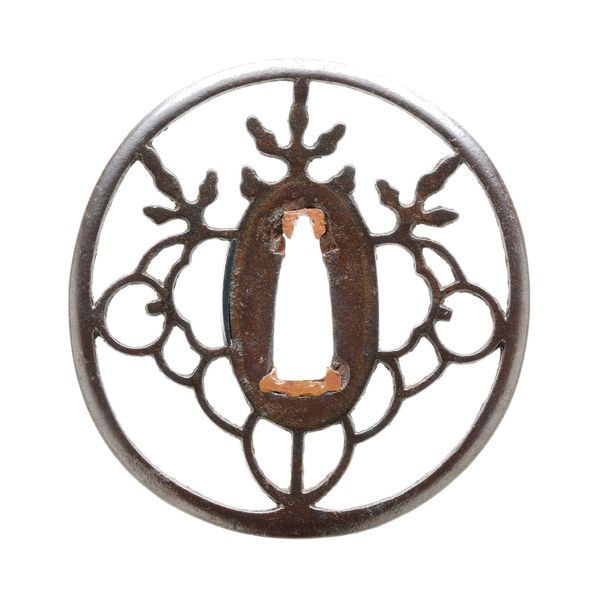
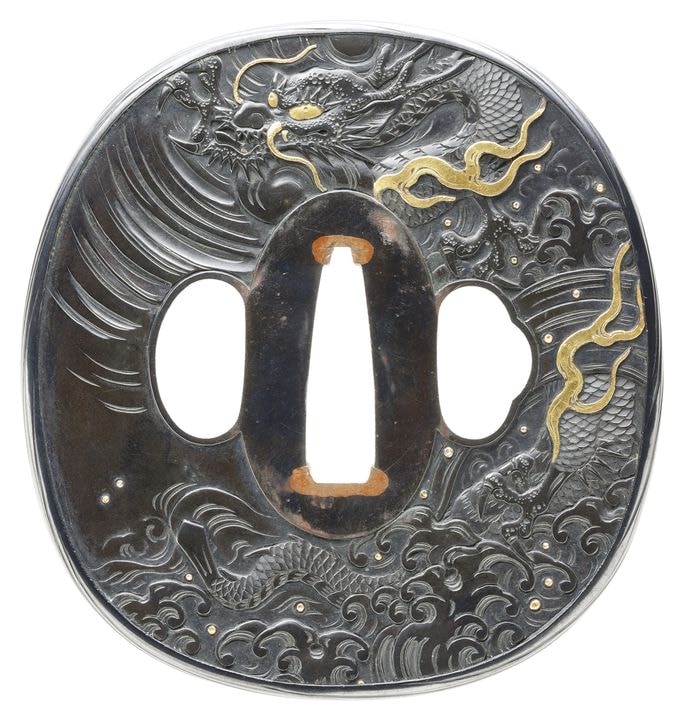
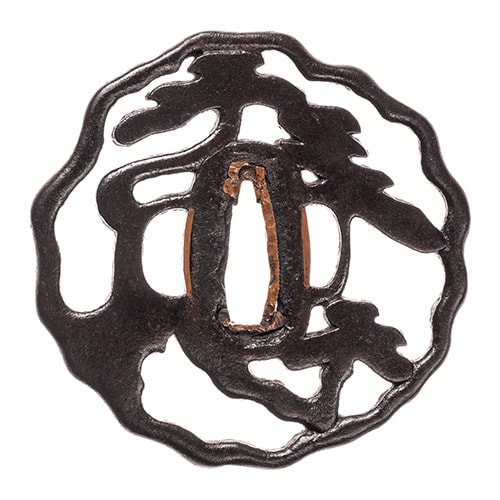
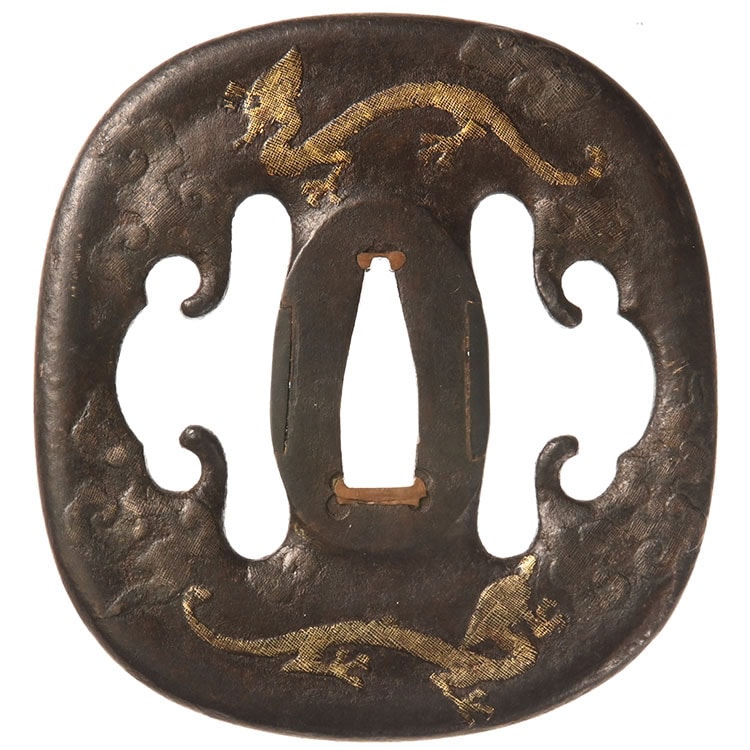
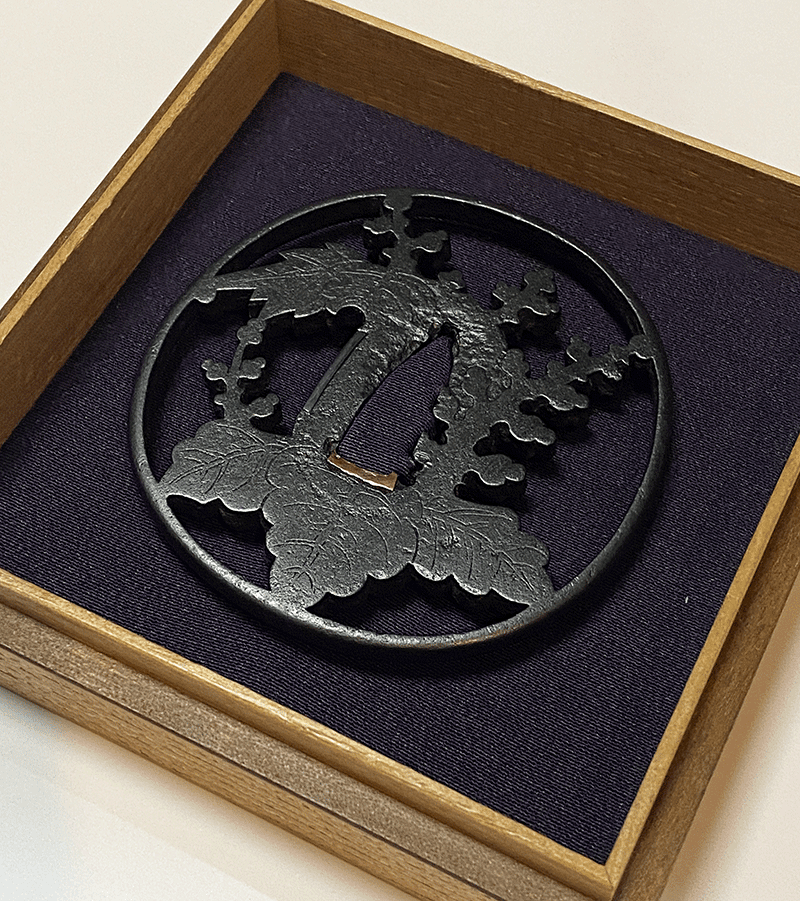
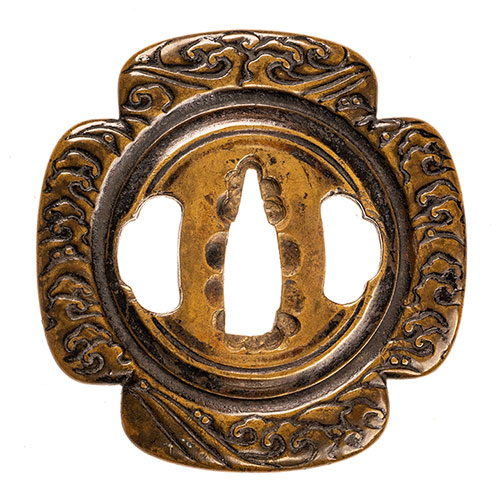
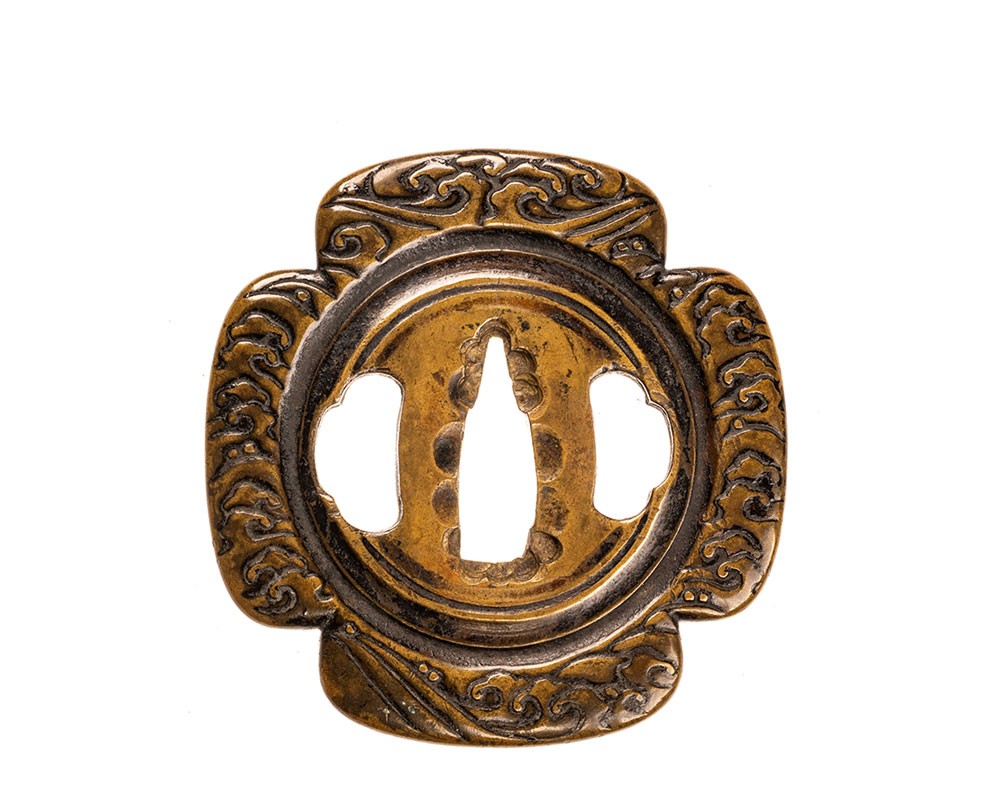
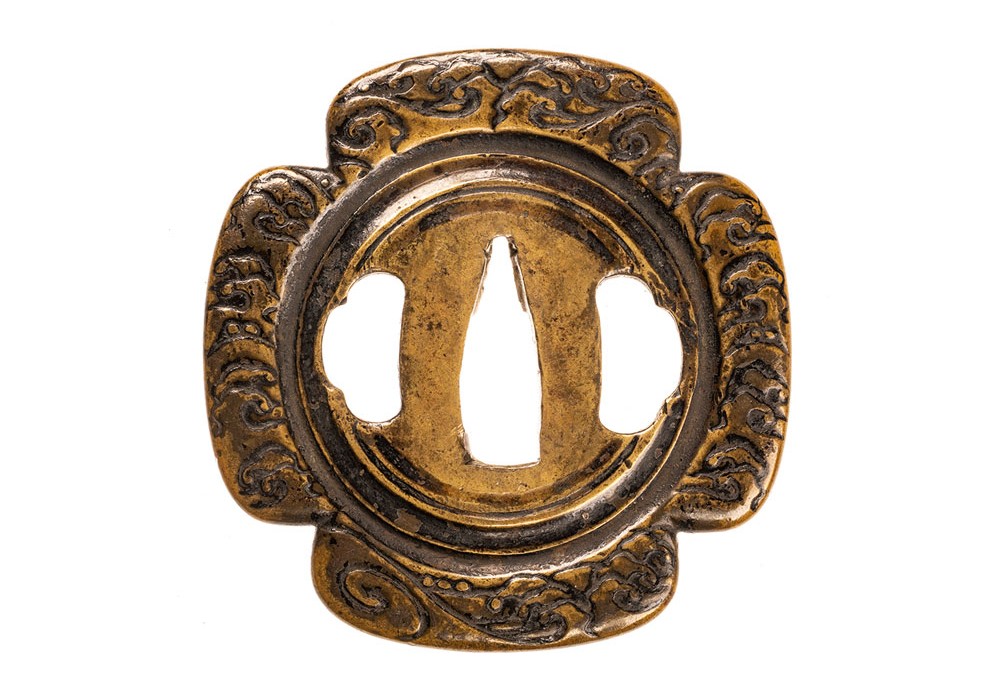
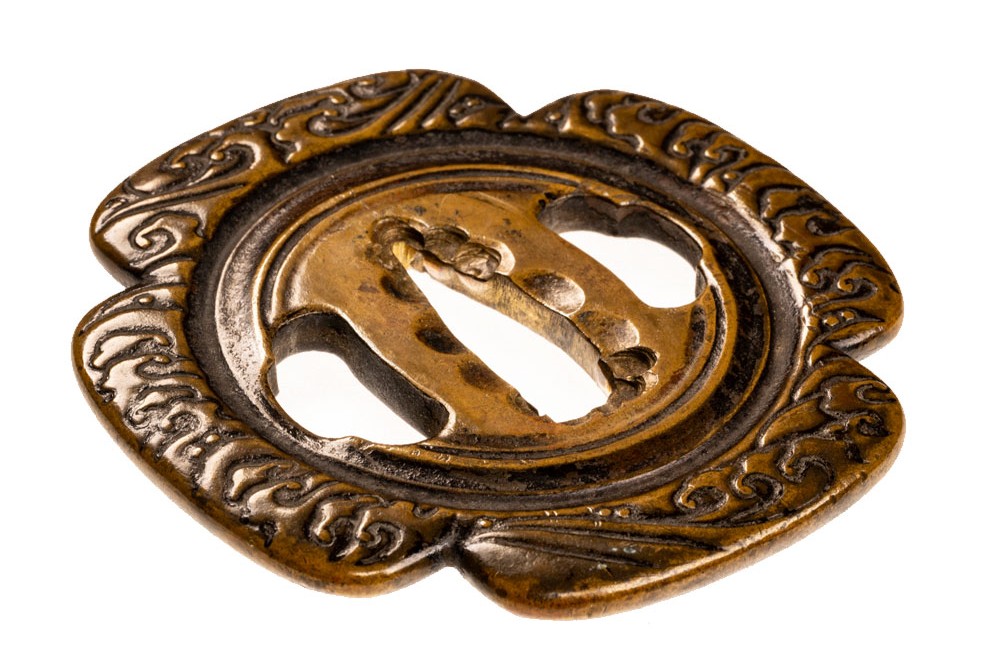
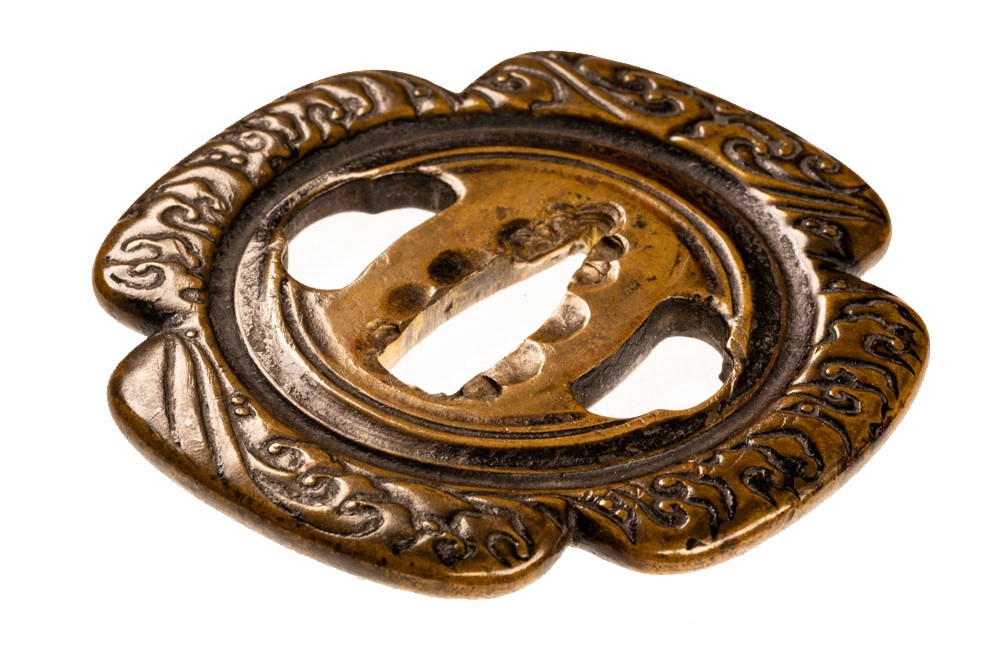
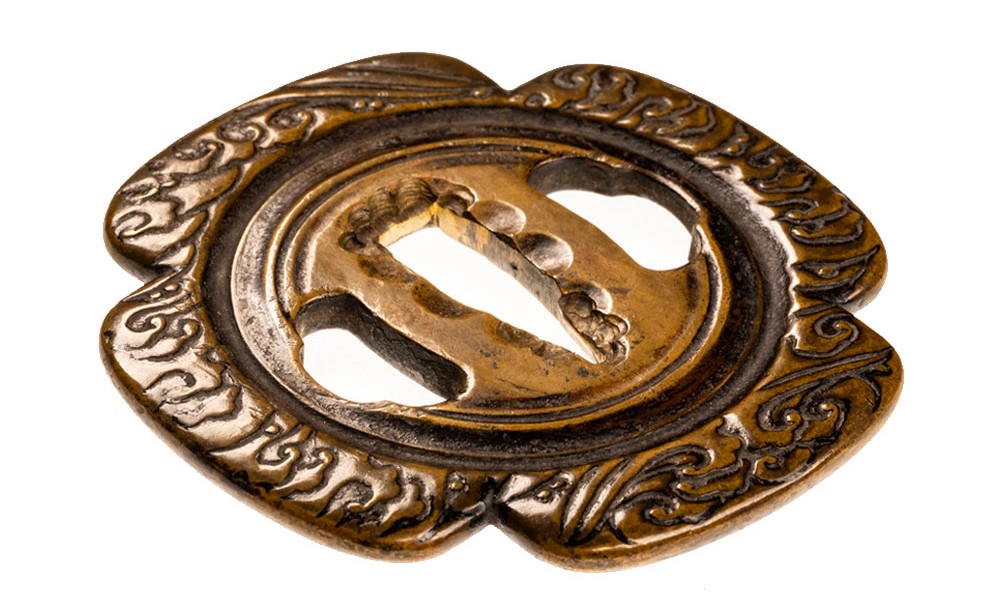
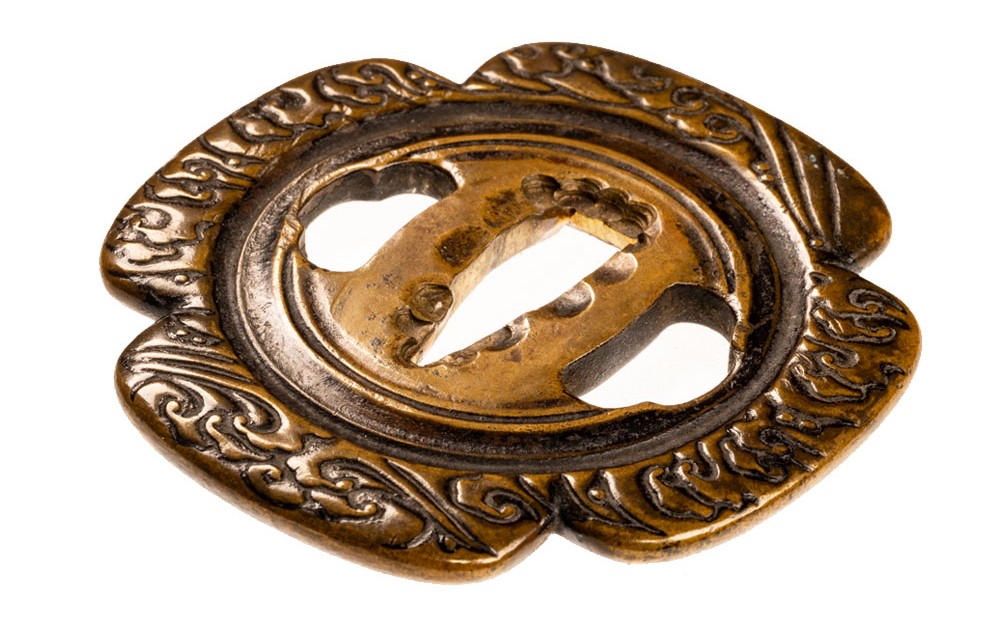
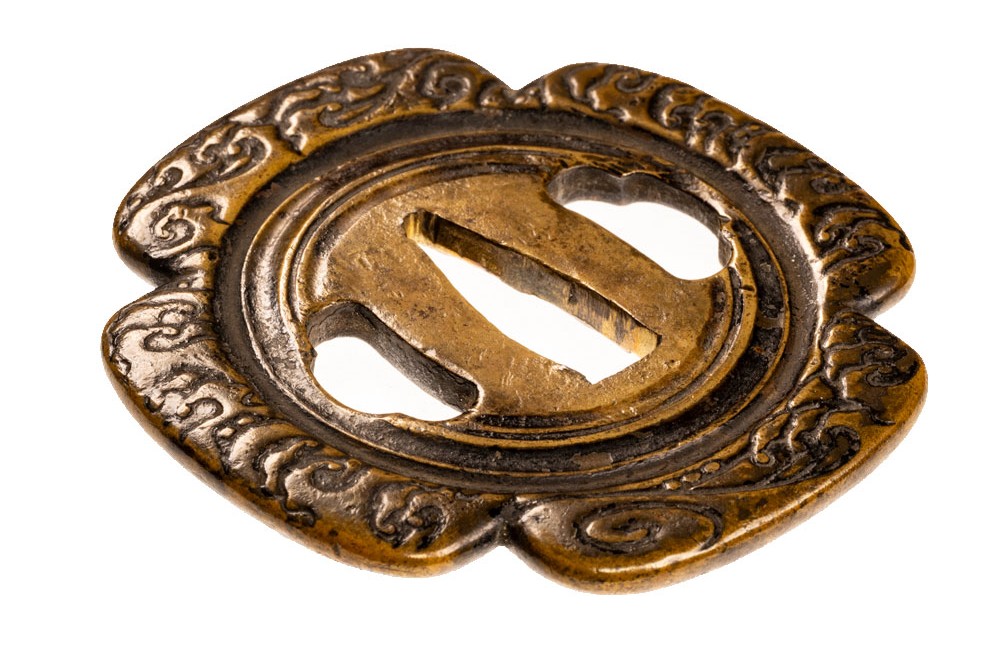
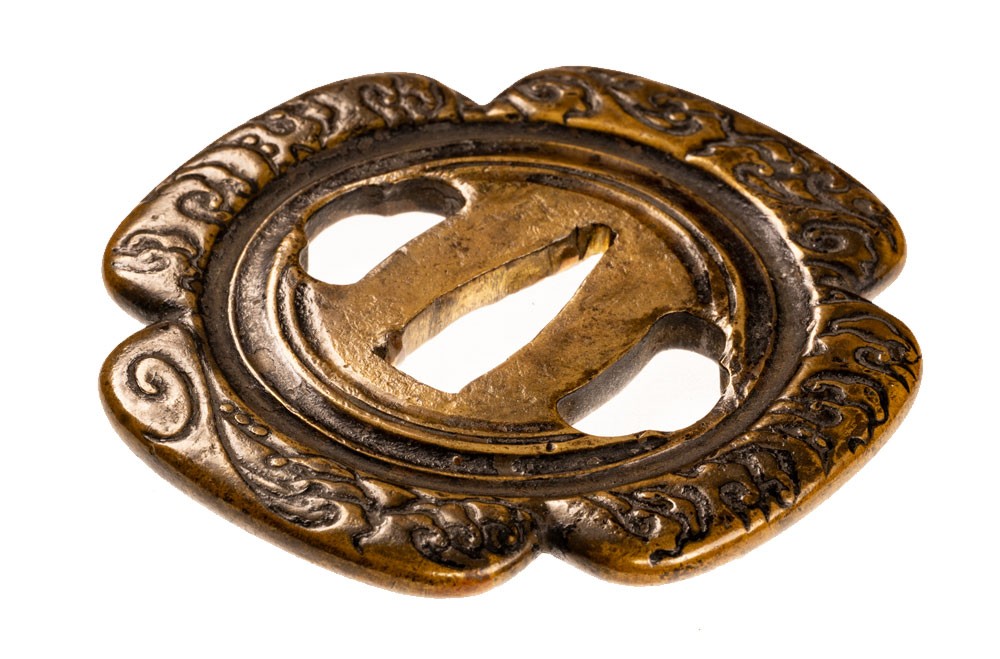
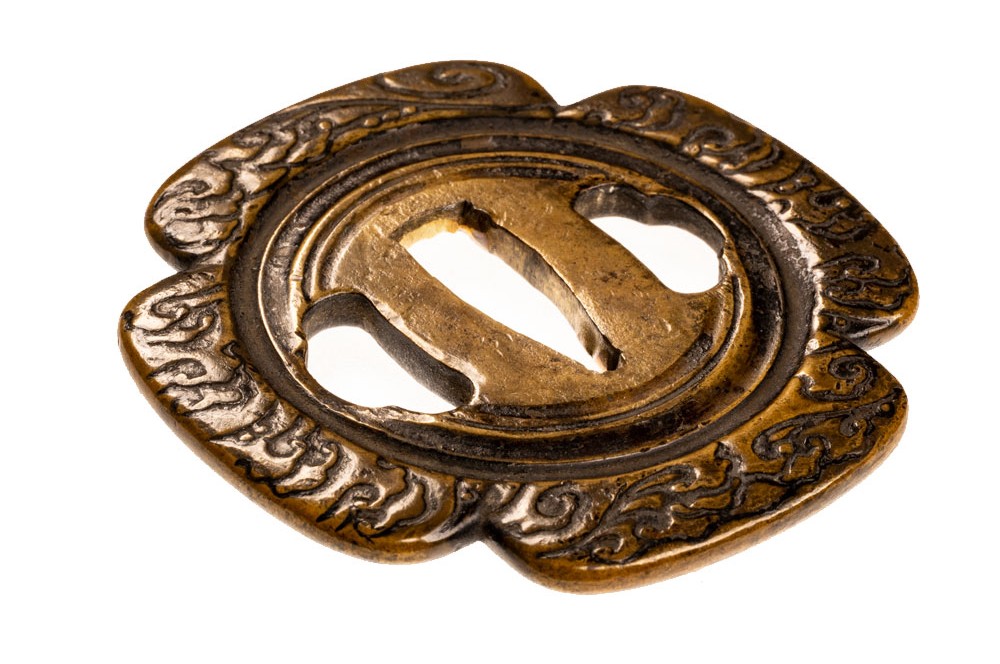
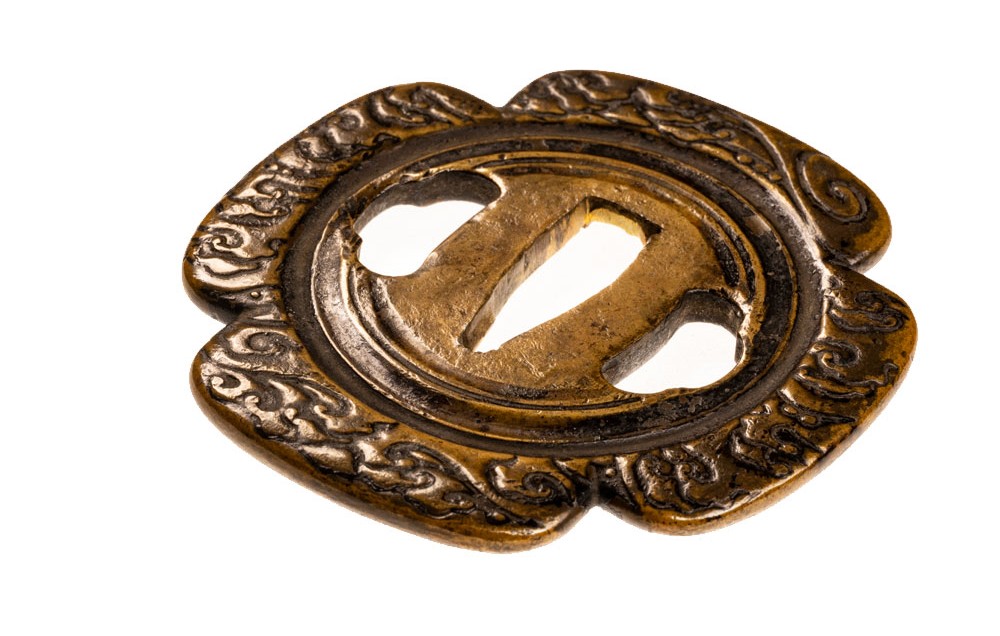
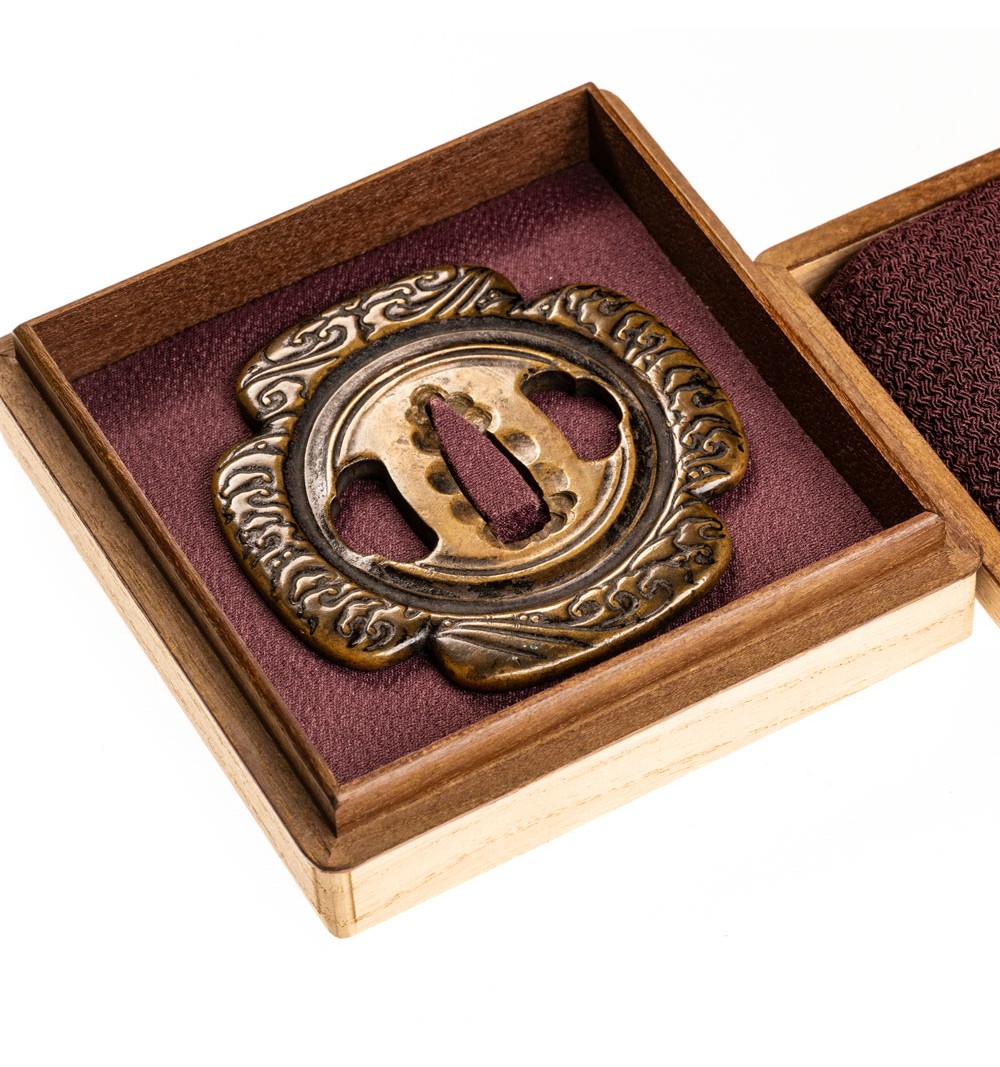
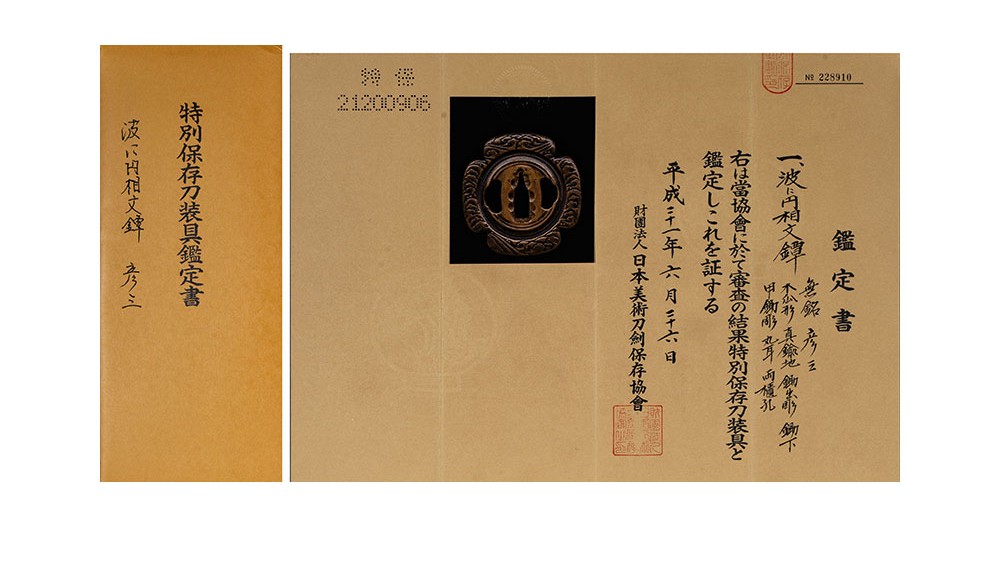
This is a Higo tsuba by Hikozou, the founder of the Hirata school, active in the early Edo period. Crafted from brass in a mokkogata shape, it features sukidashibori and sukisage techniques with a marumimi and ryohitsukou. The design depicts waves and a circular motif, showcasing the distinctive artistry and high aesthetic value characteristic of Higo tosogu.
 NihontoWatch
Hirata · Edo

Higo · Higo
5 pieces on the market now
Hirata Hikozo, founder of the Hirata school of Higo metalworkers, was a craftsman of Shoami lineage who served the celebrated warrior and tea master Hosokawa Sansai in Kyoto. When the Hosokawa domain was transferred, Hikozo accompanied his lord first to Tango and Kokura, and finally down to Kumamoto, where he died in Kan'ei 12 (1635). Under the guidance of Sansai — famed for his command of both martial and cultural refinement — Hikozo developed an aesthetic vision that merged outstanding practical function suited to the warrior's taste with a dignified, elevated artistic quality. From among his followers emerged Shimizu Jingo (his nephew) and Nishigaki Kanshiro; together with Hayashi Matahichi of the Owari lineage, these masters formed what came to be regarded as the four major schools of Higo metalwork. It was Hikozo who established the artistic foundations upon which this entire tradition would rest.
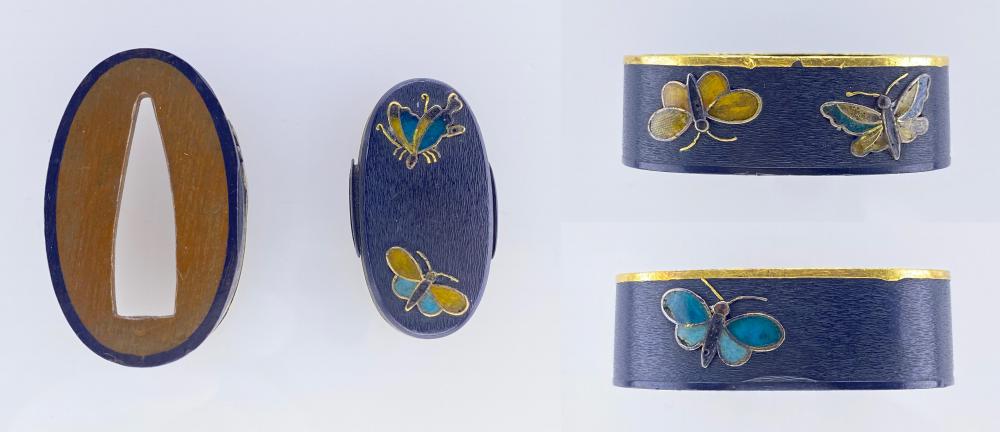
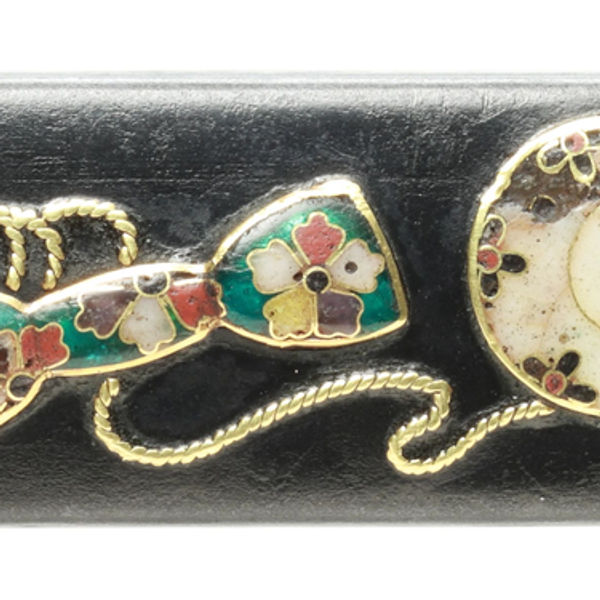
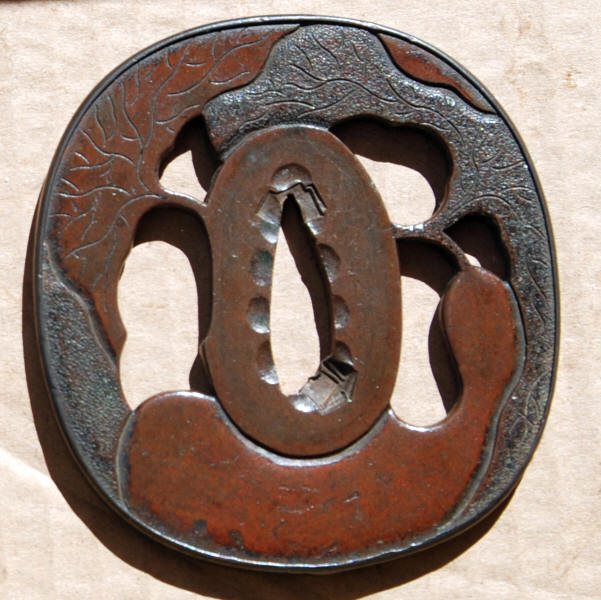
Technically, the Hirata school inherited much of the Shoami tradition. While iron-ground works are also encountered, Hikozo frequently employed irogane such as yamagane, brass, and shakudo, producing the distinctive, richly toned coloration known as "Hikozo-gane." In addition to zogan inlay — including gold keshikomi-zogan, silver-wire inlay, and on rare occasions shippo-zogan (cloisonne inlay) — he heightened decorative elegance by applying characteristic filing treatments such as Amida-yasuri and Okina-yasuri, thereby adding an abundance of refined and courtly taste[[c:1]]. His invention of the Odawara fukurin rim technique became a hallmark of the school, executed in shakudo, brass, shibuichi, or yamagane with a rope-pattern (nawame) finish of dense workmanship. His openwork favored kage-sukashi — shadow or negative silhouettes — rendered with gentle chamfering that contributes to a prevailing softness of impression. Traces of black lacquer often remain upon the ground, producing an exquisite modulation of tone that harmonizes with the underlying metal surface.
What distinguishes Hikozo within the broader Higo tradition is the convergence of plainness and profundity in a single plate. The NBTHK setsumei repeatedly identify in his work a "plain, sincere character" joined to "archaic elegance[[c:3]]," a sensibility "removed from the mundane" that yields results described as "mysterious, esoteric, and subtly profound." His tsuba are praised for expressing the quiet, tranquil beauty of kanjaku and the refined elegance of sabi — qualities rooted in the aesthetic of the Hosokawa school of tea. Through long years, the ground metal acquires a deeper flavor, and a quiet, dignified world is formed within the single plate[[c:2]]. Whether working in bold o-sukashi openwork or restrained enso compositions, Hikozo's pieces are consistently recognized as possessing an ineffable atmosphere: a subdued, moist feeling of finish[[c:4]] in which the high level of technique is fully apparent precisely because the design is so direct and spare.
Where Hikozo stands among comparable artisans: across all of nihontō, and within tradition, era, and period. The tiers (Foremost · Leading · Major · Notable) weigh official designations from the NBTHK and Japan's Agency for Cultural Affairs, together with historical honors of lasting repute such as the Sansaku and Meibutsu-chō.
Select a lens to see how it's measured.
Higo · Higo
10 pieces on the market now
The Hirata school encompasses two distinct but related lineages of Japanese metalworkers bearing the Hirata name, each distinguished by its founder's artistic inheritance and medium. The first is the Hirata school of Higo Province, founded by Hirata Hikozo, a craftsman of Shoami lineage who served the celebrated warrior and tea master Hosokawa Sansai. Having accompanied his lord from Kyoto through Tango and Kokura to Kumamoto, where he died in Kan'ei 12 (1635), Hikozo established the artistic foundations upon which the Higo metalworking tradition would rest -- one of the four major schools of Higo tosogu alongside the Shimizu, Nishigaki, and Hayashi lineages. The second is the Hirata lineage of Edo, founded by Hirata Donin (Hikoshiro), a Kyoto-born craftsman who learned shippo (cloisonne enamel) techniques from Korean artisans during the Momoyama period. Summoned by Tokugawa Ieyasu, Donin relocated to Edo, where the Hirata family received a stipend and served as official artisans retained by the shogunate. The cloisonne methods were transmitted as isshi soden -- a closely guarded, single-heir tradition -- through successive generations, each head bearing the common name Hikoshiro, continuing into the Meiji period when the hereditary techniques were applied to the manufacture of state decorations. The two branches are united by name but diverge sharply in technique and aesthetic. " The school's technical vocabulary includes keshikomi-zogan (flush inlay), Amida-yasuri and Okina-yasuri filing treatments, and the characteristic Odawara fukurin rim executed with a rope-pattern (nawame) finish -- a technique Hikozo invented that became a hallmark of the lineage.
Openwork favored kage-sukashi, shadow silhouettes rendered with gentle chamfering that contributes to a prevailing softness of impression, while traces of black lacquer modulate the ground metal's tone. The Edo lineage, by contrast, specialized in shippo-zogan executed through gold-wire cloisons -- kinsen shippo -- fusing richly saturated enamels onto shakudo migaki-ji grounds. Donin's Mount Fuji compositions, rendered with striking seasonal variation, became the branch's signature subject. By the eighth generation, Harunari expanded beyond hereditary cloisonne into chokin (metal carving), uniting takabori with colored metals in gold, silver, shibuichi, and suaka, and producing works in which transparent, clear enamels replaced the earlier doro-shippo heaped in thicker relief. What distinguishes the Hirata name across both branches is the convergence of technical mastery with an aesthetic of dignified restraint. The NBTHK setsumei repeatedly identify in Hikozo's Higo work a "plain, sincere character" joined to "archaic elegance" -- a sensibility rooted in the kanjaku and sabi of the Hosokawa tea aesthetic, where a quiet, tranquil beauty forms within the single plate. Donin's Momoyama-era cloisonne, for all its sumptuous coloring, is consistently characterized as possessing "antique elegance and dignified restraint," with hues praised for their profound beauty beneath the surface opulence. " Whether expressed through the moist, iron-ground austerity of Higo or the jewel-like luminescence of Edo cloisonne, the Hirata tradition represents a sustained dialogue between technical refinement and expressive restraint -- a lineage in which the highest technique reveals itself precisely through the directness and spare elegance of the design. Learn more →
| Smith | Era | Designated |
|---|---|---|
| Hikozo彦三 | — | 49 |
| Shozaburo小三郎 | — | 0 |
| Hikozo彦三 | — | 0 |
A Hozon-certified fitting of notably superior craftsmanship and condition, often with signature or workmanship of high reference value.
The NBTHK (Nihon Bijutsu Tōken Hozon Kyōkai, the Society for the Preservation of Japanese Art Swords) is a public-interest incorporated foundation founded in 1948 and supervised by Japan’s Agency for Cultural Affairs (Bunkachō); it is based at the Japanese Sword Museum in Tokyo. Its expert panels physically examine each submitted work (shinsa) and issue a certificate (kanteishō) ranking it by artistic and historical merit. NBTHK papers are the most widely recognized standard of authentication for Japanese swords and fittings.
NBTHK official siteReturns/exchanges/cancellations not accepted after shipment except for significant defects; if defective, return/exchange possible within 3 days of arrival (return shipping paid by customer).
¥7,000,000