Edo was the sword’s age of connoisseurship: the Hon’ami appraisers, the shogunal register of famous blades of 1719, and a thriving literature turned the sword into an object of study even as it ceased to be drawn in war.
 NihontoWatchNihontoWatch
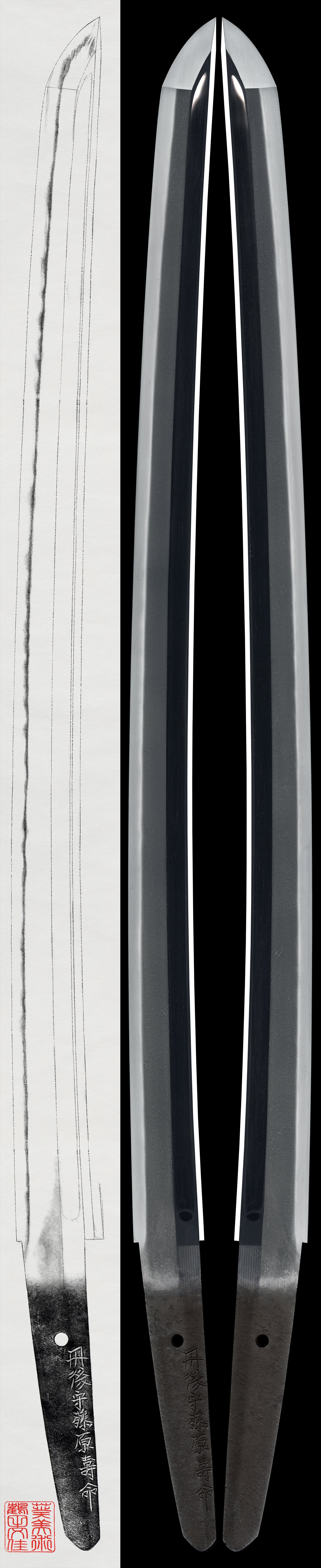
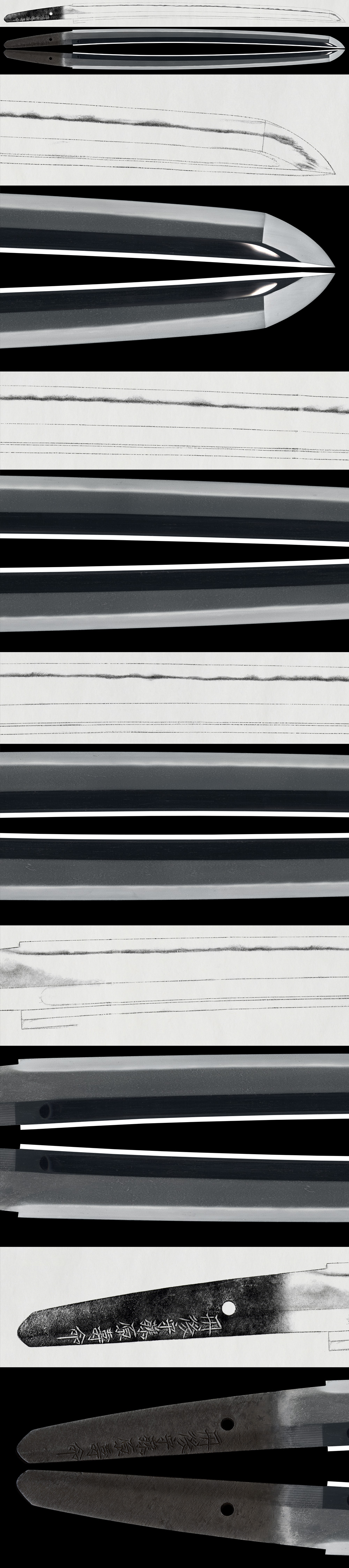
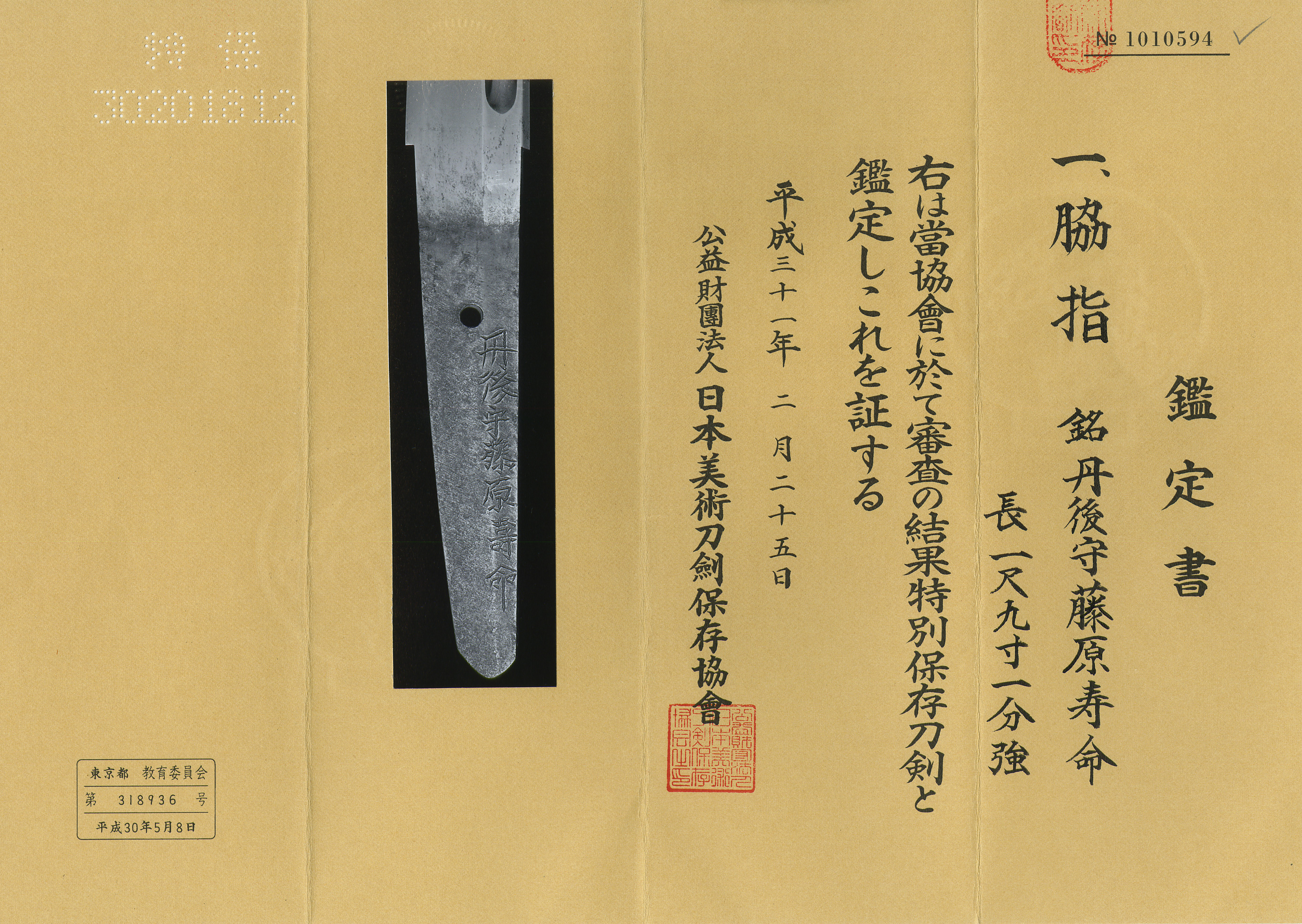
Ordering number:24379Wakizashi: Shirasaya with Koshirae (NBTHK Tokubetsu Hozon Token) (Consignment Sale)Signature: Tanba Kami Fujiwara Jumyo丹波守藤原寿命We divide 4 sections for each sword as Saijyo Saku, Jyojyo Saku, Jyo Saku, and Regular Saku.This sword is ranked as Jyojyo Saku for works by Tanba no Kami Fujiwara Jumyo.Polished.Habaki: Double habaki made of copper and silver with engraved patterns.Blade Length: 57.9 cm (22.80 in)Curvature: 0.8 cm (0.31 in)Mekugi Hole: 1Width at Base: 3.41 cm (1.34 in)Width at Tip: 2.46 cm (0.97 in)Thickness: 0.71 cm (0.28 in)Sword Weight: 635 g (1.40 lbs)Era: Around the Kanei era of the Edo periodShape: Wide body with thick kasane and wide kissaki, with bohi on both sides.Jigane: Fine koitame hada, well-forged, and high-quality jigane.Hamon: Nie-deki suguha with frequent ko-ashi. The boshi is rounded and returns.Features: Tanba no Kami Fujiwara Jumyo is a rare swordsmith. This piece has beautiful jigane and a well-crafted suguha hamon with many ko-ashi.Aoi Art’s Comment: Known as Kondo Goro, he resided in Todamachi, Owari province.The sword is in good condition with a few remaining initial cuts, indicating its robustness.It is said that Jumei made many swords because "Jumei" signifies longevity, making it a popular gift item. Considering the average lifespan of about 40 years in Japan at the time, the idea of extended life must have been greatly appreciated. This is a solid and well-made piece with a thick and sturdy nakago, highly recommended.Koshirae:Tsuba: Circular tsuba with tomoe sukashi design.Fuchi: Shakudo nanako-ji with gold dragon design.Kashira: Horn.Menuki: Copper with high-relief dragon.Saya: Black lacquered saya with some cracks in the lacquer.NBTHK Tokubetsu Hozon TokenAoi Art estimation paperWhole Oshigata*Please note: The price does not include shipping fees.Price:450,000 JPYOrder FormRelated Items:Wakizashi:Tanba no Kami Yoshimichi (Osaka 3rd) (NBTHK Hozon Token)Wakizashi:Dewa Daijo Fujiwara Kunimichi(NBTHK Tokubetsu H
Certificate reading — 銘 丹後守藤原寿命
NihontoWatchJumyo壽命
Offered by Aoi Art
This piece has sold
Get an email when a new Jumyo piece hits the market.



Mino-den · Owari · around 1681-1684
Tōken Taikan top 91%
Mino-den · Mino
9 pieces on the market now
The Edo period (1615 to 1868)
Edo was the sword’s age of connoisseurship: the Hon’ami appraisers, the shogunal register of famous blades of 1719, and a thriving literature turned the sword into an object of study even as it ceased to be drawn in war.
A Hozon-certified blade judged to show notably superior workmanship and a better state of preservation. The bar is higher: re-tempered blades and most unsigned Muromachi/Edo works are excluded.
The NBTHK (Nihon Bijutsu Tōken Hozon Kyōkai, the Society for the Preservation of Japanese Art Swords) is a public-interest incorporated foundation founded in 1948 and supervised by Japan’s Agency for Cultural Affairs (Bunkachō); it is based at the Japanese Sword Museum in Tokyo. Its expert panels physically examine each submitted work (shinsa) and issue a certificate (kanteishō) ranking it by artistic and historical merit. NBTHK papers are the most widely recognized standard of authentication for Japanese swords and fittings.
NBTHK official siteIf you wish to return an item, please notify us within 3 days of receipt. After this period we cannot accept cancellations. Please ship the return to us within 5 business days. Cancellation is conditional on the item being kept in the same condition as at the time of sale, so please handle it with care.