Mino was founded, tradition holds, by immigrants: Kaneuji of the Yamato Tegai line settled at Shizu to work in the new Sōshū manner, so persuasively that later appraisers judged his best blades the closest of any to Masamune.
 NihontoWatchNihontoWatch
やや俯き心の体配 加州景光 加賀景光について 銘鑑では南北朝期の延文頃(1356年頃)より、康暦、応永、文明、永正と続き、江戸時代前期の寛文頃までその名跡は続きます。 真景系で、友重弟。吉井物を思わせる小互の目を焼く。 古来より加州景光の位は高く、北条氏照が伊達政宗に贈った刀も加州景光だったと云われています。 これぞ古名刀 折れず曲らず良く切れる、実用性を兼ね備えた「美」 銘の正真関係なく「本物」の刀 江戸時代までの一般的な目利きとは、刀剣そのものがもつ切れ味等を見極めることが目利きでした。その実験に試し斬りの列位も作られ、業物列位で刀工がランキングされております。 美術品となったのも戦後です。 GHQの刀狩りで武器として没収されるの阻止するために価値観の変化が非常に強くなったと思われ、それは刀剣の保存の目的では致し方ありません。 しかし「本物」はただの美ではないことを強調したく書かせていただきました。 本物の価値がわかる方、是非大切にご所有くださいませ。 本物には、歴史、業、美、強さ、全てが詰まっています。 銘が正真であろうと、折れてしまったり、曲りやすい刀はどうなのでしょうか。 折れず曲らず良く切れる この機能を兼ね備えた「本物」の刀剣をお求めの方におすすめする一振りでございます。 商品の状態 *刃切れ・刃絡み・目立った刃こぼれ・曲がり・撓え・膨れ・匂い切れ・駆け出しなどございません。 *時代による、汚れ、細かな擦れ傷,劣化等はご了承ください。写真を参考にしてください。 ハバキは古い銀着せですが、一部破れ後有り、銀蒔絵で簡易補修しています。
NihontoWatchOffered by Yazawa Shokai
This piece has sold
21 on the market
Get an email when a new Kaga Kagemitsu piece hits the market.

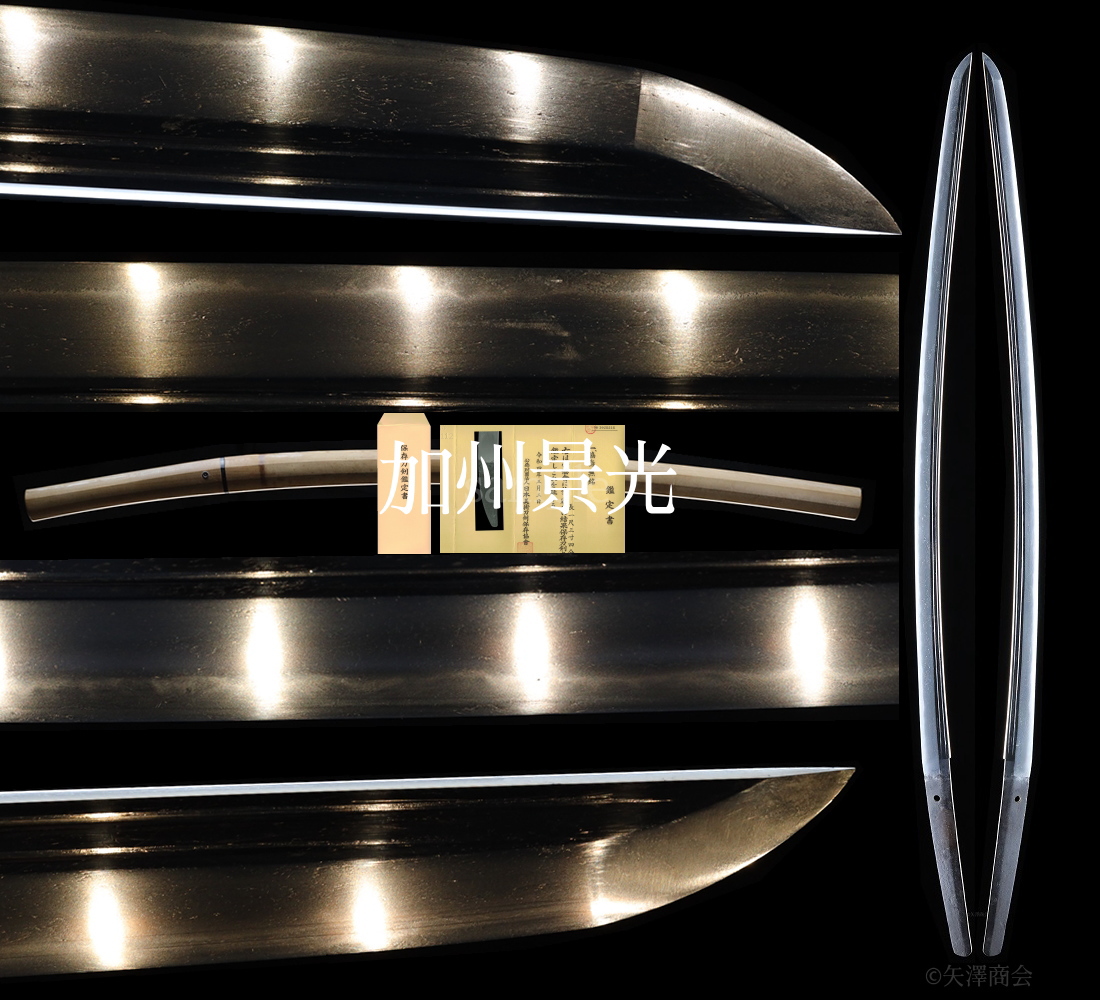



As written by the shop
Mino-den · Kaga · around 1362-1368
Tōken Taikan top 37%
Where Kagemitsu stands among comparable artisans: across all of nihontō, and within tradition, era, and period. The tiers (Foremost · Leading · Major · Notable) weigh official designations from the NBTHK and Japan's Agency for Cultural Affairs, together with historical honors of lasting repute such as the Sansaku and Meibutsu-chō.
Select a lens to see how it's measured.
Mino-den · Kaga
21 pieces on the market now
The Kaga inlay tradition (Kaga zōgan) emerged in Kaga Province during the early Edo period, centered on the castle town of Kanazawa under the patronage of the Maeda clan. This distinctive form of hira-zōgan is said to have developed when craftsmen specializing in stirrup decoration (abumi-shi) adapted their metalworking techniques to tsuba and other sword fittings, flourishing from the early seventeenth century through the Kyōhō era (1716–1736). Working against polished grounds of shakudō, shibuichi, or occasionally refined copper (suaka), these artisans created works characterized by their compositional sophistication and technical precision, establishing a regional aesthetic that would influence later generations of metalworkers. The hallmark of Kaga workmanship lies in its masterful deployment of multiple colored metals—gold, silver, copper, shakudō, and shibuichi—inlaid in flat relief against dark, highly polished grounds. Motifs range from naturalistic subjects such as autumn grasses, butterflies, and mandarin ducks beneath willows to more formal designs including paulownia crests and brocade wrappers, all rendered with meticulous kebori line engraving that adds refinement to the broader inlay work.
The compositions typically extend across the entire surface of the guard, creating an effect of visual richness and decorative abundance. Against jet-black shakudō or the warm tonality of suaka, the multicolored inlays achieve a luminous clarity, producing works of elegant splendor (fūryū) that balance technical virtuosity with restrained taste. The tradition's influence extended beyond its geographic center, with works attributed to Kaga methods appearing in collections throughout Japan. Large-scale presentation pieces demonstrate the school's capacity for ambitious design, while the consistent quality of execution across surviving examples suggests a well-established workshop system with shared technical standards. Though individual makers within the tradition rarely signed their work, the distinctive aesthetic—characterized by full-surface compositions, polished dark grounds, and precise multicolor inlay—remains immediately recognizable, preserving the legacy of Kanazawa's metalworking excellence through the Edo period. Learn more →
| Smith | Era | Designated |
|---|---|---|
| Sanekage真景 | 1362-1368 | 47 |
| Takahira高平 | 1621-1644 | 9 |
| Kagemitsu景光 | 1362-1368 | 4 |
| Ietsugu家次 | 1528-1558 | 2 |
| Kagehira景平 | 1661-1673 | 1 |
Mino in the Nanbokuchō period
Mino was founded, tradition holds, by immigrants: Kaneuji of the Yamato Tegai line settled at Shizu to work in the new Sōshū manner, so persuasively that later appraisers judged his best blades the closest of any to Masamune.
Certifies a genuine blade worth preserving: a signature confirmed correct, or, if unsigned, an era, province, and school that the NBTHK can reliably identify.
The NBTHK (Nihon Bijutsu Tōken Hozon Kyōkai, the Society for the Preservation of Japanese Art Swords) is a public-interest incorporated foundation founded in 1948 and supervised by Japan’s Agency for Cultural Affairs (Bunkachō); it is based at the Japanese Sword Museum in Tokyo. Its expert panels physically examine each submitted work (shinsa) and issue a certificate (kanteishō) ranking it by artistic and historical merit. NBTHK papers are the most widely recognized standard of authentication for Japanese swords and fittings.
NBTHK official site