 NihontoWatchNihontoWatch
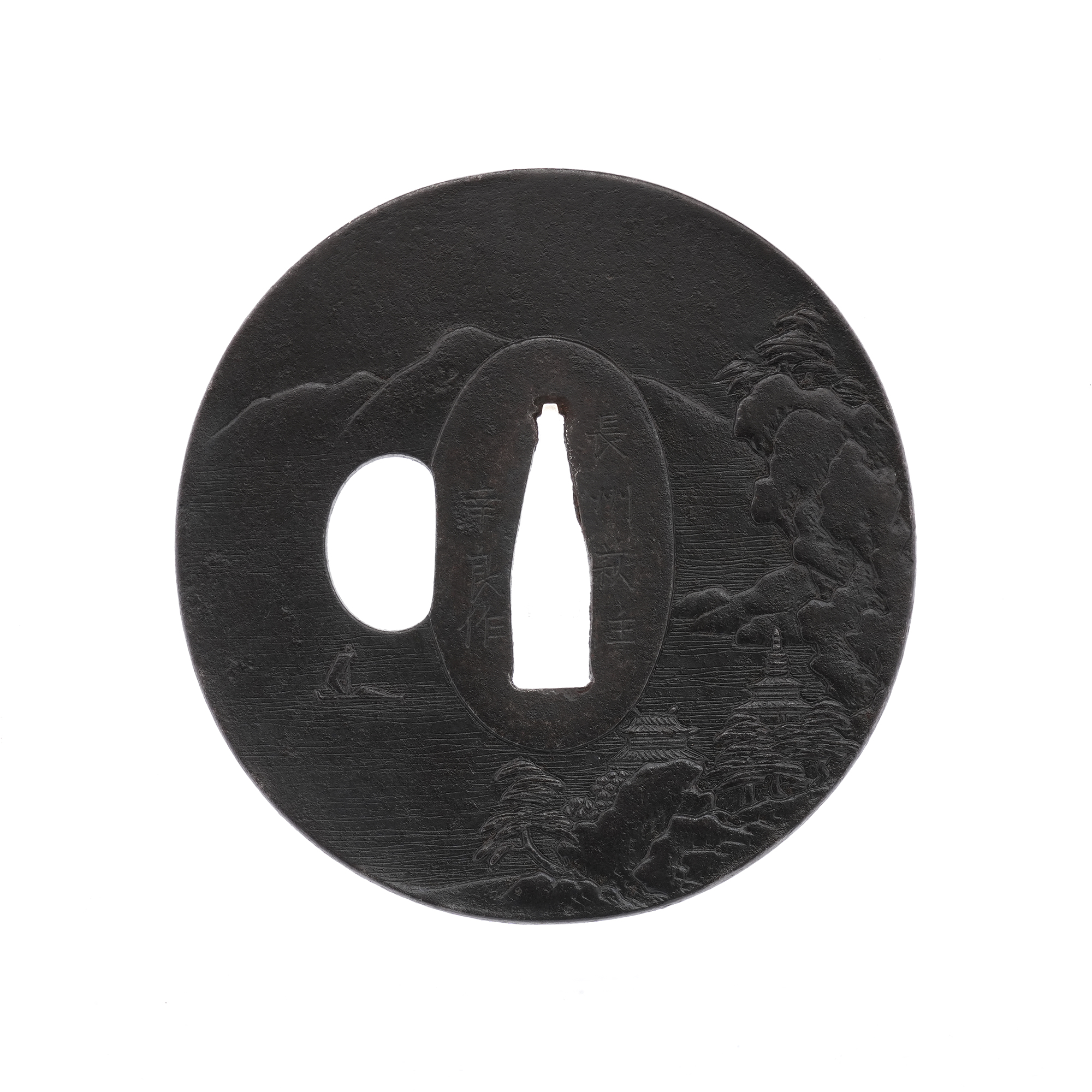
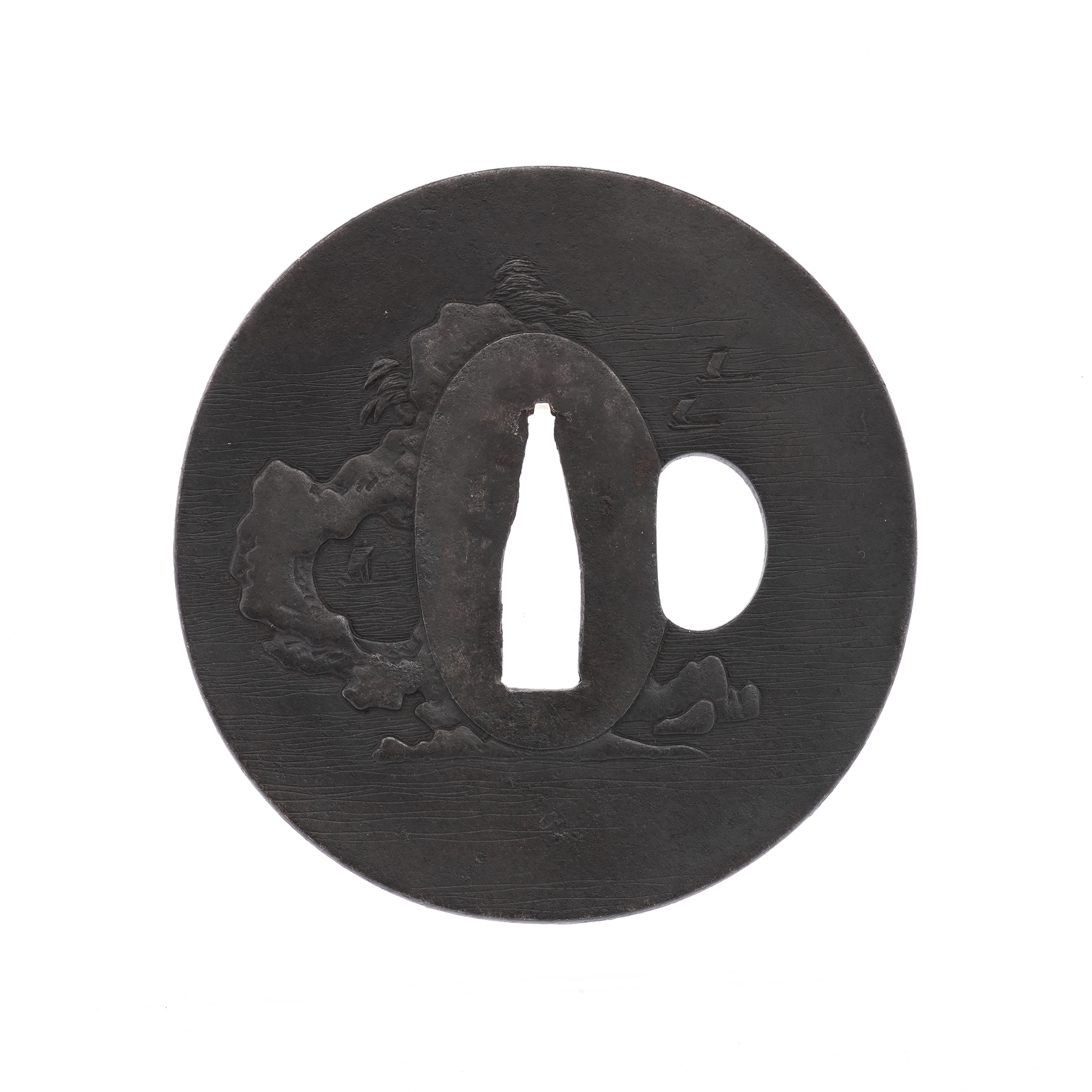
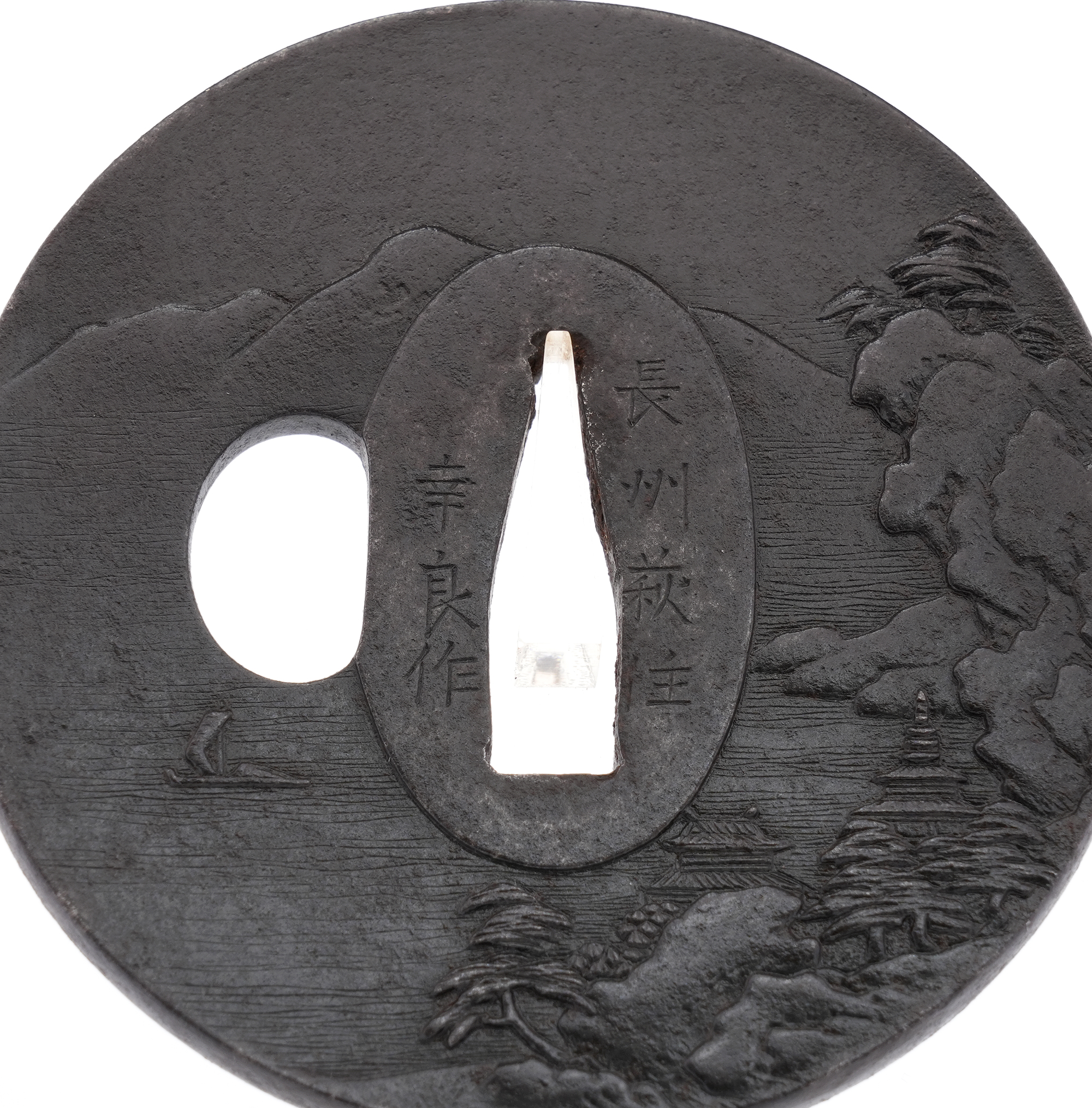
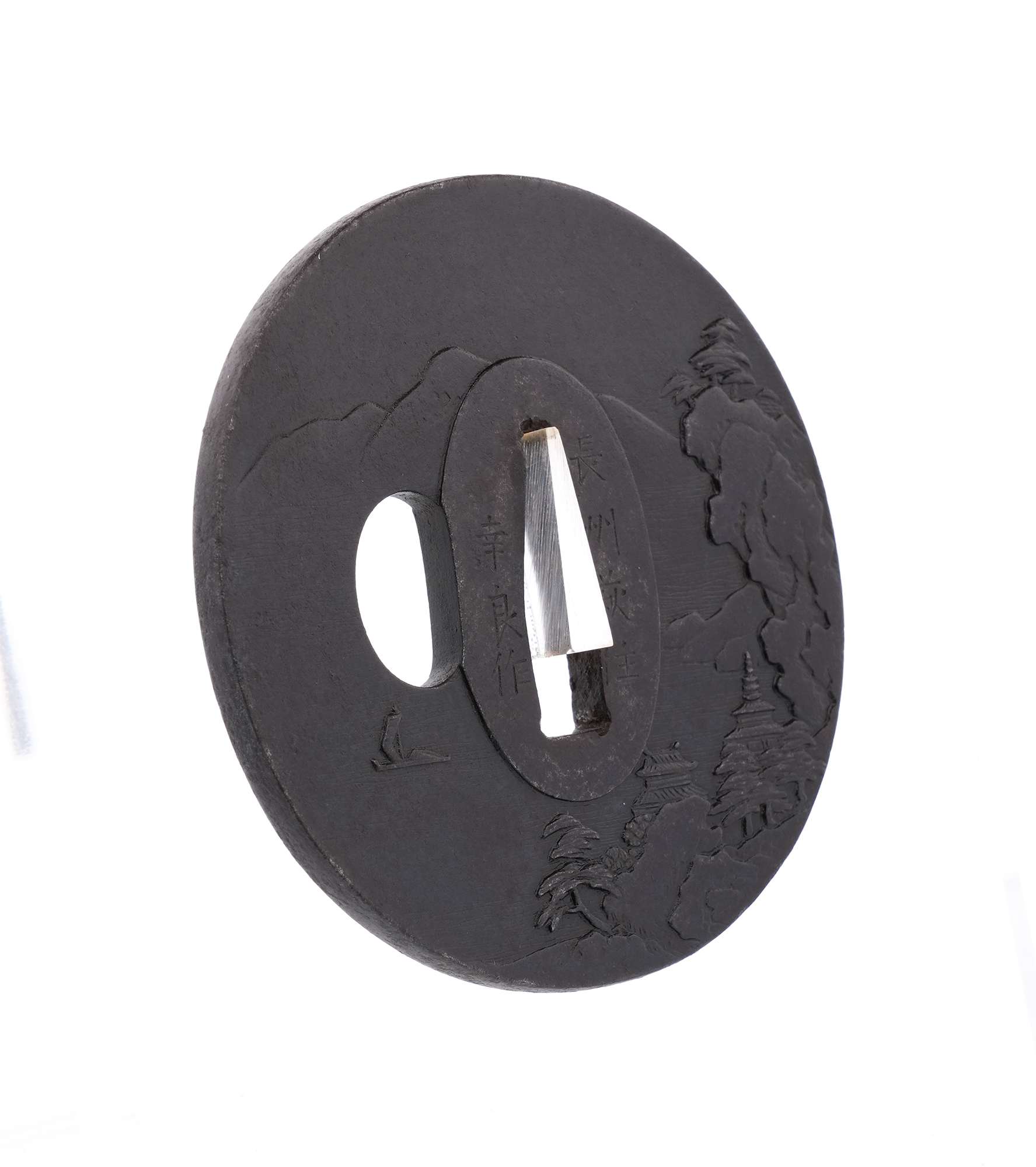
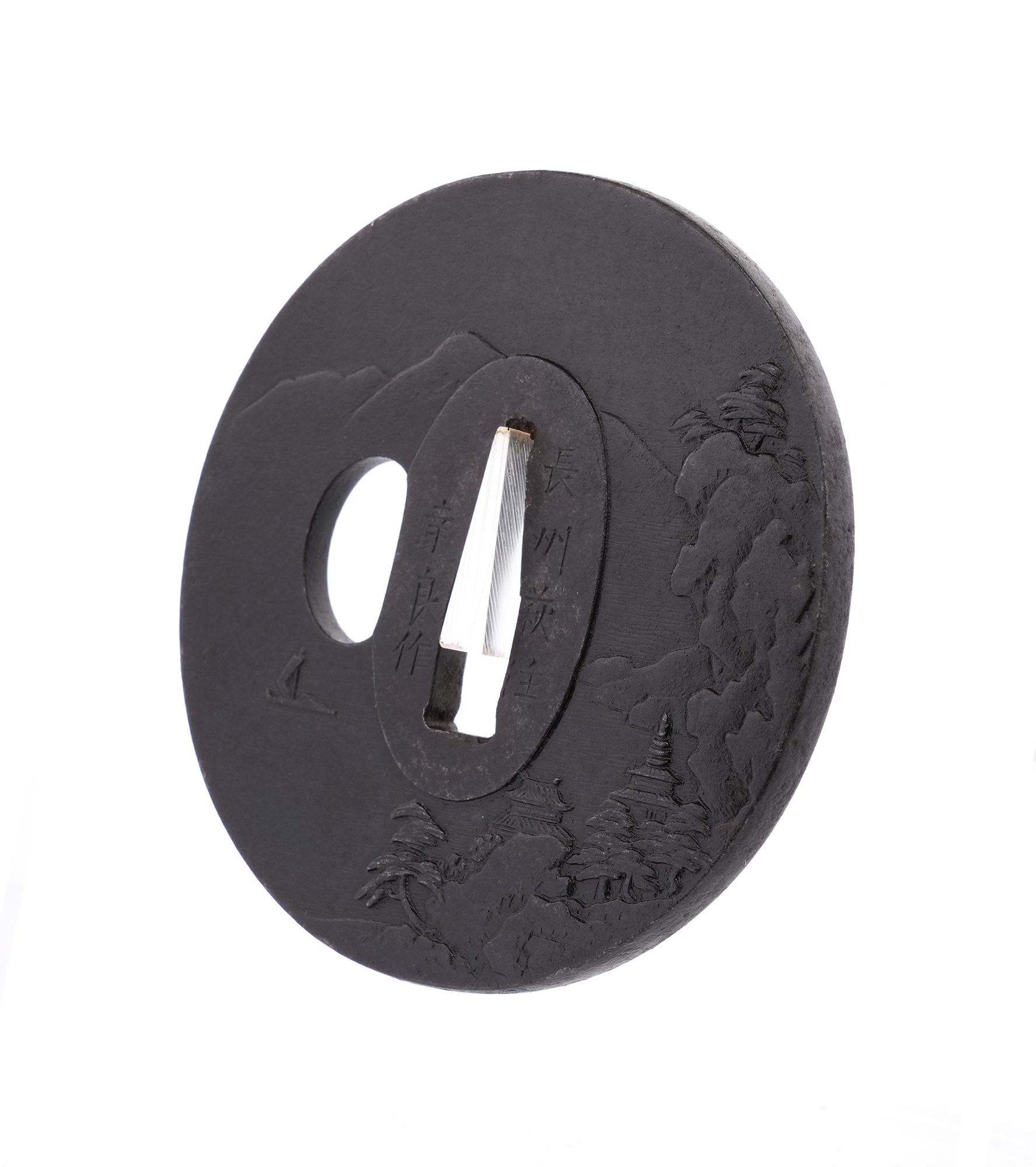
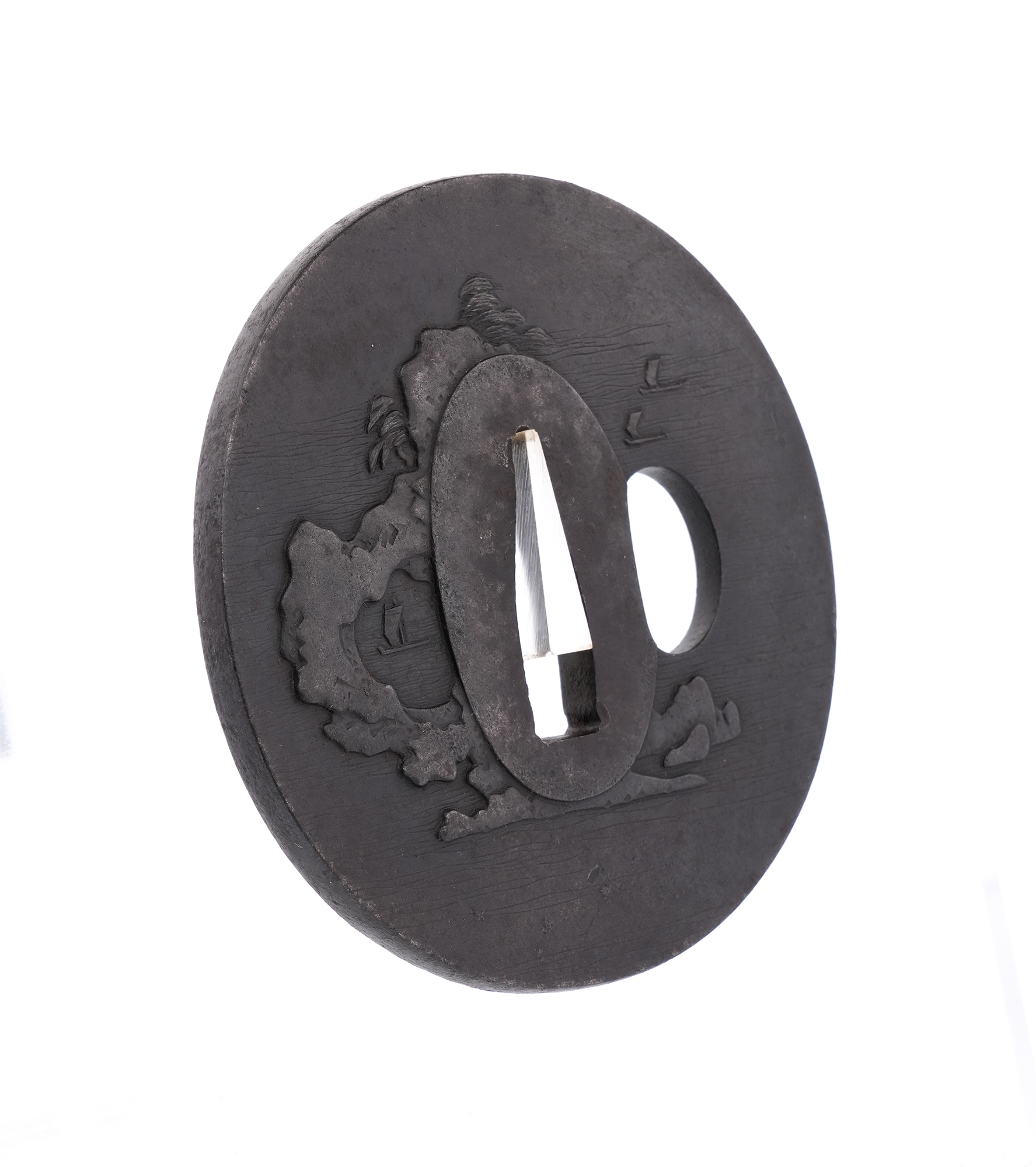
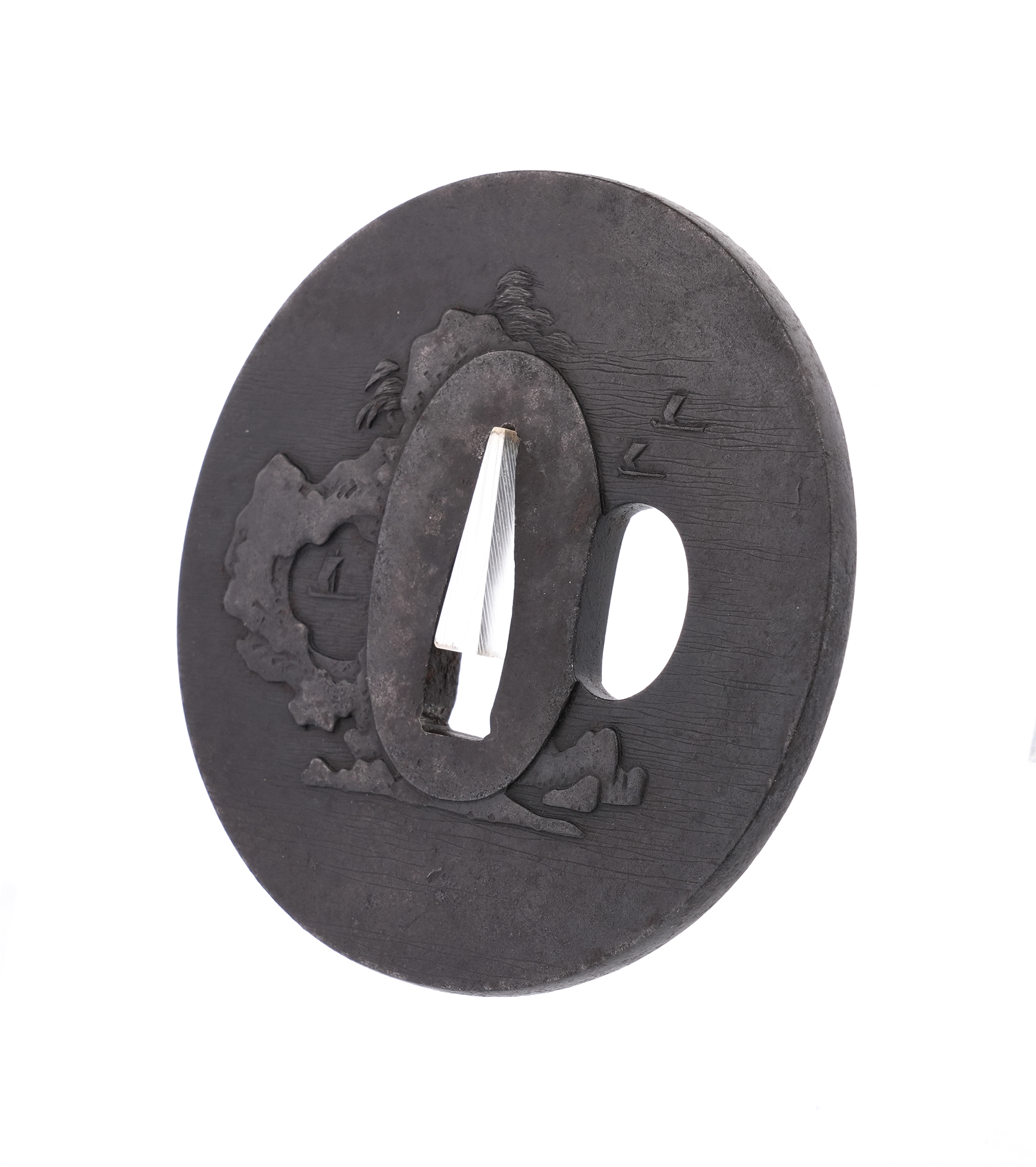
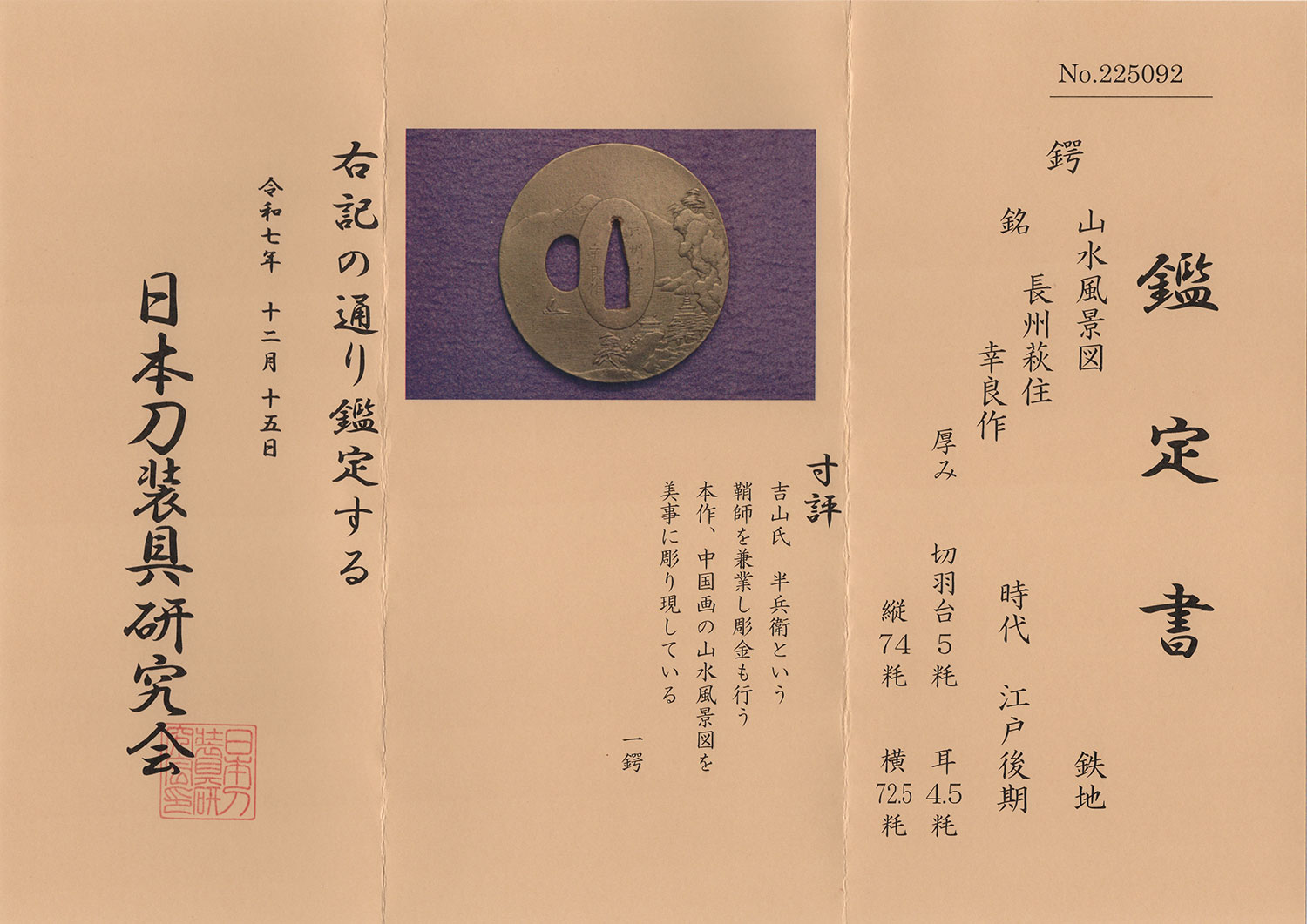
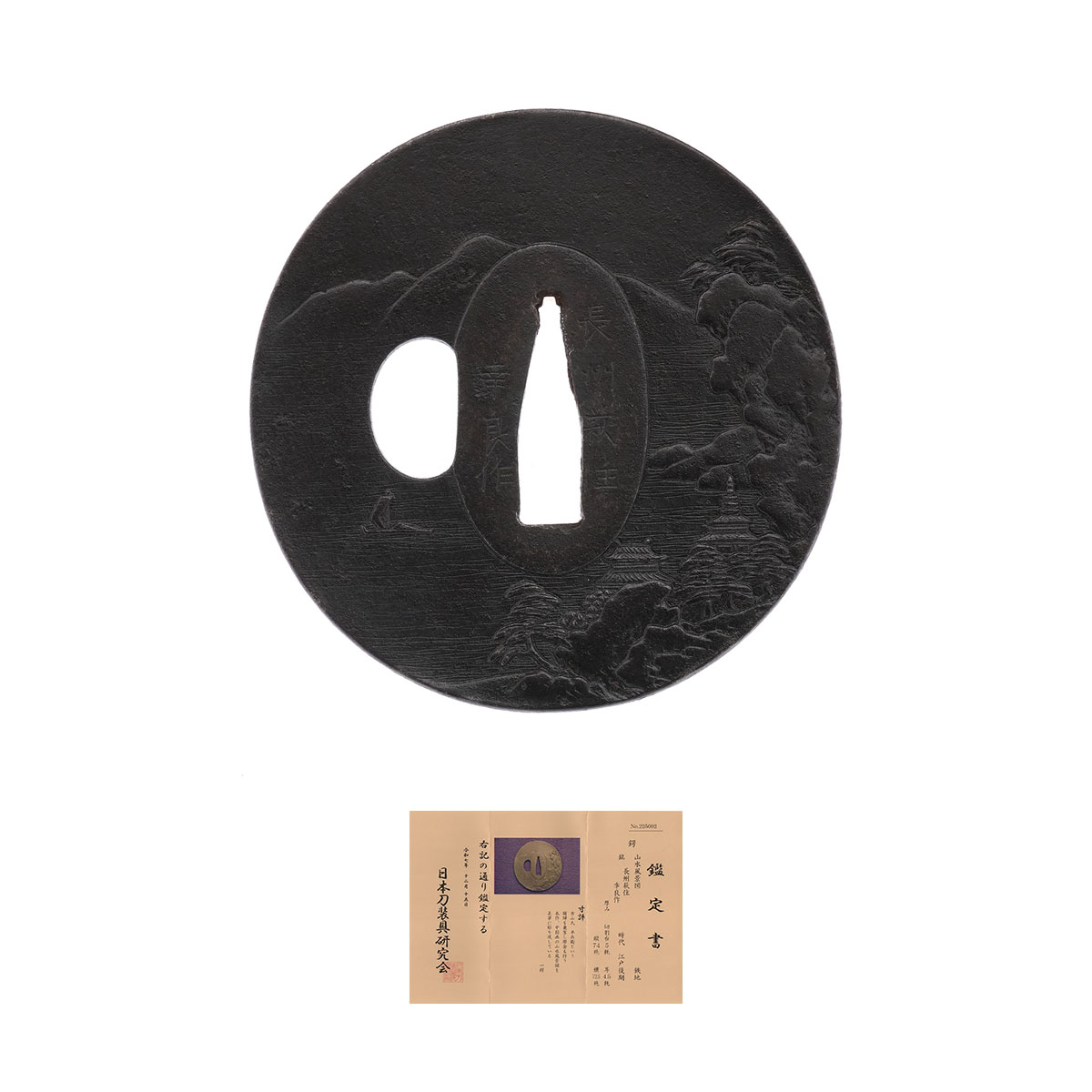
Choshu tsuba were a major trend where many metalworkers centered in Hagi competed in skill, creating a wide range of designs from sukashi to landscape carving. Yukiyoshi, who signed this piece "Choshu Hagi-ju Yukiyoshi saku," is introduced in the attached Nihon Tosogu Kenkyukai kanteisho as a person named Yoshiyama, commonly known as Hanbei, who was involved in metal carving while also working as a sayashi. You can taste the sensibility of an artist who was well-versed in both the work of mounting a sword and the work of capturing a scene on a single tsuba from this quiet seascape. The subject is a sansui landscape combining distant mountains, rocks, pine trees, seaside buildings, and sailboats. On the round iron ji, a large space is left in the upper half, and while the mountain range stretching into the distance is placed with restrained outlines, a steep rock with an old pine tree taking root is raised on the right side, and by guiding the gaze to the buildings and pagoda below it, the composition is organized to allow one to look over the scene from the distant view to the shore without strain. A small sailboat floats in the lower left of the omote, and because the thin, parallel lines crossing the sea surface continue to the left and right of the tsuba surface, the smallness of the boat conversely makes one feel the expanse of the water; when you follow the rock surface and pine branches on the right side and then return your eyes to the open sea, you realize that the scenery connects even around the seppadai. Despite being a single color of iron, the work that distinguishes the outlines of the mountains, the lines of the sea, the undulations of the rocks, and the carving of the pine needles has the negative space reminiscent of Chinese painting and the pleasure unique to tosogu where details appear the more you examine them in your hand. On the ura, strangely shaped rocks are placed on the left, and by arranging a boat visible between them and two sailboats advancing on the open sea to the right, a different view is created as if looking further out to sea from the shore on the omote. The way the outlines of the rocks nestle up to the seppadai and the shapes of the sails float small within the water lines extending horizontally makes the stillness stand out more than on the omote, and every time you turn the tsuba, there is an lingering charm as if you are walking along the same seashore and changing your viewpoint. The iron ji, with a thickness of 5.0 mm and a weight of 128.5 grams, has a solid sense of volume when held in the hand, and the contrast between the calm iron hada and the delicate carving tightens the landscape. This piece, where you can view the mountains and sea, pagoda and boat, and nearby rocks and distant mountains depicted on the front and back as a single set, is an attractive piece whether for enjoying the taste of Choshu metalwork by matching it to a koshirae, or for appreciating it carefully along with the kanteisho by storing it in a paulownia box.
Offered by Toushin
Its photos show a certificate, and the listing names the Nihon Tōsōgu Kenkyūkai (日本刀装具研究会) as the issuer; it isn’t in our records yet. Papers come from different bodies, and only current NBTHK or NTHK shinsa papers are the independent check we rely on. It’s worth asking the dealer what these papers say. — Hoshi

Machine translation of the shop's Japanese ·
Machine translation from the shop's Japanese · may contain errors ·
Iron-tsuba · Nagato
20 pieces on the market now
The tsuba-making traditions of Choshu domain (Nagato Province) trace their origins to the migration of Heianjo-sukashi openwork craftsmen from Kyoto, invited by the Ouchi family of Suo and Nagato during the Muromachi period. This transplanted lineage gave rise to the Ko-Hagi group, which flourished from the late Muromachi into the early Edo period and established a distinctive regional idiom in iron openwork. Under the subsequent patronage of the Mori clan, Choshu developed into one of Japan's foremost centres of tsuba production, earning the epithet that placed it alongside Aizu as the two great guard-making provinces: notable both for the number of artisans and the volume of work. Multiple lineages emerged — among them the Kawaji, Nakahara, Hatto, Okada, Okamoto, Kaneko, and Nakai — with Nakai Tomotsune (also known as Zensuke) achieving particular renown as a kakae-ko (retainer craftsman) of the Mori household, receiving a stipend from Horeki 8 (1758). The collective vocabulary of the Choshu tradition is grounded in iron: thin, carefully forged plates with rich surface character, including tsuchime-ji (hammered ground).
" The later Nakai school extended this foundation into a broader technical range, deploying sukidashi takabori high relief, kinzogan iroe (gold inlay with polychrome accents), shibuichi, and gold nunome-zogan in compositions of considerable ambition — naturalistic subjects such as frolicking tenaga-zaru monkeys and theatrical Shiki Samban scenes rendered with "taut, controlled modeling" and effective distribution of irogane colour metals. The Choshu tradition occupies a singular position within the tosogu canon as a regional milieu whose finest productions transcend mere provincial category. The NBTHK has recognised that the best works by Nakai Tomotsune surpass "what is ordinarily encompassed by the category of so-called Hagi tsuba,"[[c:1]] distinguished in composition, carving technique, and the character of the iron (tetsumi) alike[[c:2]]. At the same time, the Ko-Hagi group preserves an older and quieter aesthetic — rooted in the Kyoto openwork heritage yet transformed into something "not seen in other makers' work" — that testifies to the depth and continuity of metalworking practice in Nagato Province across several centuries. Learn more →
| Smith | Era | Designated |
|---|---|---|
| Tomonori友矩 | 1770-1800 | 0 |
| Tomohiro友広 | — | 0 |
| Tomotsune友恒 | 1670 | 2 |
| Nobushige信重 | 1781-1867 | 0 |
| Tomotsune友恒 | 1684-1704 | 0 |
We could not find an authenticity certificate on the seller’s listing. Japanese swords and fittings are normally papered by the NBTHK (or the NTHK). Without one, the attribution is the seller’s own assessment and has not been independently verified — treat it with caution and ask the dealer about certification before buying.
As a rule we do not accept returns, except when we have sent a different item from the one ordered or when there is a significant discrepancy between the description and the item. If you wish to return an item, please contact us within 3 days of its arrival and then send it back.
¥132,000