Edo was the sword’s age of connoisseurship: the Hon’ami appraisers, the shogunal register of famous blades of 1719, and a thriving literature turned the sword into an object of study even as it ceased to be drawn in war.
 NihontoWatchNihontoWatch
販売価格 (税込) ¥520,000 在庫状態 : 在庫有り 数量 振 A2916 52万円 兼先 さび、刃こぼれなし。板目肌。直刀。小切先。小丸。生茎。栗尻。波の如き絵柄を彫金した銀ハバキ。縁と鯉口に黒水牛の角。銘「因州住兼先」。日本美術刀剣保存協会 保存刀剣鑑定書。 刀番 A2916 万円 52万円 銘 兼先 長さcm 63.1cm 反り 1.2 目釘 1 時代 江戸初 刃紋 直 元幅 2.9 元重 0.6 先幅 1.7 先重 0.3 重g 580g 登録番号 大阪6877 登録年 平成26
NihontoWatchOffered by Nakano Kosen
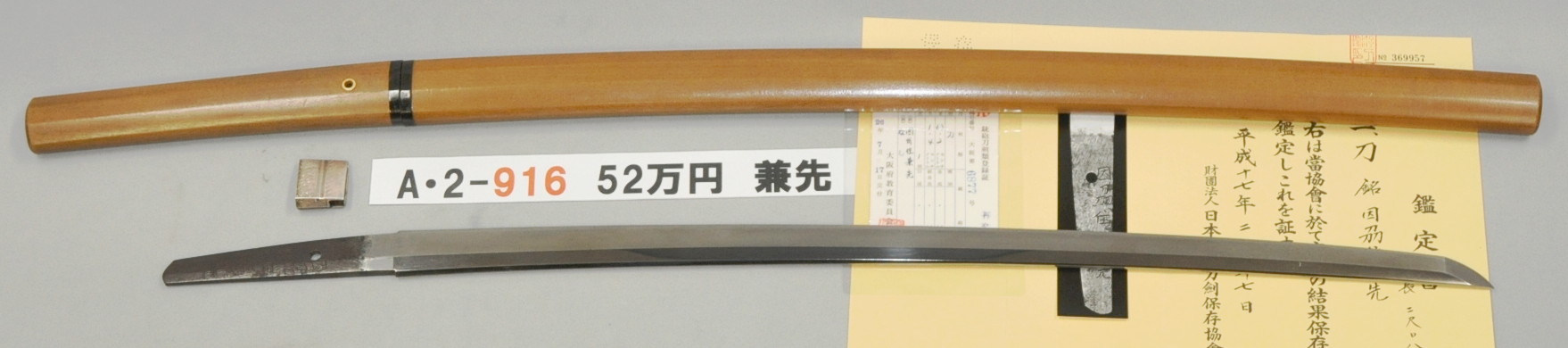
Inaba · around 1624-1644
Tōken Taikan top 91%
3 pieces on the market now
The Edo period (1615 to 1868)
Edo was the sword’s age of connoisseurship: the Hon’ami appraisers, the shogunal register of famous blades of 1719, and a thriving literature turned the sword into an object of study even as it ceased to be drawn in war.
Certifies a genuine blade worth preserving: a signature confirmed correct, or, if unsigned, an era, province, and school that the NBTHK can reliably identify.
The NBTHK (Nihon Bijutsu Tōken Hozon Kyōkai, the Society for the Preservation of Japanese Art Swords) is a public-interest incorporated foundation founded in 1948 and supervised by Japan’s Agency for Cultural Affairs (Bunkachō); it is based at the Japanese Sword Museum in Tokyo. Its expert panels physically examine each submitted work (shinsa) and issue a certificate (kanteishō) ranking it by artistic and historical merit. NBTHK papers are the most widely recognized standard of authentication for Japanese swords and fittings.
NBTHK official site¥520,000