NihontoWatch Mon

NihontoWatchBETA

MarketAuctions
Encyclopedia
NihontoWatch Mon

NihontoWatchBETA

MarketAuctions
Encyclopedia

Description

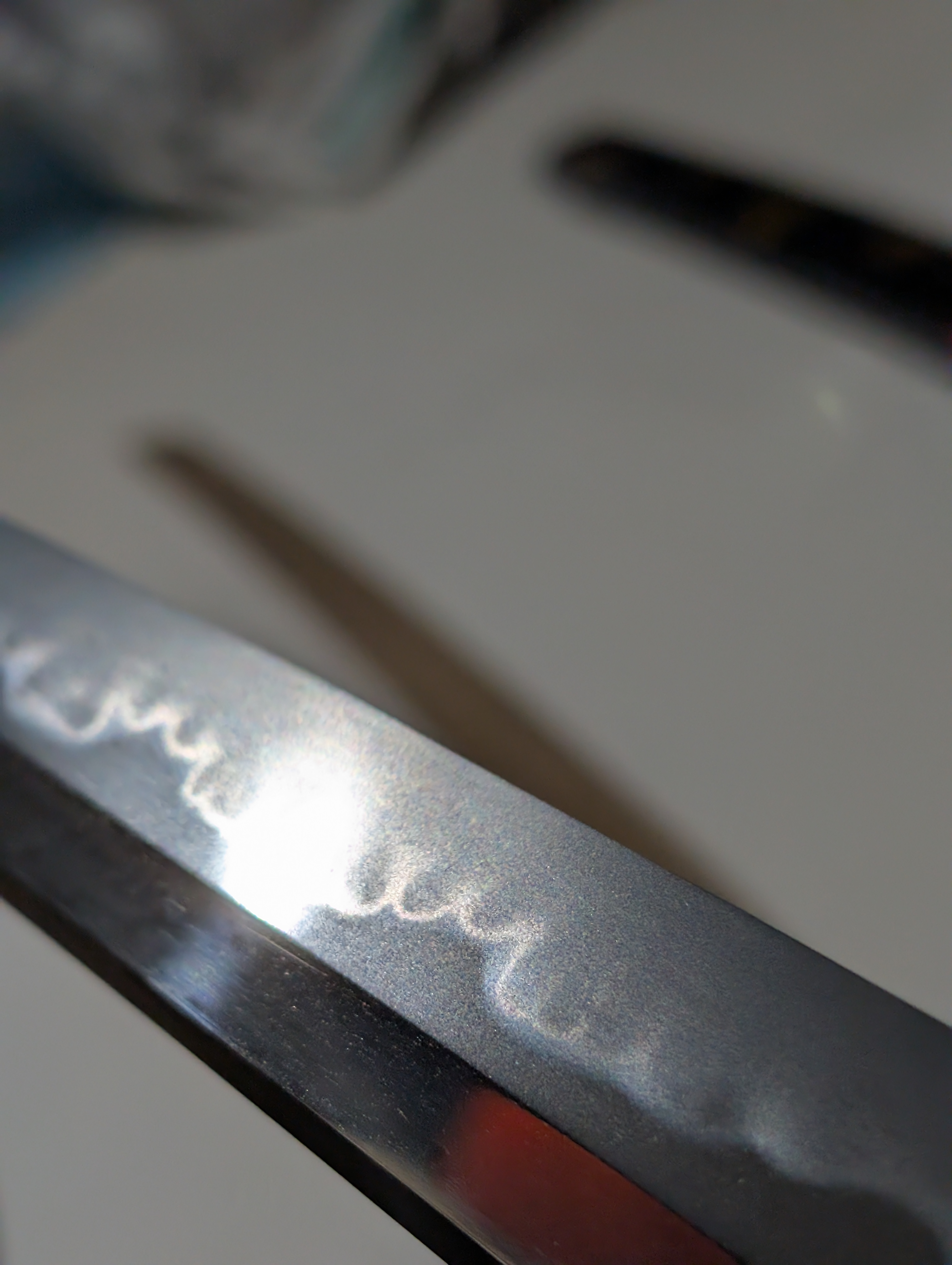
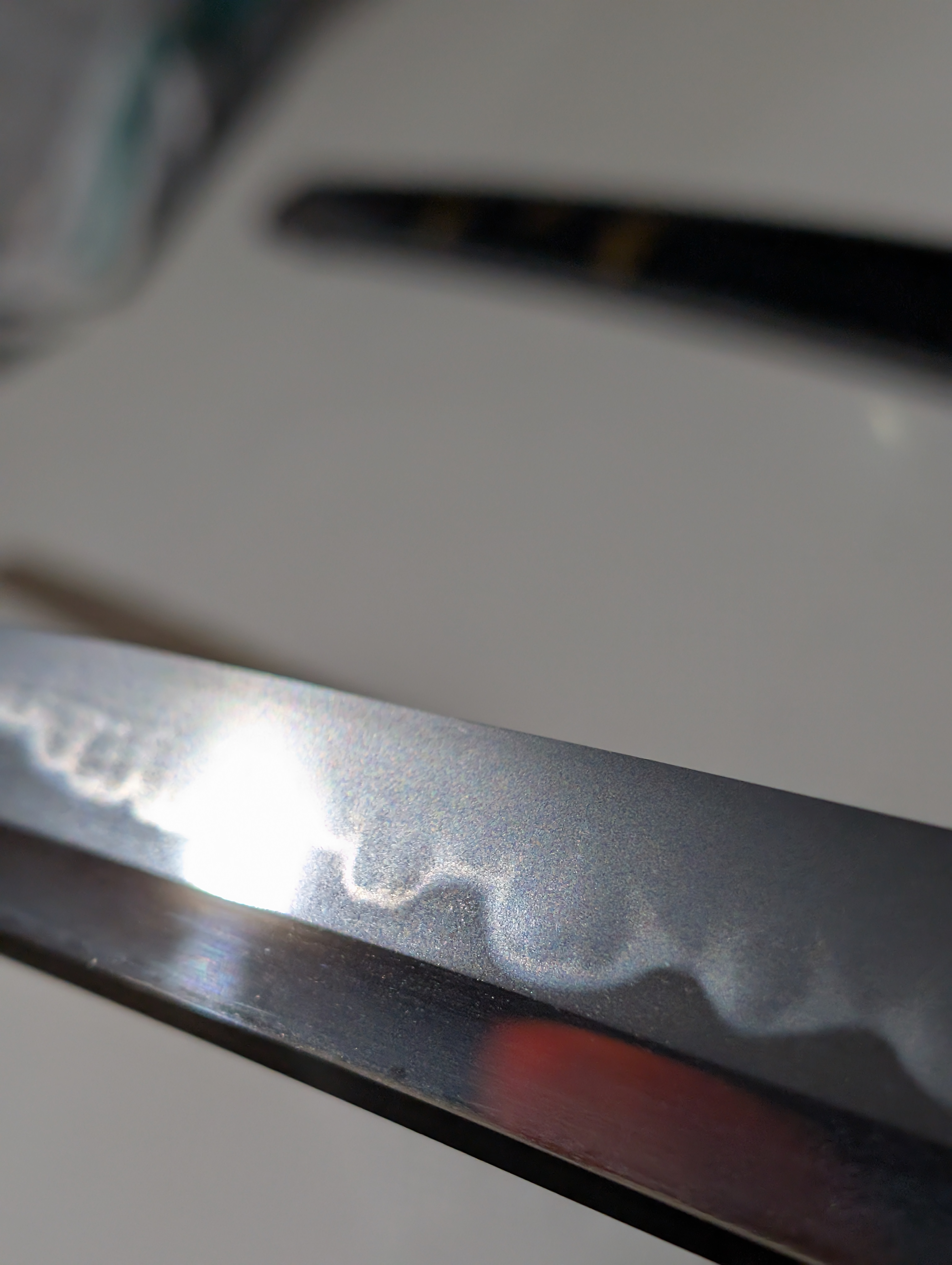
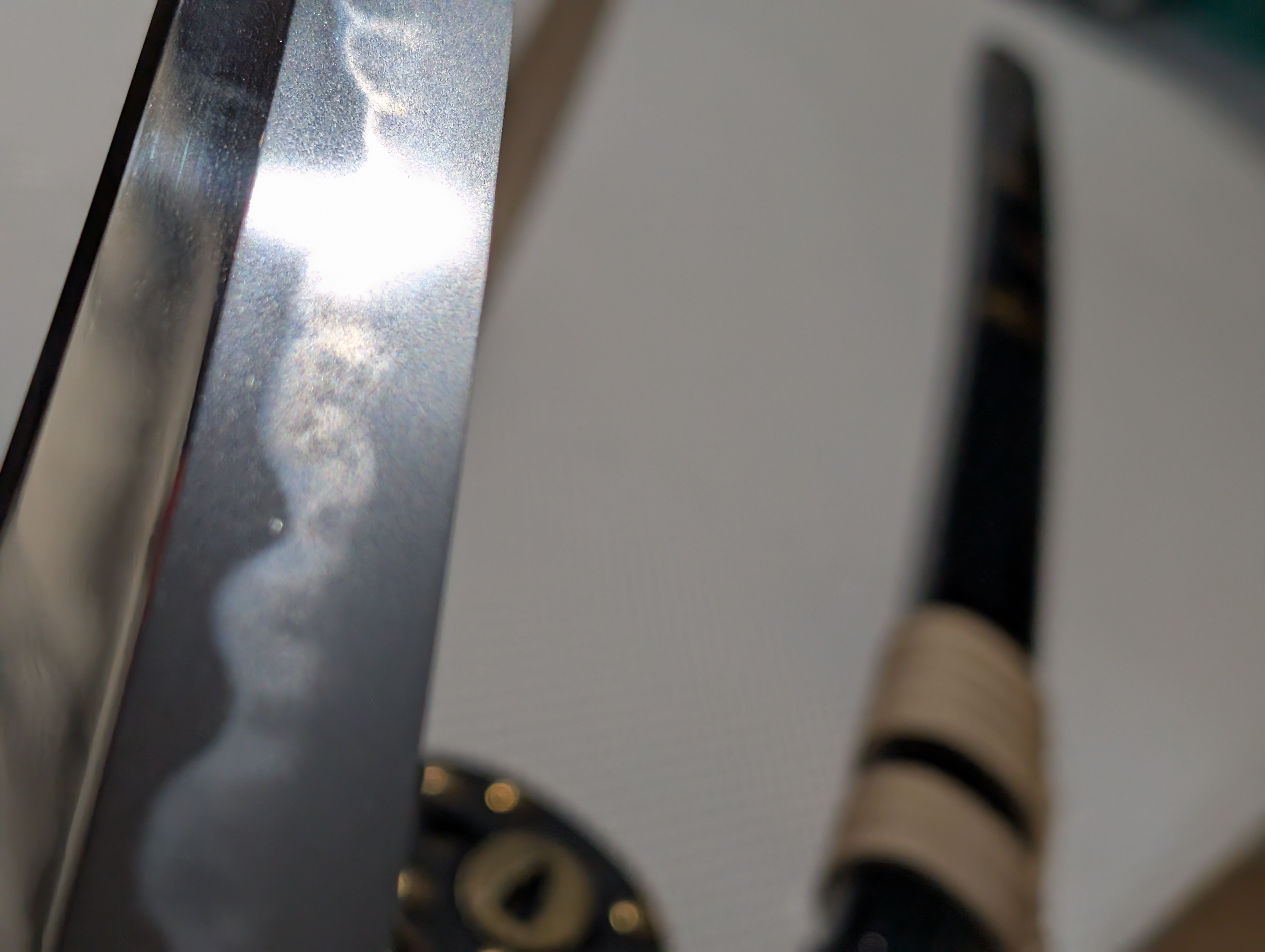
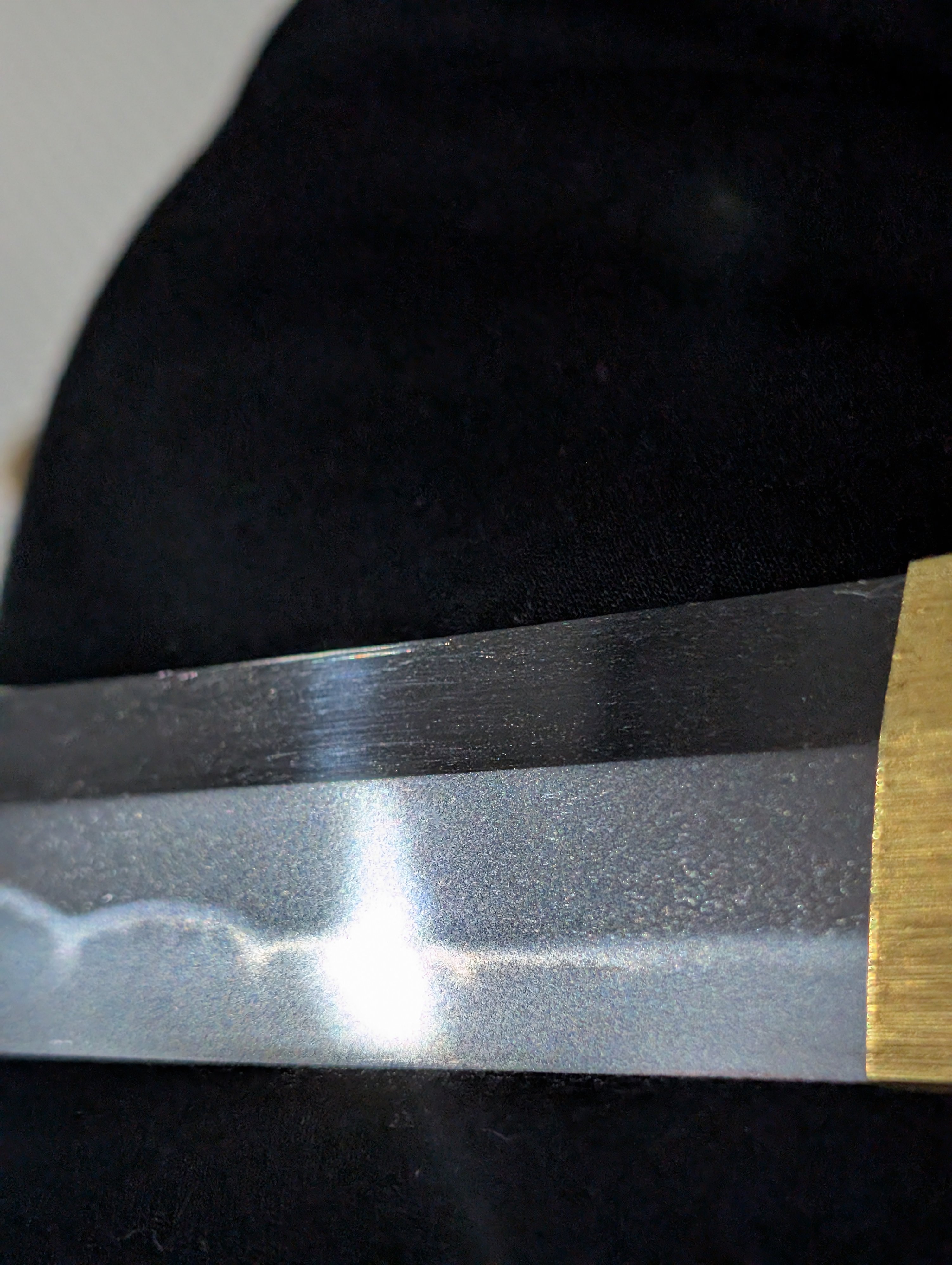
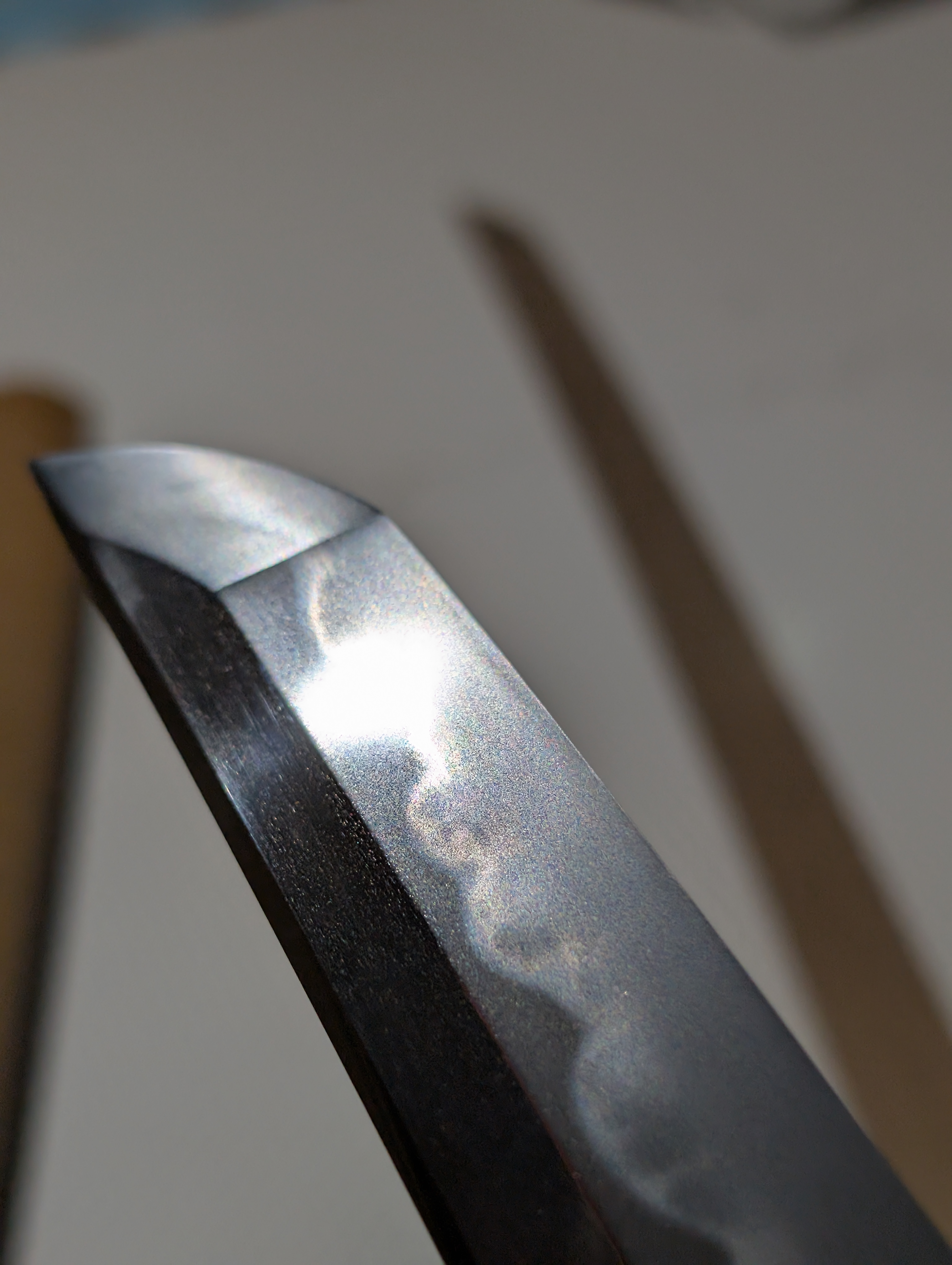
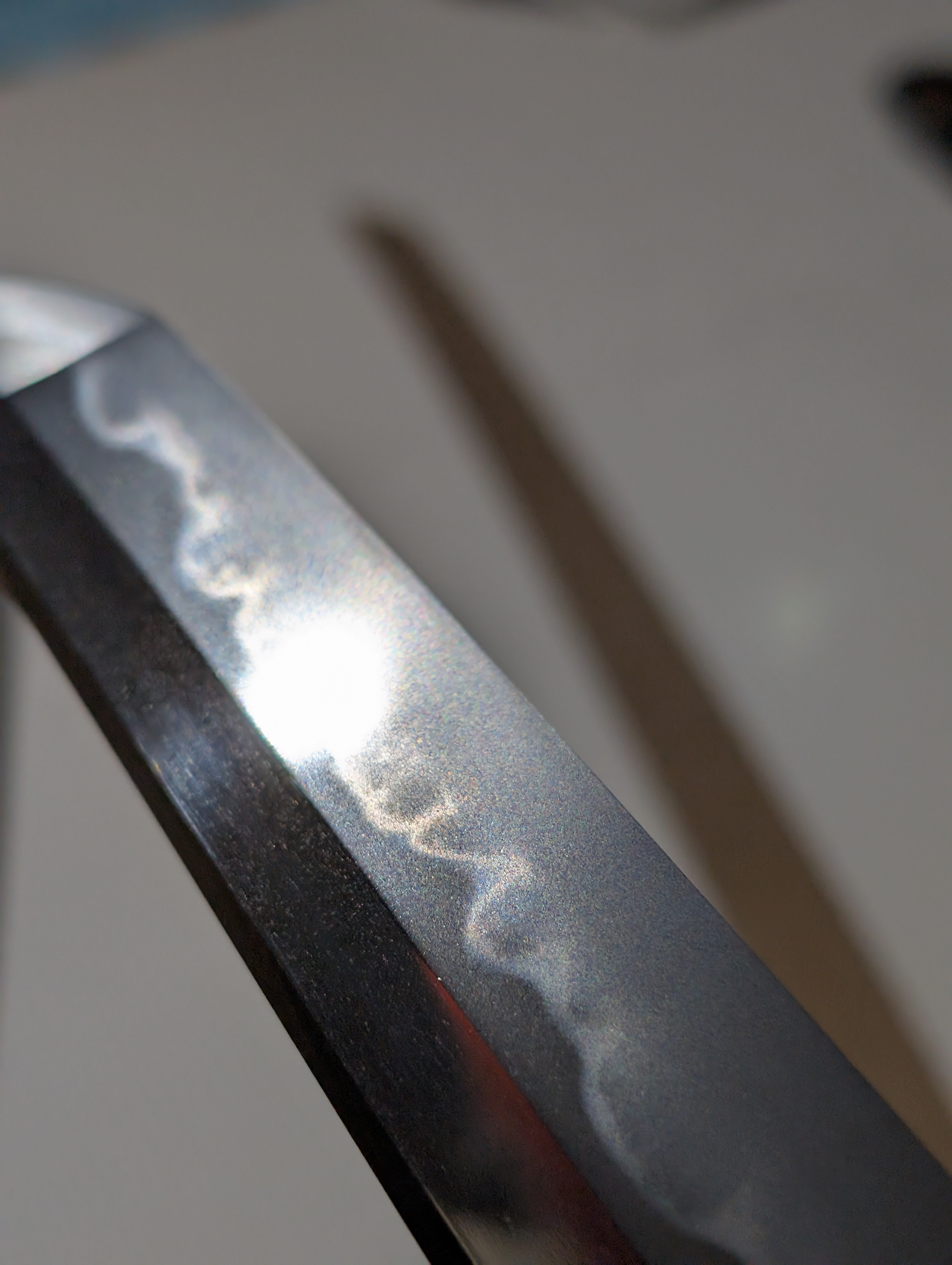
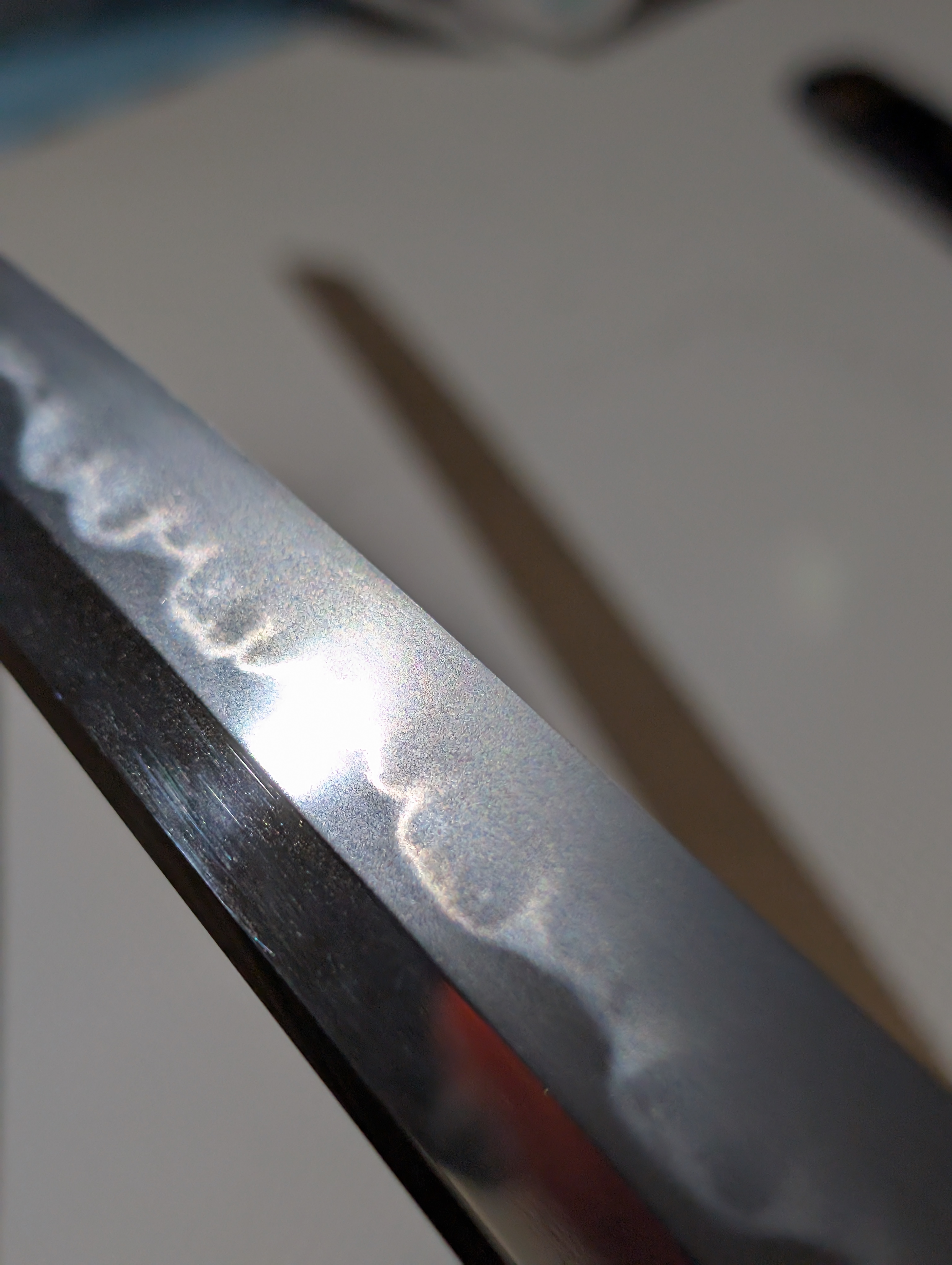
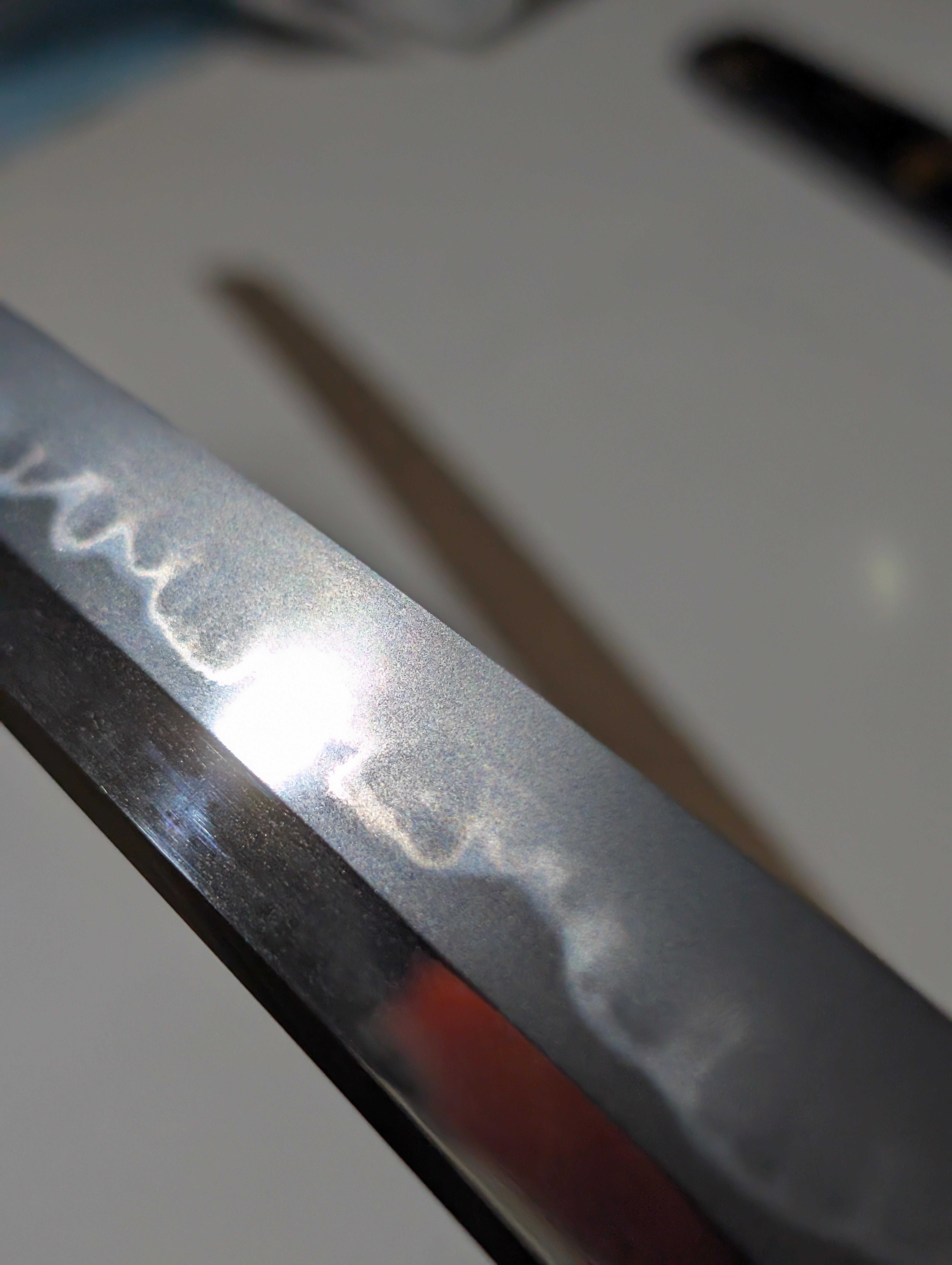
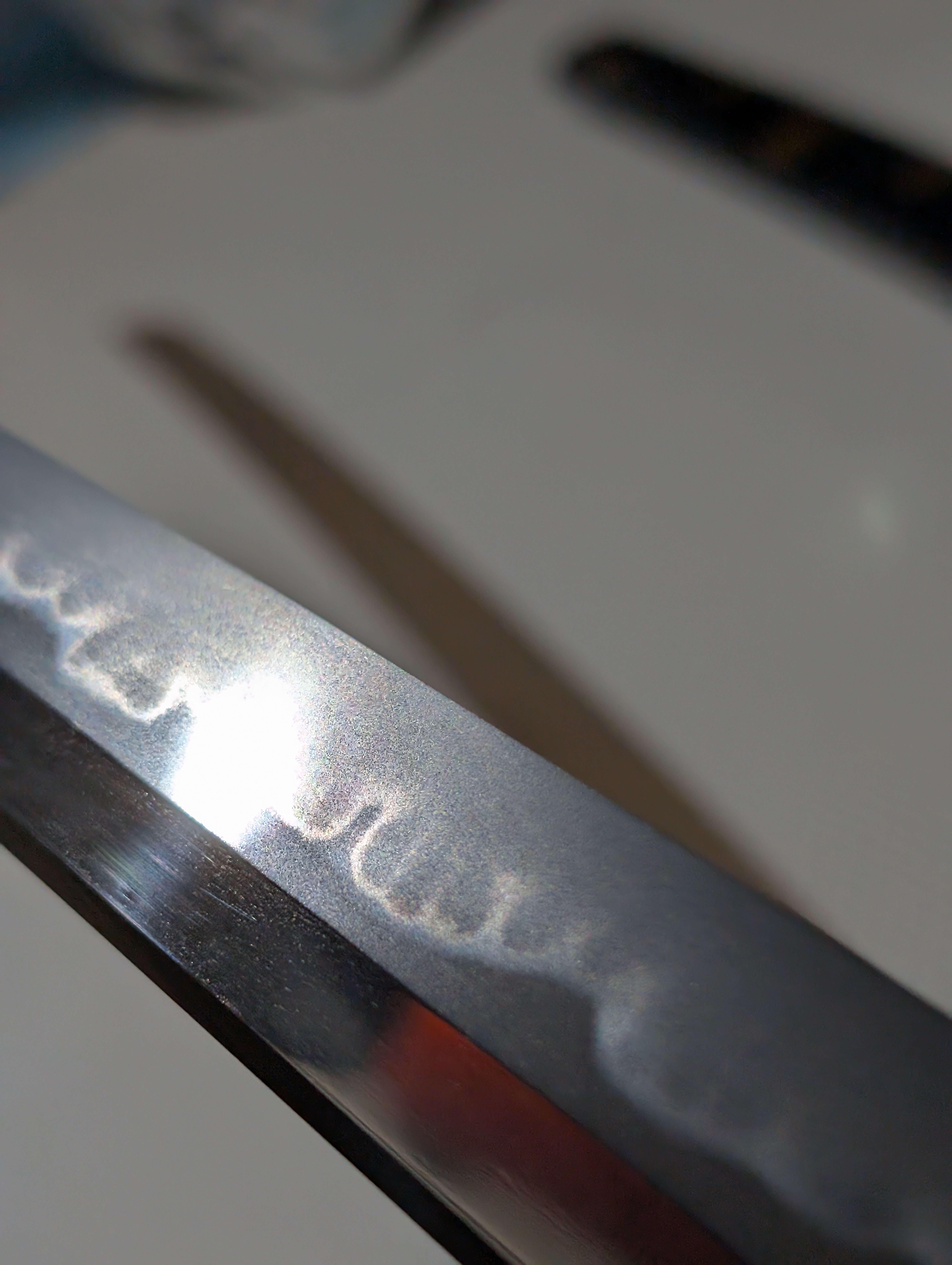
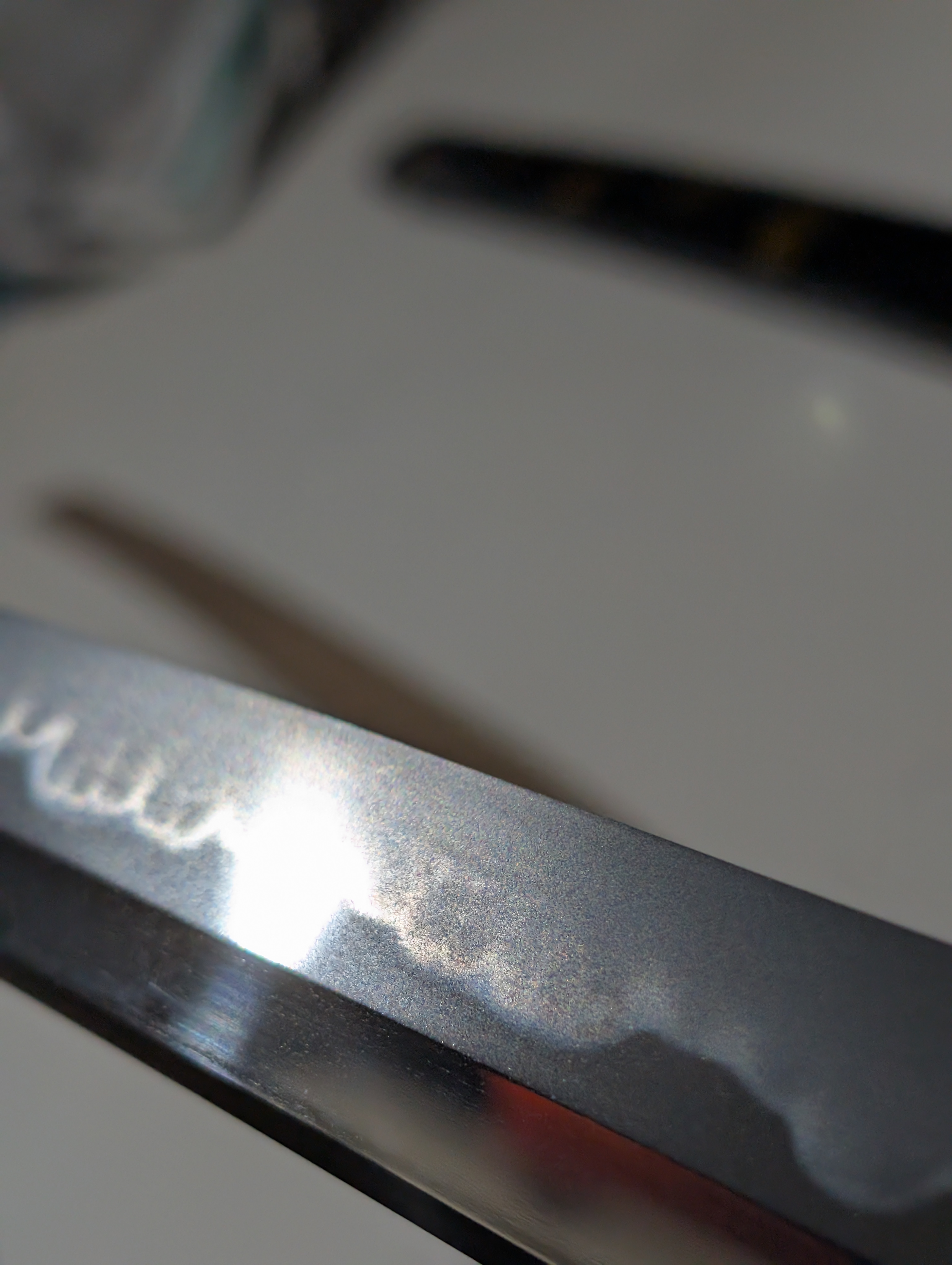
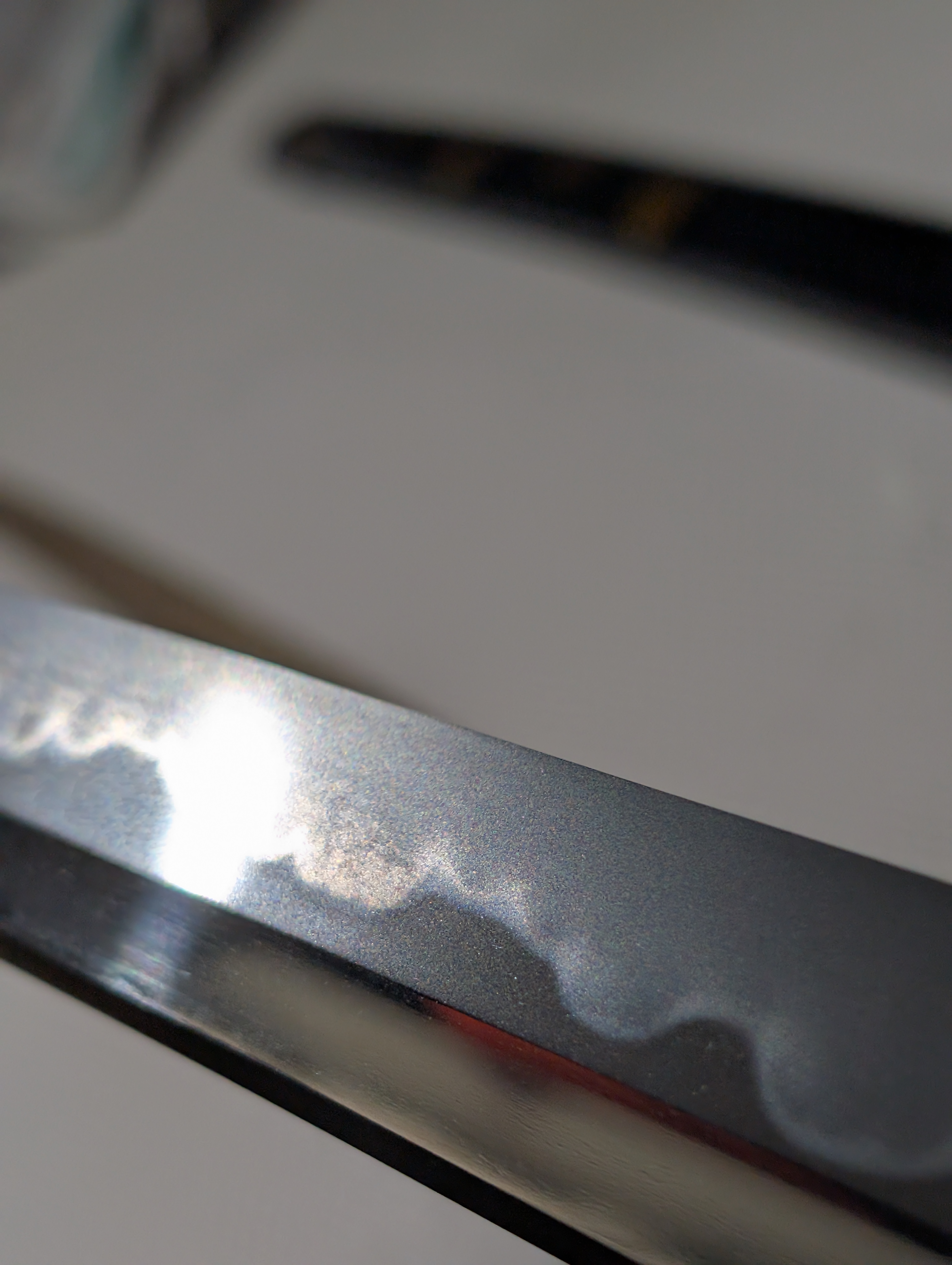
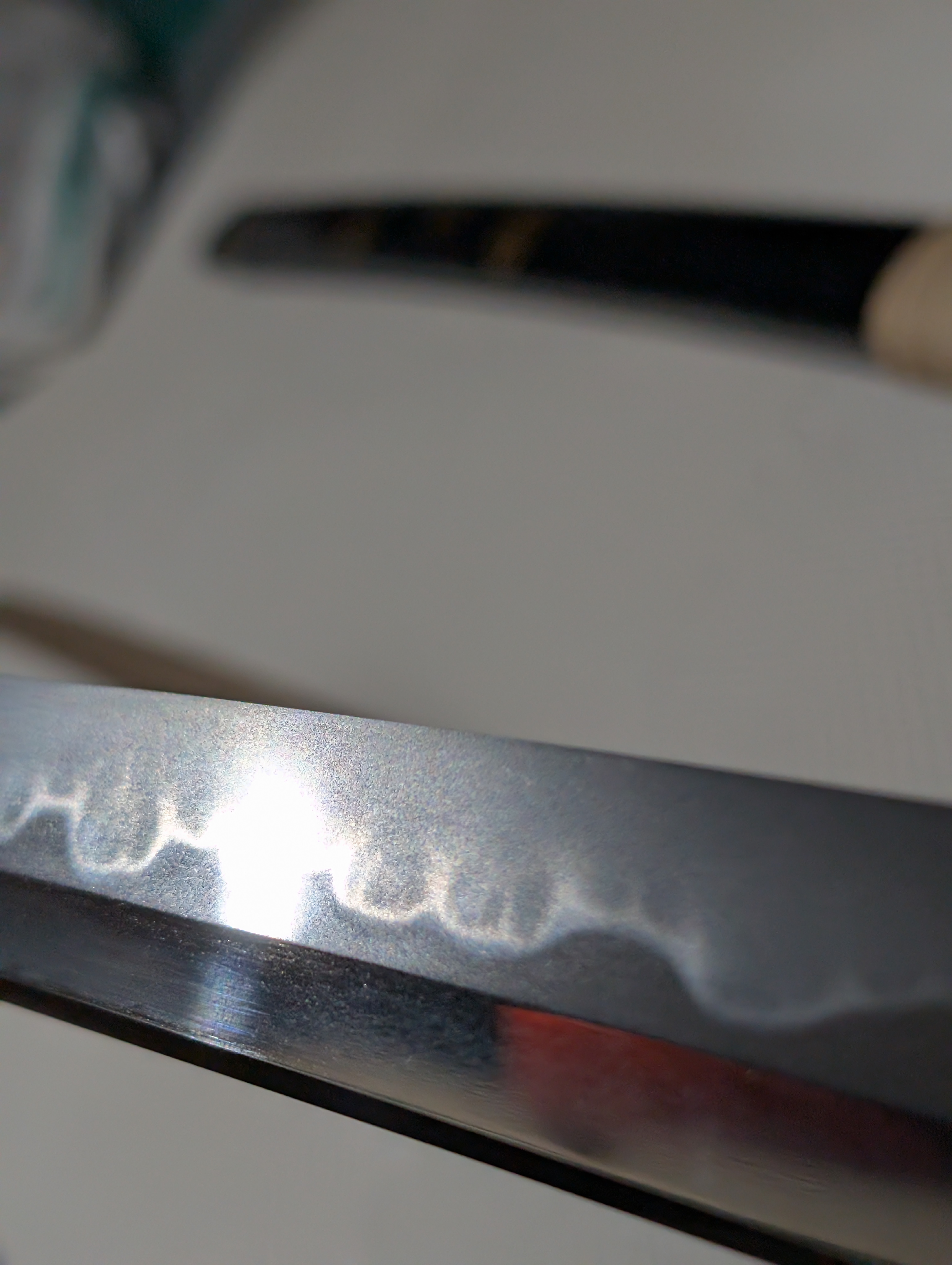
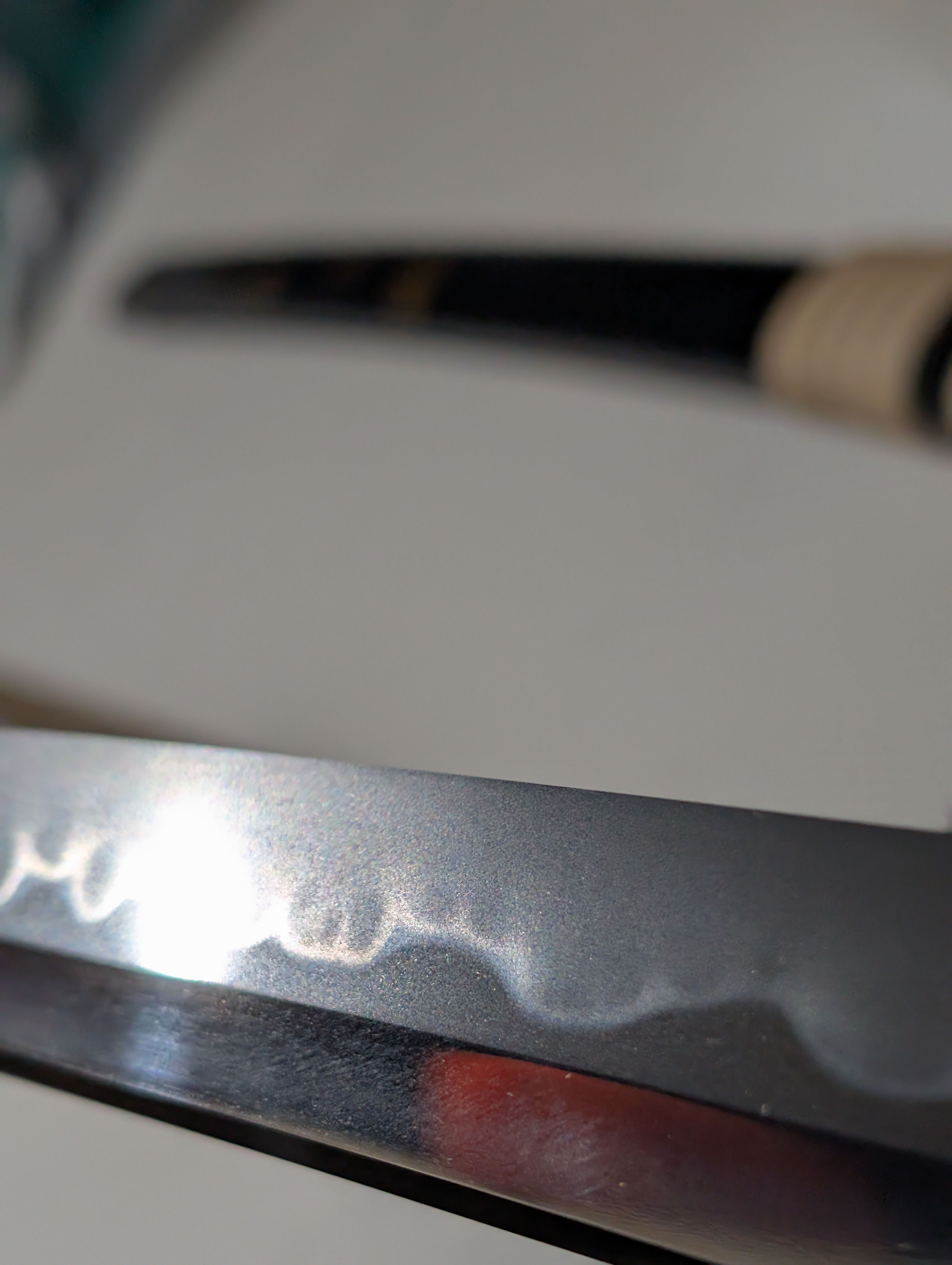
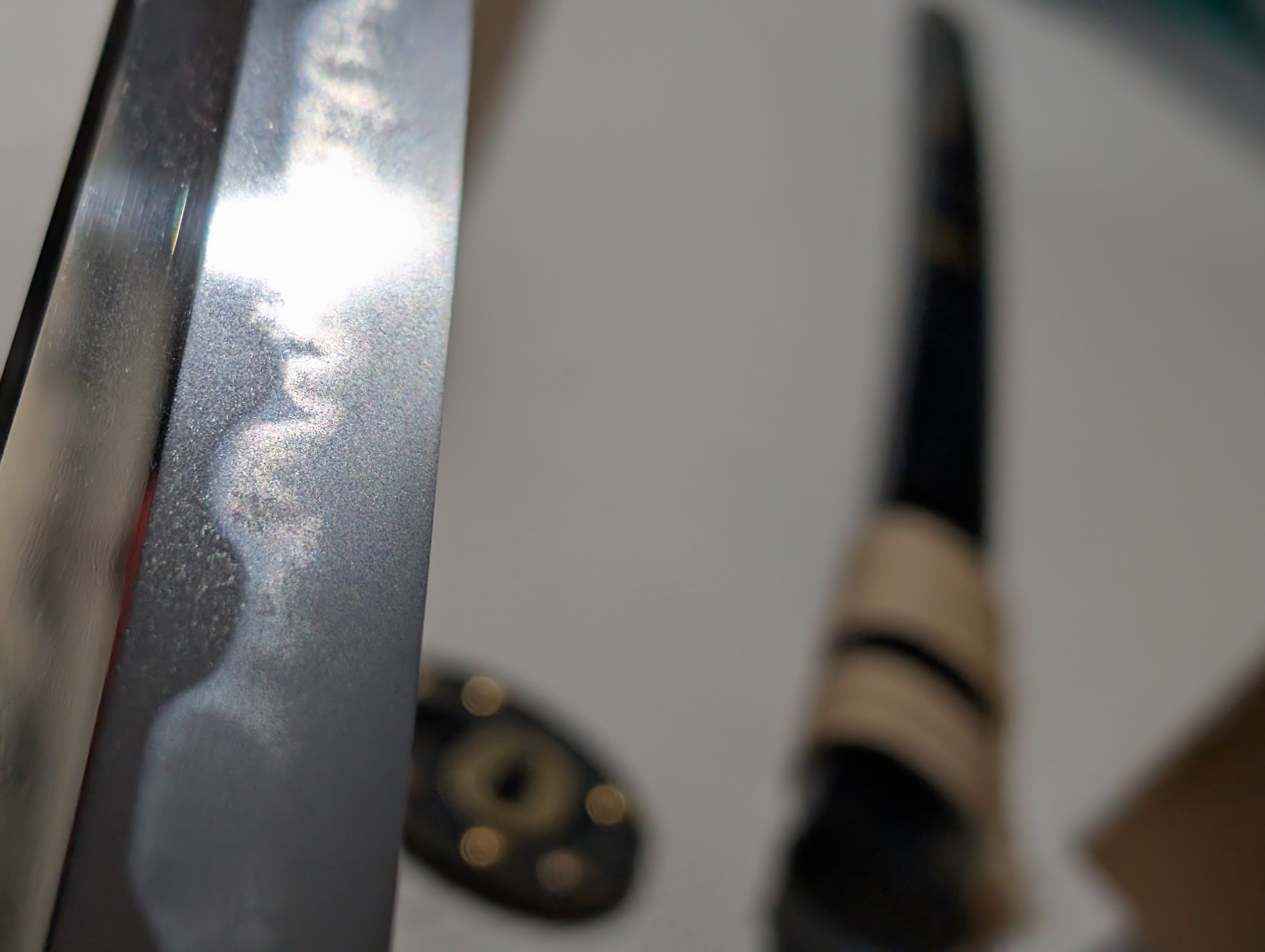
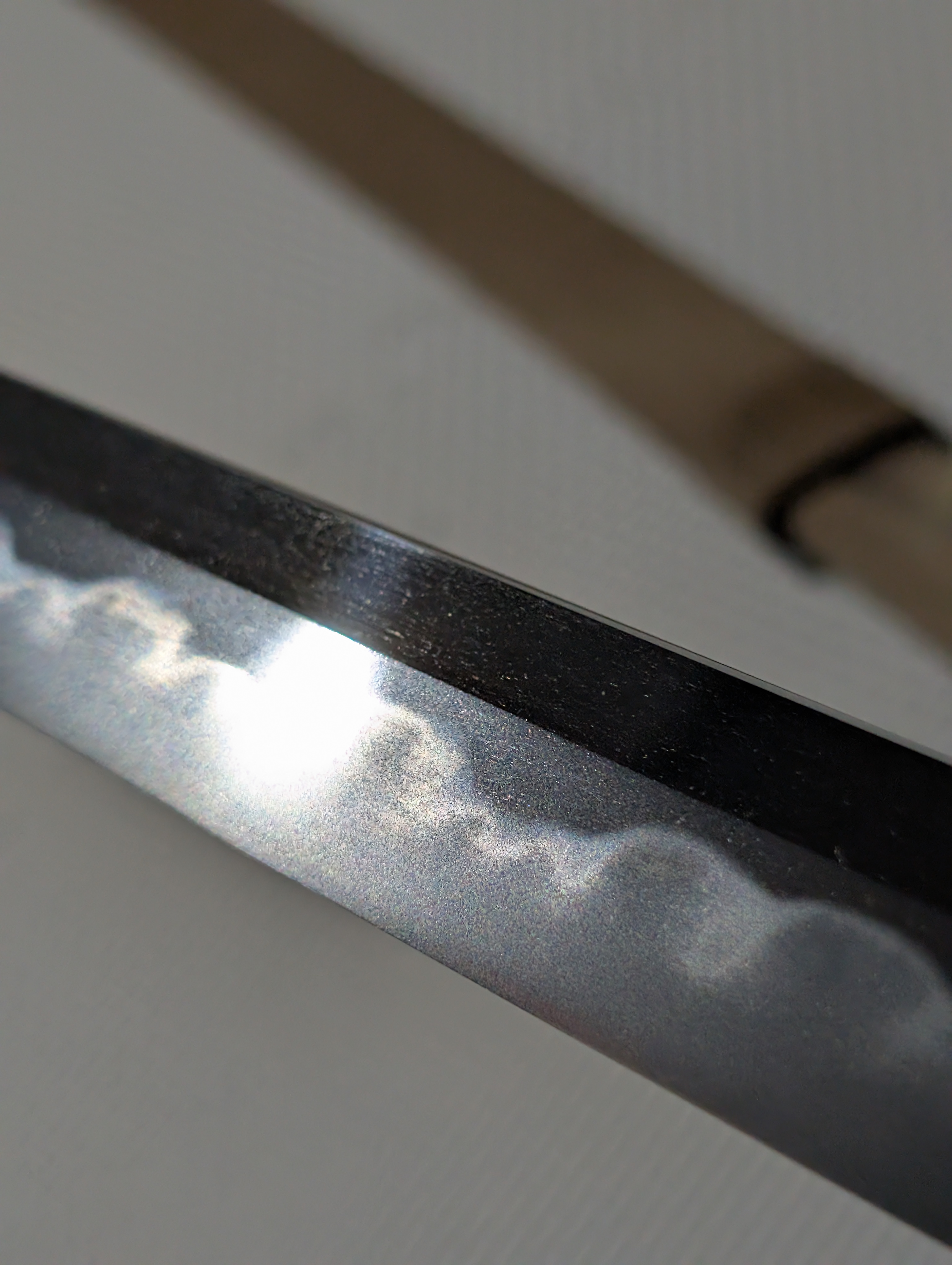
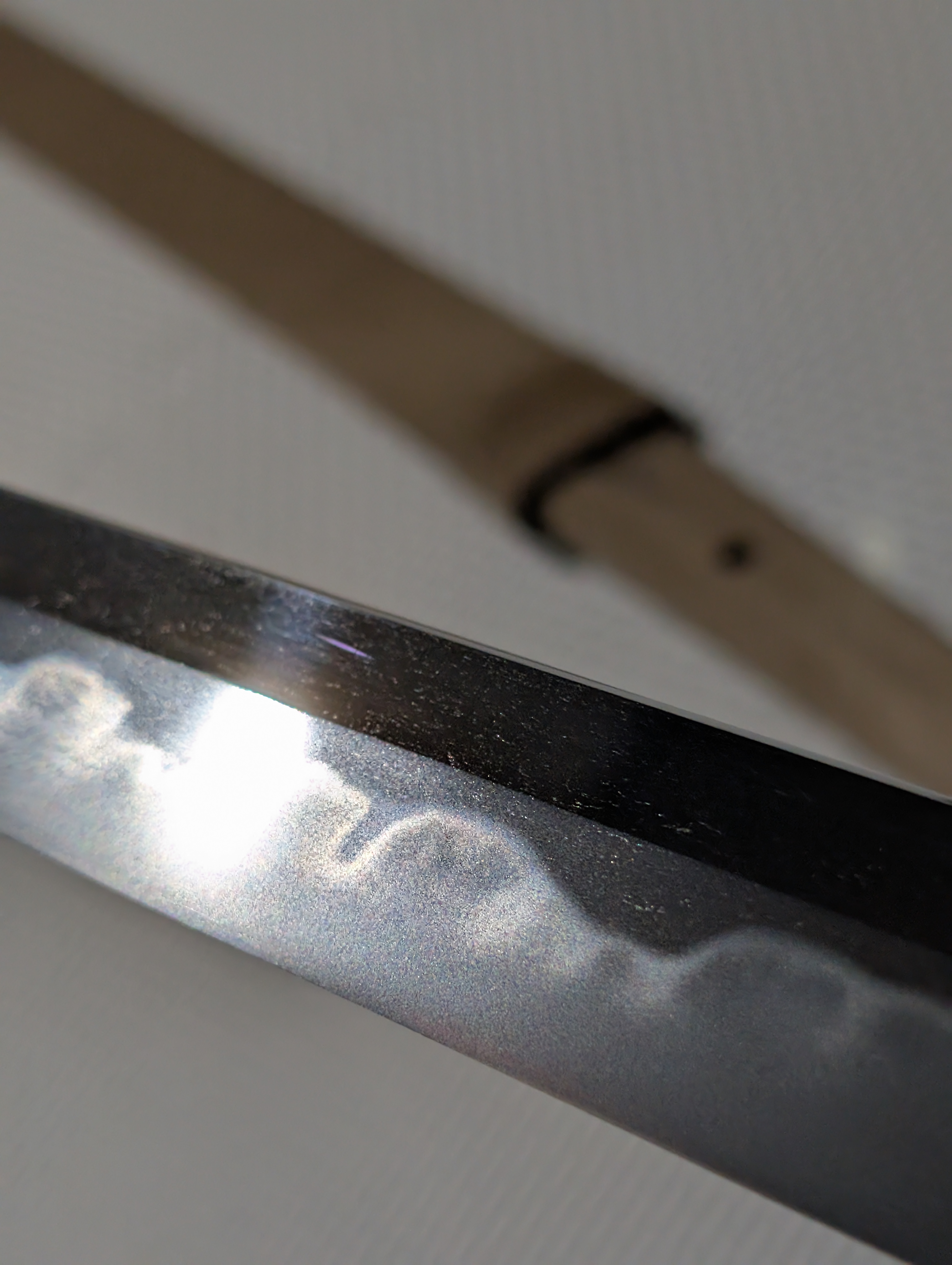
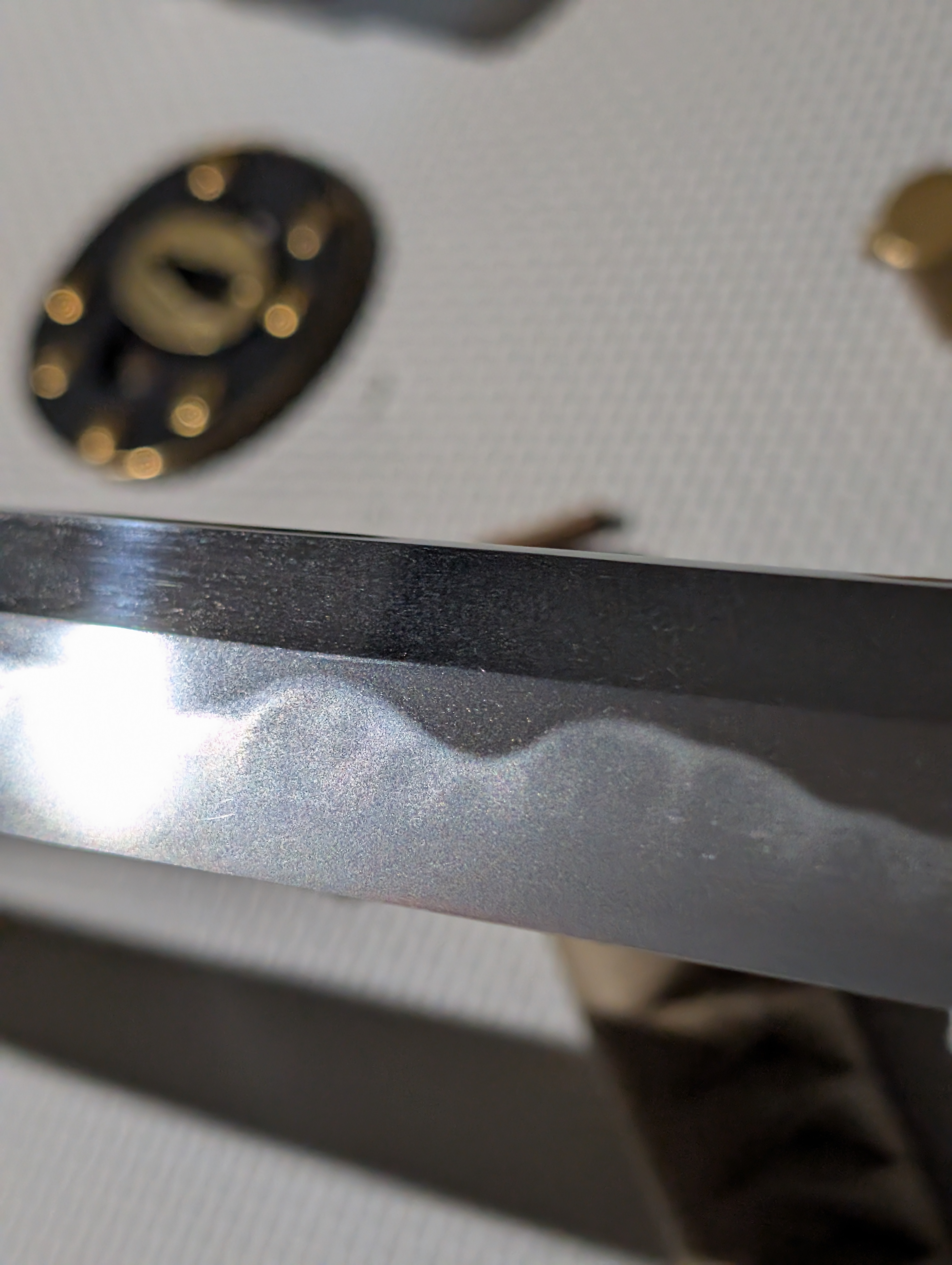
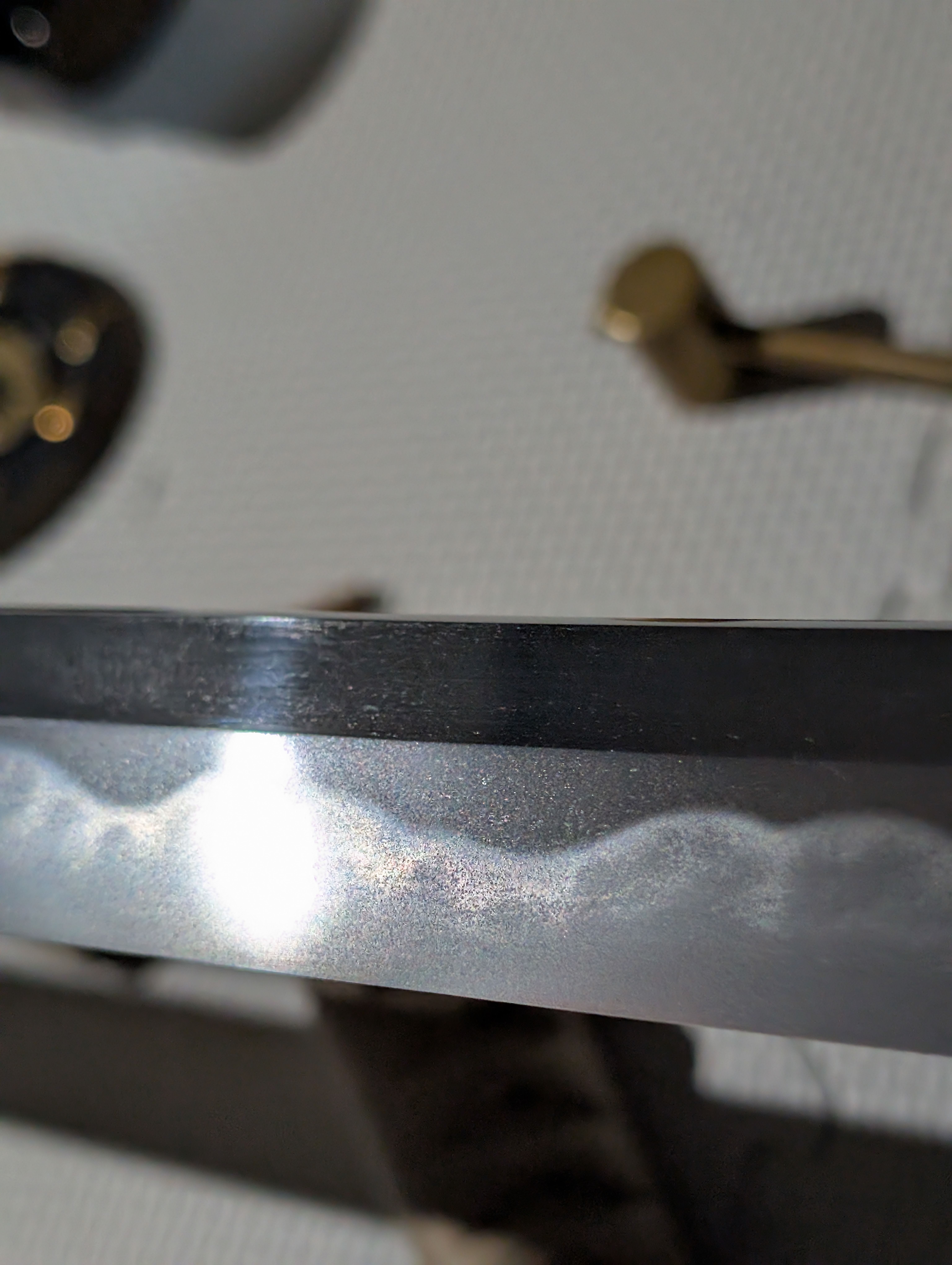
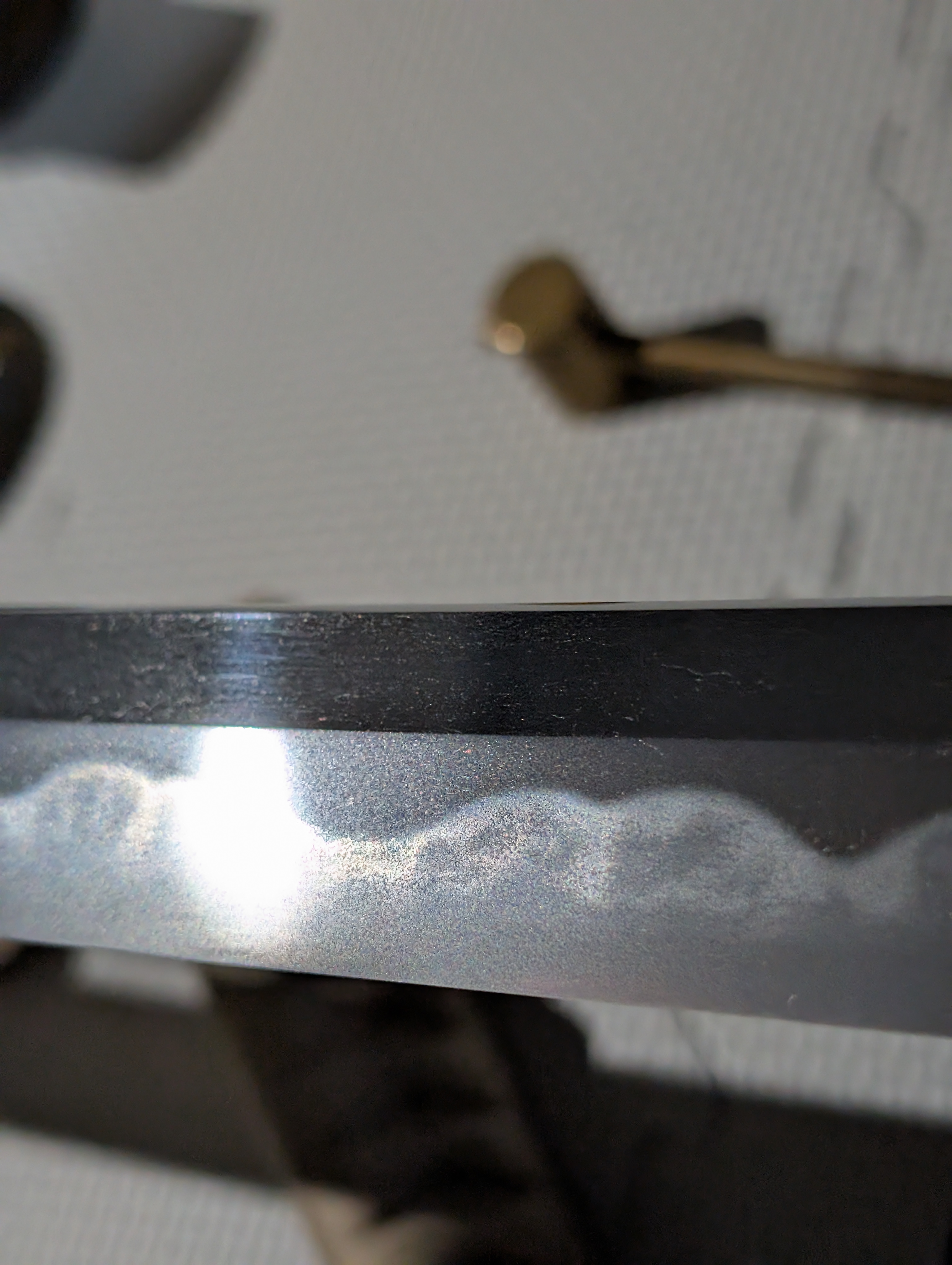
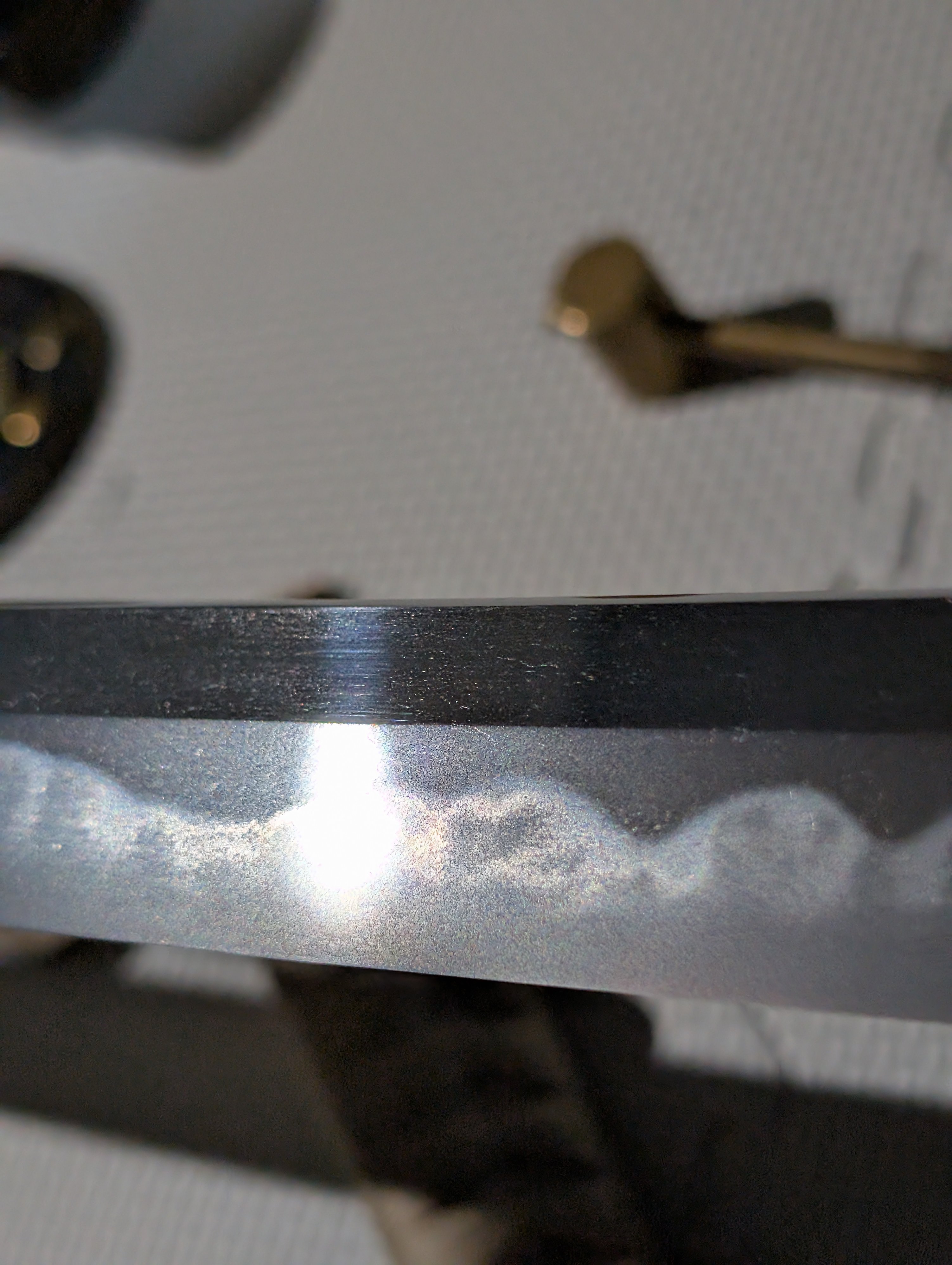
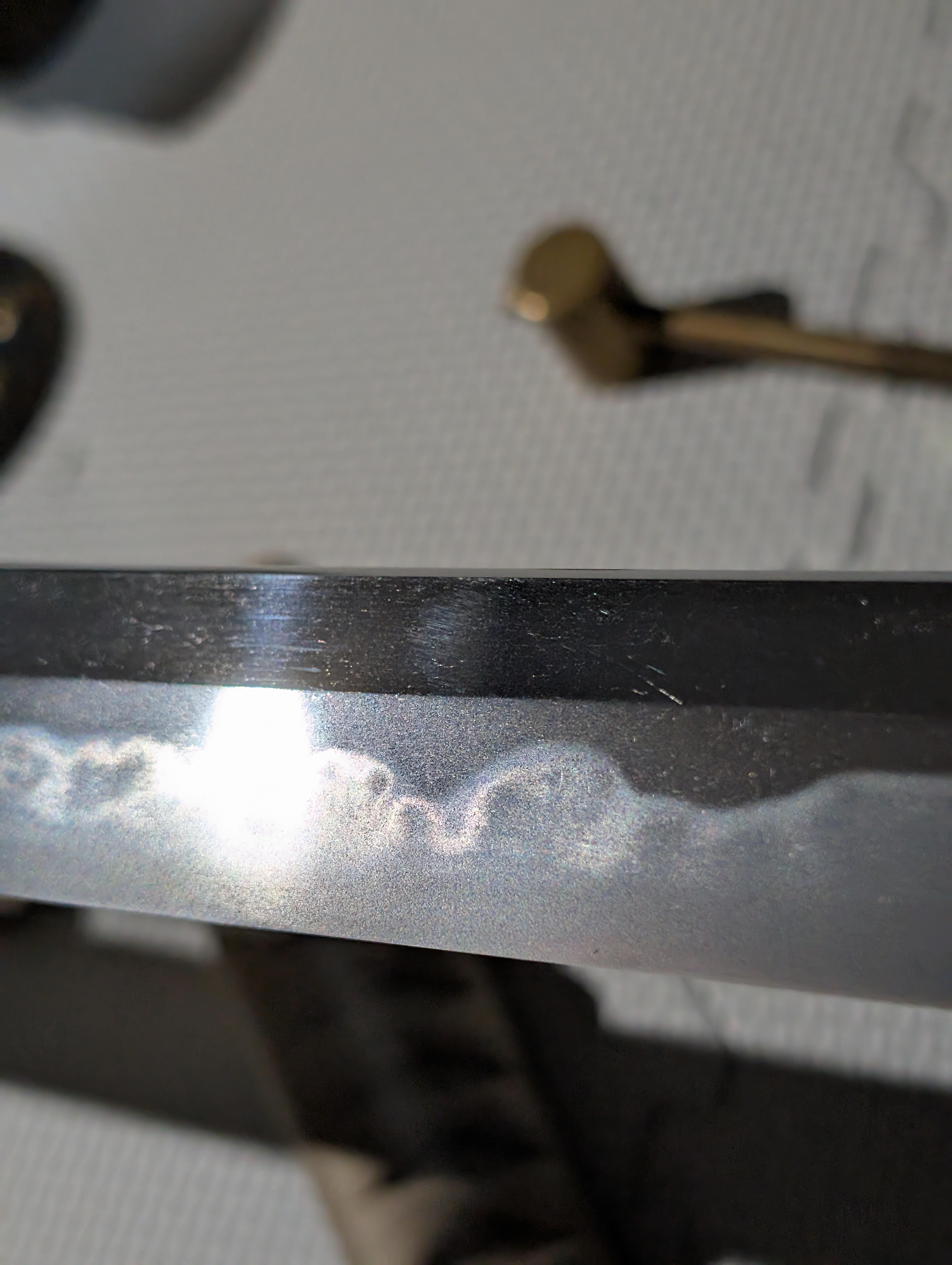
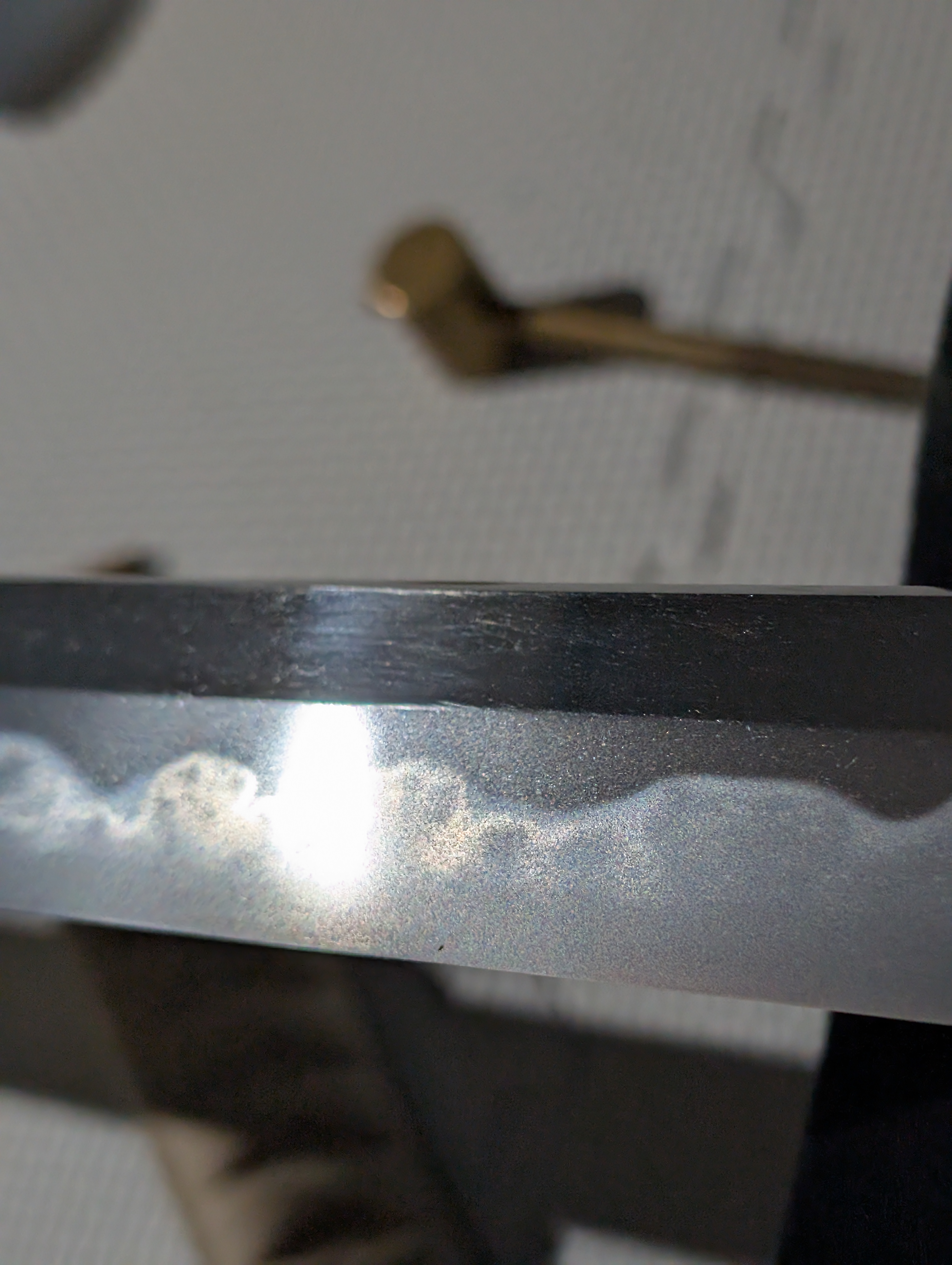
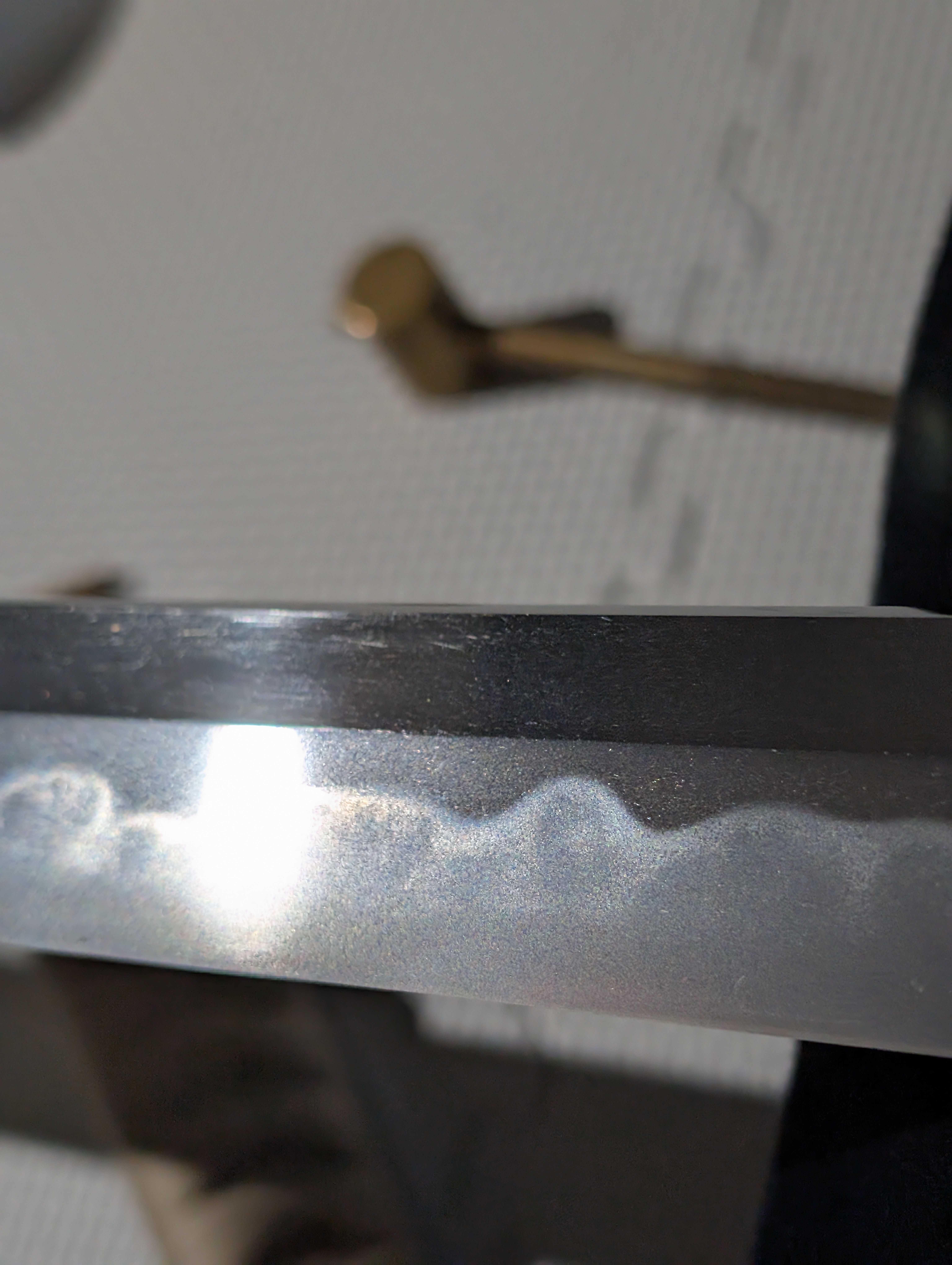
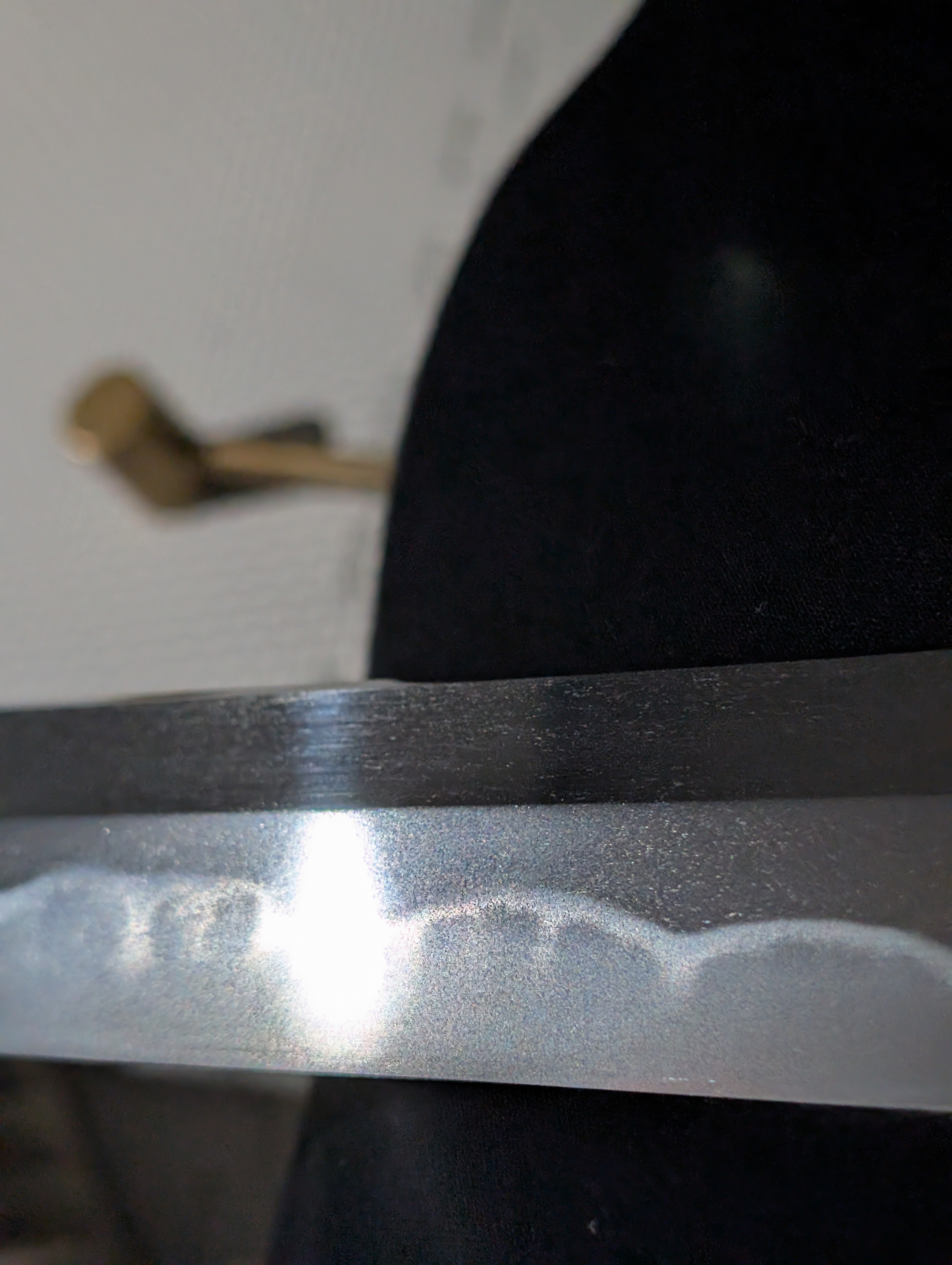
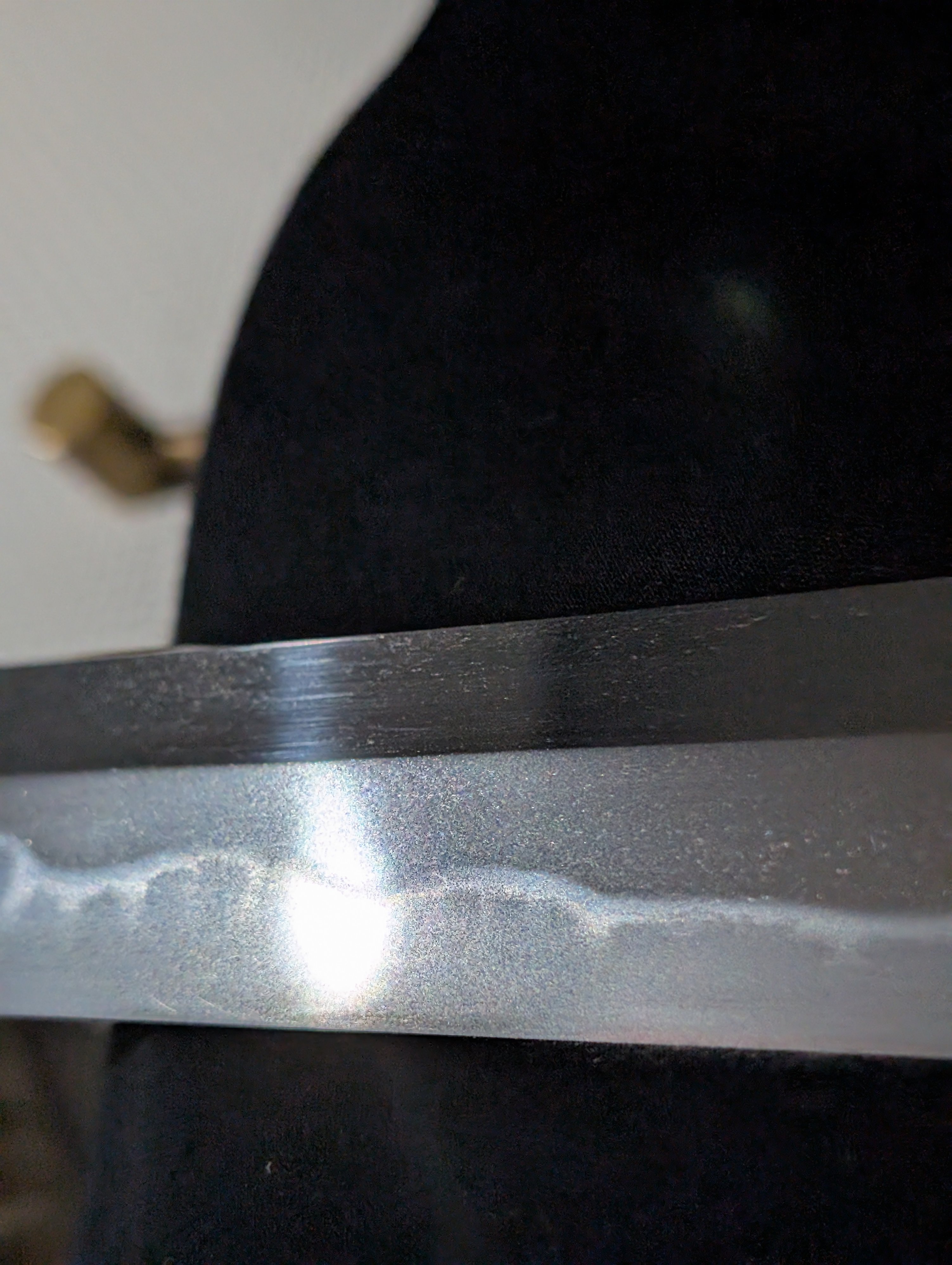
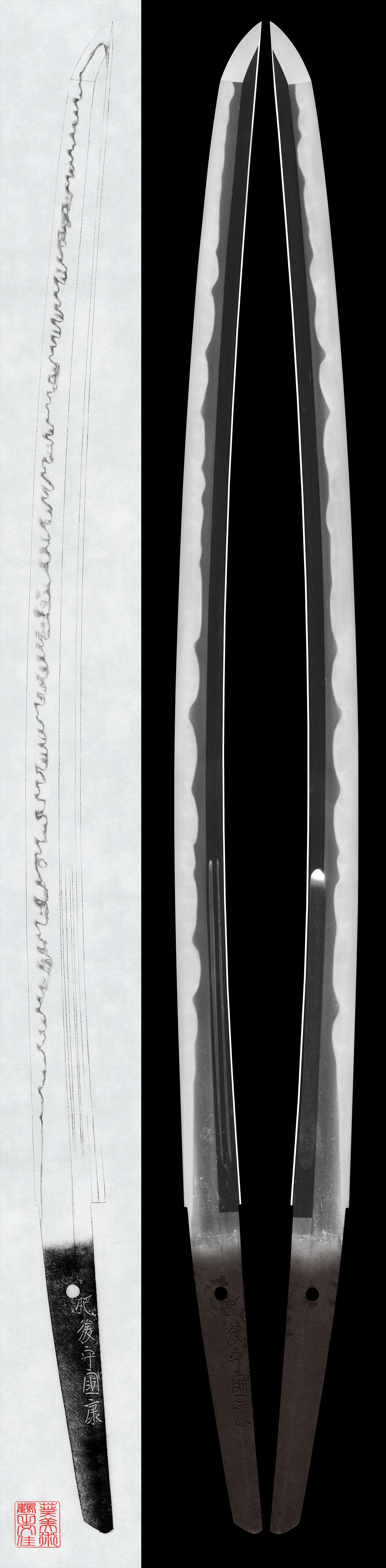
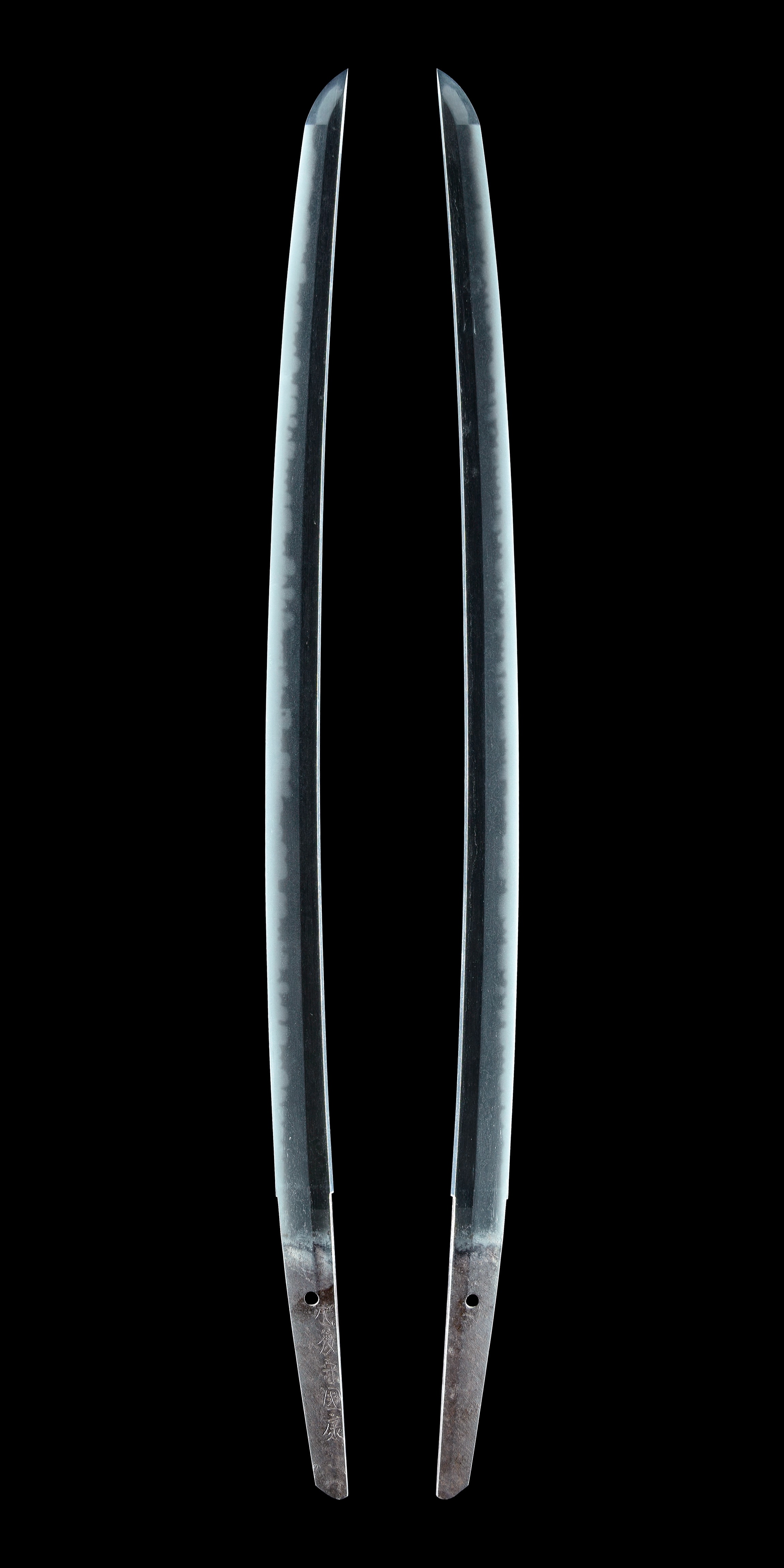
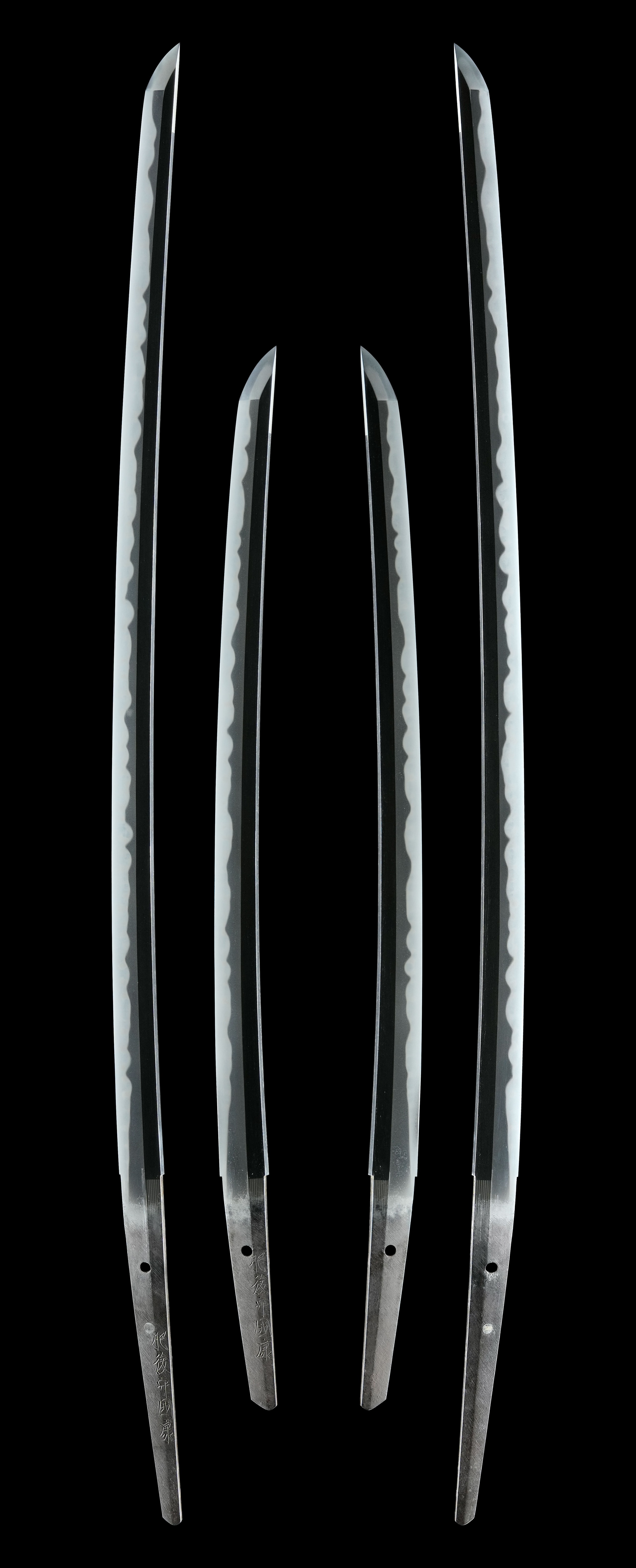
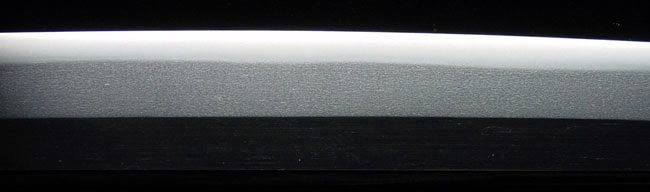
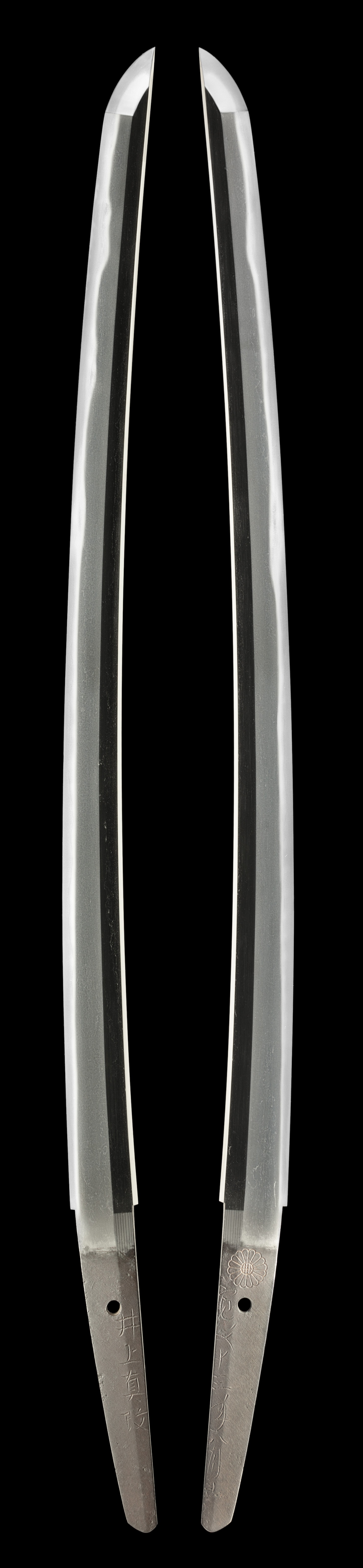
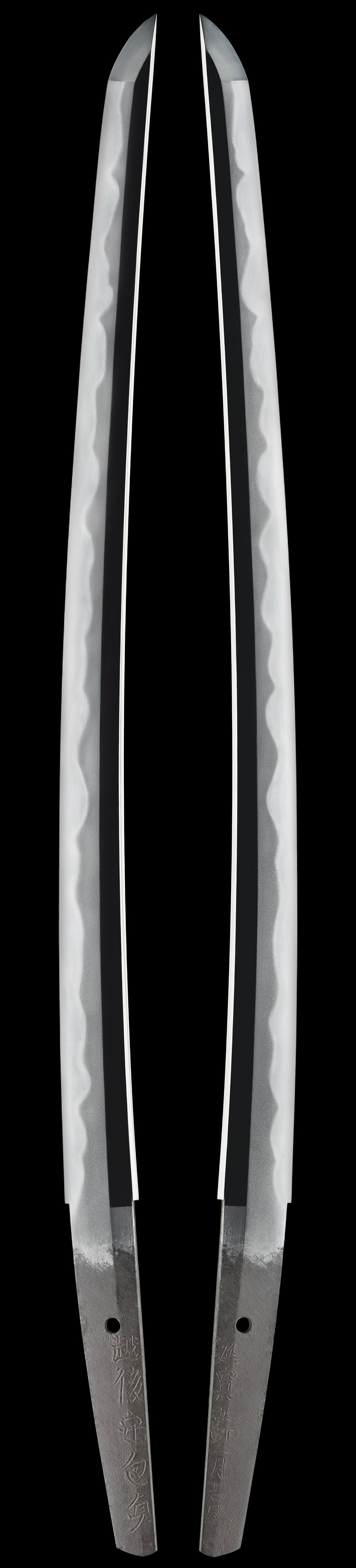
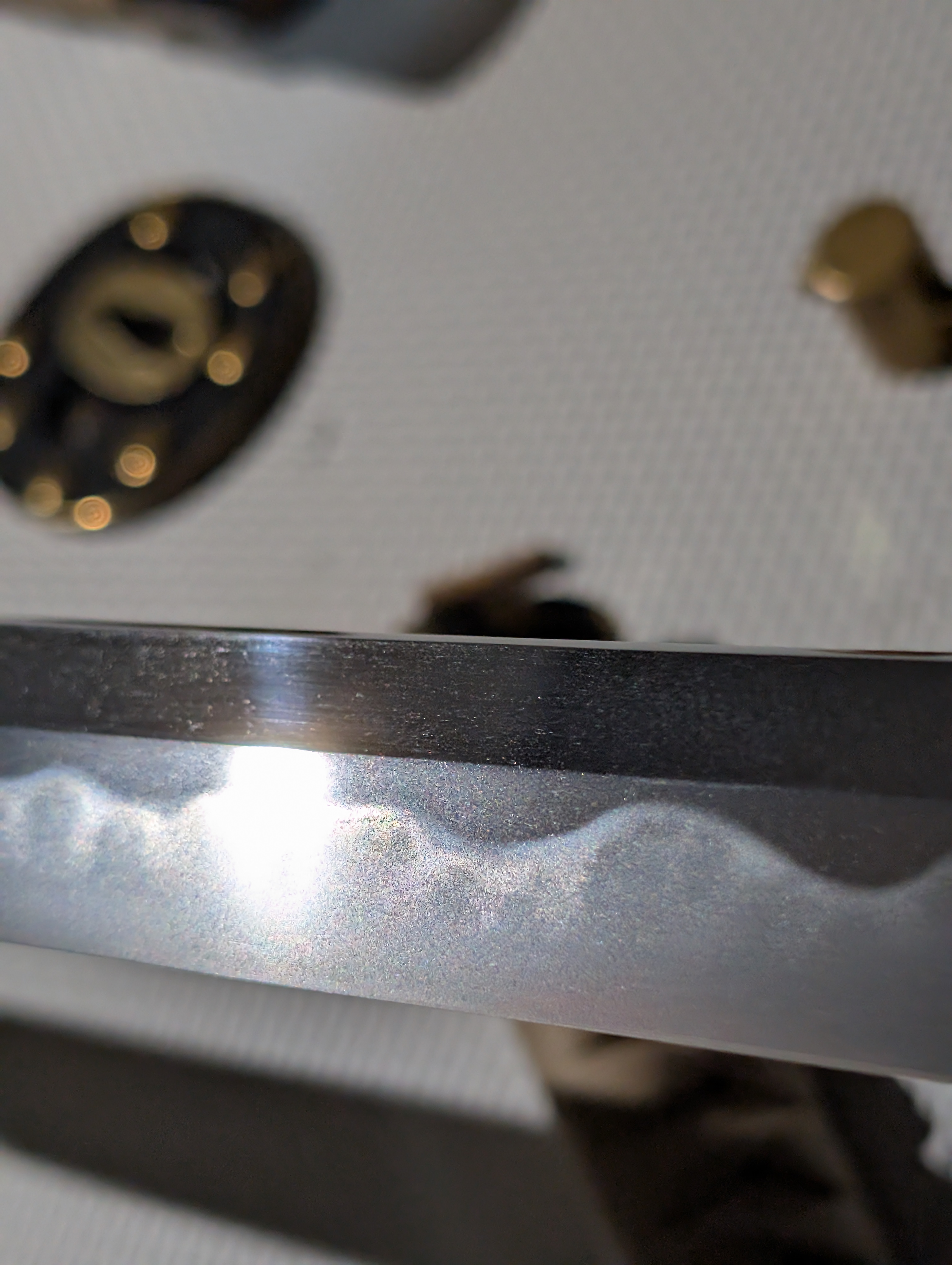
This is a katana by Higo no Kami Kuniyasu, a direct descendant of the Kawachi no Kami Kunisuke school, active in the late 17th century. The blade exhibits typical Kanbun Shinto dimensions with a stout geometry and shallow saki-sori, featuring a tight ko-itame hada and a flamboyant hamon with kobushigata choji midare. It is rated Juyo by the NBTHK and comes with a set of late Edo Period uchigatana fittings adorned with the Tokugawa Aoi crest.

NBTHK Setsumei

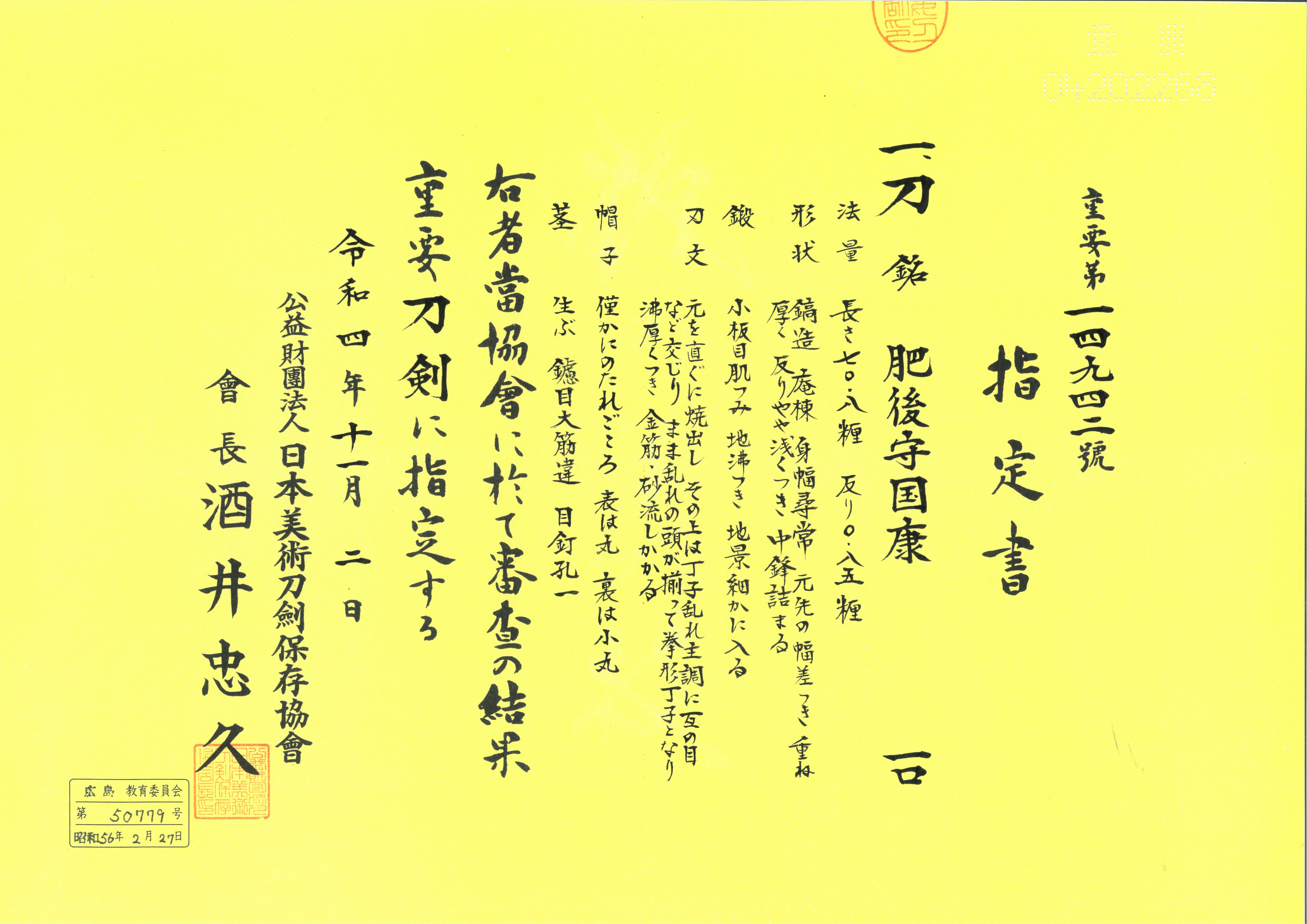
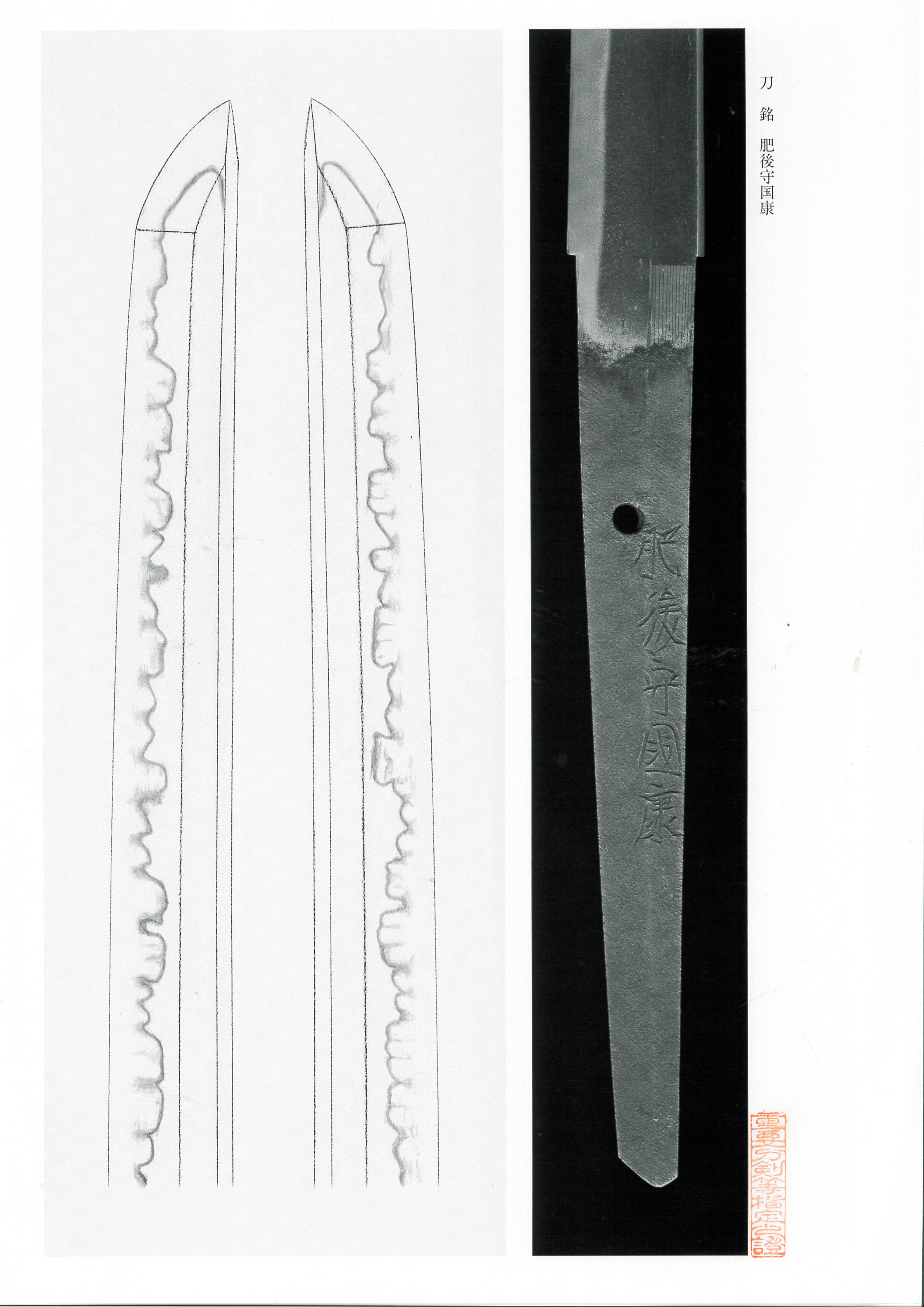
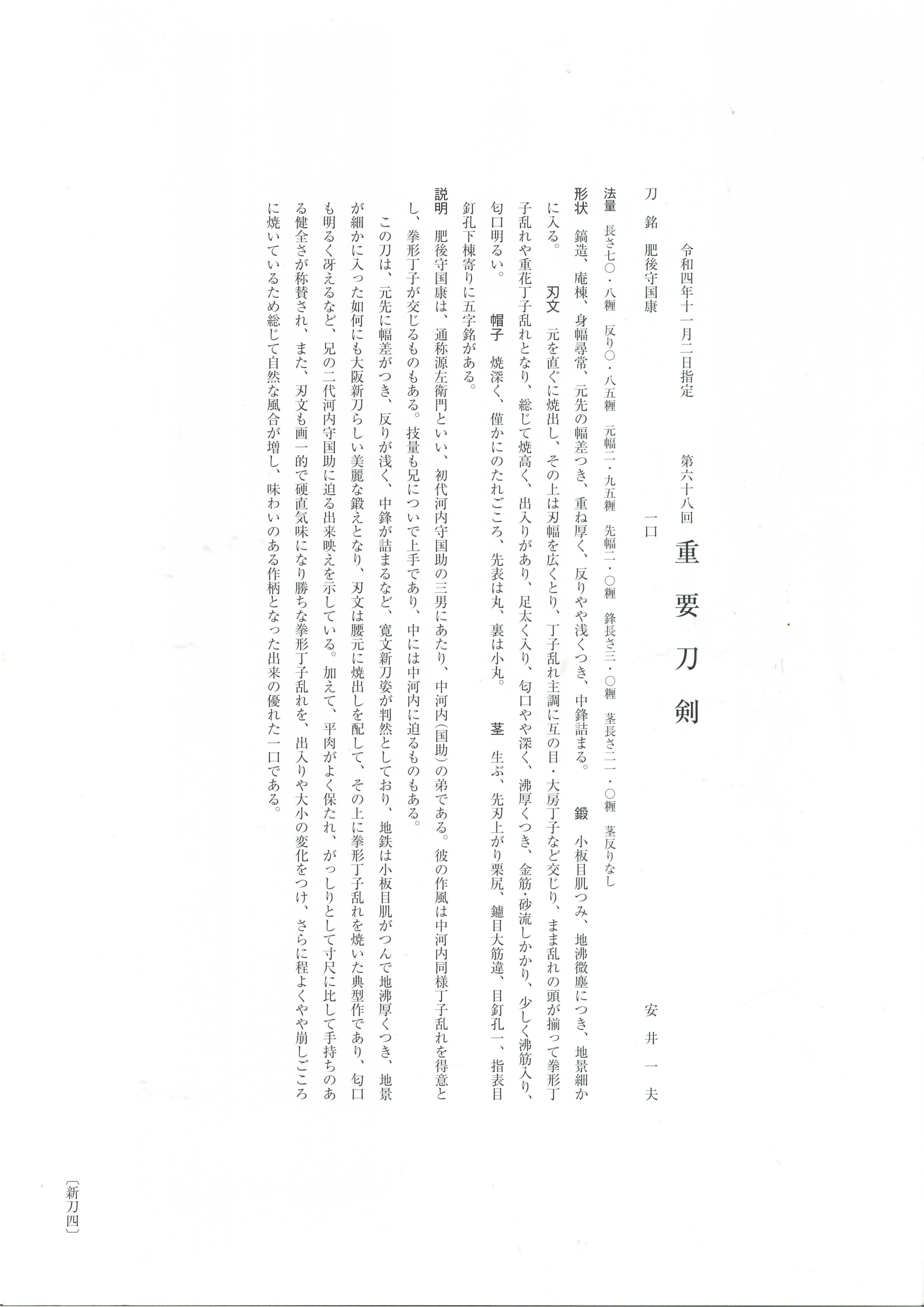
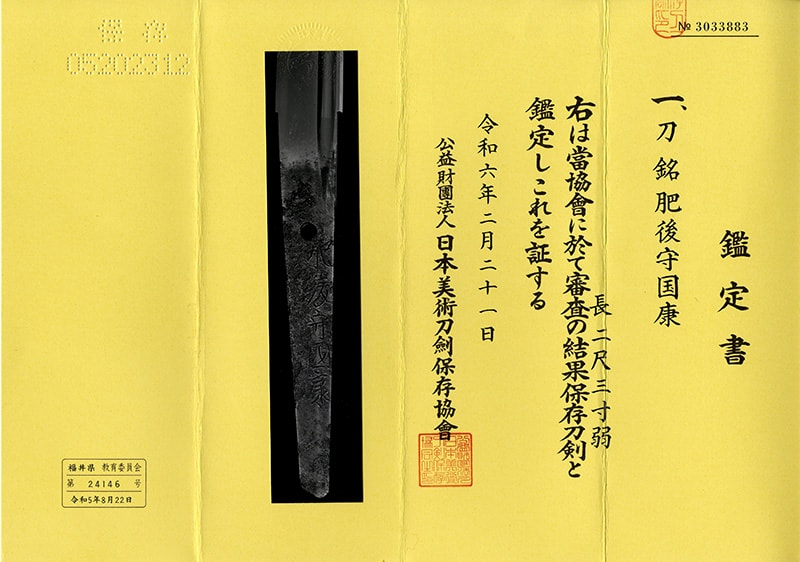
Jūyō-Tōken, 68th Session — Designated January 1, 2022 Katana, signed: Higo no Kami Kuniyasu (肥後守国康) — one blade Measurements Nagasa 70.0 cm, sori 0.85 cm, motohaba 2.95 cm, sakihaba 2.0 cm, kissaki-nagasa 3.0 cm, nakago-nagasa 21.0 cm, nakago-sori none Description Keijō: shinogi-zukuri, iori-mune; mihaba standard, with a noticeable taper from base to tip; kasane thick; curvature somewhat shallow; chū-kissaki compact. Kitae: tight ko-itame-hada; fine ji-nie; delicate chikei appear. Hamon: begins with a suguha yakidashi at the hamachi; above this the temper is comparatively broad, with chōji-midare as the main motif, mixed with gunome and ōfusa-chōji; at times the crests of the midare align to form “fist-shaped” chōji-midare, and also “layered-flower” chōji-midare; overall the temper is tall with pronounced undulations; thick ashi enter; the nioiguchi is somewhat deep; nie is abundantly applied; kinsuji and sunagashi appear; there is a small amount of nie-suji; the nioiguchi is bright. Bōshi: tempered deeply, with a slight tendency toward notare; the point on the omote turns back maru, and on the ura turns back ko-maru. Horimono: None. Nakago: ubu; tip ha-agari-kurijiri; filemarks ō-sujikai; one mekugi-ana; on the sashi-omote, below the peg hole and close to the mune, there is a five-character signature. Artisan Higo no Kami Kuniyasu (肥後守国康) Era Shintō, Kanbun-era style (early Edo period) Explanation Higo no Kami Kuniyasu—commonly called Genzaemon—was the third son of the first-generation Kawachi no Kami Kunisuke, and a younger brother of Naka-Kawachi (Kunisuke). His manner of workmanship, like that of Naka-Kawachi, excelled in chōji-midare, and there are examples in which “fist-shaped” chōji are mixed in. In skill he ranked next to his elder brother, and among his works there are some that approach the level of Naka-Kawachi. This katana clearly displays the Kanbun-shintō sugata: an evident taper between base and tip, shallow curvature, and a compact chū-kissaki. The jihada is a finely compacted ko-itame with plentiful ji-nie and delicate chikei, forming a beautiful forging that is thoroughly characteristic of Ōsaka shintō. The hamon places a yakidashi at the lower portion and above it forms a quintessential example of his work by tempering “fist-shaped” chōji-midare; moreover, the nioiguchi is bright and clear, demonstrating workmanship that approaches that of his brother, the second-generation Kawachi no Kami Kunisuke. In addition, the hiraniku is well preserved; the blade is sturdy, and its sound condition—offering a strong “in-hand” feel beyond what its dimensions might suggest—is praised. Also, while “fist-shaped” chōji-midare can easily become uniform and somewhat rigid, here the maker introduces deki with rises and falls and variations of large and small, and further tempers it with a suitably, slightly “broken” nuance; as a result, the overall impression gains a more natural texture, yielding a work with depth of taste. It is an excellent blade of notable quality.

NihontoWatch MonNihontoWatchBETA
MarketAuctionsEncyclopedia
Swords›Osaka Shinto›Kuniyasu›Juyo Higo no Kami Kuniyasu Katana
katanaJūyō
Shinto Kuniyasu

Juyo Higo no Kami Kuniyasu Katana

mei · Kunisuke School · Kanbun (1661-1673) · nagasa 70.8cm · sori 0.85cm

Price on request
Visit seller website →
Shinto Kuniyasu — 1 of 30
Shinto Kuniyasu — 2 of 30
Shinto Kuniyasu — 3 of 30
Shinto Kuniyasu — 4 of 30
Shinto Kuniyasu — 5 of 30
Shinto Kuniyasu — 6 of 30
Shinto Kuniyasu — 7 of 30
Shinto Kuniyasu — 8 of 30
Shinto Kuniyasu — 9 of 30
Shinto Kuniyasu — 10 of 30
Shinto Kuniyasu — 11 of 30
Shinto Kuniyasu — 12 of 30
Shinto Kuniyasu — 13 of 30
Shinto Kuniyasu — 14 of 30
Shinto Kuniyasu — 15 of 30
Shinto Kuniyasu — 16 of 30
Shinto Kuniyasu — 17 of 30
Shinto Kuniyasu — 18 of 30
Shinto Kuniyasu — 19 of 30
Shinto Kuniyasu — 20 of 30
Shinto Kuniyasu — 21 of 30
Shinto Kuniyasu — 22 of 30
Shinto Kuniyasu — 23 of 30
Shinto Kuniyasu — 24 of 30
Shinto Kuniyasu — 25 of 30
Shinto Kuniyasu — 26 of 30
Shinto Kuniyasu — 27 of 30
Shinto Kuniyasu — 28 of 30
Shinto Kuniyasu — 29 of 30
Shinto Kuniyasu — 30 of 30
1 / 30
1 / 30
Shinto Kuniyasu — 1 of 30Shinto Kuniyasu — 2 of 30Shinto Kuniyasu — 3 of 30Shinto Kuniyasu — 4 of 30Shinto Kuniyasu — 5 of 30Shinto Kuniyasu — 6 of 30Shinto Kuniyasu — 7 of 30Shinto Kuniyasu — 8 of 30Shinto Kuniyasu — 9 of 30Shinto Kuniyasu — 10 of 30Shinto Kuniyasu — 11 of 30Shinto Kuniyasu — 12 of 30Shinto Kuniyasu — 13 of 30Shinto Kuniyasu — 14 of 30Shinto Kuniyasu — 15 of 30Shinto Kuniyasu — 16 of 30Shinto Kuniyasu — 17 of 30Shinto Kuniyasu — 18 of 30Shinto Kuniyasu — 19 of 30Shinto Kuniyasu — 20 of 30Shinto Kuniyasu — 21 of 30Shinto Kuniyasu — 22 of 30Shinto Kuniyasu — 23 of 30Shinto Kuniyasu — 24 of 30Shinto Kuniyasu — 25 of 30Shinto Kuniyasu — 26 of 30Shinto Kuniyasu — 27 of 30Shinto Kuniyasu — 28 of 30Shinto Kuniyasu — 29 of 30Shinto Kuniyasu — 30 of 30
Measurements & details
Smith
Shinto Kuniyasu
Type
Katana
School
Osaka Shinto
Period
Around 1661–1673(Kanbun)
Province
Settsu
Signature
Signed(100% of this smith's designated works are signed)
Measurements
Nagasa 70.8cmSori 0.85cmMotohaba 2.95cmSakihaba 2cm
Description

This is a katana by Higo no Kami Kuniyasu, a direct descendant of the Kawachi no Kami Kunisuke school, active in the late 17th century. The blade exhibits typical Kanbun Shinto dimensions with a stout geometry and shallow saki-sori, featuring a tight ko-itame hada and a flamboyant hamon with kobushigata choji midare. It is rated Juyo by the NBTHK and comes with a set of late Edo Period uchigatana fittings adorned with the Tokugawa Aoi crest.

NBTHK Zufu Commentary

Juyo

AI translation — may contain errors

-, 68th Session — Designated January 1, 2022

, signed: no Kami Kuniyasu (肥後守国康) — one blade

Measurements 70.0 cm, 0.85 cm, 2.95 cm, 2.0 cm, 3.0 cm, 21.0 cm, none

Description Keijō: , ; standard, with a noticeable taper from base to tip; thick; curvature somewhat shallow; compact. : tight ; fine ; delicate appear. : begins with a at the ; above this the temper is comparatively broad, with as the main motif, mixed with and ōfusa-; at times the crests of the align to form “fist-shaped” , and also “layered-flower” ; overall the temper is tall with pronounced undulations; thick enter; the is somewhat deep; is abundantly applied; and appear; there is a small amount of ; the is bright. : tempered deeply, with a slight tendency toward ; the point on the turns back , and on the turns back . : None. : ; tip ; filemarks ; one ; on the , below the peg hole and close to the , there is a five-character signature.

Artisan no Kami Kuniyasu (肥後守国康)

Era , -era style (early period)

Explanation no Kami Kuniyasu—commonly called Genzaemon—was the third son of the first-generation Kawachi no Kami Kunisuke, and a younger brother of Naka-Kawachi (Kunisuke). His manner of workmanship, like that of Naka-Kawachi, excelled in , and there are examples in which “fist-shaped” are mixed in. In skill he ranked next to his elder brother, and among his works there are some that approach the level of Naka-Kawachi.

This clearly displays the - : an evident taper between base and tip, shallow curvature, and a compact . The is a finely compacted with plentiful and delicate , forming a beautiful forging that is thoroughly characteristic of Ōsaka . The places a at the lower portion and above it forms a quintessential example of his work by tempering “fist-shaped” ; moreover, the is bright and clear, demonstrating workmanship that approaches that of his brother, the second-generation Kawachi no Kami Kunisuke. In addition, the is well preserved; the blade is sturdy, and its sound condition—offering a strong “in-hand” feel beyond what its dimensions might suggest—is praised. Also, while “fist-shaped” can easily become uniform and somewhat rigid, here the maker introduces with rises and falls and variations of large and small, and further tempers it with a suitably, slightly “broken” nuance; as a result, the overall impression gains a more natural texture, yielding a work with depth of taste. It is an excellent blade of notable quality.

About the maker

Kuniyasu

國康

Osaka Shinto (Kawachi no Kami Kunisuke line) · Settsu · around 1661-1673

Tōken Taikan top 60%

5 pieces on the market now

›

Higo no Kami Kuniyasu, commonly called Genzaemon, signed his blades with a five-character mei and was the third son of the first-generation Kawachi no Kami Kunisuke of Osaka, the younger brother of the second generation whom the published sources call Naka-Kawachi. He worked in Settsu during the Kanbun years of the early Edo period, in the choji wing of the Osaka Shinto school. That line descends through Kunisuke from the Ishido tradition, which had revived the koto Bizen choji in new-sword steel, and Kuniyasu carries the manner one remove from its second-generation peak. The published record places him in skill just below his elder brother, observing that comparatively few of his works reach Naka-Kawachi in the quality of both ji and ha, while granting that the best of them approach him closely. On one katana the judges go further, finding the work so fully his own that it is 「中河内と選ぶところがない」[[c:1]], a piece that may be chosen without distinction from Naka-Kawachi.

What marks his hand first is the choji-midare and the fist-headed clove set within it. Over a suguha yakidashi that opens the temper above the hamachi, the ha rises into a choji-midare mixed with gunome, and into the pattern Kuniyasu sets the kobushi-gata choji, the clenched-fist heads that the second-generation Kunisuke had made the ornament of the line. On more than half his designated blades the judges name this feature as the point that exhibits his characteristic work, and on his richest katana the midare crests align further into juka-choji and admit the large-tasselled o-busa-choji, the temper running tall with marked rises and falls. The straight yakidashi at the base is the quiet tell that separates this from the old Bizen choji it otherwise recalls, an Edo Osaka convention rather than a Kamakura habit. Ashi enter the ha well, yo are sometimes mixed in, ko-nie adhere, and through the pattern run kinsuji and sunagashi, the nioiguchi staying bright and clear.

The jigane is a tight ko-itame, closely forged and laid with ji-nie, here and there opening into a patch of larger hada. On his finest work the ji-nie gathers fine and thick with delicate chikei, a forging the published sources call 「如何にも大阪新刀らしい」[[c:2]], thoroughly characteristic of Osaka shinto, beautiful and clear. The bohi and naginata-hi cut on one blade, and the double grooves on another, are the carving of a careful late hand. Over so animated an edge the boshi stays restrained, running straight and turning back in a small ko-maru rather than following the midare into the point, the calm finish the Osaka smiths favored. The sugata is the Kanbun-Shinto build, the mihaba slightly wide with little taper from base to tip, the kasane somewhat thick, the sori shallow and the chu-kissaki compact; one long katana extends past two shaku six sun in a dignified and well-balanced taihai whose thick kasane gives a real sense of weight in the hand.

The corpus the published record preserves is small and remarkably consistent: seven designated katana, all but one signed, all on ubu nakago carrying the five-character Higo no Kami Kuniyasu signature near the mune of the omote. There is no mumei or daimei problem to untangle and no dated survival to anchor a chronology, so the kantei rests entirely on the work, and the work is of one settled manner seen at two settings. At the everyday setting the choji-midare is regular and the kobushi-gata choji intermittent; at the best, on the late Reiwa-designated pieces, the temper broadens, the kobushi heads cluster and align, and the judges reach for their fullest praise. The phrase they apply to his most worked blade is exact: it is a 「拳形丁子乱れを焼いた典型作」[[c:3]], a quintessential example of his work in which the fist-shaped choji-midare is tempered above a yakidashi placed at the base.

Within the Kawachi-no-kami line Kuniyasu is the chief hand carrying the choji manner alongside and just beneath his brother. The resemblance the judges draw is to Naka-Kawachi, again and again, and it is a true one, grounded in the shared kobushi-gata choji, the dense ji-nie ko-itame and the bright nioiguchi the two brothers worked from the same workshop. His own blades are told within that closeness by degree rather than by a different feature: where his temper holds its rises and falls and avoids the rigidity into which the fist-shaped choji can stiffen, the result gains a natural texture and a depth of taste, and on one katana the published sources find his technical level revealed in 「殊更に拳形丁子を交えた華やかな丁子乱れに国康の技術の高さ」[[c:4]], the high skill shown in the gorgeous choji-midare with its fist-shaped heads. They call that blade a superior work that approaches Naka-Kawachi, 「中河内に迫る優品」[[c:5]].

In the connoisseurship he is a smith of the middle tiers rather than the summit, his record one of seven blades that have reached Juyo, none yet raised to Tokubetsu Juyo and none standing in the higher designations above it. None of the seven carries a recorded provenance or a named former owner, so his blades are encountered for the quality of their workmanship rather than for the houses they passed through. That makes him an accessible point of entry into the Osaka Shinto choji manner: a signed, sound Kanbun katana by Kuniyasu comes to the serious collector with some regularity, far more readily than the rare survivals of his father or the prized work of his brother Naka-Kawachi, and it offers the line's distinctive kobushi-gata choji on a blade that the judges themselves at their warmest set beside the second generation. The published sources give his common name as 「源左衛門」 and fix his place as the third son of the first Kawachi no Kami Kunisuke; the seven katana on record carry that lineage in steel, a careful and at moments brilliant hand working the brightest choji of the early Osaka school.

Historical importance

Where Kuniyasu stands among comparable artisans: across all of nihontō, and within tradition, era, and period. The tiers (Foremost · Leading · Major · Notable) weigh official designations from the NBTHK and Japan's Agency for Cultural Affairs, together with historical honors of lasting repute such as the Sansaku and Meibutsu-chō.

随一
Foremost
屈指
Leading
有数
Major
著名
Notable

Select a lens to see how it's measured.

Designation record
7 designated works
Jūyō
7
5 works by Kuniyasu on the market→
Kuniyasu — full profileOsaka Shinto (Kawachi no Kami Kunisuke line) school
About the school

Osaka Shinto

大坂新刀

Shinto · Settsu

73 pieces on the market now

›

Osaka in the early-to-mid Edo period was a merchant capital, a city of commerce and capital rather than a castle town tied to a single daimyo house, and the swordsmiths who gathered there worked for a wealthy townsman clientele as much as for warriors. The grouping known as Osaka Shinto (大坂新刀) took shape in Settsu from two feeder currents. Learn more →

17 recorded smiths255 designated works
Leading smiths
SmithEraDesignated
Shinkai真改1649-168279
Tadatsuna忠綱1673-171753
Kanesada包貞1673-168278
Kanesada包貞1648-165210
Kunisuke國助1658-166310
Explore the Osaka Shinto school →
NBTHK Certificate
Jūyō Tōken重要刀剣
Important Sword
›

A blade of top-grade workmanship and condition, formally judged to rank with a nationally recognized Important Art Object (Jūyō Bijutsuhin). Awarded only at the NBTHK’s competitive annual examination.

Of Japan’s roughly 2.5 million registered swords, only 12,307 (about 1 in 203) have ever attained Jūyō.

About the NBTHK›

The NBTHK (Nihon Bijutsu Tōken Hozon Kyōkai, the Society for the Preservation of Japanese Art Swords) is a public-interest incorporated foundation founded in 1948 and supervised by Japan’s Agency for Cultural Affairs (Bunkachō); it is based at the Japanese Sword Museum in Tokyo. Its expert panels physically examine each submitted work (shinsa) and issue a certificate (kanteishō) ranking it by artistic and historical merit. NBTHK papers are the most widely recognized standard of authentication for Japanese swords and fittings.

NBTHK official site→
Seller
T
Tosa Touken Do
🇯🇵Ships from Japan
›
✓Verified dealertosatoukendo.com
✓Ships worldwide✓English support
Return policy

As a rule, we do not accept returns from overseas. Once a deposit is paid, we hold the item for up to 3 months. The deposit is non-refundable.

View all of Tosa Touken Do’s listings→View this item on the dealer’s site→

More works by Shinto Kuniyasu

View all →
Aoi Art
Hozon
Katana - Hozon - by Shinto Kuniyasu - Higo Kami KuniyasuKatana - Hozon - by Shinto Kuniyasu - Higo Kami Kuniyasu

Katana

ByShinto Kuniyasu
¥2,700,000
Toushin
Tokuho
Daisho - Tokuho - by Shinto Kuniyasu - Daisho: Higo no kami KuniyasuDaisho - Tokuho - by Shinto Kuniyasu - Daisho: Higo no kami Kuniyasu

Daishō

ByShinto Kuniyasu
¥2,640,000
Yushindou
Hozon
Wakizashi - Hozon - by Shinto Kuniyasu - Higono-kami Kunihiro - Hozon TokenWakizashi - Hozon - by Shinto Kuniyasu - Higono-kami Kunihiro - Hozon Token

Wakizashi

ByShinto Kuniyasu
¥600,000
Toushin
Tokuho
Wakizashi - Tokuho - by Shinto Kuniyasu - Higonokami KuniyasuWakizashi - Tokuho - by Shinto Kuniyasu - Higonokami Kuniyasu

Wakizashi

ByShinto Kuniyasu
¥880,000

Previously sold by Shinto Kuniyasu

Choshuya
Wakizashi - by Shinto Kuniyasu - Hirazukuri Wakizashi: Higo no Kami Kuniyasu (O-Wazamono)Wakizashi - by Shinto Kuniyasu - Hirazukuri Wakizashi: Higo no Kami Kuniyasu (O-Wazamono)
Sold

Wakizashi

ByShinto Kuniyasu
SOLD
Tokka Biz
Tokuho
Wakizashi - Tokuho - by Shinto Kuniyasu - Higo no Kami KuniyasuWakizashi - Tokuho - by Shinto Kuniyasu - Higo no Kami Kuniyasu
Sold

Wakizashi

ByShinto Kuniyasu
SOLD
E-sword
Hozon
Katana - Hozon - by Shinto Kuniyasu - Higo no Kami Kuniyasu (Shinto Josaku, O-Wazamono)Katana - Hozon - by Shinto Kuniyasu - Higo no Kami Kuniyasu (Shinto Josaku, O-Wazamono)
Sold

Katana

ByShinto Kuniyasu
SOLD
Choshuya
Wakizashi - by Shinto Kuniyasu - Higo no Kami KuniyasuWakizashi - by Shinto Kuniyasu - Higo no Kami Kuniyasu
Sold

Wakizashi

ByShinto Kuniyasu
SOLD
Choshuya
Wakizashi - by Shinto Kuniyasu - Higo no Kami Kuniyasu (O-wazamono)Wakizashi - by Shinto Kuniyasu - Higo no Kami Kuniyasu (O-wazamono)
Sold

Wakizashi

ByShinto Kuniyasu
SOLD
Toushin
Wakizashi - by Shinto Kuniyasu - Higo no kami KuniyasuWakizashi - by Shinto Kuniyasu - Higo no kami Kuniyasu
Sold

Wakizashi

ByShinto Kuniyasu
SOLD
Choshuya
Wakizashi - by Shinto Kuniyasu - Higo no Kami KuniyasuWakizashi - by Shinto Kuniyasu - Higo no Kami Kuniyasu
Sold

Wakizashi

ByShinto Kuniyasu
SOLD
E-sword
Hozon
Yari - Hozon - by Shinto Kuniyasu - Higo no Kami KuniyasuYari - Hozon - by Shinto Kuniyasu - Higo no Kami Kuniyasu
Sold

Yari

ByShinto Kuniyasu
SOLD

More from the Osaka Shinto school

View all →
World Seiyudo
Tokuho
Wakizashi - Tokuho - by Shinto Tadatsuna - Awataguchi Omi-no-kami Tadatsuna (Ikkanshi Tadatsuna) - Tokubetsu Hozon TokenWakizashi - Tokuho - by Shinto Tadatsuna - Awataguchi Omi-no-kami Tadatsuna (Ikkanshi Tadatsuna) - Tokubetsu Hozon Token

Wakizashi

ByShinto Tadatsuna
¥1,500,000
Touken Komachi
Tokuho
Katana - Tokuho - by Osaka Shinkai - 1st Generation Izumi-no-kami KunisadaKatana - Tokuho - by Osaka Shinkai - 1st Generation Izumi-no-kami Kunisada

Katana

ByOsaka Shinkai
¥1,200,000
Bushido Antique Japanese Swords
Tokuho
Wakizashi - Tokuho - by Shinto Tadatsuna - Awataguchi Omi No Kami Tadatsuna WakizashiWakizashi - Tokuho - by Shinto Tadatsuna - Awataguchi Omi No Kami Tadatsuna Wakizashi

Wakizashi

ByShinto Tadatsuna
¥24,000
World Seiyudo
Tokuho
Wakizashi - Tokuho - by Shinto Terukane - Sakakura Gonnoshin TerukaneWakizashi - Tokuho - by Shinto Terukane - Sakakura Gonnoshin Terukane

Wakizashi

ByShinto Terukane
¥1,900,000
Aoi Art
Tokuho
Wakizashi - Tokuho - by Osaka Shinto School - Higo no Kami KuniyasuWakizashi - Tokuho - by Osaka Shinto School - Higo no Kami Kuniyasu

Wakizashi

ByOsaka Shinto School
Starting Bid¥650,000
Katana Yamadaiya
Tokubetsu Kichō
Wakizashi - Tokubetsu Kichō - by Shinto Suketaka - Special Kicho Token: Ozaki Suketaka, forged at the request of Mr. Okamura, Tenmei 6, February 4th...Wakizashi - Tokubetsu Kichō - by Shinto Suketaka - Special Kicho Token: Ozaki Suketaka, forged at the request of Mr. Okamura, Tenmei 6, February 4th...

Wakizashi

ByShinto Suketaka
¥350,000
World Seiyudo
Tokuho
Katana - Tokuho - by Shinto Tadatsuna - Omi-No-Kami Tadatsuna (Ikkanshi Tadatsuna)Katana - Tokuho - by Shinto Tadatsuna - Omi-No-Kami Tadatsuna (Ikkanshi Tadatsuna)

Katana

ByShinto Tadatsuna
¥4,000,000
Iida Koendo
Tokuho
Katana - Tokuho - by Osaka Shinkai - Inoue Shinkai - Dated 1678Katana - Tokuho - by Osaka Shinkai - Inoue Shinkai - Dated 1678

Katana

ByOsaka Shinkai
¥13,200,000

Swords

  • Katana
  • Wakizashi
  • Tantō
  • Tachi
  • Naginata
  • Yari

Fittings

  • Tsuba
  • Fuchi-Kashira
  • Kozuka
  • Menuki

By Certification

  • Tokujū
  • Jūyō
  • Tokuho
  • Hozon

Resources

  • Dealer Directory
  • Artist Directory
  • Glossary
  • Browse All
Nihontowatch© 2026
TermsPrivacyCookiesAbout

Description

This is a katana by Higo no Kami Kuniyasu, a direct descendant of the Kawachi no Kami Kunisuke school, active in the late 17th century. The blade exhibits typical Kanbun Shinto dimensions with a stout geometry and shallow saki-sori, featuring a tight ko-itame hada and a flamboyant hamon with kobushigata choji midare. It is rated Juyo by the NBTHK and comes with a set of late Edo Period uchigatana fittings adorned with the Tokugawa Aoi crest.

NBTHK Setsumei

Jūyō-Tōken, 68th Session — Designated January 1, 2022 Katana, signed: Higo no Kami Kuniyasu (肥後守国康) — one blade Measurements Nagasa 70.0 cm, sori 0.85 cm, motohaba 2.95 cm, sakihaba 2.0 cm, kissaki-nagasa 3.0 cm, nakago-nagasa 21.0 cm, nakago-sori none Description Keijō: shinogi-zukuri, iori-mune; mihaba standard, with a noticeable taper from base to tip; kasane thick; curvature somewhat shallow; chū-kissaki compact. Kitae: tight ko-itame-hada; fine ji-nie; delicate chikei appear. Hamon: begins with a suguha yakidashi at the hamachi; above this the temper is comparatively broad, with chōji-midare as the main motif, mixed with gunome and ōfusa-chōji; at times the crests of the midare align to form “fist-shaped” chōji-midare, and also “layered-flower” chōji-midare; overall the temper is tall with pronounced undulations; thick ashi enter; the nioiguchi is somewhat deep; nie is abundantly applied; kinsuji and sunagashi appear; there is a small amount of nie-suji; the nioiguchi is bright. Bōshi: tempered deeply, with a slight tendency toward notare; the point on the omote turns back maru, and on the ura turns back ko-maru. Horimono: None. Nakago: ubu; tip ha-agari-kurijiri; filemarks ō-sujikai; one mekugi-ana; on the sashi-omote, below the peg hole and close to the mune, there is a five-character signature. Artisan Higo no Kami Kuniyasu (肥後守国康) Era Shintō, Kanbun-era style (early Edo period) Explanation Higo no Kami Kuniyasu—commonly called Genzaemon—was the third son of the first-generation Kawachi no Kami Kunisuke, and a younger brother of Naka-Kawachi (Kunisuke). His manner of workmanship, like that of Naka-Kawachi, excelled in chōji-midare, and there are examples in which “fist-shaped” chōji are mixed in. In skill he ranked next to his elder brother, and among his works there are some that approach the level of Naka-Kawachi. This katana clearly displays the Kanbun-shintō sugata: an evident taper between base and tip, shallow curvature, and a compact chū-kissaki. The jihada is a finely compacted ko-itame with plentiful ji-nie and delicate chikei, forming a beautiful forging that is thoroughly characteristic of Ōsaka shintō. The hamon places a yakidashi at the lower portion and above it forms a quintessential example of his work by tempering “fist-shaped” chōji-midare; moreover, the nioiguchi is bright and clear, demonstrating workmanship that approaches that of his brother, the second-generation Kawachi no Kami Kunisuke. In addition, the hiraniku is well preserved; the blade is sturdy, and its sound condition—offering a strong “in-hand” feel beyond what its dimensions might suggest—is praised. Also, while “fist-shaped” chōji-midare can easily become uniform and somewhat rigid, here the maker introduces deki with rises and falls and variations of large and small, and further tempers it with a suitably, slightly “broken” nuance; as a result, the overall impression gains a more natural texture, yielding a work with depth of taste. It is an excellent blade of notable quality.

NihontoWatch MonNihontoWatchBETA
MarketAuctionsEncyclopedia
Swords›Osaka Shinto›Kuniyasu›Juyo Higo no Kami Kuniyasu Katana
katanaJūyō
Shinto Kuniyasu

Juyo Higo no Kami Kuniyasu Katana

mei · Kunisuke School · Kanbun (1661-1673) · nagasa 70.8cm · sori 0.85cm

Price on request
Visit seller website →
Shinto Kuniyasu — 1 of 30
Shinto Kuniyasu — 2 of 30
Shinto Kuniyasu — 3 of 30
Shinto Kuniyasu — 4 of 30
Shinto Kuniyasu — 5 of 30
Shinto Kuniyasu — 6 of 30
Shinto Kuniyasu — 7 of 30
Shinto Kuniyasu — 8 of 30
Shinto Kuniyasu — 9 of 30
Shinto Kuniyasu — 10 of 30
Shinto Kuniyasu — 11 of 30
Shinto Kuniyasu — 12 of 30
Shinto Kuniyasu — 13 of 30
Shinto Kuniyasu — 14 of 30
Shinto Kuniyasu — 15 of 30
Shinto Kuniyasu — 16 of 30
Shinto Kuniyasu — 17 of 30
Shinto Kuniyasu — 18 of 30
Shinto Kuniyasu — 19 of 30
Shinto Kuniyasu — 20 of 30
Shinto Kuniyasu — 21 of 30
Shinto Kuniyasu — 22 of 30
Shinto Kuniyasu — 23 of 30
Shinto Kuniyasu — 24 of 30
Shinto Kuniyasu — 25 of 30
Shinto Kuniyasu — 26 of 30
Shinto Kuniyasu — 27 of 30
Shinto Kuniyasu — 28 of 30
Shinto Kuniyasu — 29 of 30
Shinto Kuniyasu — 30 of 30
1 / 30
1 / 30
Shinto Kuniyasu — 1 of 30Shinto Kuniyasu — 2 of 30Shinto Kuniyasu — 3 of 30Shinto Kuniyasu — 4 of 30Shinto Kuniyasu — 5 of 30Shinto Kuniyasu — 6 of 30Shinto Kuniyasu — 7 of 30Shinto Kuniyasu — 8 of 30Shinto Kuniyasu — 9 of 30Shinto Kuniyasu — 10 of 30Shinto Kuniyasu — 11 of 30Shinto Kuniyasu — 12 of 30Shinto Kuniyasu — 13 of 30Shinto Kuniyasu — 14 of 30Shinto Kuniyasu — 15 of 30Shinto Kuniyasu — 16 of 30Shinto Kuniyasu — 17 of 30Shinto Kuniyasu — 18 of 30Shinto Kuniyasu — 19 of 30Shinto Kuniyasu — 20 of 30Shinto Kuniyasu — 21 of 30Shinto Kuniyasu — 22 of 30Shinto Kuniyasu — 23 of 30Shinto Kuniyasu — 24 of 30Shinto Kuniyasu — 25 of 30Shinto Kuniyasu — 26 of 30Shinto Kuniyasu — 27 of 30Shinto Kuniyasu — 28 of 30Shinto Kuniyasu — 29 of 30Shinto Kuniyasu — 30 of 30
Measurements & details
Smith
Shinto Kuniyasu
Type
Katana
School
Osaka Shinto
Period
Around 1661–1673(Kanbun)
Province
Settsu
Signature
Signed(100% of this smith's designated works are signed)
Measurements
Nagasa 70.8cmSori 0.85cmMotohaba 2.95cmSakihaba 2cm
Description

This is a katana by Higo no Kami Kuniyasu, a direct descendant of the Kawachi no Kami Kunisuke school, active in the late 17th century. The blade exhibits typical Kanbun Shinto dimensions with a stout geometry and shallow saki-sori, featuring a tight ko-itame hada and a flamboyant hamon with kobushigata choji midare. It is rated Juyo by the NBTHK and comes with a set of late Edo Period uchigatana fittings adorned with the Tokugawa Aoi crest.

NBTHK Zufu Commentary

Juyo

AI translation — may contain errors

-, 68th Session — Designated January 1, 2022

, signed: no Kami Kuniyasu (肥後守国康) — one blade

Measurements 70.0 cm, 0.85 cm, 2.95 cm, 2.0 cm, 3.0 cm, 21.0 cm, none

Description Keijō: , ; standard, with a noticeable taper from base to tip; thick; curvature somewhat shallow; compact. : tight ; fine ; delicate appear. : begins with a at the ; above this the temper is comparatively broad, with as the main motif, mixed with and ōfusa-; at times the crests of the align to form “fist-shaped” , and also “layered-flower” ; overall the temper is tall with pronounced undulations; thick enter; the is somewhat deep; is abundantly applied; and appear; there is a small amount of ; the is bright. : tempered deeply, with a slight tendency toward ; the point on the turns back , and on the turns back . : None. : ; tip ; filemarks ; one ; on the , below the peg hole and close to the , there is a five-character signature.

Artisan no Kami Kuniyasu (肥後守国康)

Era , -era style (early period)

Explanation no Kami Kuniyasu—commonly called Genzaemon—was the third son of the first-generation Kawachi no Kami Kunisuke, and a younger brother of Naka-Kawachi (Kunisuke). His manner of workmanship, like that of Naka-Kawachi, excelled in , and there are examples in which “fist-shaped” are mixed in. In skill he ranked next to his elder brother, and among his works there are some that approach the level of Naka-Kawachi.

This clearly displays the - : an evident taper between base and tip, shallow curvature, and a compact . The is a finely compacted with plentiful and delicate , forming a beautiful forging that is thoroughly characteristic of Ōsaka . The places a at the lower portion and above it forms a quintessential example of his work by tempering “fist-shaped” ; moreover, the is bright and clear, demonstrating workmanship that approaches that of his brother, the second-generation Kawachi no Kami Kunisuke. In addition, the is well preserved; the blade is sturdy, and its sound condition—offering a strong “in-hand” feel beyond what its dimensions might suggest—is praised. Also, while “fist-shaped” can easily become uniform and somewhat rigid, here the maker introduces with rises and falls and variations of large and small, and further tempers it with a suitably, slightly “broken” nuance; as a result, the overall impression gains a more natural texture, yielding a work with depth of taste. It is an excellent blade of notable quality.

About the maker

Kuniyasu

國康

Osaka Shinto (Kawachi no Kami Kunisuke line) · Settsu · around 1661-1673

Tōken Taikan top 60%

5 pieces on the market now

›

Higo no Kami Kuniyasu, commonly called Genzaemon, signed his blades with a five-character mei and was the third son of the first-generation Kawachi no Kami Kunisuke of Osaka, the younger brother of the second generation whom the published sources call Naka-Kawachi. He worked in Settsu during the Kanbun years of the early Edo period, in the choji wing of the Osaka Shinto school. That line descends through Kunisuke from the Ishido tradition, which had revived the koto Bizen choji in new-sword steel, and Kuniyasu carries the manner one remove from its second-generation peak. The published record places him in skill just below his elder brother, observing that comparatively few of his works reach Naka-Kawachi in the quality of both ji and ha, while granting that the best of them approach him closely. On one katana the judges go further, finding the work so fully his own that it is 「中河内と選ぶところがない」[[c:1]], a piece that may be chosen without distinction from Naka-Kawachi.

What marks his hand first is the choji-midare and the fist-headed clove set within it. Over a suguha yakidashi that opens the temper above the hamachi, the ha rises into a choji-midare mixed with gunome, and into the pattern Kuniyasu sets the kobushi-gata choji, the clenched-fist heads that the second-generation Kunisuke had made the ornament of the line. On more than half his designated blades the judges name this feature as the point that exhibits his characteristic work, and on his richest katana the midare crests align further into juka-choji and admit the large-tasselled o-busa-choji, the temper running tall with marked rises and falls. The straight yakidashi at the base is the quiet tell that separates this from the old Bizen choji it otherwise recalls, an Edo Osaka convention rather than a Kamakura habit. Ashi enter the ha well, yo are sometimes mixed in, ko-nie adhere, and through the pattern run kinsuji and sunagashi, the nioiguchi staying bright and clear.

The jigane is a tight ko-itame, closely forged and laid with ji-nie, here and there opening into a patch of larger hada. On his finest work the ji-nie gathers fine and thick with delicate chikei, a forging the published sources call 「如何にも大阪新刀らしい」[[c:2]], thoroughly characteristic of Osaka shinto, beautiful and clear. The bohi and naginata-hi cut on one blade, and the double grooves on another, are the carving of a careful late hand. Over so animated an edge the boshi stays restrained, running straight and turning back in a small ko-maru rather than following the midare into the point, the calm finish the Osaka smiths favored. The sugata is the Kanbun-Shinto build, the mihaba slightly wide with little taper from base to tip, the kasane somewhat thick, the sori shallow and the chu-kissaki compact; one long katana extends past two shaku six sun in a dignified and well-balanced taihai whose thick kasane gives a real sense of weight in the hand.

The corpus the published record preserves is small and remarkably consistent: seven designated katana, all but one signed, all on ubu nakago carrying the five-character Higo no Kami Kuniyasu signature near the mune of the omote. There is no mumei or daimei problem to untangle and no dated survival to anchor a chronology, so the kantei rests entirely on the work, and the work is of one settled manner seen at two settings. At the everyday setting the choji-midare is regular and the kobushi-gata choji intermittent; at the best, on the late Reiwa-designated pieces, the temper broadens, the kobushi heads cluster and align, and the judges reach for their fullest praise. The phrase they apply to his most worked blade is exact: it is a 「拳形丁子乱れを焼いた典型作」[[c:3]], a quintessential example of his work in which the fist-shaped choji-midare is tempered above a yakidashi placed at the base.

Within the Kawachi-no-kami line Kuniyasu is the chief hand carrying the choji manner alongside and just beneath his brother. The resemblance the judges draw is to Naka-Kawachi, again and again, and it is a true one, grounded in the shared kobushi-gata choji, the dense ji-nie ko-itame and the bright nioiguchi the two brothers worked from the same workshop. His own blades are told within that closeness by degree rather than by a different feature: where his temper holds its rises and falls and avoids the rigidity into which the fist-shaped choji can stiffen, the result gains a natural texture and a depth of taste, and on one katana the published sources find his technical level revealed in 「殊更に拳形丁子を交えた華やかな丁子乱れに国康の技術の高さ」[[c:4]], the high skill shown in the gorgeous choji-midare with its fist-shaped heads. They call that blade a superior work that approaches Naka-Kawachi, 「中河内に迫る優品」[[c:5]].

In the connoisseurship he is a smith of the middle tiers rather than the summit, his record one of seven blades that have reached Juyo, none yet raised to Tokubetsu Juyo and none standing in the higher designations above it. None of the seven carries a recorded provenance or a named former owner, so his blades are encountered for the quality of their workmanship rather than for the houses they passed through. That makes him an accessible point of entry into the Osaka Shinto choji manner: a signed, sound Kanbun katana by Kuniyasu comes to the serious collector with some regularity, far more readily than the rare survivals of his father or the prized work of his brother Naka-Kawachi, and it offers the line's distinctive kobushi-gata choji on a blade that the judges themselves at their warmest set beside the second generation. The published sources give his common name as 「源左衛門」 and fix his place as the third son of the first Kawachi no Kami Kunisuke; the seven katana on record carry that lineage in steel, a careful and at moments brilliant hand working the brightest choji of the early Osaka school.
Historical importance

Where Kuniyasu stands among comparable artisans: across all of nihontō, and within tradition, era, and period. The tiers (Foremost · Leading · Major · Notable) weigh official designations from the NBTHK and Japan's Agency for Cultural Affairs, together with historical honors of lasting repute such as the Sansaku and Meibutsu-chō.
随一
Foremost
屈指
Leading
有数
Major
著名
Notable

Select a lens to see how it's measured.

Designation record
7 designated works
Jūyō
7
5 works by Kuniyasu on the market→
Kuniyasu — full profileOsaka Shinto (Kawachi no Kami Kunisuke line) school
About the school

Osaka Shinto

大坂新刀

Shinto · Settsu

73 pieces on the market now

›

Osaka in the early-to-mid Edo period was a merchant capital, a city of commerce and capital rather than a castle town tied to a single daimyo house, and the swordsmiths who gathered there worked for a wealthy townsman clientele as much as for warriors. The grouping known as Osaka Shinto (大坂新刀) took shape in Settsu from two feeder currents. Learn more →

17 recorded smiths255 designated works
Leading smiths
SmithEraDesignated
Shinkai真改1649-168279
Tadatsuna忠綱1673-171753
Kanesada包貞1673-168278
Kanesada包貞1648-165210
Kunisuke國助1658-166310
Explore the Osaka Shinto school →
NBTHK Certificate
Jūyō Tōken重要刀剣
Important Sword
›

A blade of top-grade workmanship and condition, formally judged to rank with a nationally recognized Important Art Object (Jūyō Bijutsuhin). Awarded only at the NBTHK’s competitive annual examination.

Of Japan’s roughly 2.5 million registered swords, only 12,307 (about 1 in 203) have ever attained Jūyō.

About the NBTHK›

The NBTHK (Nihon Bijutsu Tōken Hozon Kyōkai, the Society for the Preservation of Japanese Art Swords) is a public-interest incorporated foundation founded in 1948 and supervised by Japan’s Agency for Cultural Affairs (Bunkachō); it is based at the Japanese Sword Museum in Tokyo. Its expert panels physically examine each submitted work (shinsa) and issue a certificate (kanteishō) ranking it by artistic and historical merit. NBTHK papers are the most widely recognized standard of authentication for Japanese swords and fittings.

NBTHK official site→
Seller
T
Tosa Touken Do
🇯🇵Ships from Japan
›
✓Verified dealertosatoukendo.com
✓Ships worldwide✓English support
Return policy

As a rule, we do not accept returns from overseas. Once a deposit is paid, we hold the item for up to 3 months. The deposit is non-refundable.

View all of Tosa Touken Do’s listings→View this item on the dealer’s site→

More works by Shinto Kuniyasu

View all →
Aoi Art
Hozon
Katana - Hozon - by Shinto Kuniyasu - Higo Kami KuniyasuKatana - Hozon - by Shinto Kuniyasu - Higo Kami Kuniyasu

Katana

ByShinto Kuniyasu
¥2,700,000
Toushin
Tokuho
Daisho - Tokuho - by Shinto Kuniyasu - Daisho: Higo no kami KuniyasuDaisho - Tokuho - by Shinto Kuniyasu - Daisho: Higo no kami Kuniyasu

Daishō

ByShinto Kuniyasu
¥2,640,000
Yushindou
Hozon
Wakizashi - Hozon - by Shinto Kuniyasu - Higono-kami Kunihiro - Hozon TokenWakizashi - Hozon - by Shinto Kuniyasu - Higono-kami Kunihiro - Hozon Token

Wakizashi

ByShinto Kuniyasu
¥600,000
Toushin
Tokuho
Wakizashi - Tokuho - by Shinto Kuniyasu - Higonokami KuniyasuWakizashi - Tokuho - by Shinto Kuniyasu - Higonokami Kuniyasu

Wakizashi

ByShinto Kuniyasu
¥880,000

Previously sold by Shinto Kuniyasu

Choshuya
Wakizashi - by Shinto Kuniyasu - Hirazukuri Wakizashi: Higo no Kami Kuniyasu (O-Wazamono)Wakizashi - by Shinto Kuniyasu - Hirazukuri Wakizashi: Higo no Kami Kuniyasu (O-Wazamono)
Sold

Wakizashi

ByShinto Kuniyasu
SOLD
Tokka Biz
Tokuho
Wakizashi - Tokuho - by Shinto Kuniyasu - Higo no Kami KuniyasuWakizashi - Tokuho - by Shinto Kuniyasu - Higo no Kami Kuniyasu
Sold

Wakizashi

ByShinto Kuniyasu
SOLD
E-sword
Hozon
Katana - Hozon - by Shinto Kuniyasu - Higo no Kami Kuniyasu (Shinto Josaku, O-Wazamono)Katana - Hozon - by Shinto Kuniyasu - Higo no Kami Kuniyasu (Shinto Josaku, O-Wazamono)
Sold

Katana

ByShinto Kuniyasu
SOLD
Choshuya
Wakizashi - by Shinto Kuniyasu - Higo no Kami KuniyasuWakizashi - by Shinto Kuniyasu - Higo no Kami Kuniyasu
Sold

Wakizashi

ByShinto Kuniyasu
SOLD
Choshuya
Wakizashi - by Shinto Kuniyasu - Higo no Kami Kuniyasu (O-wazamono)Wakizashi - by Shinto Kuniyasu - Higo no Kami Kuniyasu (O-wazamono)
Sold

Wakizashi

ByShinto Kuniyasu
SOLD
Toushin
Wakizashi - by Shinto Kuniyasu - Higo no kami KuniyasuWakizashi - by Shinto Kuniyasu - Higo no kami Kuniyasu
Sold

Wakizashi

ByShinto Kuniyasu
SOLD
Choshuya
Wakizashi - by Shinto Kuniyasu - Higo no Kami KuniyasuWakizashi - by Shinto Kuniyasu - Higo no Kami Kuniyasu
Sold

Wakizashi

ByShinto Kuniyasu
SOLD
E-sword
Hozon
Yari - Hozon - by Shinto Kuniyasu - Higo no Kami KuniyasuYari - Hozon - by Shinto Kuniyasu - Higo no Kami Kuniyasu
Sold

Yari

ByShinto Kuniyasu
SOLD

More from the Osaka Shinto school

View all →
World Seiyudo
Tokuho
Wakizashi - Tokuho - by Shinto Tadatsuna - Awataguchi Omi-no-kami Tadatsuna (Ikkanshi Tadatsuna) - Tokubetsu Hozon TokenWakizashi - Tokuho - by Shinto Tadatsuna - Awataguchi Omi-no-kami Tadatsuna (Ikkanshi Tadatsuna) - Tokubetsu Hozon Token

Wakizashi

ByShinto Tadatsuna
¥1,500,000
Touken Komachi
Tokuho
Katana - Tokuho - by Osaka Shinkai - 1st Generation Izumi-no-kami KunisadaKatana - Tokuho - by Osaka Shinkai - 1st Generation Izumi-no-kami Kunisada

Katana

ByOsaka Shinkai
¥1,200,000
Bushido Antique Japanese Swords
Tokuho
Wakizashi - Tokuho - by Shinto Tadatsuna - Awataguchi Omi No Kami Tadatsuna WakizashiWakizashi - Tokuho - by Shinto Tadatsuna - Awataguchi Omi No Kami Tadatsuna Wakizashi

Wakizashi

ByShinto Tadatsuna
¥24,000
World Seiyudo
Tokuho
Wakizashi - Tokuho - by Shinto Terukane - Sakakura Gonnoshin TerukaneWakizashi - Tokuho - by Shinto Terukane - Sakakura Gonnoshin Terukane

Wakizashi

ByShinto Terukane
¥1,900,000
Aoi Art
Tokuho
Wakizashi - Tokuho - by Osaka Shinto School - Higo no Kami KuniyasuWakizashi - Tokuho - by Osaka Shinto School - Higo no Kami Kuniyasu

Wakizashi

ByOsaka Shinto School
Starting Bid¥650,000
Katana Yamadaiya
Tokubetsu Kichō
Wakizashi - Tokubetsu Kichō - by Shinto Suketaka - Special Kicho Token: Ozaki Suketaka, forged at the request of Mr. Okamura, Tenmei 6, February 4th...Wakizashi - Tokubetsu Kichō - by Shinto Suketaka - Special Kicho Token: Ozaki Suketaka, forged at the request of Mr. Okamura, Tenmei 6, February 4th...

Wakizashi

ByShinto Suketaka
¥350,000
World Seiyudo
Tokuho
Katana - Tokuho - by Shinto Tadatsuna - Omi-No-Kami Tadatsuna (Ikkanshi Tadatsuna)Katana - Tokuho - by Shinto Tadatsuna - Omi-No-Kami Tadatsuna (Ikkanshi Tadatsuna)

Katana

ByShinto Tadatsuna
¥4,000,000
Iida Koendo
Tokuho
Katana - Tokuho - by Osaka Shinkai - Inoue Shinkai - Dated 1678Katana - Tokuho - by Osaka Shinkai - Inoue Shinkai - Dated 1678

Katana

ByOsaka Shinkai
¥13,200,000

Swords

  • Katana
  • Wakizashi
  • Tantō
  • Tachi
  • Naginata
  • Yari

Fittings

  • Tsuba
  • Fuchi-Kashira
  • Kozuka
  • Menuki

By Certification

  • Tokujū
  • Jūyō
  • Tokuho
  • Hozon

Resources

  • Dealer Directory
  • Artist Directory
  • Glossary
  • Browse All
Nihontowatch© 2026
TermsPrivacyCookiesAbout
NihontoWatch Mon

NihontoWatchBETA

MarketAuctions
Encyclopedia
NihontoWatch Mon

NihontoWatchBETA

MarketAuctions
Encyclopedia