NihontoWatch Mon

NihontoWatchBETA

MarketAuctions
Encyclopedia
NihontoWatch Mon

NihontoWatchBETA

MarketAuctions
Encyclopedia

Description

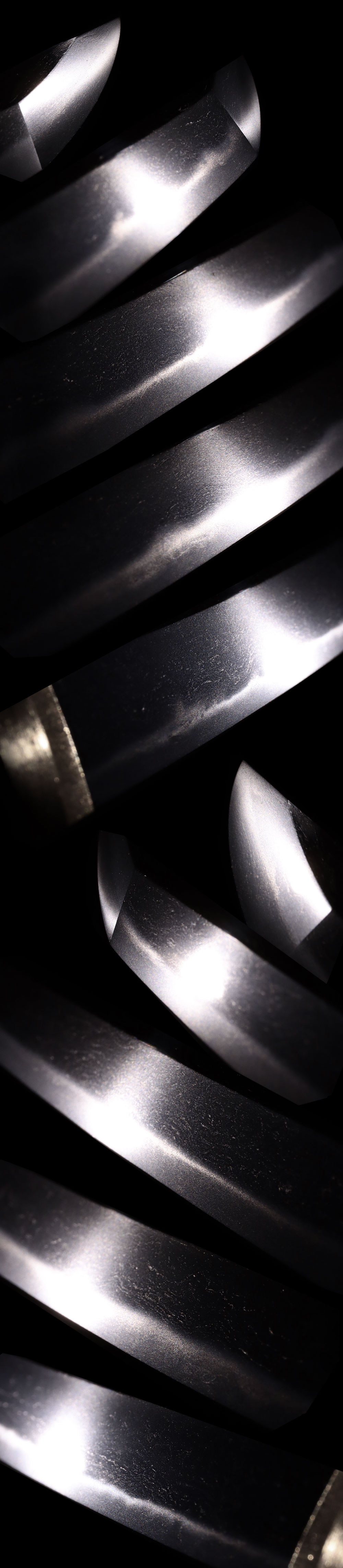
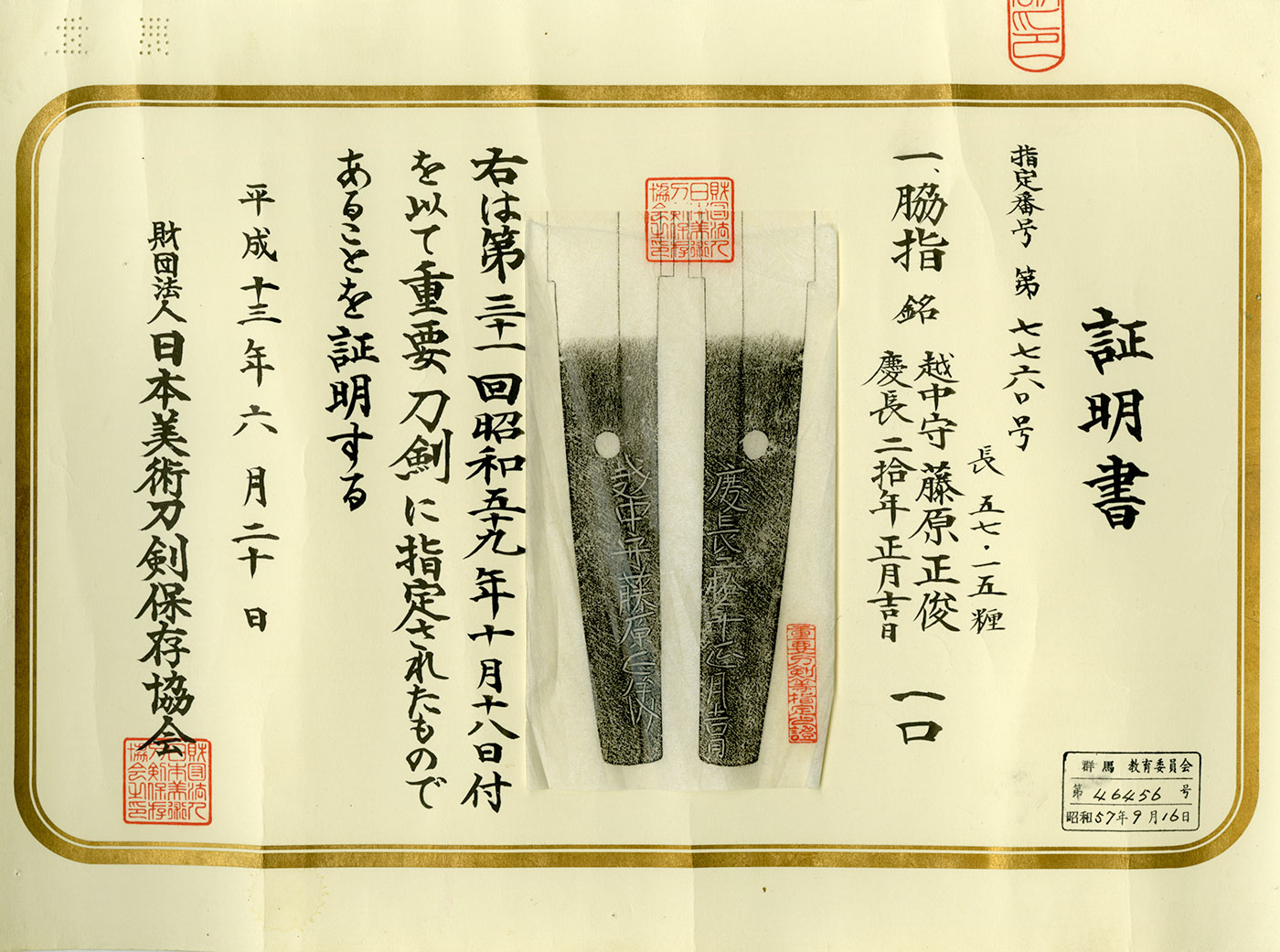
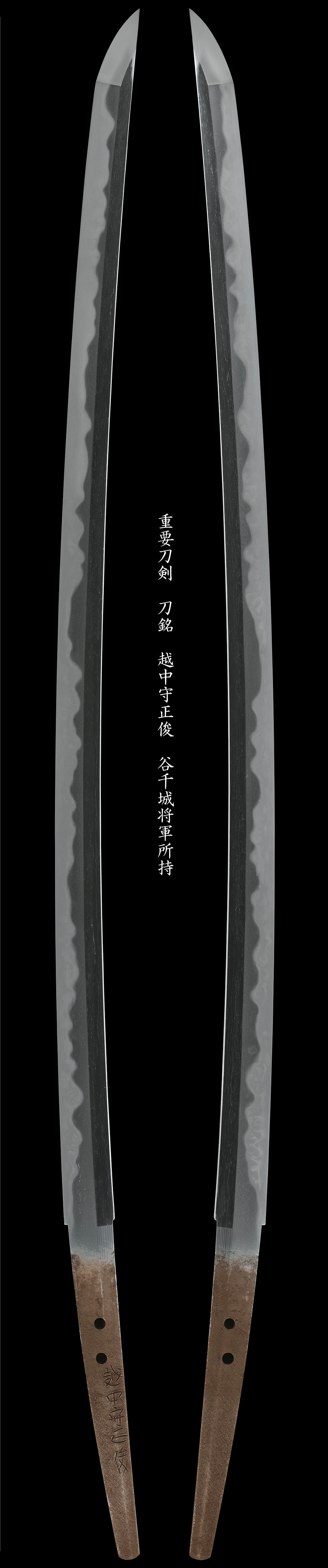
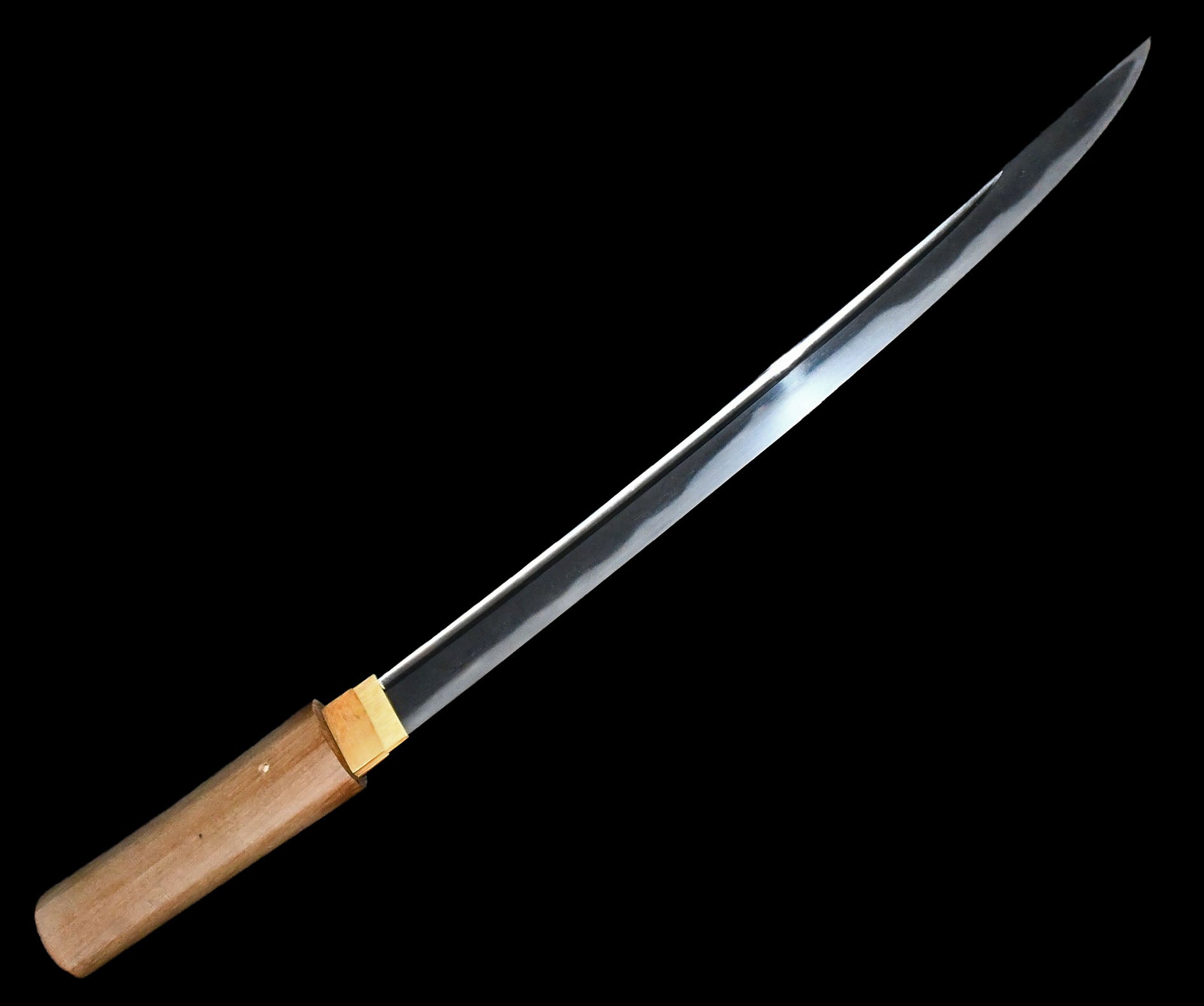
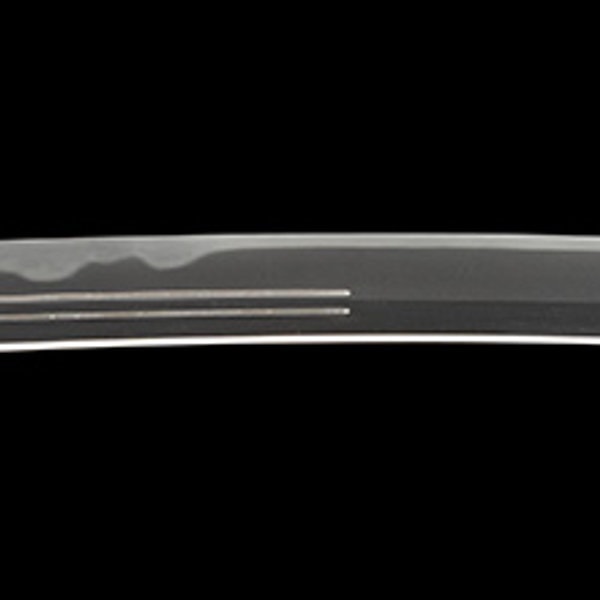
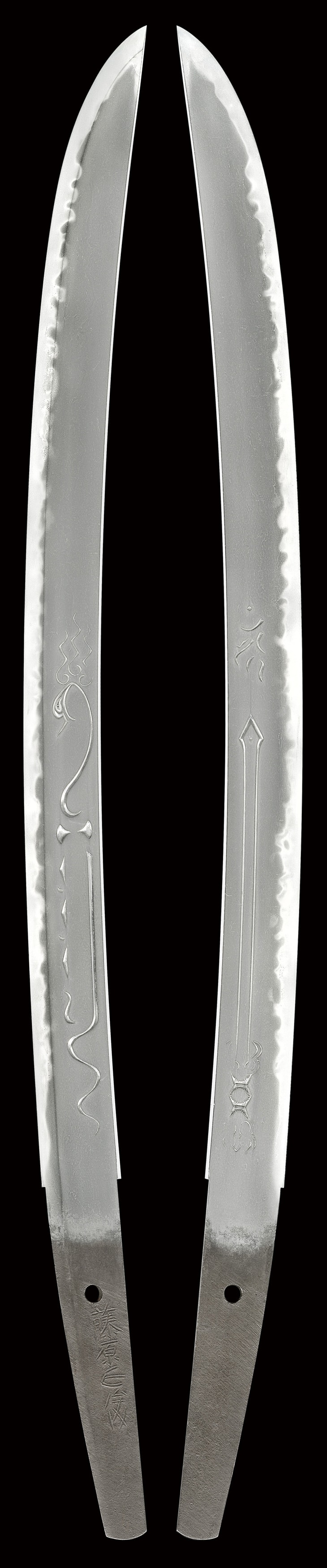
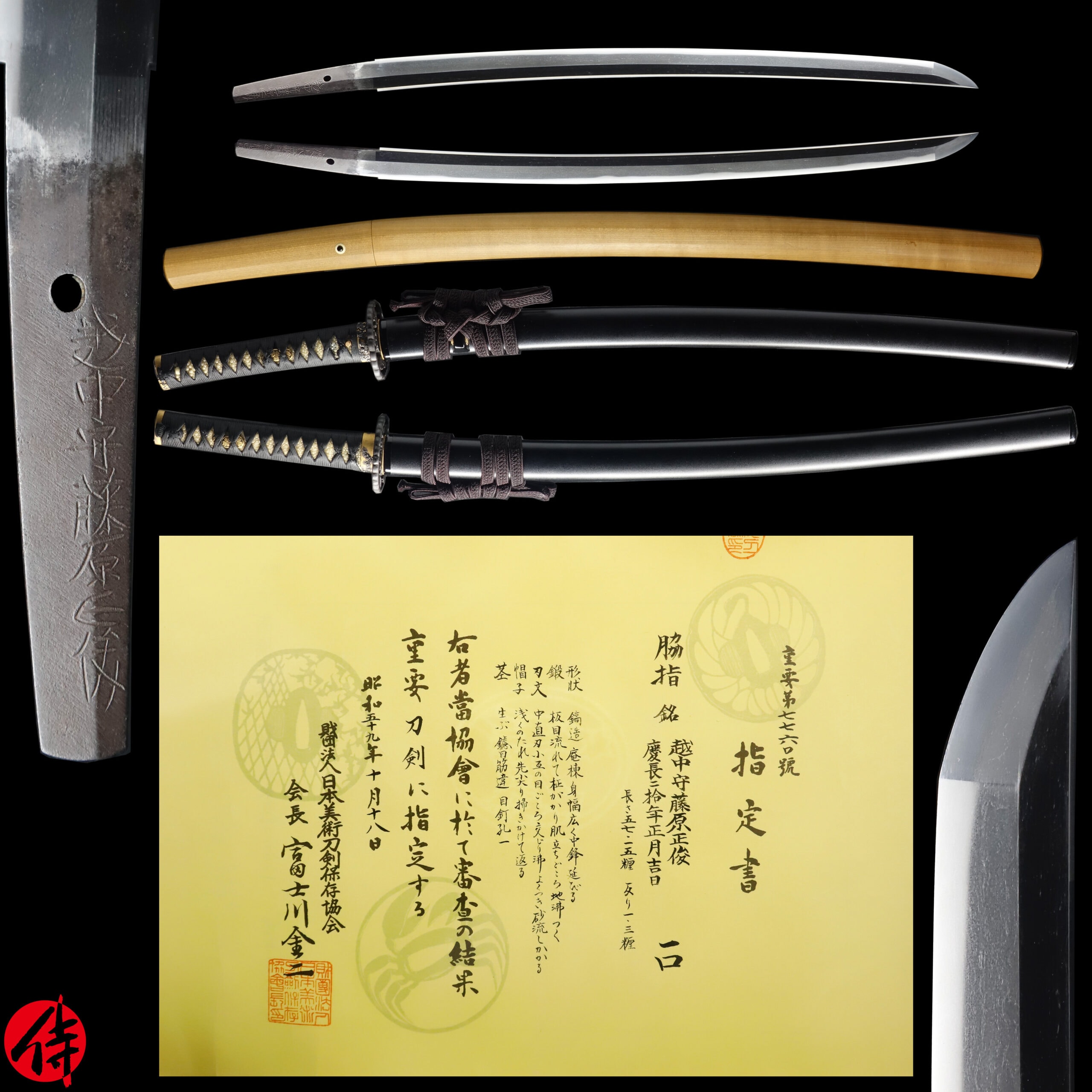
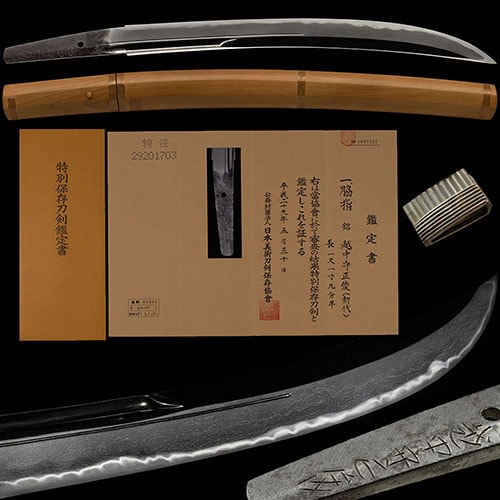
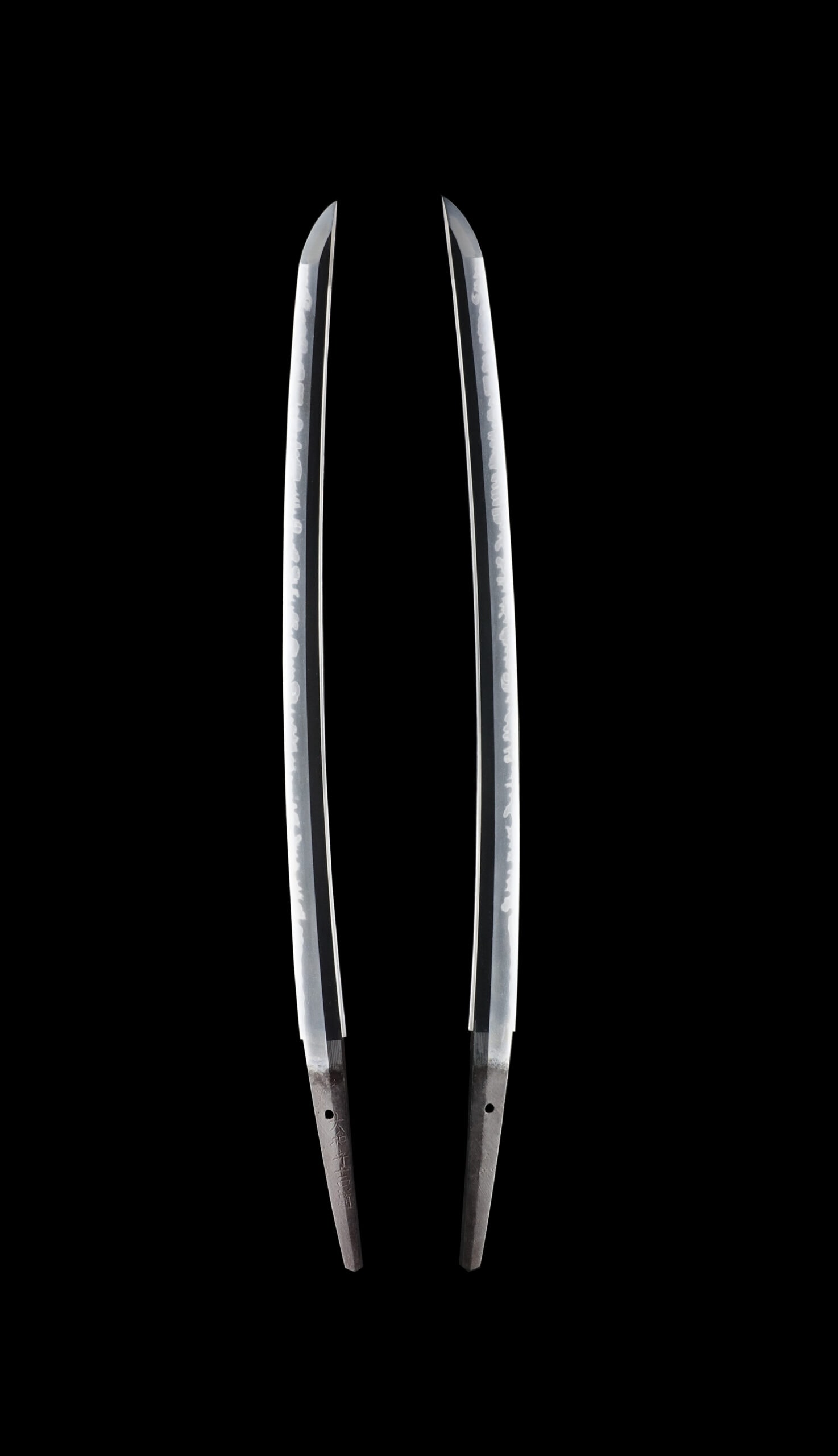
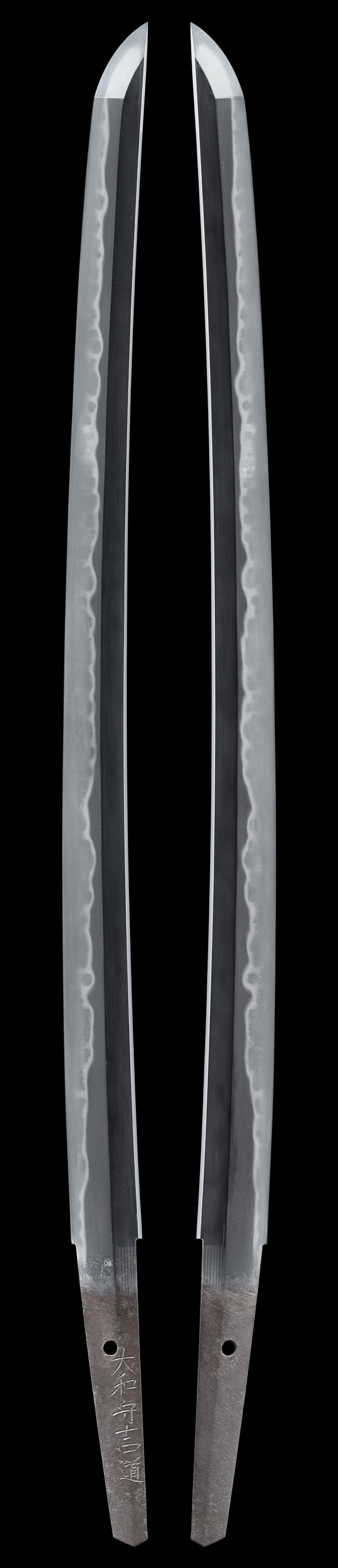
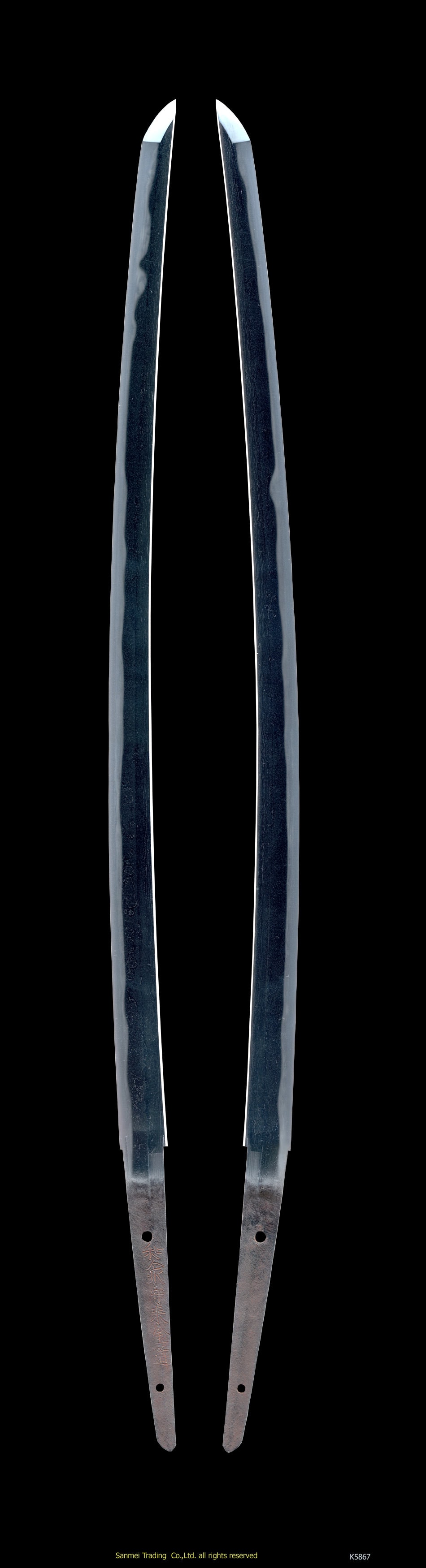
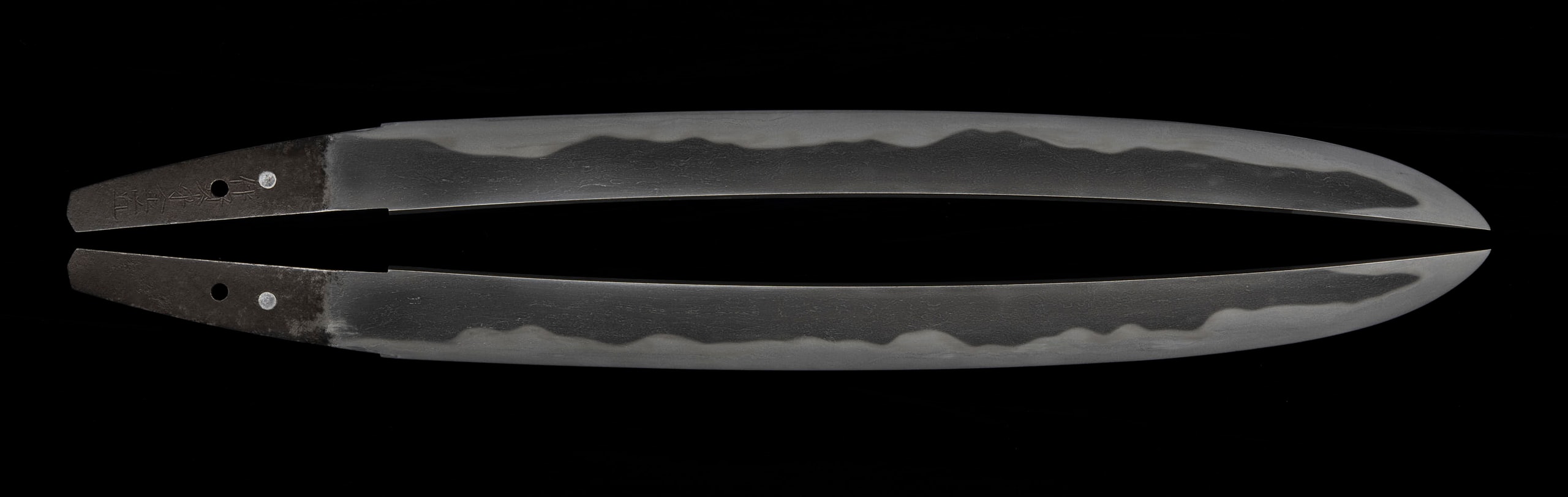
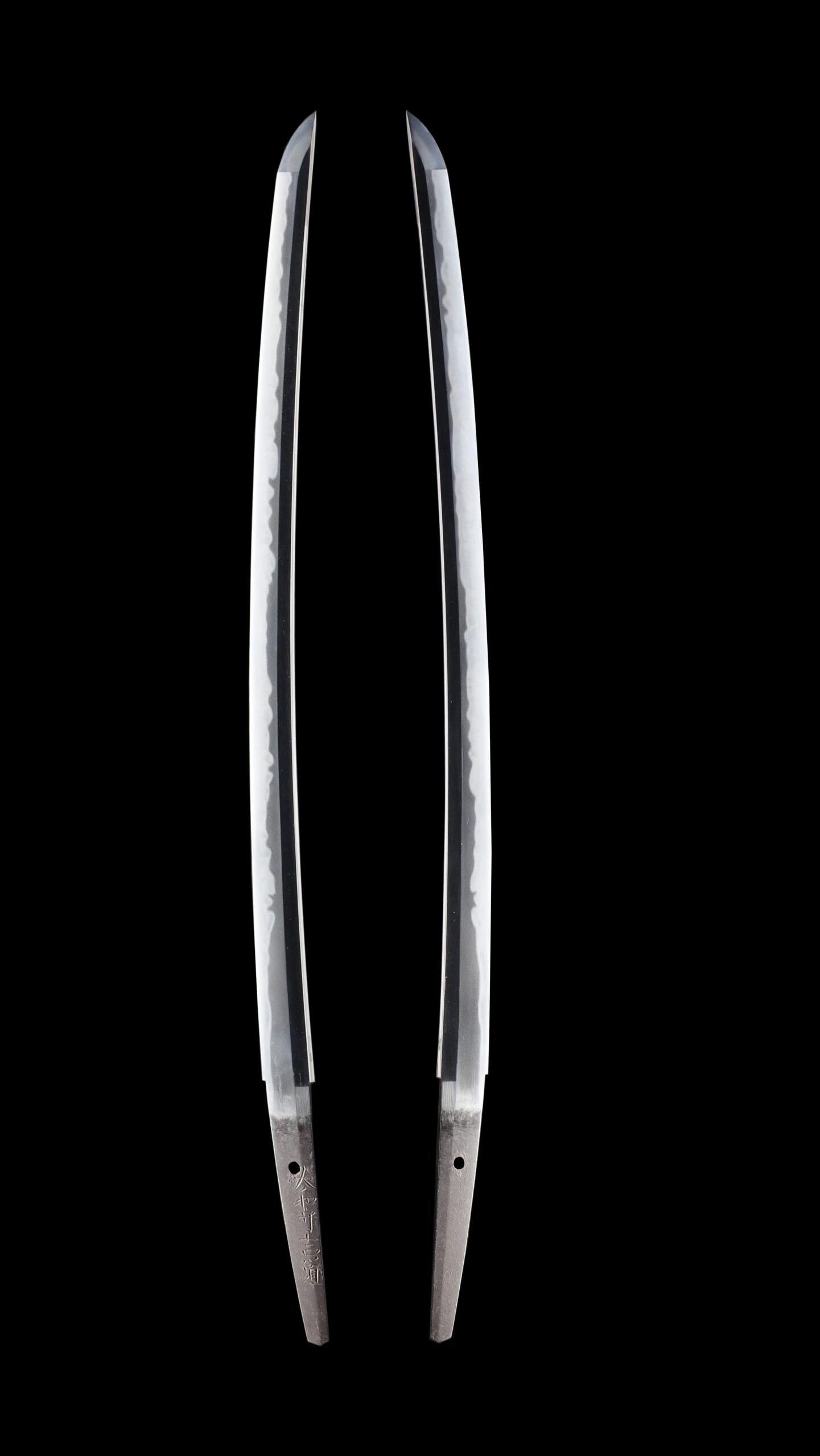
This is a wakizashi by Ecchu no Kami Fujiwara Masatoshi, dated to a lucky day in January 1615 (Keicho 20). It features a wide mihaba, solid kasane, and a long boshi, with a fine ko-itame hada and a nie-deki suguha hamon. The blade is accompanied by a koshirae and has been designated as a 31st Juyo Token by the NBTHK.

NBTHK Setsumei

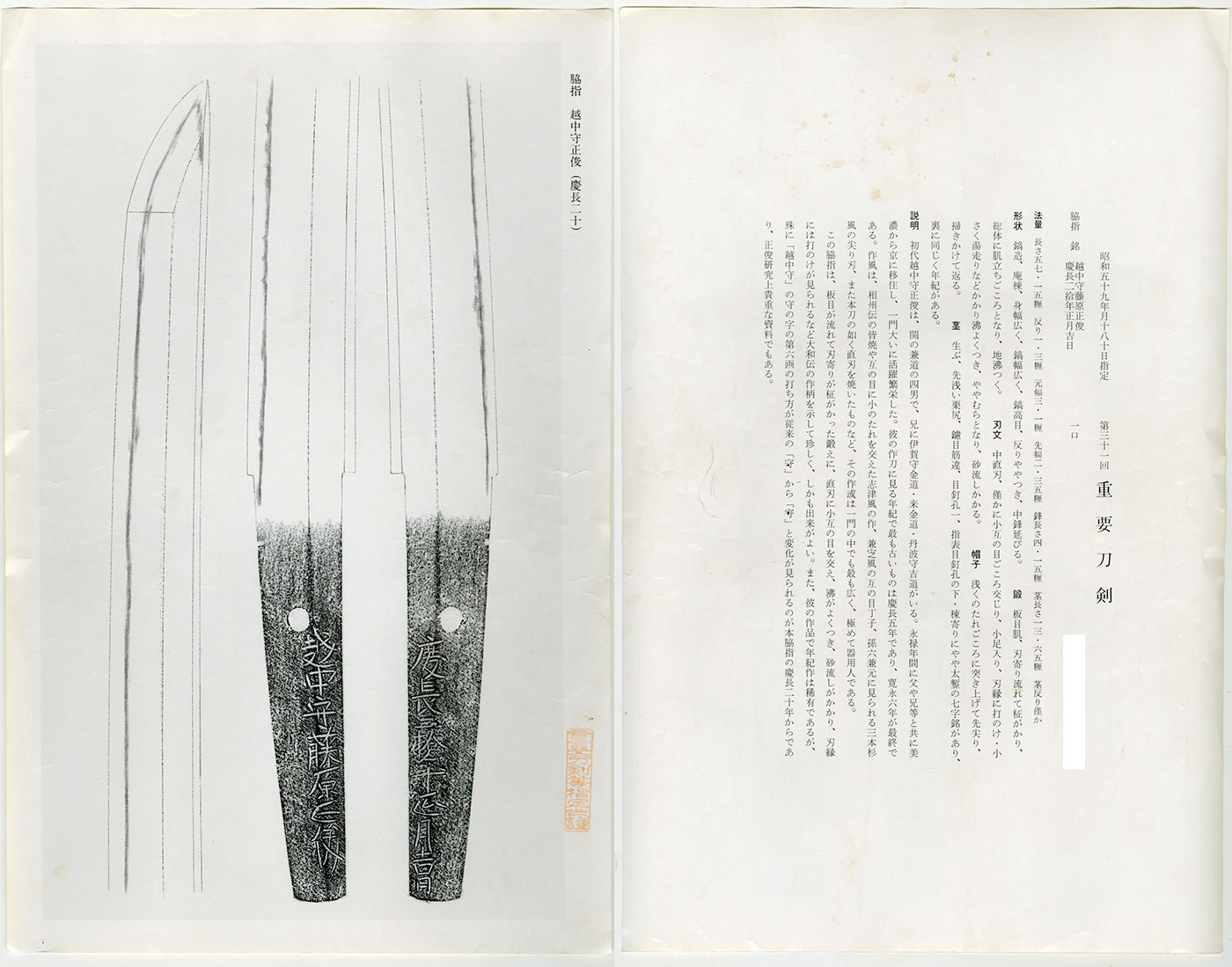
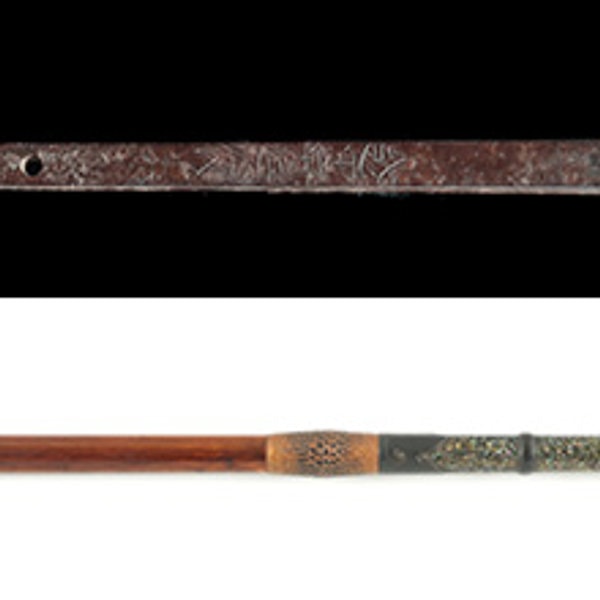
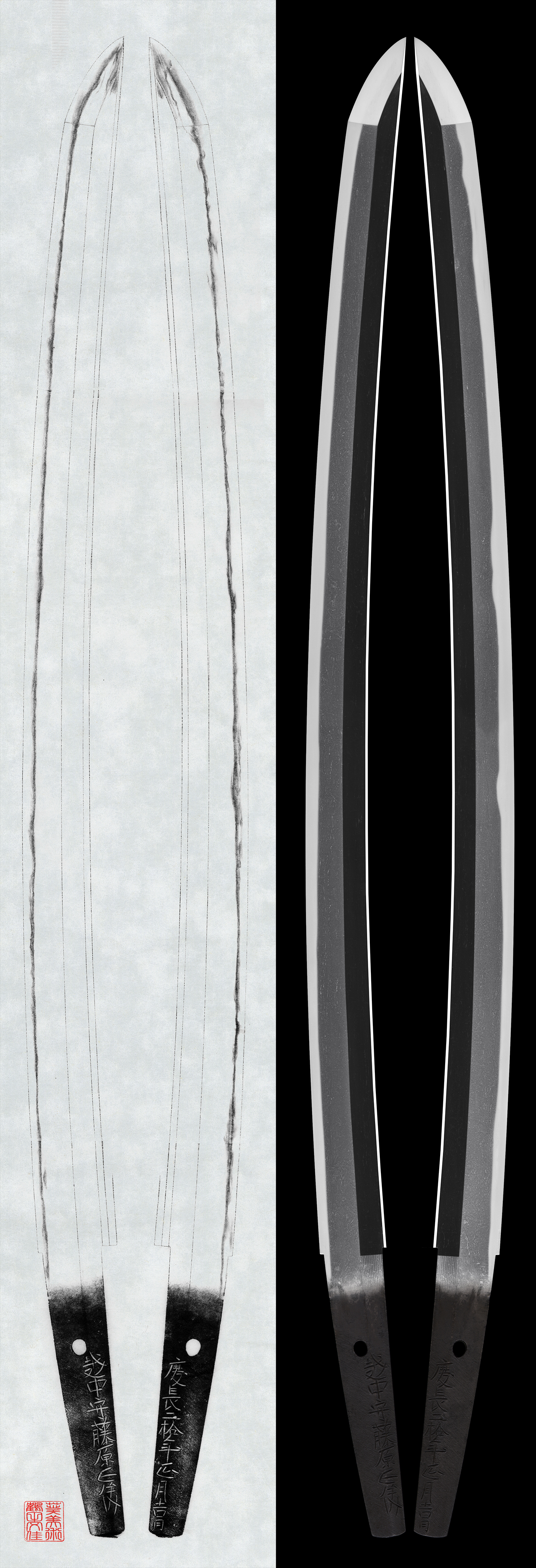
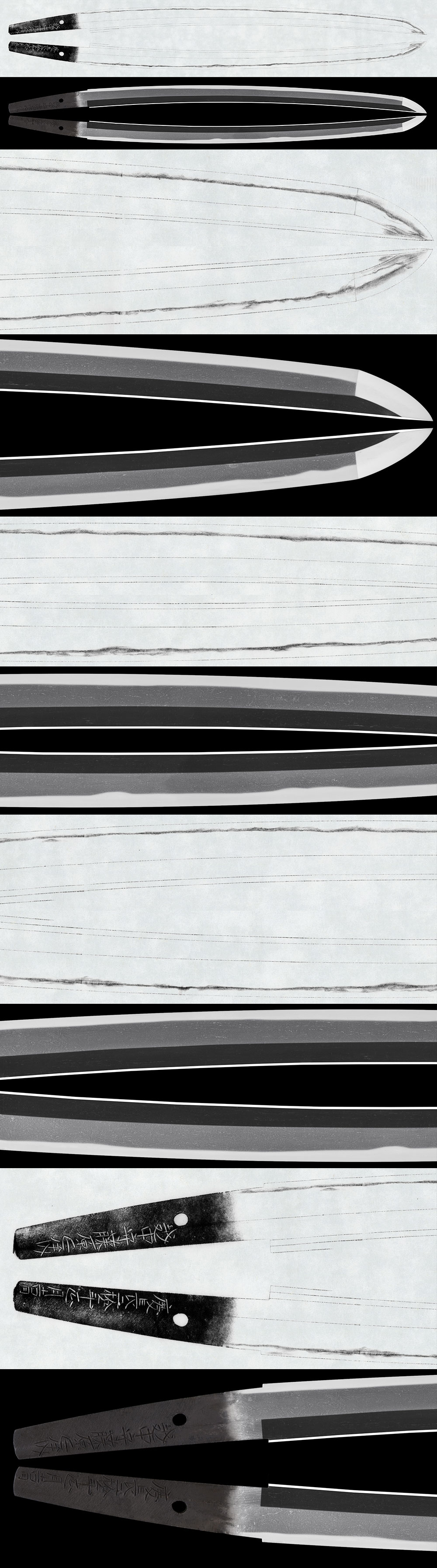
Jūyō-Tōken, 31st Session — Designated October 18, 1984 Wakizashi, mei: Etchū no Kami Fujiwara Masatoshi (越中守藤原正俊) Measurements Nagasa 57.15 cm, sori 1.3 cm, motohaba 3.1 cm, sakihaba 2.35 cm, kissaki-nagasa 4.15 cm, nakago-nagasa 13.65 cm, nakago-sori slight Description Keijō: shinogi-zukuri, iori-mune; wide mihaba with a wide shinogi-ji, rather high shinogi, somewhat sori, and an elongated chū-kissaki. Kitae: itame-hada with flowing grain toward the edge becoming masame-inclined; overall tending toward hada-dachi (standing grain), with ji-nie. Hamon: chū-suguha mixed with a slight hint of ko-gunome; with ko-ashi; along the habuchi appear uchi-noke and small yubashiri; nie adheres well, the line becomes slightly uneven, and sunagashi runs through. Bōshi: shallow notare-tinged, rising to a pointed tip; hakikake and turns back. Horimono: None. Nakago: ubu; tip a shallow kurijiri; yasurime sujikai; one mekugi-ana; on the omote, below the mekugi-ana and slightly toward the mune, there is a somewhat thickly-chiseled seven-character signature, and on the ura there is likewise a date inscription. Artisan Etchū no Kami Fujiwara Masatoshi (Shodai) Era Keichō 20 (1615), first month—an auspicious day (Keichō nijū-nen shōgatsu kichijitsu) Explanation The first-generation Etchū no Kami Masatoshi was the fourth son of Kanemichi of Seki, and his elder brothers included Iga no Kami Kinmichi, Rai Kinmichi, and Tanba no Kami Yoshimichi. During the Eiroku era (1558–1570) he, together with his father and brothers, moved from Mino to Kyōto, where the family line flourished and achieved great success. Among the dated works seen from his hand, the earliest known inscription is Keichō 5 (1600), while the latest is Kan’ei 6 (1629). His workmanship is notably broad-ranging—even within this highly capable lineage—demonstrating exceptional versatility. His styles include works in the Sōshū tradition such as hitatsura and gunome mixed with small notare in a Shizu-like manner; gunome-chōji reminiscent of Kaneyuki; pointed temper suggestive of the sanbonsugi style associated with Magoroku Kanemoto; and, as with the present blade, examples tempered in suguha. This wakizashi is forged in flowing itame that becomes masame-inclined near the edge; it shows a suguha tempered with small gunome, with nie well-adhering, sunagashi appearing, and uchi-noke visible along the habuchi. These traits present a Yamato-tradition flavor, which is unusual for Masatoshi, and moreover the workmanship is good. Dated examples among his works are rare. In particular, it is from Keichō 20—as seen on this wakizashi—that the method of cutting the sixth stroke of the character “mori” (守) in the title “Etchū no Kami” shows a change from the previously used form to a modified form. For this reason as well, this piece constitutes valuable material for the study of Masatoshi.

NihontoWatch MonNihontoWatchBETA
MarketAuctionsEncyclopedia
Swords›Mishina›Masatoshi›Wakizashi: Ecchu no Kami Fujiwara Masatoshi (January 1615) (31st Juyo Token)
wakizashiJūyō
Mishina Masatoshi

Wakizashi: Ecchu no Kami Fujiwara Masatoshi (January 1615) (31st Juyo Token)

mei · Shinto · nagasa 57.1cm · sori 1.3cm

SOLD
Mishina Masatoshi — 1 of 6
Mishina Masatoshi — 2 of 6
Mishina Masatoshi — 3 of 6
Mishina Masatoshi — 4 of 6
Mishina Masatoshi — 5 of 6
Mishina Masatoshi — 6 of 6
1 / 6
1 / 6
Mishina Masatoshi — 1 of 6Mishina Masatoshi — 2 of 6Mishina Masatoshi — 3 of 6Mishina Masatoshi — 4 of 6Mishina Masatoshi — 5 of 6Mishina Masatoshi — 6 of 6
Measurements & details
Smith
Mishina Masatoshi
Type
Wakizashi
School
Mishina
Period
Around 1596–1615(Keicho)
Signature
Signed(97% of this smith's designated works are signed)
Measurements
Nagasa 57.1cmSori 1.3cmMotohaba 3.21cmSakihaba 2.41cmKasane 0.64cmWeight 610g
Description

This is a wakizashi by Ecchu no Kami Fujiwara Masatoshi, dated to a lucky day in January 1615 (Keicho 20). It features a wide mihaba, solid kasane, and a long boshi, with a fine ko-itame hada and a nie-deki suguha hamon. The blade is accompanied by a koshirae and has been designated as a 31st Juyo Token by the NBTHK.

NBTHK Zufu Commentary

Juyo #31

AI translation — may contain errors

-, 31st Session — Designated October 18, 1984

, : no Kami Fujiwara Masatoshi (越中守藤原正俊)

Measurements 57.15 cm, 1.3 cm, 3.1 cm, 2.35 cm, 4.15 cm, 13.65 cm, slight

Description Keijō: , ; wide with a wide , rather high , somewhat , and an elongated . : with flowing grain toward the edge becoming -inclined; overall tending toward (standing grain), with . : mixed with a slight hint of ; with ; along the appear uchi-noke and small ; adheres well, the line becomes slightly uneven, and runs through. : shallow -tinged, rising to a pointed tip; and turns back. : None. : ; tip a shallow ; ; one ; on the , below the and slightly toward the , there is a somewhat thickly-chiseled seven-character signature, and on the there is likewise a date inscription.

Artisan no Kami Fujiwara Masatoshi ()

Era Keichō 20 (1615), first month—an auspicious day (Keichō nijū-nen shōgatsu )

Explanation The first-generation no Kami Masatoshi was the fourth son of Kanemichi of Seki, and his elder brothers included Iga no Kami Kinmichi, Kinmichi, and Tanba no Kami Yoshimichi. During the Eiroku era (1558–1570) he, together with his father and brothers, moved from to Kyōto, where the family line flourished and achieved great success.

Among the dated works seen from his hand, the earliest known inscription is Keichō 5 (1600), while the latest is ’ei 6 (1629). His workmanship is notably broad-ranging—even within this highly capable lineage—demonstrating exceptional versatility. His styles include works in the tradition such as and mixed with small in a -like manner; gunome-chōji reminiscent of Kaneyuki; pointed temper suggestive of the style associated with Magoroku Kanemoto; and, as with the present blade, examples tempered in .

This is forged in flowing that becomes -inclined near the edge; it shows a tempered with small , with well-adhering, appearing, and uchi-noke visible along the . These traits present a Yamato-tradition flavor, which is unusual for Masatoshi, and moreover the workmanship is good.

Dated examples among his works are rare. In particular, it is from Keichō 20—as seen on this —that the method of cutting the sixth stroke of the character “mori” (守) in the title “ no Kami” shows a change from the previously used form to a modified form. For this reason as well, this piece constitutes valuable material for the study of Masatoshi.

About the maker

Masatoshi

正俊

Mishina (Sanpin) school, Kyoto Shinto · Yamashiro · around 1596-1615

Fujishiro Jo-jo saku · Tōken Taikan top 8%

5 pieces on the market now

›

Shodai Etchū no Kami Masatoshi was the fourth and youngest son of Kanemichi of Mino-Seki, and the latest dated work from his hand bears the year Kan'ei 6 (1629), the earliest Keichō 5 (1600). With his father and his three elder brothers, Iga no Kami Kinmichi, Rai Kinmichi and Tanba no Kami Yoshimichi, he came up from Mino to Kyōto and there founded the Mishina school, one of the principal forces of Kyoto Shintō beside the Horikawa. Among the four brothers the published sources give the youngest the highest marks: they call his dexterity foremost of the brothers[[c:1]] and his range the broadest within the lineage[[c:2]], a versatility one entry sets beside that of Kunimichi of the rival Horikawa school. Fujishiro grades him Jō-jō saku. His record is not one manner held at full power but several manners practiced by a single capable hand, and it is read that way.

The center of that record is the Shizu manner the published sources say he most excelled in[[c:3]]. Over an itame mixed with mokume, ō-itame and a flowing nagare-hada that stands a little, the steel sometimes taking a slightly blackish tone, he sets a large midare based on a shallow notare, mixing gunome, ko-gunome, angular elements and pointed teeth. The nie is strong and at times coarse, gathering unevenly into patches; vigorous sunagashi runs through it, long kinsuji enter, and small tobiyaki and yubashiri cross the edge into a nijūba-like aspect, the nioiguchi tending to sink. The published sources read these as taken from the Shizu range he preferred, rustic and antique in flavor, and call his finest of them outstanding even among his own works.

The jigane is the constant that underlies every manner. An itame that flows into nagare-hada, the grain standing and often becoming masame toward the edge, carries the Mino-Seki inheritance into the Kyōto work, with thick fine ji-nie adhering and chikei entering well. Above it the activity is the tell. Sunagashi is all but constant, far heavier than on a Bizen ji, and twice over he marks himself in the bōshi and the yakigashira. The bōshi runs in most often pointed, thrusting up before the turnback and sometimes settling into a small ko-maru, with hakikake along the tip; the published sources read this shallow notare-komi pointed-and-swept form as the Mishina bōshi, single it out as most conspicuous in Masatoshi of the four brothers, and describe it, more than once, as a textbook example, a temper made as if drawn from a picture[[c:4]]. Above the yakigashira the strong nie gathers with tobiyaki and yubashiri into stripes, the sprouting of sudareba (簾刃の萌), and the judges note this is not infrequently seen in his work[[c:5]]; it is the seed of the basket-weave temper that would define the later Mishina school.

Because he was so versatile, his record divides into registers as much as phases. The Shizu prime stands beside a strongly Mino-flavored register, where the lower half flares into a flamboyant gunome-chōji mixed with gunome and the pointed sanbon-sugi teeth the sources attribute to a model in Magoroku Kanemoto, the steel flowing into masame near the edge and bunched, washed-out tama gathering in the ha. A third, quieter register is Yamato: an itame flowing into masame under a tight chū-suguha, with uchinoke, small nijūba and hotsure along the habuchi, one suguha katana read by the judges as worked with an awareness of the Shikkake smith Norinaga. To these the published commentary adds Sōshū hitatsura, so that no single edge form fixes him; what fixes him is the bōshi, the sunagashi and the flowing jigane that persist across all of them. Dated works are rare, but the brothers' move up to Kyōto, his Bunroku-era receipt of the Etchū no Kami title, and a documented change from about Keichō 20 in how the sixth stroke of the character mori in his title is cut give the signed work an unusually firm chronology.

What sets him within the school is named plainly by the judges. He is the most capable and the widest-ranging of the four Mishina brothers, and where his eldest brother Iga no Kami Kinmichi shared the Shizu specialty, Masatoshi carries it furthest and shows the family bōshi at its clearest. The name continued for several generations, but the published sources hold that the second generation and after are markedly inferior[[c:6]], so the first generation is the recognized master of the line, the hand against which the rest are measured. His distinction is therefore not a borrowed resemblance but his own spread of attested traits, the broadest in the school carried with a steady technique the commentary repeatedly calls skillful.

For the collector he is a signed and knowable name from the founding generation of Kyoto Shintō. He has no National Treasures and no Important Cultural Properties; his record runs instead through two Tokubetsu Jūyō and twenty-six Jūyō blades and the prewar Jūyō Bijutsuhin, twenty-eight pieces in the Tokujū and Jūyō tiers all told, and almost every one of them signed. Provenance is thin but distinguished, his blades passing through the hands of Oda Urakusai and the Oda family, the Imperial household, and the Kitano Shrine association. Carvings, rare in the Mishina line, appear on a few of his blades, a Fudō Myōō and Kurikara among them that the judges call valuable for the study of his hand. Most designated blades, in private hands or not, are held rather than traded, and only a small part of his record reaches the tradeable tiers, so a signed Etchū no Kami Masatoshi comes to market from time to time rather than readily. When one does, it is a sound and varied document of the smith the Mishina school regarded as its most versatile founder-generation hand.

Historical importance

Where Masatoshi stands among comparable artisans: across all of nihontō, and within tradition, era, and period. The tiers (Foremost · Leading · Major · Notable) weigh official designations from the NBTHK and Japan's Agency for Cultural Affairs, together with historical honors of lasting repute such as the Sansaku and Meibutsu-chō.

随一
Foremost
屈指
Leading
有数
Major
著名
Notable

Select a lens to see how it's measured.

Designation record
31 designated works
Jūyō Bijutsuhin
1
Gyobutsu (Imperial)
2
Tokubetsu Jūyō
2
Jūyō
26
5 works by Masatoshi on the market→
Masatoshi — full profileMishina (Sanpin) school, Kyoto Shinto school

Dated Works

Years he was demonstrably active, proven by signed-and-dated blades

Active period
1604–1606Editorial estimate: 1596–1615
2 of 28 designated works carry a date
1600
1610
1620
About the school

Mishina

三品

Shinto · Yamashiro

59 pieces on the market now

›

The Mishina school (三品), one of the two dominant smithing groups of early Edo Kyoto beside the Horikawa, grew from the late-Mino workshop of Kanemichi of Seki, whose dated blades run through the Tenbun, Eiroku, and Tenshō eras. During the closing decades of the sixteenth century Kanemichi came up to the capital with his four sons and settled at Nishinotōin Ebisugawa, where the eldest, Iga no Kami Kinmichi, is recorded as having greatly raised the name of the line. Learn more →

14 recorded smiths118 designated works
Leading smiths
SmithEraDesignated
Kinmichi金道1596-161523
Yoshimichi吉道1596-161536
Masatoshi正俊1596-161531
Kanemichi兼道1681-17045
Yoshimichi吉道1661-16736
Explore the Mishina school →
NBTHK Certificate
Jūyō Tōken重要刀剣
Important Sword
›

A blade of top-grade workmanship and condition, formally judged to rank with a nationally recognized Important Art Object (Jūyō Bijutsuhin). Awarded only at the NBTHK’s competitive annual examination.

Of Japan’s roughly 2.5 million registered swords, only 12,307 (about 1 in 203) have ever attained Jūyō.

About the NBTHK›

The NBTHK (Nihon Bijutsu Tōken Hozon Kyōkai, the Society for the Preservation of Japanese Art Swords) is a public-interest incorporated foundation founded in 1948 and supervised by Japan’s Agency for Cultural Affairs (Bunkachō); it is based at the Japanese Sword Museum in Tokyo. Its expert panels physically examine each submitted work (shinsa) and issue a certificate (kanteishō) ranking it by artistic and historical merit. NBTHK papers are the most widely recognized standard of authentication for Japanese swords and fittings.

NBTHK official site→
Seller
A
Aoi Art
🇯🇵Ships from Japan
›
✓Verified dealeraoijapan.com
✓Ships worldwide✓English supportWire transferPayPalCredit card
Return policy

If you wish to return an item, please notify us within 3 days of receipt. After this period we cannot accept cancellations. Please ship the return to us within 5 business days. Cancellation is conditional on the item being kept in the same condition as at the time of sale, so please handle it with care.

View all of Aoi Art’s listings→View this item on the dealer’s site→

More works by Mishina Masatoshi

View all →
Goushuya
Jūyō
Katana - Jūyō - by Mishina Masatoshi - Etchu no Kami Masatoshi, owned by General Tani TatekiKatana - Jūyō - by Mishina Masatoshi - Etchu no Kami Masatoshi, owned by General Tani Tateki

Katana

ByMishina Masatoshi
Ask
Toyuukai
Tokuho
Wakizashi - Tokuho - by Mishina Masatoshi - Etchuno Kami Masatoshi - NBTHK Tokubetsu HozonWakizashi - Tokuho - by Mishina Masatoshi - Etchuno Kami Masatoshi - NBTHK Tokubetsu Hozon

Wakizashi

ByMishina Masatoshi
¥1,200,000
Choshuya
Yari - by Mishina Masatoshi - Mei: Echizen no Kami Masatoshi (1st Gen.) (Owazamono), 1407Yari - by Mishina Masatoshi - Mei: Echizen no Kami Masatoshi (1st Gen.) (Owazamono), 1407

Yari

ByMishina Masatoshi
Ask
Choshuya
Wakizashi - by Mishina Masatoshi - Mumei: Echizen no Kami Masatoshi (Owazamono)Wakizashi - by Mishina Masatoshi - Mumei: Echizen no Kami Masatoshi (Owazamono)

Wakizashi

ByMishina Masatoshi
Ask
Samurai Nippon
Tokuho
Wakizashi - Tokuho - by Mishina Masatoshi - Fujiwarano Masatoshi (1st Gen. Echizen no Kami Masatoshi)Wakizashi - Tokuho - by Mishina Masatoshi - Fujiwarano Masatoshi (1st Gen. Echizen no Kami Masatoshi)

Wakizashi

ByMishina Masatoshi
¥950,000

Previously sold by Mishina Masatoshi

Samurai Museum
Hozon
Katana - Hozon - by Mishina Masatoshi - Antique Japanese Sword Katana signed by Masatoshi NBTHK Hozon CertificateKatana - Hozon - by Mishina Masatoshi - Antique Japanese Sword Katana signed by Masatoshi NBTHK Hozon Certificate
Sold

Katana

ByMishina Masatoshi
SOLD
World Seiyudo
Tokuho
Wakizashi - Tokuho - by Mishina Masatoshi - Etchu no Kami Fujiwara MasatoshiWakizashi - Tokuho - by Mishina Masatoshi - Etchu no Kami Fujiwara Masatoshi
Sold

Wakizashi

ByMishina Masatoshi
SOLD
Choshuya
Tokuho
Yari - Tokuho - by Mishina Masatoshi - Hira Sankaku Sugu-yari: Masatoshi (1st Gen.) (Wazamono)Yari - Tokuho - by Mishina Masatoshi - Hira Sankaku Sugu-yari: Masatoshi (1st Gen.) (Wazamono)
Sold

Yari

ByMishina Masatoshi
SOLD
Samurai Museum
Tokuho
Wakizashi - Tokuho - by Mishina Masatoshi - 1st Gen. Masatoshi - NBTHK Tokubetsu Hozon CertificateWakizashi - Tokuho - by Mishina Masatoshi - 1st Gen. Masatoshi - NBTHK Tokubetsu Hozon Certificate
Sold

Wakizashi

ByMishina Masatoshi
SOLD
Eirakudo
Tokuho
Wakizashi - Tokuho - by Mishina Masatoshi - Masatoshi - Tokubetsu Hozon TokenWakizashi - Tokuho - by Mishina Masatoshi - Masatoshi - Tokubetsu Hozon Token
Sold

Wakizashi

ByMishina Masatoshi
SOLD
Samurai Museum
Jūyō
Wakizashi - Jūyō - by Mishina Masatoshi - Etchu no Kami Fujiwara MasatoshiWakizashi - Jūyō - by Mishina Masatoshi - Etchu no Kami Fujiwara Masatoshi
Sold

Wakizashi

ByMishina Masatoshi
SOLD
Iida Koendo
Tokuho
Wakizashi - Tokuho - by Mishina Masatoshi - Echu no Kami MasatoshiWakizashi - Tokuho - by Mishina Masatoshi - Echu no Kami Masatoshi
Sold

Wakizashi

ByMishina Masatoshi
SOLD
Samurai Museum
Tokuho
Wakizashi - Tokuho - by Mishina Masatoshi - 1st Gen. Etchu no Kami MasatoshiWakizashi - Tokuho - by Mishina Masatoshi - 1st Gen. Etchu no Kami Masatoshi
Sold

Wakizashi

ByMishina Masatoshi
SOLD

More from the Mishina school

View all →
Aoi Art
Tokuho
Katana - Tokuho - by Mishina School - Echigo-no-kami Fujiwara Rai KinmichiKatana - Tokuho - by Mishina School - Echigo-no-kami Fujiwara Rai Kinmichi

Katana

ByMishina School
Starting Bid¥800,000
Aoi Art
Tokuho
Yari - Tokuho - by Mishina School - Echizen no Kami MasatoshiYari - Tokuho - by Mishina School - Echizen no Kami Masatoshi

Yari

ByMishina School
Starting Bid¥410,000
Nipponto
Hozon
Katana - Hozon - by Mishina Kinmichi - Katana Mumei Shodai Iganokami Kinmichi (Sayagaki is Shinoarare Shizu)Katana - Hozon - by Mishina Kinmichi - Katana Mumei Shodai Iganokami Kinmichi (Sayagaki is Shinoarare Shizu)

Katana

ByMishina Kinmichi
¥650,000
Katana Yamadaiya
Tokuho
Katana - Tokuho - by Mishina Hisamichi - Tokubetsu Hozon Token / Koshu Tokubetsu Kicho Token: Omi no Kami Minamoto Hisamichi (with Edagiku Mon)Katana - Tokuho - by Mishina Hisamichi - Tokubetsu Hozon Token / Koshu Tokubetsu Kicho Token: Omi no Kami Minamoto Hisamichi (with Edagiku Mon)

Katana

ByMishina Hisamichi
¥1,000,000
Mandarin Mansion
Jūyō
Wakizashi - Jūyō - by Mishina Kinmichi - Iga no Kami KinmichiWakizashi - Jūyō - by Mishina Kinmichi - Iga no Kami Kinmichi

Wakizashi

ByMishina Kinmichi
¥27,500
Touken Matsumoto
Tokuho
Katana - Tokuho - by Mishina Kinmichi - Izumi no Kami Rai Kinmichi & Hokkyo Rai EisenKatana - Tokuho - by Mishina Kinmichi - Izumi no Kami Rai Kinmichi & Hokkyo Rai Eisen

Katana

ByMishina Kinmichi
¥2,000,000
Choshuya
Tokuho
Katana - Tokuho - by Mishina School - Iga no Kami Fujiwara KinmichiKatana - Tokuho - by Mishina School - Iga no Kami Fujiwara Kinmichi

Katana

ByMishina School
¥1,700,000
Choshuya
Tokuho
Katana - Tokuho - by Mishina Hisamichi - Omi no Kami Minamoto no HisamichiKatana - Tokuho - by Mishina Hisamichi - Omi no Kami Minamoto no Hisamichi

Katana

ByMishina Hisamichi
¥1,400,000

Swords

  • Katana
  • Wakizashi
  • Tantō
  • Tachi
  • Naginata
  • Yari

Fittings

  • Tsuba
  • Fuchi-Kashira
  • Kozuka
  • Menuki

By Certification

  • Tokujū
  • Jūyō
  • Tokuho
  • Hozon

Resources

  • Dealer Directory
  • Artist Directory
  • Glossary
  • Browse All
Nihontowatch© 2026
TermsPrivacyCookiesAbout

Description

This is a wakizashi by Ecchu no Kami Fujiwara Masatoshi, dated to a lucky day in January 1615 (Keicho 20). It features a wide mihaba, solid kasane, and a long boshi, with a fine ko-itame hada and a nie-deki suguha hamon. The blade is accompanied by a koshirae and has been designated as a 31st Juyo Token by the NBTHK.

NBTHK Setsumei

Jūyō-Tōken, 31st Session — Designated October 18, 1984 Wakizashi, mei: Etchū no Kami Fujiwara Masatoshi (越中守藤原正俊) Measurements Nagasa 57.15 cm, sori 1.3 cm, motohaba 3.1 cm, sakihaba 2.35 cm, kissaki-nagasa 4.15 cm, nakago-nagasa 13.65 cm, nakago-sori slight Description Keijō: shinogi-zukuri, iori-mune; wide mihaba with a wide shinogi-ji, rather high shinogi, somewhat sori, and an elongated chū-kissaki. Kitae: itame-hada with flowing grain toward the edge becoming masame-inclined; overall tending toward hada-dachi (standing grain), with ji-nie. Hamon: chū-suguha mixed with a slight hint of ko-gunome; with ko-ashi; along the habuchi appear uchi-noke and small yubashiri; nie adheres well, the line becomes slightly uneven, and sunagashi runs through. Bōshi: shallow notare-tinged, rising to a pointed tip; hakikake and turns back. Horimono: None. Nakago: ubu; tip a shallow kurijiri; yasurime sujikai; one mekugi-ana; on the omote, below the mekugi-ana and slightly toward the mune, there is a somewhat thickly-chiseled seven-character signature, and on the ura there is likewise a date inscription. Artisan Etchū no Kami Fujiwara Masatoshi (Shodai) Era Keichō 20 (1615), first month—an auspicious day (Keichō nijū-nen shōgatsu kichijitsu) Explanation The first-generation Etchū no Kami Masatoshi was the fourth son of Kanemichi of Seki, and his elder brothers included Iga no Kami Kinmichi, Rai Kinmichi, and Tanba no Kami Yoshimichi. During the Eiroku era (1558–1570) he, together with his father and brothers, moved from Mino to Kyōto, where the family line flourished and achieved great success. Among the dated works seen from his hand, the earliest known inscription is Keichō 5 (1600), while the latest is Kan’ei 6 (1629). His workmanship is notably broad-ranging—even within this highly capable lineage—demonstrating exceptional versatility. His styles include works in the Sōshū tradition such as hitatsura and gunome mixed with small notare in a Shizu-like manner; gunome-chōji reminiscent of Kaneyuki; pointed temper suggestive of the sanbonsugi style associated with Magoroku Kanemoto; and, as with the present blade, examples tempered in suguha. This wakizashi is forged in flowing itame that becomes masame-inclined near the edge; it shows a suguha tempered with small gunome, with nie well-adhering, sunagashi appearing, and uchi-noke visible along the habuchi. These traits present a Yamato-tradition flavor, which is unusual for Masatoshi, and moreover the workmanship is good. Dated examples among his works are rare. In particular, it is from Keichō 20—as seen on this wakizashi—that the method of cutting the sixth stroke of the character “mori” (守) in the title “Etchū no Kami” shows a change from the previously used form to a modified form. For this reason as well, this piece constitutes valuable material for the study of Masatoshi.

NihontoWatch MonNihontoWatchBETA
MarketAuctionsEncyclopedia
Swords›Mishina›Masatoshi›Wakizashi: Ecchu no Kami Fujiwara Masatoshi (January 1615) (31st Juyo Token)
wakizashiJūyō
Mishina Masatoshi

Wakizashi: Ecchu no Kami Fujiwara Masatoshi (January 1615) (31st Juyo Token)

mei · Shinto · nagasa 57.1cm · sori 1.3cm

SOLD
Mishina Masatoshi — 1 of 6
Mishina Masatoshi — 2 of 6
Mishina Masatoshi — 3 of 6
Mishina Masatoshi — 4 of 6
Mishina Masatoshi — 5 of 6
Mishina Masatoshi — 6 of 6
1 / 6
1 / 6
Mishina Masatoshi — 1 of 6Mishina Masatoshi — 2 of 6Mishina Masatoshi — 3 of 6Mishina Masatoshi — 4 of 6Mishina Masatoshi — 5 of 6Mishina Masatoshi — 6 of 6
Measurements & details
Smith
Mishina Masatoshi
Type
Wakizashi
School
Mishina
Period
Around 1596–1615(Keicho)
Signature
Signed(97% of this smith's designated works are signed)
Measurements
Nagasa 57.1cmSori 1.3cmMotohaba 3.21cmSakihaba 2.41cmKasane 0.64cmWeight 610g
Description

This is a wakizashi by Ecchu no Kami Fujiwara Masatoshi, dated to a lucky day in January 1615 (Keicho 20). It features a wide mihaba, solid kasane, and a long boshi, with a fine ko-itame hada and a nie-deki suguha hamon. The blade is accompanied by a koshirae and has been designated as a 31st Juyo Token by the NBTHK.

NBTHK Zufu Commentary

Juyo #31

AI translation — may contain errors

-, 31st Session — Designated October 18, 1984

, : no Kami Fujiwara Masatoshi (越中守藤原正俊)

Measurements 57.15 cm, 1.3 cm, 3.1 cm, 2.35 cm, 4.15 cm, 13.65 cm, slight

Description Keijō: , ; wide with a wide , rather high , somewhat , and an elongated . : with flowing grain toward the edge becoming -inclined; overall tending toward (standing grain), with . : mixed with a slight hint of ; with ; along the appear uchi-noke and small ; adheres well, the line becomes slightly uneven, and runs through. : shallow -tinged, rising to a pointed tip; and turns back. : None. : ; tip a shallow ; ; one ; on the , below the and slightly toward the , there is a somewhat thickly-chiseled seven-character signature, and on the there is likewise a date inscription.

Artisan no Kami Fujiwara Masatoshi ()

Era Keichō 20 (1615), first month—an auspicious day (Keichō nijū-nen shōgatsu )

Explanation The first-generation no Kami Masatoshi was the fourth son of Kanemichi of Seki, and his elder brothers included Iga no Kami Kinmichi, Kinmichi, and Tanba no Kami Yoshimichi. During the Eiroku era (1558–1570) he, together with his father and brothers, moved from to Kyōto, where the family line flourished and achieved great success.

Among the dated works seen from his hand, the earliest known inscription is Keichō 5 (1600), while the latest is ’ei 6 (1629). His workmanship is notably broad-ranging—even within this highly capable lineage—demonstrating exceptional versatility. His styles include works in the tradition such as and mixed with small in a -like manner; gunome-chōji reminiscent of Kaneyuki; pointed temper suggestive of the style associated with Magoroku Kanemoto; and, as with the present blade, examples tempered in .

This is forged in flowing that becomes -inclined near the edge; it shows a tempered with small , with well-adhering, appearing, and uchi-noke visible along the . These traits present a Yamato-tradition flavor, which is unusual for Masatoshi, and moreover the workmanship is good.

Dated examples among his works are rare. In particular, it is from Keichō 20—as seen on this —that the method of cutting the sixth stroke of the character “mori” (守) in the title “ no Kami” shows a change from the previously used form to a modified form. For this reason as well, this piece constitutes valuable material for the study of Masatoshi.

About the maker

Masatoshi

正俊

Mishina (Sanpin) school, Kyoto Shinto · Yamashiro · around 1596-1615

Fujishiro Jo-jo saku · Tōken Taikan top 8%

5 pieces on the market now

›

Shodai Etchū no Kami Masatoshi was the fourth and youngest son of Kanemichi of Mino-Seki, and the latest dated work from his hand bears the year Kan'ei 6 (1629), the earliest Keichō 5 (1600). With his father and his three elder brothers, Iga no Kami Kinmichi, Rai Kinmichi and Tanba no Kami Yoshimichi, he came up from Mino to Kyōto and there founded the Mishina school, one of the principal forces of Kyoto Shintō beside the Horikawa. Among the four brothers the published sources give the youngest the highest marks: they call his dexterity foremost of the brothers[[c:1]] and his range the broadest within the lineage[[c:2]], a versatility one entry sets beside that of Kunimichi of the rival Horikawa school. Fujishiro grades him Jō-jō saku. His record is not one manner held at full power but several manners practiced by a single capable hand, and it is read that way.

The center of that record is the Shizu manner the published sources say he most excelled in[[c:3]]. Over an itame mixed with mokume, ō-itame and a flowing nagare-hada that stands a little, the steel sometimes taking a slightly blackish tone, he sets a large midare based on a shallow notare, mixing gunome, ko-gunome, angular elements and pointed teeth. The nie is strong and at times coarse, gathering unevenly into patches; vigorous sunagashi runs through it, long kinsuji enter, and small tobiyaki and yubashiri cross the edge into a nijūba-like aspect, the nioiguchi tending to sink. The published sources read these as taken from the Shizu range he preferred, rustic and antique in flavor, and call his finest of them outstanding even among his own works.

The jigane is the constant that underlies every manner. An itame that flows into nagare-hada, the grain standing and often becoming masame toward the edge, carries the Mino-Seki inheritance into the Kyōto work, with thick fine ji-nie adhering and chikei entering well. Above it the activity is the tell. Sunagashi is all but constant, far heavier than on a Bizen ji, and twice over he marks himself in the bōshi and the yakigashira. The bōshi runs in most often pointed, thrusting up before the turnback and sometimes settling into a small ko-maru, with hakikake along the tip; the published sources read this shallow notare-komi pointed-and-swept form as the Mishina bōshi, single it out as most conspicuous in Masatoshi of the four brothers, and describe it, more than once, as a textbook example, a temper made as if drawn from a picture[[c:4]]. Above the yakigashira the strong nie gathers with tobiyaki and yubashiri into stripes, the sprouting of sudareba (簾刃の萌), and the judges note this is not infrequently seen in his work[[c:5]]; it is the seed of the basket-weave temper that would define the later Mishina school.

Because he was so versatile, his record divides into registers as much as phases. The Shizu prime stands beside a strongly Mino-flavored register, where the lower half flares into a flamboyant gunome-chōji mixed with gunome and the pointed sanbon-sugi teeth the sources attribute to a model in Magoroku Kanemoto, the steel flowing into masame near the edge and bunched, washed-out tama gathering in the ha. A third, quieter register is Yamato: an itame flowing into masame under a tight chū-suguha, with uchinoke, small nijūba and hotsure along the habuchi, one suguha katana read by the judges as worked with an awareness of the Shikkake smith Norinaga. To these the published commentary adds Sōshū hitatsura, so that no single edge form fixes him; what fixes him is the bōshi, the sunagashi and the flowing jigane that persist across all of them. Dated works are rare, but the brothers' move up to Kyōto, his Bunroku-era receipt of the Etchū no Kami title, and a documented change from about Keichō 20 in how the sixth stroke of the character mori in his title is cut give the signed work an unusually firm chronology.

What sets him within the school is named plainly by the judges. He is the most capable and the widest-ranging of the four Mishina brothers, and where his eldest brother Iga no Kami Kinmichi shared the Shizu specialty, Masatoshi carries it furthest and shows the family bōshi at its clearest. The name continued for several generations, but the published sources hold that the second generation and after are markedly inferior[[c:6]], so the first generation is the recognized master of the line, the hand against which the rest are measured. His distinction is therefore not a borrowed resemblance but his own spread of attested traits, the broadest in the school carried with a steady technique the commentary repeatedly calls skillful.

For the collector he is a signed and knowable name from the founding generation of Kyoto Shintō. He has no National Treasures and no Important Cultural Properties; his record runs instead through two Tokubetsu Jūyō and twenty-six Jūyō blades and the prewar Jūyō Bijutsuhin, twenty-eight pieces in the Tokujū and Jūyō tiers all told, and almost every one of them signed. Provenance is thin but distinguished, his blades passing through the hands of Oda Urakusai and the Oda family, the Imperial household, and the Kitano Shrine association. Carvings, rare in the Mishina line, appear on a few of his blades, a Fudō Myōō and Kurikara among them that the judges call valuable for the study of his hand. Most designated blades, in private hands or not, are held rather than traded, and only a small part of his record reaches the tradeable tiers, so a signed Etchū no Kami Masatoshi comes to market from time to time rather than readily. When one does, it is a sound and varied document of the smith the Mishina school regarded as its most versatile founder-generation hand.
Historical importance

Where Masatoshi stands among comparable artisans: across all of nihontō, and within tradition, era, and period. The tiers (Foremost · Leading · Major · Notable) weigh official designations from the NBTHK and Japan's Agency for Cultural Affairs, together with historical honors of lasting repute such as the Sansaku and Meibutsu-chō.

随一
Foremost
屈指
Leading
有数
Major
著名
Notable

Select a lens to see how it's measured.

Designation record
31 designated works
Jūyō Bijutsuhin
1
Gyobutsu (Imperial)
2
Tokubetsu Jūyō
2
Jūyō
26
5 works by Masatoshi on the market→
Masatoshi — full profileMishina (Sanpin) school, Kyoto Shinto school

Dated Works

Years he was demonstrably active, proven by signed-and-dated blades

Active period
1604–1606Editorial estimate: 1596–1615
2 of 28 designated works carry a date
1600
1610
1620
About the school

Mishina

三品

Shinto · Yamashiro

59 pieces on the market now

›

The Mishina school (三品), one of the two dominant smithing groups of early Edo Kyoto beside the Horikawa, grew from the late-Mino workshop of Kanemichi of Seki, whose dated blades run through the Tenbun, Eiroku, and Tenshō eras. During the closing decades of the sixteenth century Kanemichi came up to the capital with his four sons and settled at Nishinotōin Ebisugawa, where the eldest, Iga no Kami Kinmichi, is recorded as having greatly raised the name of the line. Learn more →

14 recorded smiths118 designated works
Leading smiths
SmithEraDesignated
Kinmichi金道1596-161523
Yoshimichi吉道1596-161536
Masatoshi正俊1596-161531
Kanemichi兼道1681-17045
Yoshimichi吉道1661-16736
Explore the Mishina school →
NBTHK Certificate
Jūyō Tōken重要刀剣
Important Sword
›

A blade of top-grade workmanship and condition, formally judged to rank with a nationally recognized Important Art Object (Jūyō Bijutsuhin). Awarded only at the NBTHK’s competitive annual examination.

Of Japan’s roughly 2.5 million registered swords, only 12,307 (about 1 in 203) have ever attained Jūyō.

About the NBTHK›

The NBTHK (Nihon Bijutsu Tōken Hozon Kyōkai, the Society for the Preservation of Japanese Art Swords) is a public-interest incorporated foundation founded in 1948 and supervised by Japan’s Agency for Cultural Affairs (Bunkachō); it is based at the Japanese Sword Museum in Tokyo. Its expert panels physically examine each submitted work (shinsa) and issue a certificate (kanteishō) ranking it by artistic and historical merit. NBTHK papers are the most widely recognized standard of authentication for Japanese swords and fittings.

NBTHK official site→
Seller
A
Aoi Art
🇯🇵Ships from Japan
›
✓Verified dealeraoijapan.com
✓Ships worldwide✓English supportWire transferPayPalCredit card
Return policy

If you wish to return an item, please notify us within 3 days of receipt. After this period we cannot accept cancellations. Please ship the return to us within 5 business days. Cancellation is conditional on the item being kept in the same condition as at the time of sale, so please handle it with care.

View all of Aoi Art’s listings→View this item on the dealer’s site→

More works by Mishina Masatoshi

View all →
Goushuya
Jūyō
Katana - Jūyō - by Mishina Masatoshi - Etchu no Kami Masatoshi, owned by General Tani TatekiKatana - Jūyō - by Mishina Masatoshi - Etchu no Kami Masatoshi, owned by General Tani Tateki

Katana

ByMishina Masatoshi
Ask
Toyuukai
Tokuho
Wakizashi - Tokuho - by Mishina Masatoshi - Etchuno Kami Masatoshi - NBTHK Tokubetsu HozonWakizashi - Tokuho - by Mishina Masatoshi - Etchuno Kami Masatoshi - NBTHK Tokubetsu Hozon

Wakizashi

ByMishina Masatoshi
¥1,200,000
Choshuya
Yari - by Mishina Masatoshi - Mei: Echizen no Kami Masatoshi (1st Gen.) (Owazamono), 1407Yari - by Mishina Masatoshi - Mei: Echizen no Kami Masatoshi (1st Gen.) (Owazamono), 1407

Yari

ByMishina Masatoshi
Ask
Choshuya
Wakizashi - by Mishina Masatoshi - Mumei: Echizen no Kami Masatoshi (Owazamono)Wakizashi - by Mishina Masatoshi - Mumei: Echizen no Kami Masatoshi (Owazamono)

Wakizashi

ByMishina Masatoshi
Ask
Samurai Nippon
Tokuho
Wakizashi - Tokuho - by Mishina Masatoshi - Fujiwarano Masatoshi (1st Gen. Echizen no Kami Masatoshi)Wakizashi - Tokuho - by Mishina Masatoshi - Fujiwarano Masatoshi (1st Gen. Echizen no Kami Masatoshi)

Wakizashi

ByMishina Masatoshi
¥950,000

Previously sold by Mishina Masatoshi

Samurai Museum
Hozon
Katana - Hozon - by Mishina Masatoshi - Antique Japanese Sword Katana signed by Masatoshi NBTHK Hozon CertificateKatana - Hozon - by Mishina Masatoshi - Antique Japanese Sword Katana signed by Masatoshi NBTHK Hozon Certificate
Sold

Katana

ByMishina Masatoshi
SOLD
World Seiyudo
Tokuho
Wakizashi - Tokuho - by Mishina Masatoshi - Etchu no Kami Fujiwara MasatoshiWakizashi - Tokuho - by Mishina Masatoshi - Etchu no Kami Fujiwara Masatoshi
Sold

Wakizashi

ByMishina Masatoshi
SOLD
Choshuya
Tokuho
Yari - Tokuho - by Mishina Masatoshi - Hira Sankaku Sugu-yari: Masatoshi (1st Gen.) (Wazamono)Yari - Tokuho - by Mishina Masatoshi - Hira Sankaku Sugu-yari: Masatoshi (1st Gen.) (Wazamono)
Sold

Yari

ByMishina Masatoshi
SOLD
Samurai Museum
Tokuho
Wakizashi - Tokuho - by Mishina Masatoshi - 1st Gen. Masatoshi - NBTHK Tokubetsu Hozon CertificateWakizashi - Tokuho - by Mishina Masatoshi - 1st Gen. Masatoshi - NBTHK Tokubetsu Hozon Certificate
Sold

Wakizashi

ByMishina Masatoshi
SOLD
Eirakudo
Tokuho
Wakizashi - Tokuho - by Mishina Masatoshi - Masatoshi - Tokubetsu Hozon TokenWakizashi - Tokuho - by Mishina Masatoshi - Masatoshi - Tokubetsu Hozon Token
Sold

Wakizashi

ByMishina Masatoshi
SOLD
Samurai Museum
Jūyō
Wakizashi - Jūyō - by Mishina Masatoshi - Etchu no Kami Fujiwara MasatoshiWakizashi - Jūyō - by Mishina Masatoshi - Etchu no Kami Fujiwara Masatoshi
Sold

Wakizashi

ByMishina Masatoshi
SOLD
Iida Koendo
Tokuho
Wakizashi - Tokuho - by Mishina Masatoshi - Echu no Kami MasatoshiWakizashi - Tokuho - by Mishina Masatoshi - Echu no Kami Masatoshi
Sold

Wakizashi

ByMishina Masatoshi
SOLD
Samurai Museum
Tokuho
Wakizashi - Tokuho - by Mishina Masatoshi - 1st Gen. Etchu no Kami MasatoshiWakizashi - Tokuho - by Mishina Masatoshi - 1st Gen. Etchu no Kami Masatoshi
Sold

Wakizashi

ByMishina Masatoshi
SOLD

More from the Mishina school

View all →
Aoi Art
Tokuho
Katana - Tokuho - by Mishina School - Echigo-no-kami Fujiwara Rai KinmichiKatana - Tokuho - by Mishina School - Echigo-no-kami Fujiwara Rai Kinmichi

Katana

ByMishina School
Starting Bid¥800,000
Aoi Art
Tokuho
Yari - Tokuho - by Mishina School - Echizen no Kami MasatoshiYari - Tokuho - by Mishina School - Echizen no Kami Masatoshi

Yari

ByMishina School
Starting Bid¥410,000
Nipponto
Hozon
Katana - Hozon - by Mishina Kinmichi - Katana Mumei Shodai Iganokami Kinmichi (Sayagaki is Shinoarare Shizu)Katana - Hozon - by Mishina Kinmichi - Katana Mumei Shodai Iganokami Kinmichi (Sayagaki is Shinoarare Shizu)

Katana

ByMishina Kinmichi
¥650,000
Katana Yamadaiya
Tokuho
Katana - Tokuho - by Mishina Hisamichi - Tokubetsu Hozon Token / Koshu Tokubetsu Kicho Token: Omi no Kami Minamoto Hisamichi (with Edagiku Mon)Katana - Tokuho - by Mishina Hisamichi - Tokubetsu Hozon Token / Koshu Tokubetsu Kicho Token: Omi no Kami Minamoto Hisamichi (with Edagiku Mon)

Katana

ByMishina Hisamichi
¥1,000,000
Mandarin Mansion
Jūyō
Wakizashi - Jūyō - by Mishina Kinmichi - Iga no Kami KinmichiWakizashi - Jūyō - by Mishina Kinmichi - Iga no Kami Kinmichi

Wakizashi

ByMishina Kinmichi
¥27,500
Touken Matsumoto
Tokuho
Katana - Tokuho - by Mishina Kinmichi - Izumi no Kami Rai Kinmichi & Hokkyo Rai EisenKatana - Tokuho - by Mishina Kinmichi - Izumi no Kami Rai Kinmichi & Hokkyo Rai Eisen

Katana

ByMishina Kinmichi
¥2,000,000
Choshuya
Tokuho
Katana - Tokuho - by Mishina School - Iga no Kami Fujiwara KinmichiKatana - Tokuho - by Mishina School - Iga no Kami Fujiwara Kinmichi

Katana

ByMishina School
¥1,700,000
Choshuya
Tokuho
Katana - Tokuho - by Mishina Hisamichi - Omi no Kami Minamoto no HisamichiKatana - Tokuho - by Mishina Hisamichi - Omi no Kami Minamoto no Hisamichi

Katana

ByMishina Hisamichi
¥1,400,000

Swords

  • Katana
  • Wakizashi
  • Tantō
  • Tachi
  • Naginata
  • Yari

Fittings

  • Tsuba
  • Fuchi-Kashira
  • Kozuka
  • Menuki

By Certification

  • Tokujū
  • Jūyō
  • Tokuho
  • Hozon

Resources

  • Dealer Directory
  • Artist Directory
  • Glossary
  • Browse All
Nihontowatch© 2026
TermsPrivacyCookiesAbout
NihontoWatch Mon

NihontoWatchBETA

MarketAuctions
Encyclopedia
NihontoWatch Mon

NihontoWatchBETA

MarketAuctions
Encyclopedia