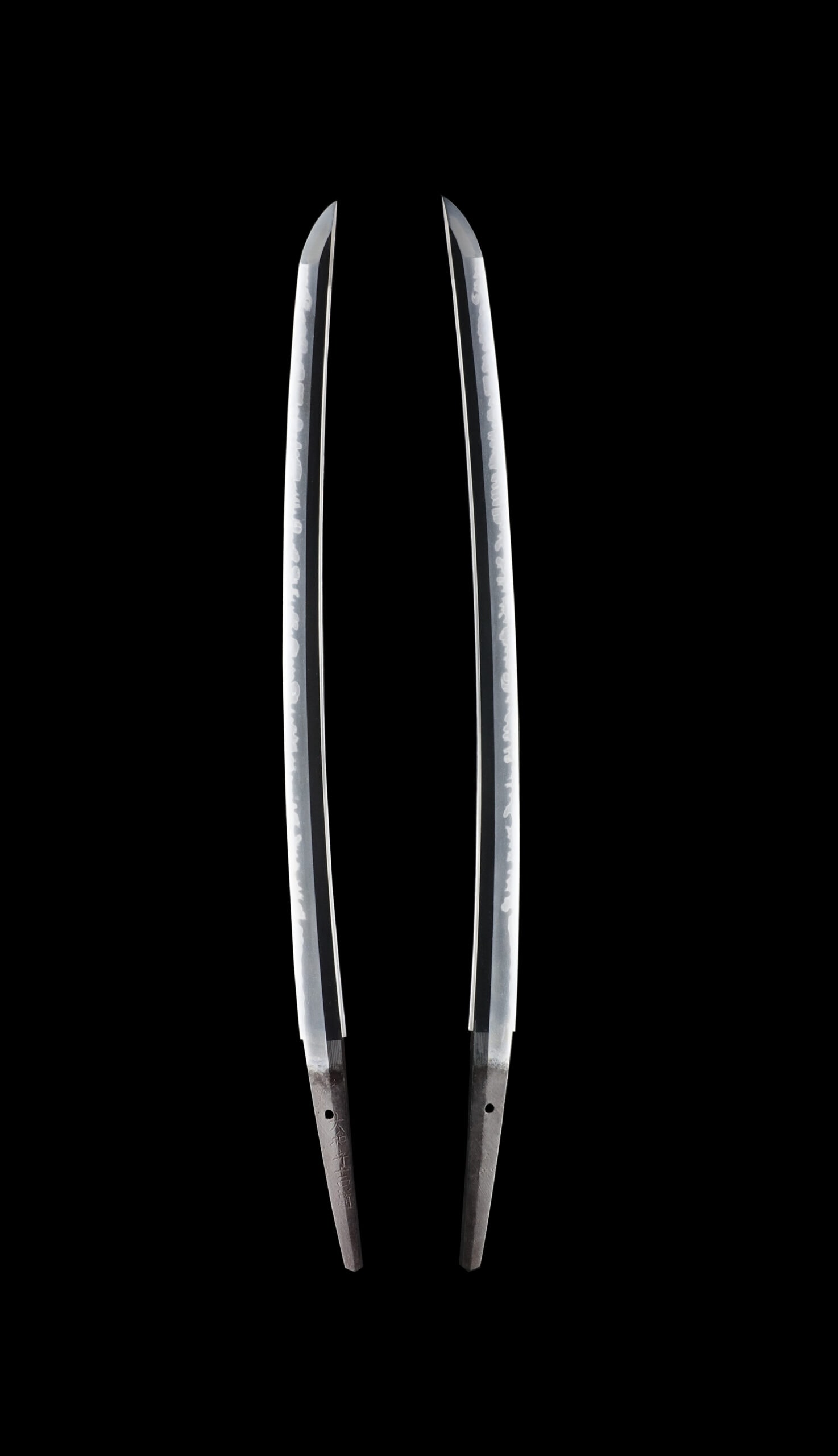
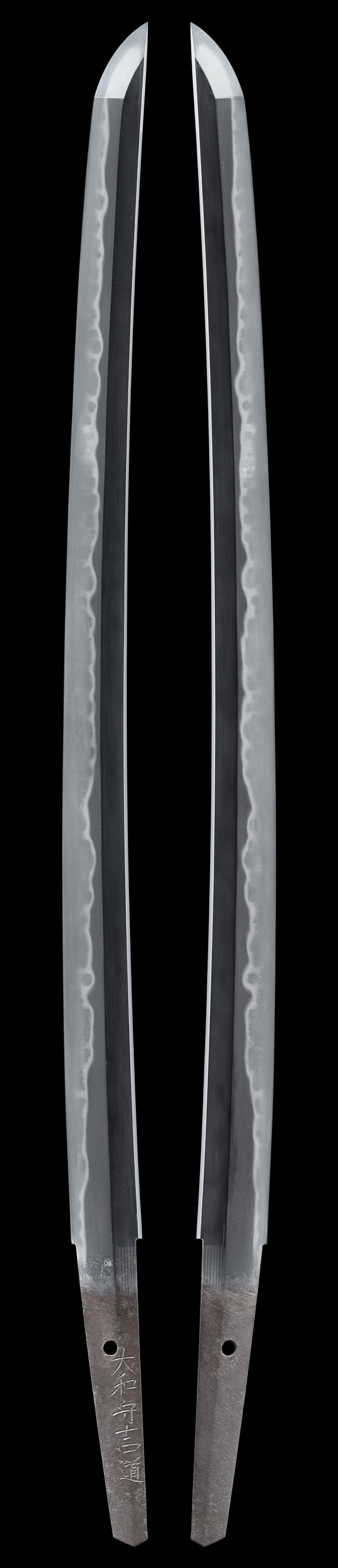
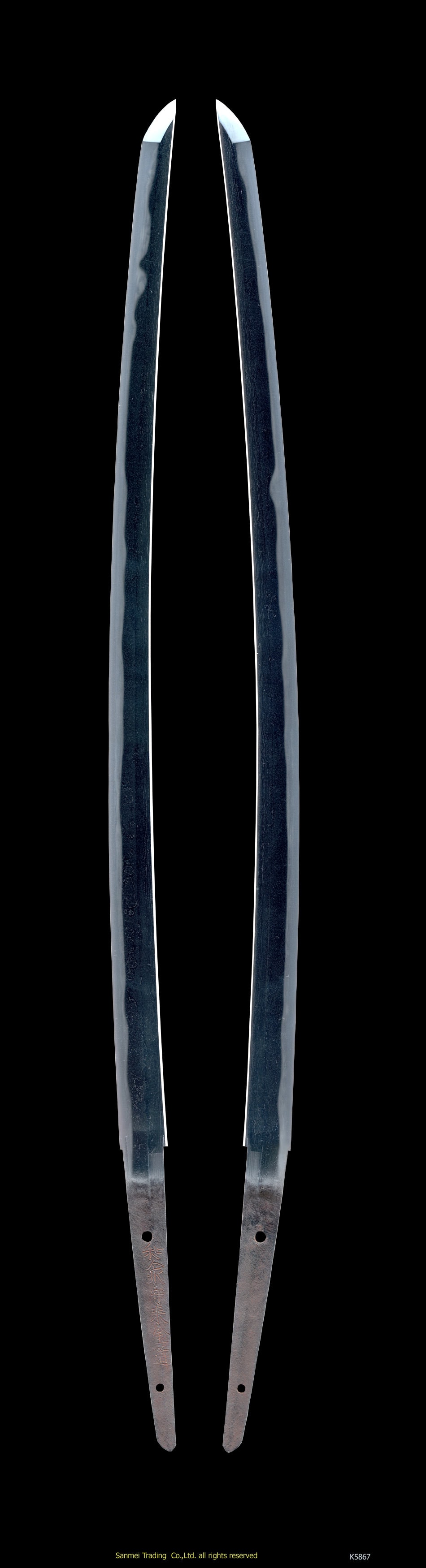
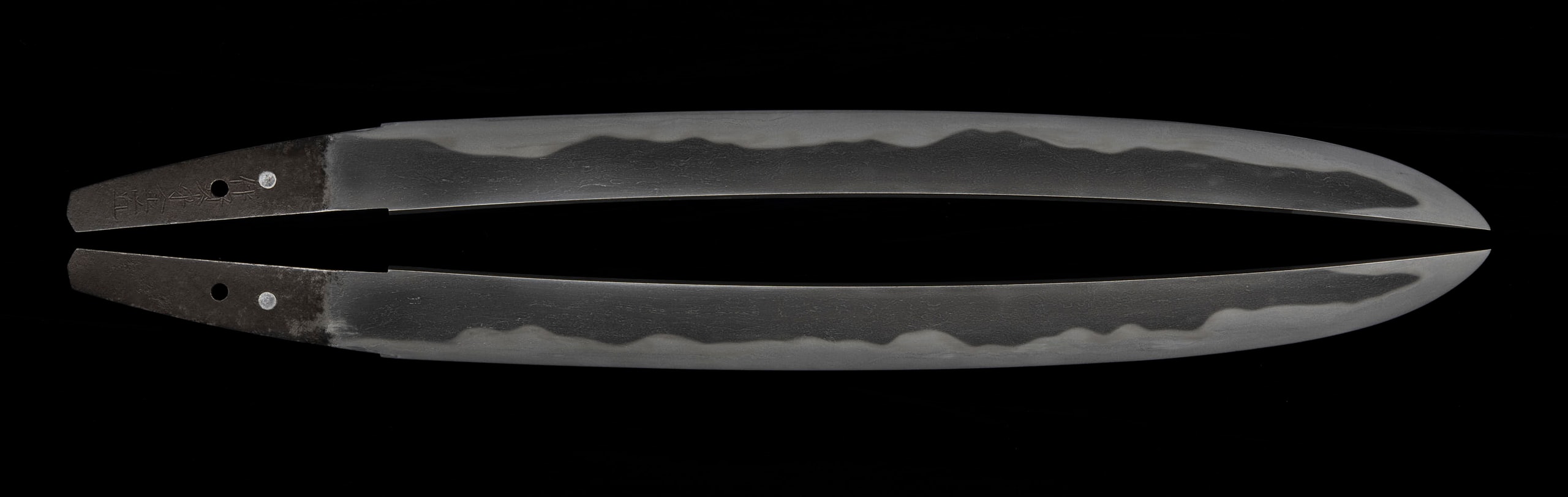
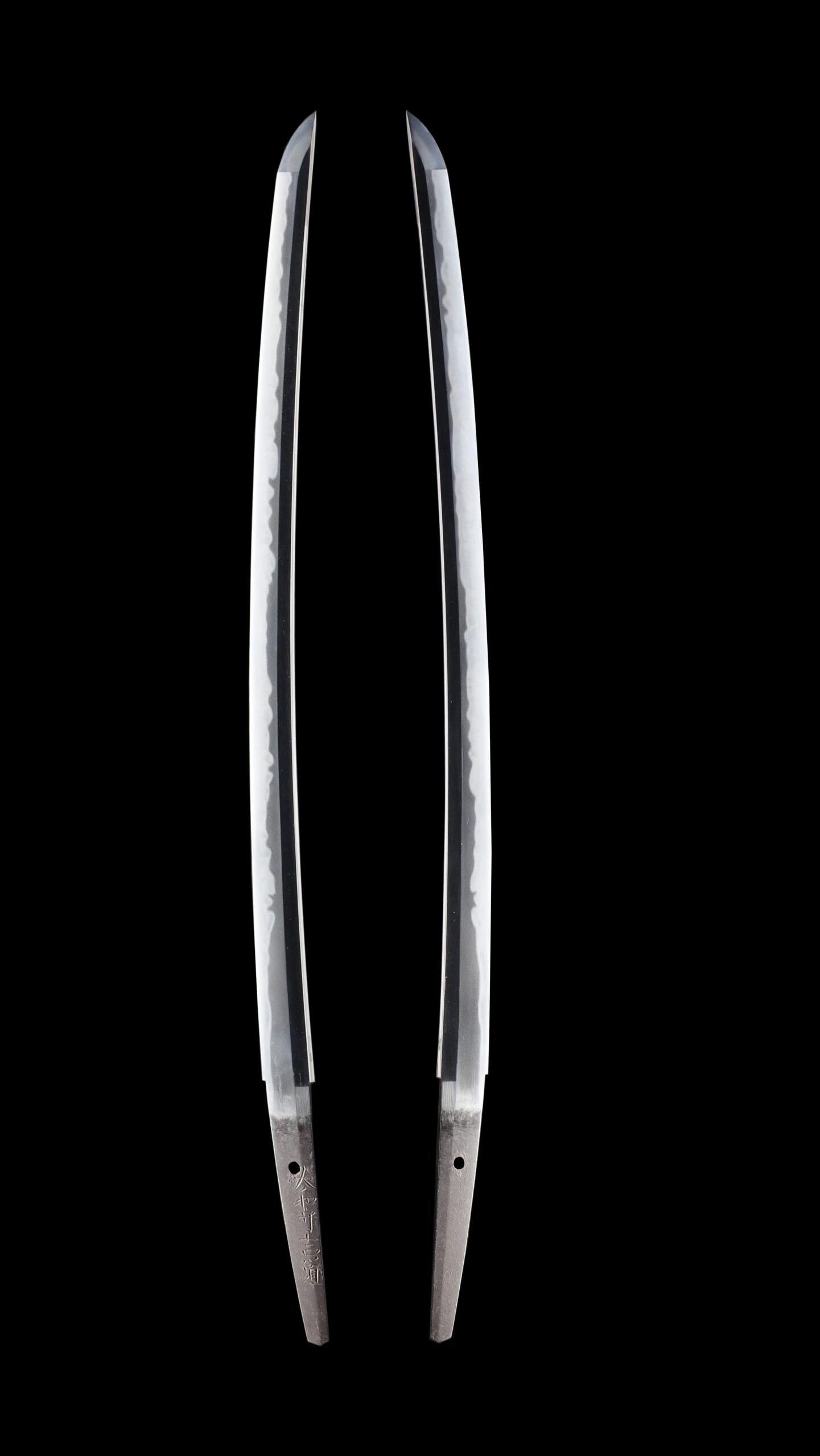
no Kami Masatoshi was the fourth and youngest son of Kanemichi of -Seki, and the latest dated work from his hand bears the year 'ei 6 (1629), the earliest Keichō 5 (1600). With his father and his three elder brothers, Iga no Kami Kinmichi, Kinmichi and Tanba no Kami Yoshimichi, he came up from to Kyōto and there founded the school, one of the principal forces of Kyoto beside the . Among the four brothers the published sources give the youngest the highest marks: they call his dexterity foremost of the brothers and his range the broadest within the lineage, a versatility one entry sets beside that of Kunimichi of the rival school. Fujishiro grades him Jō-jō . His record is not one manner held at full power but several manners practiced by a single capable hand, and it is read that way.
The center of that record is the manner the published sources say he most excelled in. Over an mixed with , and a flowing that stands a little, the steel sometimes taking a slightly blackish tone, he sets a large based on a shallow , mixing , , angular elements and pointed teeth. The is strong and at times coarse, gathering unevenly into patches; vigorous runs through it, long enter, and small and cross the edge into a -like aspect, the tending to sink. The published sources read these as taken from the range he preferred, rustic and antique in flavor, and call his finest of them outstanding even among his own works.
The is the constant that underlies every manner. An that flows into , the grain standing and often becoming toward the edge, carries the -Seki inheritance into the Kyōto work, with thick fine adhering and entering well. Above it the activity is the tell. is all but constant, far heavier than on a , and twice over he marks himself in the and the . The runs in most often pointed, thrusting up before the turnback and sometimes settling into a small , with along the tip; the published sources read this shallow pointed-and-swept form as the , single it out as most conspicuous in Masatoshi of the four brothers, and describe it, more than once, as a textbook example, a temper made as if drawn from a picture. Above the the strong gathers with and into stripes, the sprouting of (簾刃の萌), and the judges note this is not infrequently seen in his work; it is the seed of the basket-weave temper that would define the later school.
Because he was so versatile, his record divides into registers as much as phases. The prime stands beside a strongly -flavored register, where the lower half flares into a flamboyant gunome-chōji mixed with and the pointed teeth the sources attribute to a model in Magoroku Kanemoto, the steel flowing into near the edge and bunched, washed-out gathering in the . A third, quieter register is Yamato: an flowing into under a tight , with , small and along the , one read by the judges as worked with an awareness of the Shikkake smith Norinaga. To these the published commentary adds , so that no single edge form fixes him; what fixes him is the , the and the flowing that persist across all of them. Dated works are rare, but the brothers' move up to Kyōto, his Bunroku-era receipt of the no Kami title, and a documented change from about Keichō 20 in how the sixth stroke of the character mori in his title is cut give the signed work an unusually firm chronology.
What sets him within the school is named plainly by the judges. He is the most capable and the widest-ranging of the four brothers, and where his eldest brother Iga no Kami Kinmichi shared the specialty, Masatoshi carries it furthest and shows the family at its clearest. The name continued for several generations, but the published sources hold that the second generation and after are markedly inferior, so the first generation is the recognized master of the line, the hand against which the rest are measured. His distinction is therefore not a borrowed resemblance but his own spread of attested traits, the broadest in the school carried with a steady technique the commentary repeatedly calls skillful.
For the collector he is a signed and knowable name from the founding generation of Kyoto . He has no National Treasures and no Important Cultural Properties; his record runs instead through two and twenty-six blades and the prewar Jūyō Bijutsuhin, twenty-eight pieces in the Tokujū and tiers all told, and almost every one of them signed. Provenance is thin but distinguished, his blades passing through the hands of Oda Urakusai and the Oda family, the Imperial household, and the Kitano Shrine association. Carvings, rare in the line, appear on a few of his blades, a Fudō Myōō and among them that the judges call valuable for the study of his hand. Most designated blades, in private hands or not, are held rather than traded, and only a small part of his record reaches the tradeable tiers, so a signed no Kami Masatoshi comes to market from time to time rather than readily. When one does, it is a sound and varied document of the smith the school regarded as its most versatile founder-generation hand.