The swordsmith Shibata Ka, whose real name was Shibata Masataro, was born in Meiji 17 in Ogachi-gun, Akita Prefecture, currently Ugo-machi, Ogachi-gun, Akita Prefecture. Born into a distinguished and wealthy family, he was a multi-talented individual who also excelled in haiku, suiboku-ga, and calligraphy. He took an interest in smithing from a young age, later researching ancient traditions and completing his own unique forging method that incorporated Yamato-den and Soshu-den.
In Showa 9, he was accepted into the Teiten exhibition, and thereafter received numerous awards such as the Prime Minister's Award, Special Award, and Army Minister's Award. Furthermore, he had the honor of presenting a dedicated sword to the Imperial Family, received the title of "Kokko" (National Smith) which is considered the highest rank for a swordsmith, and served as a judge and Gon-daisojo for the New Sword Exhibition. In the Seidai Tosho Iretsu-hyo of Showa 17, he was listed as one of the twelve individuals in the highest rank, the "Shinpin-no-retsu."
Additionally, Shibata Ka was known as a famous sword connoisseur; he owned the Meibutsu: Sayo Samonji, and because he loved it deeply, he took the go "Sayo-an." He had a son, the swordsmith Shibata Akira, and both the father's name "Ka" and the son's name "Akira" are read as "Akira." Shibata Akira also inherited his father's style, leaving behind powerful works based on Soshu-den.
His deep longing for and research into famous ancient swords is greatly reflected in Shibata Ka's sword making, and many of his works show a Soshu-den style with haki in the ji and ha. He is a unique master smith representing the pre-war and wartime periods; his extant works are not numerous, and today he is evaluated as a rare swordsmith.
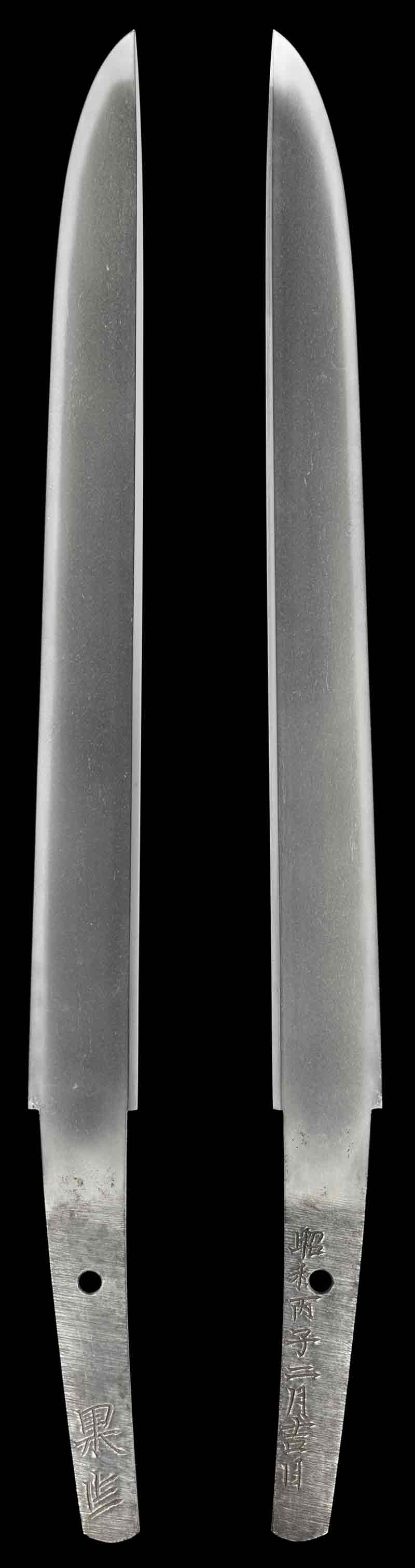
This work was made by the swordsmith Shibata Ka at the age of 52, and its shape is hira-zukuri with mitsu-mune. The mihaba is ordinary, the kasane is slightly thick, and it has uchi-zori. The kitae is ko-itame hada tsumi, becoming slightly masame towards the ha, with jinie appearing in fine particles and chikei entering. The hamon has about four ko-gunome fired in a row at the koshimoto on both sides, and above that it becomes suguba, slightly tinged with notare-gokoro. It shows a handsome dekikuchi characteristic of a Toshiro Yoshimitsu utsushi, with deep nioiguchi, ko-nie well-attached, sunagashi appearing finely, slightly mixed with yubashiri in the style of tobiyaki, and the boshi is sugu returning shortly in ko-maru with hakikake at the tip. In particular, the exquisite flavor of the jitetsu and ha-nie feels as though it approaches the atmosphere of ancient works.
Due to the old polish, fine hike are visible.
Due to the wooden habaki, ko-sabi is visible at the ha-machi.
Machine translation from the shop's Japanese · may contain errors ·
The swordsmith Shibata Ka, whose real name was Shibata Masataro, was born in Meiji 17 in Ogachi-gun, Akita Prefecture, currently Ugo-machi, Ogachi-gun, Akita Prefecture. Born into a distinguished and wealthy family, he was a multi-talented individual who also excelled in haiku, suiboku-ga, and calligraphy. He took an interest in smithing from a young age, later researching ancient traditions and completing his own unique forging method that incorporated Yamato-den and Soshu-den.
In Showa 9, he was accepted into the Teiten exhibition, and thereafter received numerous awards such as the Prime Minister's Award, Special Award, and Army Minister's Award. Furthermore, he had the honor of presenting a dedicated sword to the Imperial Family, received the title of "Kokko" (National Smith) which is considered the highest rank for a swordsmith, and served as a judge and Gon-daisojo for the New Sword Exhibition. In the Seidai Tosho Iretsu-hyo of Showa 17, he was listed as one of the twelve individuals in the highest rank, the "Shinpin-no-retsu."
Additionally, Shibata Ka was known as a famous sword connoisseur; he owned the Meibutsu: Sayo Samonji, and because he loved it deeply, he took the go "Sayo-an." He had a son, the swordsmith Shibata Akira, and both the father's name "Ka" and the son's name "Akira" are read as "Akira." Shibata Akira also inherited his father's style, leaving behind powerful works based on Soshu-den.
His deep longing for and research into famous ancient swords is greatly reflected in Shibata Ka's sword making, and many of his works show a Soshu-den style with haki in the ji and ha. He is a unique master smith representing the pre-war and wartime periods; his extant works are not numerous, and today he is evaluated as a rare swordsmith.
This work was made by the swordsmith Shibata Ka at the age of 52, and its shape is hira-zukuri with mitsu-mune. The mihaba is ordinary, the kasane is slightly thick, and it has uchi-zori. The kitae is ko-itame hada tsumi, becoming slightly masame towards the ha, with jinie appearing in fine particles and chikei entering. The hamon has about four ko-gunome fired in a row at the koshimoto on both sides, and above that it becomes suguba, slightly tinged with notare-gokoro. It shows a handsome dekikuchi characteristic of a Toshiro Yoshimitsu utsushi, with deep nioiguchi, ko-nie well-attached, sunagashi appearing finely, slightly mixed with yubashiri in the style of tobiyaki, and the boshi is sugu returning shortly in ko-maru with hakikake at the tip. In particular, the exquisite flavor of the jitetsu and ha-nie feels as though it approaches the atmosphere of ancient works.
Due to the old polish, fine hike are visible.
Due to the wooden habaki, ko-sabi is visible at the ha-machi.
The twentieth century nearly killed the craft twice: wartime distortion, then the occupation ban. The NBTHK’s founding in 1948 and licensed forging from 1953 rebuilt the sword as an art, crowned by Living National Treasures and the mukansa rank.
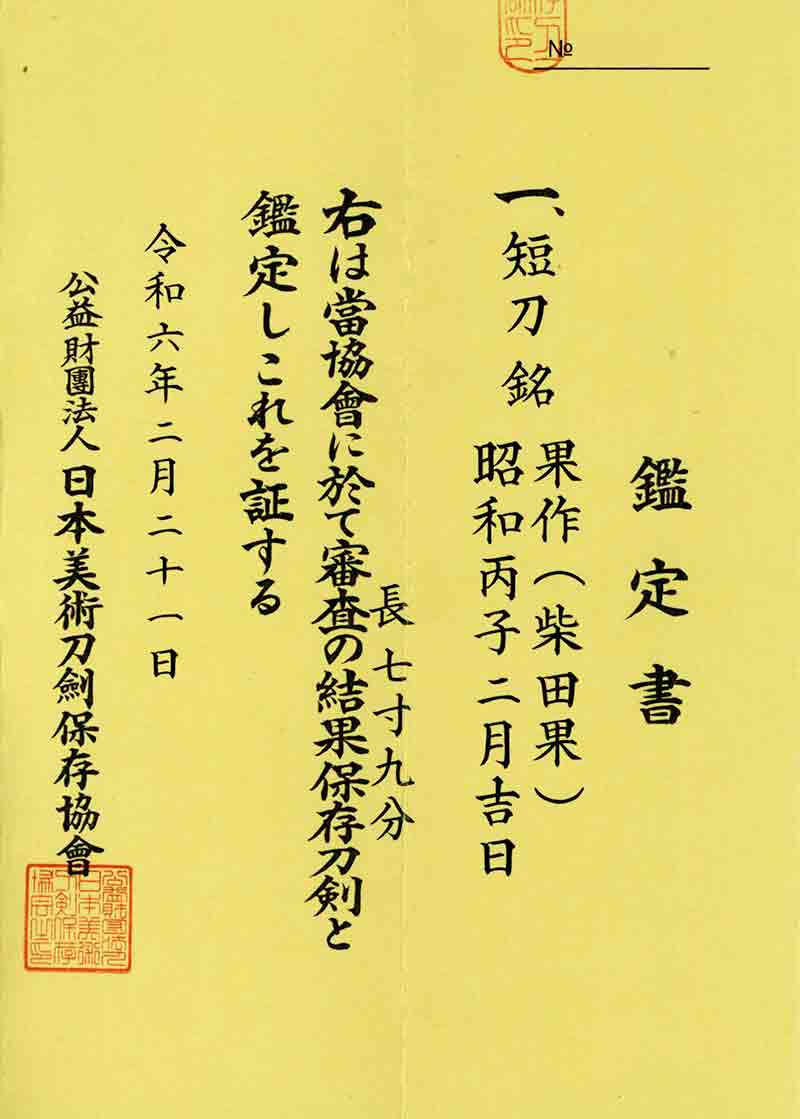
Certifies a genuine blade worth preserving: a signature confirmed correct, or, if unsigned, an era, province, and school that the NBTHK can reliably identify.
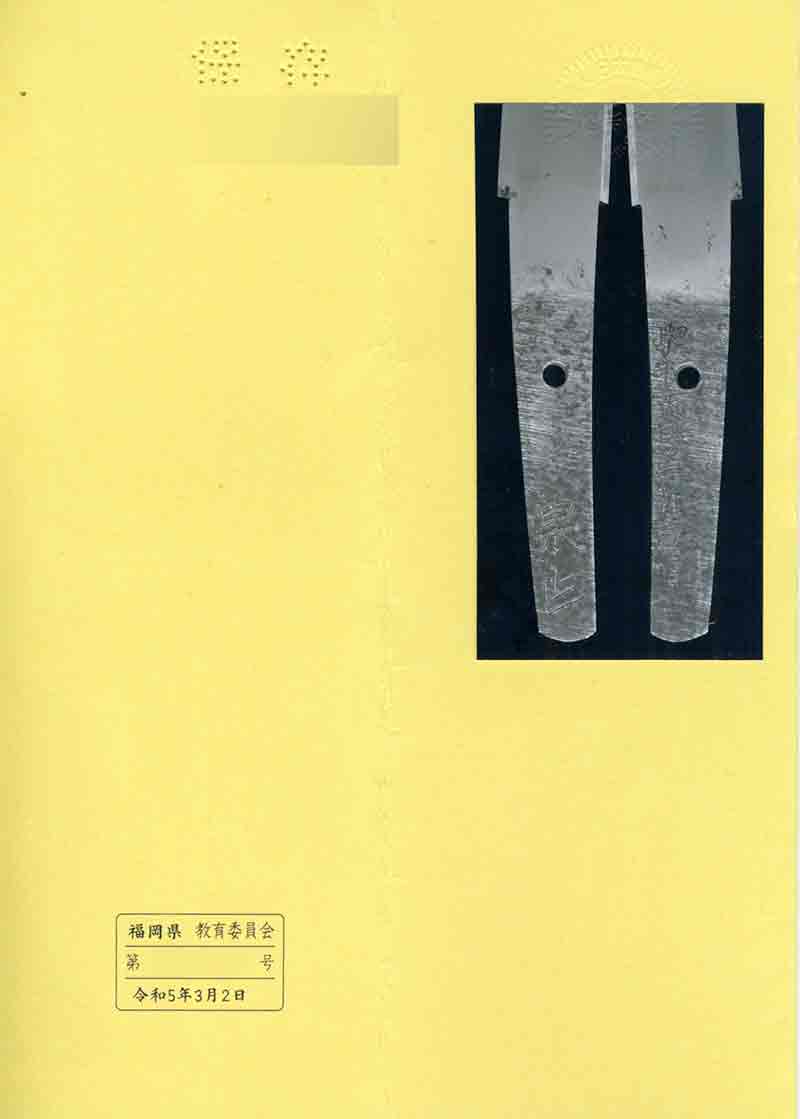
Signed: 果作(柴田果) 昭和丙子二月吉日 (Shibata Ka)
As written on the certificate
About the NBTHK›
The NBTHK (Nihon Bijutsu Tōken Hozon Kyōkai, the Society for the Preservation of Japanese Art Swords) is a public-interest incorporated foundation founded in 1948 and supervised by Japan’s Agency for Cultural Affairs (Bunkachō); it is based at the Japanese Sword Museum in Tokyo. Its expert panels physically examine each submitted work (shinsa) and issue a certificate (kanteishō) ranking it by artistic and historical merit. NBTHK papers are the most widely recognized standard of authentication for Japanese swords and fittings.
Please exercise cooling-off within 8 days of the item's arrival.
(1) We cannot accept items that have been altered or worked on in any way (e.g. test cutting, polishing or other work, display at viewing meetings, photography, taking oshigata rubbings, use for appreciation, copying of books).
(2) Return shipping is at the customer's expense.
(3) Costs other than the item price (bank transfer fees, cash-on-delivery fees, installment fees, etc.) cannot be refunded.
(4) For cash-on-delivery and similar payments, the refund is made after the payment has reached us.
(5) We cannot accept a return when a trade-in item is involved.
(6) Items delivered overseas cannot be returned or refunded (because of the time involved and, for swords, the surrender of the registration certificate and other circumstances).

 NihontoWatch