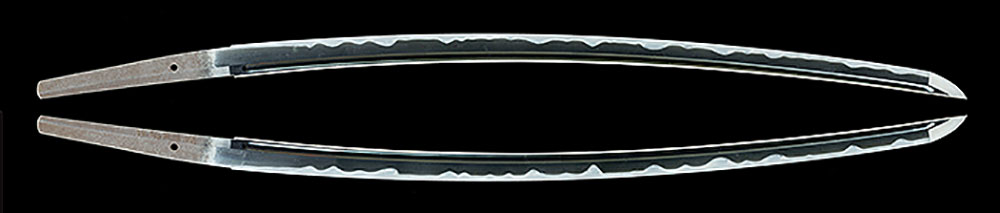
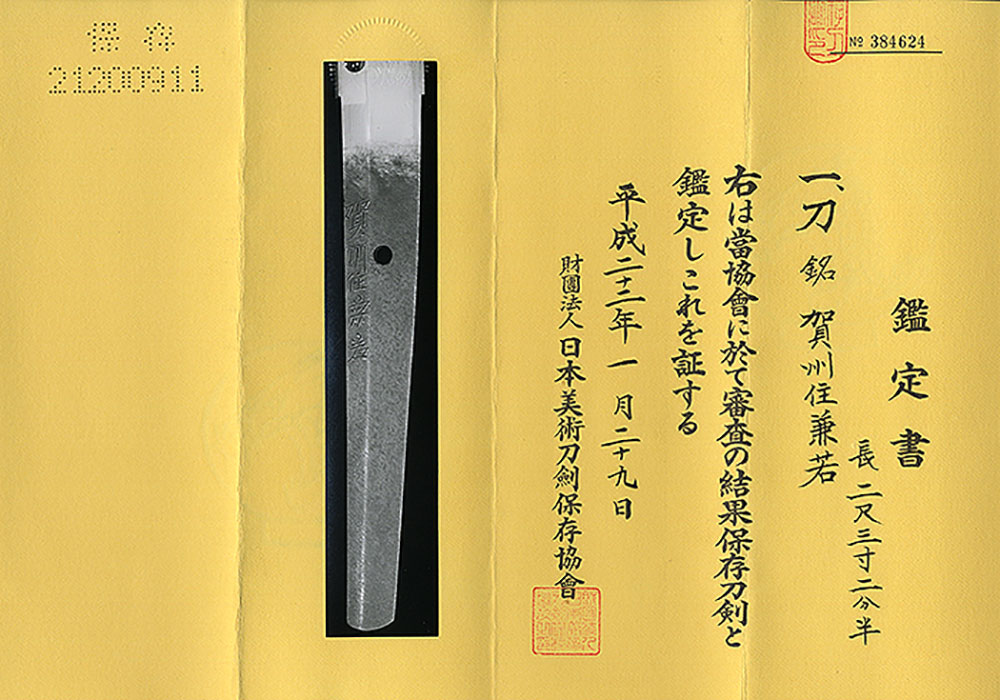
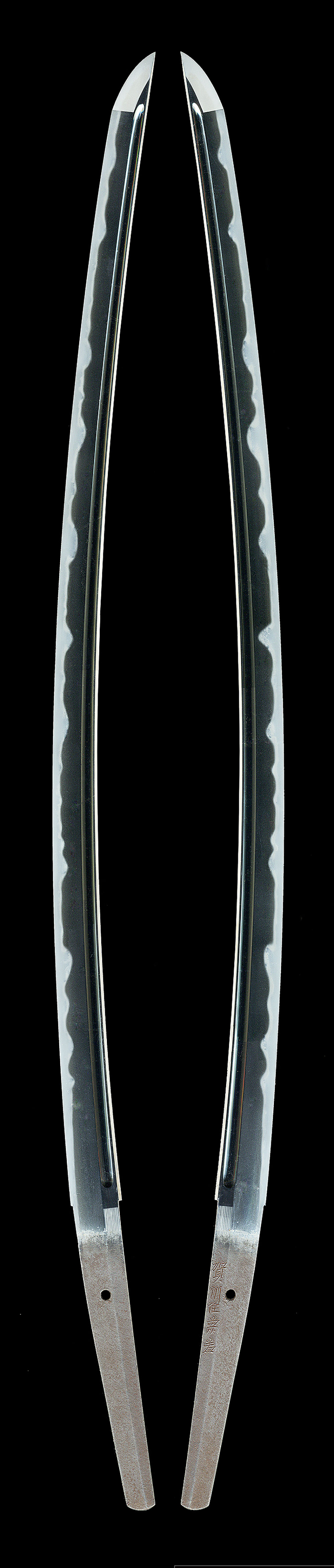
Among the shintō workshops of the northern provinces, the Kanewaka line of Kaga (Kashū) traces its root to Mino. The setsumei record that the first-generation smith was a son of Shihōsuke Kanewaka of Seki and that, though he stood in the lineage of the Seki smiths, he forged his blades in Kaga. " The second generation, Matasuke, was the third son of the first, born in Keichō 17 (1612), active from Kan'ei through Enpō, and dead in Enpō 5 (1677) at sixty-six. The third, his legitimate heir, took the name Shirōemon and worked from Kanbun through Shōtoku, with dated pieces from Enpō 5 to Hōei 4 (1677 to 1707); a fourth, the Tsujiura Shirōemon of the same name, assisted his father as a substitute smith and inherited the name after Matasuke's death. The cutting-test katana signed Tsujimura Etchū no Kami Fujiwara Takahira[[c:2]] ties the workshop to the Maeda domain's swords, its blade tested five times and the result inlaid in kinzōgan. The shared hand is grounded in Mino forging carried north. The jigane across these blades is itame mixed with masame and mokume, often with standing grain (hada-dachi), abundant ji-nie, fine chikei, and a steel of slightly blackish yet clear tone, a cast the setsumei call a trait of the northern provinces (Hokukoku-mono). The temper is built on ko-notare mixed with gunome and pointed togariba, frequently assuming a boxed (hako-ba) character, with deep nioi, well-adhering nie, conspicuous sunagashi, kinsuji, and at times tobiyaki; the bōshi runs sugu with ko-maru or enters midare-komi, often with hakikake and a yakitsume-leaning point, a Yamato-tradition close noted on the masame-forged third-generation work.
To read the hand, the setsumei point to Mino Shizu and Naoe Shizu affinity, the wanare-based mixture of gunome and togari, and the box-shaped temper. Generations are told apart by that box: in the first generation it tends toward nie-kuzure, flavorful and not sharply drawn, and a defined hako-ba is comparatively uncommon; from the second and third it grows more crisply outlined. The third generation also worked saka-chōji-midare (reverse chōji), and in such pieces the fourth produced utsuri effects that could be taken for the Ishidō school. The kantei points the setsumei fix upon are the standing, blackish itame-masame ground, the boxed notare with sunagashi and kinsuji, and the Shizu-derived midare leaning. " Named works carry the lineage: a Genna 5 ken, whose date proves the title came later; the Kashū Fujiwara Yukimitsu tachi dated Bunmei 17 (1485) marks the older Muromachi Kashū ground from which such northern work descends; and a katana with kenuki-gata tachi koshirae in ashide maki-e shows the dress that accompanied the line. One blade, recorded in Honma's inventory of the Imperial collection, is attributed to the fourth-generation Tsujiura Shirōemon, and record provenance in Kaga and Ishikawa hands. Across the generations the verdict is consistent: each smith was skilled in his own right, the forging at times exceeding ordinary Kashū work, and the dated inscriptions stand as documentary anchors for early Kaga shintō. Learn more →


 NihontoWatch