Muromachi turned sword making into an industry: the uchigatana rose with massed infantry warfare, Osafune and Seki produced bundle swords beside custom orders, and the Ming trade carried Japanese blades abroad by the tens of thousands.
 NihontoWatchNihontoWatch
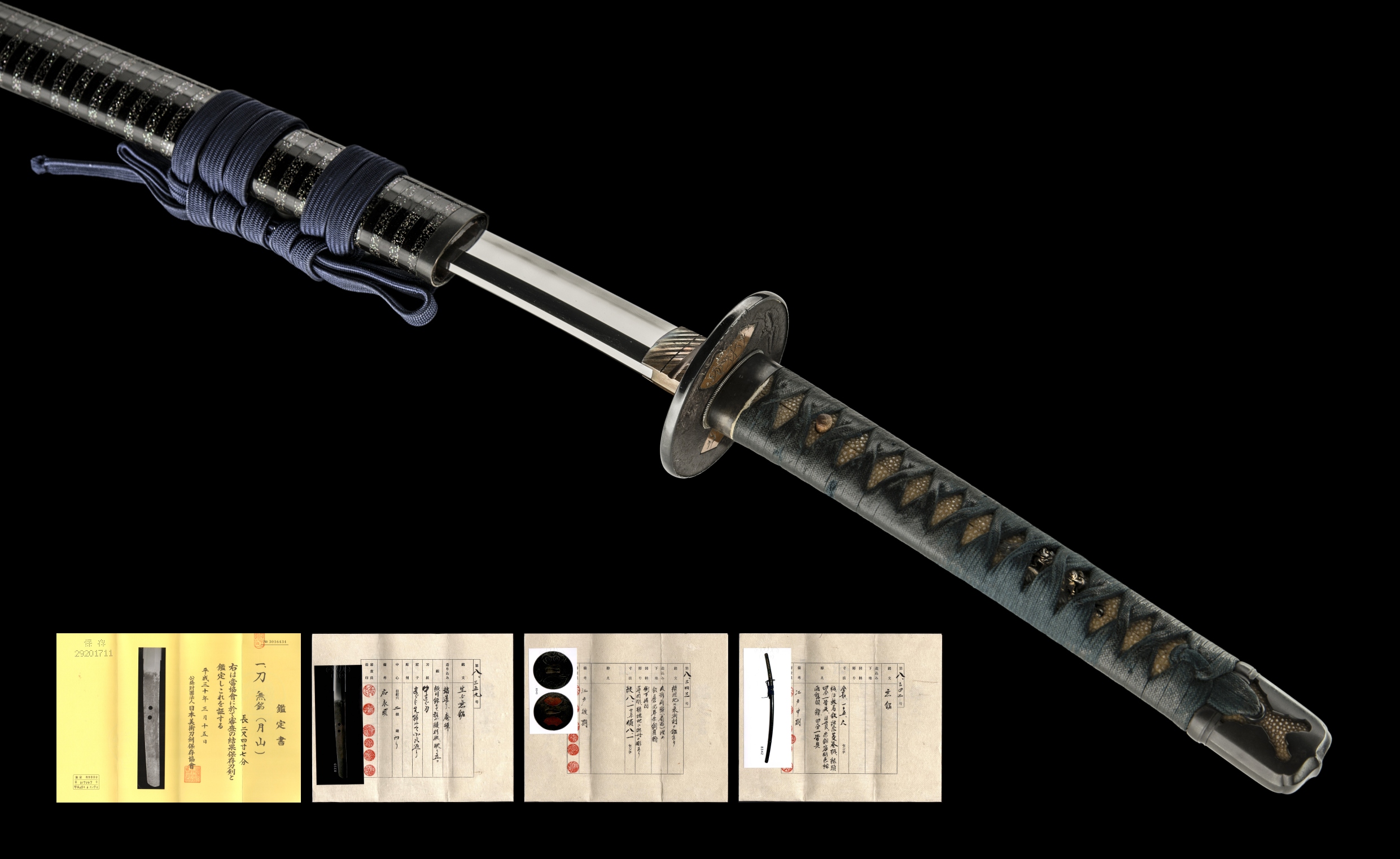
The Gassan school is one of the most celebrated lineages in Japanese sword-forging, with roots in Mt. Gassan in the ancient province of Dewa – present-day Yamagata prefecture. Mountain priests trained there from earliest times, and swordsmiths bearing the Gassan name are documented from the Heian period, though no signed work predates the close of the Nanbokuchô era in 1394. Blades made before the Edo period carry the prefix Ko (ancient), and this katana, dated to the first era of the Muromachi period circa 1400, is a textbook example of the school at its most refined. The line continues unbroken to this day under Living National Treasure Gassan Sadatoshi, and the reason for that longevity is visible in every inch of this blade. The steel tells the story immediately. The ayasugi-hada – also written as Gassan-hada (月山肌) – rolls across the ji in perfectly controlled waves, each crest crisp and deliberate, the whole surface alive with movement. Named after the decorative carving pattern found on traditional Japanese koto and shamisen instruments, it has been the school’s trademark for centuries. A misty utsuri rises through the body of the blade as if conjured from within the steel itself. The hamon is a composed chu-suguha, its straight line picking up a gentle undulation as it rides the underlying grain – disciplined craftsmanship working in quiet harmony with the material. The boshi is a classic hakikake, the brushed tip finishing the edge with characteristic Gassan authority. The sugata is graceful and long, with an elegant torii-zori – the deepest point of curvature resting near the middle of the blade, as befits a sword of this period. The nakago is ubu – original and unaltered in length – and carries a history worth noting. The blade was originally left unsigned by its maker. At some later point a Gassan signature was added as an ato-mei; as this was not by the original smith, it constituted a gimei (false inscription). That signature was carefully removed prior to submission to the NBTHK, which formally certified the blade to the Gassan school. The sword also retains its original torokusho registration card, issued on 12 March 1951 in Kanagawa – the 26th year of Shôwa – bearing the serial number 1568. That year was the very first in which swords were formally registered in Japan, and the low serial number strongly suggests this blade was submitted by a prominent, possibly former daimyô family. It comes with a magnificent late Edo-period handachi koshirae – the Kuro Aogai Nuri Wake Fue Maki Saya Shibuichi Kaigu – its black lacquer saya decorated with crushed mother-of-pearl in a striped fue (bamboo flute) pattern. All major fittings are matched shibuichi alloy. The iron tsuba, from the Kishu school, is the work of Zoko and depicts a wild boar resting under a tree, with peony engravings across the surface. The menuki take the form of rain dragons. The ensemble has remained essentially unchanged since its last samurai owner in the early 1800s – even the original samekawa is present, worn gracefully with age.
Offered by Unique Japan
This piece has sold
Get an email when a new Gassan piece hits the market.
Wakimono · Dewa · around 1394-1428
Tōken Taikan top 60%
2 pieces on the market now
Where Gassan stands among comparable artisans: across all of nihontō, and within tradition, era, and period. The tiers (Foremost · Leading · Major · Notable) weigh official designations from the NBTHK and Japan's Agency for Cultural Affairs, together with historical honors of lasting repute such as the Sansaku and Meibutsu-chō.
Select a lens to see how it's measured.
Wakimono · Dewa
35 pieces on the market now
Mount Gassan rises among the Dewa Sanzan, the three sacred peaks of northern Japan bound to the mountain asceticism of Shugendō, and the swordsmiths who took the mountain's name worked in its shadow in Ōshū, Dewa Province. The setsumei record that smiths signing "Gassan" are noted in the Kanchiin-bon Meizukushi as early as the Heian period, and the lineage's oldest surviving signed blade is a tachi simply signed Gassan, kept at the Gassan Shrine and judged to date from the late Nanbokuchō to early Muromachi period. Around that same early Nanbokuchō moment the corpus places Gassan Nagamitsu, whose signed tachi answers to the "Ushū Gassan group, around the Ryakuō era" recorded in the Meikan, and Shōgun, a Nanbokuchō hand sometimes identified with Gunshō, dated Genchū 3 (1386). A later branch is carried by Gassan Chikanori, working into the mid and late Muromachi (an ubu wakizashi dated Eishō 9, 1512). The line was revived in Osaka in the closing Tokugawa and Meiji years by Gassan Sadayoshi and his adopted son Gassan Sadakazu, who endured the Haitōrei edict and was appointed Teishitsu Gigei-in (Artist to the Imperial Household) in Meiji 39; his own adopted son Gassan Sadaichi continued the title into Taishō. The forging is the school's signature. " Over the itame base the grain flows (nagare) and tends to stand; ji-nie adheres and chikei enter, and the northern steel takes a dark, metal-like (kana-iro) hue read as Ōshū temperament.
The temper of the old line is a suguha whose nioiguchi is shizumi (subdued), at times mixed with gunome and ko-midare and softened toward urumi, the bōshi turning back in ko-maru. Departures within the corpus mark the lineage's range: Chikanori's late work can drop the ayasugi entirely and absorb Sue-Bizen and Osafune manners, while the Osaka revival smiths command itame with thick ji-nie, flamboyant nie-laden midare, kinsuji, and sunagashi in a full Sōshū idiom, and both Sadakazu and Sadaichi added meticulous horimono, from Bishamonten kurikara to taki kaen Fudō and dragon carvings carved by the same hand that forged the blade. For recognition the setsumei point first to the wave-grain ayasugi and the subdued, often slightly urumi northern nioiguchi, and where these recede, to the dark steel and standing grain that still betray an Ōshū hand. Signed examples of the old line are described as extremely rare, which raises the documentary weight of Nagamitsu's tachi and Shōgun's dated tantō. Provenance threads through the school's own sanctuary: the founding tachi and an Important Art Object tachi both reside at the Dewa Sanzan and Gassan Shrines. The Osaka revival is anchored by Sadaichi tantō signed Teishitsu Gigeiin, recorded in Honma's inventory of the Imperial collection, alongside a Sadakazu wakizashi made on commission for Prince Kuni. Across six centuries the setsumei track a single mountain workshop, from the subdued ayasugi of the Dewa founders through a Muromachi offshoot that turned toward Bizen, to the Imperial-rank carvers of Osaka who reproduced the old wave-grain while mastering the wider traditions. Learn more →
| Smith | Era | Designated |
|---|---|---|
| Tomosada友定 | 1532-1555 | 0 |
| Naonori直則 | 1830-1844 | 0 |
| Toshiyasu俊安 | 1504-1521 | 0 |
| Nagahisa長久 | 1334-1338 | 0 |
| Hisatoshi久利 | 1392-1573 | 0 |
The Muromachi period (1392 to 1573)
Muromachi turned sword making into an industry: the uchigatana rose with massed infantry warfare, Osafune and Seki produced bundle swords beside custom orders, and the Ming trade carried Japanese blades abroad by the tens of thousands.
Certifies a genuine blade worth preserving: a signature confirmed correct, or, if unsigned, an era, province, and school that the NBTHK can reliably identify.
The NBTHK (Nihon Bijutsu Tōken Hozon Kyōkai, the Society for the Preservation of Japanese Art Swords) is a public-interest incorporated foundation founded in 1948 and supervised by Japan’s Agency for Cultural Affairs (Bunkachō); it is based at the Japanese Sword Museum in Tokyo. Its expert panels physically examine each submitted work (shinsa) and issue a certificate (kanteishō) ranking it by artistic and historical merit. NBTHK papers are the most widely recognized standard of authentication for Japanese swords and fittings.
NBTHK official siteAll swords come with a three-day inspection period beginning from the date of delivery. If not satisfied, the sword may be returned within this period for a full refund of the purchase price. Outside of this period, all sales are final. Swords purchased on a layaway payment plan are not eligible for the three-day inspection period.