Gendai, Niigata
Ningen Kokuho
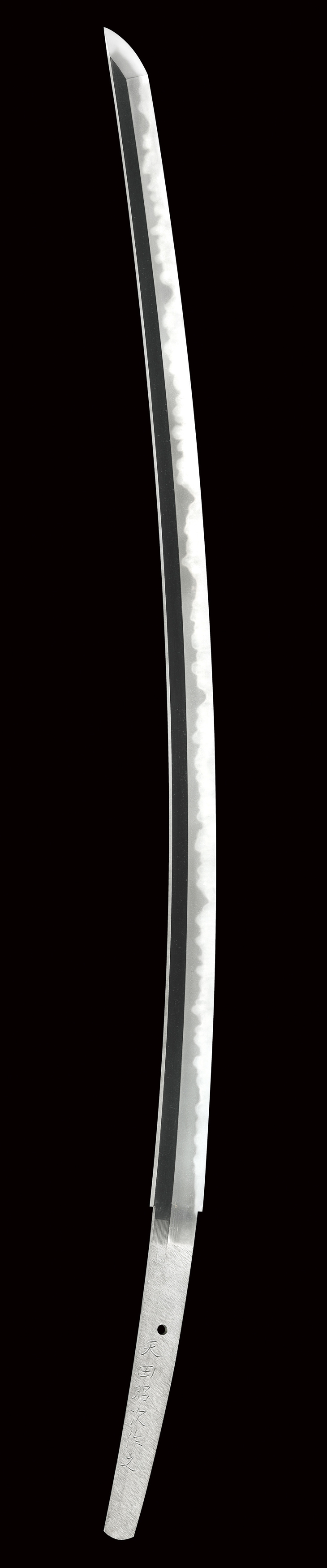
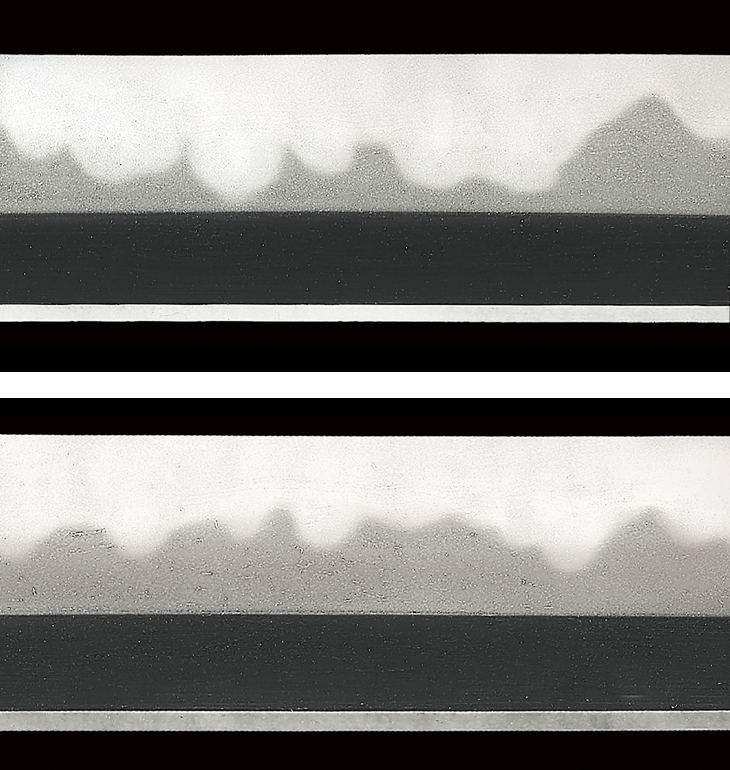
Shinogi-zukuri, high shinogi and low iori-mune, kissaki slightly clogged in ikubi style. Kitae: ko-itame hada well-packed, finely and elegantly hada-dachi, thick ji-nie, seiryo jigane. Hamon: based on gunome choji midare, the habuchi has deep nioi with ko-nie and is bright and sae, inside the ha there are frequent yo, gunome-ashi, and choji-ashi, with delicate kinsuji and sunagashi. Boshi: deeply baked notare-komi, returning in ko-maru. Nakago ubu, tip is kuri-jiri, yasurime sujikai. Copper with kin-kise habaki. Jidai-kenma (small rust present). In shirasaya.
Akitsugu, whose name was Amada Seiichi, was born in Showa 2 in what is now Honda, Shibata City, Niigata Prefecture; he lost his father Sadayoshi at age nine, and in Showa 15 he went to Tokyo and became a monjin of Kurihara Hikosaburo at the Nihonto Tanren Denshu-jo. At that time, Miyairi Akihira (Yukihira) was his senior disciple. Entering the Showa 30s he began to distinguish himself, receiving the Yushu-sho every year at the Shinsakuto-ten, but just as he was starting out around Showa 35 at age 33, he suffered a serious illness and was forced into an eight-year hiatus. In Showa 43, upon resuming sword forging, he established the "Hogetsusan Tanren-jo" as his home and forge on the outskirts of the Tsukioka Onsen district in Shibata City. Returning with an indomitable spirit, Akitsugu became Mukansa in Showa 47, and in Showa 52, 60, and Heisei 8, he received the "Masamune-sho," the highest award in the sword world, three times; receiving this award three times is the third instance following Sumitani Masamine and Osumi Toshihira, but Akitsugu is the only one to receive it for entirely different styles: Yamashiro-den, Soshu-den, and Bizen-den. In Heisei 9 he was designated a Ningen Kokuho, and in Heisei 25 he passed away at age 85.
This work was made in Showa 57 when the smith was 55 years old, with a nagasa of slightly less than 2 shaku 4 sun 6 bu; the kissaki is slightly clogged in ikubi style, and the mihaba and kasane are solid, creating a grand and powerful style that reproduces a typical tachi sugata of the mid-Kamakura period.
It is a stroke aimed at Bizen Ichimonji, with a sophisticated ko-itame hada covered in thick ji-nie, and a blade based on gunome choji midare with deep nioi that is so flamboyant it partially reaches the shinogi; the habuchi is bright and sae, and soft choji-ashi enter the ha frequently. The sae of the ji and ha can be called the smith's finest.
Since becoming independent, the smith reached the conclusion that in order to approach the old masterpiece swords of the Kamakura and Nanbokucho periods, the reproduction of the iron of that time was essential, and he began working on full-scale jika-seitetsu. After various research, the result he reached through great hardship was the highest grade tamahagane created by carefully refining Masa satetsu from Oku-Izumo at low temperatures. This eventually brought the smith the honor of his first "Masamune-sho."
This work is a confident piece from the time he was working with conviction in his own jika-seitetsu method after winning his first "Masamune-sho"; as mentioned above, his third "Masamune-sho" winning work was a Bizen-den choji-ba, but this work shows a workmanship that is not inferior to it.
A masterpiece of Bizen-den choji-ba, earnestly forged in pursuit of the ultimate beauty of iron by the Ningen Kokuho Amada Akitsugu, who was fascinated by the famous swords of the Kamakura and Nanbokucho periods.
Machine translation from the shop's Japanese · may contain errors ·
Gendai, Niigata
Ningen Kokuho
Shinogi-zukuri, high shinogi and low iori-mune, kissaki slightly clogged in ikubi style. Kitae: ko-itame hada well-packed, finely and elegantly hada-dachi, thick ji-nie, seiryo jigane. Hamon: based on gunome choji midare, the habuchi has deep nioi with ko-nie and is bright and sae, inside the ha there are frequent yo, gunome-ashi, and choji-ashi, with delicate kinsuji and sunagashi. Boshi: deeply baked notare-komi, returning in ko-maru. Nakago ubu, tip is kuri-jiri, yasurime sujikai. Copper with kin-kise habaki. Jidai-kenma (small rust present). In shirasaya.
Akitsugu, whose name was Amada Seiichi, was born in Showa 2 in what is now Honda, Shibata City, Niigata Prefecture; he lost his father Sadayoshi at age nine, and in Showa 15 he went to Tokyo and became a monjin of Kurihara Hikosaburo at the Nihonto Tanren Denshu-jo. At that time, Miyairi Akihira (Yukihira) was his senior disciple. Entering the Showa 30s he began to distinguish himself, receiving the Yushu-sho every year at the Shinsakuto-ten, but just as he was starting out around Showa 35 at age 33, he suffered a serious illness and was forced into an eight-year hiatus. In Showa 43, upon resuming sword forging, he established the "Hogetsusan Tanren-jo" as his home and forge on the outskirts of the Tsukioka Onsen district in Shibata City. Returning with an indomitable spirit, Akitsugu became Mukansa in Showa 47, and in Showa 52, 60, and Heisei 8, he received the "Masamune-sho," the highest award in the sword world, three times; receiving this award three times is the third instance following Sumitani Masamine and Osumi Toshihira, but Akitsugu is the only one to receive it for entirely different styles: Yamashiro-den, Soshu-den, and Bizen-den. In Heisei 9 he was designated a Ningen Kokuho, and in Heisei 25 he passed away at age 85.
This work was made in Showa 57 when the smith was 55 years old, with a nagasa of slightly less than 2 shaku 4 sun 6 bu; the kissaki is slightly clogged in ikubi style, and the mihaba and kasane are solid, creating a grand and powerful style that reproduces a typical tachi sugata of the mid-Kamakura period.
It is a stroke aimed at Bizen Ichimonji, with a sophisticated ko-itame hada covered in thick ji-nie, and a blade based on gunome choji midare with deep nioi that is so flamboyant it partially reaches the shinogi; the habuchi is bright and sae, and soft choji-ashi enter the ha frequently. The sae of the ji and ha can be called the smith's finest.
Since becoming independent, the smith reached the conclusion that in order to approach the old masterpiece swords of the Kamakura and Nanbokucho periods, the reproduction of the iron of that time was essential, and he began working on full-scale jika-seitetsu. After various research, the result he reached through great hardship was the highest grade tamahagane created by carefully refining Masa satetsu from Oku-Izumo at low temperatures. This eventually brought the smith the honor of his first "Masamune-sho."
This work is a confident piece from the time he was working with conviction in his own jika-seitetsu method after winning his first "Masamune-sho"; as mentioned above, his third "Masamune-sho" winning work was a Bizen-den choji-ba, but this work shows a workmanship that is not inferior to it.
A masterpiece of Bizen-den choji-ba, earnestly forged in pursuit of the ultimate beauty of iron by the Ningen Kokuho Amada Akitsugu, who was fascinated by the famous swords of the Kamakura and Nanbokucho periods.
The twentieth century nearly killed the craft twice: wartime distortion, then the occupation ban. The NBTHK’s founding in 1948 and licensed forging from 1953 rebuilt the sword as an art, crowned by Living National Treasures and the mukansa rank.
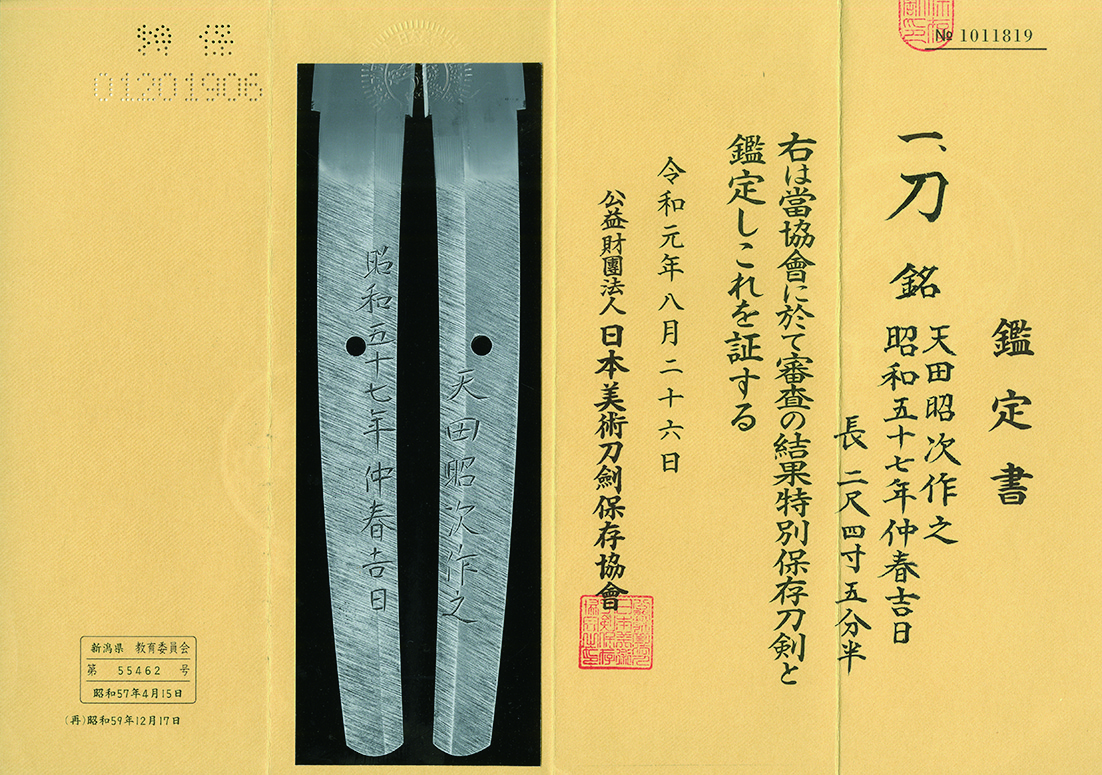
A Hozon-certified blade judged to show notably superior workmanship and a better state of preservation. The bar is higher: re-tempered blades and most unsigned Muromachi/Edo works are excluded.
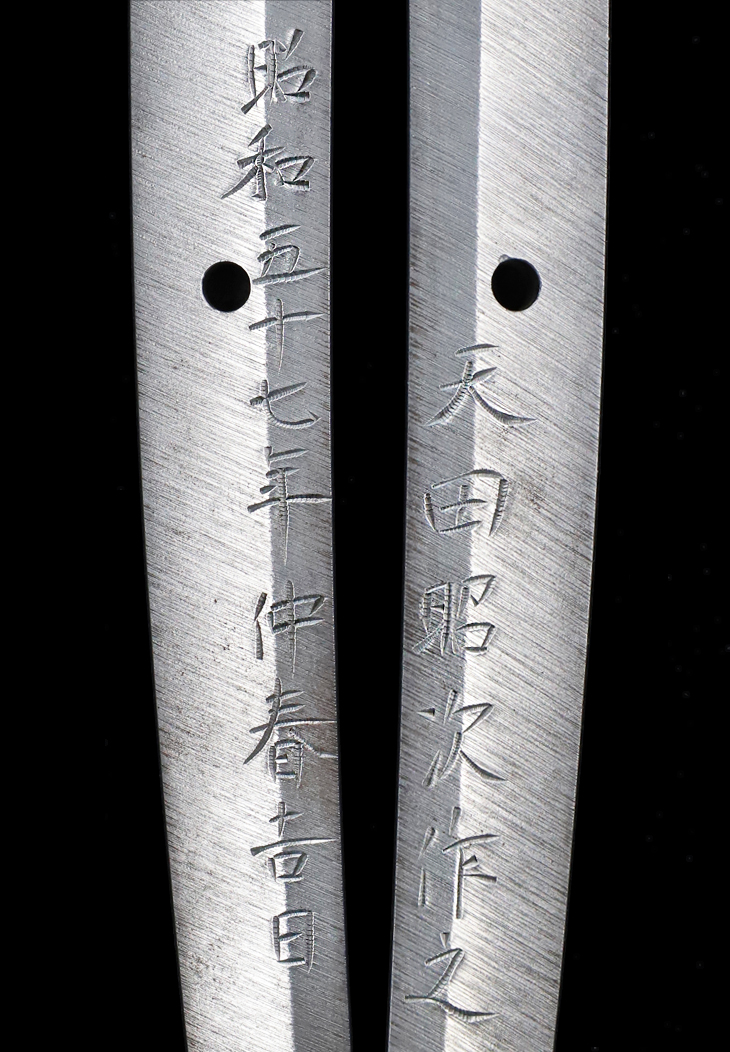
Signed: 天田昭次作之 昭和五十七年仲春吉日 (Miyairi Akitsugu)
As written on the certificate
About the NBTHK›
The NBTHK (Nihon Bijutsu Tōken Hozon Kyōkai, the Society for the Preservation of Japanese Art Swords) is a public-interest incorporated foundation founded in 1948 and supervised by Japan’s Agency for Cultural Affairs (Bunkachō); it is based at the Japanese Sword Museum in Tokyo. Its expert panels physically examine each submitted work (shinsa) and issue a certificate (kanteishō) ranking it by artistic and historical merit. NBTHK papers are the most widely recognized standard of authentication for Japanese swords and fittings.
For one-of-a-kind items such as swords, sword fittings and antiques, other customers may be waiting for the item, so please contact us about a return within 3 days of its arrival and ship it back within 8 days. Refunds are made on the day the returned item arrives.

 NihontoWatch