 NihontoWatchNihontoWatch
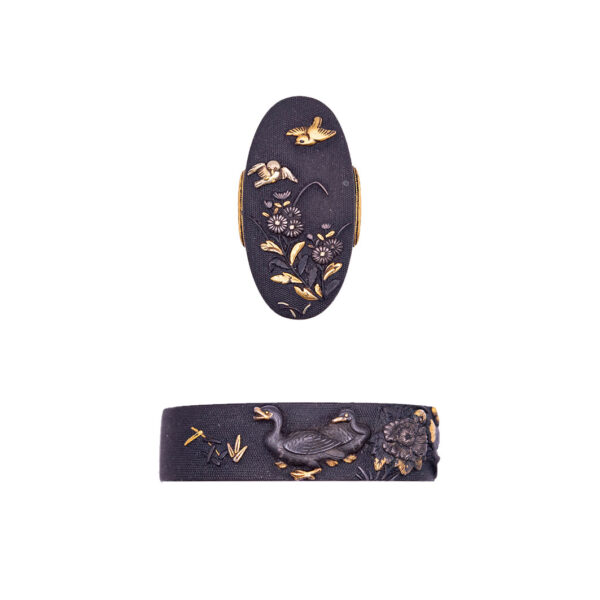
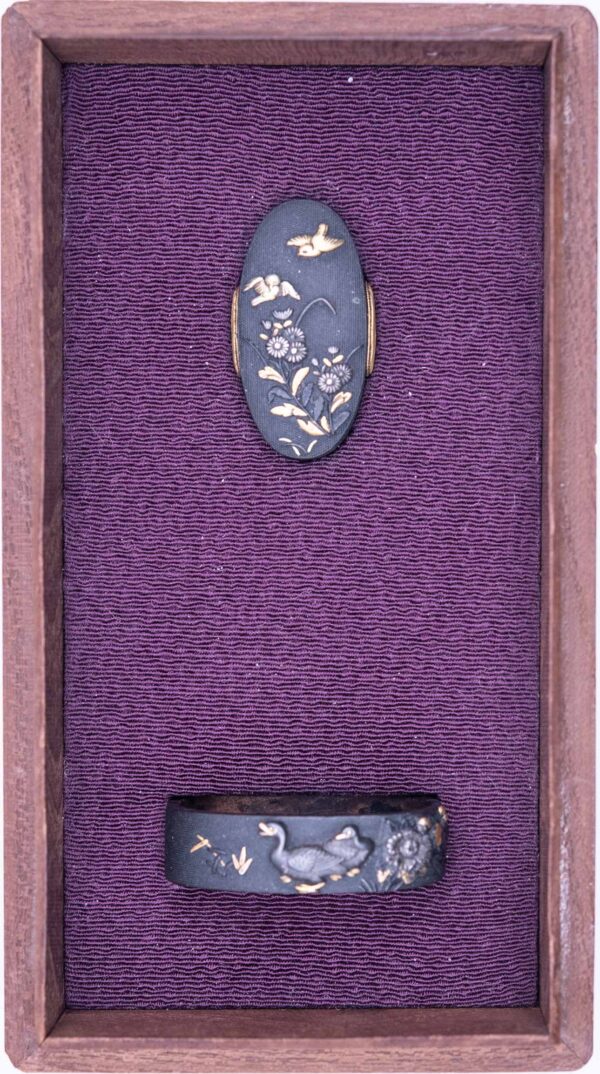
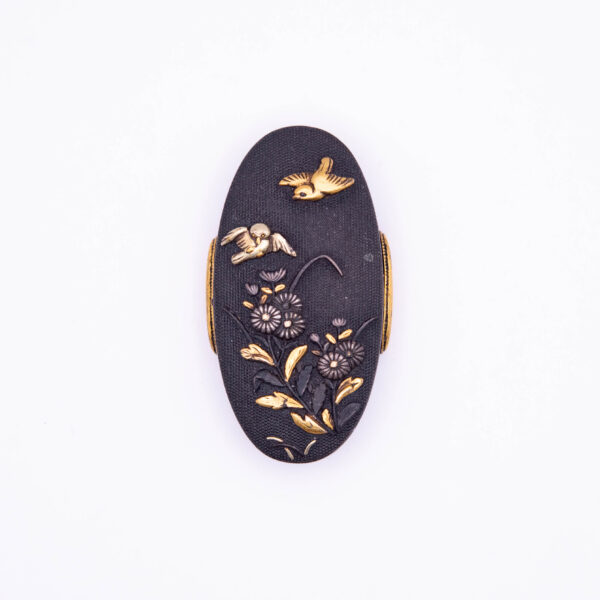
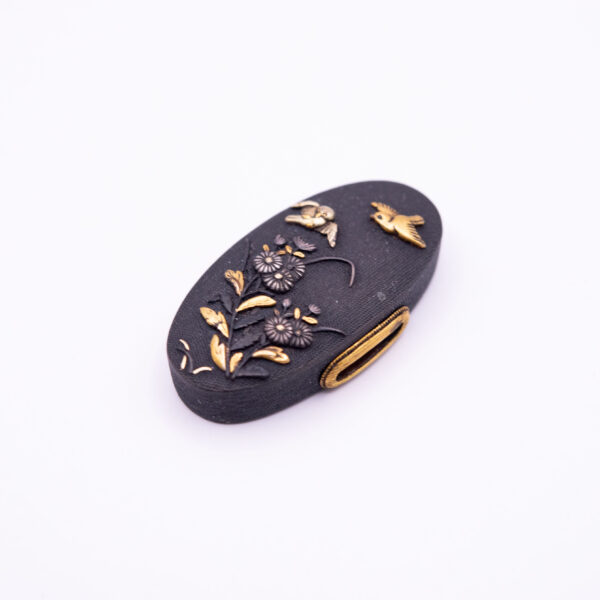
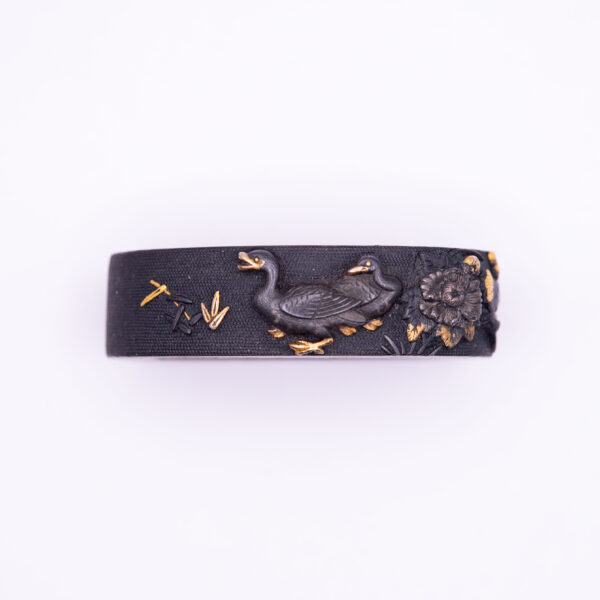
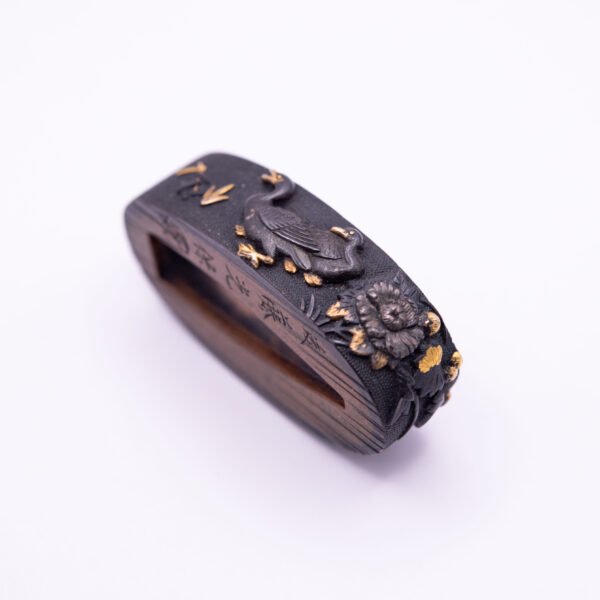
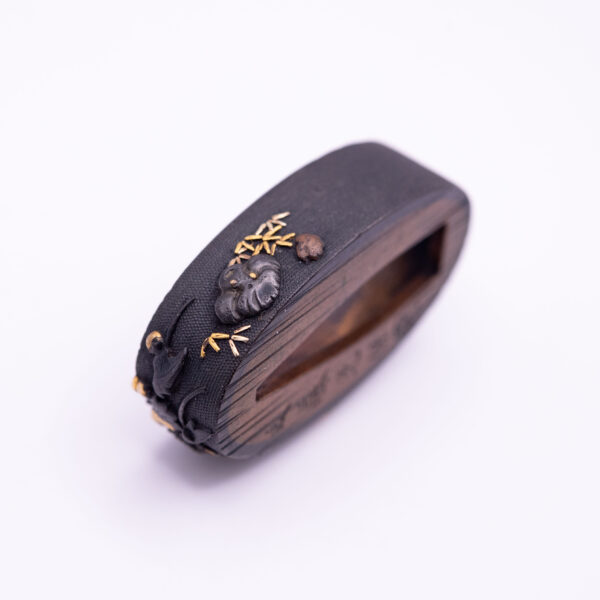
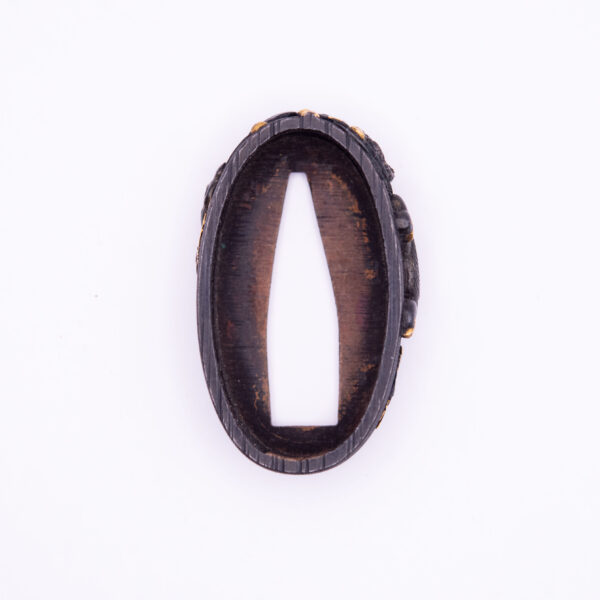
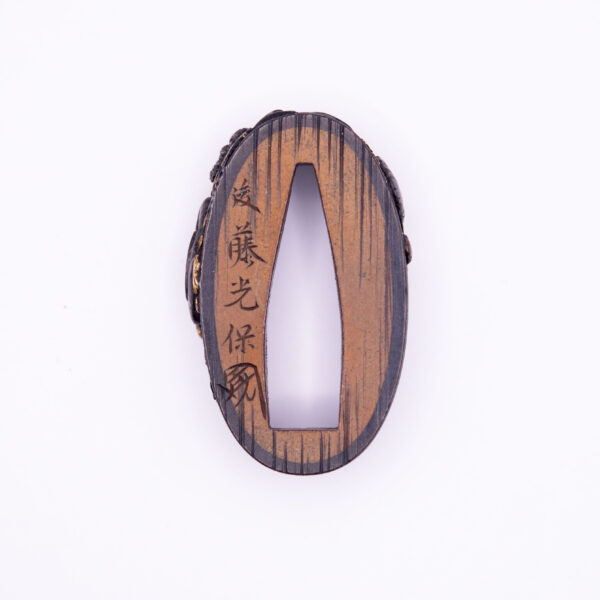
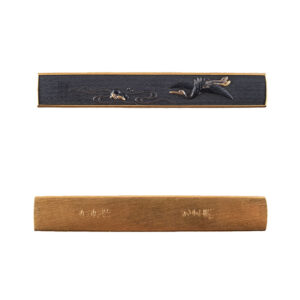
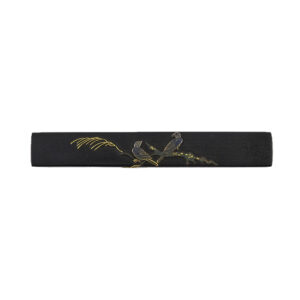
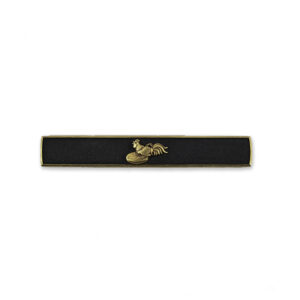
Goto Mitsuyasu (1795 – 1852) was a member of the distinguished Goto family, which served Japan’s ruling clans as goldsmiths for over four centuries, reaching seventeen generations in its lineage. He is listed in the Kinko Meikan on page 401 as a “Ryoko” (良工, skilled master), indicating both technical excellence and refined artistic sensibility. He was better known under the name ‘Benjo’ and became the fifth master of the Hanzaemon Waki Goto line. He was likely influenced by the style of Ichijo who was only 4 years older than him, as we can see in his naturalistic interpretation of flora and fauna elements. His works are known for their precision in carving and for the harmonious relationship between motif, material, and form. The fuchi depicts a serene landscape with ducks and a peony (botan). The ducks are executed in takabori high relief and made of shibuichi, with beaks, eyes, and feet delicately detailed in gold. The base is shakudō with a finely executed nanako background, lending texture and depth to the composition. The peony blossom is rendered in silver, while the leaves are in shakudo with subtle gold highlights. The piece is signed “Goto Mitsuyasu” and bears the artist’s kao (seal). On the signature side, the characteristic vertical file marks are visible—an identifying feature often found in the Gotō Ichijo school. The kashira shows two small birds, likely sparrows (suzume), above a flowering plant with several stems and leaves. The birds are executed in gold, while the ground is shakudo with a fine nanako surface. The flower petals are in silver, creating a pleasing contrast of tone and texture. The shitodome are finished in gold and neatly worked with yasurime detailing. Overall, the set exemplifies the refined harmony of naturalistic design and formal elegance—hallmarks of Goto Mitsuyasu’s artistry and the cultivated aesthetic of the later Kyoto Waki Goto tradition. Comes with a custom made box. Size: Find more items from the Goto school here: https://tsuba.info/product-category/kinko/goto/
NihontoWatchOffered by Tsuba Info
This piece has sold
72 on the market
Get an email when a new Gotō Kakujō Mitsuyasu piece hits the market.

Waki Goto
Edo
Signed
As written by the shop
Iebori · Yamashiro
Iebori · Kyoto
72 pieces on the market now
The Waki-Goto tradition designates the branch and collateral lines of the Goto mainline (soke) that sustained the family's metalworking legacy across generations while extending its reach beyond the central house in Kyoto and later Edo. The Goto family itself constituted the preeminent dynasty of sword-fitting craftsmen in Japanese history, serving successive shogunal families from the Muromachi period through the Edo era. Their work, designated iebori ("house carving"), was distinguished from the machibori ("town carving") produced for general market demand. Among the most important Waki-Goto lines were the Rihei house, established by Teijo (the ninth mainline master) and continued through Etsujo, who anchored the tradition in Kaga Province under Maeda patronage; the various mainline heads themselves -- Kojo (fourth generation), Renjo (tenth generation), and Teijo -- who shaped the canonical vocabulary; and the later Shichiroemon branch, which produced Ichijo and Koran, the terminal masters who brought the Goto heritage to its culminating expression in the Bakumatsu period. The technical vocabulary of the Waki-Goto lineages adheres with remarkable fidelity to the orthodox manner established by the founding patriarch Yujo. The characteristic ground is shakudo finished with impeccably regular nanako-ji, praised across generations for its orderly precision and deep, limpid quality. Upon this lustrous black surface, motifs are rendered through takabori and sukidashi takabori (raised high-relief carving) enriched by gold and silver iroe, with solid gold nikubori and sculptural yobori employed for menuki. The canonical Goto subjects -- dragons, lions (shishi), kirin, and clouds -- recur throughout the lineage, transmitted according to established conventions and executed with meticulous niku-dori (modulation of sculpted flesh). Kojo, identified as second in ability only to the founder, introduced preparatory drawings (shita-e) by Kano masters and is credited with originating warrior-figure and dragon-and-tiger motifs within the house.
His works display the Momoyama spirit -- heroic, dynamic, and brimming with vitality. Teijo's carving is characterized as restrained and meticulous, achieving a crisp, controlled effect, while Renjo inherited his father's methods and introduced fresh elements: robust and magnificent carving that "raises the peaks high and drives the valleys deep," recalling the grand manner of the early generations. Etsujo, transmitting the mainline aesthetic into Kaga, maintained a standard "in no way inferior to that of Teijo," and his contributions are credited with fostering the flourishing of Kaga metalwork. The later Shichiroemon branch, under Ichijo and Koran, shifted toward compositions grounded in close observation from life -- birds, flowers, and landscapes -- while sustaining the ancestral foundation of nanako-ji grounds, polychrome iroe, and chuya shitate (day-and-night construction). Across all branches, signed works are characterized as exceedingly rare and of high documentary value. The Waki-Goto tradition represents the mechanism by which the Goto house's artistic achievement was preserved, transmitted, and adapted across nearly five centuries. " The Rihei branch's transplantation to Kaga ensured that the tradition flourished beyond its Kyoto and Edo centers, while the Shichiroemon branch's culmination in Ichijo produced an artist whose command of the full kinko repertoire "adorned the shaft-end" of the entire Goto lineage. Works from across the Waki-Goto branches have been transmitted through distinguished collections -- the Konoike merchant house, the Hachisuka and Maeda daimyo families -- and carry origami appraisals from successive Goto masters assigning valuations of exceptional magnitude. In its collective continuity and its capacity to adapt the iebori heritage to changing tastes while preserving its essential dignity, the Waki-Goto tradition stands as one of the most remarkable dynasties in the decorative arts of Japan. Learn more →
| Smith | Era | Designated |
|---|---|---|
| Korejo是乗 | 1818-1830 | 3 |
| Munetomo/Sochi宗知 | — | 0 |
| Morimura Atsutaka守邨厚隆 | — | 0 |
| Taijo泰乗 | — | 0 |
| Mitsuharu光治 | — | 0 |
All sales are final and no refund will be issued. Individual refund conditions may be offered on request. For items with third-party certificates (e.g. NBTHK), a return is offered if the certificate is proven falsified and claimed within one year after shipment.