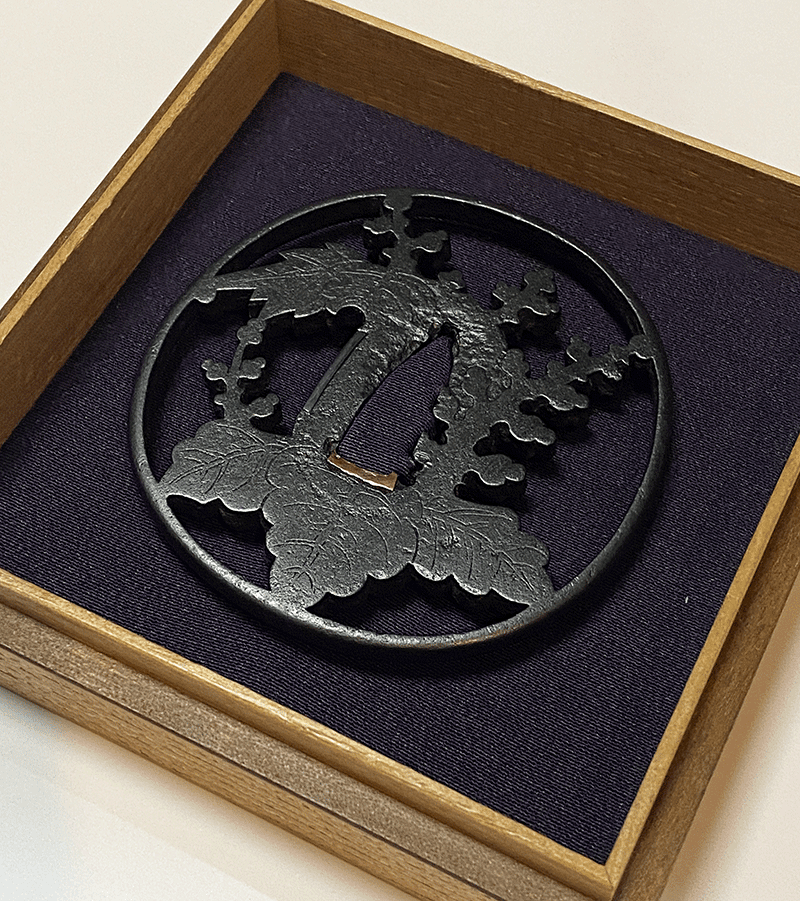
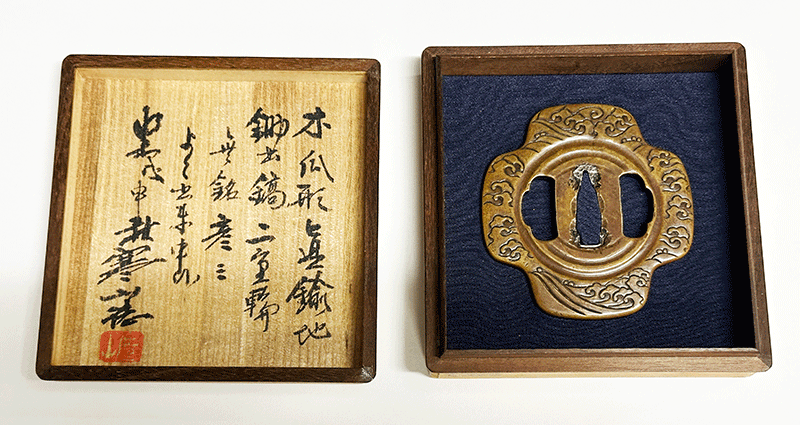
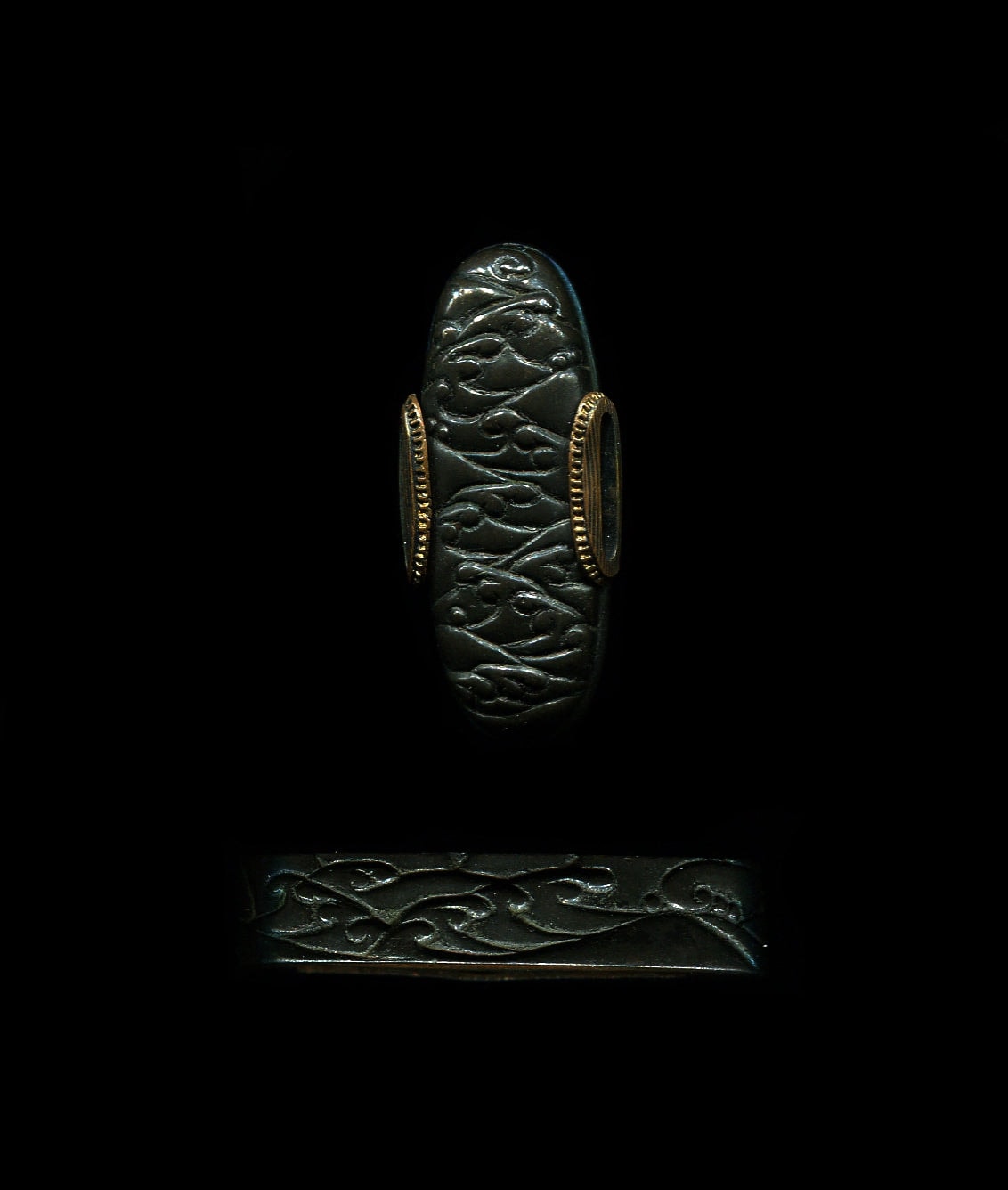
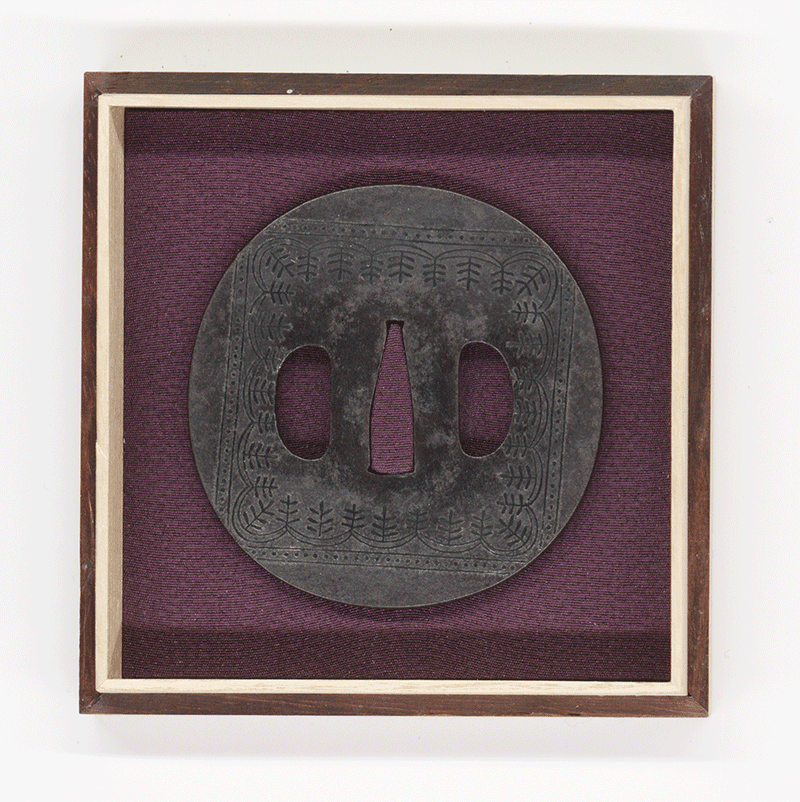
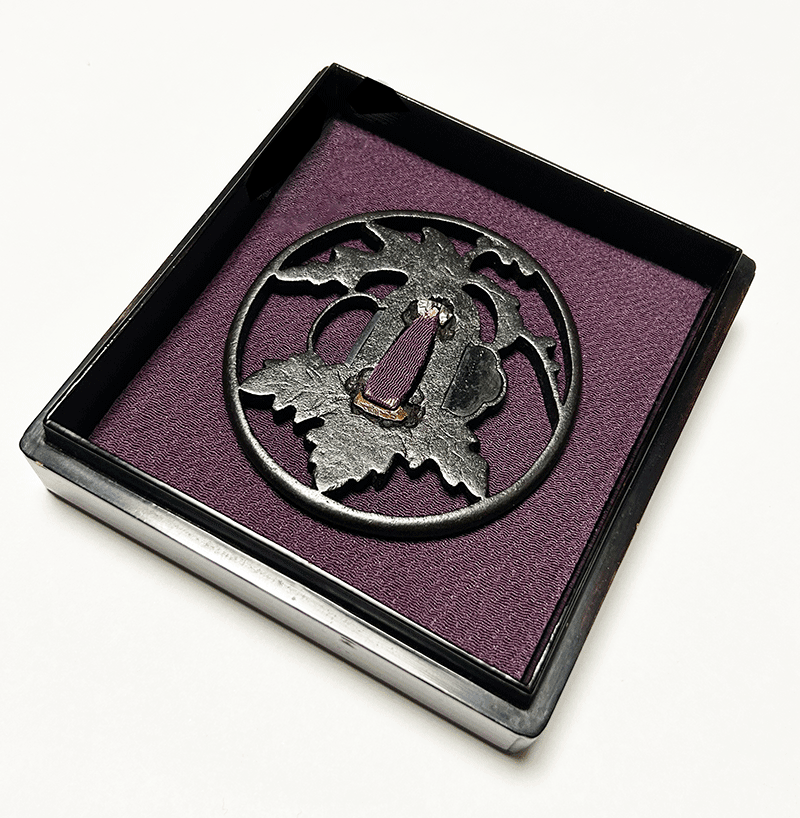
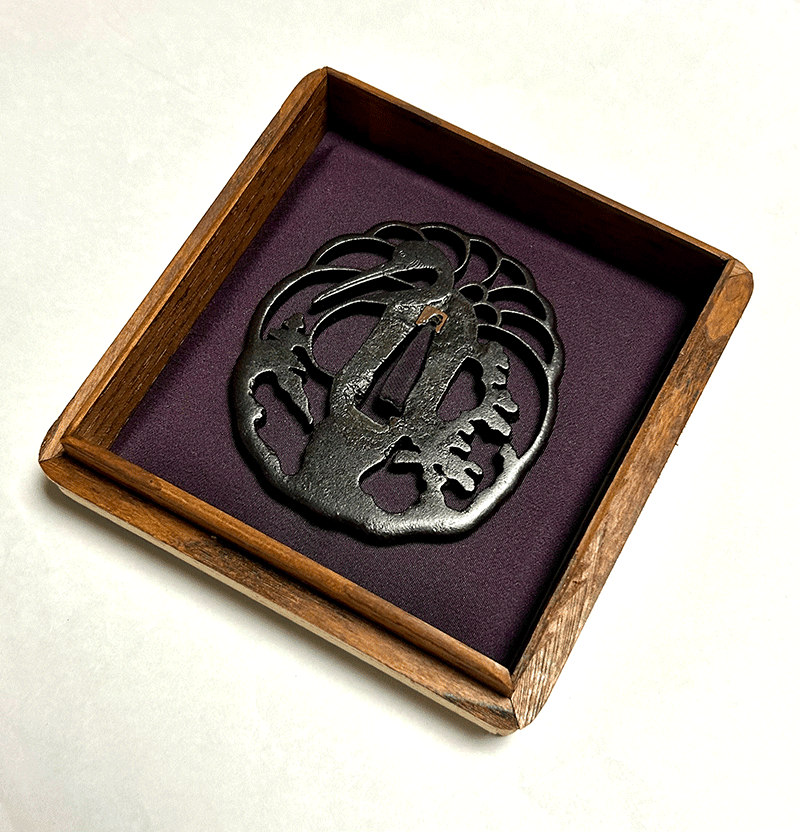
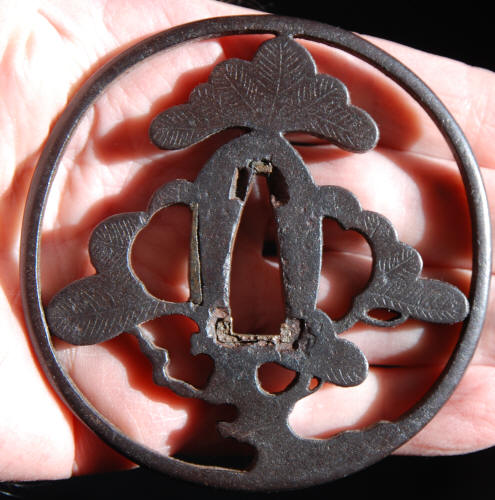
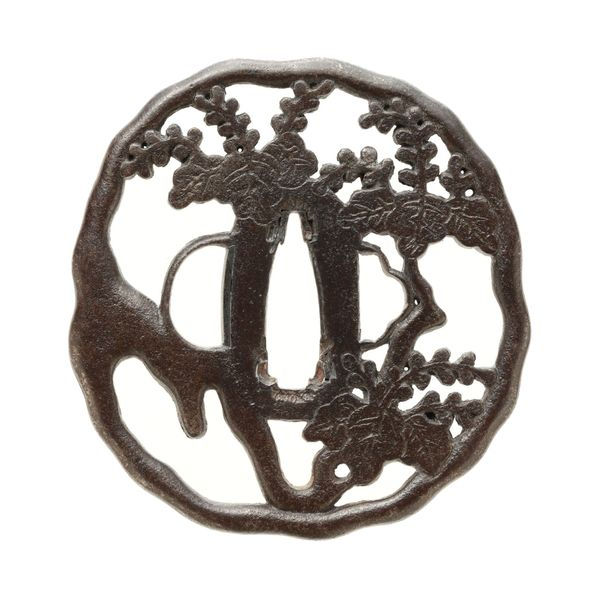
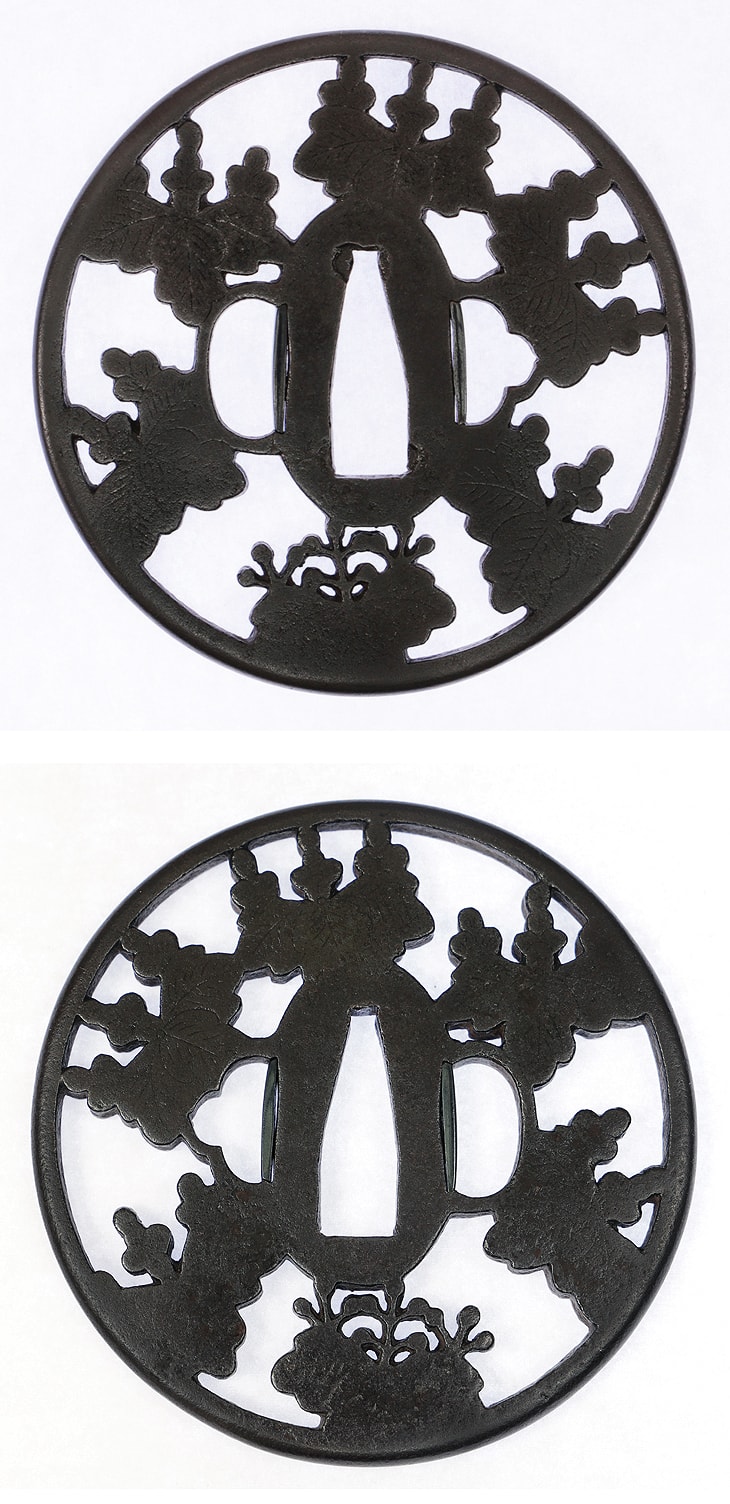
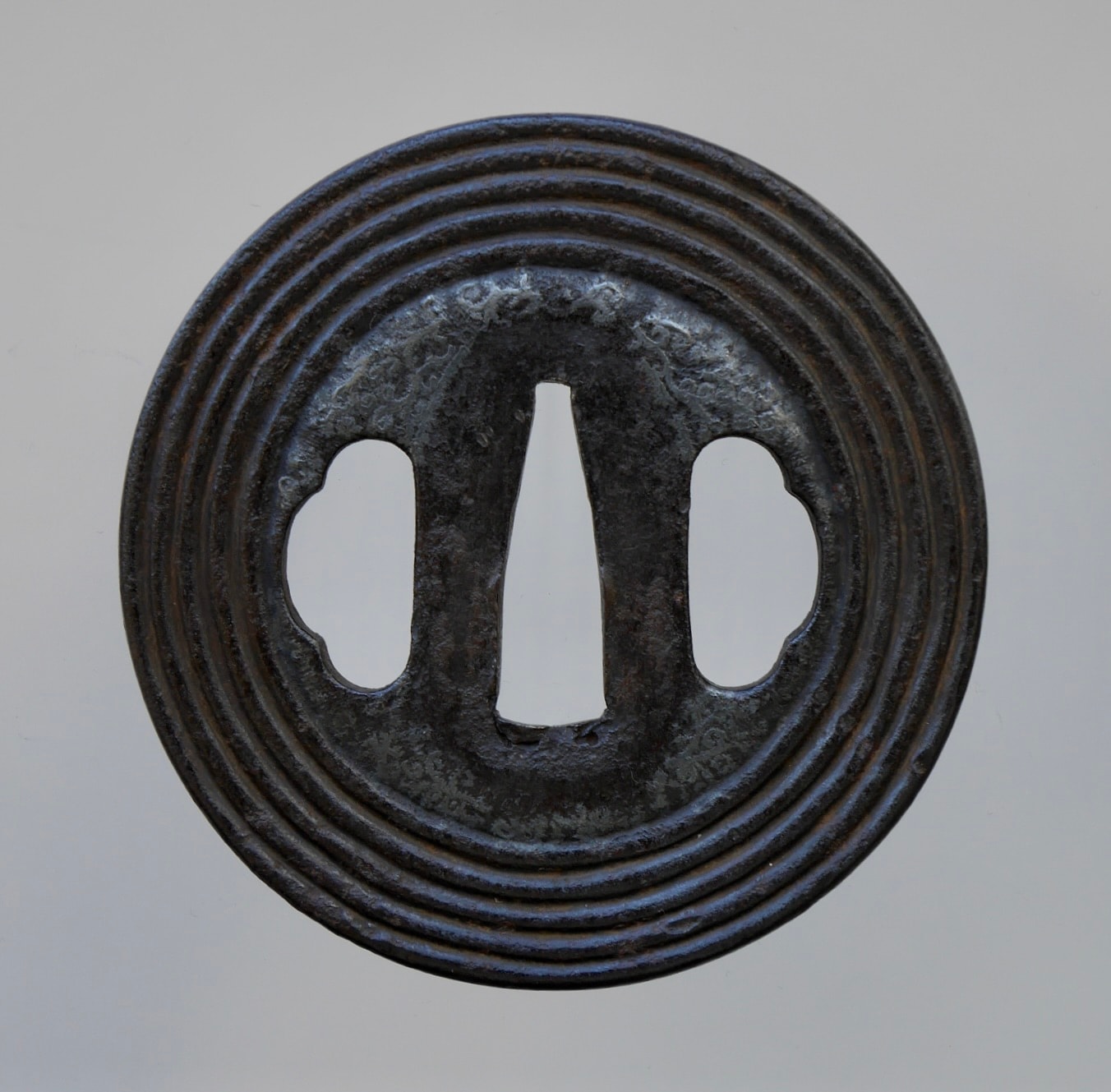
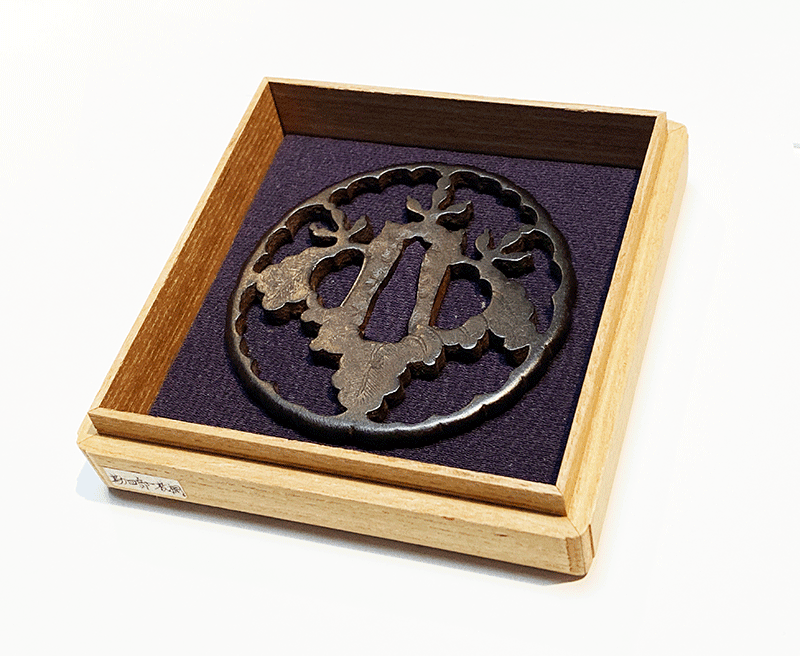
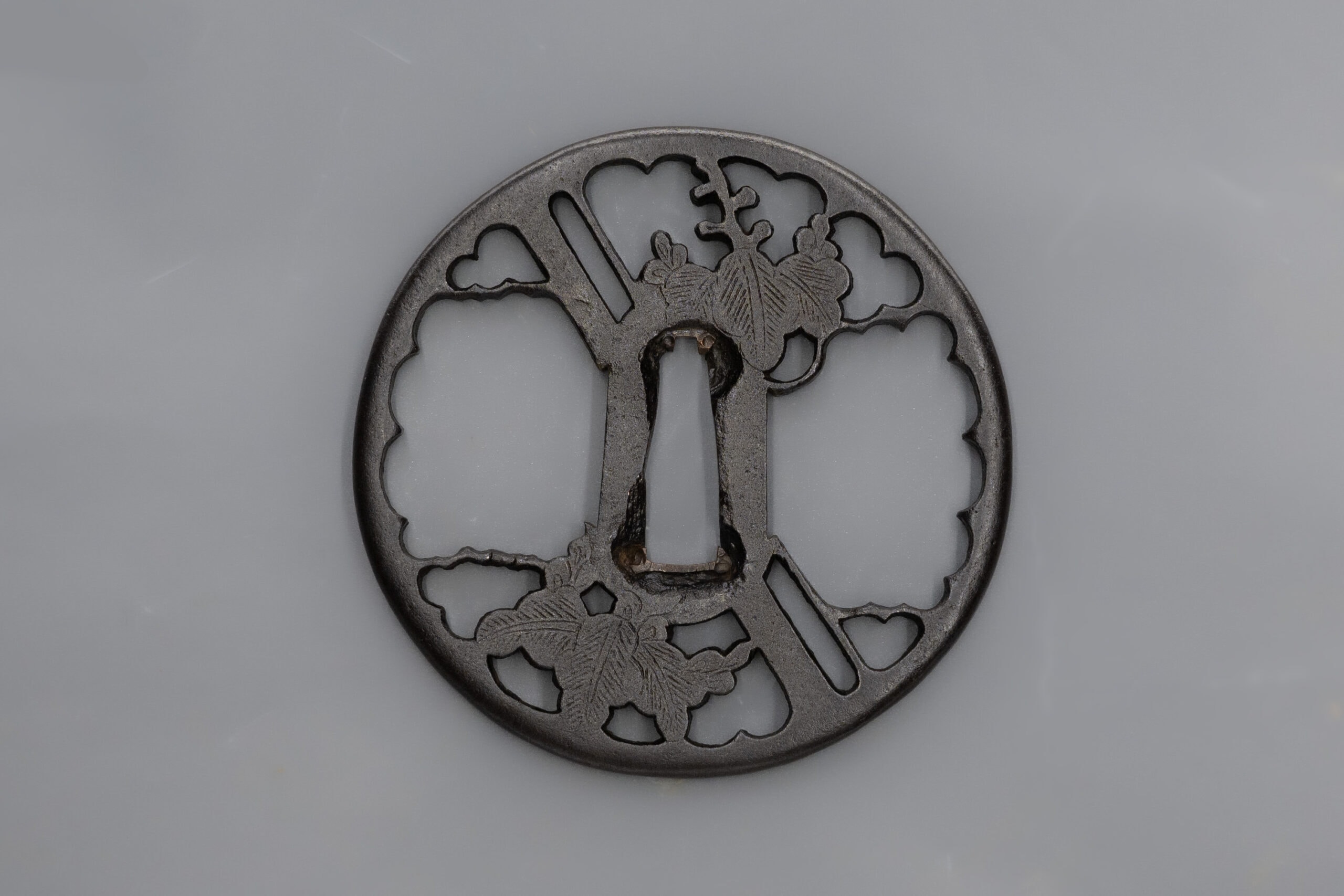
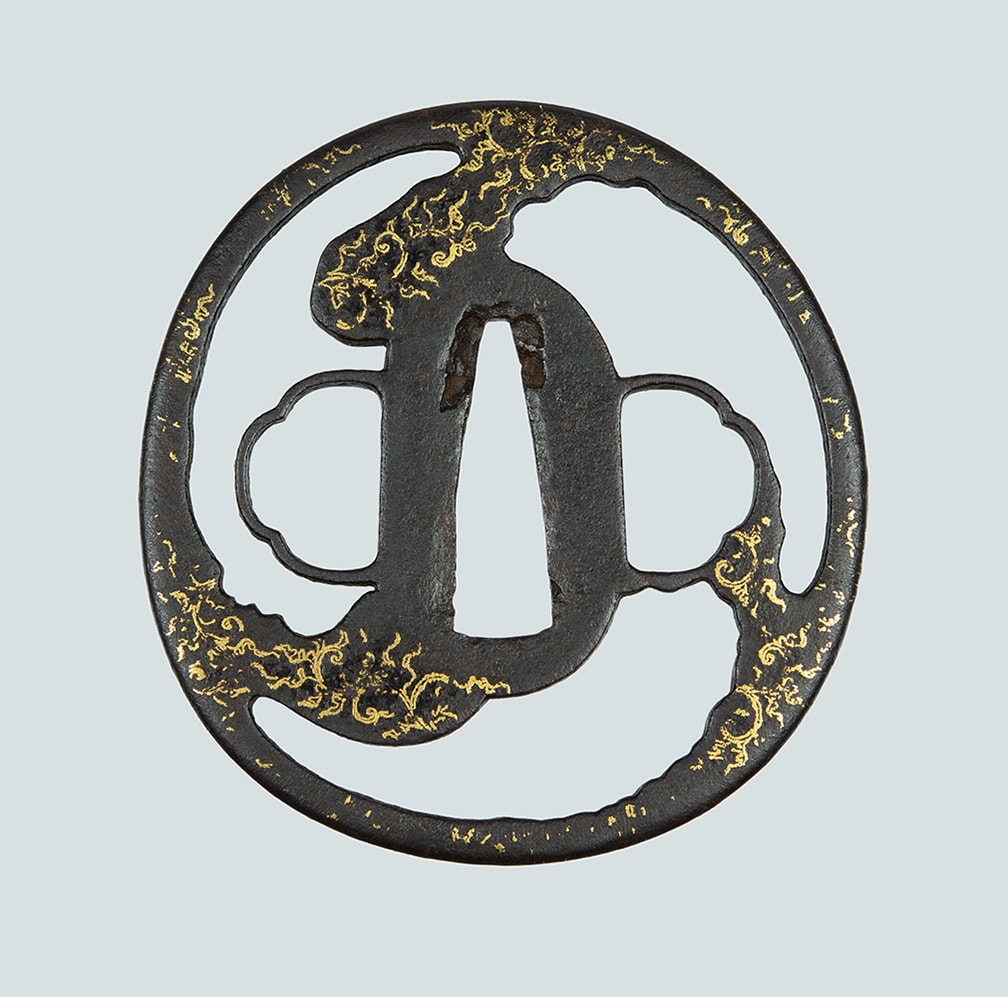
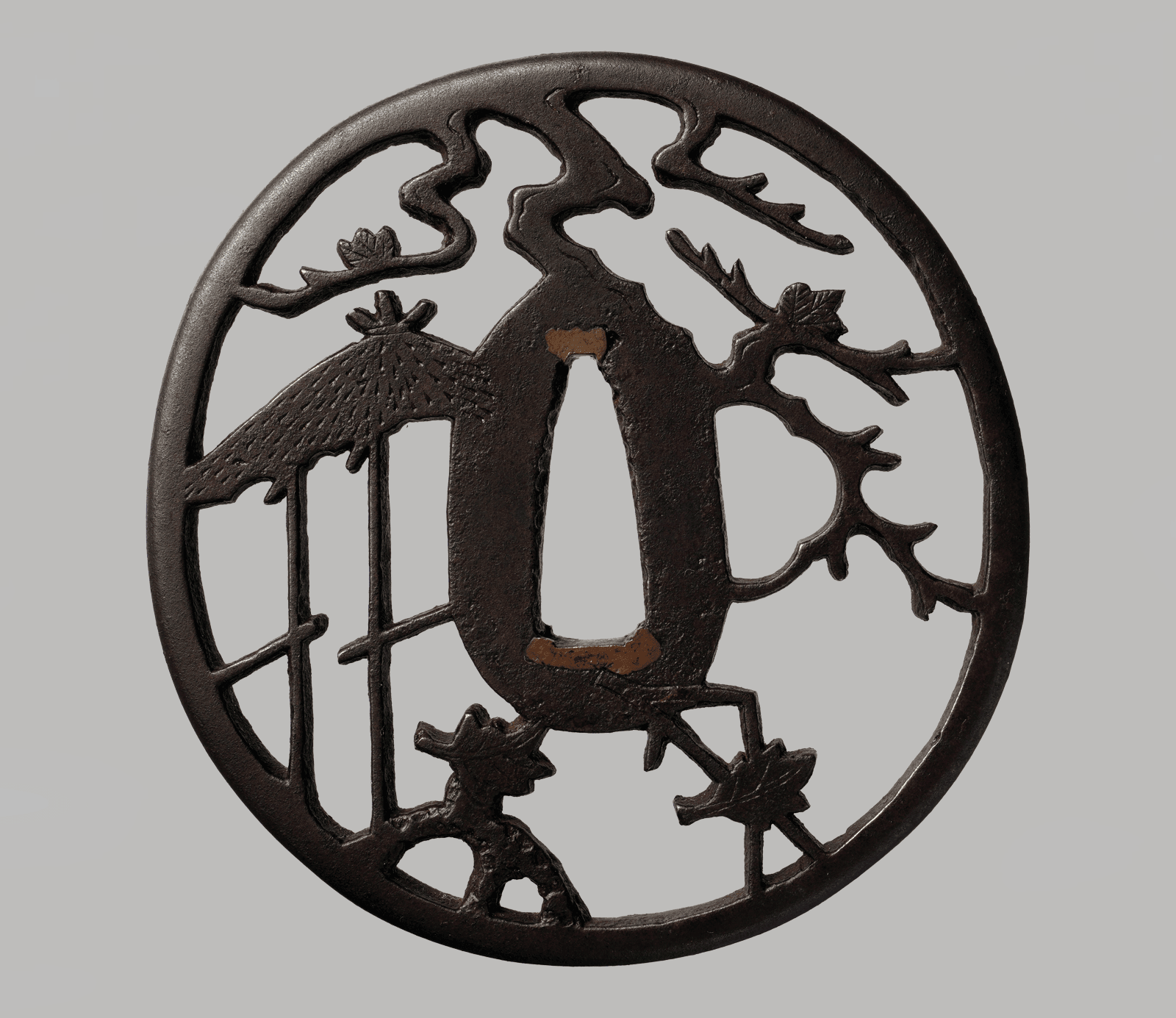
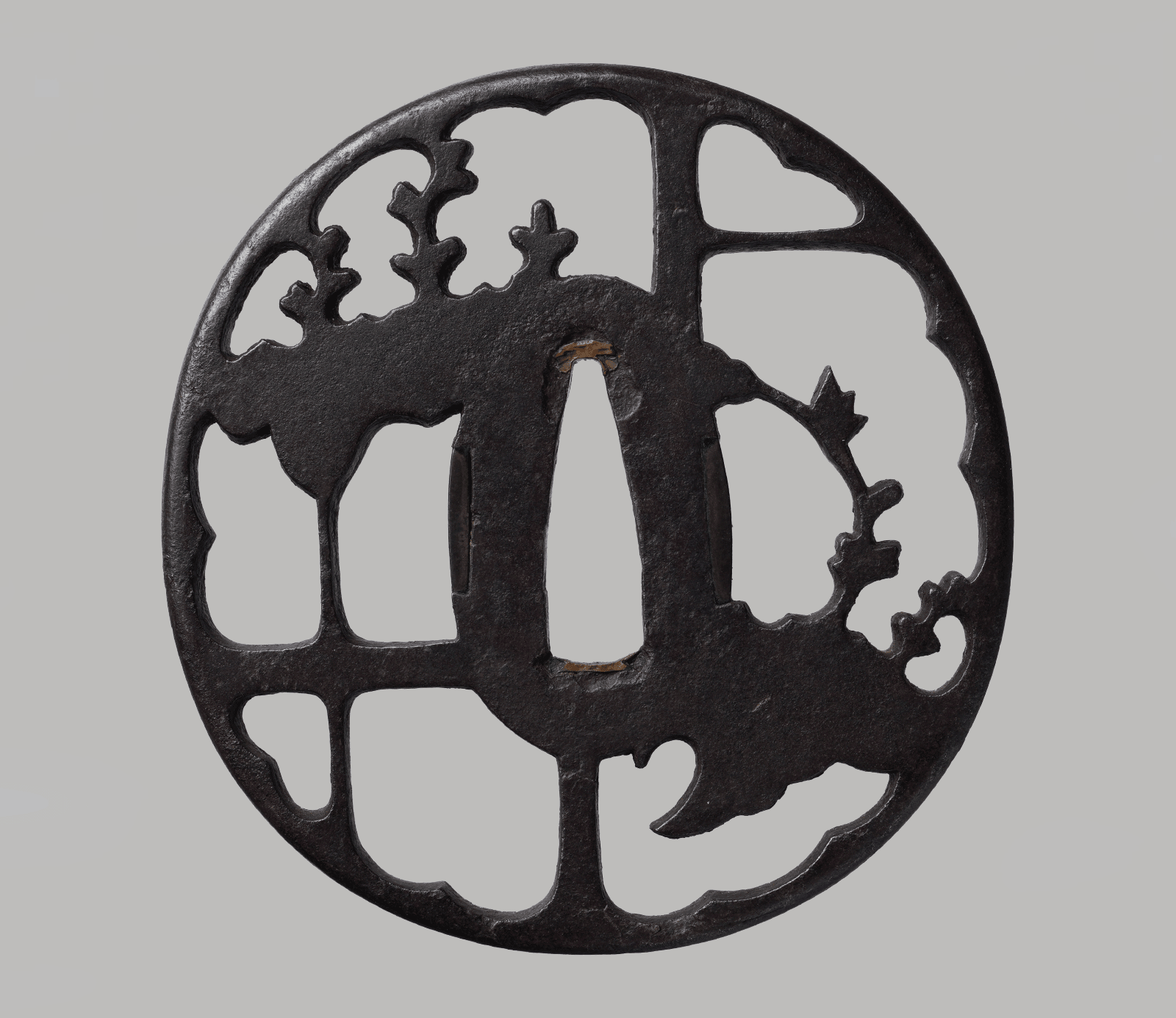
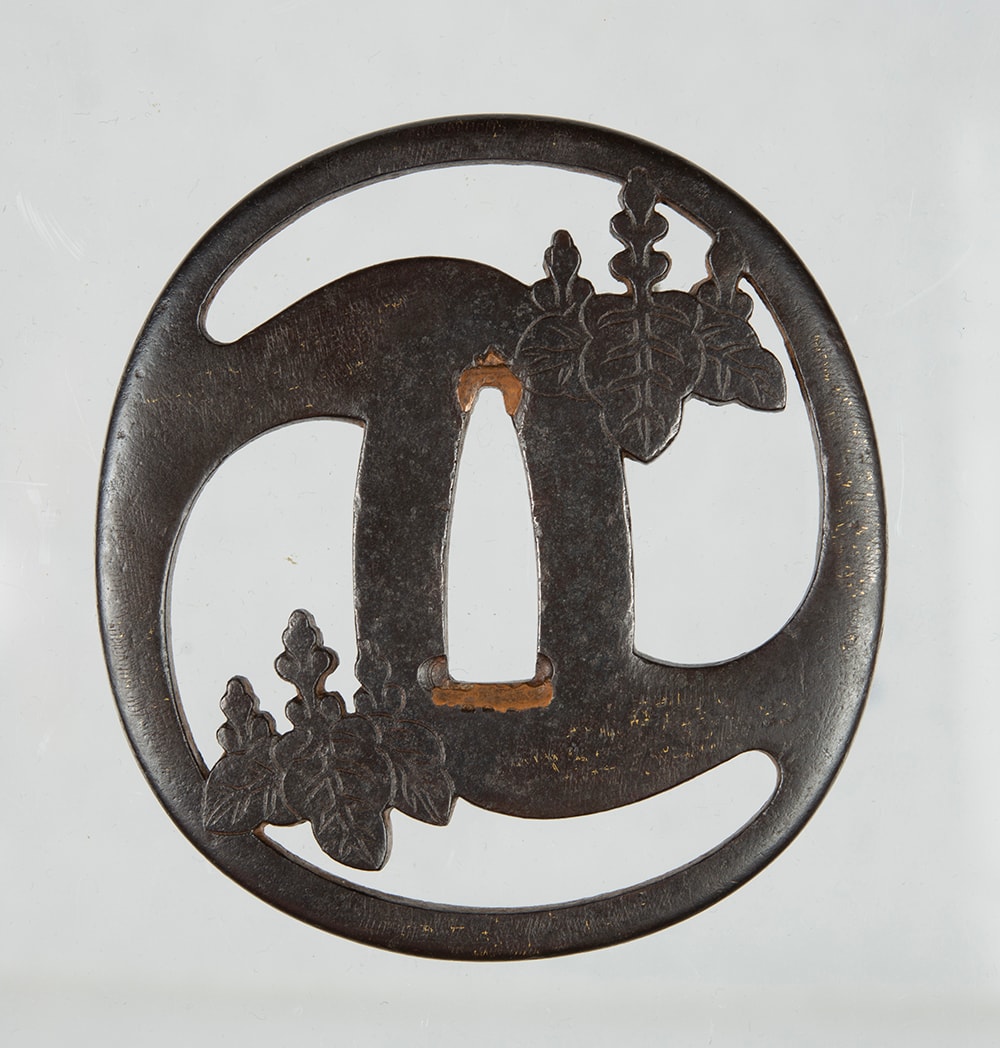
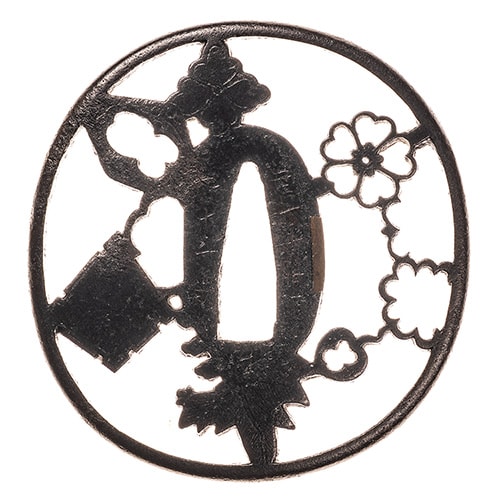
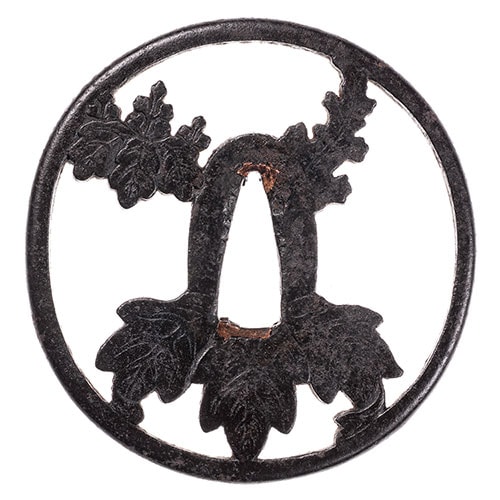
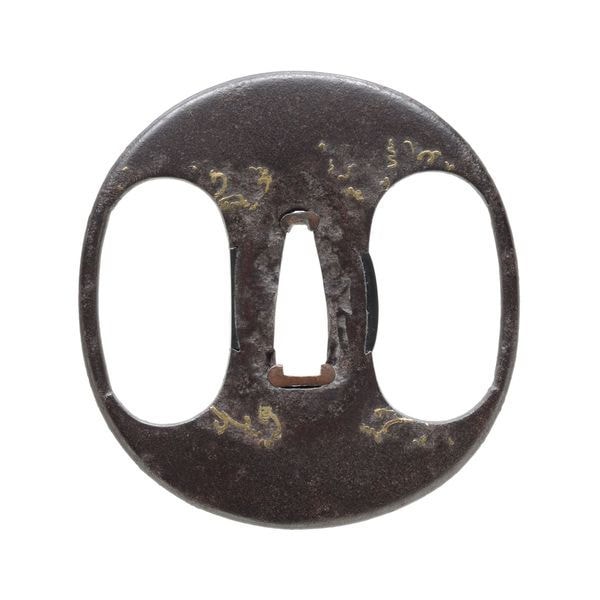
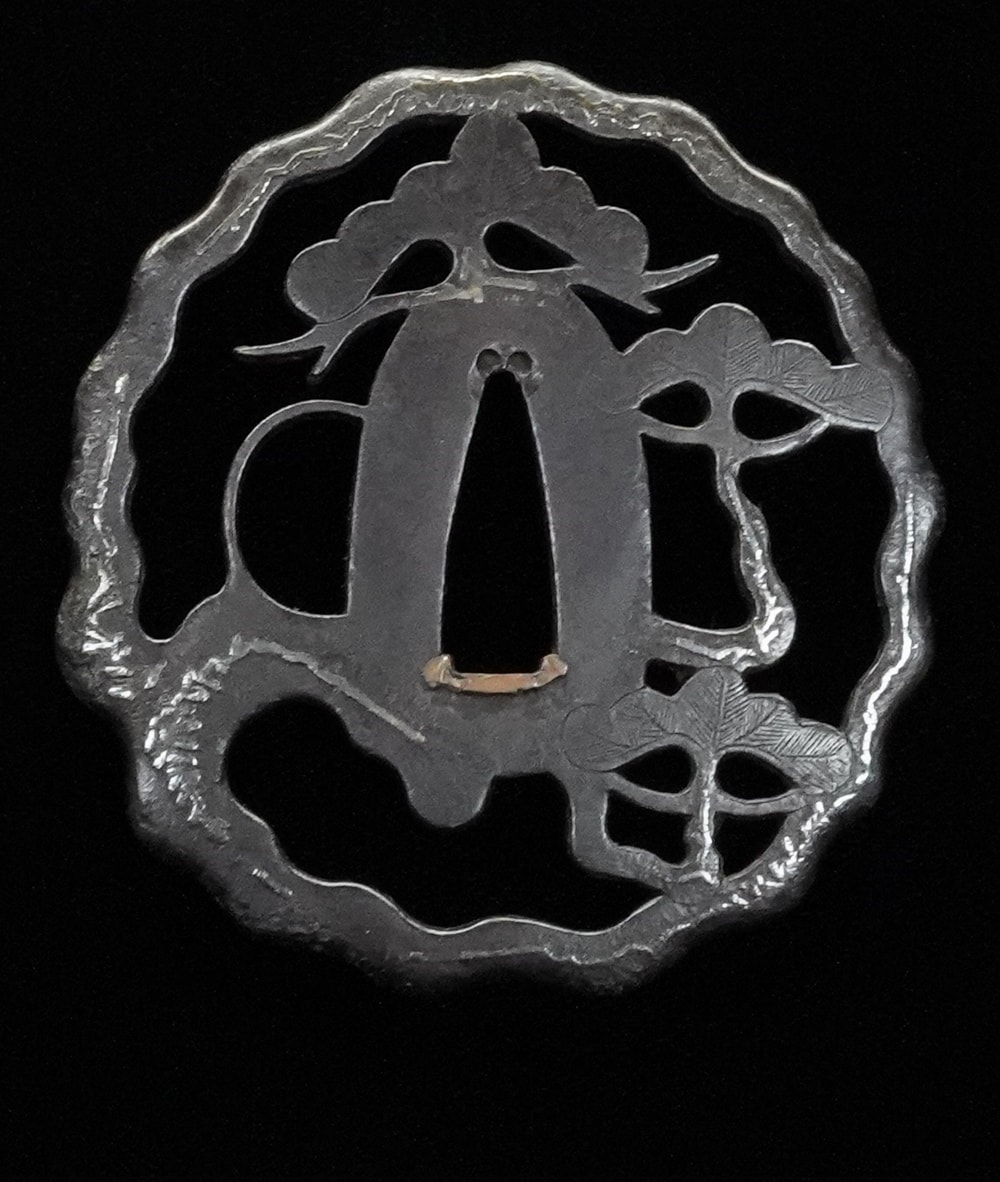
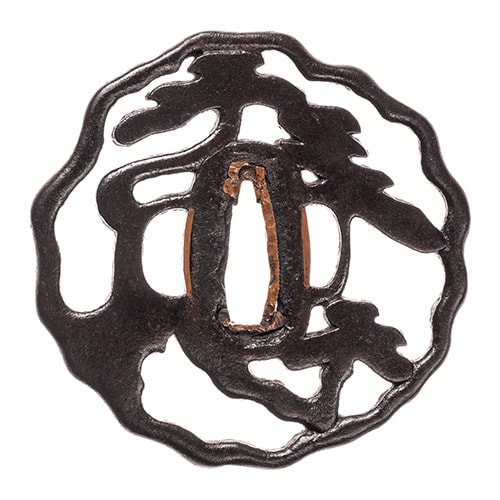
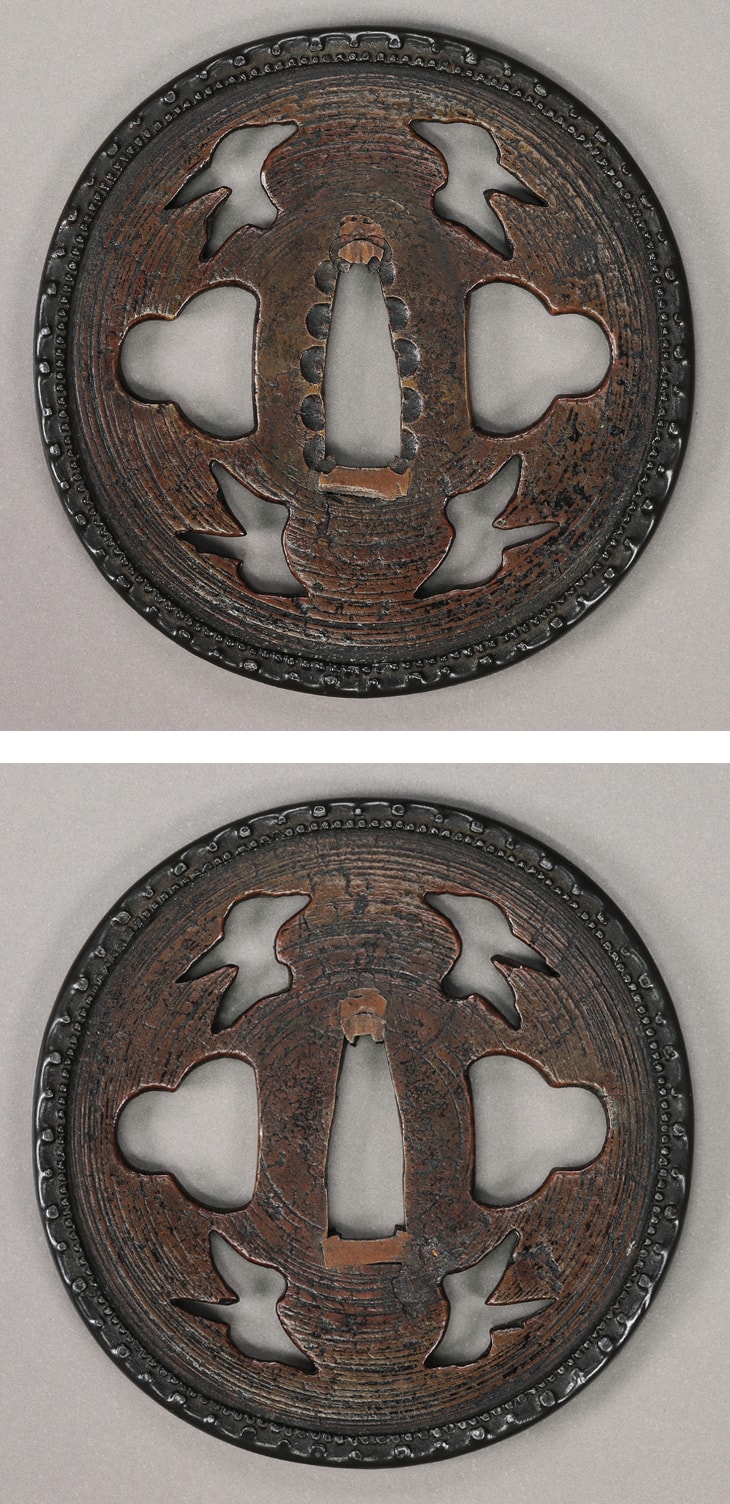
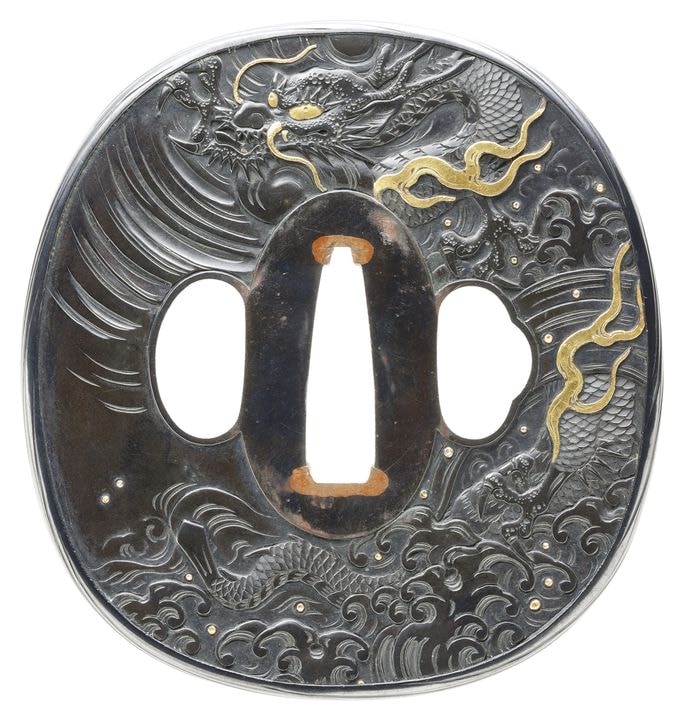
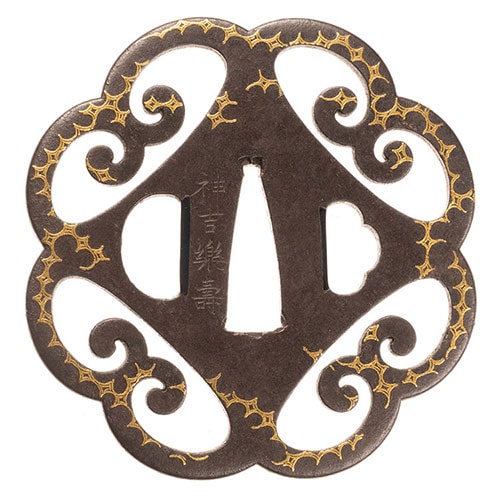
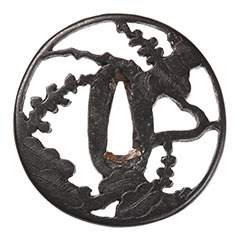
This is an iron tsuba by Kanshiro, featuring an openwork design of branches and paulownia. The first Kanshiro was born in Buzen Province in 1613 and became a retainer craftsman for the Hosokawa family. His works are known for their unique elegance and graceful technique, with a quality of iron comparable to the Hayashi school.
 NihontoWatch
Early Edo (1613-1693)

Nishigaki Kanshiro
Early Edo (1613-1693)
Buzen
Tokuho (NBTHK)
Higo · Higo
8 pieces on the market now
Nishigaki Kanshiro, also known as Yoshihiro, was born in Keicho 18 (1613) at Nakatsu in Buzen Province, the son of a Shinto priest. He became a disciple of Hirata Hikozo, received full transmission licensing (soden menkyo), and established himself independently. He subsequently entered the service of the Hosokawa family as a retained craftsman (kakae-ko), receiving a stipend of twenty persons' rations from Hosokawa Sansai Tadaoki. In the twelfth month of Kan'ei 9 (1632), he accompanied his lord upon transfer of fief and relocated to Yatsushiro in Higo Province, later moving again to the artisans' quarter in Kumamoto. Together with the Hayashi, Hirata, and Shimizu families, he formed the mainstream of the Higo group of metalsmiths and founded the Nishigaki school, counted among the four great lineages of Higo metalworkers. Hayashi Matashichi was of the same generation, born in the same year; because their materials and manner of workmanship share certain similarities, the two have often been contrasted in terms of artistic character: Matashichi is said to possess the dignified bearing of a kunshi, whereas Kanshiro is characterized as having the elegant refinement of a koshi. Both absorbed the cultivation of Hosokawa Sansai and gave expression upon the tsuba to a poetic resonance (fuin) informed by the aesthetics of tea. The second-generation Kanshiro, the eldest son of the founder, bore the common name Mosaku and also used the names Yoshito and Eikyu; he was born in Kan'ei 16 (1639) and died in Kyoho 2 (1717) at the age of seventy-nine. The first Kanshiro died in the sixth month of Genroku 6 (1693) at the age of eighty-one.
The first-generation Kanshiro excelled particularly in iron ji-sukashi (ground openwork) plates, working favored motifs including the tokiri or nagekiri (throwing paulownia), edagiri (branching paulownia), aged pine (oimatsu), and chrysanthemum designs. The tokiri design takes a cursive-style paulownia blossom crest and abstracts it into openwork; because of its appearance it is also called odori-kiri (dancing paulownia) or nimai-kiri (two-sheet paulownia). His iron plates characteristically display a gentle, pliant quality with a distinctive "taste" (aji), and his patination frequently shows the so-called yokan-iro — a deep, lustrous reddish-brown reminiscent of sweet bean jelly. Many of his works adopt the shodeigata profile with a subtly flared lower portion (shita-bari), and his outlines often incorporate a deliberate, slight distortion that creates an uneven, varied movement across the design. The distribution of thickness (nikuoki) is thoughtfully devised, and his kebori (hairline engraving) is characteristically fine and animated, applied with attentive density yet never pressing or forced. A compositional hallmark is the "positive-and-negative" (in'yo) structuring of openwork, as seen in chrysanthemum tsuba where the flower form serves simultaneously as silhouette and ground design. Distinguishing features from works of the Hayashi school include gentler carving contours, more animated kebori leaf-vein lines, and a distinctive treatment whereby the inner edge of the rim takes on a chrysanthemum-flower-like character. While the first generation worked primarily in iron, examples in copper (sudo) and brass (shinchu) also exist, following the precedent of his teacher Hirata Hikozo. The second-generation Kanshiro, by contrast, demonstrates his true strengths in works that make sophisticated use of inlay on brass or suaka grounds.
The Nishigaki school occupies a position of singular importance within the Higo metalworking tradition. Works of such high tone and strong individuality captivated viewers, and the designs of Kanshiro's tsuba were copied in great numbers by makers of Akasaka tsuba and by Tosa Myochin; however, it is with Kanshiro that this manner is regarded as having its beginning. His mature works embody the quiet austerity (sabimi) and refined elegance (gashu) associated with the Hosokawa tradition of tea, expressing a richness communicated in a restrained and dignified way. The influence of Hosokawa Sansai — celebrated both as a tea devotee and as one of the "Seven Sages of Rikyu" — is manifest throughout Kanshiro's oeuvre in the poetic sensibility that pervades each composition. Whether in the unrestrained freedom of his paulownia openwork, the suggestive resonance of open spaces, or the sophisticated interplay of form and negative space, Kanshiro's art conveys precisely the cultivated elegance of the lofty recluse with which his name has long been associated.
Where Kanshiro stands among comparable artisans: across all of nihontō, and within tradition, era, and period. The tiers (Foremost · Leading · Major · Notable) weigh official designations from the NBTHK and Japan's Agency for Cultural Affairs, together with historical honors of lasting repute such as the Sansaku and Meibutsu-chō.
Select a lens to see how it's measured.
Higo · Higo
40 pieces on the market now
The Nishigaki school is one of the four great lineages of Higo metalworkers, ranked alongside the Hayashi, Hirata, and Shimizu families. Its founder, Nishigaki Kanshiro I (also known as Yoshihiro), was born in Keicho 18 (1613) at Nakatsu in Buzen Province, the son of a Shinto priest. He entered the workshop of Hirata Hikozo, received full transmission licensing (soden menkyo), and upon establishing himself independently was taken into service by the Hosokawa clan as a retained craftsman, receiving a stipend of twenty men's rations from Hosokawa Sansai Tadaoki. In Kan'ei 9 (1632) he accompanied his lord upon the domain transfer and relocated to Yatsushiro in Higo Province, later settling in the artisans' quarter of Kumamoto. As a contemporary of Hayashi Matashichi, the two are frequently contrasted: whereas Matashichi is said to possess the dignified bearing of a kunshi (gentleman)[[c:1]], Kanshiro is characterized as having the elegant refinement of a koshi[[c:2]] -- a lofty, cultivated recluse. Through the guidance of Sansai -- one of the Seven Sages of Rikyu and deeply versed in chanoyu -- the school came to express on the tsuba a fuin (aesthetic resonance) grounded in the sensibility of tea. Kanshiro died in Genroku 6 (1693) at eighty-one. The first Kanshiro's oeuvre centres on iron ji-sukashi (ground openwork) tsuba, with the nagekiri-kiri (thrown paulownia) as his most characteristic motif -- also called odori-kiri (dancing paulownia) or nimai-kiri, a stylization of the cursive hana-kiri mon. Other hallmark subjects include aged pines (oimatsu), chrysanthemums, and sea cucumbers (namako).
The setsumei identify several diagnostic traits: carving contours slightly gentler than those of the Hayashi school; finer, more animated kebori (hairline engraving) in leaf-vein detailing; a distinctive treatment whereby the inner rim edge assumes a chrysanthemum-like character; and an intentionally irregular outline with subtle distortion, often incorporating the shitabari (flared-lower) shodei-gata that is a major hallmark. A compositional technique of in'yo-sukashi -- "positive-and-negative" openwork pairing contrasting motifs in outer and inner contours -- is noted as a particular strength. The iron is repeatedly praised for its soft, pliant character and beautiful yokan-iro (dark reddish-brown bean-jelly hue). Beyond iron, the school also worked in suaka (plain copper) and brass (shinchu) grounds, sometimes with lacquer finishing. The second-generation Kanshiro (Nagahisa, also Yoshito or Eikyu; 1639--1717), eldest son of the founder, studied additionally under the Goto mainline master Kenjo and excelled in zogan (inlay) -- including nunome-zogan and suemon-zogan on brass and suaka grounds, extending his range to fuchi-kashira, kozuka, and menuki. "[[c:3]] The Nishigaki school occupies a distinctive place in the Higo canon as the embodiment of cultivated restraint -- refined elegance (gashu, fuga) achieved through studied imperfection. The first Kanshiro's iron openwork tsuba, with their deliberately asymmetric contours, subdued yet resonant surfaces, and evocative negative space, are repeatedly appraised as expressing precisely the wabi beauty of the Hosokawa school of tea. Among the school's most celebrated works, Nagahisa's Tagoto no tsuki ("Moon over the Rice Paddies") tsuba -- a Juyo-Bijutsuhin now held by Eisei Bunko -- demonstrates the family's mastery of polychrome inlay, employing shakudo, shibuichi, copper, shudo, and fine gold zogan on a brass ground to render moonlight variously reflected across partitioned paddies. "[[c:4]] The school's works embody a sustained dialogue between daimyo patronage and the refined aesthetics of chanoyu, achieving quiet beauty through the suggestive resonance of open spaces and the distinctive savour (aji) of Higo iron. Learn more →
| Smith | Era | Designated |
|---|---|---|
| Kanshiro勘四郎 | — | 31 |
| Kanzaemon勘左衛門 | — | 0 |
| Kanzaemon勘左衛門 | — | 0 |
| Nagahisa永久 | — | 5 |
| Kanpei勘平 | — | 0 |
A Hozon-certified fitting of notably superior craftsmanship and condition, often with signature or workmanship of high reference value.
The NBTHK (Nihon Bijutsu Tōken Hozon Kyōkai, the Society for the Preservation of Japanese Art Swords) is a public-interest incorporated foundation founded in 1948 and supervised by Japan’s Agency for Cultural Affairs (Bunkachō); it is based at the Japanese Sword Museum in Tokyo. Its expert panels physically examine each submitted work (shinsa) and issue a certificate (kanteishō) ranking it by artistic and historical merit. NBTHK papers are the most widely recognized standard of authentication for Japanese swords and fittings.
NBTHK official siteReturns/exchanges/cancellations not accepted after shipment except for significant defects; if defective, return/exchange possible within 3 days of arrival (return shipping paid by customer).
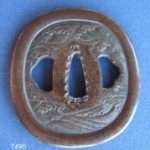
This is an iron tsuba by Kanshiro, featuring an openwork design of branches and paulownia. The first Kanshiro was born in Buzen Province in 1613 and became a retainer craftsman for the Hosokawa family. His works are known for their unique elegance and graceful technique, with a quality of iron comparable to the Hayashi school.
NihontoWatchEarly Edo (1613-1693)
Nishigaki Kanshiro
Early Edo (1613-1693)
Buzen
Tokuho (NBTHK)
Higo · Higo
8 pieces on the market now
Nishigaki Kanshiro, also known as Yoshihiro, was born in Keicho 18 (1613) at Nakatsu in Buzen Province, the son of a Shinto priest. He became a disciple of Hirata Hikozo, received full transmission licensing (soden menkyo), and established himself independently. He subsequently entered the service of the Hosokawa family as a retained craftsman (kakae-ko), receiving a stipend of twenty persons' rations from Hosokawa Sansai Tadaoki. In the twelfth month of Kan'ei 9 (1632), he accompanied his lord upon transfer of fief and relocated to Yatsushiro in Higo Province, later moving again to the artisans' quarter in Kumamoto. Together with the Hayashi, Hirata, and Shimizu families, he formed the mainstream of the Higo group of metalsmiths and founded the Nishigaki school, counted among the four great lineages of Higo metalworkers. Hayashi Matashichi was of the same generation, born in the same year; because their materials and manner of workmanship share certain similarities, the two have often been contrasted in terms of artistic character: Matashichi is said to possess the dignified bearing of a kunshi, whereas Kanshiro is characterized as having the elegant refinement of a koshi. Both absorbed the cultivation of Hosokawa Sansai and gave expression upon the tsuba to a poetic resonance (fuin) informed by the aesthetics of tea. The second-generation Kanshiro, the eldest son of the founder, bore the common name Mosaku and also used the names Yoshito and Eikyu; he was born in Kan'ei 16 (1639) and died in Kyoho 2 (1717) at the age of seventy-nine. The first Kanshiro died in the sixth month of Genroku 6 (1693) at the age of eighty-one.
The first-generation Kanshiro excelled particularly in iron ji-sukashi (ground openwork) plates, working favored motifs including the tokiri or nagekiri (throwing paulownia), edagiri (branching paulownia), aged pine (oimatsu), and chrysanthemum designs. The tokiri design takes a cursive-style paulownia blossom crest and abstracts it into openwork; because of its appearance it is also called odori-kiri (dancing paulownia) or nimai-kiri (two-sheet paulownia). His iron plates characteristically display a gentle, pliant quality with a distinctive "taste" (aji), and his patination frequently shows the so-called yokan-iro — a deep, lustrous reddish-brown reminiscent of sweet bean jelly. Many of his works adopt the shodeigata profile with a subtly flared lower portion (shita-bari), and his outlines often incorporate a deliberate, slight distortion that creates an uneven, varied movement across the design. The distribution of thickness (nikuoki) is thoughtfully devised, and his kebori (hairline engraving) is characteristically fine and animated, applied with attentive density yet never pressing or forced. A compositional hallmark is the "positive-and-negative" (in'yo) structuring of openwork, as seen in chrysanthemum tsuba where the flower form serves simultaneously as silhouette and ground design. Distinguishing features from works of the Hayashi school include gentler carving contours, more animated kebori leaf-vein lines, and a distinctive treatment whereby the inner edge of the rim takes on a chrysanthemum-flower-like character. While the first generation worked primarily in iron, examples in copper (sudo) and brass (shinchu) also exist, following the precedent of his teacher Hirata Hikozo. The second-generation Kanshiro, by contrast, demonstrates his true strengths in works that make sophisticated use of inlay on brass or suaka grounds.
The Nishigaki school occupies a position of singular importance within the Higo metalworking tradition. Works of such high tone and strong individuality captivated viewers, and the designs of Kanshiro's tsuba were copied in great numbers by makers of Akasaka tsuba and by Tosa Myochin; however, it is with Kanshiro that this manner is regarded as having its beginning. His mature works embody the quiet austerity (sabimi) and refined elegance (gashu) associated with the Hosokawa tradition of tea, expressing a richness communicated in a restrained and dignified way. The influence of Hosokawa Sansai — celebrated both as a tea devotee and as one of the "Seven Sages of Rikyu" — is manifest throughout Kanshiro's oeuvre in the poetic sensibility that pervades each composition. Whether in the unrestrained freedom of his paulownia openwork, the suggestive resonance of open spaces, or the sophisticated interplay of form and negative space, Kanshiro's art conveys precisely the cultivated elegance of the lofty recluse with which his name has long been associated.
Where Kanshiro stands among comparable artisans: across all of nihontō, and within tradition, era, and period. The tiers (Foremost · Leading · Major · Notable) weigh official designations from the NBTHK and Japan's Agency for Cultural Affairs, together with historical honors of lasting repute such as the Sansaku and Meibutsu-chō.
Select a lens to see how it's measured.
Higo · Higo
40 pieces on the market now
The Nishigaki school is one of the four great lineages of Higo metalworkers, ranked alongside the Hayashi, Hirata, and Shimizu families. Its founder, Nishigaki Kanshiro I (also known as Yoshihiro), was born in Keicho 18 (1613) at Nakatsu in Buzen Province, the son of a Shinto priest. He entered the workshop of Hirata Hikozo, received full transmission licensing (soden menkyo), and upon establishing himself independently was taken into service by the Hosokawa clan as a retained craftsman, receiving a stipend of twenty men's rations from Hosokawa Sansai Tadaoki. In Kan'ei 9 (1632) he accompanied his lord upon the domain transfer and relocated to Yatsushiro in Higo Province, later settling in the artisans' quarter of Kumamoto. As a contemporary of Hayashi Matashichi, the two are frequently contrasted: whereas Matashichi is said to possess the dignified bearing of a kunshi (gentleman)[[c:1]], Kanshiro is characterized as having the elegant refinement of a koshi[[c:2]] -- a lofty, cultivated recluse. Through the guidance of Sansai -- one of the Seven Sages of Rikyu and deeply versed in chanoyu -- the school came to express on the tsuba a fuin (aesthetic resonance) grounded in the sensibility of tea. Kanshiro died in Genroku 6 (1693) at eighty-one. The first Kanshiro's oeuvre centres on iron ji-sukashi (ground openwork) tsuba, with the nagekiri-kiri (thrown paulownia) as his most characteristic motif -- also called odori-kiri (dancing paulownia) or nimai-kiri, a stylization of the cursive hana-kiri mon. Other hallmark subjects include aged pines (oimatsu), chrysanthemums, and sea cucumbers (namako).
The setsumei identify several diagnostic traits: carving contours slightly gentler than those of the Hayashi school; finer, more animated kebori (hairline engraving) in leaf-vein detailing; a distinctive treatment whereby the inner rim edge assumes a chrysanthemum-like character; and an intentionally irregular outline with subtle distortion, often incorporating the shitabari (flared-lower) shodei-gata that is a major hallmark. A compositional technique of in'yo-sukashi -- "positive-and-negative" openwork pairing contrasting motifs in outer and inner contours -- is noted as a particular strength. The iron is repeatedly praised for its soft, pliant character and beautiful yokan-iro (dark reddish-brown bean-jelly hue). Beyond iron, the school also worked in suaka (plain copper) and brass (shinchu) grounds, sometimes with lacquer finishing. The second-generation Kanshiro (Nagahisa, also Yoshito or Eikyu; 1639--1717), eldest son of the founder, studied additionally under the Goto mainline master Kenjo and excelled in zogan (inlay) -- including nunome-zogan and suemon-zogan on brass and suaka grounds, extending his range to fuchi-kashira, kozuka, and menuki. "[[c:3]] The Nishigaki school occupies a distinctive place in the Higo canon as the embodiment of cultivated restraint -- refined elegance (gashu, fuga) achieved through studied imperfection. The first Kanshiro's iron openwork tsuba, with their deliberately asymmetric contours, subdued yet resonant surfaces, and evocative negative space, are repeatedly appraised as expressing precisely the wabi beauty of the Hosokawa school of tea. Among the school's most celebrated works, Nagahisa's Tagoto no tsuki ("Moon over the Rice Paddies") tsuba -- a Juyo-Bijutsuhin now held by Eisei Bunko -- demonstrates the family's mastery of polychrome inlay, employing shakudo, shibuichi, copper, shudo, and fine gold zogan on a brass ground to render moonlight variously reflected across partitioned paddies. "[[c:4]] The school's works embody a sustained dialogue between daimyo patronage and the refined aesthetics of chanoyu, achieving quiet beauty through the suggestive resonance of open spaces and the distinctive savour (aji) of Higo iron. Learn more →
| Smith | Era | Designated |
|---|---|---|
| Kanshiro勘四郎 | — | 31 |
| Kanzaemon勘左衛門 | — | 0 |
| Kanzaemon勘左衛門 | — | 0 |
| Nagahisa永久 | — | 5 |
| Kanpei勘平 | — | 0 |
A Hozon-certified fitting of notably superior craftsmanship and condition, often with signature or workmanship of high reference value.
The NBTHK (Nihon Bijutsu Tōken Hozon Kyōkai, the Society for the Preservation of Japanese Art Swords) is a public-interest incorporated foundation founded in 1948 and supervised by Japan’s Agency for Cultural Affairs (Bunkachō); it is based at the Japanese Sword Museum in Tokyo. Its expert panels physically examine each submitted work (shinsa) and issue a certificate (kanteishō) ranking it by artistic and historical merit. NBTHK papers are the most widely recognized standard of authentication for Japanese swords and fittings.
NBTHK official siteReturns/exchanges/cancellations not accepted after shipment except for significant defects; if defective, return/exchange possible within 3 days of arrival (return shipping paid by customer).