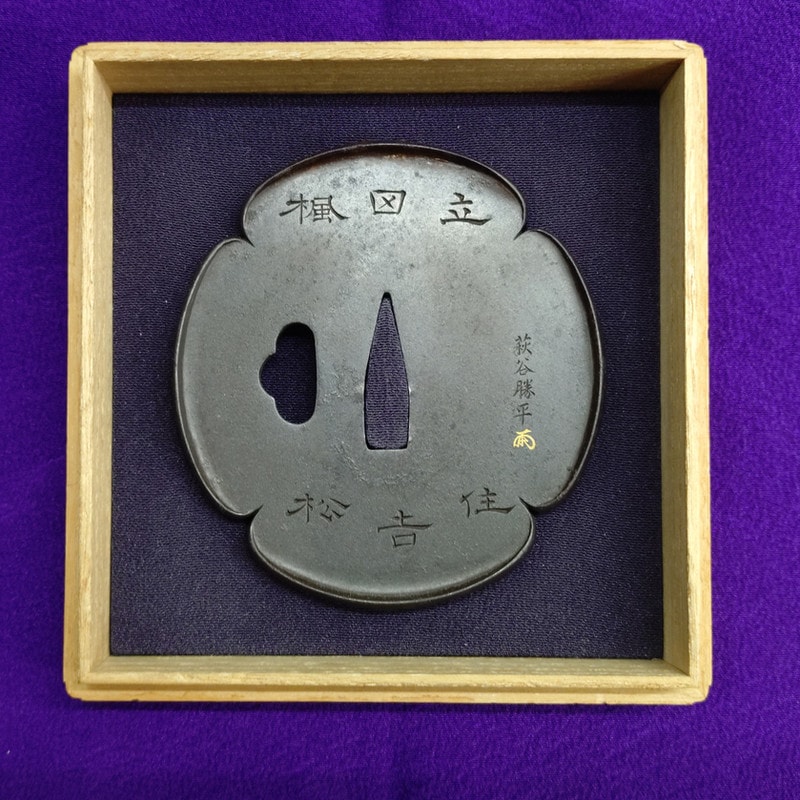
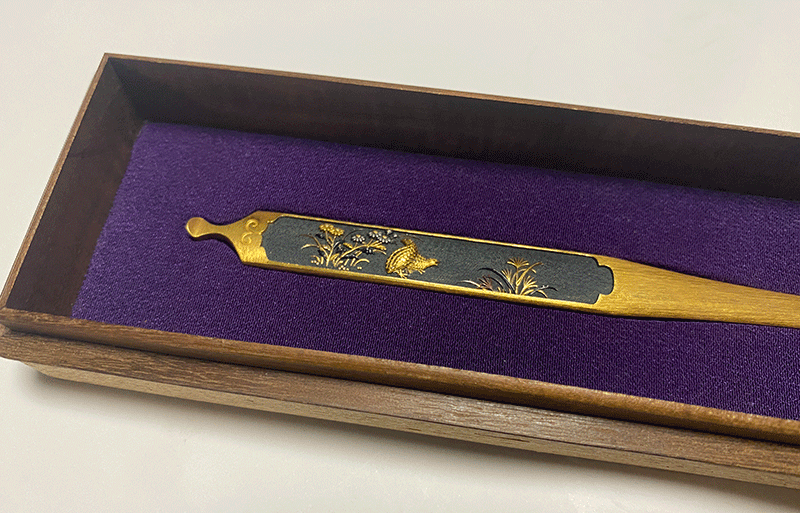
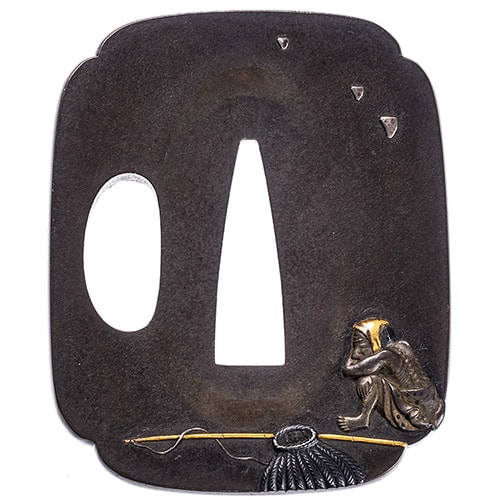
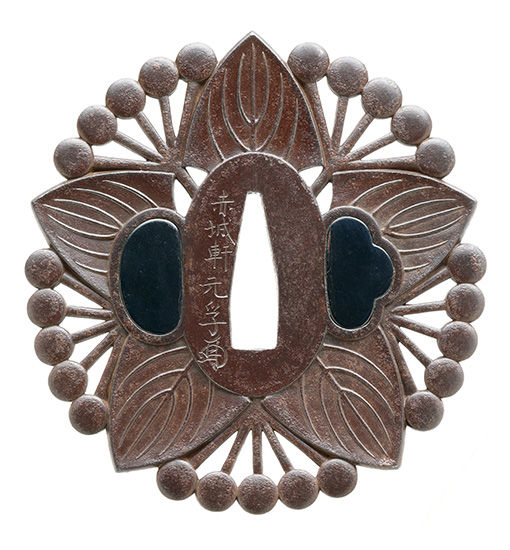
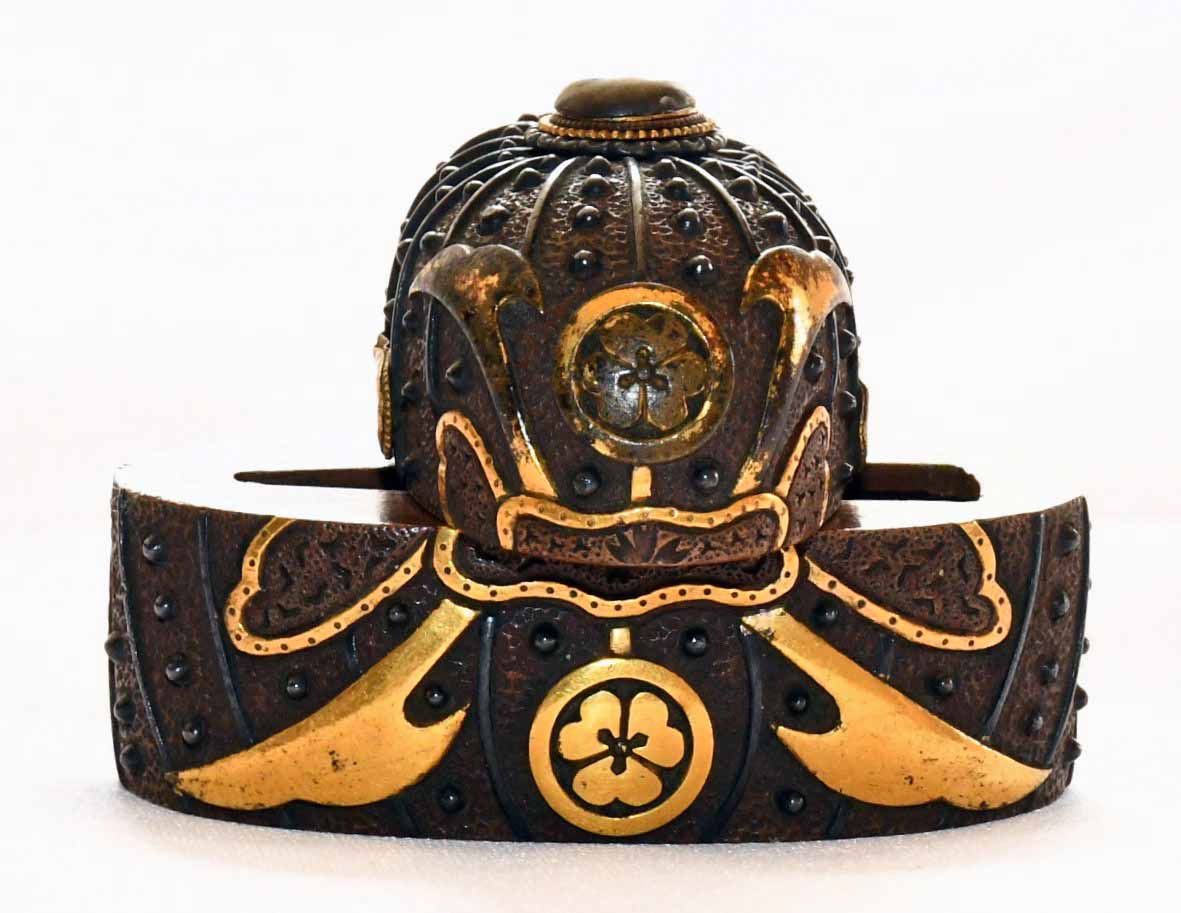
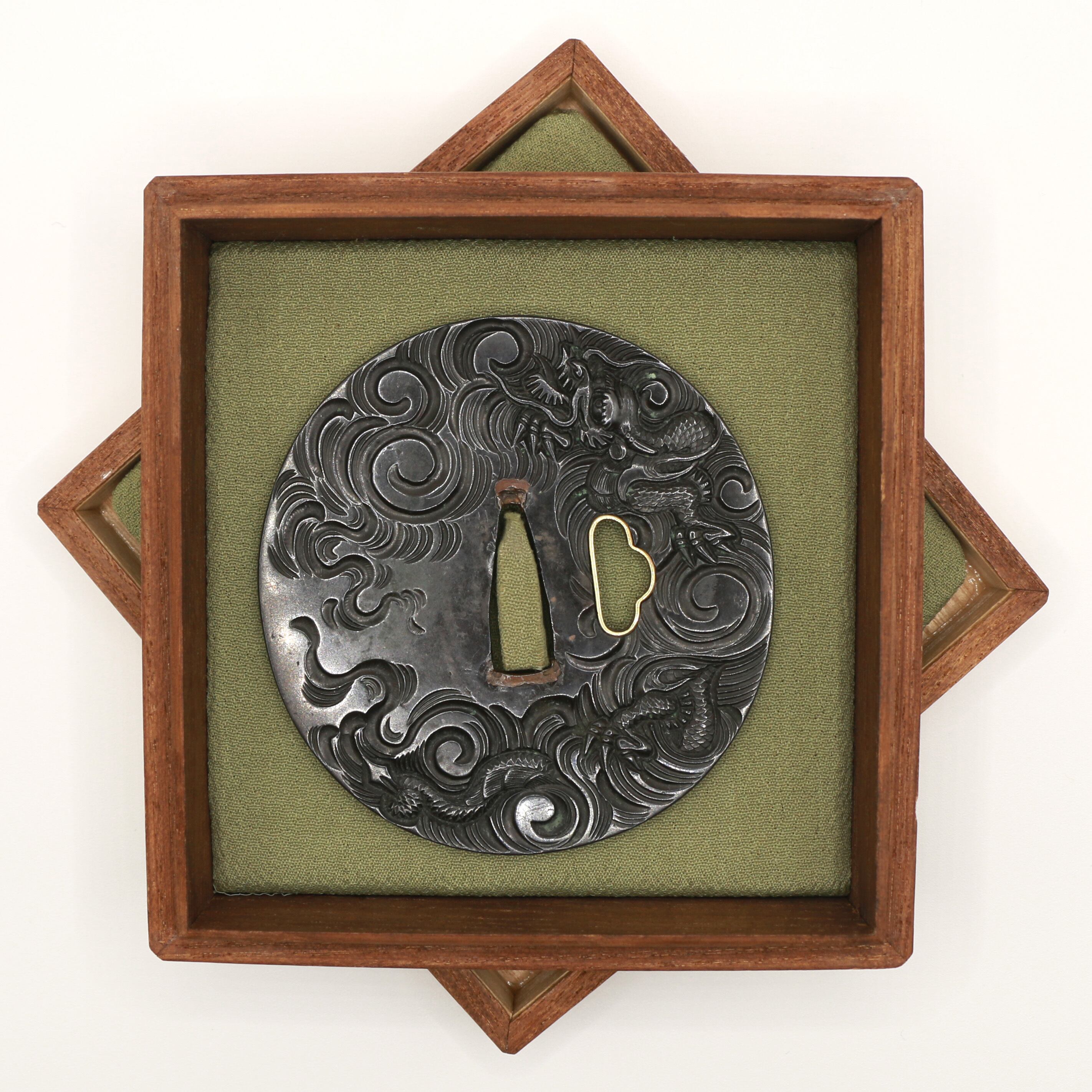
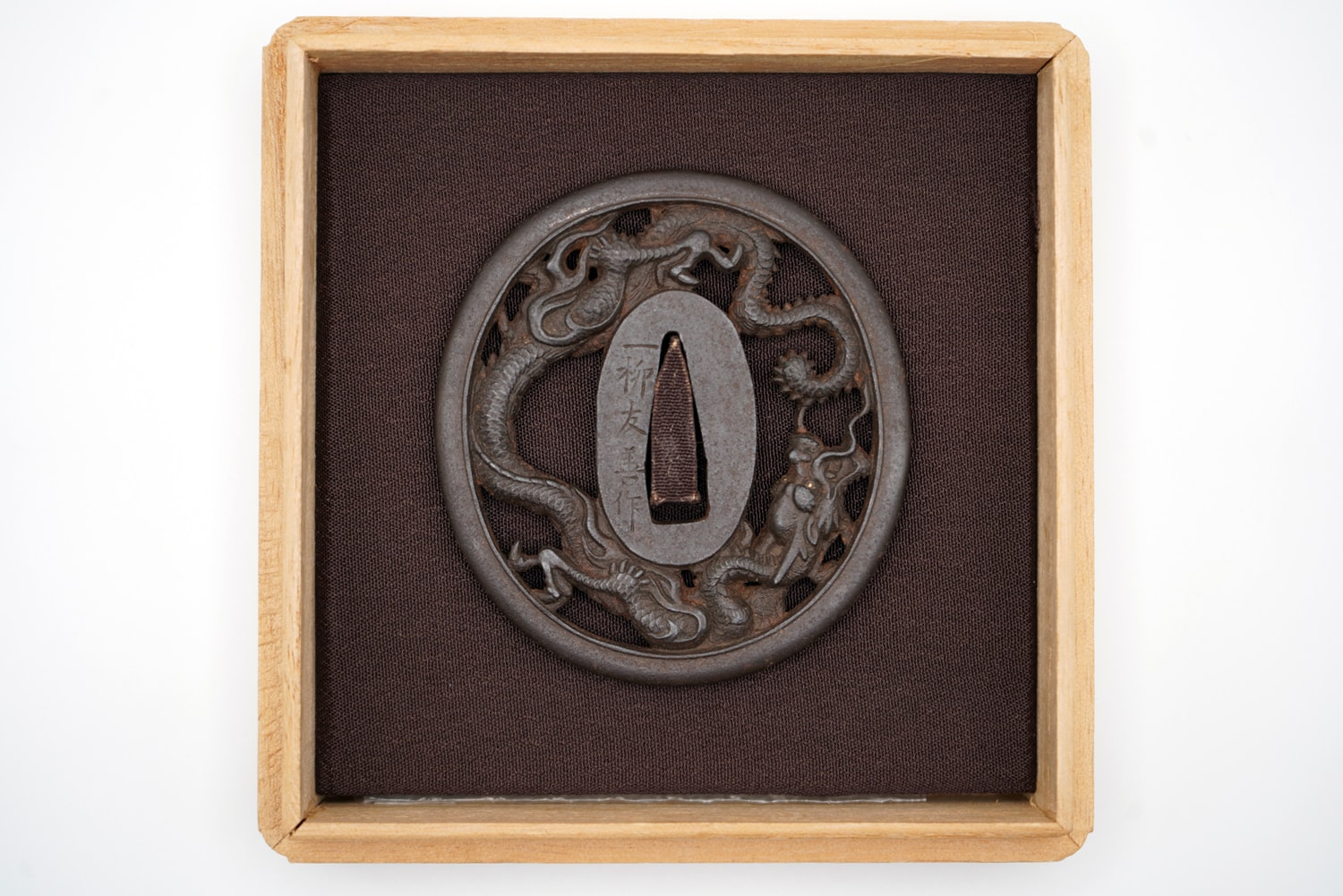
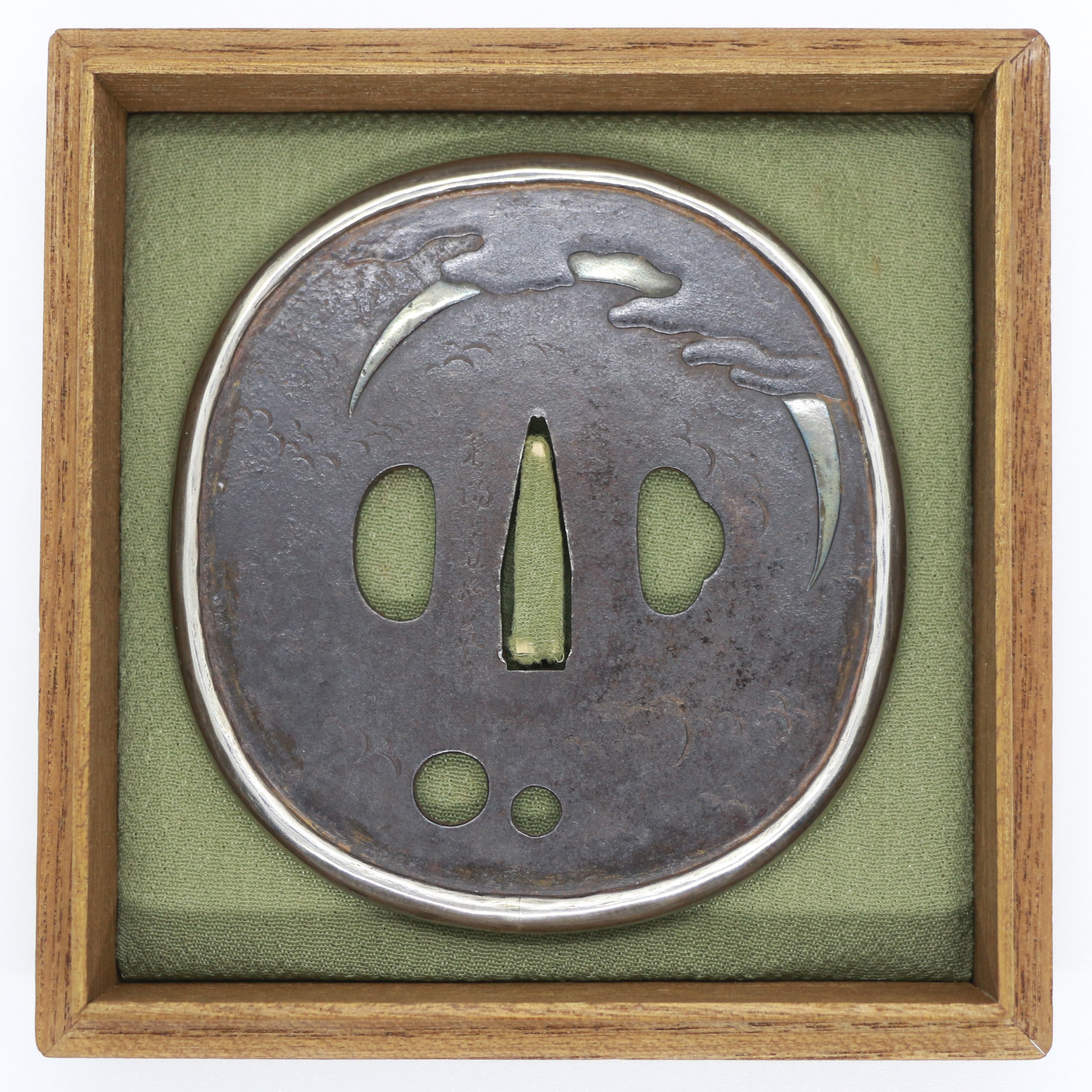
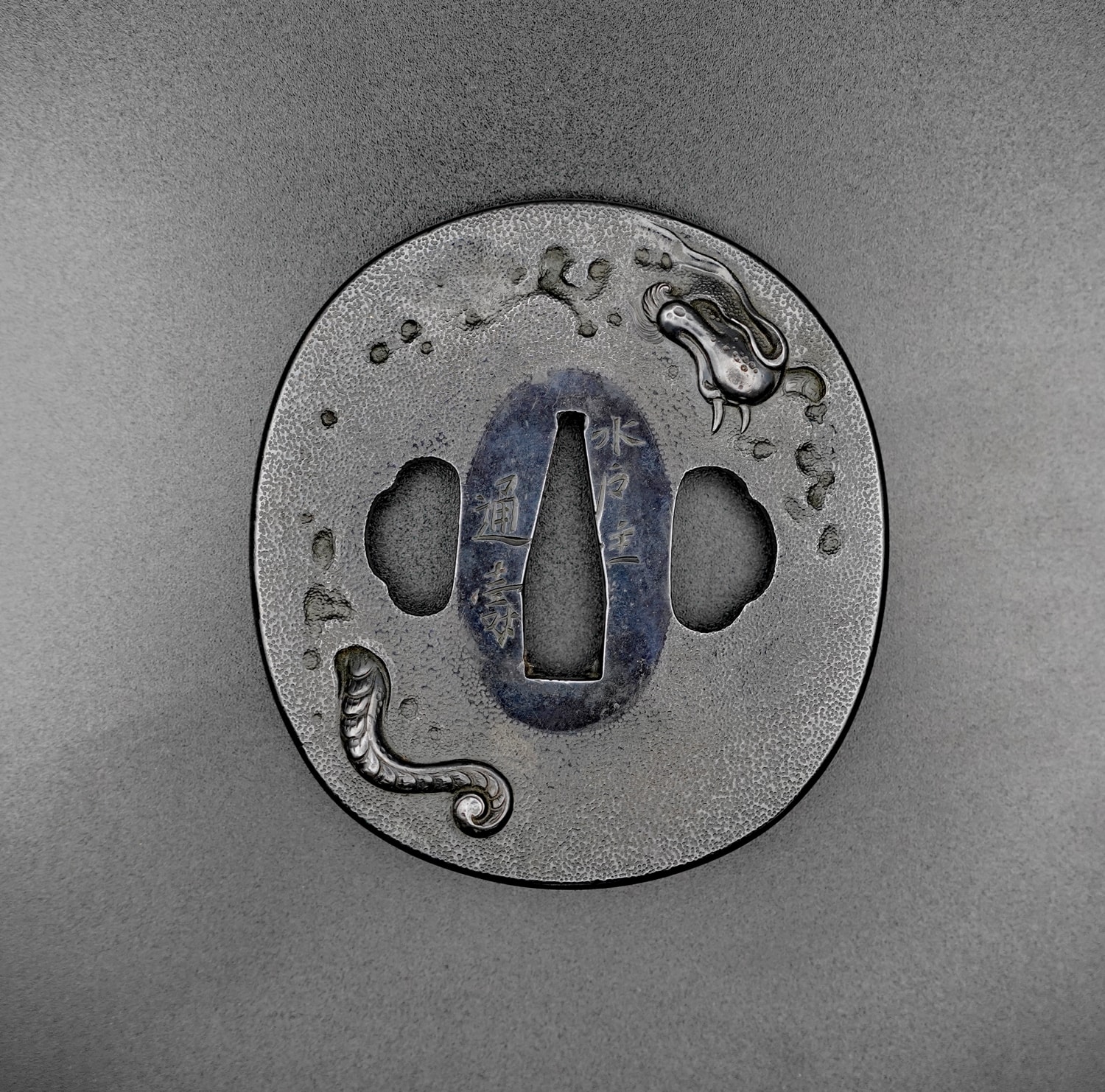
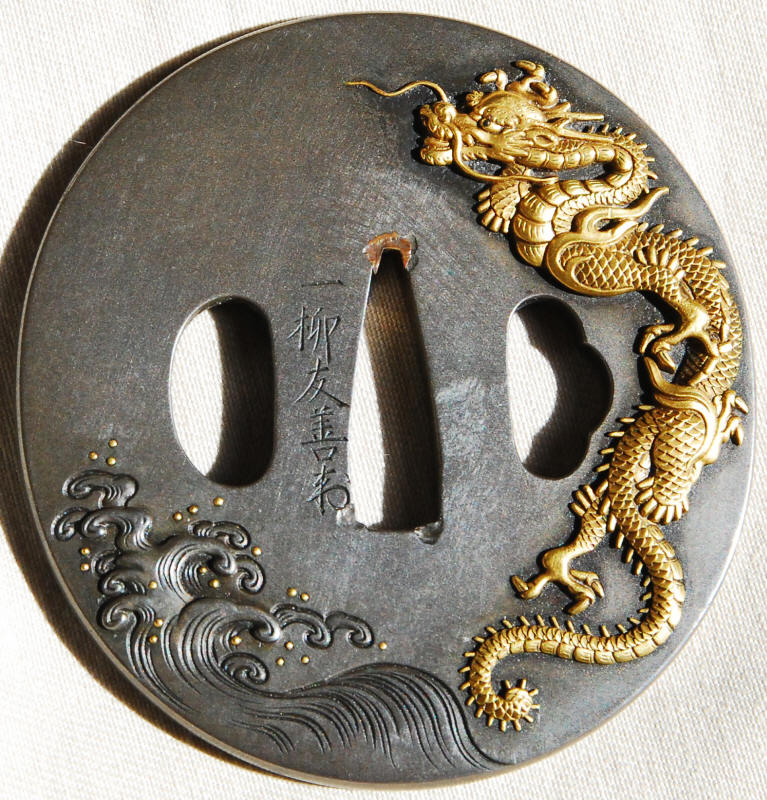
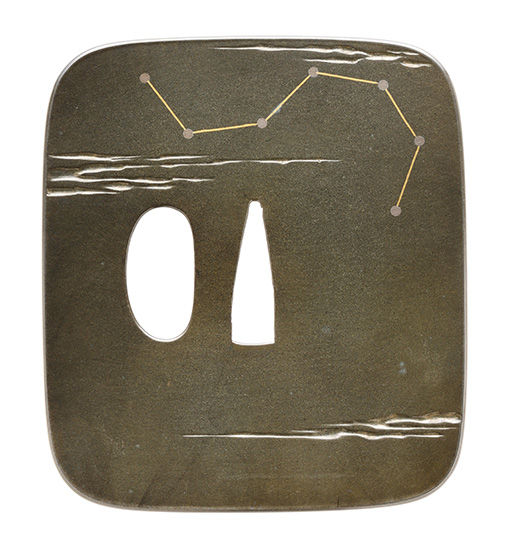
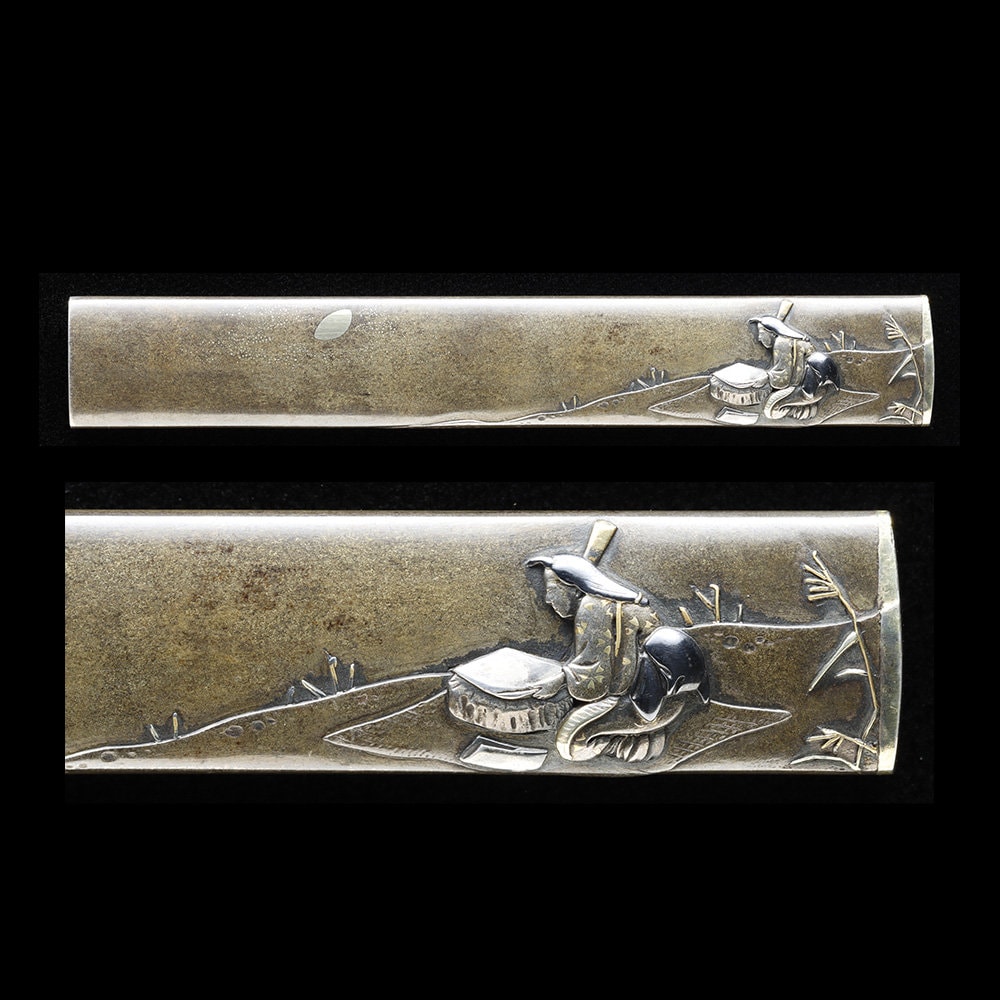
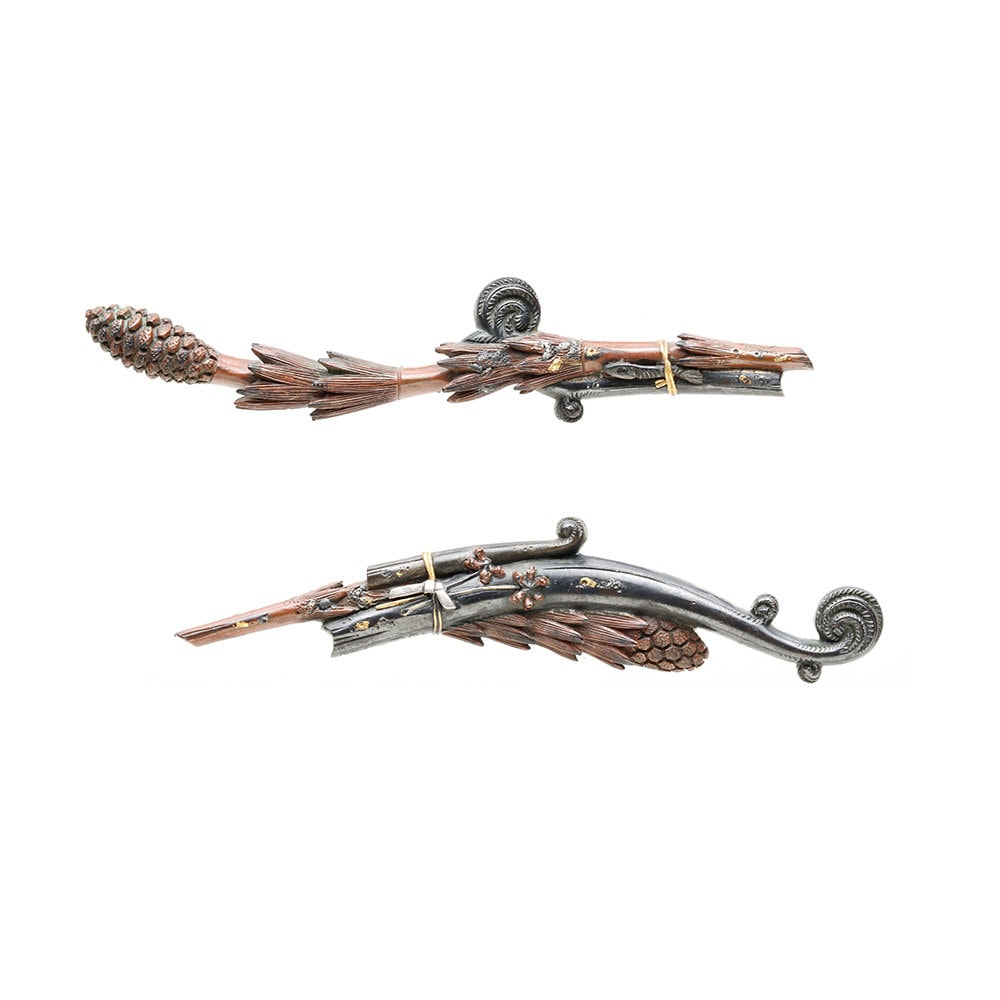
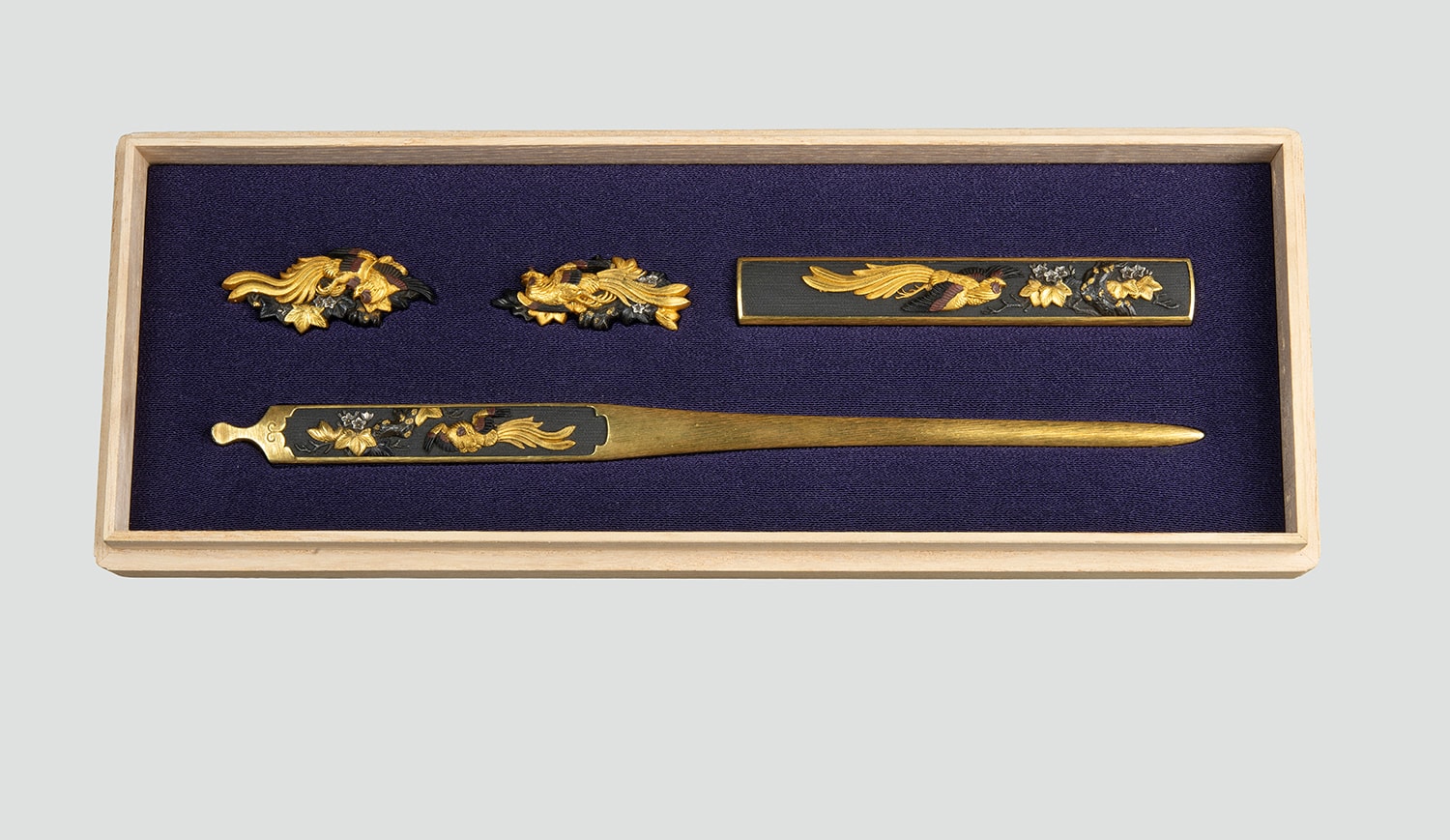
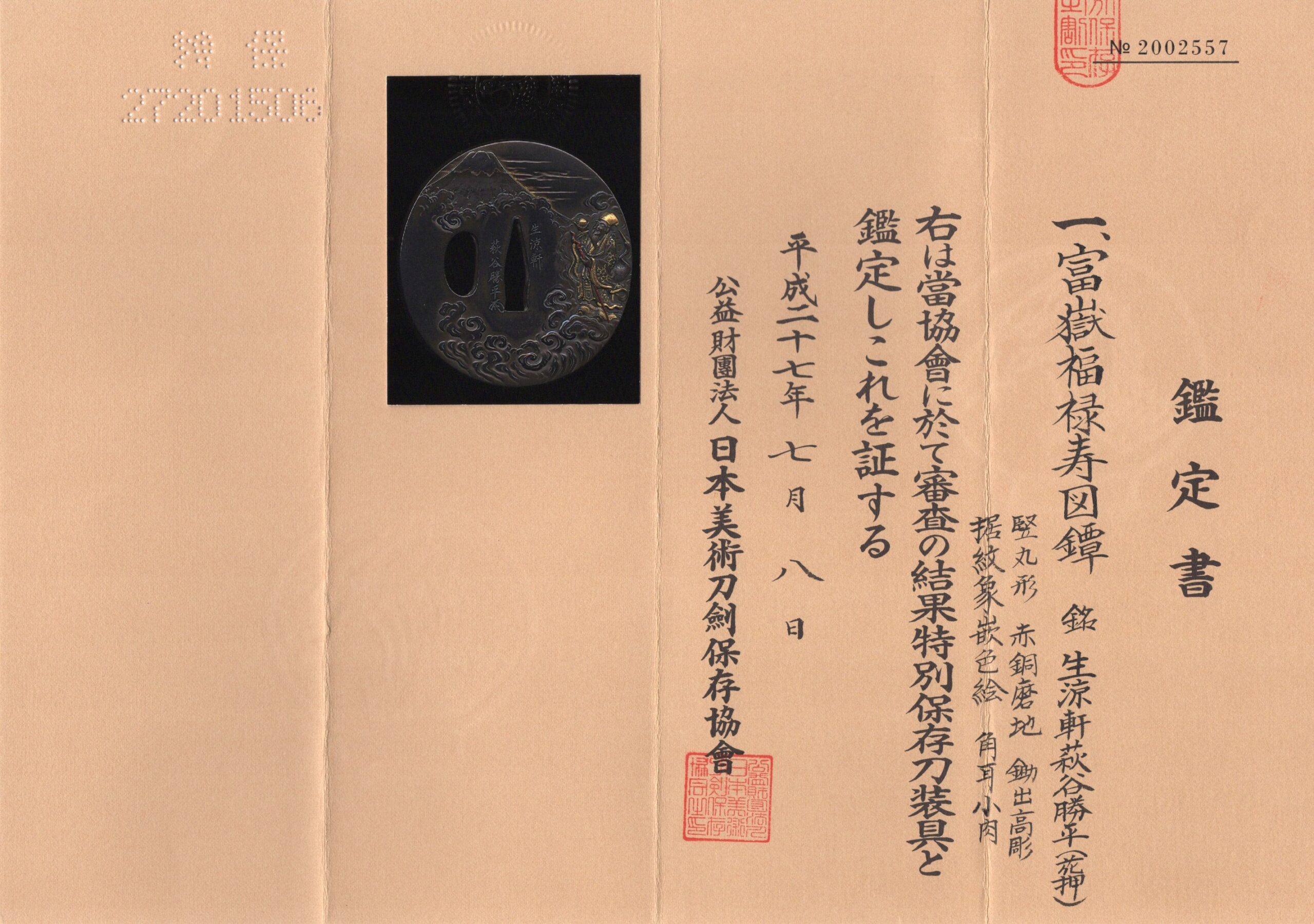
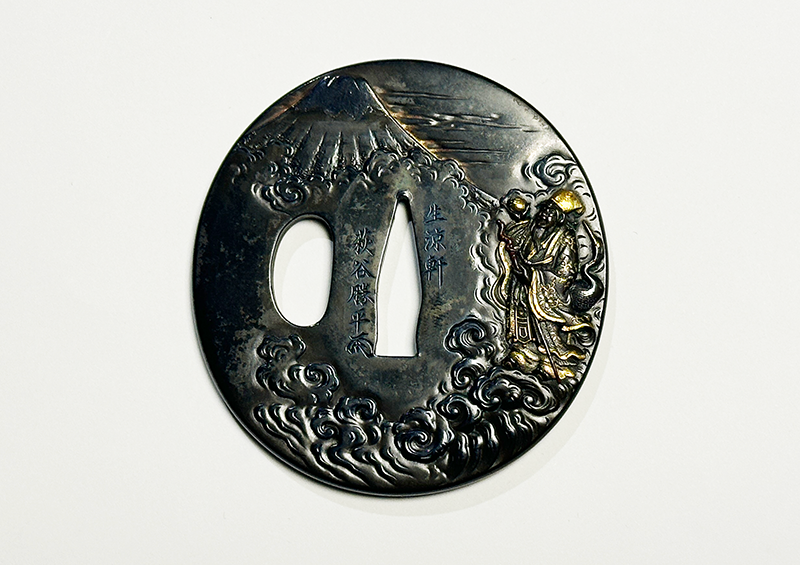
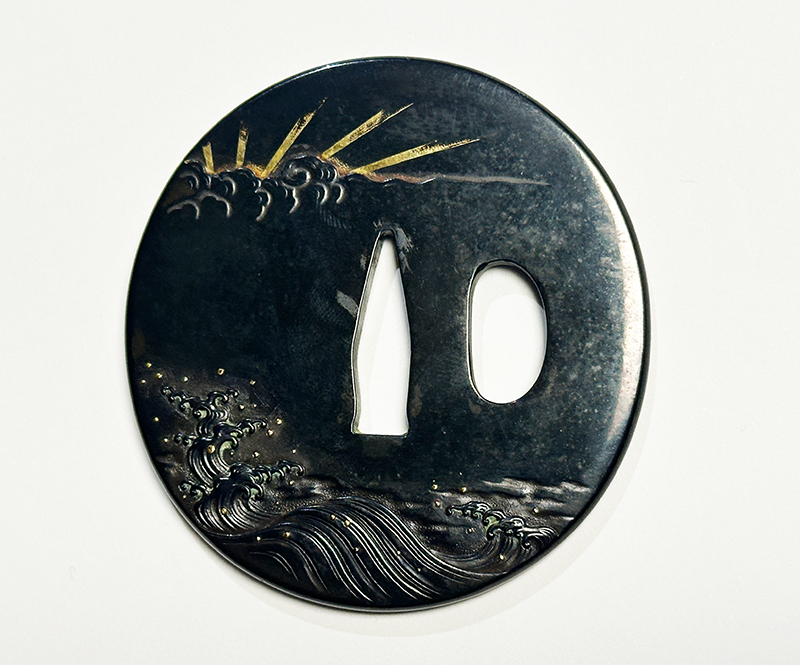
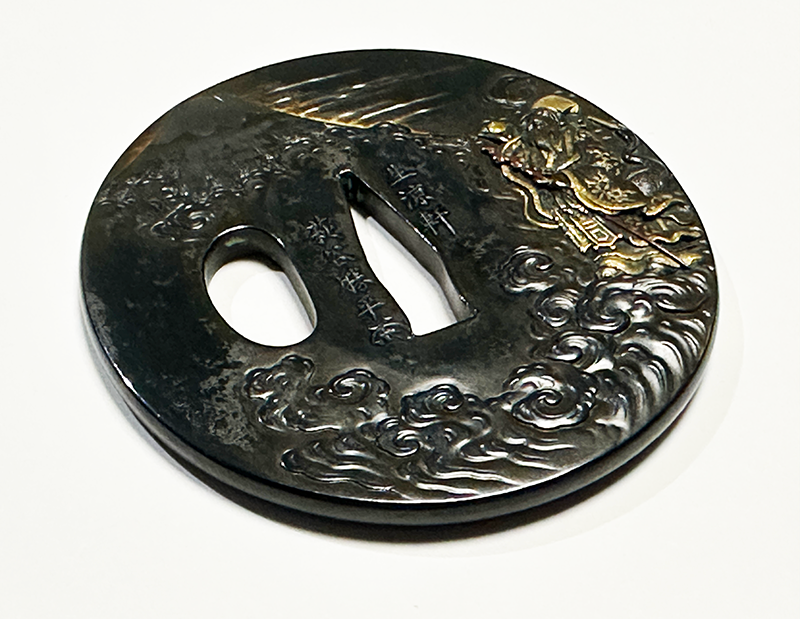
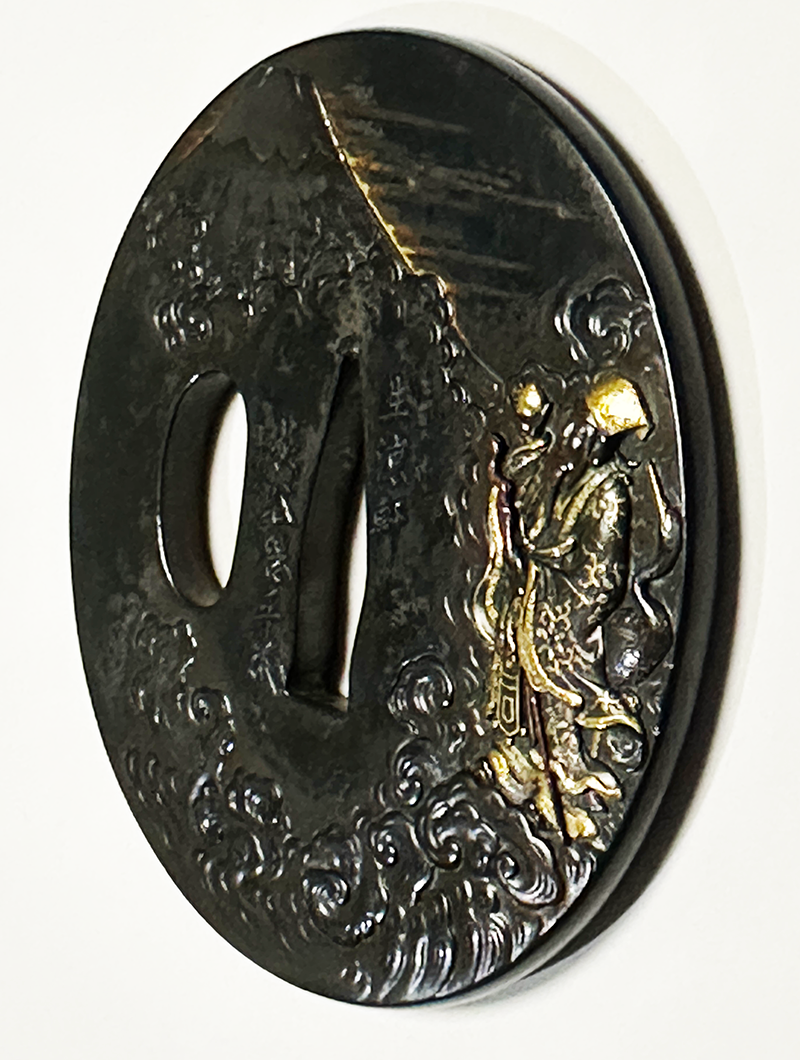
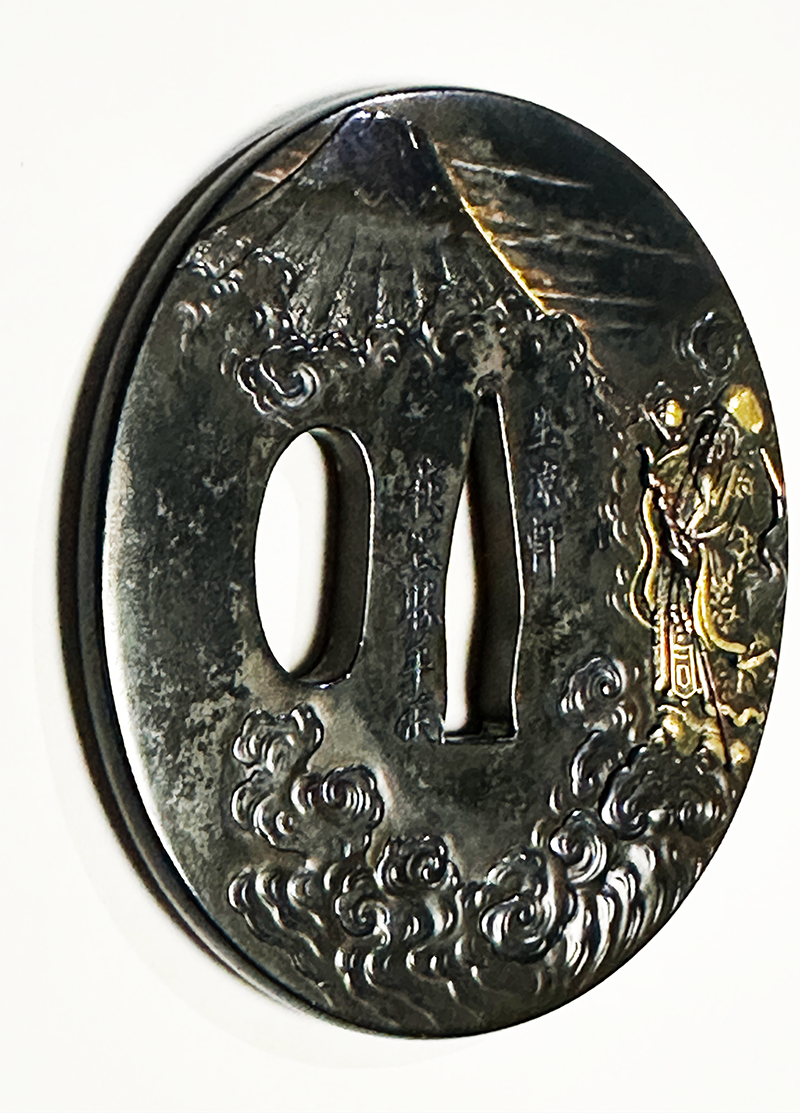
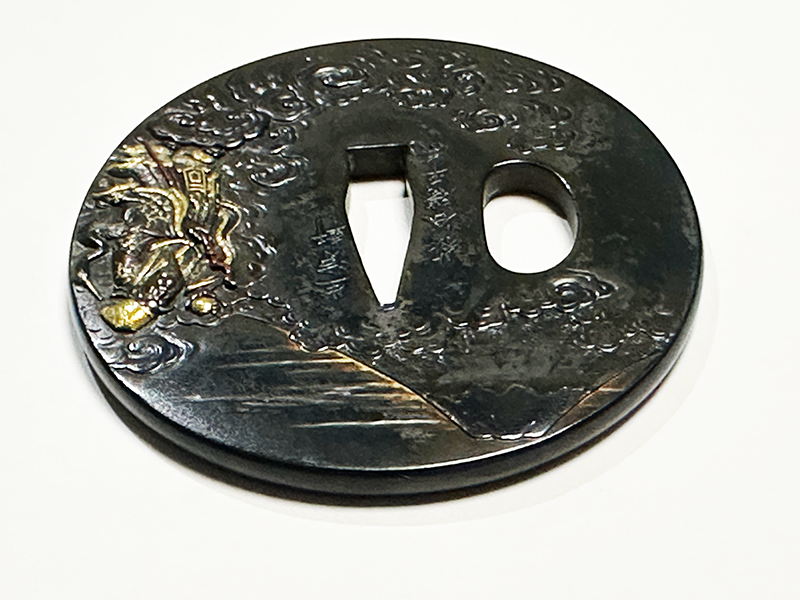
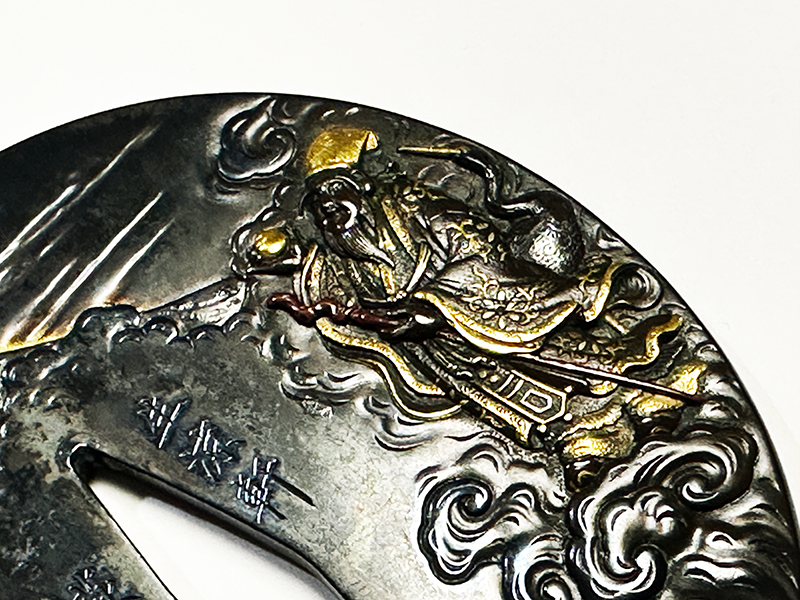
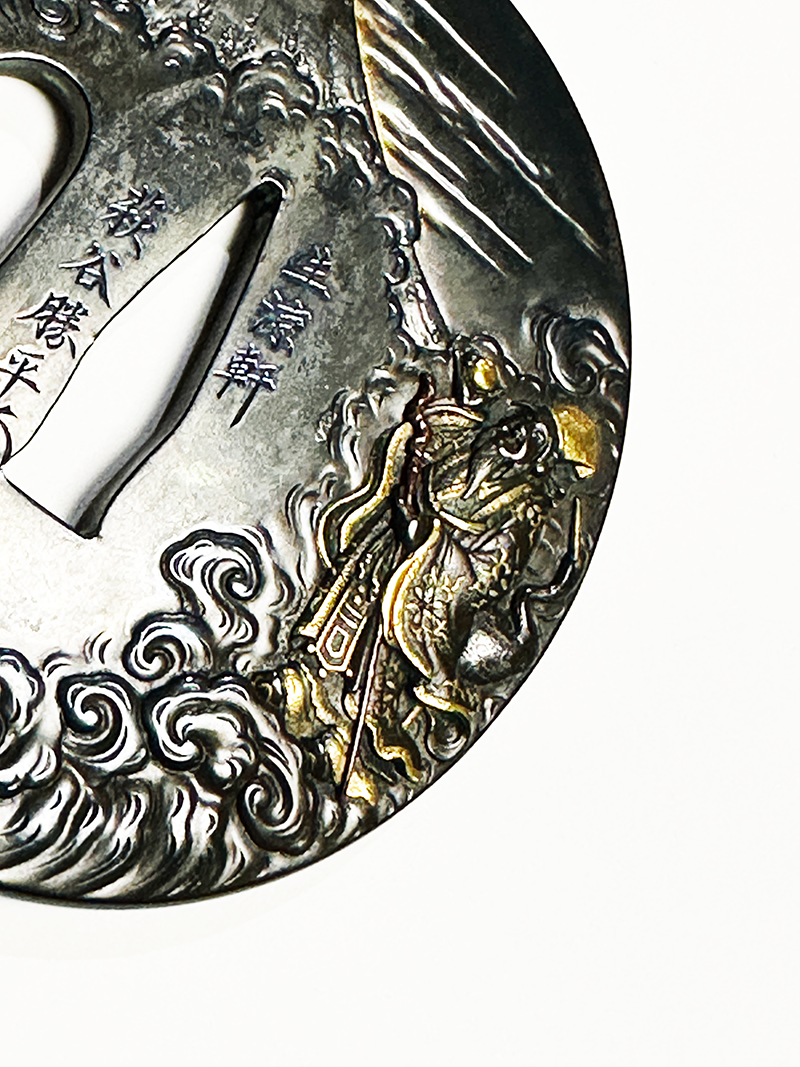
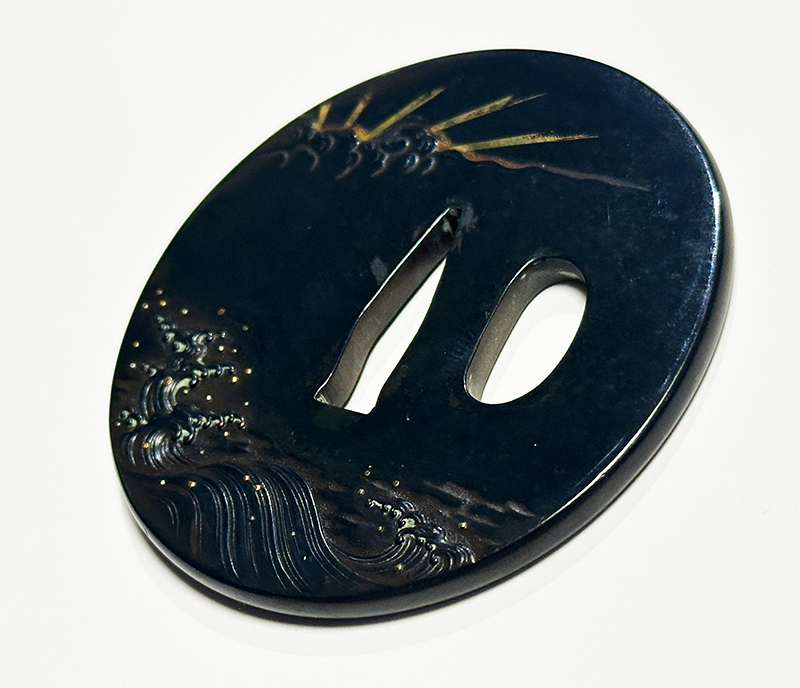
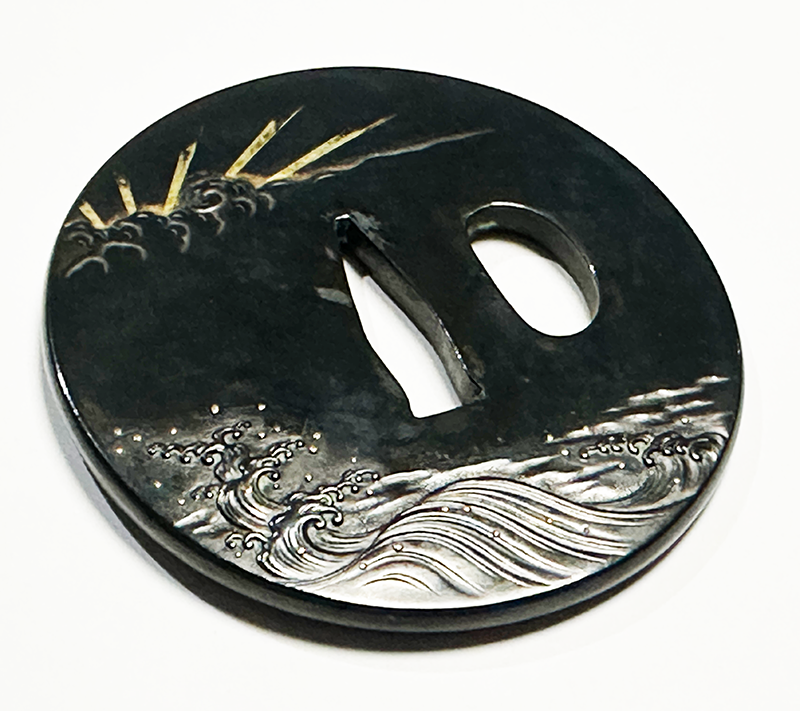
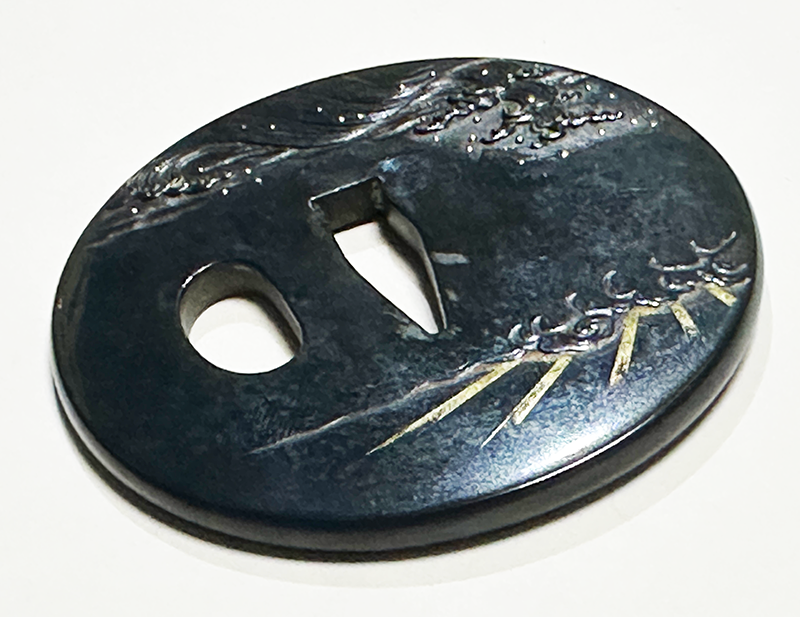
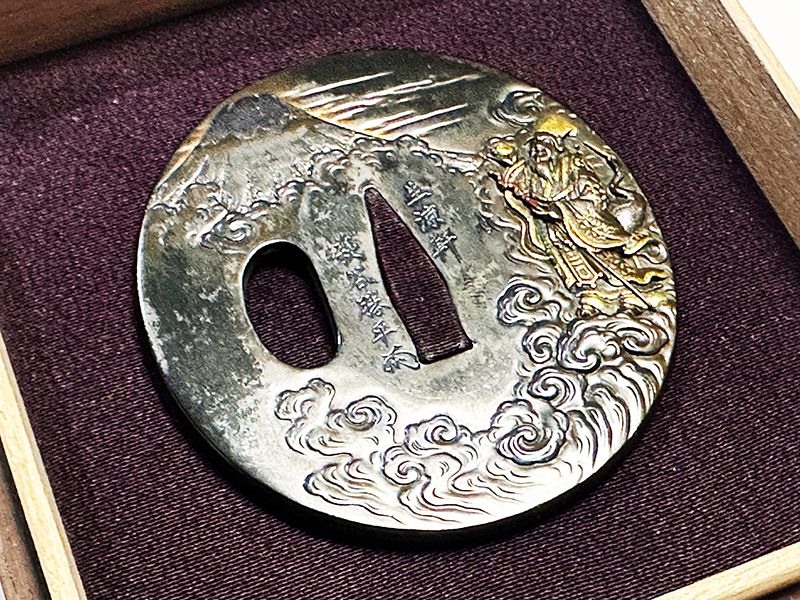
A Tokubetsu Hozon designated tsuba made by Hagiya Katsuhira during the Edo period. The tsuba features a design of Mount Fuji and Hotei in the clouds on the front, and a sunrise and waves on the back, rendered in high relief carving with color iron inlay.
 NihontoWatchBETA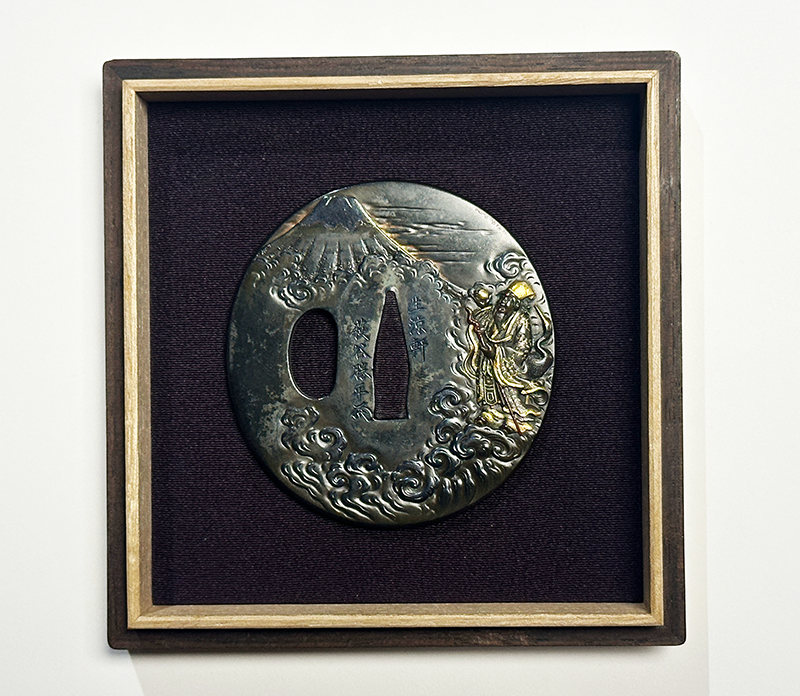
Mito Katsuhira
Edo
Signed
Tokuho (NBTHK)
Machibori · Hitachi · around 1804-1886
2 pieces on the market now
Hagiya Katsuhira (萩谷勝平), art name Seiryōken (生涼軒), was born in Mito on the twentieth day of the tenth month of Bunka 1 (1804) as the second son of Terakado Yoshishige. He was adopted into the Hagiya family through Hagiya Jinbei of Kamikanemachi, and took the common name Yasuke. One early source suggests he first studied under his elder brother Katsufusa before entering formal apprenticeship with Shinozaki Katsushige, a direct-line successor within the Mito kinkō tradition. From Tenpō 15 (1844) he served the domain as an officially appointed metal-carver (goyō horimonoshi), and was active as a leading figure among the Mito metalworkers through the final years of the shogunate and into the Meiji era. He trained many pupils, bestowing the character "Ya"[[c:1]] from his own common name upon his disciples as a customary element in theirs; from his school emerged such celebrated craftsmen as Namekawa Sadakatsu and Unno Shōmin. His two sons, Katsuyasu and Katsuho, continued the metalworking lineage — the elder adopted into the Suzuki family, the younger succeeding to the Hagiya line. Katsuhira died in Meiji 19 (1886) at the age of eighty-three.
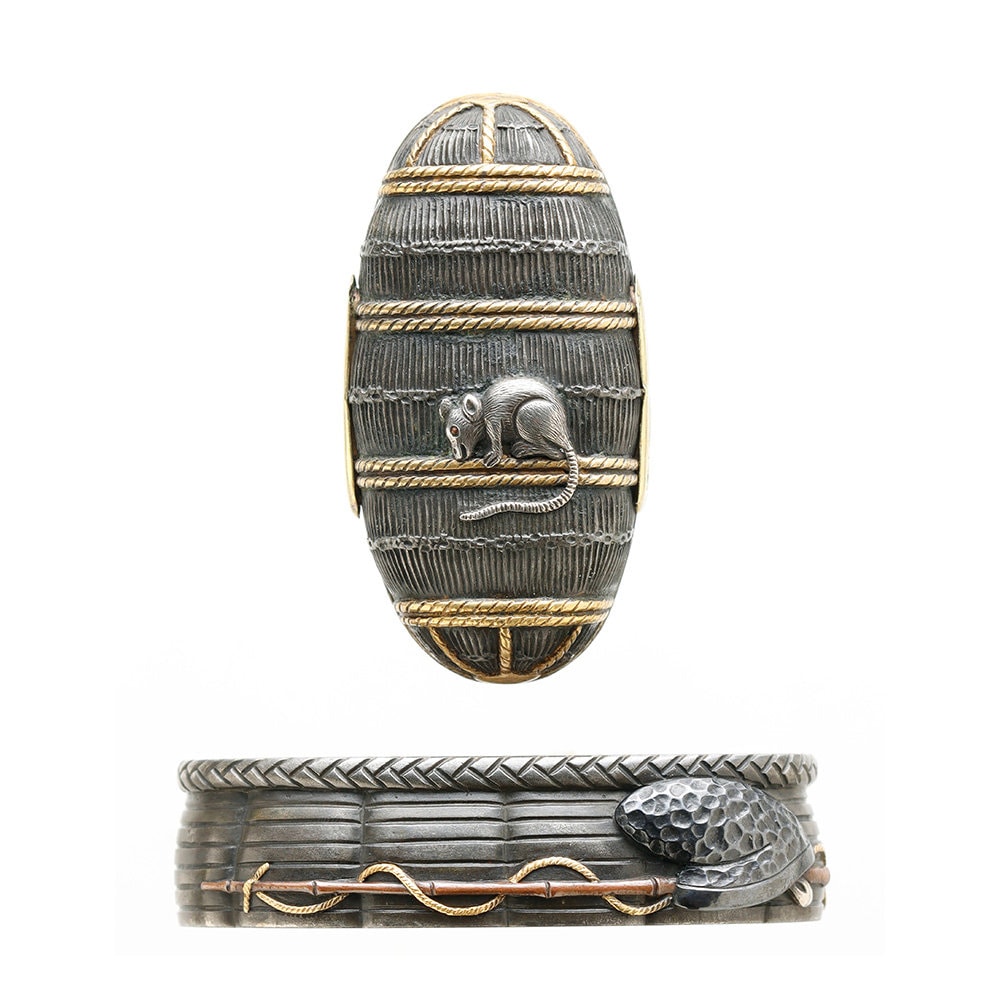
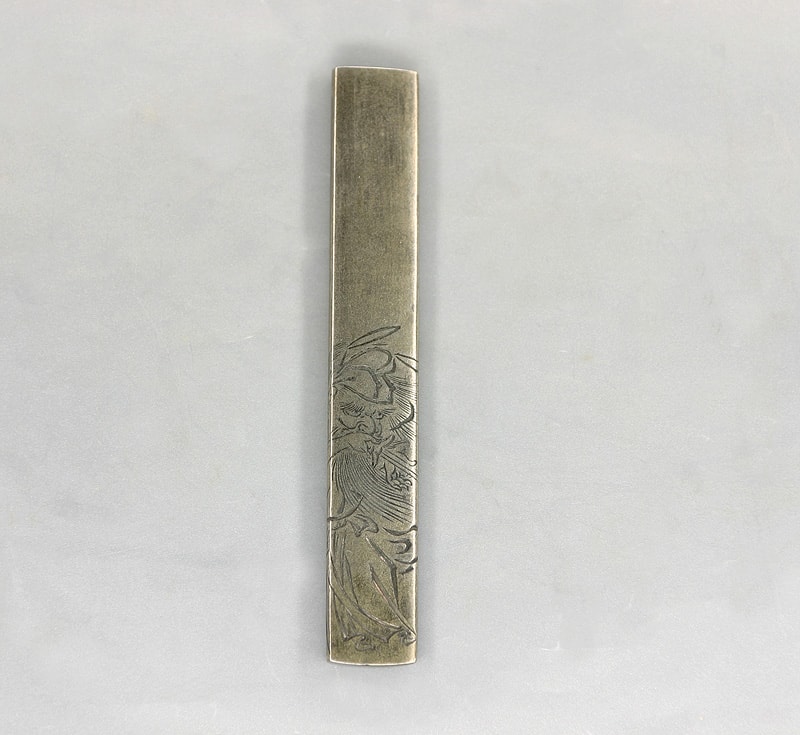
Katsuhira's work is defined by the richly textural takabori (high-relief carving) for which he was especially renowned, executed with a deep and forceful chisel and enriched throughout by polychrome iroe (color metal inlay) employing gold, silver, shakudō, shibuichi, oborogin, and hidō. His compositions display a Yokoya-school flavor — the NBTHK observes that his manner of depicting lions "suggests that Katsuhira took Sōmin as a model" — yet are grounded firmly in the Mito metalworking idiom. He worked fluently across multiple ground treatments, from polished iron migaki-ji to shibuichi with ishime-ji (stone-texture ground) and tsuchime-ji (hammered ground), adapting surface texture to narrative purpose. His shakudō nanako-ji pieces, though "comparatively uncommon within Mito metalwork as a whole," demonstrate command of a technique more often associated with earlier traditions. Whether depicting Hōjōe crane-release scenes, the Aridōshi shrine from the nō repertoire, rain dragons, or Buddhist subjects such as Fugen and Monju, his figure carving is singled out for its vivid expressiveness — Yoritomo's "cool, refreshing expression suggesting an inner vigor" is noted as "a quality that can only be expected from a first-rate Mito metalworker." Across his oeuvre, hira-zōgan for textile patterns, minute "dew" inlay for sea spray, and ko-sukashi (small openwork) complement the dominant takabori to produce works of layered visual depth.
The NBTHK consistently describes Katsuhira's output in terms of "compelling power and presence," "forceful vigor and technical refinement," and "an intense, forceful spirit" — language that positions him as a maker whose strength lay in muscular, richly worked compositions rather than restrained understatement. His works are repeatedly characterized as "meticulous and forceful," "exceptionally careful and deliberate," and "finished to an especially outstanding level even among the maker's works." The menuki depicting Fugen and Monju are said to convey "an elegant and richly full-bodied feeling, attaining a refined nobility," while his complete koshirae suites are held to "vividly display the consummate skill of Mito tōsō craftsmanship." Taken together, the designation records affirm Katsuhira as one of the foremost representatives of Mito metalwork — a master in whom the full abilities of the tradition were brought to bear.
Where Katsuhira stands among comparable artisans: across all of nihontō, and within tradition, era, and period. The tiers (Foremost · Leading · Major · Notable) weigh official designations from the NBTHK and Japan's Agency for Cultural Affairs, together with historical honors of lasting repute such as the Sansaku and Meibutsu-chō.
Select a lens to see how it's measured.
Machibori · Hitachi
78 pieces on the market now
The Mito school of sword-fitting makers emerged as an officially sponsored tradition in the domains of the Tokugawa family's Mito branch, achieving particular prominence in the late Edo period. The school's lineage traces through Shinozaki Katsushige and his successors, who served as goyō horimonoshi (official engravers) to the domain. Unlike the privately patronized workshops of Edo and Kyoto, Mito metalworkers operated within a system of domain service, producing both presentation fittings for formal occasions and richly decorated works for commission. Learn more →
| Smith | Era | Designated |
|---|---|---|
| Katsuhira勝平 | 1804-1886 | 13 |
| Shomin勝珉 | 1844-1915 | 11 |
| Teikan貞幹 | — | 5 |
| Katsutoshi勝寿 | — | 1 |
| Mototane元胤 | — | 0 |
A Hozon-certified fitting of notably superior craftsmanship and condition, often with signature or workmanship of high reference value.
The NBTHK (Nihon Bijutsu Tōken Hozon Kyōkai, the Society for the Preservation of Japanese Art Swords) is a public-interest incorporated foundation founded in 1948 and supervised by Japan’s Agency for Cultural Affairs (Bunkachō); it is based at the Japanese Sword Museum in Tokyo. Its expert panels physically examine each submitted work (shinsa) and issue a certificate (kanteishō) ranking it by artistic and historical merit. NBTHK papers are the most widely recognized standard of authentication for Japanese swords and fittings.
NBTHK official siteCustomer-initiated returns accepted within two days of arrival; return shipping paid by customer and fees non-refundable. Returns/refunds unavailable for overseas deliveries.
A Tokubetsu Hozon designated tsuba made by Hagiya Katsuhira during the Edo period. The tsuba features a design of Mount Fuji and Hotei in the clouds on the front, and a sunrise and waves on the back, rendered in high relief carving with color iron inlay.
NihontoWatchBETAMito Katsuhira
Edo
Signed
Tokuho (NBTHK)
Machibori · Hitachi · around 1804-1886
2 pieces on the market now
Hagiya Katsuhira (萩谷勝平), art name Seiryōken (生涼軒), was born in Mito on the twentieth day of the tenth month of Bunka 1 (1804) as the second son of Terakado Yoshishige. He was adopted into the Hagiya family through Hagiya Jinbei of Kamikanemachi, and took the common name Yasuke. One early source suggests he first studied under his elder brother Katsufusa before entering formal apprenticeship with Shinozaki Katsushige, a direct-line successor within the Mito kinkō tradition. From Tenpō 15 (1844) he served the domain as an officially appointed metal-carver (goyō horimonoshi), and was active as a leading figure among the Mito metalworkers through the final years of the shogunate and into the Meiji era. He trained many pupils, bestowing the character "Ya"[[c:1]] from his own common name upon his disciples as a customary element in theirs; from his school emerged such celebrated craftsmen as Namekawa Sadakatsu and Unno Shōmin. His two sons, Katsuyasu and Katsuho, continued the metalworking lineage — the elder adopted into the Suzuki family, the younger succeeding to the Hagiya line. Katsuhira died in Meiji 19 (1886) at the age of eighty-three.
Katsuhira's work is defined by the richly textural takabori (high-relief carving) for which he was especially renowned, executed with a deep and forceful chisel and enriched throughout by polychrome iroe (color metal inlay) employing gold, silver, shakudō, shibuichi, oborogin, and hidō. His compositions display a Yokoya-school flavor — the NBTHK observes that his manner of depicting lions "suggests that Katsuhira took Sōmin as a model" — yet are grounded firmly in the Mito metalworking idiom. He worked fluently across multiple ground treatments, from polished iron migaki-ji to shibuichi with ishime-ji (stone-texture ground) and tsuchime-ji (hammered ground), adapting surface texture to narrative purpose. His shakudō nanako-ji pieces, though "comparatively uncommon within Mito metalwork as a whole," demonstrate command of a technique more often associated with earlier traditions. Whether depicting Hōjōe crane-release scenes, the Aridōshi shrine from the nō repertoire, rain dragons, or Buddhist subjects such as Fugen and Monju, his figure carving is singled out for its vivid expressiveness — Yoritomo's "cool, refreshing expression suggesting an inner vigor" is noted as "a quality that can only be expected from a first-rate Mito metalworker." Across his oeuvre, hira-zōgan for textile patterns, minute "dew" inlay for sea spray, and ko-sukashi (small openwork) complement the dominant takabori to produce works of layered visual depth.
The NBTHK consistently describes Katsuhira's output in terms of "compelling power and presence," "forceful vigor and technical refinement," and "an intense, forceful spirit" — language that positions him as a maker whose strength lay in muscular, richly worked compositions rather than restrained understatement. His works are repeatedly characterized as "meticulous and forceful," "exceptionally careful and deliberate," and "finished to an especially outstanding level even among the maker's works." The menuki depicting Fugen and Monju are said to convey "an elegant and richly full-bodied feeling, attaining a refined nobility," while his complete koshirae suites are held to "vividly display the consummate skill of Mito tōsō craftsmanship." Taken together, the designation records affirm Katsuhira as one of the foremost representatives of Mito metalwork — a master in whom the full abilities of the tradition were brought to bear.
Where Katsuhira stands among comparable artisans: across all of nihontō, and within tradition, era, and period. The tiers (Foremost · Leading · Major · Notable) weigh official designations from the NBTHK and Japan's Agency for Cultural Affairs, together with historical honors of lasting repute such as the Sansaku and Meibutsu-chō.
Select a lens to see how it's measured.
Machibori · Hitachi
78 pieces on the market now
The Mito school of sword-fitting makers emerged as an officially sponsored tradition in the domains of the Tokugawa family's Mito branch, achieving particular prominence in the late Edo period. The school's lineage traces through Shinozaki Katsushige and his successors, who served as goyō horimonoshi (official engravers) to the domain. Unlike the privately patronized workshops of Edo and Kyoto, Mito metalworkers operated within a system of domain service, producing both presentation fittings for formal occasions and richly decorated works for commission. Learn more →
| Smith | Era | Designated |
|---|---|---|
| Katsuhira勝平 | 1804-1886 | 13 |
| Shomin勝珉 | 1844-1915 | 11 |
| Teikan貞幹 | — | 5 |
| Katsutoshi勝寿 | — | 1 |
| Mototane元胤 | — | 0 |
A Hozon-certified fitting of notably superior craftsmanship and condition, often with signature or workmanship of high reference value.
The NBTHK (Nihon Bijutsu Tōken Hozon Kyōkai, the Society for the Preservation of Japanese Art Swords) is a public-interest incorporated foundation founded in 1948 and supervised by Japan’s Agency for Cultural Affairs (Bunkachō); it is based at the Japanese Sword Museum in Tokyo. Its expert panels physically examine each submitted work (shinsa) and issue a certificate (kanteishō) ranking it by artistic and historical merit. NBTHK papers are the most widely recognized standard of authentication for Japanese swords and fittings.
NBTHK official siteCustomer-initiated returns accepted within two days of arrival; return shipping paid by customer and fees non-refundable. Returns/refunds unavailable for overseas deliveries.