 NihontoWatchNihontoWatch
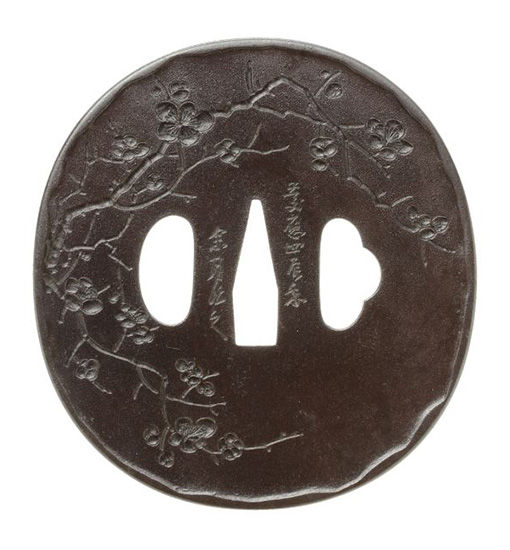
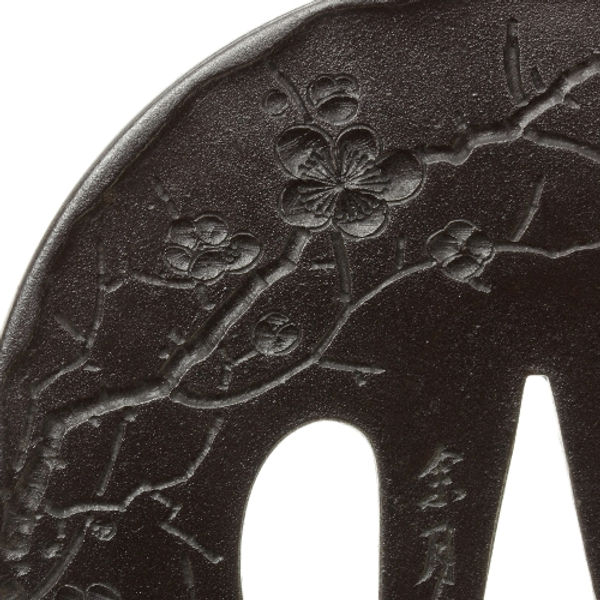
Amidst the lingering cold, plum blossoms bloom ahead of all other flowers. The branches twist and grow upward, with round, lovely petals. The unique and tasteful sen-bori is the koshu-bori that Goto Ichijo and his top pupil Ikkin excelled at. The modulated uchikaeshi at the mimi is also a shape unique to the Ichijo school. The fine ishime-ji expresses the cold air of early spring. With no other iroe used, the plum branches emerge from the monochrome iron ground, awakening a fragrant scent from memory. Itteki was born as the fourth son of the tenth generation of the Nakagawa family, a famous family of metalworkers in Tsuyama, Mimasaka no Kuni (Okayama Prefecture). His older brothers were Nakagawa Issho and Shoami Katsuyoshi. Through the connection of his brother Issho, he became a student of Goto Ichijo, later succeeded as the eleventh generation of the Nakagawa family, and was a skilled artisan who became a retained craftsman for the Matsudaira family.
NihontoWatchOffered by Choshuya

Translated from the shop's Japanese ·
Rows still in Japanese are as written by the shop
Machine translation from the shop's Japanese · may contain errors ·
Iebori · Mimasaka (Tsuyama)
2 pieces on the market now
Iebori · Kyoto
38 pieces on the market now
" Ichijo was the fifth-generation head of the Shichiroemon house, a cadet branch of the Goto family, and trained under Hanzaemon Kamejo before succeeding to the headship at fifteen. His imperial commissions -- fittings for Emperor Kokaku in 1824 and Emperor Komei in 1862 -- earned him the ranks of Hokyo and Hogen respectively, and his atelier in Kyoto attracted a circle of gifted disciples who extended his aesthetic into the Bakumatsu and early Meiji periods. Among them, the celebrated "Five Tigers" (Goko) -- Funada Ikkin, Imai Nagatake, Hashimoto Isshi, Nakagawa Issho, and Wada Isshin -- together with the master's younger brother Goto Koran, constituted one of the most prolific and technically accomplished workshops in the history of Japanese tosogu production. The collective technical identity of the Ichijo school rests upon a foundation of shakudo nanako-ji of surpassing fineness -- described as "minute and orderly, deep and limpid," meriting the appellation kinume-nanako -- upon which elaborate pictorial compositions are built through takabori enriched by polychrome iroe employing gold, silver, shakudo, shibuichi, and suaka. Ichijo himself established the artistic direction by shifting from the canonical iebori subjects of dragons and lions toward compositions centered on close observation (shasei), rendering grasses, flowers, insects, birds, and landscapes with meticulous carving and refined dignity. This painterly sensibility pervades the entire school. Nagatake brought a distinctive ornamental density, arranging seasonal plants across entire surfaces with richly varied colored metals.
" Ikkin developed an unrivaled command of kosuki-bori -- a bold, thick chiseling technique that even Ichijo conceded was "beyond my own reach[[c:1]]" -- and his dragon subjects carried a distinctive forcefulness. " Isshin absorbed the hereditary vocabulary while concentrating creative zeal into individual passages of invention, and Issho achieved works of luxurious, courtly elegance through refined kinu-nanako and precise kebori. Koran, working in a manner akin to his elder brother yet "finished with an even more delicate and nuanced sensibility," brought the Shichiroemon branch to its most accomplished expression. Across the school, the favored tsuba form is the sumi-iri mokko-gata, and many works exhibit chuya shitate -- "day-and-night" construction using contrasting alloys on obverse and reverse. Complete daisho soroe kanagu sets, coordinated around seasonal, auspicious, or literary-historical themes, represent the school's highest format. " This standard was transmitted faithfully through the circle. " The school's productions are consistently praised for an elevated, Kyoto-inflected refinement that balances splendor and restraint in just measure. Learn more →
| Smith | Era | Designated |
|---|---|---|
| Goto Ichijo後藤一乗 | — | 91 |
| Tomei東明 | — | 30 |
| Nagatake永武 | — | 13 |
| Ikkin一琴 | — | 11 |
| Issho一匠 | 1828-1876 | 10 |
A Hozon-certified fitting of notably superior craftsmanship and condition, often with signature or workmanship of high reference value.
The NBTHK (Nihon Bijutsu Tōken Hozon Kyōkai, the Society for the Preservation of Japanese Art Swords) is a public-interest incorporated foundation founded in 1948 and supervised by Japan’s Agency for Cultural Affairs (Bunkachō); it is based at the Japanese Sword Museum in Tokyo. Its expert panels physically examine each submitted work (shinsa) and issue a certificate (kanteishō) ranking it by artistic and historical merit. NBTHK papers are the most widely recognized standard of authentication for Japanese swords and fittings.
NBTHK official siteIf, due to our fault, the item differs significantly from its proper condition, the item may be returned. Cooling-off is within one week of the item's arrival.