 NihontoWatchNihontoWatch
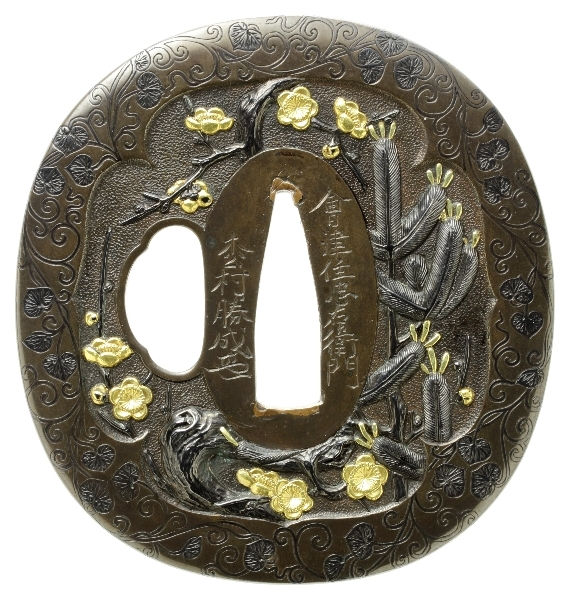
Matsumura Katsunari, who went by the name Chuuemon, was a metalworker of the Aizu Shoami school. The school excelled at takabori depictions of botanical illustrations, and Katsunari was a representative artist. This tsuba is crafted from shibuichi with a deep hue into a slightly saddle-flap style tatemaru-gata, with the edge thinned into a goishi shape, and further features a complex and stylish construction such as a dote-mimi and a mokko-gata carved into the plate. Along the edge, a karakusa pattern is chased with kebori, and the addition of shakudo iroe to a portion of the leaves enhances the luxurious feel. The subject of pine and plum, overflowing with three-dimensional effect through high-relief sukidashi-bori, is vivid, with pine needles featuring shakudo iroe and delicate kebori, and plum blossoms in a rich, warm gold iroe. One of Katsunari's greatest masterpieces. Hozon Tosogu Kanteisho
NihontoWatchOffered by Choshuya

Translated from the shop's Japanese ·
Rows still in Japanese are as written by the shop
Machine translation from the shop's Japanese · may contain errors ·
Mutsu
1 piece on the market now
Certifies a genuine fitting worth preserving: a correct signature, or, if unsigned, an identifiable era and school, with recognized artistic and craft value.
The NBTHK (Nihon Bijutsu Tōken Hozon Kyōkai, the Society for the Preservation of Japanese Art Swords) is a public-interest incorporated foundation founded in 1948 and supervised by Japan’s Agency for Cultural Affairs (Bunkachō); it is based at the Japanese Sword Museum in Tokyo. Its expert panels physically examine each submitted work (shinsa) and issue a certificate (kanteishō) ranking it by artistic and historical merit. NBTHK papers are the most widely recognized standard of authentication for Japanese swords and fittings.
NBTHK official siteIf, due to our fault, the item differs significantly from its proper condition, the item may be returned. Cooling-off is within one week of the item's arrival.