Perry’s arrival in 1853 unraveled the Tokugawa peace and created the first mass demand for working swords in two centuries. Kiyomaro, called the Masamune of Yotsuya, died on its eve; Munetsugu and Yukihide carried the boom to the end.
 NihontoWatchNihontoWatch
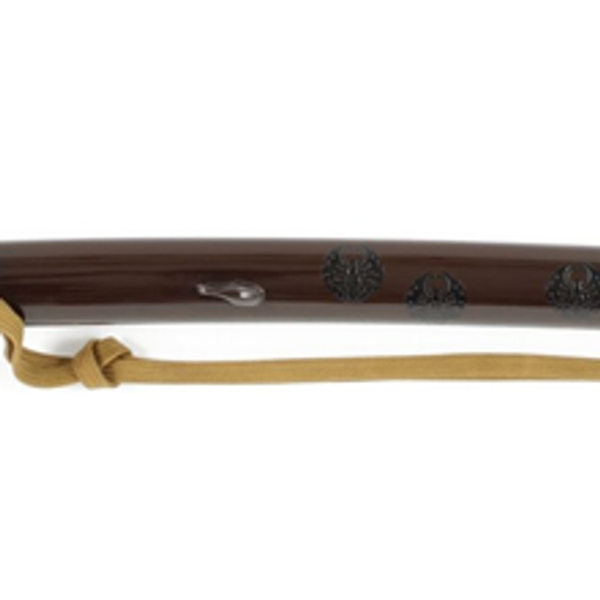
This uchigatana koshirae features snail-themed menuki and fuchi-kashira, creating a stylish appearance. The saya (scabbard) is adorned with Bizen-cho (butterfly) family crests scattered over a glossy cha urumi-nuri (tea-colored lacquer) finish, with black lacquer raised to create a textured effect. The tsuba, an Aoi Mokko-gata from Edo Higo, is made of iron with gold nunome-zogan depicting a phoenix playing among paulownia trees. The snail-themed menuki, wrapped with ancient purple thread, are made of suaka (plain copper) with iroe (color inlay) in gold and silver, and the snails' bodies have a realistic, slimy texture rendered in black lacquer. The matching snail-themed fuchi-kashira are signed by Tomonori, a metalworker from Mito during the late Edo period.
NihontoWatchMito (Swordsmiths) School水戸鍛冶派
Offered by Choshuya
Shinshinto · Hitachi
5 pieces on the market now
The Mito swordsmiths worked under the Tokugawa branch house that governed Suifu (水府) in Hitachi province during the closing decades of the Edo period. The setsumei gather two principal hands whose blades carry the shinshintō date inscriptions of the Bunka through Keiō years, together with a daishō by the tenth lord of the domain. Ichige Tokuchika (市毛徳鄰, also recorded with the title Ōmi-no-suke and at times read Tokurin), common name Genzaemon, was born in An'ei 6 (1777); he first studied under the domain smith Kume Naganori, then traveled to Osaka to train in the school of Ozaki Suketaka, and in Bunka 6 (1809) was taken on as an officially retained smith of the domain. Katsumura Tokukatsu (勝村徳勝), common name Hikoroku, was born in Bunka 6 (1809) in Mito and learned first from the domain smith Sekinai Tokumune; in Kaei 5 (1852) he was sent by domain order up to Edo, where the records say he entered the circles of Hosokawa Masayoshi and the Ishidō smith Unju Korekazu, and in the Bunkyū years he relocated to the Mito residence at Koishikawa. The third name is Tokugawa Keitoku (順公, Junkō), tenth lord of the domain, whose daishō survives in a black wax-lacquer mounting with hollyhock-crested fittings by the domain artisan Tamagawa Yoshihisa. The setsumei place all of this within the bakumatsu service of a domain whose Tokugawa loyalist temper is felt in the martial bearing of its blades. The two productive hands do not share a single style, and the setsumei keep them apart. Tokuchika is read primarily through his Osaka schooling: a tightly forged ko-itame with dense ji-nie and fine chikei, and a tempering range that runs from large gunome-midare swept into a billowing tōran manner after Suketaka, to a quieter suguha with shallow notare that the writers compare to Shinkai and to Suishinshi Naotane. His hamon characteristically opens with a yakidashi, carries deep nioi and thick nie, and shows kinsuji and sunagashi against a bright nioiguchi; the bōshi turns in ko-maru with a long kaeri.
Tokukatsu reads as the opposite temperament. The setsumei describe broad, long blades of thick kasane and shallow sori with an imposing martial form, forged in masame-hada that tends toward standing grain, tempered in a chū-suguha base with shallow notare and intermittent ko-gunome, the habuchi breaking into hotsure with abundant sunagashi and kinsuji, and a bōshi swept with vigorous hakikake. The writers read in this a Yamato temperament and link his later work directly to the Shikkake tradition, noting that his early period followed Sekinai's itame and gunome before he settled into the masame and suguha of Yamato-den. For kantei, the recurring inscriptions Suifu-jū, Mito-jū, and Tosumi anchor the signatures, with Tokuchika's wording shifting from Mito-jū to Suifu-jū around the Bunsei era, a marker the writers use to date the work. Several blades carry named or recorded provenance: a Tokukatsu katana bears the inscription naming Sakai Tadahiro of Shizuoka, another is styled with the gō Shōri-ken (勝利剣, "Victory"), and a third was judged to carry a daimei by his disciple Masakatsu. The setsumei also record the Imperial line: a wakizashi signed Mito Hachiman-jū Ichige Tokurin, presented through the Governor of Ibaraki, is recorded in Honma's inventory of the Imperial collection, and there the writers name Tokuchika the finest of the Mito shinshintō smiths. Horimono appear rarely, the Tokukatsu katana with bonji and sankō-ken in ukibori being noted as unusual for his hand. Across the corpus the writers treat Tokuchika's tōran and Shinkai-toned work and Tokukatsu's Yamato-den masame as the two distinct registers by which Mito blades of the bakumatsu are recognized. Learn more →
| Smith | Era | Designated |
|---|---|---|
| Tokurin徳鄰 | 1812-1830 | 11 |
| Norikatsu徳勝 | 1848-1872 | 5 |
| Norikatsu徳勝 | 1868-1912 | 0 |
| Yoshiatsu慶篤 | — | 1 |
| Tokurin徳隣 | 1818-1830 | 1 |
Bakumatsu: the last war market
Perry’s arrival in 1853 unraveled the Tokugawa peace and created the first mass demand for working swords in two centuries. Kiyomaro, called the Masamune of Yotsuya, died on its eve; Munetsugu and Yukihide carried the boom to the end.
If, due to our fault, the item differs significantly from its proper condition, the item may be returned. Cooling-off is within one week of the item's arrival.