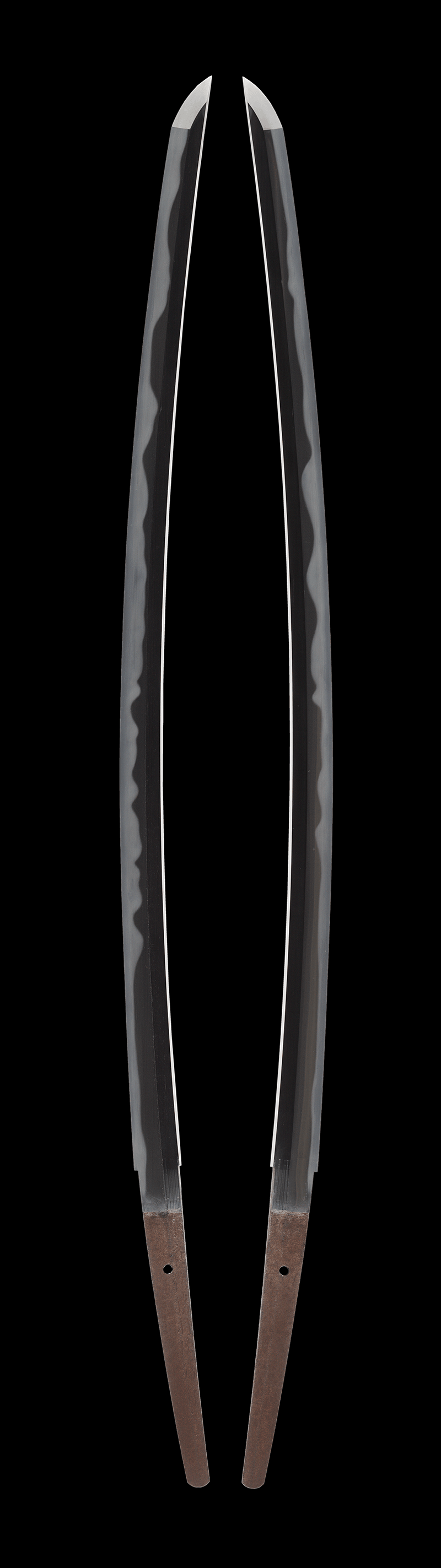
Ichige Tokurin signed his blades with the province at the head of a long inscription and his common name Genzaemon set into it, as on the Suifu Ichige Genzaemon Tokurin , and the records of his work read his life as plainly as those signatures: born in An'ei 6, in 1777, he was a retainer of the Mito clan who first trained under the clan smith Kume Naganori, then went down to Osaka and entered the gate of Ozaki Suketaka, where he reached maturity. In Bunka 6, at thirty-three, he was made the retained smith of the Mito clan; in Tenpo 1 he received the title Omi-no-, the rank his later blades carry; and he died in Tenpo 6, in 1835. Through Suketaka his line descends from the Osaka tradition of Tsuda Sukehiro, whose second generation invented the billowing-wave temper, and it is that temper, carried north into the bakumatsu Mito school, that the published sources name the manner Tokurin most favored and best commanded.
His characteristic hand is the toran (濤瀾), a large that crests in regular swells like the open sea. He builds it over a well packed and clear, often beginning the temper with a straight at the before the wave pattern opens above it; long enter the crests, the runs deep, lie thickly through the line, plays across it, and the stands bright and clear. The published sources judge his success in this manner not by flamboyance but by control. They observe of his finest that the wave forms are tempered in order without breaking down, and of the that the particles are even and well matched, lying without unevenness through the . Of the late- smiths who all took up the toran, the published record sets him at the top, writing of one that the wave- workmanship is something the bakumatsu smiths attempted in numbers, 「濤瀾乱れの作柄は、幕末期の刀工が挙って試みているが、中でも徳鄰は抜群」 of technique among them. His own surviving work in this manner is comparatively few, which is part of why the dated, signed pieces that remain are valued as they are.
The beneath both his manners is the refined steel: a that packs tightly, sometimes with and flowing grain mixed in, the applied fine and at times dust-fine and thick, fine entering well, and the steel clear. On his best pieces the published sources call this forging a degree above the rest, the dust-fine and the finely entering singled out for their refinement. The is read with the vocabulary whichever register he works in: deep , thickly applied , fine and , and the bright clear that is the recurring point of his work. The is the one constant across everything on record, running straight to a small , at times turning back a touch deeply with the tip lightly brushed in . Where the shape is described it is a or , the body somewhat broad, the thick, a tendency to at the base, the running extended.
Beside the toran the records lay out a second and a third manner, so that he is best understood as one smith working in registers keyed to the model he is imitating. The first is a Shinkai-style -tateage, a chu or wide , at times a -toned base shallowly undulating, with , and long entering it; the published sources call this register 「同作としては比較的珍らしい真改風の作域」, comparatively rare among his work, and prize it the more for that, noting the on these pieces applied a degree thicker and the more uniform, the bright clear the point worth singling out. The third is a Hankei-style , named beside the others, all of them judged skilled. His tracks the care: every blade on record carries a long signature on an tang, and the published sources read the wording itself as a dating key, the inscription running 水戸住 in the Bunka years and changing to 水府住 in the Bunsei years, so that one -dated can be inferred to about Bunsei 2 by the resemblance of its signature alone.
What sets Tokurin apart in the crowded field of bakumatsu wave-temper smiths is not a wider repertoire but the cleanness and order of his hand. The the judges call comparatively scarce in survival they also name his typical work, writing that of his extant pieces 「この作は、彼の典型といえるもの」, the workmanship outstanding. His standing rests on this control rather than on the size of his output or any borrowed resemblance: where many of his contemporaries reached for the toran and left it ragged, his crests hold their shape and his lie uniform, and on one of his the published sources find his real ability brought out without reserve, 「彼の本領が遺憾無く発揮されている」. Within the Mito school of the late period he stands among the leading hands, the wave temper his signature inheritance from the Suketaka line, the refined his proof that the technique was a matter of skill and not of a single trick.
Tokurin's record is wholly of the tier: eight of his blades are designated , all of them signed and , and the published sources call several of them his highest or representative work, the and alike judged superb. He has no National Treasures and no Important Cultural Properties, and no museum or holding is recorded against his name, so his presence is felt through these signed and rather than through a roll of famous owners. The Fujishiro appraisal places him at Jo- and the Toko Taikan values his work in the upper-middle range, the standing of a capable late- master rather than a national figure. For a private collector his blades are not beyond reach in the way a name would be, but they come forward only rarely, and a healthy signed and dated example, in the toran he made his own or in the rarer Shinkai-style , is the kind of piece that rewards patience: comparatively few survive, each carries his full long signature with the common name, and the best of them show, in the published judges' own measure, 「沸の粒が均一でよく揃ってむらなくつき」, the even uniform that is the surest sign of his hand.