The twentieth century nearly killed the craft twice: wartime distortion, then the occupation ban. The NBTHK’s founding in 1948 and licensed forging from 1953 rebuilt the sword as an art, crowned by Living National Treasures and the mukansa rank.
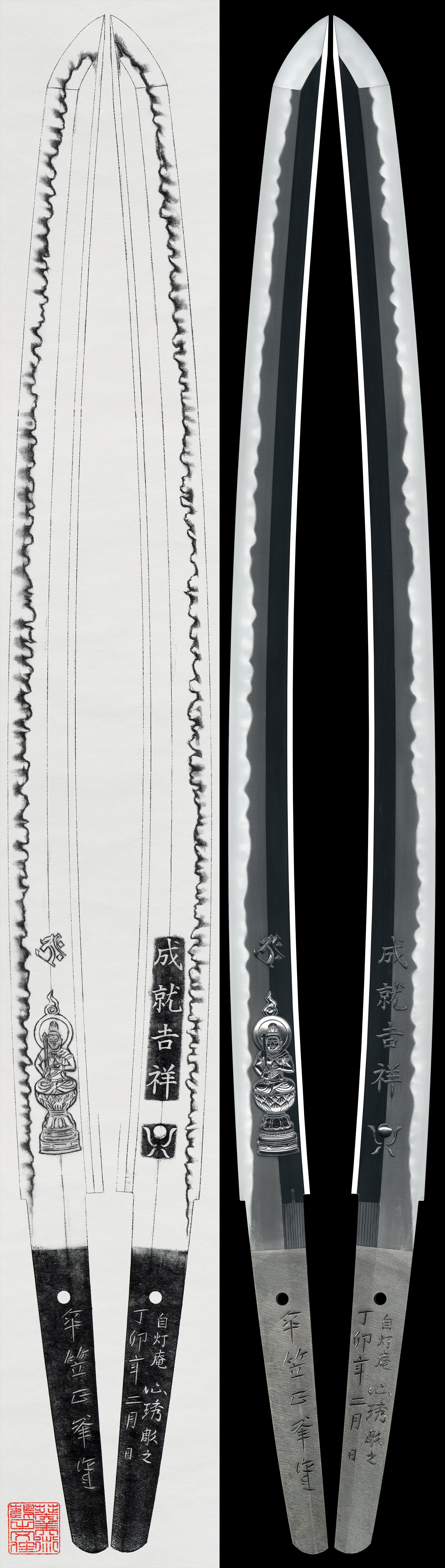
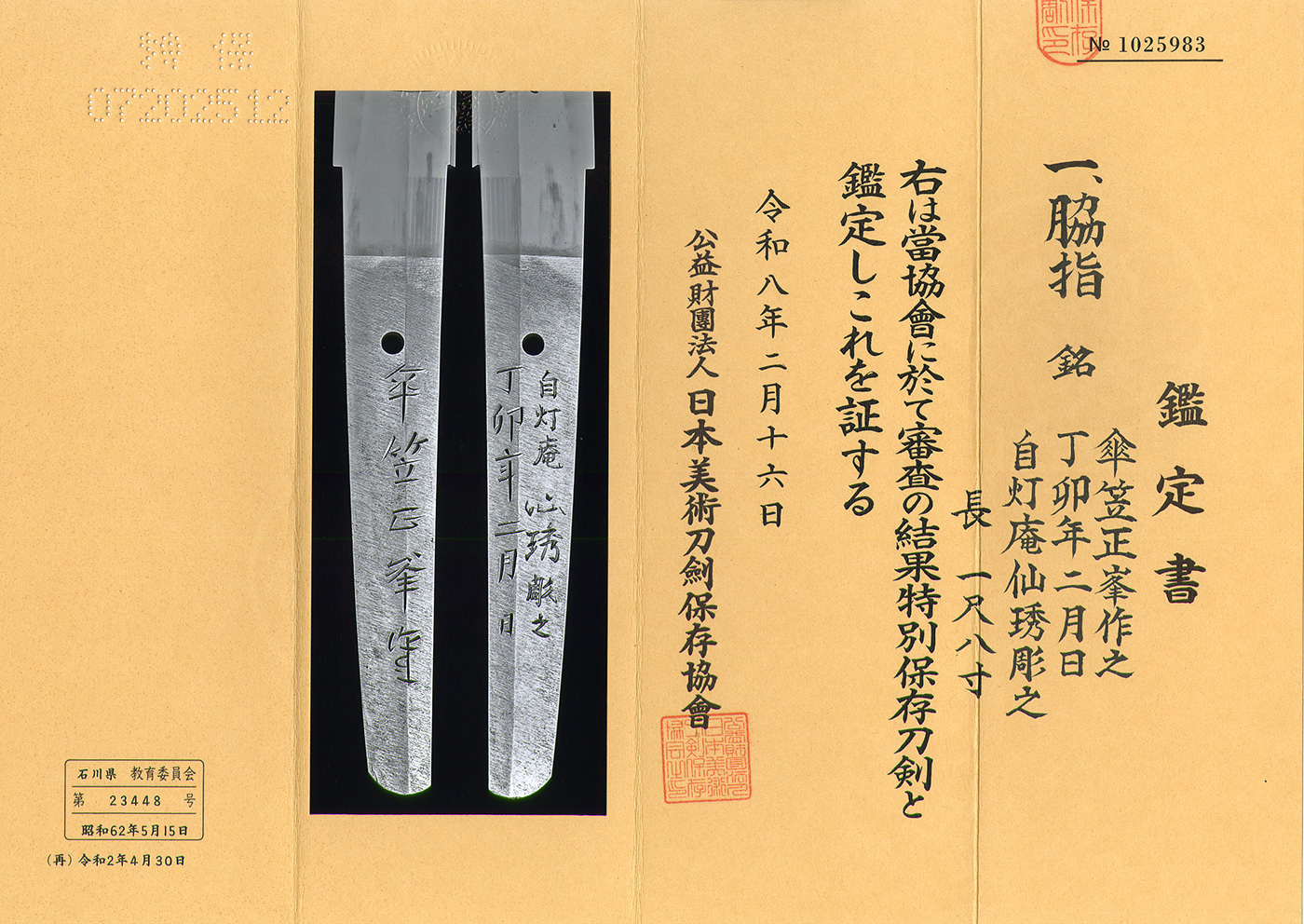
Ordering Number: 25511Wakizashi in Shirasaya (NBTHK Tokubetsu Hozon Token)Inscription:Sanryu Masamine (Sumitani Masamine) 傘笠正峯Hinoto-u 2Gatsu Hi (February 1987) 丁卯年二月日Jitoan Senshu Horu Kore (carved by Kokeguchi Senshu)自灯庵仙琇彫之(We divide 4 sections for each sword as Saijyo Saku, Jyojyo Saku, Jyo Saku and Regular Saku).The workmanship of this piece is ranked as Saijyo Saku among works by Masamine and carvings by Senshū.Habaki: Gold-plated double habakiBlade Length: 54.5 cm (21.46 in)Curvature: 1.3 cm (0.51 in)Mekugi Hole: 1Width at Base (Motohaba): 3.17 cm (1.25 in)Width at Tip (Sakihaba): 2.27 cm (0.89 in)Thickness of rim (Kasane): 0.70 cm (0.28 in)Sword Weight: 650 gEra: modern times, 1987Shape: wide and thick bladeJigane: packed Ko-itame hada looking plain and bright JiganeHamon: Ko-nie base Gunome midare wtih thick Nioikuchi and Ko-ashi. Boshi is midarekomi and rounded.Features:Sumitani Masamine(隅谷 正峯) was a swordsmith from Ishikawa Prefecture, born in 1921. After graduating from Ritsumeikan University, he entered the Ritsumeikan Japanese Sword Forging Research Institute, where he studied under Sakurai Masayuki.He later became independent and established a sword-forging workshop, Sanryutei, in his hometown of Matto City, Ishikawa Prefecture, where he produced many works. He received numerous awards, including the Masamune Prize, and was designated a Living National Treasure in 1981.He passed away in 1998 at the age of 77.The carvings on the front of the blade depict Kokūzō Bosatsu(Ākāśagarbha), revered as the deity of wisdom, along with the Sanskrit character representing it.On the reverse side, there are carvings of “Jōju Kichijō” (auspicious fulfillment) and a lotus pedestal motif. The carvings were executed by Kokeguchi Senshū, who is known as the foremost masters of modern sword engraving.NBTHK Tokubetsu Hozon TokenAoiArt estimation paper: Whole Oshigata.Please note: The price does not include the international shipping fees.Price:2,500,000JPY商談中 HOLDRelated I
Certificate reading — 銘 傘笠正峯作之 丁卯年二月日 自灯庵仙琇彫之
Offered by Aoi Art
This piece has sold
Get an email when a new Sumitani Masamine piece hits the market.


Ishikawa · around 1921-1998
7 pieces on the market now
Shōwa to the present: destruction and revival
The twentieth century nearly killed the craft twice: wartime distortion, then the occupation ban. The NBTHK’s founding in 1948 and licensed forging from 1953 rebuilt the sword as an art, crowned by Living National Treasures and the mukansa rank.
A Hozon-certified blade judged to show notably superior workmanship and a better state of preservation. The bar is higher: re-tempered blades and most unsigned Muromachi/Edo works are excluded.
The NBTHK (Nihon Bijutsu Tōken Hozon Kyōkai, the Society for the Preservation of Japanese Art Swords) is a public-interest incorporated foundation founded in 1948 and supervised by Japan’s Agency for Cultural Affairs (Bunkachō); it is based at the Japanese Sword Museum in Tokyo. Its expert panels physically examine each submitted work (shinsa) and issue a certificate (kanteishō) ranking it by artistic and historical merit. NBTHK papers are the most widely recognized standard of authentication for Japanese swords and fittings.
NBTHK official siteIf you wish to return an item, please notify us within 3 days of receipt. After this period we cannot accept cancellations. Please ship the return to us within 5 business days. Cancellation is conditional on the item being kept in the same condition as at the time of sale, so please handle it with care.