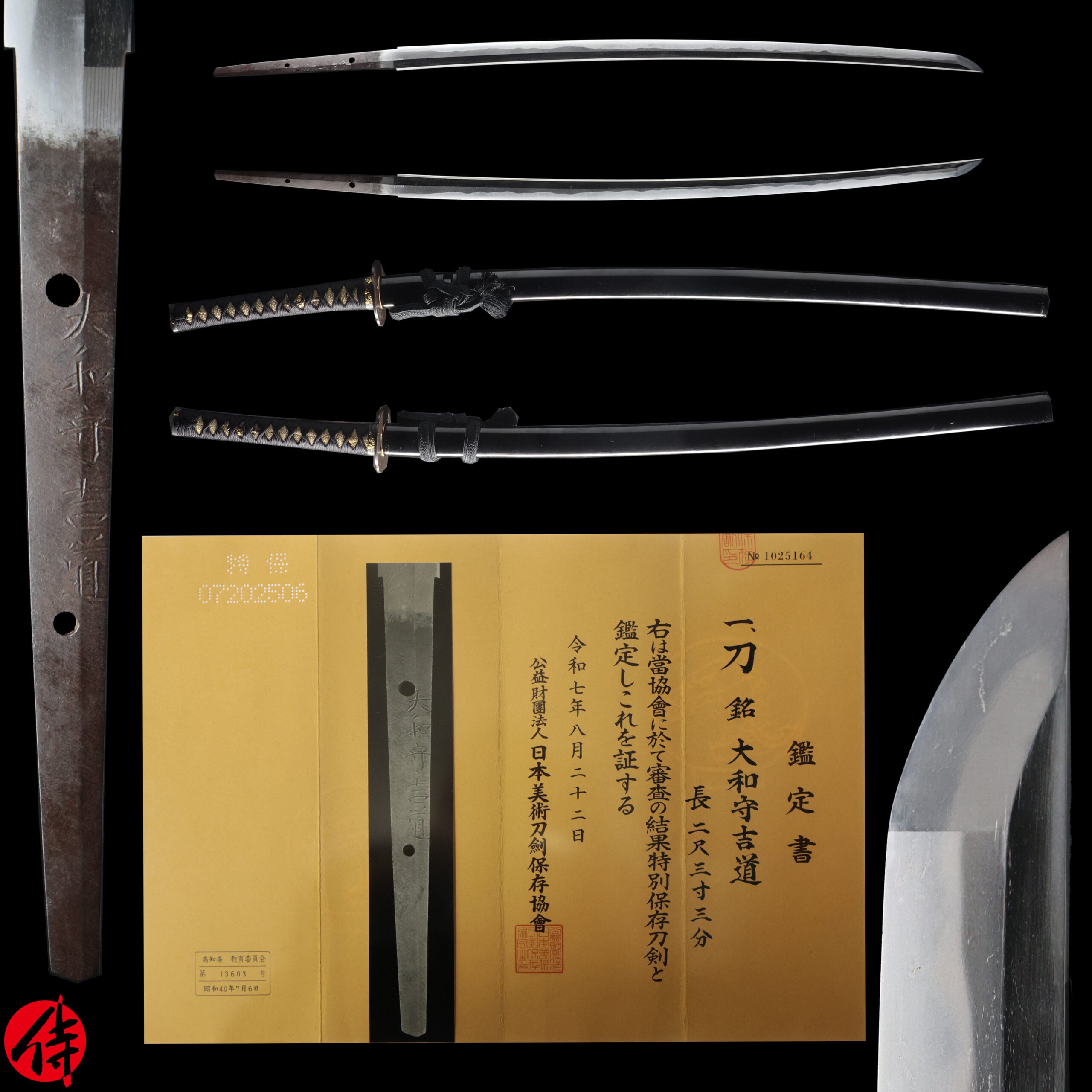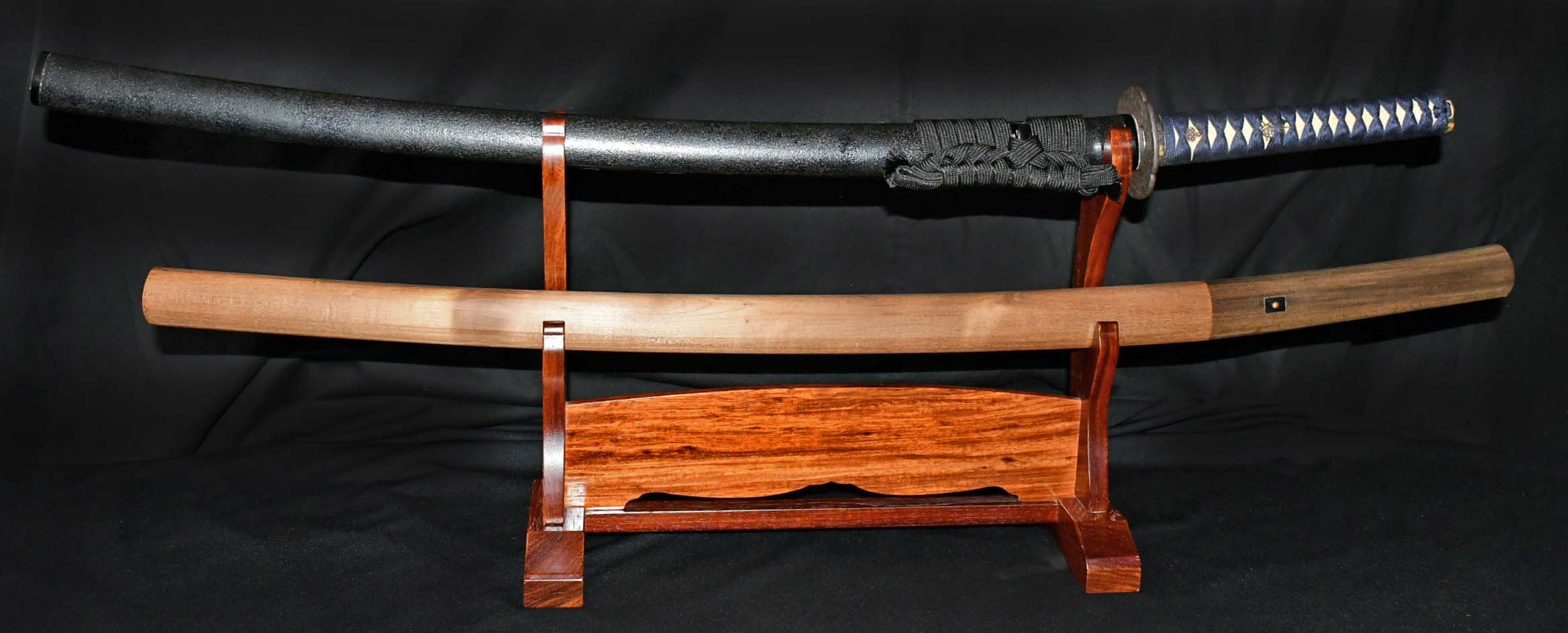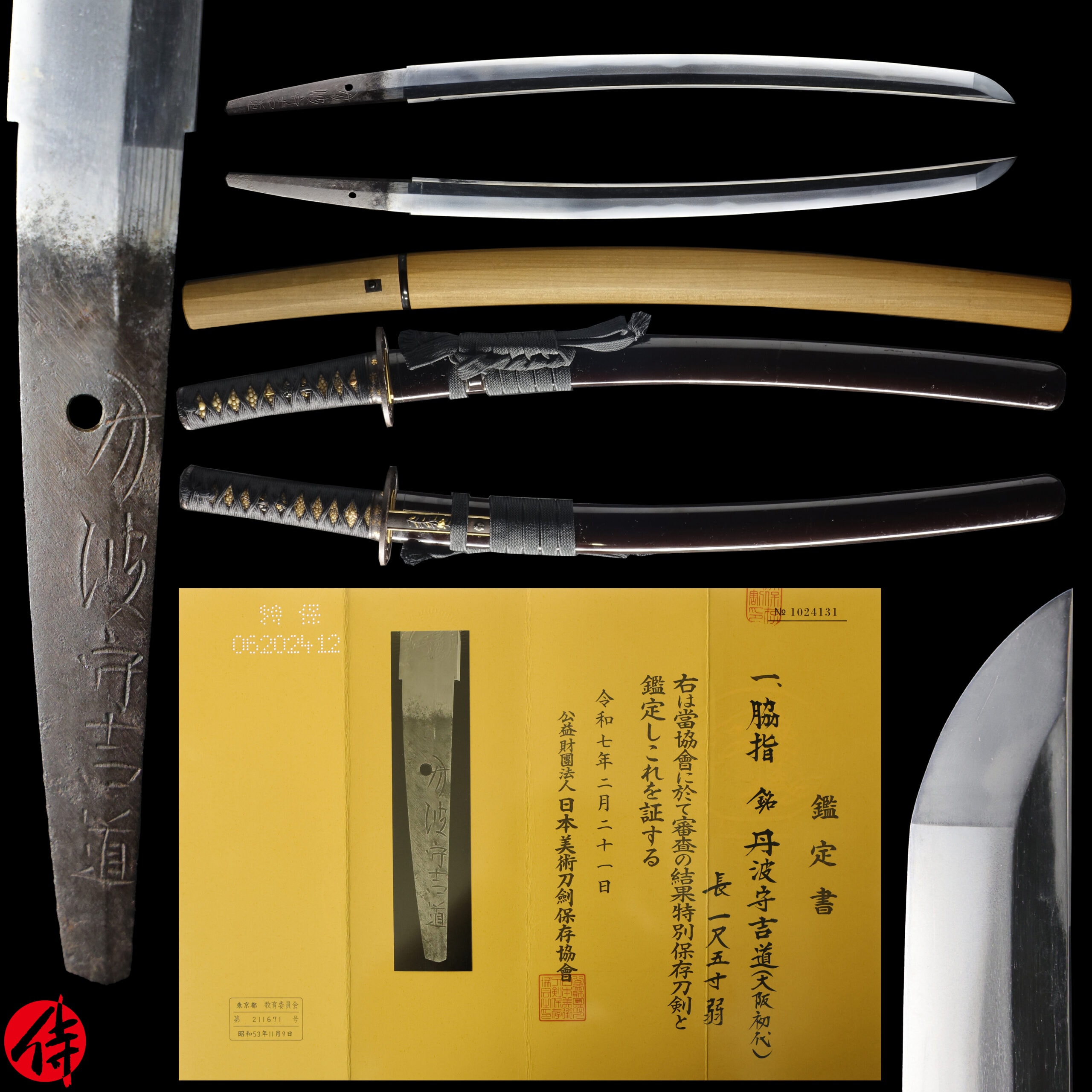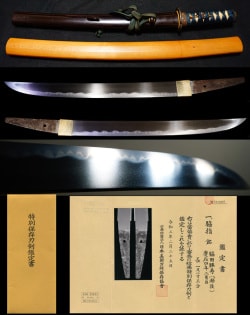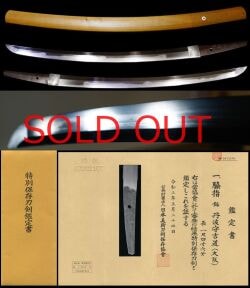
大阪新刀代表工初代在銘『丹波守吉道』京都三品派名門特別保存刀剣
SOLD
Tracked across 76 dealers worldwide · price history · sold archive
Kanbun (1661-1673)
Specifications
44.2 cm
1.6 cm
2.8 cm
2 cm
About the maker
Mishina Yoshimichi吉道
Yoshimichi is the most celebrated name of the Mishina school, the Kyoto-rooted shinto line founded by a son of Kanemichi of Seki. The first-generation Tanba no Kami Yoshimichi and his brothers Iga no Kami Kinmichi and Etchu no Kami Masatoshi are named together in the published sources as masters of the Sanpin lineage, the three smiths who carried Mishina work to the front rank of the early Edo period. This record gathers the Osaka branch of that name. At its center stands the shodai Osaka Tanba no Kami Yoshimichi, born in Keicho 3 and styled Sanpin Kin'emon, the second son of the Kyoto shodai who moved to Osaka and became the founder of the Osaka-Tanba line, around whom are set his son Yamato no Kami Yoshimichi, known as Mishina Uemon, and a blade the published record assigns to the second generation. Where the elder Kinmichi and the younger Masatoshi worked diversely, Yoshimichi held to one signature manner, and it is that manner the school is remembered by. That manner is the sudare-ba, the bamboo-blind temper. Layered sunagashi and kinsuji are drawn through a notare and gunome midare until the temper stripes into parallel bands like the slats of a hanging reed blind, and the published sources call it the school's hallmark, the Osaka-Tanba line handling it more often and more skilfully than any other style. On a wide, slightly elongated, thick-kasane hira-zukuri wakizashi of Keicho-shinto shape, the shodai opens the temper with a long straight yakidashi at the koshimoto and then widens the yakihaba above it, building over a ko-notare base mixed with gunome into a flamboyant large midare. Long, vigorous yubashiri run through it, the sunagashi layers in double and triple bands until it stripes into the sudare-ba, ashi enter, strong nie gathers and clumps unevenly, long kinsuji appear in places, and muneyaki and tobiyaki are added. The boshi rises shallow and pointed in a tsukiage, swept with frequent hakikake into a flame shape and run down long. The published sources read the whole as bolder and more flamboyant than usual, of his hallmark style yet pressing on the work of the Kyoto shodai. The jigane carries the temper. On the shodai's wakizashi the kitae is a compact ko-itame mixed with mokume, the ji-nie adhering thickly and exceedingly fine, fine chikei entering well, the hada flowing and standing a little in places. The yakidashi itself is a study of its own. The published sources distinguish the shodai's straight sudare-ba yakidashi from the broadening Osaka yakidashi, noting that here the yakihaba keeps an even width as it rises rather than spreading toward the upper blade, a point of recognition within the Osaka-Tanba hand. The slender katana assigned to the second generation shows the same vocabulary in lower key, an itame tending to nagare with ji-nie, a large midare with sunagashi and gunome and ashi resolving into sudare-ba, the boshi a shallow, moist o-maru swept at the tip. The temper is the constant, the build and the strength of the nie the variables across the hands gathered here. The name is read by hand and by signature rather than by a single dated chronology. The shodai Osaka Tanba stands as the prime sudare-ba hand, his son Yamato no Kami Yoshimichi forms a parallel and contrasting one. On a wide shinogi-zukuri katana with a clear difference between base and point width, Yamato no Kami forges not the family blind-temper but a choji-midare in what the published sources call 「中河内風の丁子乱れ」, frequent ashi entering, ko-nie adhering, sunagashi scattered, the boshi a slight notare ending in ko-maru; at times a little of the family temper is mixed in, and rarely he works a rolling-wave manner within which choji are set, a range the sources liken to Ikkanshi. The published record judges this katana an outstanding example among his works, its nie somewhat stronger than on Nakagawachi pieces, and it notes his collaborative blades with the first and second Osaka Tanba Yoshimichi and with the second-generation Kawachi no Kami Kunisuke, by which the exchange among these Osaka smiths can be followed. The second-generation blade closes the descent: the published sources write that 「同工の特色ある簾刃を焼いて」 without vulgarity, sound in workmanship though slender in build. Within the school the line is best placed by its own signature. The shodai's sudare-ba 「一派のお家芸である簾刃を最も得意としており」, and his straight, even yakidashi and pointed, flame-swept boshi distinguish his hand from the broadening Osaka yakidashi of his neighbours and from the choji his own son preferred. Against the Kyoto shodai he is most easily confused and most carefully separated: because the Osaka line cut no chrysanthemum crest while the Kyoto line did from the second generation on, the published sources give the character 守 of the signature as the decisive point, its 寸 element cut straight down on Osaka work and slanting on Kyoto work. The sources are honest about the line's later course, observing that 「代が下るに従って」 the manner grew more technical and more uniform, the temper settling toward a single pattern as the individuality of the founders thinned. The Osaka shodai is rated Jo-saku by Fujishiro, and four of these blades are held in the Juyo tier, none higher on this record. Provenance is sparse but distinguished: one blade descends through the Imperial collection, the kind of patrimony that is preserved rather than traded, and a second carries recorded provenance as well. There are no National Treasures or Important Cultural Properties on this record to speak of, and the holdings are modest in number, so a designated Osaka-Tanba Yoshimichi is not a blade that appears often. When one does, it is most often a Juyo wakizashi or katana of the hira-zukuri Keicho-shinto build, and it comes to a private collection only from time to time and with patience. For a name carried by several generations to one signature, the surviving designated works are few enough that each is a documented point on the line rather than a routine example, and the sudare-ba on a sound blade remains the surest mark by which this Osaka branch of the Mishina school is known.