 NihontoWatchNihontoWatch
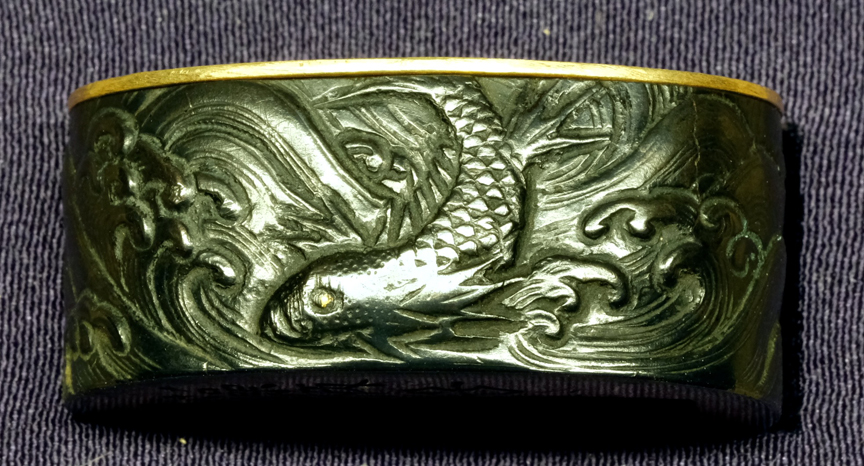
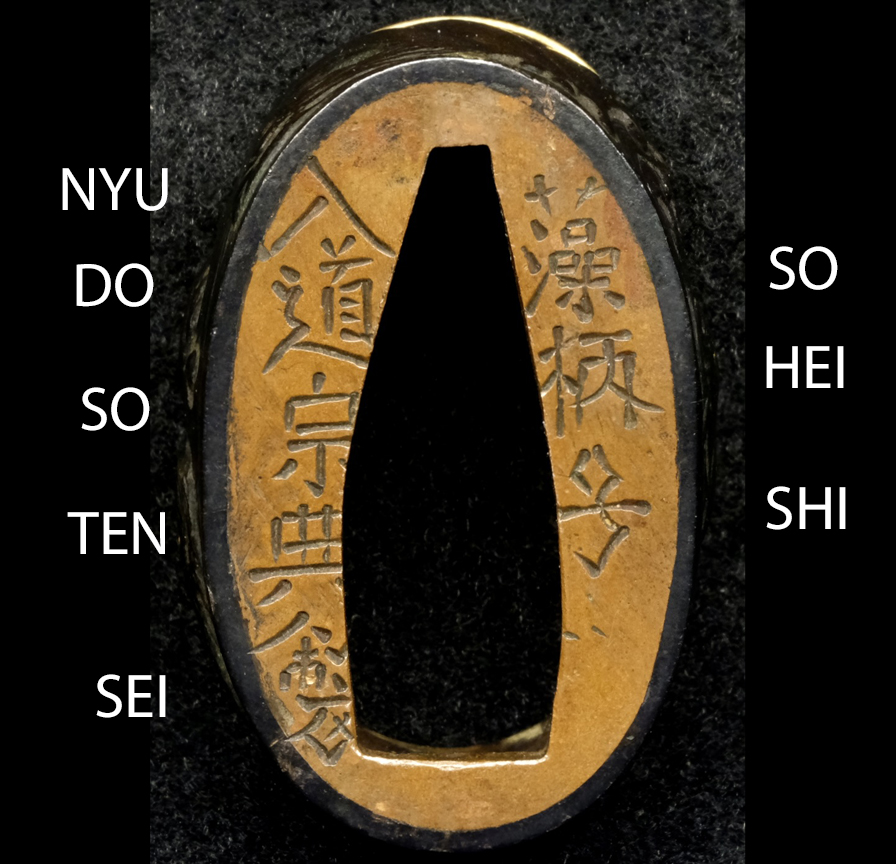
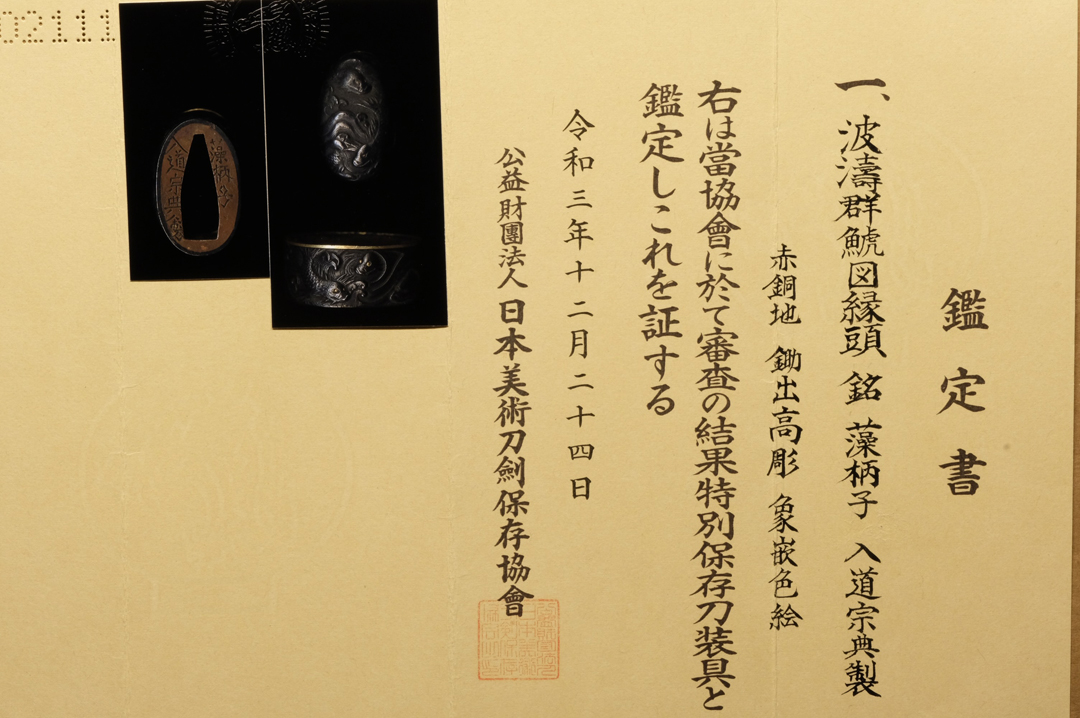
LARGE SOTEN FUCHI / KASHIRA SHACHI 鯱 (DRAGONFISH) NBTHK TOKUBETSU HOZON -School history from Sesko’s, Toso Kinko Schools The Sōten school is commonly classified as tankō (鐔工), that means in the category of tsuba craftsmen who worked in iron. But because they also made some softmetal works and were very productive, I took the opportunity to introduce them here. Founder of the Sōten school was Kitagawa Zengorō (喜多川善五郎) who lived in Kyōto ́s Hachiman district (八幡町). His family name „Kitagawa“ is also written with the characters (喜多河). Old sources like the „Sōken- kishō“ say that he first used the craftsman name „Shūten“ (秀典) before he was active under the name of „Sōten“ (宗典) in Nakajiki (中敷) in Ōmi ́s Hikone (彦根). But it is unclear if Shūten and Sōten were really the same artist. Today it is assumed that Sōten used the latter name first as the „normal“craftsman name and so the Japanese reading „Munenori“ was applied. Later when he entered priesthood he kept the name and read it as his nyūdō-gō as „Sōten“. The characteristic style of Sōten, i.e. detailed figures accentuated with gold iroe on an iron tsuba with or without sukashi, became famous throughout the country under the name „Hikone-bori“ (彦根彫) and was very popular during the Edo period. As a result, many forgeries and „well-meant“ copies were produced. This trend was joined by the fact that the works of later generations and Sōten students lack more and more attention to detail and so works from the Sōten school in general have been evaluated rather low in more recent publications. Anyway, the gō „Sōheishi“ (藻柄子) which is also read „Mogarashi“ was probably used by the direct mainline students or members of the Kitagawa family. The meikan records mostly list a 2nd gen. Sōten but works of the two are virtually indistinguishable. There is a work extant which probably goes back to the 1st gen. because it is dated Kan ́en three (1750) in combination with the information „made at the age of 72“. So his year of birth may be calculated to Enpō seven (1679). The 2nd gen. is traditionally dated after the Kan ́en era, i.e. around Hōreki (1751-1764) and Meiwa (1764-1772). In the following I would like to introduce some of the more well- known Sōten students. First, there were Munekata (宗賢, also read „Sōken“), whose first name was „Zengorō“ (善五郎), Munehide (宗秀, also read „Sōshū“), called „Zengorō“ too and with the gō „Ryūsōshi“ (竜藻子), Munehide ́s son Zengorō Hidetsugu (善五郎秀次), and Sō ́un (宗運), who used the gō „Shusōshi“ (主藻子). All of them belonged to the Kitagawa family. Kanenori (包教), whose civilian name was „Nomura Saburōji“ (野村三郎次) and who is also listed with the first name „Saburōbei“ (三郎兵衛), was a student of the 1st gen. Sōten. He used the gō „Kan ́eishi“ (干英子). By the way, it is said that the craftsman name „Kanenori“ was read back then as „Masanori“. The Sōten style was continued by Kanenori ́s student Ōchi Sōkurō (大地 宗九郎) who used the craftsman name „Muneaki“ (宗顕, also read „Sōken“) and the gō „Yūmeishi“ (幽明子). Muneaki also bore the family name of his master, i.e. „Nomura“. A Sōten branch was formed by the Tsutsui family (筒井). We know Tsutsui craftsmen like Yoshihiro (吉広), first name „Yoshihiro“ (芳広), Yoshitake (吉武), according to transmission a student of the 2nd gen. Sōten, and Yoshifusa (吉房), who bore the first name „Yoshifusa“ (芳房) and the gō „Sōheishi“ and „Kotōken“ (湖東軒). Another Sōten student who worked in the style of the school but who also displayed his own interpretations was Kanetane (兼胤). Kanetane ́s civilian name was „Yoshikawa Hei ́emon“ (吉川平右衛門) and he also signed with the gō „Sōheishi“. The Iriyama family (入山), another Sōten branch, used successively the gō „Zaichōshi“ (財彫子). Representative craftsmen of the Iriyama line were for example Yoshitomo (喜知), Munehide (宗英), Yoshishige (義重), and Yoshichika (義近, also read „Gikin“), who also signed besides „Zaichōshi“ with the pseudonym Nikuborishi“ (肉彫子) and his craftsman name „Yoshichika“ also with the characters (義親). This truly is a rare set of fittings. It is rare to find Soten work in shakudo or any soft metals as they typically worked in iron as mentioned above. The large size is also somewhat rare. The length and width are not necessarily oversized, but they are 0.75” tall which is outside the standard size. This rare and wonderful F/K set comes in a custom box and NBTHK Tokubetsu Hozon kanteisho. NLA
Offered by Yakiba
This piece has sold
33 on the market
Get an email when new Hikone School work hits the market.
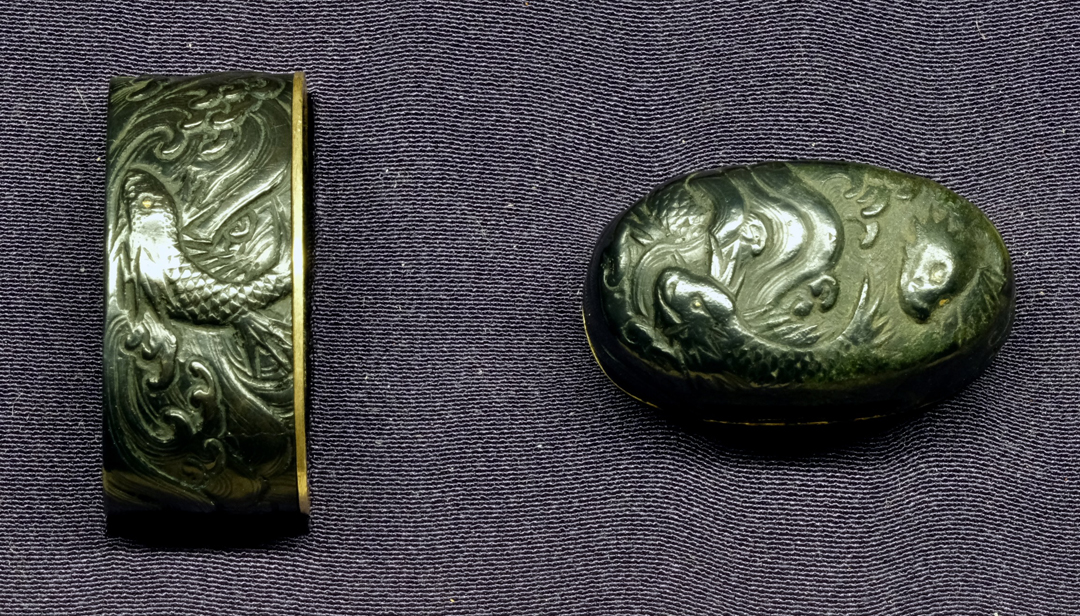
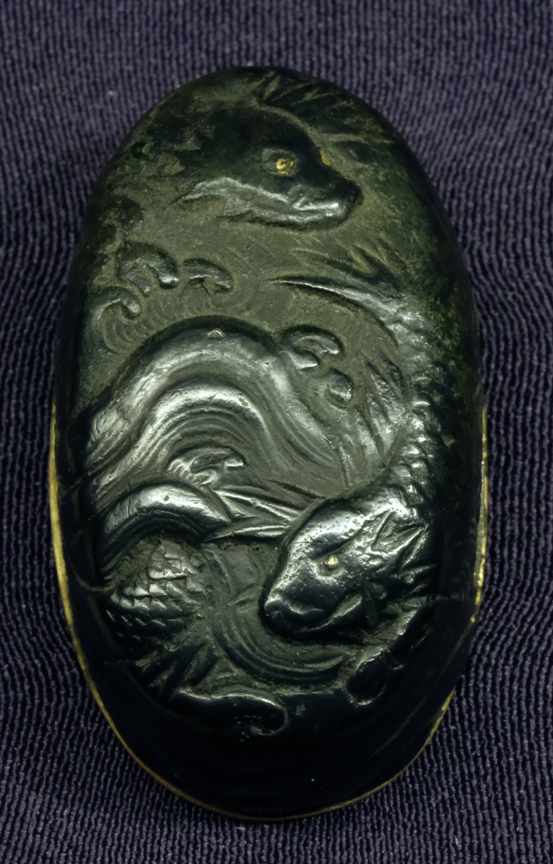
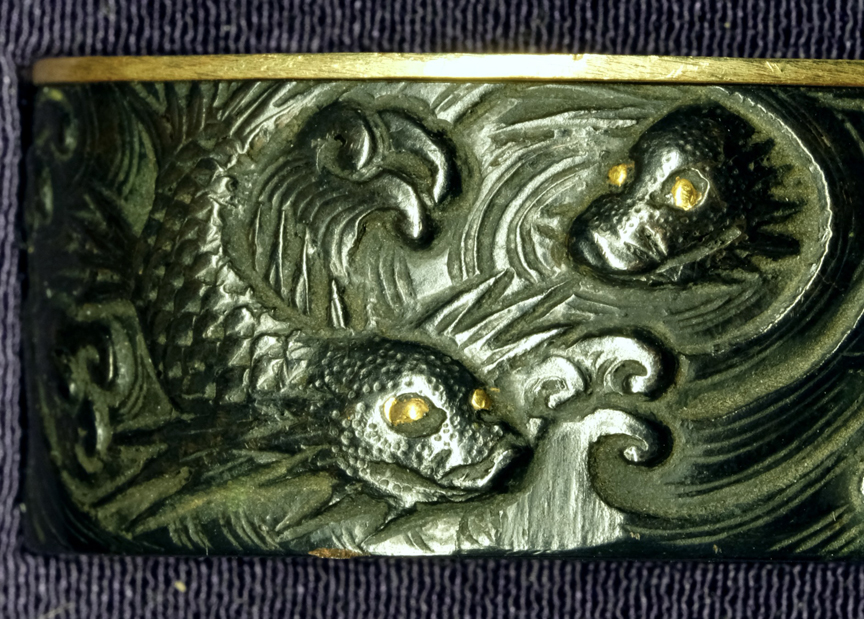
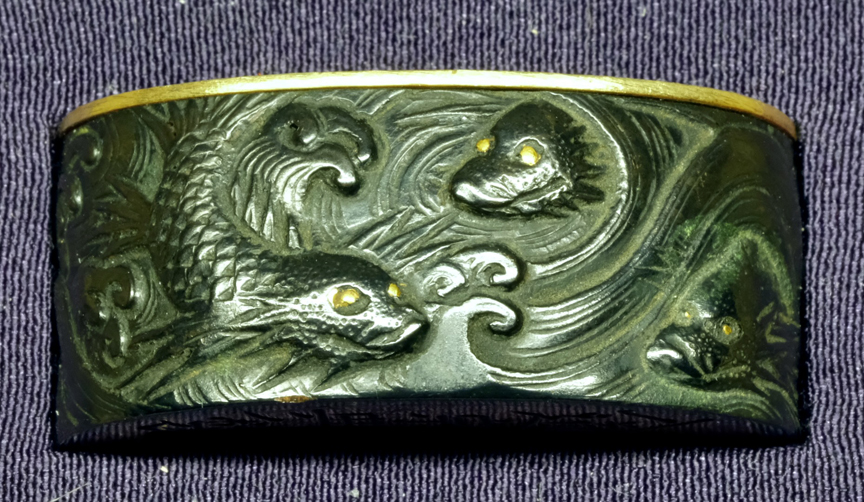
Soten
Edo
Signed
Tokuho (NBTHK)
Kinko · Omi
33 pieces on the market now
The Hikone school of sword fittings -- known as Hikone-bori -- was established at Nakayabu in Hikone, Omi Province, by Mogarashi Nyudo Soten, who settled there after leaving Kyoto and entered the service of the Kawakita family, hereditary vassals of the Hikone domain. One source records that Soten initially trained under the Goto family, citing the Kinko Soran for the existence of works signed "made by Kitagawa Hidenori, a disciple of the Goto," before developing the distinctive carving manner that would define his lineage. The school's connection to the broader Mino-bori tradition is also recognized. There were reportedly two generations working under Soten's name, with the first born in Joo 1 (1652) and active from the early through mid-Edo period. From his workshop emerged a circle of accomplished students, chief among them Nomura Kanenori and Munenori, who carried the Hikone-bori manner forward and established it as one of the most distinctive regional styles in the kinko tradition. The technical hallmark of Hikone-bori is sukidashi takabori -- richly modeled high-relief carving executed on generously proportioned iron plates, further enlivened through zogan iroe employing gold, silver, shakudo, and suaka. The NBTHK notes that even among the gold applications, "multiple types of gold are used," producing expansive pictorial fields of considerable chromatic variety.
Subjects encompass warriors, Daoist immortals, elder sages at elegant gatherings, and flowers-and-birds compositions, rendered across the entirety of both surfaces of the guard. The school's masters also demonstrated facility in shakudo work, including nanako-ji plates with high-relief compositions displaying a pronounced Goto-like flavor, as well as nikubori ji-sukashi and polychrome mitokoromono sets. What unifies the school's output is the synthesis of imposing compositional scale with refined polychrome technique. " Munenori's contribution is recognized for its assured command of shakudo nanako-ji ground preparation and boldly modeled takabori, enriched with polychrome iroe employing multiple varieties of gold across both faces -- a sumptuous, animated effect characteristic of the mature Hikone style. The Hikone school's significance within the broader kinko tradition rests on its creation of a distinctively pictorial approach to sword-fitting decoration that stands apart from both the restrained elegance of the Goto mainline and the narrative density of the Yokoya school. The NBTHK's evaluative language converges on a single defining quality: the school's ability to fill expansive iron and shakudo surfaces with ambitious narrative compositions while maintaining compositional coherence and chromatic refinement. " That Soten's overwhelming fame led later makers to adopt his signature on subsequent Hikone-carved works testifies to the enduring authority of the school's founding aesthetic, while the surviving origami documentation -- including one dated Kanbun 5 (1665) from Goto Mitsutomo -- provides valuable evidence for understanding workshop practices and the collaborative production that sustained the Hikone tradition across the early and mid-Edo period. Learn more →
| Smith | Era | Designated |
|---|---|---|
| Soten宗典 | Edo | 10 |
| Kanenori包教 | Edo | 3 |
| Masatsugu政次 | Edo | 0 |
| Mitsuyoshi光義 | Edo | 0 |
| Munekata宗賢 | Edo | 0 |
A Hozon-certified fitting of notably superior craftsmanship and condition, often with signature or workmanship of high reference value.
The NBTHK (Nihon Bijutsu Tōken Hozon Kyōkai, the Society for the Preservation of Japanese Art Swords) is a public-interest incorporated foundation founded in 1948 and supervised by Japan’s Agency for Cultural Affairs (Bunkachō); it is based at the Japanese Sword Museum in Tokyo. Its expert panels physically examine each submitted work (shinsa) and issue a certificate (kanteishō) ranking it by artistic and historical merit. NBTHK papers are the most widely recognized standard of authentication for Japanese swords and fittings.
NBTHK official siteAll swords sold for $5000 USD or less are considered final! Swords above the $5000 range may be returned for any reason within 48 hrs. Buyer will receive a full refund minus shipping/handling, insurance and or any fees incurred in shipping or sale.