 NihontoWatchNihontoWatch
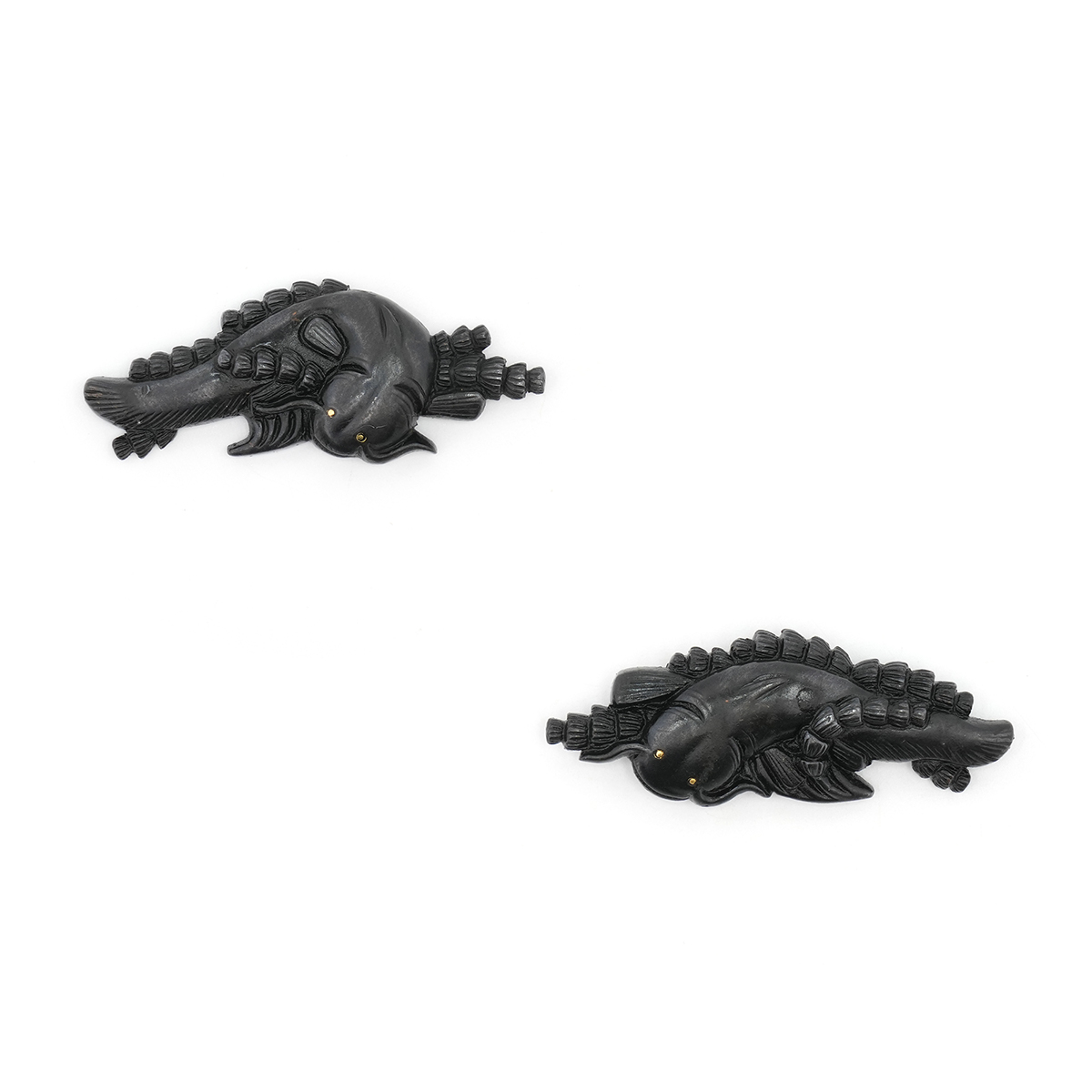
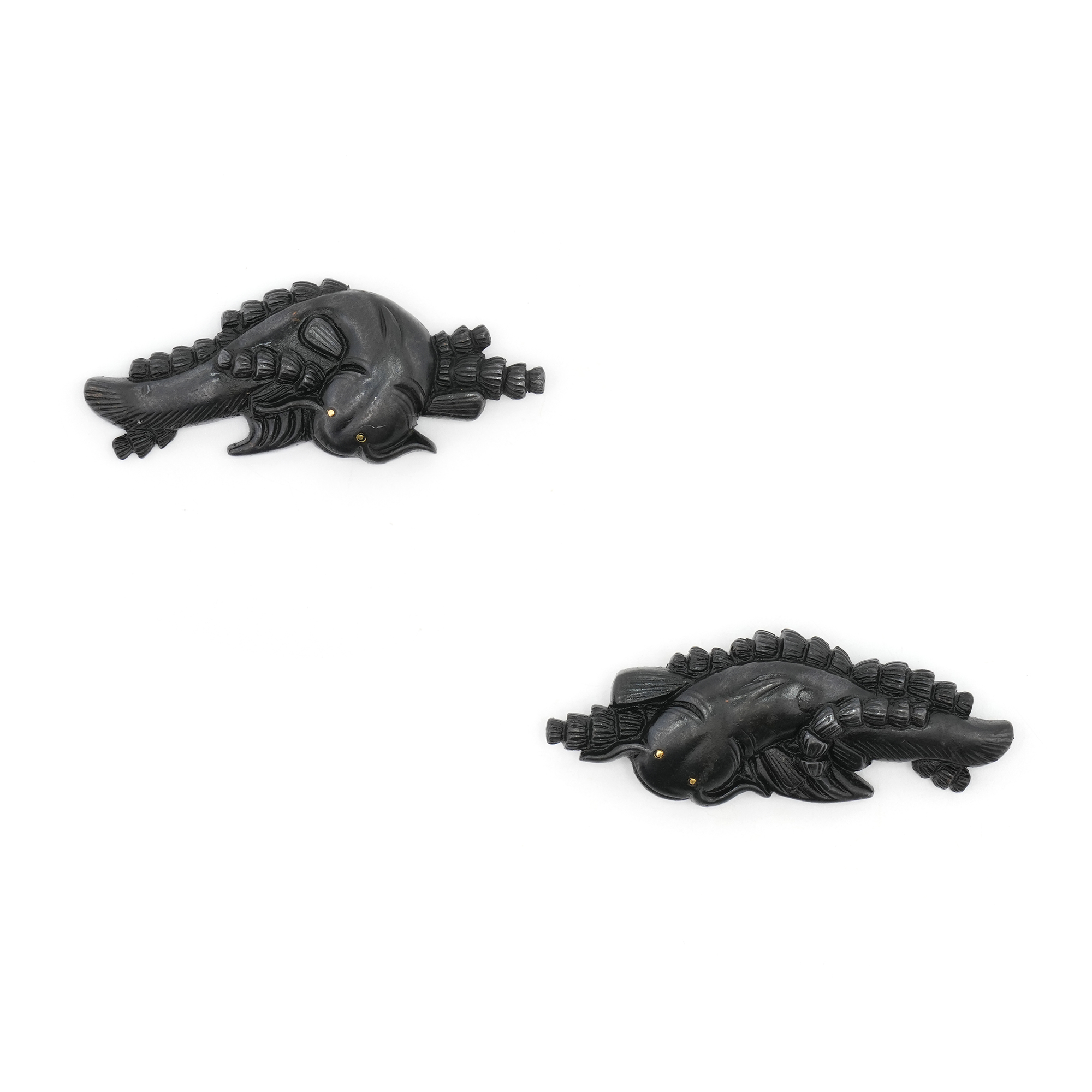
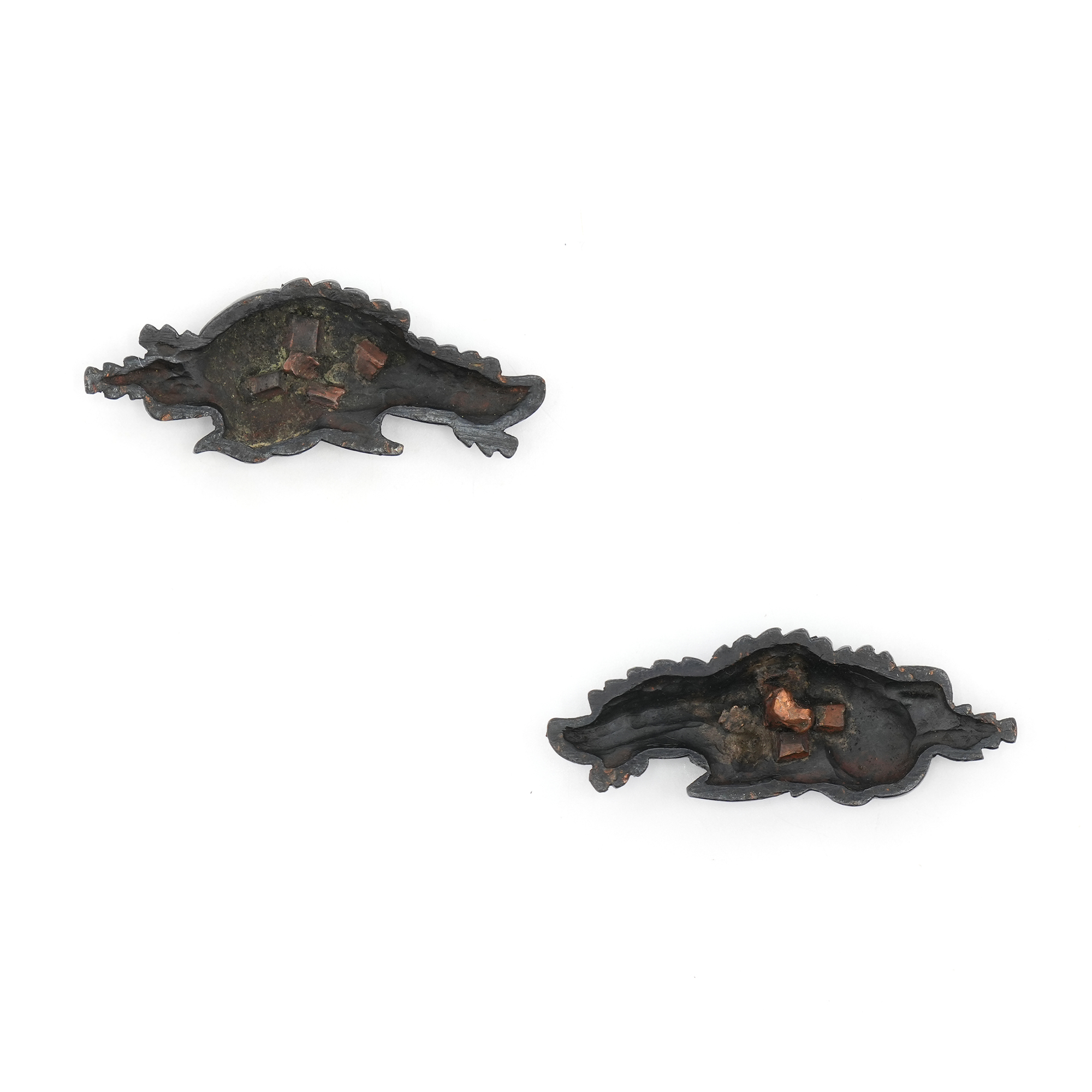
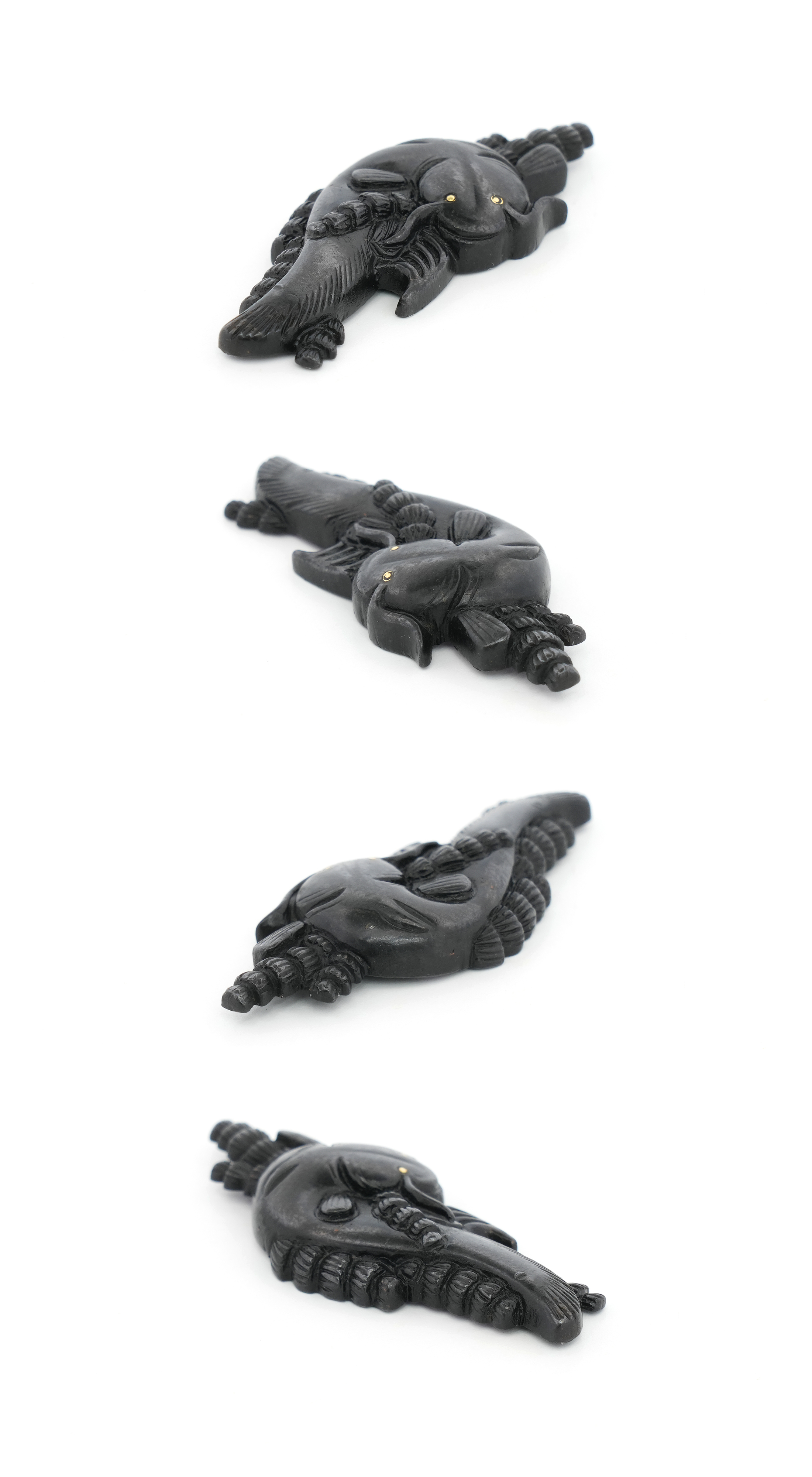
The catfish, with its round and flat head, round eyes, long mouth, and whiskers, is a familiar subject that was often taken up in Edo period paintings, caricatures, netsuke, and tosogu due to its charming appearance. It is a fish full of vitality that can freely turn its body while lurking at the bottom of the water, and its unique silhouette is well-suited for three-dimensional expression through katachibori; in this piece, by capturing the moment it swims through water plants in different postures on the left and right respectively, it has been fashioned into a set that possesses movement and a narrative quality while being based on a single black tone. For the jigane, shakudo with a deep blackish hue is used, and the catfish is expressed as a single piece in thick katachibori, from its large head to its round, taut body and long, slender tail; thin lines are carved into the pectoral fins spreading to the left and right and the fins on the belly, clearly distinguishing the texture from the smooth body surface. The head is plump and raised high, the gentle line of the mouth and the long-extending whiskers create a catfish-like expression, and because the gold iroe applied to the eyes on the left and right places a vivid focal point within the deep shakudo color, the friendly face stands out when viewed from the front, and when viewed from an angle, the rich volume continuing from the head to the body and the overlapping of the fins emerge. Around the perimeter, water plants growing thick on the bottom are arranged in layers, and the leaves connected as if stacking joints, the buds with rounded tips, and the clusters of leaves that continue into the background while overlapping the body of the catfish are expressed with fine su-bori. By not showing only the silhouette of the catfish alone, but by intertwining water plants in front of, behind, above, and below the body, a sense of movement as it pushes through the water and depth of the water bottom are created, and the contrast between the thick body and the delicate leaves gives rich variety to the composition; the way the depth of the chisel marks and the luster of the polished surfaces quietly shift within the blackish tone is also a highlight. The two pieces are not simply inversions of the same prototype; one is composed with the head slightly lowered and the tail extended long, while the other is composed with the head raised and the body significantly curved, and variations are also provided in the overlapping of the mouth, whiskers, fins, and water plants. When mounted on a tsuka, it becomes a scene where catfish swim toward each other from the left and right, and while the fish bodies, which are mainly composed of soft curves, fit well into the hand, the gold eyes shine small from between the black tsukamaki, adding a playful personality to a practical koshirae. Although mumei, the calm hue of the solid shakudo, the thick modeling of the catfish, the substantial composition carved down to the details including the water plants, and the unity as a set with different postures for the left and right have a certain visual appeal, and one can enjoy the realism and wit characteristic of animal metalwork from the mid to late Edo period. While the charming subject of the catfish possesses a friendliness different from that of dragons or lions, when housed on a tsuka, the blackish shakudo and gold eyes show a dignified expression, so this is a menuki with rich volume that I would like to recommend not only to those who collect tosogu featuring fish as a subject, but also to those who wish to prepare a koshirae with a unique taste.
Offered by Toushin

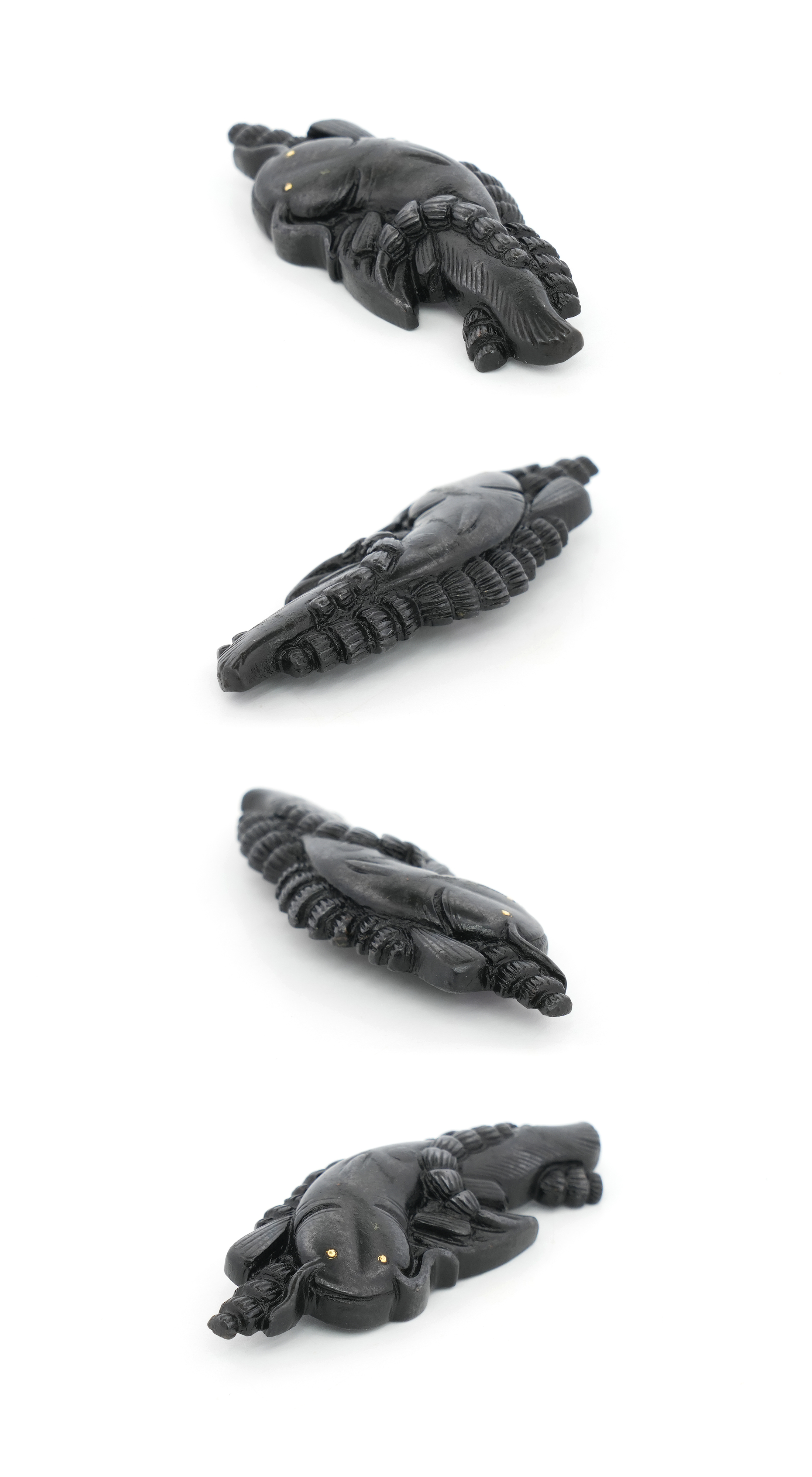
Edo
Unsigned
Machine translation of the shop's Japanese ·
Machine translation from the shop's Japanese · may contain errors ·
We could not find an authenticity certificate on the seller’s listing. Japanese swords and fittings are normally papered by the NBTHK (or the NTHK). Without one, the attribution is the seller’s own assessment and has not been independently verified — treat it with caution and ask the dealer about certification before buying.
As a rule we do not accept returns, except when we have sent a different item from the one ordered or when there is a significant discrepancy between the description and the item. If you wish to return an item, please contact us within 3 days of its arrival and then send it back.
¥88,000