 NihontoWatchNihontoWatch
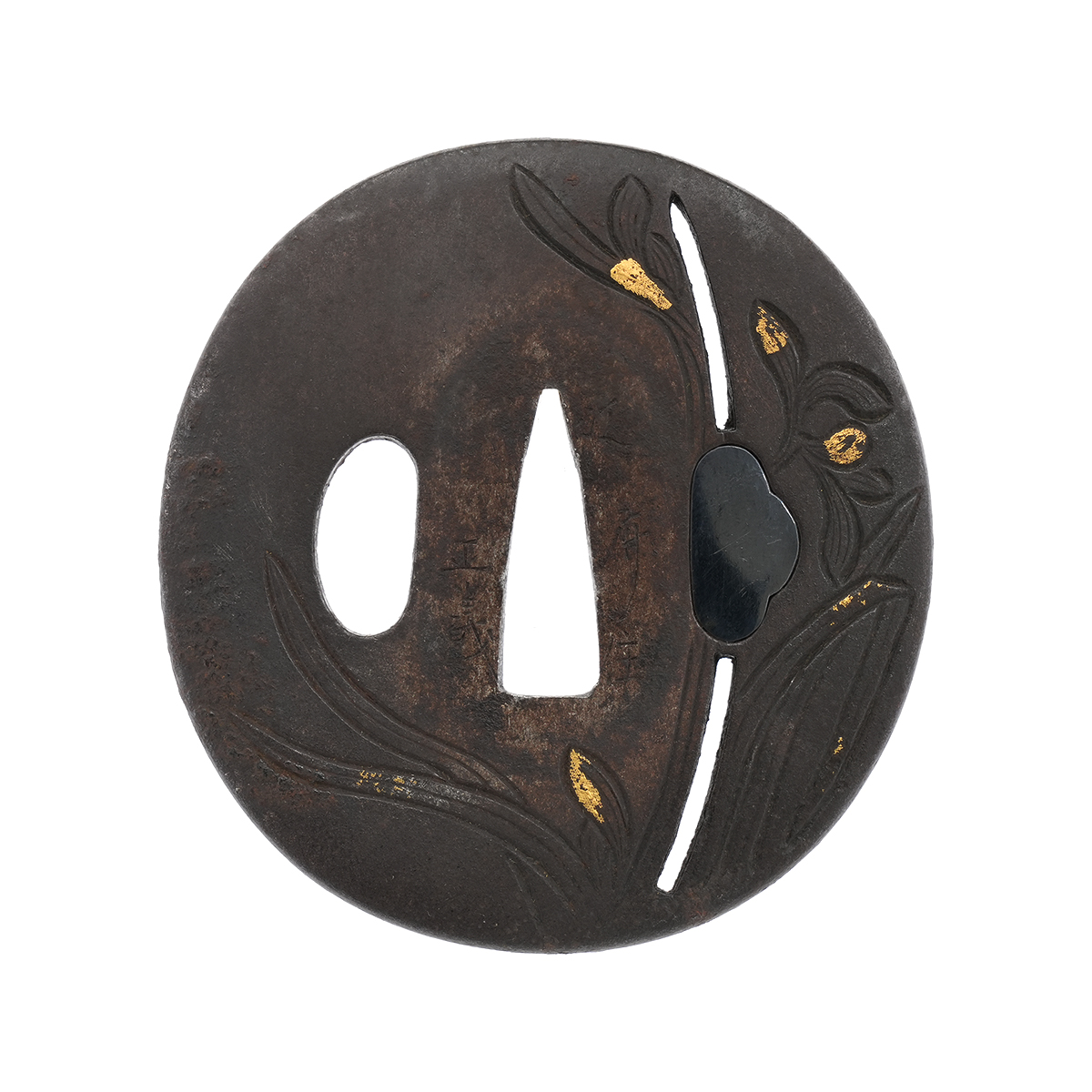
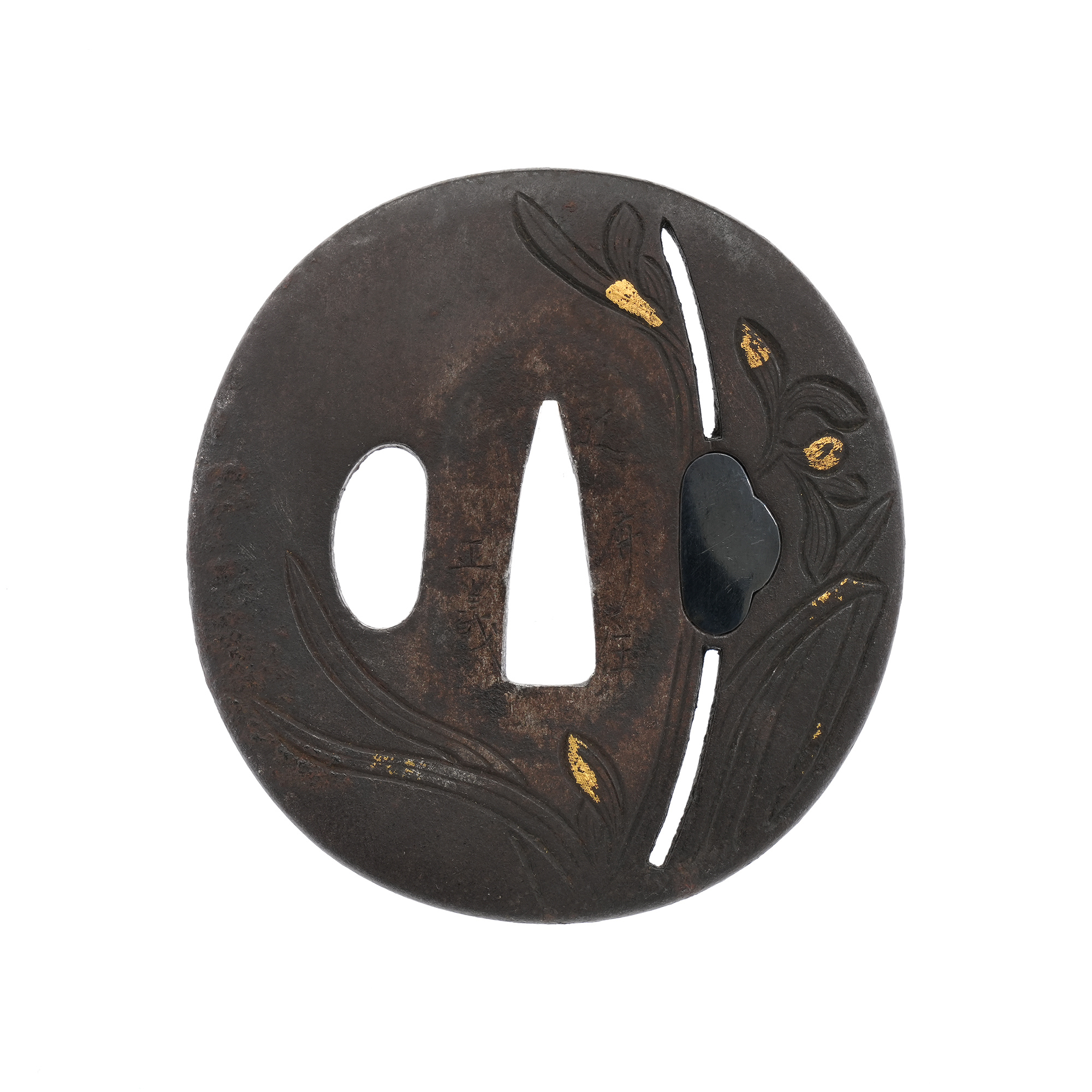
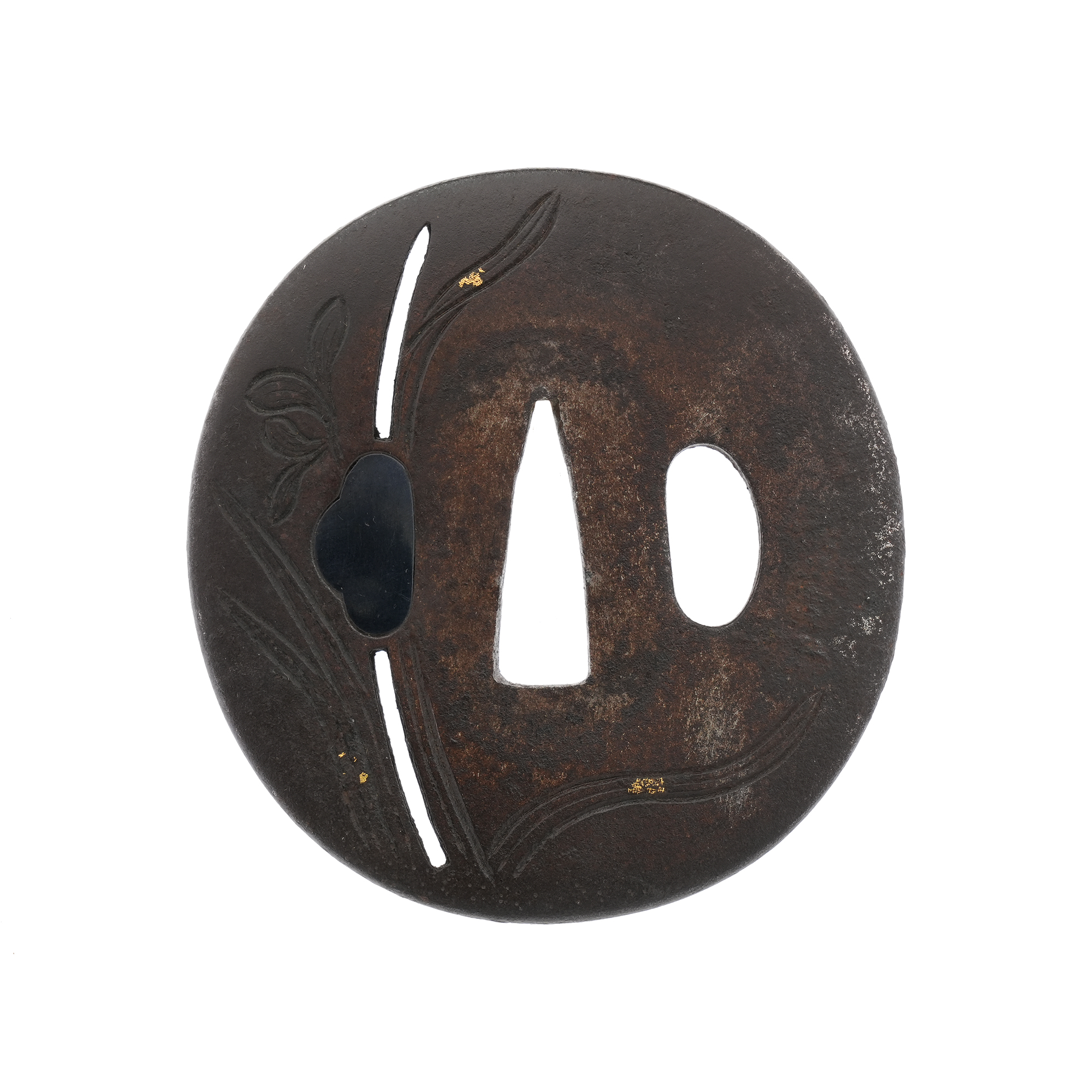
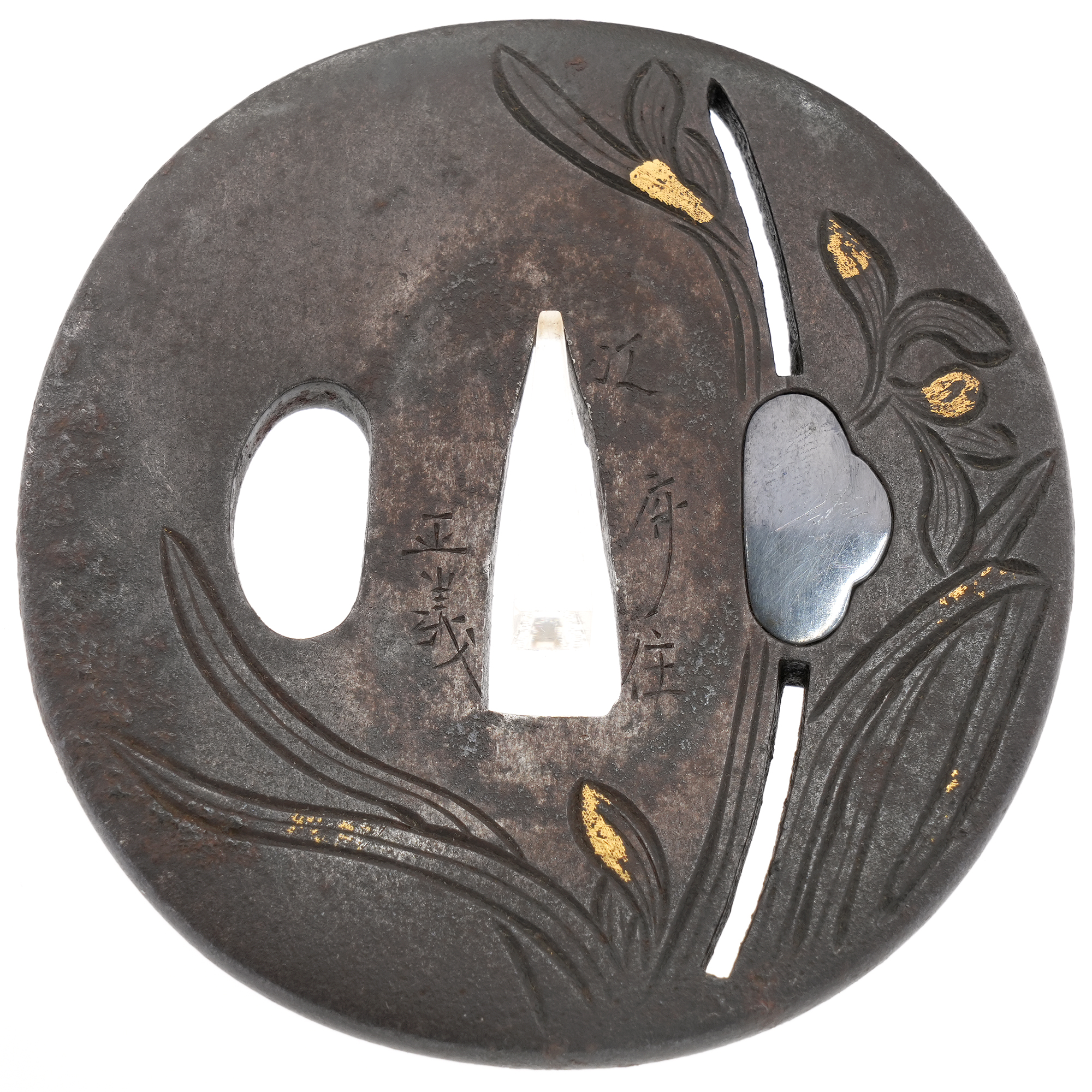
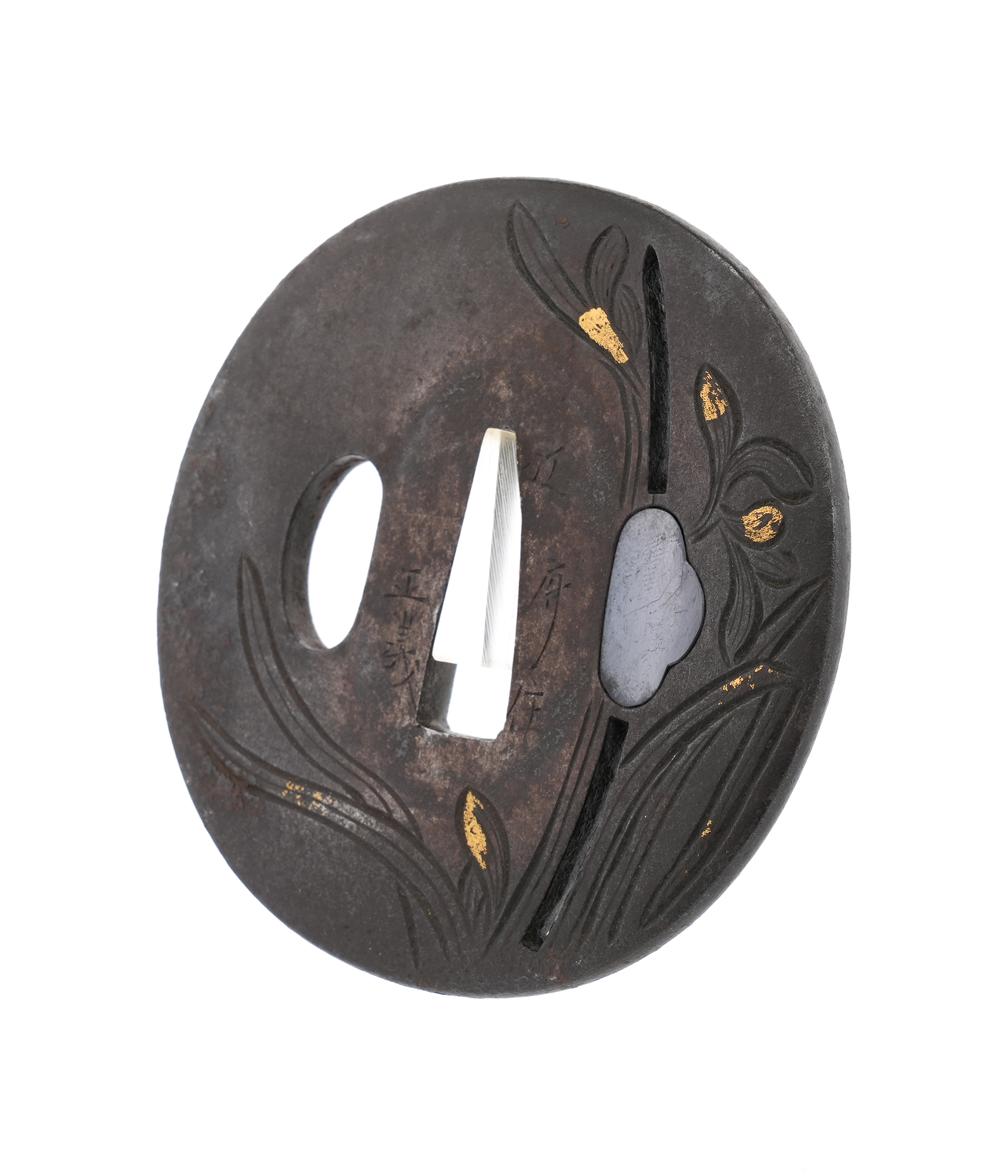
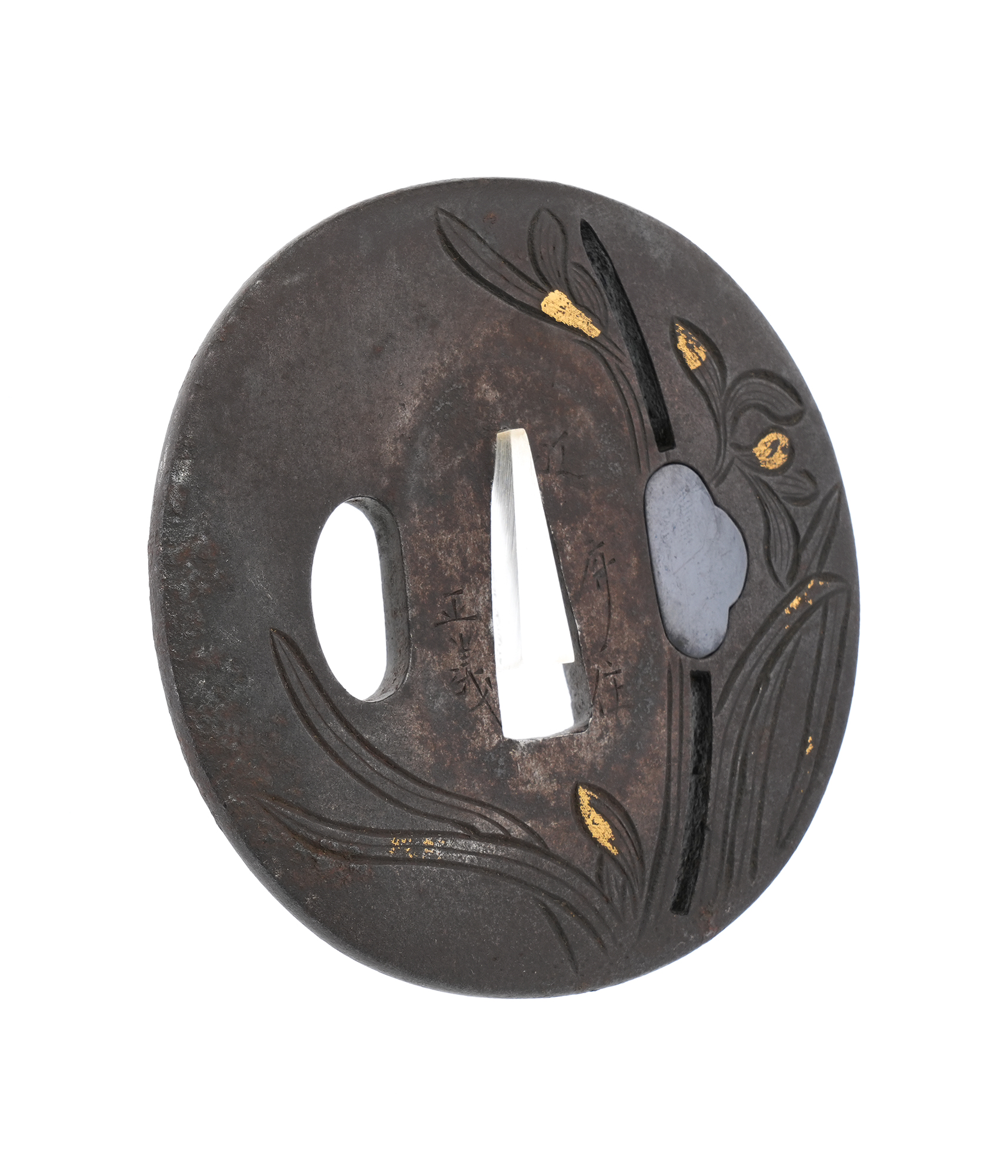
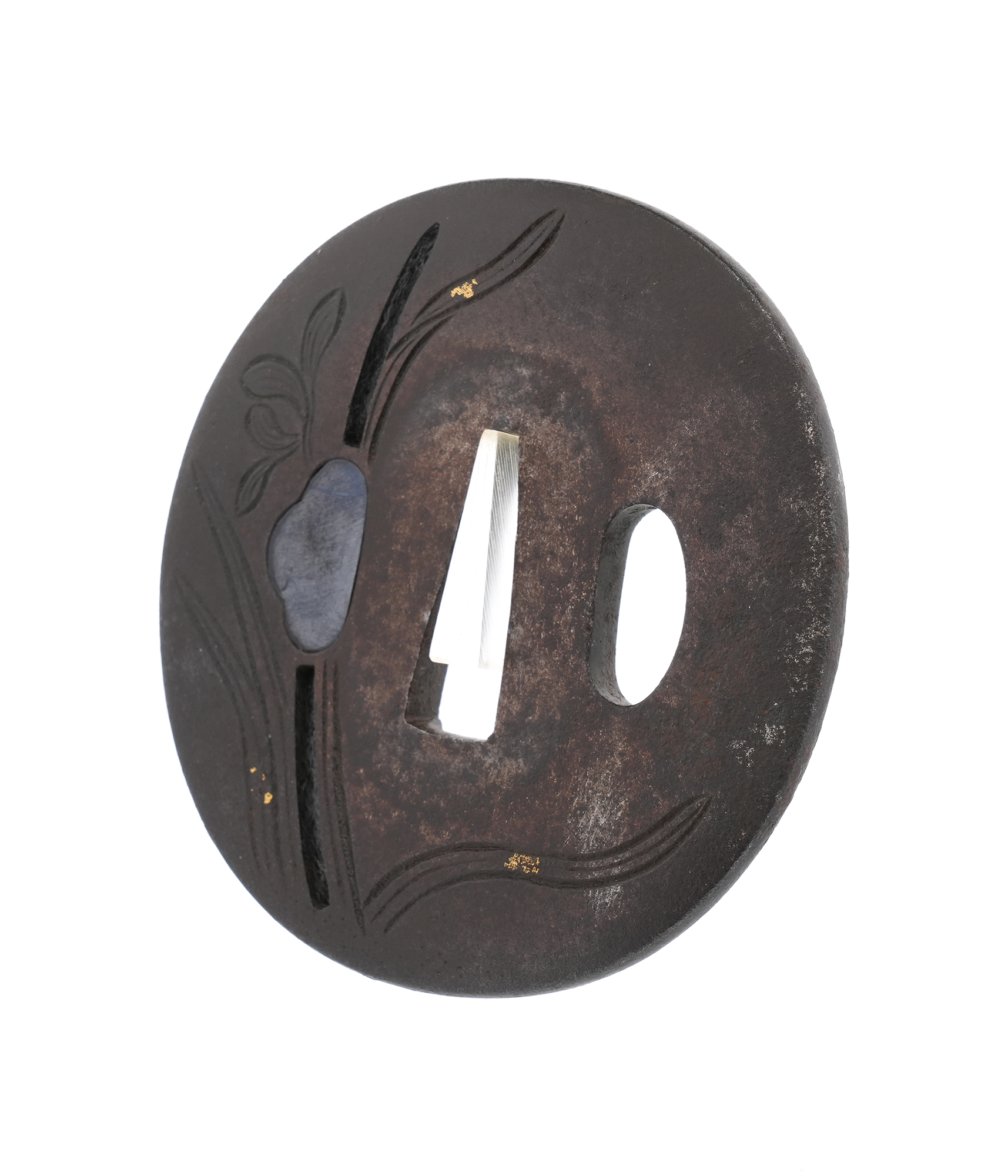
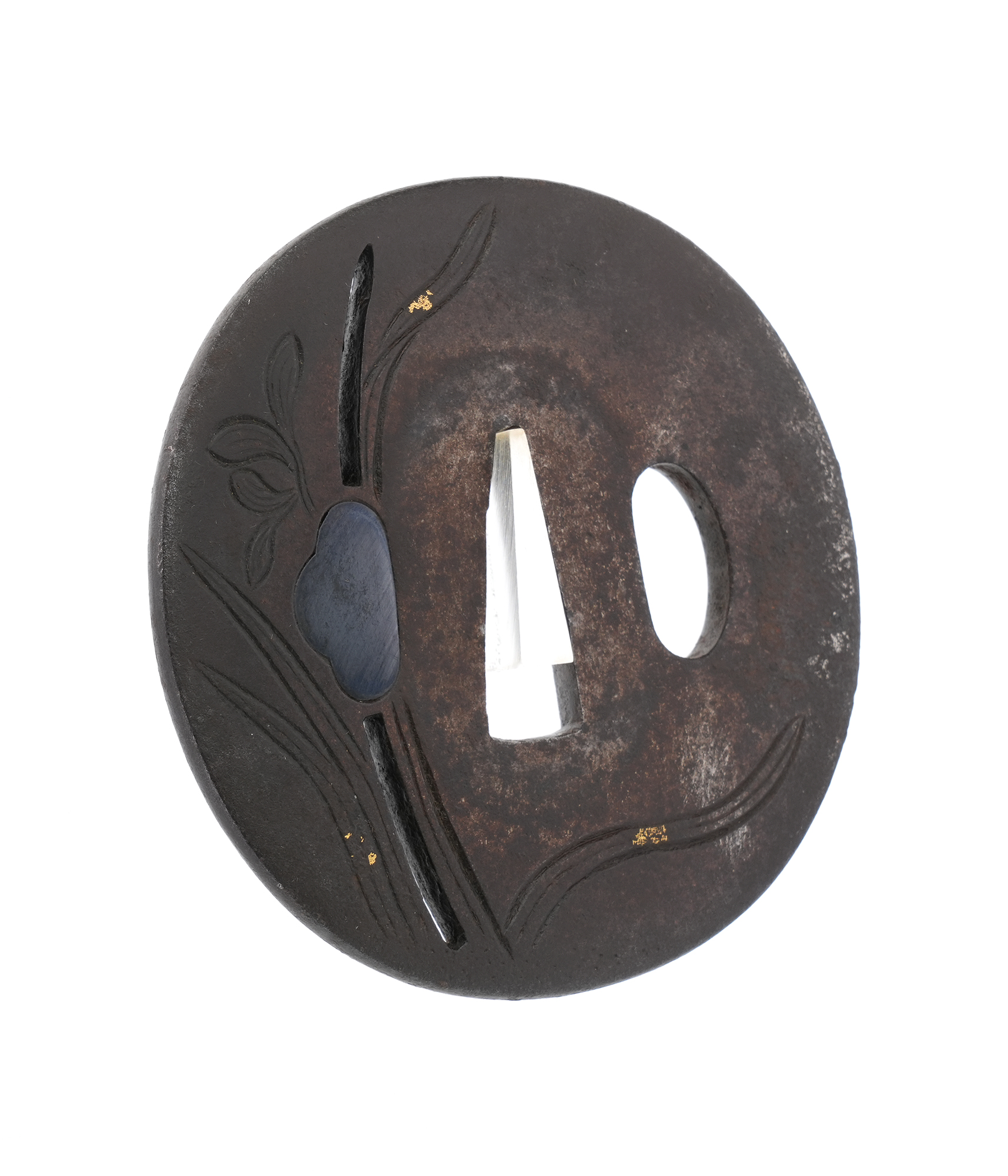
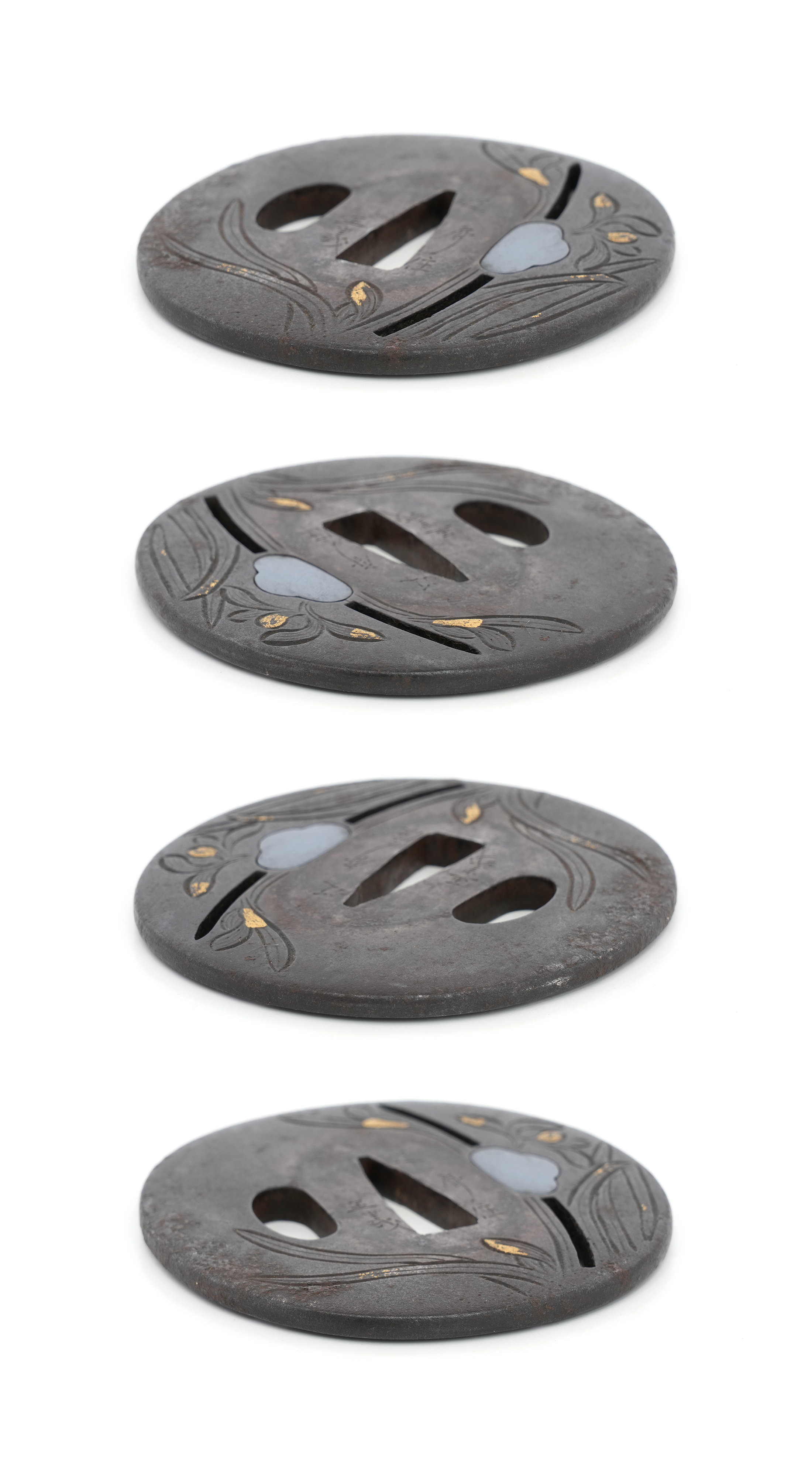
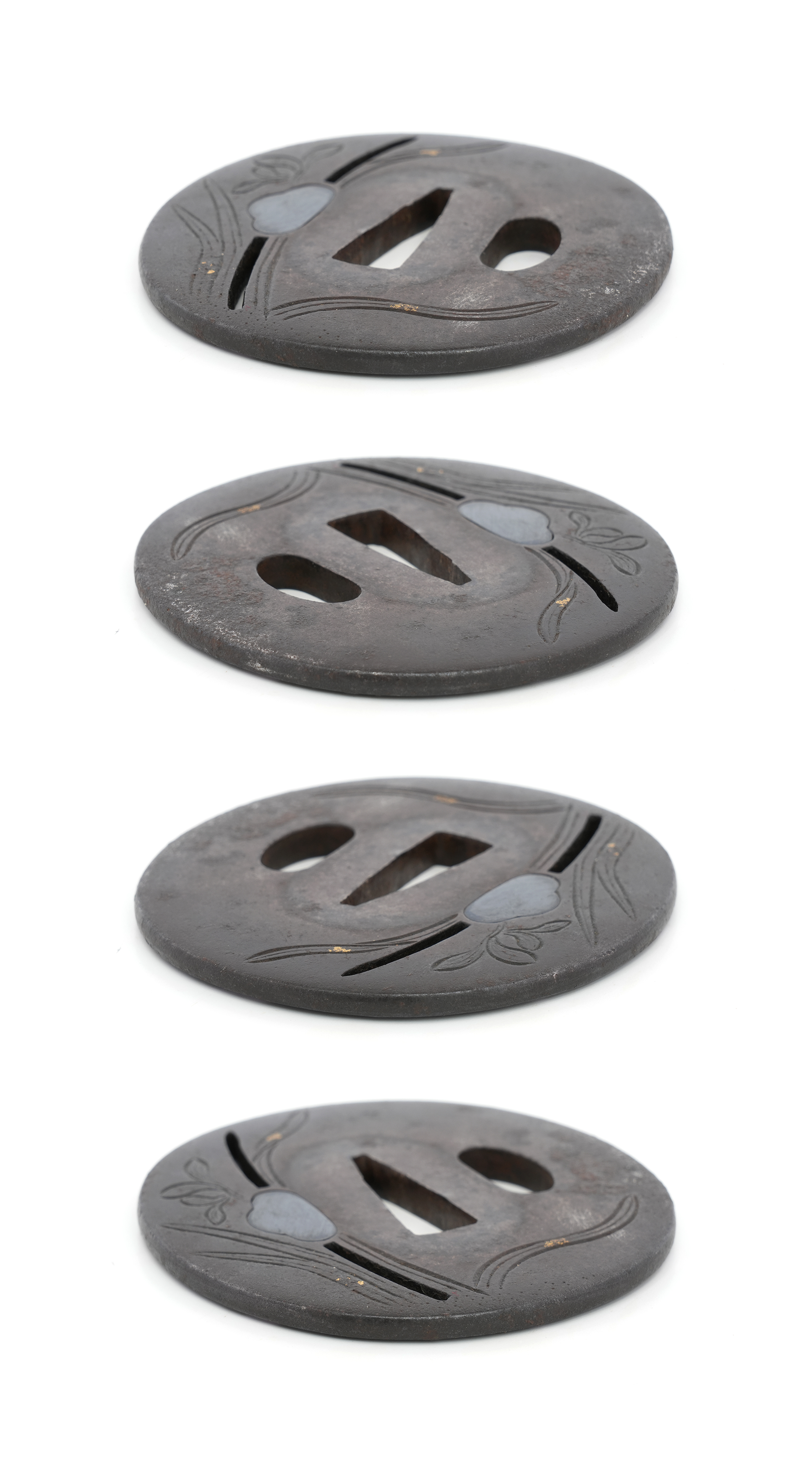
Masayoshi was a kinkou who was active in Edo. The hanashobu is a traditional Japanese garden plant that blooms in early summer; its cultivation and selective breeding advanced during the Edo period, eventually becoming so popular that hanashobu gardens became famous sightseeing spots. In this work, flowers and long, slender leaves of the hanashobu are arranged fluidly upon a calm tetsu-ji, and the brilliance of the gold placed at the base of the petals brings out the freshness of early summer. Even in light of the difference between the hanashobu, which has yellow markings at the base of the petals, and the kakitsubata, which shows white streaks there, it is appropriate to appreciate this design with its added gold as a hanashobu, and that coloration makes the form of the flowers and the beauty of the composition even clearer. On the omote, the flower opening at the top right and the leaves flowing downward are unified into a single continuous scene; as the eye moves along the fine hori of the leaf veins and stems, the kin-nunome-zogan applied here and there on the petals and leaves rises up from the sober tones of the tetsu, and the accent colors, which do not lean toward gaudiness, highlight the refreshing appearance of the hanashobu. The design, featuring a single leaf rendered as a slender sukashi, creates a light sense of space within the frame, and through the contrast with the leaves carved into the tetsu-ji, it creates a sense of depth as if the leaves are overlapping in the wind; meanwhile, the dark surface where the kogai-hitsu-ana has been carefully filled with shakudo sits naturally beside the flower, skillfully utilizing the sukashi and umegane to compose the form of a single plant. The scenery of leaves and flowers continues on the ura, and turning the tsuba over offers the charm of encountering another expression of the hanashobu seen on the front; the combination of the quiet texture of the tetsu-ji, the shakudo umegane, and the scattered brilliance of the kin-nunome-zogan provides the pleasure of discovering detailed work the more one tilts it in hand, making this a deeply flavorful piece with a mei, whether paired with a sword or kept for appreciation as a kakin-zu tsuba.
NihontoWatchOffered by Toushin

We couldn’t find current papers for this piece. Ask the dealer whether it has been, or can be, submitted to shinsa. — Hoshi

Machine translation of the shop's Japanese ·
Machine translation from the shop's Japanese · may contain errors ·
Iron-tsuba · Musashi
3 pieces on the market now
Iron-tsuba · Musashi
55 pieces on the market now
The Ito school (伊藤派) was a prolific kinkō lineage based in Kanda, Edo, in Musashi province. The line was established by Masanaga (正長, d. 1727), who received appointment as official tsuba maker (kōgi o-kakae tsubashi) to the Tokugawa Shogunate following an audience with Shogun Ienobu in 1710. Successive heads bore the character 正 (Masa-) in their art names, producing ten recorded generations from the Genroku era through the Meiji period. The second-generation master Masatsune (正恒) developed ito-sukashi (糸透かし), the school's signature technique of extremely fine saw-cut openwork. The tenth and final head, Itō Katsumi (伊藤勝見, 1829--1910), originally named Masataka (正隆), entered the school of Tanaka Seiju (田中清寿) at twelve, was adopted into his master's household at seventeen, and received the rank of Hōkyō (法橋) while still young, together with the art name Tōryūsai (東竜斎). After parting ways with Seiju, Katsumi studied maki-e under Shibata Zeshin (柴田是真), and in Man'en 1 (1860) was adopted into the Itō Masahiro family, becoming the tenth-generation head. This dual formation -- kinkō discipline under the Tanaka lineage and lacquer refinement under Zeshin -- profoundly shaped the school's late output.
The Ito school's collective style is characterised by mastery of zōgan (象嵌, inlay) and iroe (色絵, polychrome metalwork) deployed with what the setsumei repeatedly describe as precision and accuracy. Works are executed on plates of iron, shibuichi (四分一), oboro-gin (朧銀), or shakudō (赤銅), frequently with nanako-ji (魚子地) grounds. The technical repertoire encompasses takabori (高彫, high relief), sukidashi takabori (鋤出高彫), katakiribori (片切彫), fine kebori (毛彫, hairline engraving), suemon-zōgan (据文象嵌), and nunome-zōgan (布目象嵌), often combined within a single composition. Masatsune's work employs shippō (七宝, cloisonné enamel) on iron plate, as seen in a unified uchigatana koshirae signed "Bushū-jū Masatsune" whose tsuba, fuchi-kashira, kurikata, and kaerizuno are coordinated as a single aesthetic programme[[c:1]] with raden (螺鈿, mother-of-pearl) and gold uchikomi (打込) work. Katsumi's mature output favours figural and narrative subjects: the Frog Battle after the celebrated Chōjū-giga scrolls attributed to Toba Sōjō, Gama Sennin with his toad beneath a willow, and Daisē Fudō Myōō realised with emphatic devotional presence. "[[c:6]] The Ito school occupies a distinctive place in the tsuba canon as a Musashi-based lineage that sustained high-level production across the entire Edo period. Its works were widely disseminated through the sankin-kōtai system, as samurai from all provinces acquired Ito tsuba during their attendance in Edo. "[[c:7]] That his tsuba depicting the Chōjū-giga Frog Battle is described as a "forceful work from his later years"[[c:5]] whose "composition, which successfully preserves the spirit of the original painting, is outstanding" confirms the school's enduring capacity to unite pictorial invention with metalworking virtuosity. Learn more →
| Smith | Era | Designated |
|---|---|---|
| Katsumi勝見 | — | 4 |
| Sadatsune貞恒 | — | 0 |
| Masayoshi正備 | — | 0 |
| Masatsune正常 | — | 0 |
| Masakane正金 | — | 0 |
We could not find an authenticity certificate on the seller’s listing. Japanese swords and fittings are normally papered by the NBTHK (or the NTHK). Without one, the attribution is the seller’s own assessment and has not been independently verified — treat it with caution and ask the dealer about certification before buying.
As a rule we do not accept returns, except when we have sent a different item from the one ordered or when there is a significant discrepancy between the description and the item. If you wish to return an item, please contact us within 3 days of its arrival and then send it back.
¥132,000