


The twentieth century nearly killed the craft twice: wartime distortion, then the occupation ban. The NBTHK’s founding in 1948 and licensed forging from 1953 rebuilt the sword as an art, crowned by Living National Treasures and the mukansa rank.
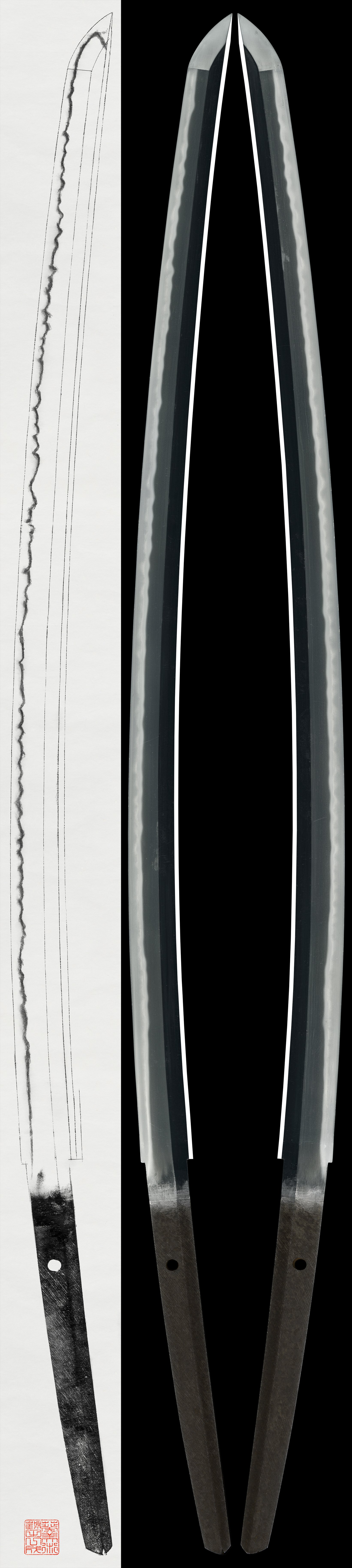
Katana in Military Sword Koshirae (Gunto Koshirae) (We divide 4 sections for each sword as Saijyo Saku, Jyojyo Saku, Jyo Saku and Regular Saku). This blade is ranked as Regular Saku among unsigned works. Shape: A robust katana with a wide mihaba, substantial kasane, and an elongated kissaki. Jigane: The forging appears to be somewhat insufficient, and we believe this blade is a partially forged sword, commonly referred to as a Han-Tanren-to. The boshi forms a rounded tip with a turnback. Features: Generally, non-traditionally forged swords (Mu-Tanren-to) bear markings such as the Showa stamp, Seki stamp, or anchor mark, indicating their classification as non-traditionally forged swords. However, swords bearing the anchor mark were forged, so we believe they may qualify for registration in Japan. Other types of non-traditionally forged swords are subject to confiscation during the registration examination. Similarly, Mantetsu-to swords manufactured in Manchuria are not eligible for registration in Japan. Aoi Art’s Comment: Regarding Japanese swords produced during World War II. During the war, some officers and non-commissioned officers in the Japanese military carried Japanese swords. Most Japanese Army swords survived the war, but relatively few Japanese Navy swords remain today because so many naval vessels were sunk. War is a cruel tragedy that separates countless families and takes the lives of many people. We sincerely hope that humanity will firmly resolve never to allow such a war to happen again.
Offered by Aoi Art


Machine translation of the shop's Japanese ·
Shōwa to the present: destruction and revival
The twentieth century nearly killed the craft twice: wartime distortion, then the occupation ban. The NBTHK’s founding in 1948 and licensed forging from 1953 rebuilt the sword as an art, crowned by Living National Treasures and the mukansa rank.
We could not find an authenticity certificate on the seller’s listing. Japanese swords and fittings are normally papered by the NBTHK (or the NTHK). Without one, the attribution is the seller’s own assessment and has not been independently verified — treat it with caution and ask the dealer about certification before buying.
If you wish to return an item, please notify us within 3 days of receipt. After this period we cannot accept cancellations. Please ship the return to us within 5 business days. Cancellation is conditional on the item being kept in the same condition as at the time of sale, so please handle it with care.
¥250,000