Shinshinto Musashi (Shinano), late Edo period, Saijo-saku
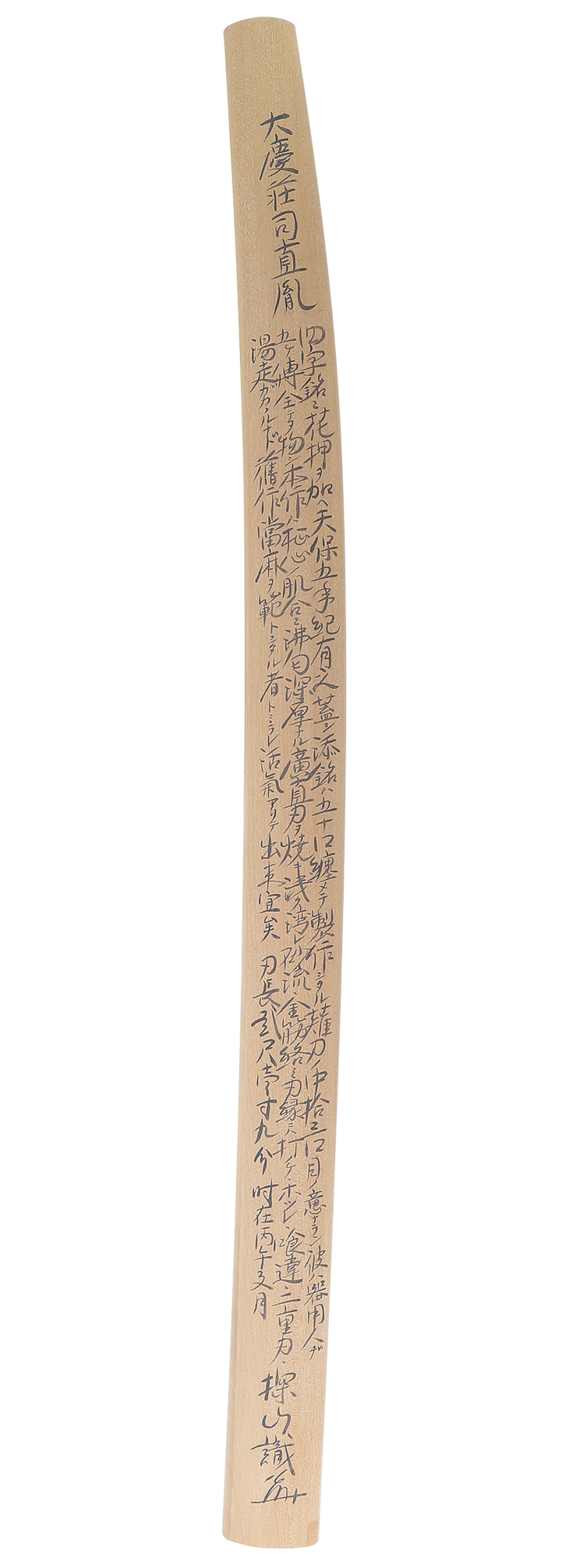
With sayagaki by Tanzan Sensei
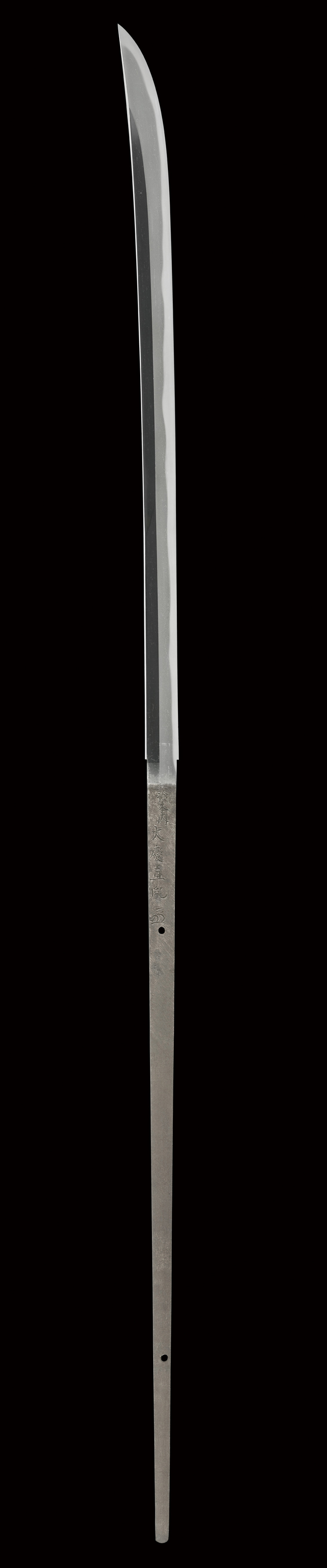
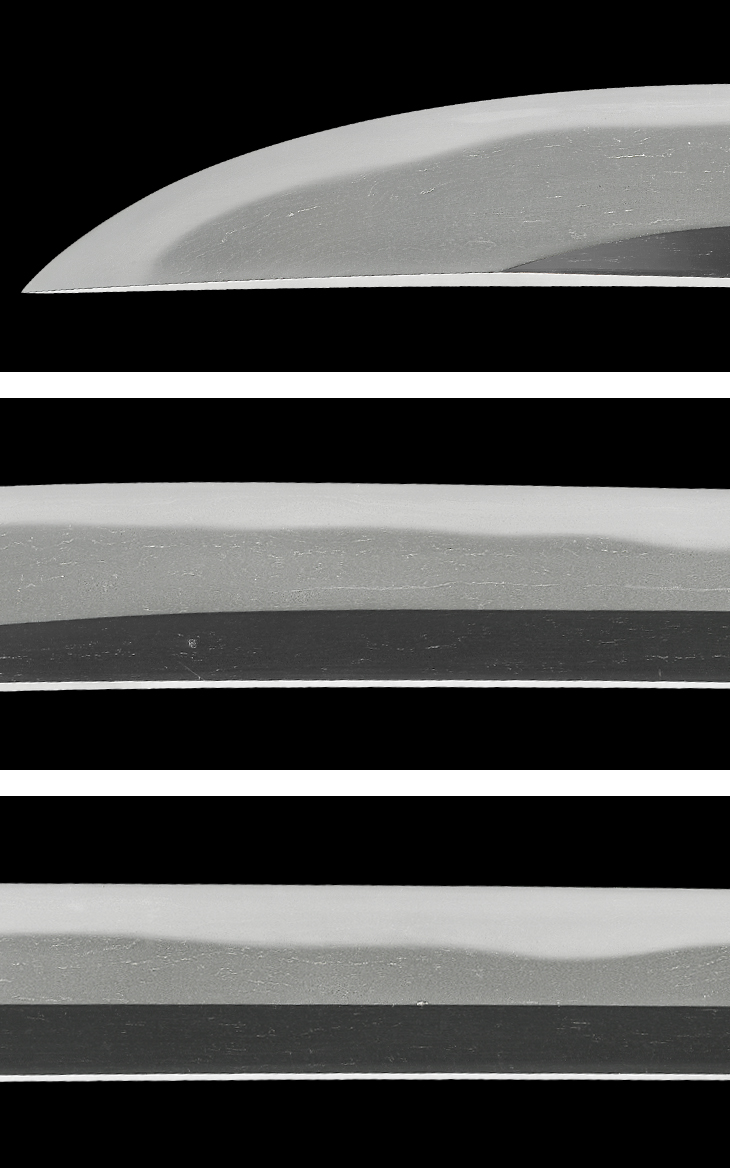
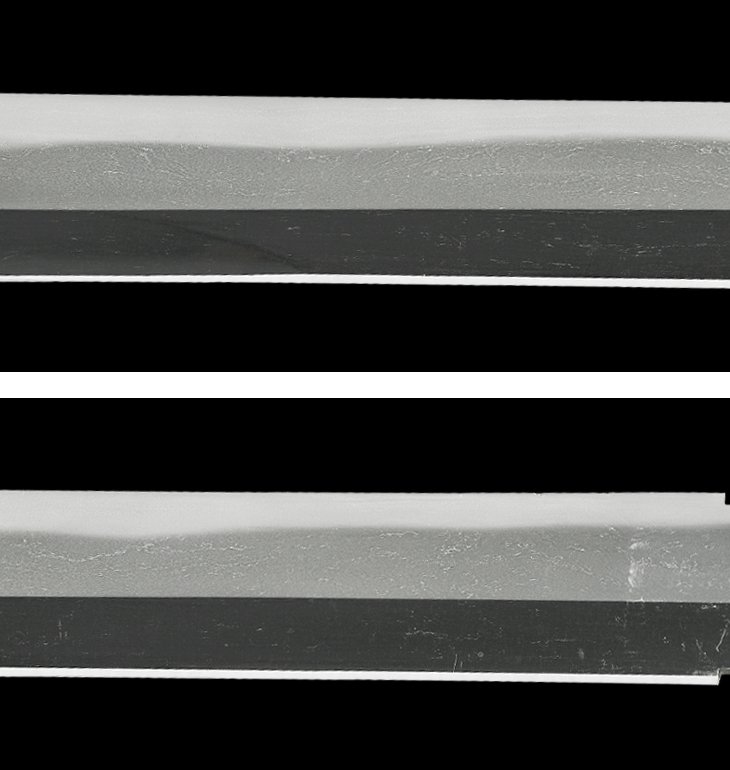
Naginata-zukuri, high shinogi, low iori-mune. Kitae, masame flows in waves, partially flowing strongly to become masaware, thick ji-nie, jikei enters well, jitetsu is good. Hamon, notare-midare style hamon mixed with gunome and ko-gunome, the habuchi is violently covered in nie with deep nioi, hotsure, uchinoke, nijuba, kuichigaiba occur, kinsuji and sunagashi in the ha occur violently in multiple layers, with nie-sake and nie-kuzure appearing in places. Boshi, notare style with the tip being yakitsume. Nakago is ubu, tip is kurijiri, upper half of the yasurime is kesho o-sujikai, lower half is sensuki. Copper habaki with gold foil. Period polishing. In shirasaya.
Naotane was born in Dewa no Kuni Yamagata in Ansei 7, was called Shoji Minobei, and used the go Taikei. Around Kansei 10, he entered the school of Suishinshi Masahide in Edo, became independent around the beginning of Bunsei, and changed his titles to "Chikuzen Daijo" in Bunsei 4 and "Mino no Suke" in Kaei 1.
Alongside Minamoto Kiyomaro and Suishinshi Masahide, he is called one of the "Edo Sansaku" and mastered all of the Goke-den.
His works remain from around the end of Kansei to around Ansei 3, and he died in Ansei 4 at the age of 79.
From the Tenpo era after he turned fifty, he went on three long journeys and forged swords in various locations, leaving those place names as kokuin or kiritsuke-mei on the nakago.
The kokuin include "Higashi (Edo)", "Miyako (Kyoto)", "Naniwa (Osaka)", "Ise (Ise)", "Shinano (Shinano)", "Itsu (Izu)", "Hitchu (Bitchu)", "Sakami (Sagami)", "Enshu (Totomi Hamamatsu)", "Chiha (Chiba)", etc., all of which have high rarity value.
This work was made in Tenpo 5 when the smith was 57 years old, a naginata with a nagasa of slightly over 2 shaku 1 sun 9 bu and a total length of slightly over 4 shaku 5 sun, the ji and ha are as healthy as a gendaito.
While naginata are occasionally seen in the Shinshinto period, this construction where the width at the point does not flare and there is little sori imitates the typical style of Kamakura period naginata.
The masame flows in waves, partially flowing strongly to become masaware, and the notare-midare style hamon has a habuchi violently covered in nie with deep nioi, hotsure, uchinoke, nijuba, kuichigaiba occur, kinsuji and sunagashi in the ha occur violently in multiple layers, with nie-sake and nie-kuzure appearing in places; the habuchi is indistinct and emits a strong radiance.
This style where the kitae is Yamato-den and the ha is Soshu-den is occasionally seen in this smith's work, and in recent years it is also called Yamato-Soshu-den.
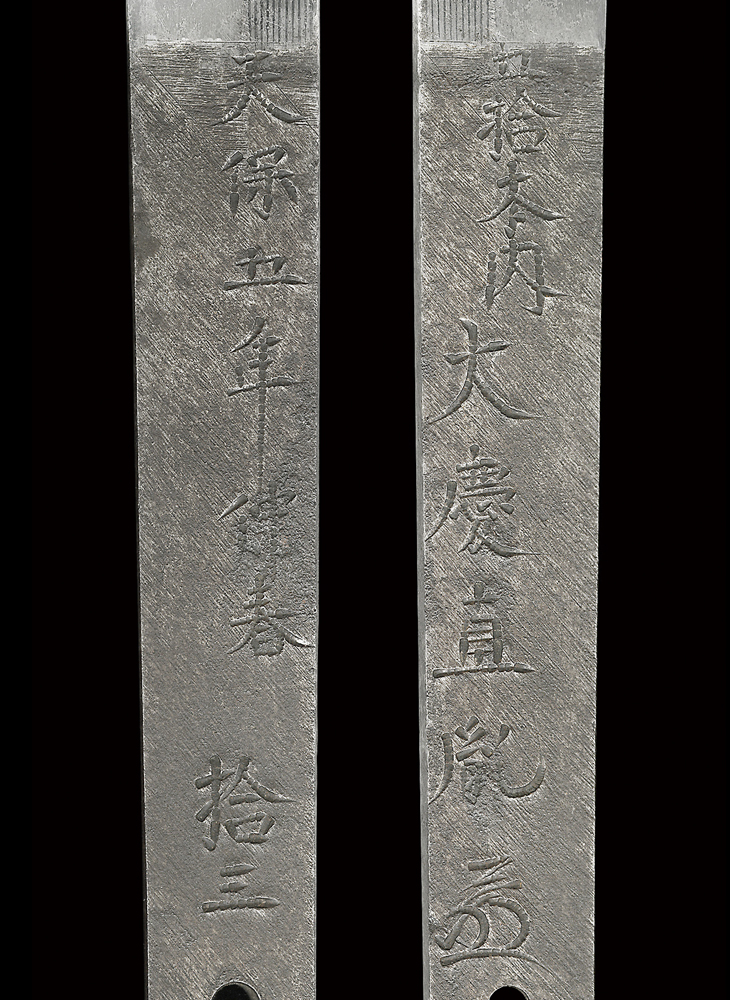
Regarding the kiritsuke-mei "Gojubon-nai Ju-san", Naotane forged fifty swords in that location at the invitation of the Matsushiro Han Lord of Shinano no Kuni, Sanada Yukitsura, from the end of Tenpo 4 to around the end of Tenpo 7. These are the so-called "Shinano" works, and the kiritsuke-mei is its serial number (production number), meaning "the 13th out of 50" as the mei states.
Besides this work, others remain such as "Kai Gojubon-nai Taikei Naotane (kao) Tenpo 4 Chushu" and "Zō Taikei Naotane (kao) (kokuin) Shinano Tenpo 7 November Kichijitsu", and the use of "Kai" originates from the fact that Matsushiro Castle was originally called Kaizu Castle.
Sanada Yukitsura was the 8th generation lord of the domain and a great-grandson of Tokugawa Yoshimune; in the famous "Tenpo Reforms", he was plucked by Mizuno Tadakuni to serve as a Roju and played a part in the reforms, while also achieving many results in the reform of his own domain's administration.
This is a blade forged in response to the request of Sanada Yukitsura, who is counted as one of the wise lords of the late Edo period; furthermore, as can be seen from the fact that the majority of this smith's Juyo designated items are works from the Tenpo era, this is a work from his best period, a Shinshinto Saijo-saku, Taikei Naotane's "Tenpo Shinano-uchi", an exceptional item handed down in the Sanada family during the feudal era that should not be overlooked.
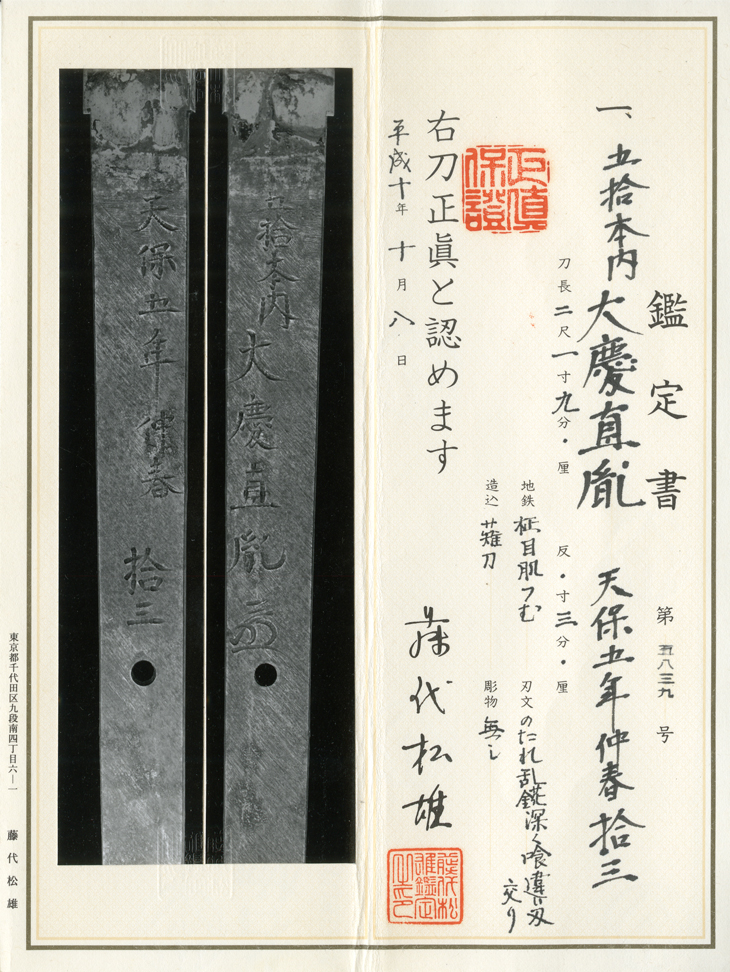
Its photos show a certificate that isn’t in our records yet. Papers can come from different bodies (the NBTHK, the NTHK and smaller societies), and only current NBTHK or NTHK shinsa papers are the independent check we rely on. Please ask the dealer which body issued them. — Hoshi
Machine translation from the shop's Japanese · may contain errors ·
Shinshinto Musashi (Shinano), late Edo period, Saijo-saku
With sayagaki by Tanzan Sensei
Naginata-zukuri, high shinogi, low iori-mune. Kitae, masame flows in waves, partially flowing strongly to become masaware, thick ji-nie, jikei enters well, jitetsu is good. Hamon, notare-midare style hamon mixed with gunome and ko-gunome, the habuchi is violently covered in nie with deep nioi, hotsure, uchinoke, nijuba, kuichigaiba occur, kinsuji and sunagashi in the ha occur violently in multiple layers, with nie-sake and nie-kuzure appearing in places. Boshi, notare style with the tip being yakitsume. Nakago is ubu, tip is kurijiri, upper half of the yasurime is kesho o-sujikai, lower half is sensuki. Copper habaki with gold foil. Period polishing. In shirasaya.
Naotane was born in Dewa no Kuni Yamagata in Ansei 7, was called Shoji Minobei, and used the go Taikei. Around Kansei 10, he entered the school of Suishinshi Masahide in Edo, became independent around the beginning of Bunsei, and changed his titles to "Chikuzen Daijo" in Bunsei 4 and "Mino no Suke" in Kaei 1.
Alongside Minamoto Kiyomaro and Suishinshi Masahide, he is called one of the "Edo Sansaku" and mastered all of the Goke-den.
His works remain from around the end of Kansei to around Ansei 3, and he died in Ansei 4 at the age of 79.
From the Tenpo era after he turned fifty, he went on three long journeys and forged swords in various locations, leaving those place names as kokuin or kiritsuke-mei on the nakago.
The kokuin include "Higashi (Edo)", "Miyako (Kyoto)", "Naniwa (Osaka)", "Ise (Ise)", "Shinano (Shinano)", "Itsu (Izu)", "Hitchu (Bitchu)", "Sakami (Sagami)", "Enshu (Totomi Hamamatsu)", "Chiha (Chiba)", etc., all of which have high rarity value.
This work was made in Tenpo 5 when the smith was 57 years old, a naginata with a nagasa of slightly over 2 shaku 1 sun 9 bu and a total length of slightly over 4 shaku 5 sun, the ji and ha are as healthy as a gendaito.
While naginata are occasionally seen in the Shinshinto period, this construction where the width at the point does not flare and there is little sori imitates the typical style of Kamakura period naginata.
The masame flows in waves, partially flowing strongly to become masaware, and the notare-midare style hamon has a habuchi violently covered in nie with deep nioi, hotsure, uchinoke, nijuba, kuichigaiba occur, kinsuji and sunagashi in the ha occur violently in multiple layers, with nie-sake and nie-kuzure appearing in places; the habuchi is indistinct and emits a strong radiance.
This style where the kitae is Yamato-den and the ha is Soshu-den is occasionally seen in this smith's work, and in recent years it is also called Yamato-Soshu-den.
Regarding the kiritsuke-mei "Gojubon-nai Ju-san", Naotane forged fifty swords in that location at the invitation of the Matsushiro Han Lord of Shinano no Kuni, Sanada Yukitsura, from the end of Tenpo 4 to around the end of Tenpo 7. These are the so-called "Shinano" works, and the kiritsuke-mei is its serial number (production number), meaning "the 13th out of 50" as the mei states.
Besides this work, others remain such as "Kai Gojubon-nai Taikei Naotane (kao) Tenpo 4 Chushu" and "Zō Taikei Naotane (kao) (kokuin) Shinano Tenpo 7 November Kichijitsu", and the use of "Kai" originates from the fact that Matsushiro Castle was originally called Kaizu Castle.
Sanada Yukitsura was the 8th generation lord of the domain and a great-grandson of Tokugawa Yoshimune; in the famous "Tenpo Reforms", he was plucked by Mizuno Tadakuni to serve as a Roju and played a part in the reforms, while also achieving many results in the reform of his own domain's administration.
This is a blade forged in response to the request of Sanada Yukitsura, who is counted as one of the wise lords of the late Edo period; furthermore, as can be seen from the fact that the majority of this smith's Juyo designated items are works from the Tenpo era, this is a work from his best period, a Shinshinto Saijo-saku, Taikei Naotane's "Tenpo Shinano-uchi", an exceptional item handed down in the Sanada family during the feudal era that should not be overlooked.
Historical context
The Shinshintō revival
›
Around 1800 Suishinshi Masahide argued in his writings that the craft must return to the old masters’ methods: the fukkotō revival. His greatest successor Naotane worked convincingly in Bizen and Sōshū manners that had been dead for centuries.
We could not find an authenticity certificate on the seller’s listing. Japanese swords and fittings are normally papered by the NBTHK (or the NTHK). Without one, the attribution is the seller’s own assessment and has not been independently verified — treat it with caution and ask the dealer about certification before buying.
For one-of-a-kind items such as swords, sword fittings and antiques, other customers may be waiting for the item, so please contact us about a return within 3 days of its arrival and ship it back within 8 days. Refunds are made on the day the returned item arrives.

 NihontoWatch