 NihontoWatchNihontoWatch
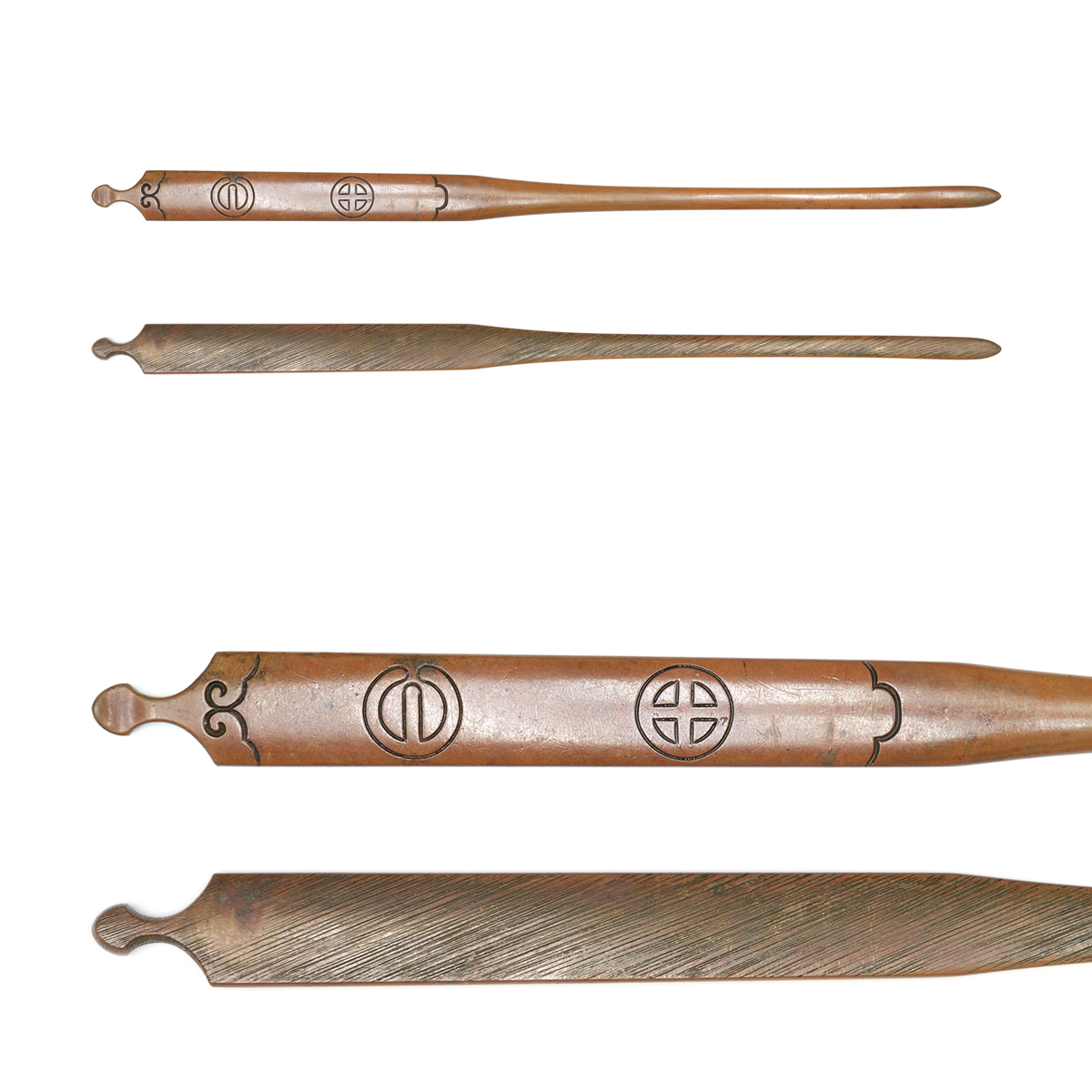
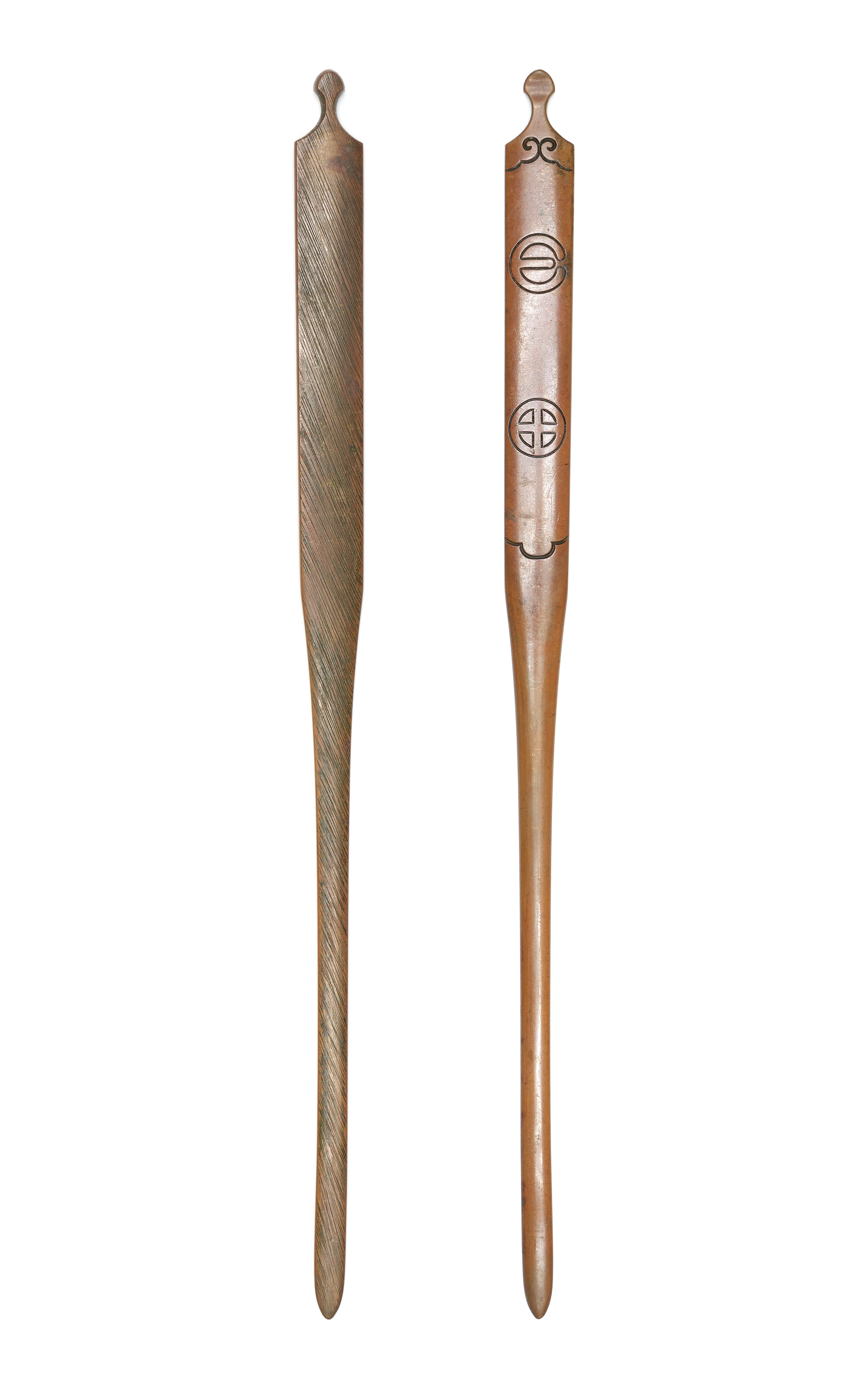
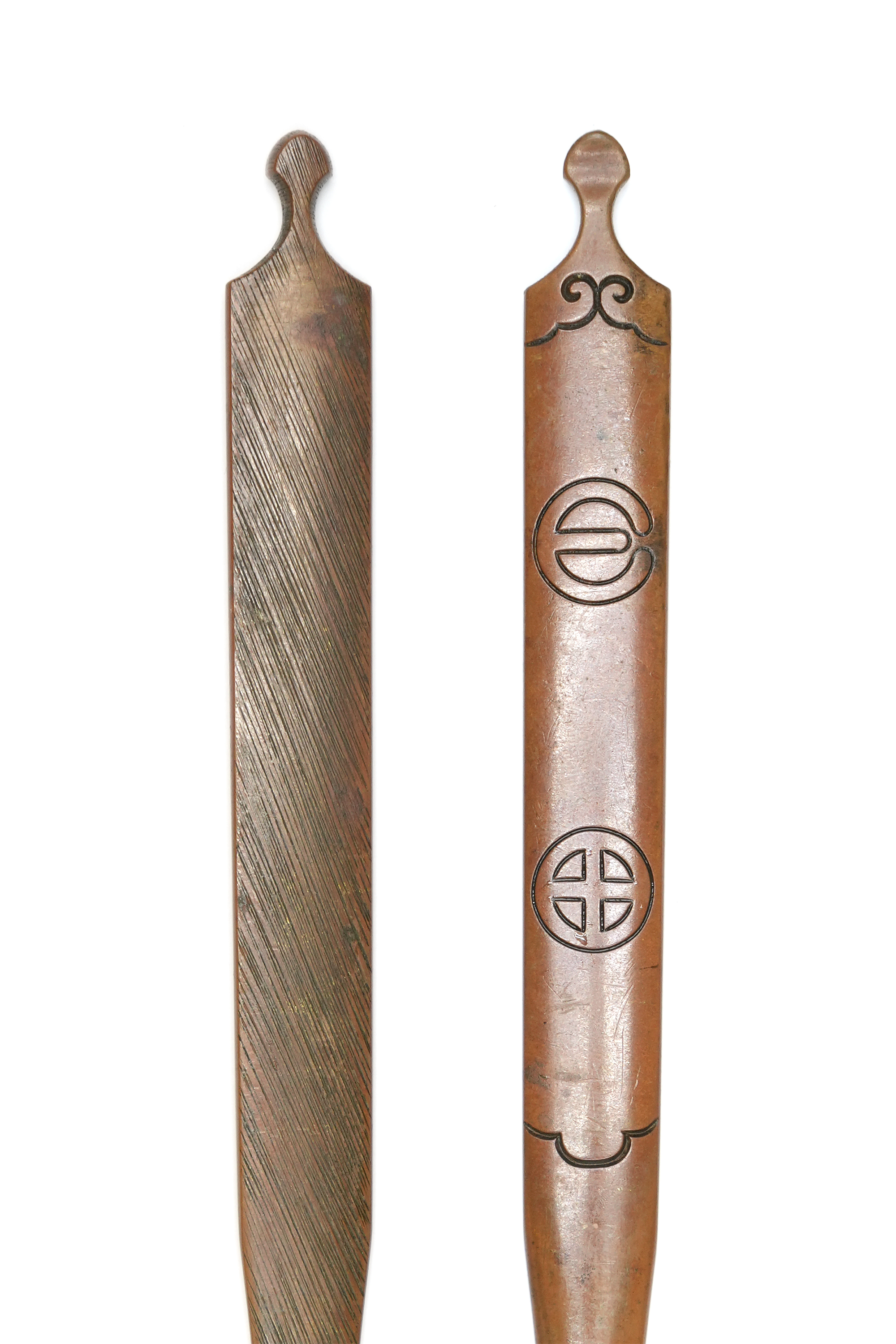
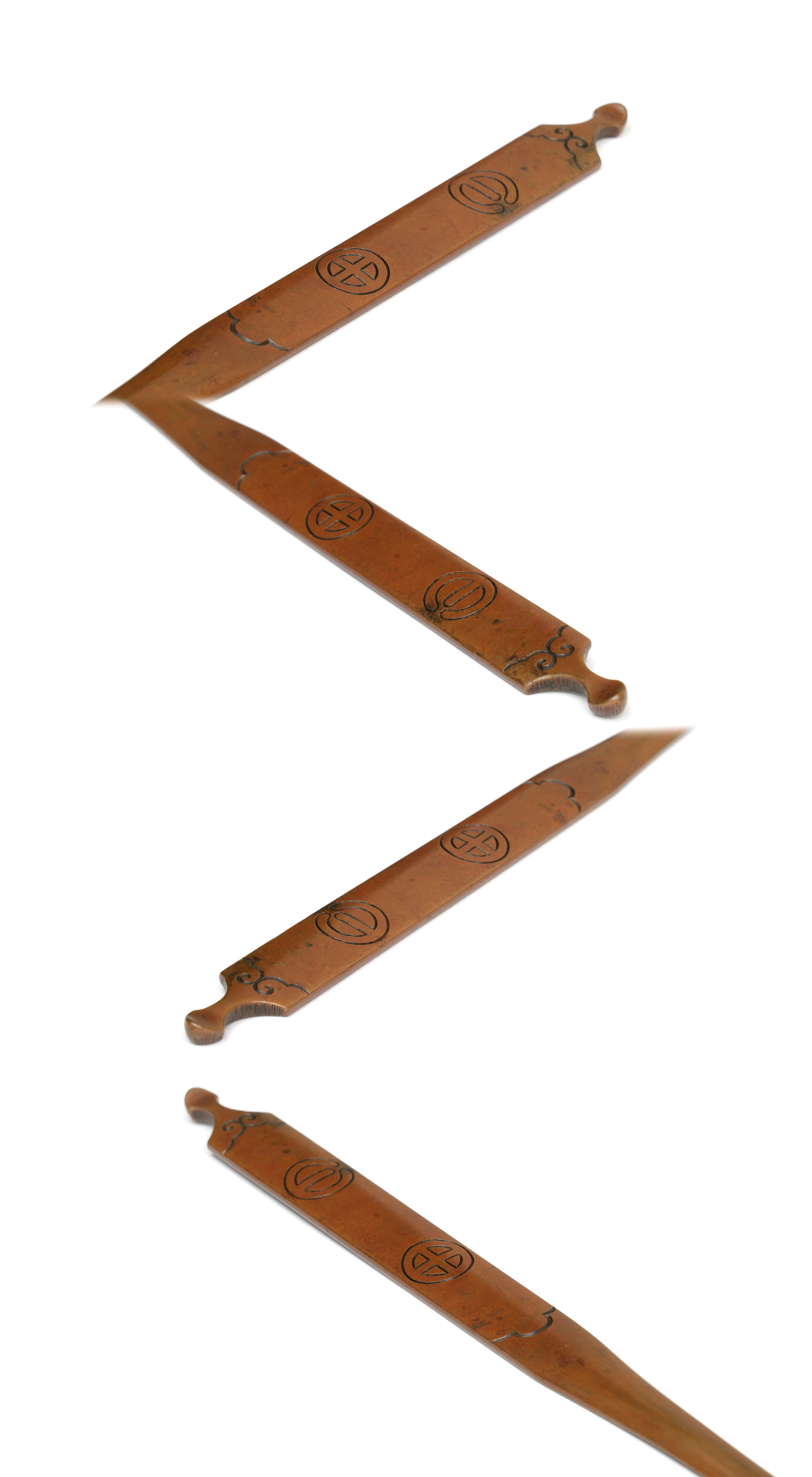
As this piece is mumei, it cannot be attributed to a specific maker or school, but it is an archaic kogai that features a suaka-ji body with a warm reddish tint crafted as a single unit, showing the texture of the jigane and the outlines of the family crests rather than relying on takabori or colorful iroe for decoration. The rise of the mimi is gentle, and it possesses a soft contour that transitions naturally from the slender neck to the shoulder and body, differing in atmosphere from the later styles with short necks and broad shoulders, conveying the simple strength unique to a jidai-kogai handed down as a practical item for a buke. On the do, a Maru-ni-yamamoji-mon and a Maru-ni-juji-mon are spaced at good intervals; the yamamoji-mon is the same crest as the one rendered in gold on the kogai in separate listing 251, clearly indicating the connection between these two items passed down from the same family, and while it possesses both a sense of stability from its flared base and an upward momentum, the crest containing a neat cross within a circle has a clarity that seems to concentrate power toward the center. In buke and noble families, there were cases where omote-mon representing the house were used alongside ura-mon or kae-mon depending on the occasion or purpose, and although it is not possible to specify which crest corresponds to which, the composition of these two items, which pair the common yamamoji-mon with different crests, allows one to imagine the multiple crests inherited within a single family and their distinct uses. The patterns are simply executed by carving the outlines with a tagane to utilize the difference in the tone of the jigane, and by leaving sufficient margin around the crests, the two designs stand out clearly without crowding each other. In simple geometric shapes and family crests, distortions in circles, irregularities in line width, and off-center alignments are easily noticed and directly reveal the skill of the kinko; in this piece, the circles and internal lines are well-balanced within a limited width, and each crest is clearly established with only a few tagane lines, allowing one to see steady workmanship within a restrained composition. On the ura-men, fine diagonal yasurime are applied uniformly across the entire surface, showing a neat jihada different from the omote where the patterns are placed, and from the mimi to the do, through the sao, to the rounded hosaki, the gentle luster of suaka that has aged over time remains continuously. Unlike flamboyant iroe fittings, the charm of this work lies in its integrity, established only through the basic elements of material, shape, tagane lines, and yasurime, making it an interesting piece for considering the form of the kogai as it transitioned from the end of the Muromachi period to the beginning of the early modern era. This piece is one item handed down together from the same family as the "Yamamoji-mon and Gunbai-mon Kogai" in a separate listing, and while the two differ in materials and decorative techniques, they both share the yamamoji-mon. While I do not conclude that they are a matching set, they are interesting as a combination that invites imagination regarding the background of their use and inheritance within a single family; as a single item, one can enjoy the calm texture of an old jidai-kogai, and by placing the two side-by-side, one can enjoy comparing the family crest designs and the changes in techniques over time, making this a piece rich in the appeal of buke kinko.
Offered by Toushin

We couldn’t find current papers for this piece. Ask the dealer whether it has been, or can be, submitted to shinsa. — Hoshi

Momoyama
Unsigned
As written by the shop
Machine translation from the shop's Japanese · may contain errors ·
We could not find an authenticity certificate on the seller’s listing. Japanese swords and fittings are normally papered by the NBTHK (or the NTHK). Without one, the attribution is the seller’s own assessment and has not been independently verified — treat it with caution and ask the dealer about certification before buying.
As a rule we do not accept returns, except when we have sent a different item from the one ordered or when there is a significant discrepancy between the description and the item. If you wish to return an item, please contact us within 3 days of its arrival and then send it back.
¥198,000