Forged by Miyairi Kei (Kozaemon Yukihira)
Moto-haba (Width at Ha-machi) approx. 3.94cm
"Yushu" prize winning work by NBTHK in 1995
Swordsmith Miyairi Kei is the son of the master Miyairi Yukihira, who was designated a Living National Treasure, and was born in Showa 32. Although he entered an apprenticeship under master Yukihira in Showa 52, because the master passed away suddenly that same year, he received subsequent instruction from his fellow student, swordsmith Fujiyasu Masahira. He has worked exclusively on the reproduction of the old Soshu tradition, creating intense midare-deki with a strong emphasis on nie, and is highly popular; he has received numerous special prizes at the Shinsakuto Exhibition, including the Kanzan Award, the Mainichi Shimbun Award, and the Takamatsunomiya Award, and was certified as a Mukansa swordsmith in Heisei 12. Furthermore, in Heisei 8, he inherited the mei of Yukihira used by his father and changed his name to Kozaemon Yukihira. He is one of the swordsmiths with a wide range of cultural activities, having exchanges not only with sword making but also with artists in other fields.
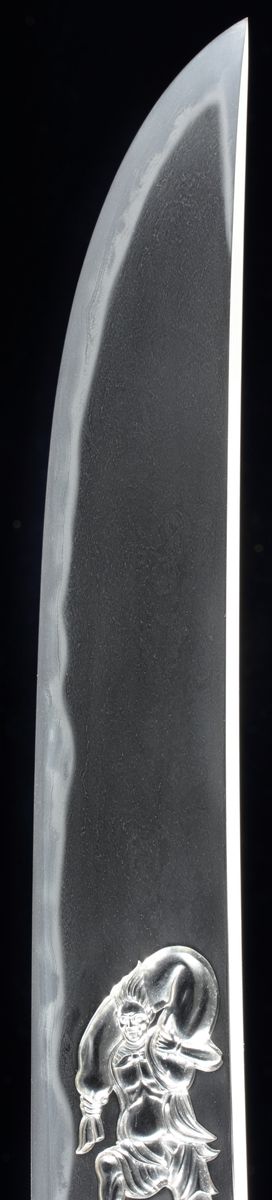
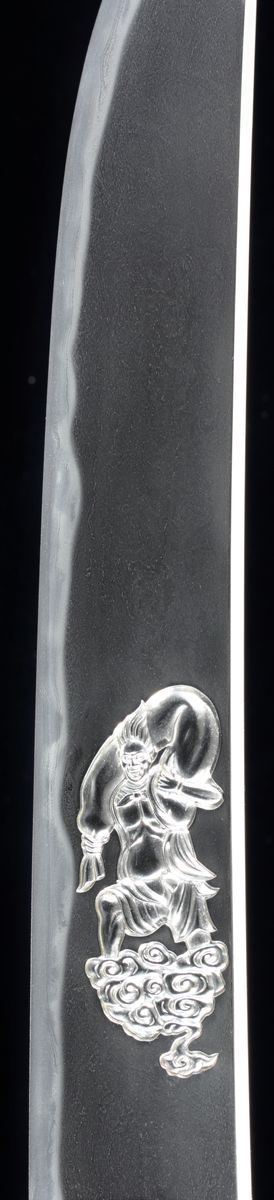
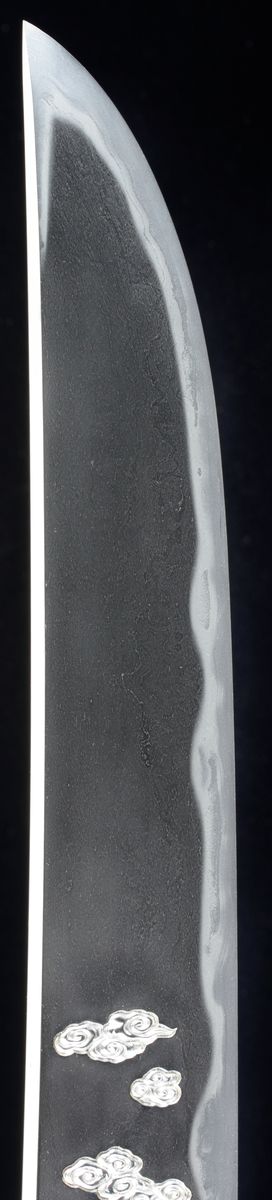
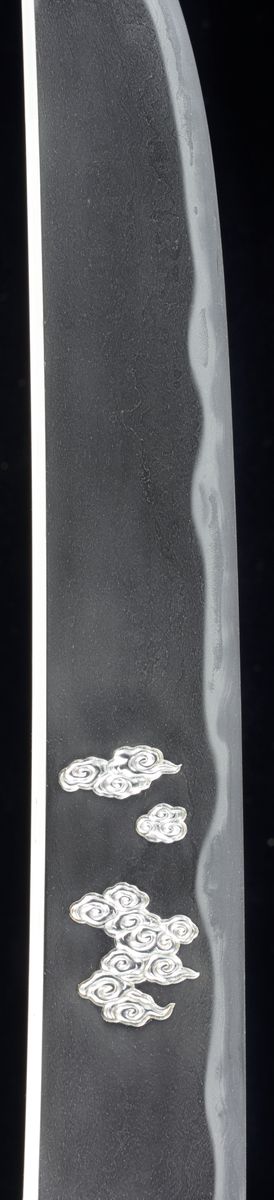
The sword engraver Yanagimura Soju is the son of master Yanagimura Senju, who was acclaimed as a master of sword engraving for expressing not only classical coiled dragons and Fudo Myoo but also novel designs in an antique style, and was born in Showa 46. From a young age, he was exposed to his father's work, inherited everything from him, and is also exploring new styles. He is a promising craftsman who will carry the future, having consecutively won special prizes such as the Excellence Award and the Chairman's Award at the Shinsakuto Exhibition.
Machine translation from the shop's Japanese · may contain errors ·
Forged by Miyairi Kei (Kozaemon Yukihira)
Moto-haba (Width at Ha-machi) approx. 3.94cm
"Yushu" prize winning work by NBTHK in 1995
Swordsmith Miyairi Kei is the son of the master Miyairi Yukihira, who was designated a Living National Treasure, and was born in Showa 32. Although he entered an apprenticeship under master Yukihira in Showa 52, because the master passed away suddenly that same year, he received subsequent instruction from his fellow student, swordsmith Fujiyasu Masahira. He has worked exclusively on the reproduction of the old Soshu tradition, creating intense midare-deki with a strong emphasis on nie, and is highly popular; he has received numerous special prizes at the Shinsakuto Exhibition, including the Kanzan Award, the Mainichi Shimbun Award, and the Takamatsunomiya Award, and was certified as a Mukansa swordsmith in Heisei 12. Furthermore, in Heisei 8, he inherited the mei of Yukihira used by his father and changed his name to Kozaemon Yukihira. He is one of the swordsmiths with a wide range of cultural activities, having exchanges not only with sword making but also with artists in other fields.
The sword engraver Yanagimura Soju is the son of master Yanagimura Senju, who was acclaimed as a master of sword engraving for expressing not only classical coiled dragons and Fudo Myoo but also novel designs in an antique style, and was born in Showa 46. From a young age, he was exposed to his father's work, inherited everything from him, and is also exploring new styles. He is a promising craftsman who will carry the future, having consecutively won special prizes such as the Excellence Award and the Chairman's Award at the Shinsakuto Exhibition.
Historical context
Shōwa to the present: destruction and revival
›
The twentieth century nearly killed the craft twice: wartime distortion, then the occupation ban. The NBTHK’s founding in 1948 and licensed forging from 1953 rebuilt the sword as an art, crowned by Living National Treasures and the mukansa rank.
If, due to our fault, the item differs significantly from its proper condition, the item may be returned. Cooling-off is within one week of the item's arrival.



 NihontoWatch