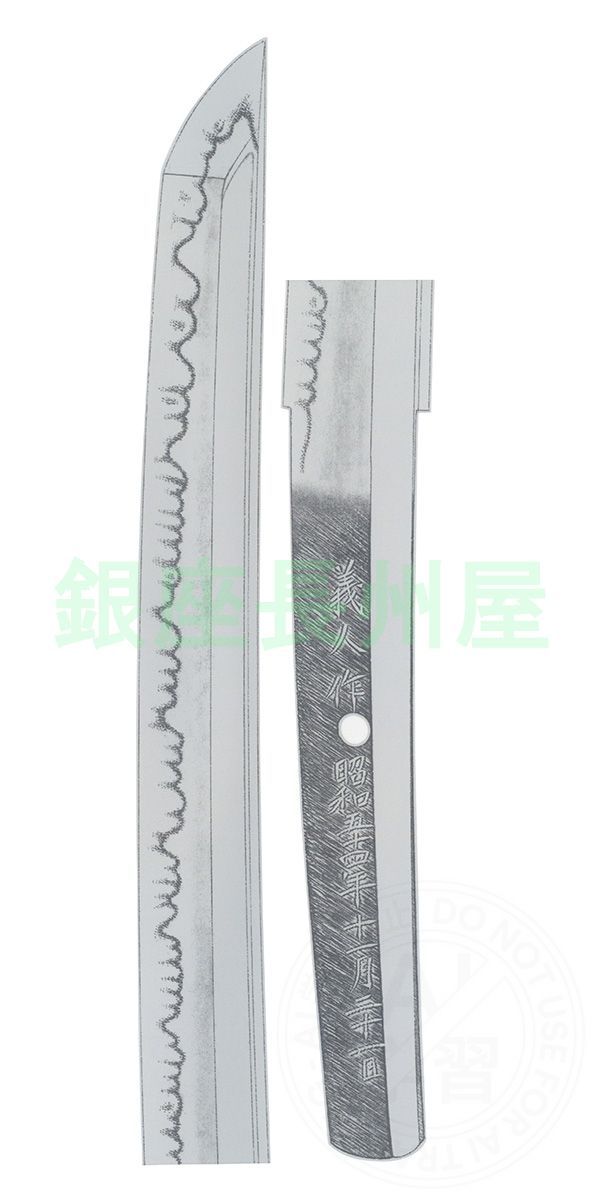
This is a piece by the master swordsmith Yoshihara Yoshindo, celebrated as a master of the Bizen-den, who likely took the Osafune Kagemitsu of the late Kamakura period as his model, resulting in a blade with a gorgeous and formidable hamon. While it has the dimensions of a kodachi housed in an Efu-tachi koshirae, the deep sori and the bo-hi carved through the length give it an expansive impression. The jitetsu, forged in ko-itame, has itame hidden in the depths and is finely packed, with fine ji-nie covering the entire surface to create a bright appearance; a faint utsuri accompanied by a dark band near the ha rises toward the shinogi, giving the overall piece a serene quality. The hamon is ko-gunome choji with the heads of the yakigashira thrusting in up to the middle of the blade; the choji heads are arranged in a complex manner as if dancing, and there is a tendency for the yakigashira to be aligned in a kataochi-fu style, which is exceptionally vivid. The ko-ashi that shoot out vigorously alongside the ko-choji are broken in places to become tobi-ashi, and they also slightly condense to become yo, showing diverse hataraki within the blade. The nioiguchi is bright and clear, and the yakiba, which is primarily nioi-based, has ko-nie intertwined with the yo in the blade that glisten in places, creating an impressive composition. The boshi is midare-komi and turns back in a slightly saki-togari style, with mune-yaki continuing down to the lower half of the blade.
Yoshihara Yoshindo was born in Tokyo in Showa 18. He learned sword forging from his grandfather, the first Kunikie, before becoming independent. He not only demonstrates high technical skill but also challenges himself with Bizen-to with an innate aesthetic sense; he has received the Yusho-sho consecutively at the Shinsaku Meito-ten and was certified as a Mukansa-tosho in Showa 56. He is also a man of great effort who has spared no effort in providing technical guidance to young swordsmiths and has conveyed the beauty of the Japanese sword overseas by holding solo exhibitions in various places such as Dallas, California, and San Francisco in the United States.
Machine translation from the shop's Japanese · may contain errors ·
This is a piece by the master swordsmith Yoshihara Yoshindo, celebrated as a master of the Bizen-den, who likely took the Osafune Kagemitsu of the late Kamakura period as his model, resulting in a blade with a gorgeous and formidable hamon. While it has the dimensions of a kodachi housed in an Efu-tachi koshirae, the deep sori and the bo-hi carved through the length give it an expansive impression. The jitetsu, forged in ko-itame, has itame hidden in the depths and is finely packed, with fine ji-nie covering the entire surface to create a bright appearance; a faint utsuri accompanied by a dark band near the ha rises toward the shinogi, giving the overall piece a serene quality. The hamon is ko-gunome choji with the heads of the yakigashira thrusting in up to the middle of the blade; the choji heads are arranged in a complex manner as if dancing, and there is a tendency for the yakigashira to be aligned in a kataochi-fu style, which is exceptionally vivid. The ko-ashi that shoot out vigorously alongside the ko-choji are broken in places to become tobi-ashi, and they also slightly condense to become yo, showing diverse hataraki within the blade. The nioiguchi is bright and clear, and the yakiba, which is primarily nioi-based, has ko-nie intertwined with the yo in the blade that glisten in places, creating an impressive composition. The boshi is midare-komi and turns back in a slightly saki-togari style, with mune-yaki continuing down to the lower half of the blade.
Yoshihara Yoshindo was born in Tokyo in Showa 18. He learned sword forging from his grandfather, the first Kunikie, before becoming independent. He not only demonstrates high technical skill but also challenges himself with Bizen-to with an innate aesthetic sense; he has received the Yusho-sho consecutively at the Shinsaku Meito-ten and was certified as a Mukansa-tosho in Showa 56. He is also a man of great effort who has spared no effort in providing technical guidance to young swordsmiths and has conveyed the beauty of the Japanese sword overseas by holding solo exhibitions in various places such as Dallas, California, and San Francisco in the United States.
The twentieth century nearly killed the craft twice: wartime distortion, then the occupation ban. The NBTHK’s founding in 1948 and licensed forging from 1953 rebuilt the sword as an art, crowned by Living National Treasures and the mukansa rank.
If, due to our fault, the item differs significantly from its proper condition, the item may be returned. Cooling-off is within one week of the item's arrival.








 NihontoWatch