Edo was the sword’s age of connoisseurship: the Hon’ami appraisers, the shogunal register of famous blades of 1719, and a thriving literature turned the sword into an object of study even as it ceased to be drawn in war.
 NihontoWatchNihontoWatch
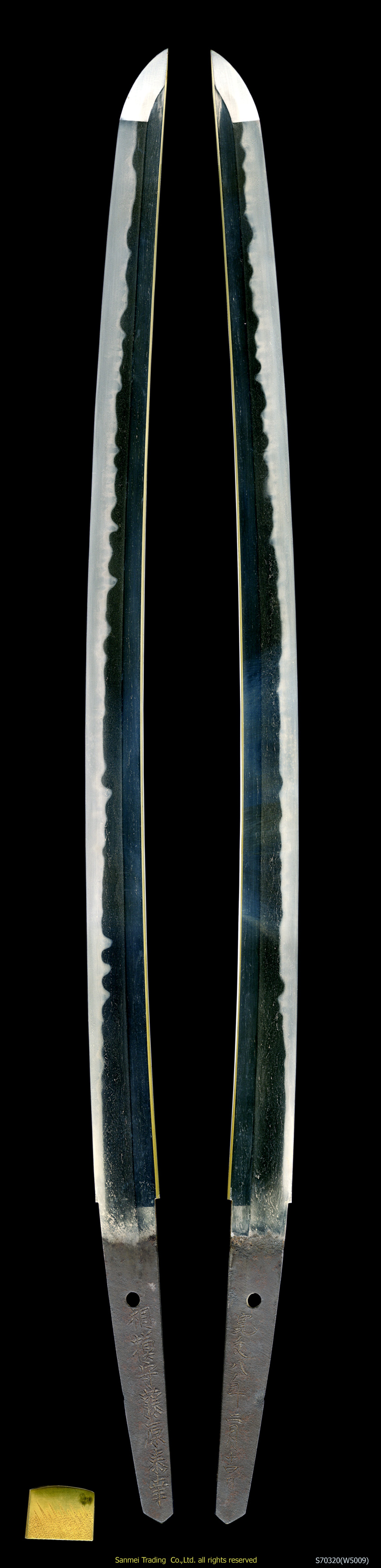
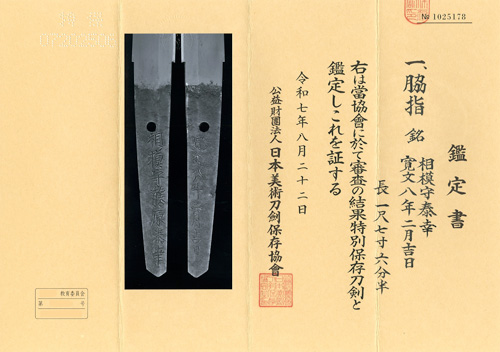
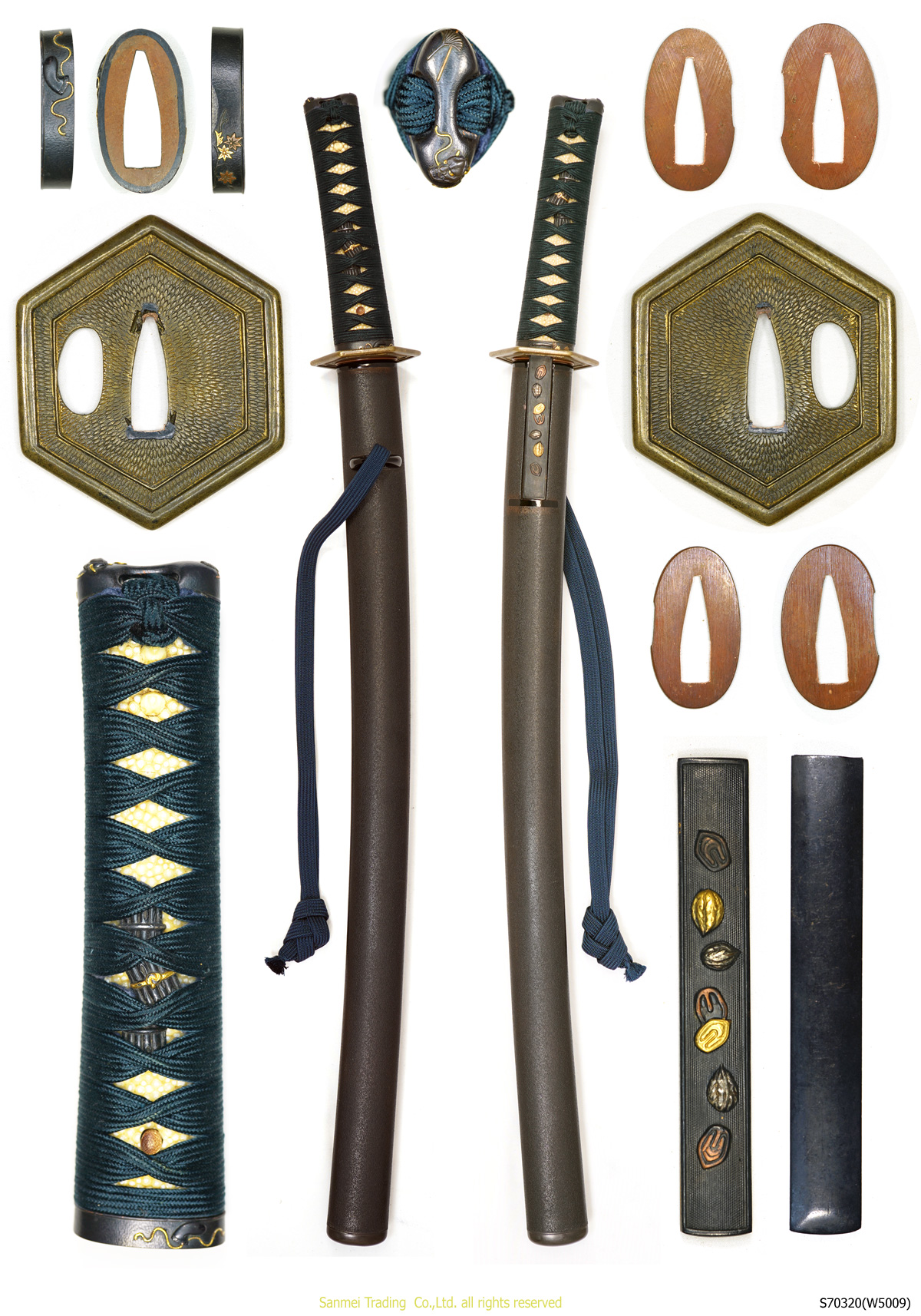
Blade construction: Shinogi-zukuri, Iori-mune. Mihaba is wide at base, appropriate degree of tapering toward the tip and shallow curve leading to an extended medium Kissaki. Forging(Hada): Forging mark is cnspicuous Itame wooden grain with streaming Masame ware. Hiraji surface is covered with uniform, sparkling glitter so called Ji-Nie - crystallized mist and darkish Nie dots so called Chikei activity gushes out from steel. Shinogi-ji surface shows Masame tight straight grain mark. Temper(Hamon): Hamon starts with slope of "Yakidashi" then sma Gunome, Togari-ha and Choji clove shape mixing with Tad-pole style Choji that varies in shape and height. Some of temper splashes over the surface to generate isolated Tobiyaki. Tang(Nakago): UBU, One peg hole. Greatly Slanting left (O-sujikai) file marks. V-shape (kengyo) heel. Back of Nakago shows Greatly Slanting left (O-sujikai) file marks.The signature on Haiomote starts with an official district Sagami-no-kami 相模守 title, the clan Fujiwara 藤原 then smith name YASUYUKI 泰幸 and the other side shows a date of manufactuing year Auspicious day in the 2nd month Kanbun 8th (1668) 寛文八年二月吉日. The 1st generation YASUYUKI 泰幸 who was born in Mino domain, had moved to Minami-Nagashima-cho, Nagoya after Nagoya castle relocation in the 2nd month, the 15th year of Keicho(1610). He obtained official district title "Noto-no-kami 能登守" and research material shows the date of year kanei 8, 13, 15, 18 and 20 (1631-1643). This wakizashi is the work of 2nd generation YASUYUKI 泰幸, who enjoyed Sagami-no-kami 相模守 title. His real name is SHINBEI 新兵衛. There are some research materials that shows the date of year Kanbun 5, 7, 8, 10 (1665-1670). As compared with the work of 1st gen., his works show thicker and deeper the chisel of signature and file marks is deeper as well. The heel shape is V-shape whereas one of 1st gen. is Double-bevelled (Kurijiri). This wakizashi, it is stout with wide Mihaba and masswive volume of Hiraniku heavy on hand. Reference to the workmanship of superfine quality steel and the date of manufactuing year Kanbun 8th (1668) adds an historical value as well. Accompanied by a Wakizashi Mounting Koshirae with Black Ishime-ji Lacquered Saya (Photographs of the complete mounting: Omote (front) / Ura (reverse) / Detailed photographs of the fittings) Fuchi-kashira: Noh Theatre Motif, Shakudō with Ishime-ji ground, high relief carving and Iroe inlays, unsigned Menuki: Bundles of Firewood Motif, Shakudō Katabori carving with Iroe inlays Tsuba: Hexagonal Design; brass grounf with Sukidashi-bori and Kebori, unsigned Kozuka: Scattered Walnuts Motif; Shakudō ground Nanako-ji surface, Takabori high relief carving and Iroe inlays, unsigned Tsuka (Hilt): Fitted with white Samegawa (ray skin) and wrapped in dark indigo-blue silk cord in a Morotsumami-hishi-maki style Single layer gold foiled Habaki collar, Preserved in a Shira-Saya plain wood mounting. An old good polish/Condition scale: mint-excellent (using a scale of mint-excellent-very good-good-fair-poor). reference data: Iwata Atou Owari Toukoufu 1985 Publisher : Nagoya city Board of Education
Yasuyuki泰幸
Offered by Sanmei
2 on the market

Owari · around 1673-1681
Fujishiro Chu-jo saku · Tōken Taikan top 77%
2 pieces on the market now
The Edo period (1615 to 1868)
Edo was the sword’s age of connoisseurship: the Hon’ami appraisers, the shogunal register of famous blades of 1719, and a thriving literature turned the sword into an object of study even as it ceased to be drawn in war.
A Hozon-certified blade judged to show notably superior workmanship and a better state of preservation. The bar is higher: re-tempered blades and most unsigned Muromachi/Edo works are excluded.
The NBTHK (Nihon Bijutsu Tōken Hozon Kyōkai, the Society for the Preservation of Japanese Art Swords) is a public-interest incorporated foundation founded in 1948 and supervised by Japan’s Agency for Cultural Affairs (Bunkachō); it is based at the Japanese Sword Museum in Tokyo. Its expert panels physically examine each submitted work (shinsa) and issue a certificate (kanteishō) ranking it by artistic and historical merit. NBTHK papers are the most widely recognized standard of authentication for Japanese swords and fittings.
NBTHK official siteFor a return, please contact us within 7 days of the item's arrival. If specification changes such as dimensions were made at the customer's request, a return cannot be accepted. Shipping and transfer fees are the customer's responsibility.
¥550,000