Born on January 23, Showa 7 (1932) in Ota City, Gunma Prefecture. Passed away in Heisei 21 (2009). Real name Osumi Sadao.
In Showa 27, he became an apprentice to the swordsmith Miyairi Akihira (Yukihira) (deceased, Ningen Kokuho).
From his master, he primarily mastered the forging methods of the Yamashiro-den and Rai Kunitoshi schools. After becoming independent, he aimed for the old celebrated swords of the Heian and Kamakura periods, engaging in the study of suguha to pursue the beauty of jitetsu. He especially devoted himself to the study and refinement of the Bitchu Aoe school's suguha.
He won the Masamune-sho, the highest award at the Meito-ten, three times. It is still fresh in memory that he respectfully crafted the omamori-gatana for Imperial Princess Toshi-no-miya Aiko in Heisei 13. With the establishment of the "Swordsmith Osumi Toshihira Support Association" in Showa 60, he has a wide fan base for his dignified suguha style, which is rare for a traditional crafts artist.
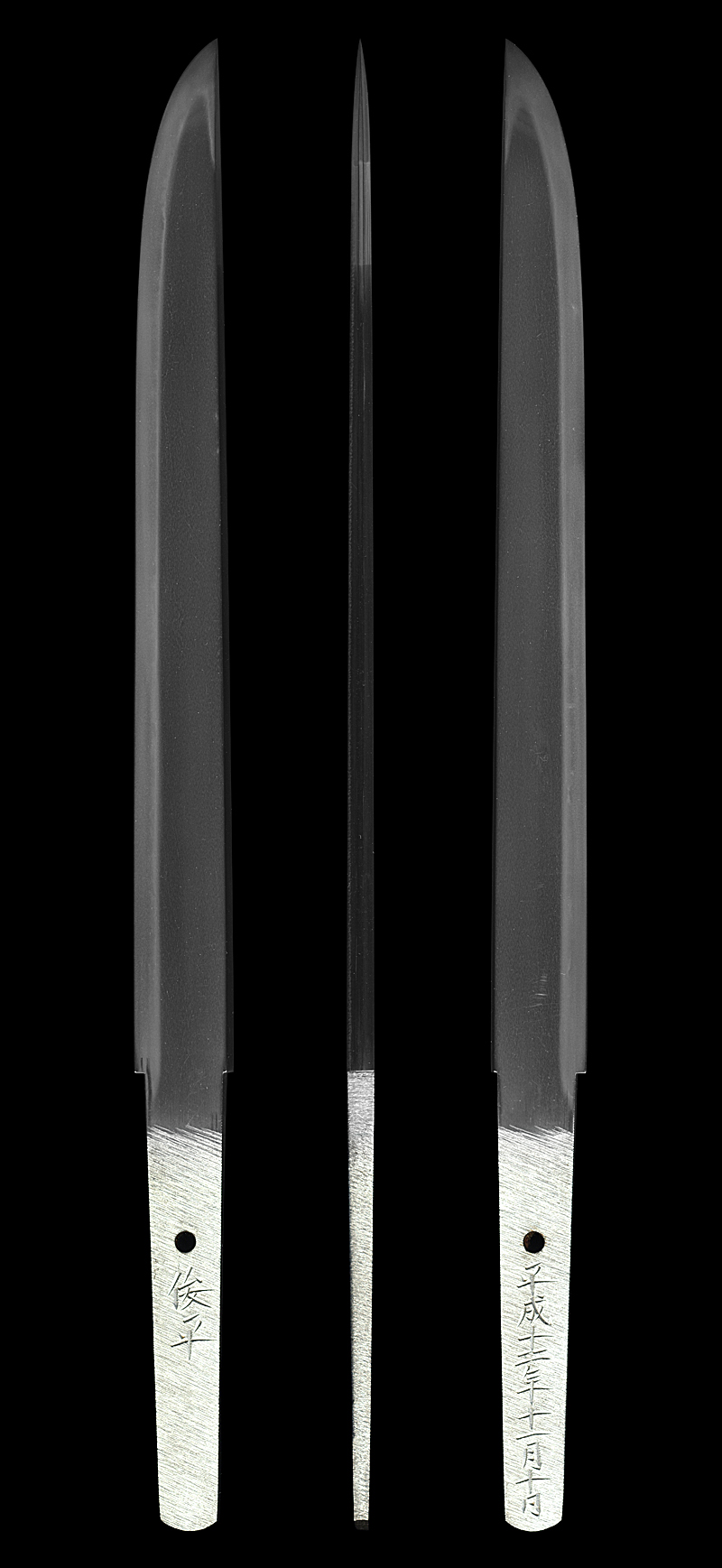
This work is believed to be an early period work by Osumi Toshihira; it is a rare work featuring hitatsura, and is a dignified and kenzen kaiken.
*Chronology of Osumi Toshihira
Showa 7: Born in Ota City, Gunma Prefecture.
Showa 27: Apprenticed to swordsmith Miyairi Akihira (Yukihira) to learn sword-making techniques.
Showa 32: Certified for sword-making by the Agency for Cultural Affairs and began sword-making activities. From his master, he primarily mastered the forging methods of the Yamashiro-den and Rai Kunitoshi schools. Thereafter, using old celebrated swords of the Heian and Kamakura periods as models, he devoted himself to the study and refinement of the Bitchu Aoe school's suguha.
Showa 33: First entry in the 4th Sakuto Gijutsu Hyopokai, receiving the Yushu-sho. Thereafter, even after the name was changed to the Shinsaku Meito-ten, he received numerous awards.
Showa 49, 51, 53: Received the Masamune-sho, the highest award, at the 10th, 12th, and 14th Shinsaku Meito-ten.
Showa 48, Heisei 5: Forged the goshinbo tachi-mi for the 60th and 61st Jingu Shikinen Sengu.
Showa 51: Certified as a holder of the Gunma Prefecture Designated Intangible Cultural Property "Nihonto".
Heisei 9: Certified as a holder of the Important Intangible Cultural Property "Nihonto".
Heisei 11: Received the Medal with Purple Ribbon.
Heisei 13: Respectfully crafted the omamori-gatana for Imperial Princess Toshi-no-miya Aiko.
Heisei 17: Received the Order of the Rising Sun, Gold Rays with Rosette.
Heisei 21: Passed away on October 4 at the age of 77.
*Regarding the respectful crafting of the omamori-gatana for Imperial Princess Toshi-no-miya Aiko
Wishing for the health of the Crown Prince and Princess's baby (Imperial Princess Toshi-no-miya Aiko), the "Shiken" ceremony was held in which a "mamori-gatana" and a hakama were gifted by His Majesty the Emperor. The sword and hakama (inventory) were handed from Grand Chamberlain Watanabe Makoto to Grand Master of the Crown Prince's Household Furukawa Kiyoshi, and were placed at the baby's bedside by a lady-in-waiting of the East Palace.
The toshin is the work of Ningen Kokuho Osumi Toshihira.
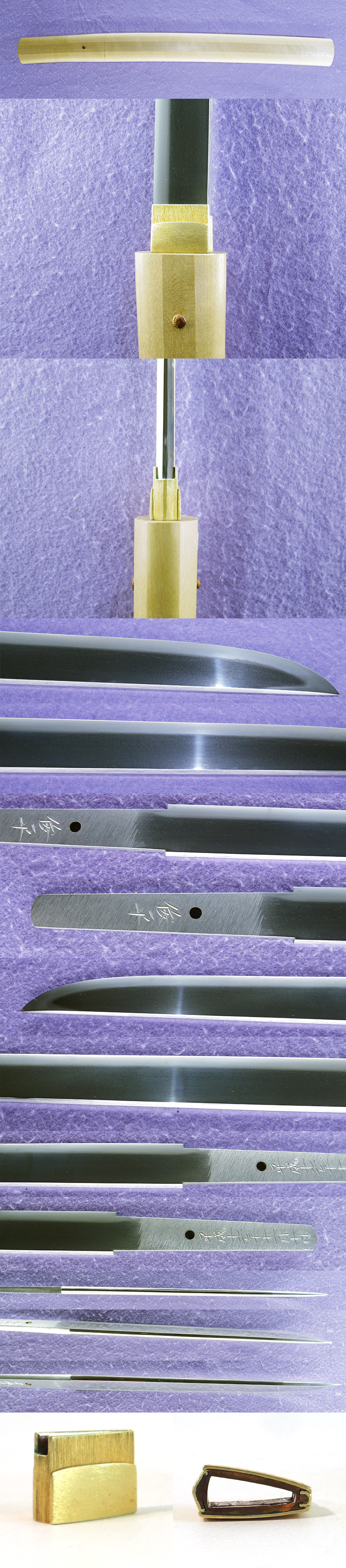
The hamachi is 25.7 centimeters. It is contained in a shiraki-zuri saya with a total length of 40.7 centimeters.
The saya is the work of Takayama Kazuyuki, who also worked on the swords for the two children of the Akishino family.
The sword was in a bag made of red nishiki on the front and white silk cloth on the back.
*What is a Ningen Kokuho?
Formally called a "Holder of an Important Intangible Cultural Property." Defined in the Law for the Protection of Cultural Properties, among intangible cultural properties with high historical or artistic value, particularly important skills are designated as "Important Intangible Cultural Properties," and individuals who have mastered and embodied them are certified as "Holders of Important Intangible Cultural Properties." They are commonly referred to as Ningen Kokuho.
Machine translation from the shop's Japanese · may contain errors ·
Born on January 23, Showa 7 (1932) in Ota City, Gunma Prefecture. Passed away in Heisei 21 (2009). Real name Osumi Sadao.
In Showa 27, he became an apprentice to the swordsmith Miyairi Akihira (Yukihira) (deceased, Ningen Kokuho).
From his master, he primarily mastered the forging methods of the Yamashiro-den and Rai Kunitoshi schools. After becoming independent, he aimed for the old celebrated swords of the Heian and Kamakura periods, engaging in the study of suguha to pursue the beauty of jitetsu. He especially devoted himself to the study and refinement of the Bitchu Aoe school's suguha.
He won the Masamune-sho, the highest award at the Meito-ten, three times. It is still fresh in memory that he respectfully crafted the omamori-gatana for Imperial Princess Toshi-no-miya Aiko in Heisei 13. With the establishment of the "Swordsmith Osumi Toshihira Support Association" in Showa 60, he has a wide fan base for his dignified suguha style, which is rare for a traditional crafts artist.
This work is believed to be an early period work by Osumi Toshihira; it is a rare work featuring hitatsura, and is a dignified and kenzen kaiken.
*Chronology of Osumi Toshihira
Showa 7: Born in Ota City, Gunma Prefecture.
Showa 27: Apprenticed to swordsmith Miyairi Akihira (Yukihira) to learn sword-making techniques.
Showa 32: Certified for sword-making by the Agency for Cultural Affairs and began sword-making activities. From his master, he primarily mastered the forging methods of the Yamashiro-den and Rai Kunitoshi schools. Thereafter, using old celebrated swords of the Heian and Kamakura periods as models, he devoted himself to the study and refinement of the Bitchu Aoe school's suguha.
Showa 33: First entry in the 4th Sakuto Gijutsu Hyopokai, receiving the Yushu-sho. Thereafter, even after the name was changed to the Shinsaku Meito-ten, he received numerous awards.
Showa 49, 51, 53: Received the Masamune-sho, the highest award, at the 10th, 12th, and 14th Shinsaku Meito-ten.
Showa 48, Heisei 5: Forged the goshinbo tachi-mi for the 60th and 61st Jingu Shikinen Sengu.
Showa 51: Certified as a holder of the Gunma Prefecture Designated Intangible Cultural Property "Nihonto".
Heisei 9: Certified as a holder of the Important Intangible Cultural Property "Nihonto".
Heisei 11: Received the Medal with Purple Ribbon.
Heisei 13: Respectfully crafted the omamori-gatana for Imperial Princess Toshi-no-miya Aiko.
Heisei 17: Received the Order of the Rising Sun, Gold Rays with Rosette.
Heisei 21: Passed away on October 4 at the age of 77.
*Regarding the respectful crafting of the omamori-gatana for Imperial Princess Toshi-no-miya Aiko
Wishing for the health of the Crown Prince and Princess's baby (Imperial Princess Toshi-no-miya Aiko), the "Shiken" ceremony was held in which a "mamori-gatana" and a hakama were gifted by His Majesty the Emperor. The sword and hakama (inventory) were handed from Grand Chamberlain Watanabe Makoto to Grand Master of the Crown Prince's Household Furukawa Kiyoshi, and were placed at the baby's bedside by a lady-in-waiting of the East Palace.
The toshin is the work of Ningen Kokuho Osumi Toshihira.
The hamachi is 25.7 centimeters. It is contained in a shiraki-zuri saya with a total length of 40.7 centimeters.
The saya is the work of Takayama Kazuyuki, who also worked on the swords for the two children of the Akishino family.
The sword was in a bag made of red nishiki on the front and white silk cloth on the back.
*What is a Ningen Kokuho?
Formally called a "Holder of an Important Intangible Cultural Property." Defined in the Law for the Protection of Cultural Properties, among intangible cultural properties with high historical or artistic value, particularly important skills are designated as "Important Intangible Cultural Properties," and individuals who have mastered and embodied them are certified as "Holders of Important Intangible Cultural Properties." They are commonly referred to as Ningen Kokuho.
Historical context
Shōwa to the present: destruction and revival
›
The twentieth century nearly killed the craft twice: wartime distortion, then the occupation ban. The NBTHK’s founding in 1948 and licensed forging from 1953 rebuilt the sword as an art, crowned by Living National Treasures and the mukansa rank.
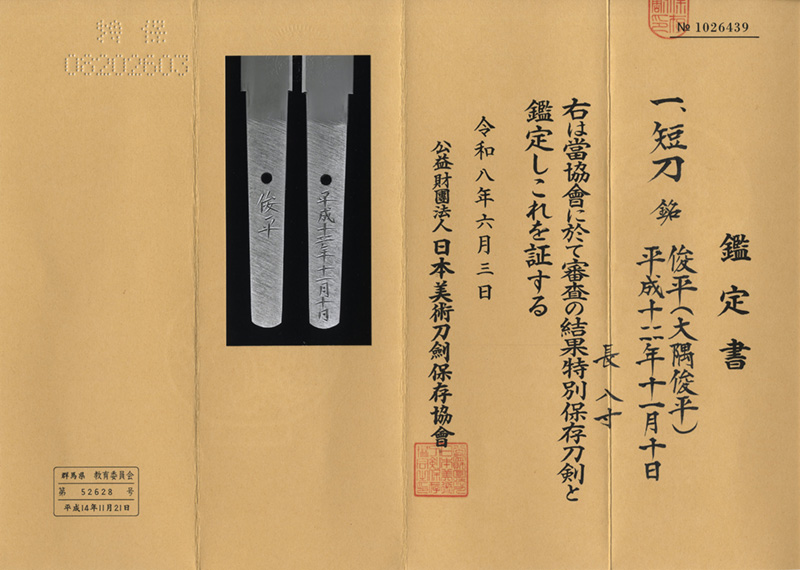
A Hozon-certified blade judged to show notably superior workmanship and a better state of preservation. The bar is higher: re-tempered blades and most unsigned Muromachi/Edo works are excluded.
About the NBTHK›
The NBTHK (Nihon Bijutsu Tōken Hozon Kyōkai, the Society for the Preservation of Japanese Art Swords) is a public-interest incorporated foundation founded in 1948 and supervised by Japan’s Agency for Cultural Affairs (Bunkachō); it is based at the Japanese Sword Museum in Tokyo. Its expert panels physically examine each submitted work (shinsa) and issue a certificate (kanteishō) ranking it by artistic and historical merit. NBTHK papers are the most widely recognized standard of authentication for Japanese swords and fittings.
Cooling-off (returns or exchanges) is accepted within 3 days of the item's arrival. Return shipping and refund transfer fees are the customer's responsibility. Fees other than the item price (transfer fees, credit card fees, etc.) cannot be refunded. Returns and refunds are not available for overseas destinations.

 NihontoWatch