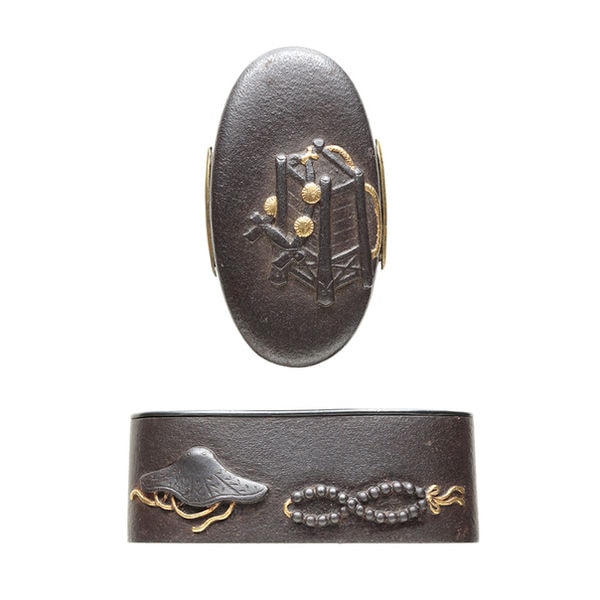
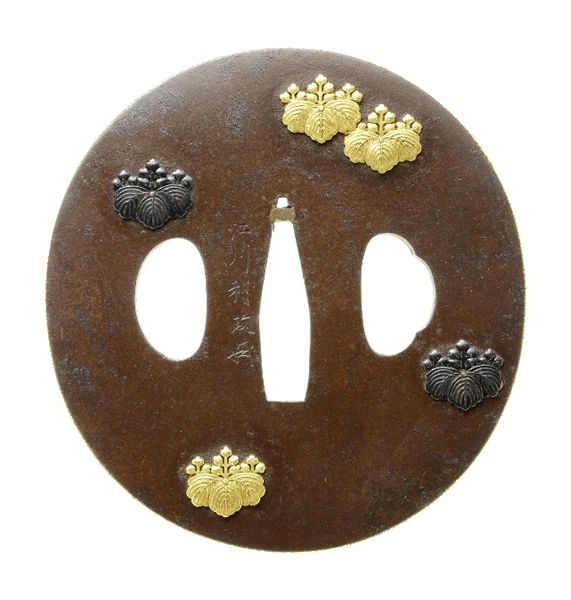
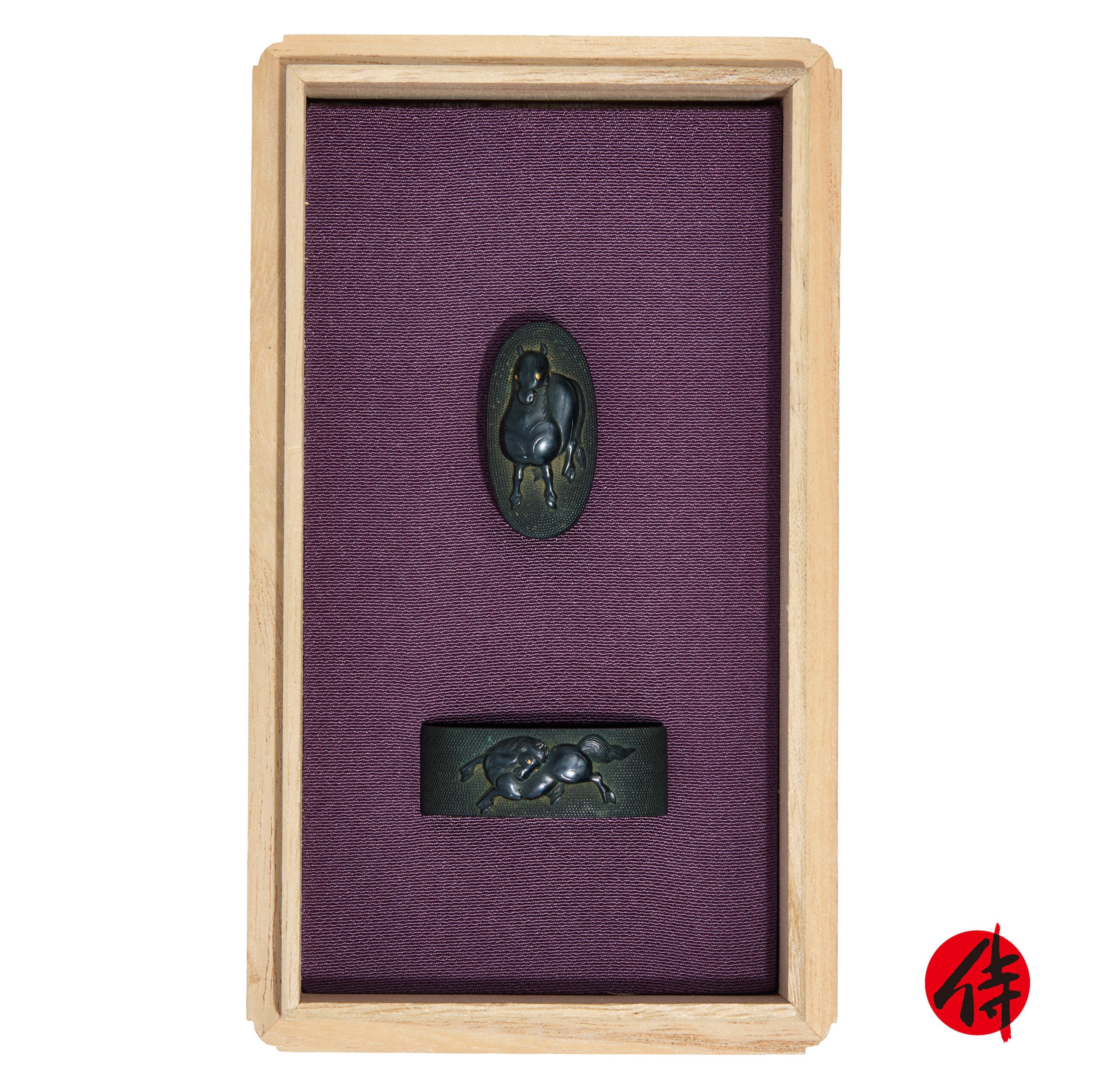
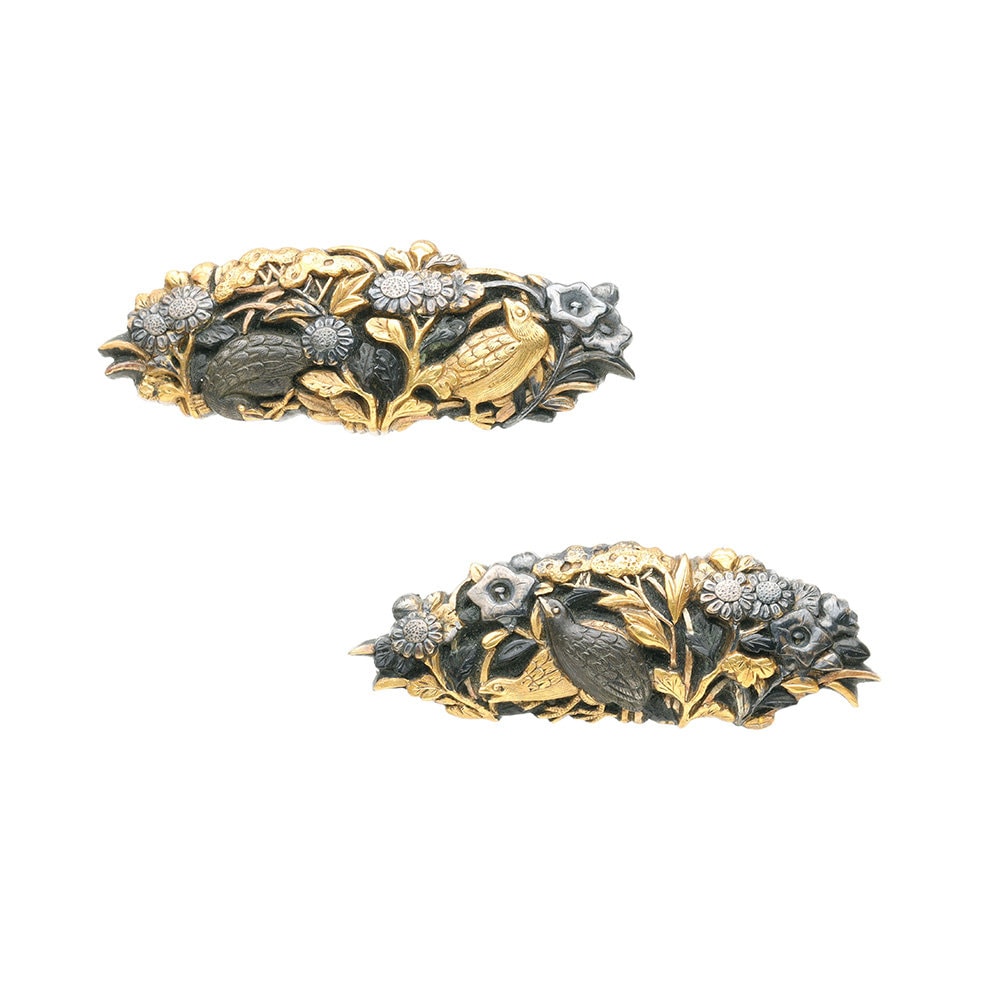
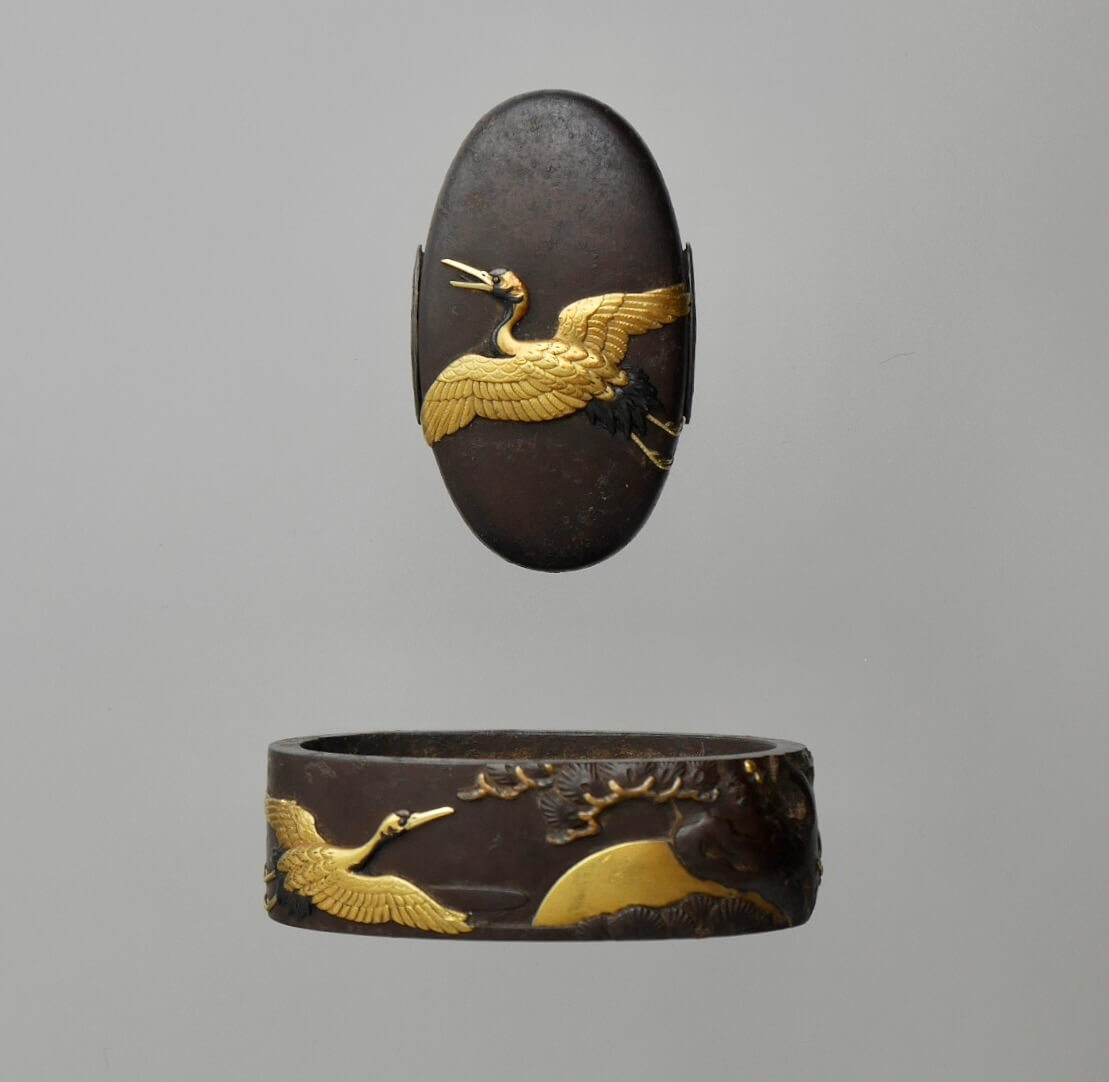
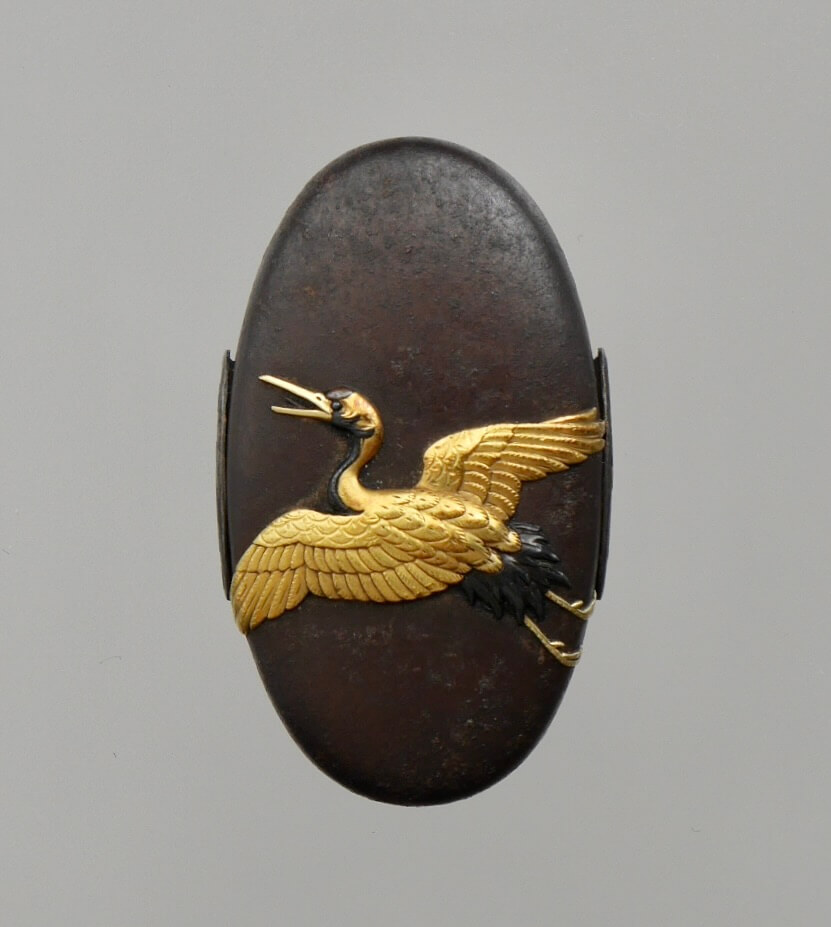
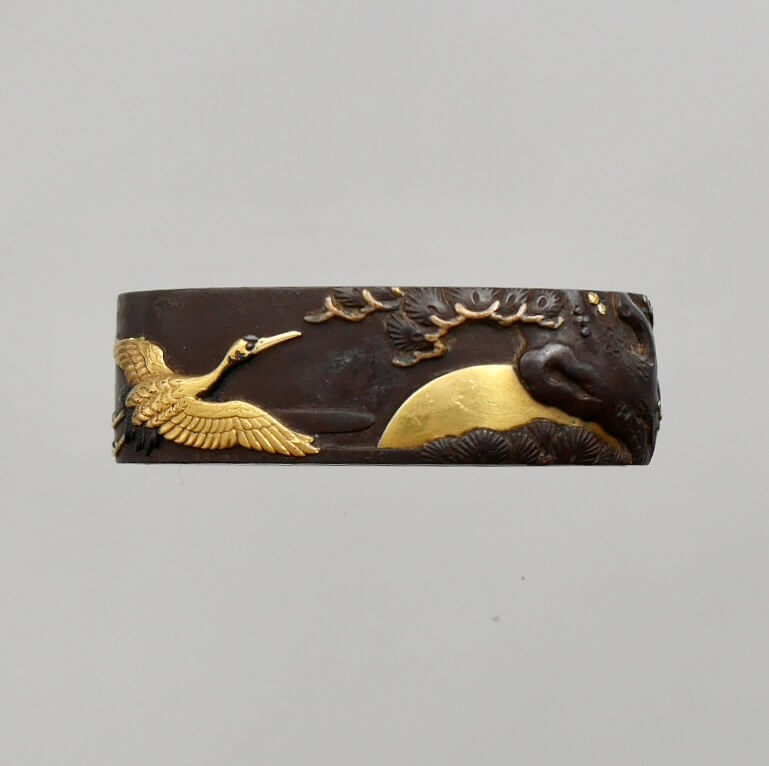
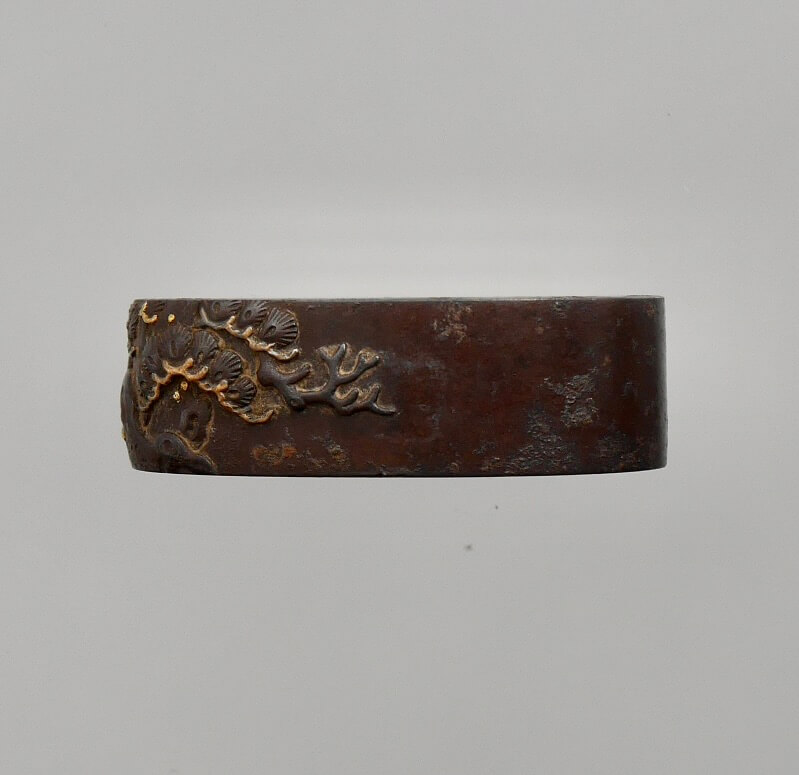
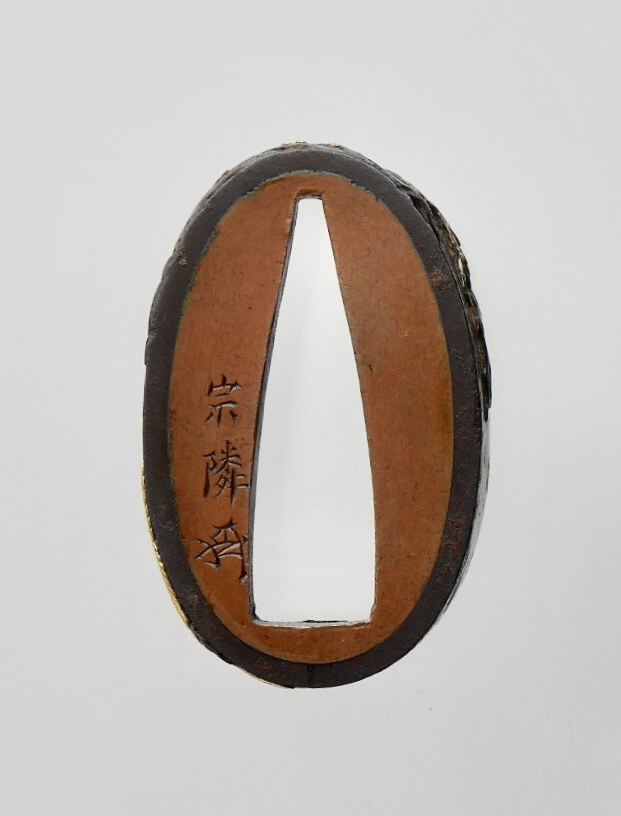
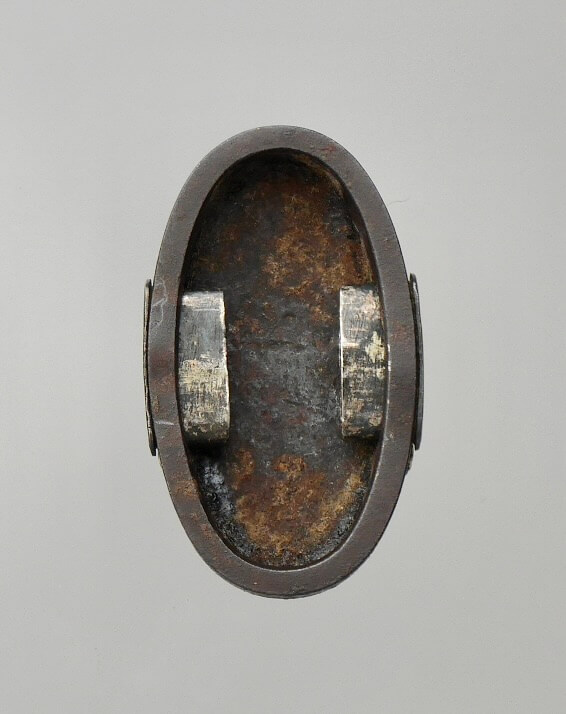
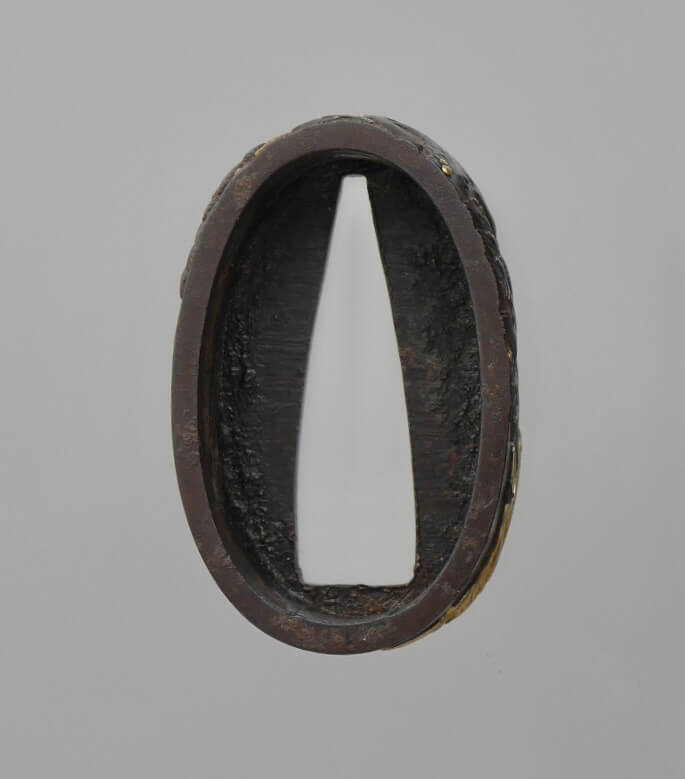
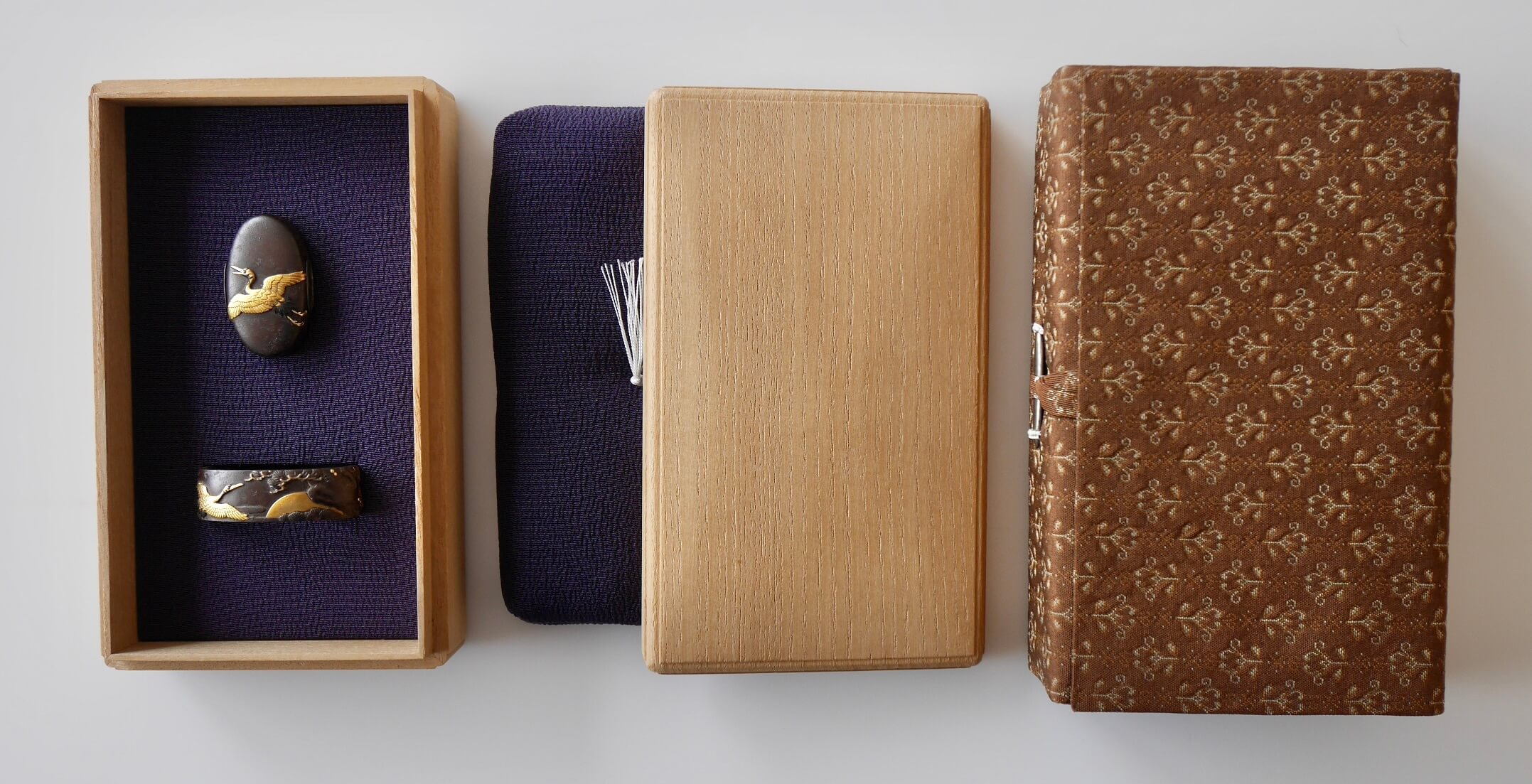
This is a signed fuchigashira by Egawa Sorin, a student of Yokoya Eisei, from the late Edo period. It features two cranes against a rising sun and pine trees, rendered in high-relief carving with various metals on an iron ground. The piece is accompanied by an NBTHK Hozon Tosogu certificate.
 NihontoWatch
mei · Yokoya · Edo (1670)
Yokoya
Edo
Signed
Hozon (NBTHK)
Kinko · around 1670
1 piece on the market now
Katsura Sorin, commonly known as Seikichi, was born in Mito in An'ei 2 (1773) under the original surname Egawa; he is the same individual as the first-generation Egawa Toshimasa. He went to Edo and studied under Yokoya Eisei, where he was recognized for his promise by Katsura Eiju, a senior fellow disciple. At Eiju's earnest request, Sorin was adopted into the Katsura house, succeeded to that family, inherited Eiju's common name Saichiro, and -- continuing in the footsteps of his adoptive father -- became a retained craftsman (kakae-ko) to the Arima family, daimyo of Kurume Domain. He was a remarkably long-lived artist: dated signatures are known from when he was seventy-five, eighty-two (Ansei 2, 1855), and even eighty-eight. He used both the Egawa and Katsura surnames and signed variously as "Katsura Sorin," "Egawa Sorin," and "Egawasai Katsura Sorin," always appending his kao.
Sorin's work is characterized by takabori (high-relief carving) of abundant volume and richly modeled weight, executed on finely finished nanako-ji grounds of shakudo, silver, or gold. His polychrome iroe employing gold, silver, and shakudo is minute and careful, superbly depicting both powerful motion and stillness. In his tsuba, he conceived compositions in which obverse and reverse are expressed straightforwardly as the near and far aspects of a landscape, skillfully exploiting openwork to heighten narrative quality. Firm nikubori modeling, delicate carving of iron grounds for water ripples and drifting haze, and fluent gold inlay on complementary fittings demonstrate mastery across materials. His ensembles are notable for the sophisticated contrast between iron tsuba and soft-metal kodugu, each technique brought to full effect within a unified artistic vision.
Sorin drew extensively upon literary and courtly subjects -- the Rokkasen (Six Immortal Poets), episodes from Ise Monogatari such as Narihira's Azuma-kudari, and celebrated meisho landscapes including Noji no Tamagawa and Noda no Tamagawa. His works overflow with an elegant, courtly sensibility, and his compositions, though sumptuous in effect, avoid any sense of disorder through the skillful placement of mist[[c:1]] and the deliberate orchestration of space. The NBTHK regards his finest productions as works in which his "true merits are fully realized," with individual pieces singled out as the hakubi (finest) among his oeuvre[[c:5]]. Even works inscribed at advanced ages display exceptionally fresh workmanship, clearly manifesting Sorin's sustained level of technique and artistic sensibility[[c:3]] across a career of extraordinary length.
Where Sorin stands among comparable artisans: across all of nihontō, and within tradition, era, and period. The tiers (Foremost · Leading · Major · Notable) weigh official designations from the NBTHK and Japan's Agency for Cultural Affairs, together with historical honors of lasting repute such as the Sansaku and Meibutsu-chō.
Select a lens to see how it's measured.
Kinko · Kai
5 pieces on the market now
The Egawa school (江川) traces its origins to Kai Province, though its defining master, Egawa Toshimasa (江川利政) -- also known as Katsura Sorin (桂宗隣) -- was born in Mito in An'ei 2 (1773). Toshimasa traveled to Edo and entered the atelier of Yokoya Eisei (横谷英精), placing himself within the Yokoya lineage of iebori (hereditary atelier carving). His promise was recognized by a senior fellow student, Katsura Eiju (桂永寿), who adopted him into the Katsura house; Toshimasa thereupon succeeded that family and, like Eiju, became a retained craftsman (kakae-ko) to the Arima family, lords of Kurume Domain. He used both the Egawa and Katsura surnames throughout a remarkably long career: dated works are recorded at ages seventy-five, eighty-one, eighty-two, and even eighty-eight -- testament to a creative life spanning the breadth of the late Edo period. The "Toshi-"[[c:1]] prefix visible in members' names suggests a hereditary lineage consciousness within the school. The technical vocabulary of the Egawa school is rooted in the Yokoya tradition yet distinctly individual. The characteristic ground is shakudo nanako-ji[[c:2]], though silver nanako-ji and oborogin (朧銀, hazy silver alloy) grounds appear with equal authority.
Upon these prepared surfaces, the school deploys takabori (高彫, high-relief carving) of pronounced volume and powerful modeling, enriched with iroe (色絵, polychrome inlay) in gold, silver, and shakudo, frequently supplemented by suemon-zogan (据文象嵌, applied-relief inlay). The repertoire of subjects is wide and literarily grounded: tigers in the mizunomi-tora (水呑虎) convention; peonies and shishi-lions in the idiom at which "the Yokoya school excelled"; Rokkasen (Six Immortal Poets) programs with menuki carved in solid-gold yobori (容彫, sculptural carving); Ise Monogatari scenes of Narihira's Azuma-kudari; and meisho landscapes evoking poetic locales such as Noji no Tamagawa and Noda no Tamagawa. " Iron grounds also appear, worked in sukidashi-bori with openwork (sukashi) "skillfully exploited to heighten the narrative quality," as in the tiger tsuba with its delicate water ripples and drifting haze. While grounded in the Yokoya iebori tradition, the school's choice of subject and modeling also reveal "the fresh, innovative sensibility associated with machibori," the town-carver idiom. The Egawa school occupies a distinctive place in the late-Edo tosogu canon as a bridge between the orthodox Yokoya atelier inheritance and the expressive freedom of the machibori world. In NBTHK examinations, Toshimasa's works have been recognized for their elevated dignity appropriate to daimyo equipment, their courtly, graceful sensibility, and their sumptuous yet disciplined pictorial programs. " That these works span formal daisho koshirae of "notably elevated dignity," unified issaku-kanagu suites, and intimate pictorial tsuba alike demonstrates the school's comprehensive command of the kinko metalworker's art. Learn more →
| Smith | Era | Designated |
|---|---|---|
| Sorin宗隣 | 1670 | 10 |
| Toshihide利英 | — | 0 |
| Toshiyasu利易 | — | 0 |
| Eiho永保 | — | 0 |
| Toshimasa利政 | — | 0 |
Certifies a genuine fitting worth preserving: a correct signature, or, if unsigned, an identifiable era and school, with recognized artistic and craft value.
The NBTHK (Nihon Bijutsu Tōken Hozon Kyōkai, the Society for the Preservation of Japanese Art Swords) is a public-interest incorporated foundation founded in 1948 and supervised by Japan’s Agency for Cultural Affairs (Bunkachō); it is based at the Japanese Sword Museum in Tokyo. Its expert panels physically examine each submitted work (shinsa) and issue a certificate (kanteishō) ranking it by artistic and historical merit. NBTHK papers are the most widely recognized standard of authentication for Japanese swords and fittings.
NBTHK official siteReturns accepted within 7 days of delivery (return shipping paid by customer); items must arrive in original condition; international orders cannot be returned.
¥420,000