説明
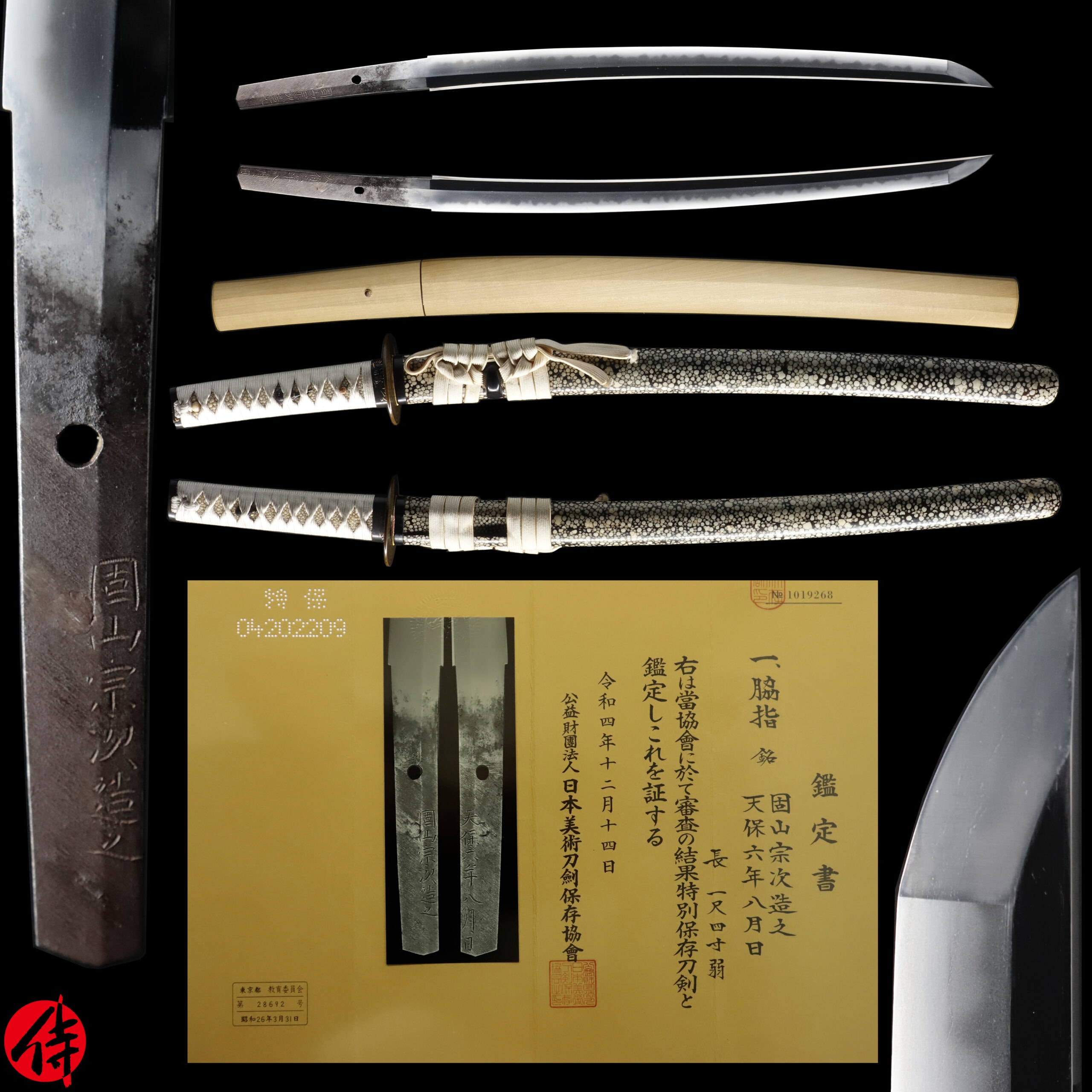
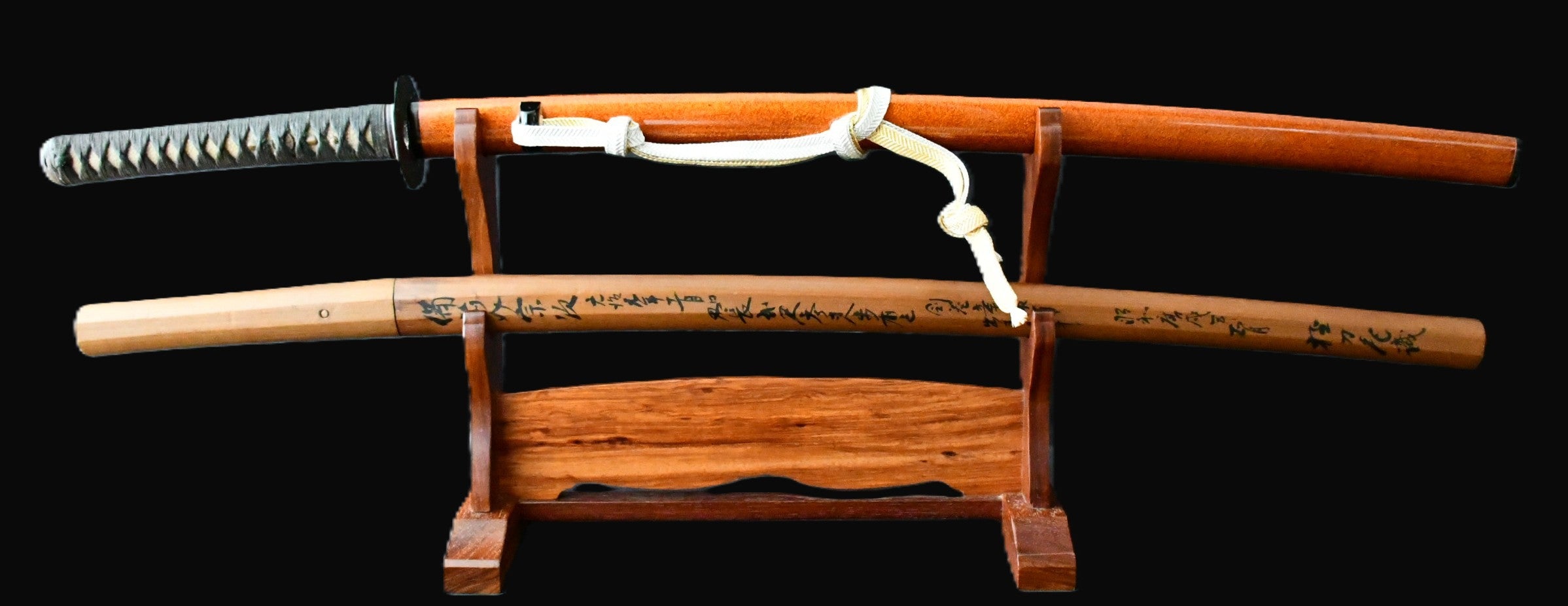
Antique Japanese Sword Wakizashi Signed by Koyama Munetsugu with NBTHK
Tokubestsu
Hozon
Certificate
【Description】
This blade is signed by Koyama Munetsugu (固山宗次) in in Musashi province (Today’s Tokyo) in the 6th year of Tenpo (1835) in Musashi province (Today’s Tokyo). He is also known as the name of Fujiwara Munetsugu (備前助藤原宗次).
Munetsugu’s birthname name was Koyama Sobei (固山宗兵衛). He was born as the third son of Koyama Munehira(固山宗平) in Shirakawa domain in Mutsu province (today’s Fukushima prefecture) in 1803. It is said that he learned the sword-forging technique from Kato Tsunahide (加藤綱英) first and was also an apprentice of
Chounsai Tsunatoshi (長運斎綱俊)
, a younger brother of Tsunahide to improve his craftsmanship. He worked for the Hisamatsu-Matsudaira family of the Shirakawa domain, and Matsudaira Sadanobu, whom he served, is widely known in Japan as one of the most famous politicians of the Edo period.
His work reflects Bizen Den, one of the five most traditional Japanese sword-forging techniques (五箇伝). He was excellent at forging blades with Choji Gunome Midare tempering line, one of the most noticeable characteristics of Bizen Tradition. He was active in sword-forging during 1830-1870. He is arguably the finest smith working in the Bizen tradition at the end of the Edo period.
This blade is appraised as a
Tokubetsu Hozon Token
(特別保存刀剣) issued by NBTHK(Nihon Bijutsu Touken Hozon Kyokai:日本美術刀剣保存協会). This authentication paper was only given to authentic Japanese swords, especially well preserved and high quality with artistic value.
*Please keep in mind that there is very light black rust on this blade. If you like to know the detailed condition, please feel free to contact us.
【Blade】
Cutting Edge Length(Nagasa)
:
42.4
cm ( 16.7
inches)
Curvature(Sori)
:
0.96 cm
(0.37 inches)
Hamon
:
The crystalline structure which forms along the cutting edge of a blade as a result of the hardening process
Jimon(Jihada)
:
visible steel surface pattern created by folding and hammering during forging process
Kissaki
:
Kissaki is the tip of the Japanese sword.
Nakago
:
Nakago is the tang of the Japanese sword.
Japanese swordsmiths left the black rust on the tang because it prevents red rust while the tang is in its handle. And the discoloration of the tang was created over time, and it is a great indicator for a Japanese sword specialist to estimate when the sword was forged.
Koshirae:
Koshirae is the mounting of the Japanese sword. There are several parts that consist of Koshirae such as Saya(Scabbard), Tsuka( Handle), Tsuba(Handguard).
Fuchi-Kashira
:
A pair of matching sword fittings that cover the upper and bottom parts of its sword hilt.
The Fuchi-Kashira is decorated with birds and one of them is a hawk.
Hawk is an intelligent bird used for hunting, called falconry. It was famous as a recreation among high-class Samurais. In the old days, it was also familiar with emperors and royal families, so it might be why the hawk was regarded as a symbol of the ruler’s authority. During the warring period, the boy’s success was to become an excellent Samurai; therefore, it has been thought that men (Samurai) and the hawk had a deep connection as a symbol of advancement and authority. Many Samurais loved this design based on that reason.
Furthermore, its wings were used for one of Samurai’s primary weapons; an arrow (They put hawk’s wings as arrow’s feather). The arrow itself is reminiscent of victory or defeat, battlefield; it is not difficult to imagine that Samurais also liked the hawk wings attracted to arrows. Still today, various family crests use this bird wing’s motif.
Tsuka and Menuki
:
Tsuka is the handle of the Japanese sword and Menuki is its decoration.
The theme of the Menuki is an eggplant.
This vegetable design has been treated as an auspicious motif. For example, there is an expression that says “Ichi-Fuji Ni-Taka San-Nasubi (一富士 二鷹 三茄子, one Mt. Fuji, two hawks, and three eggplants).” In Japan, these are considered auspicious si



![Sunnobi Tanto [Bizen-no-suke Munetsugu (Koyama Munetsugu)] [N.B.T.H.K] Tokubetsu Hozon Token](/_next/image?url=https%3A%2F%2Fitbhfhyptogxcjbjfzwx.supabase.co%2Fstorage%2Fv1%2Fobject%2Fpublic%2Flisting-images%2Fworld-seiyudo%2FL73468%2F00.jpg&w=2560&q=90)