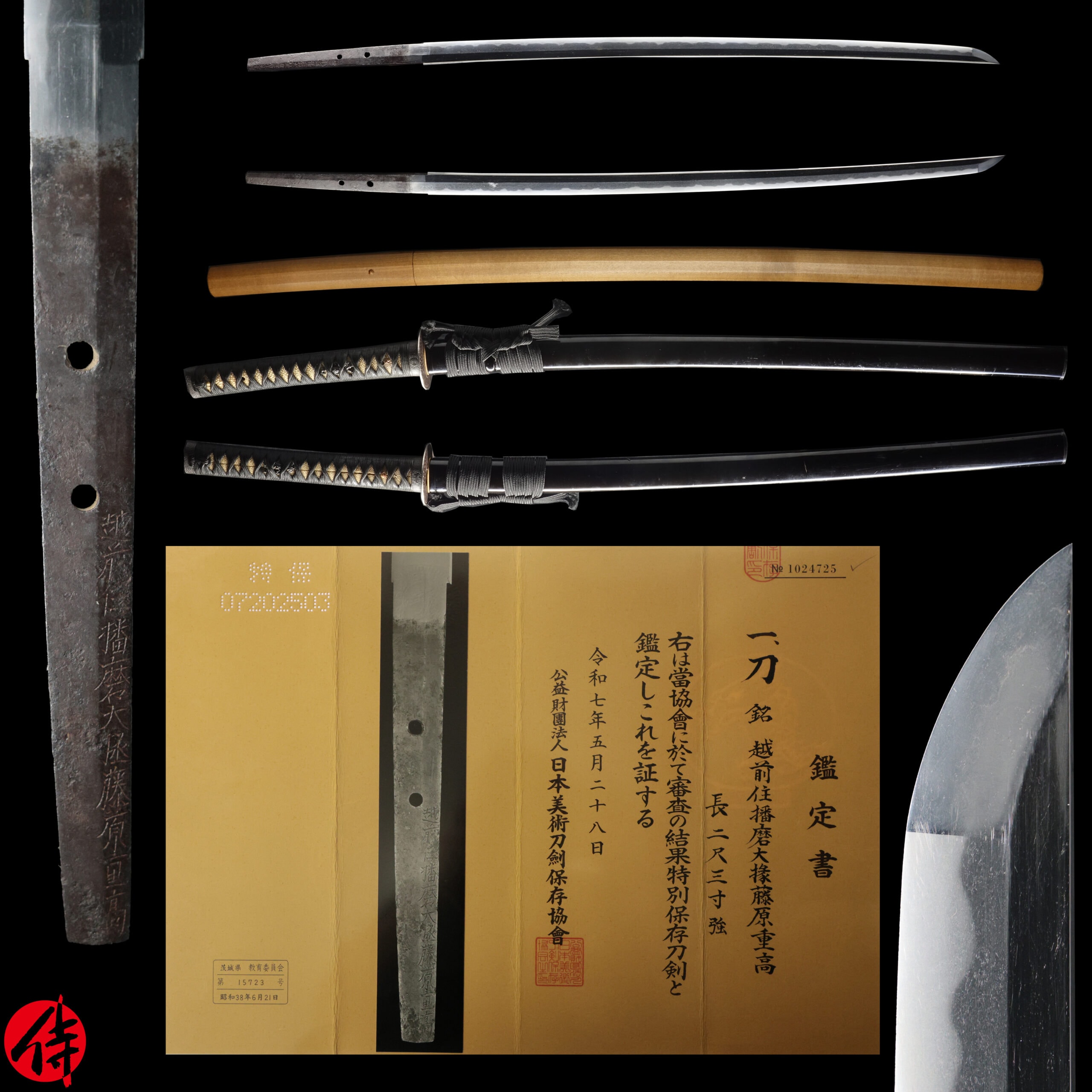
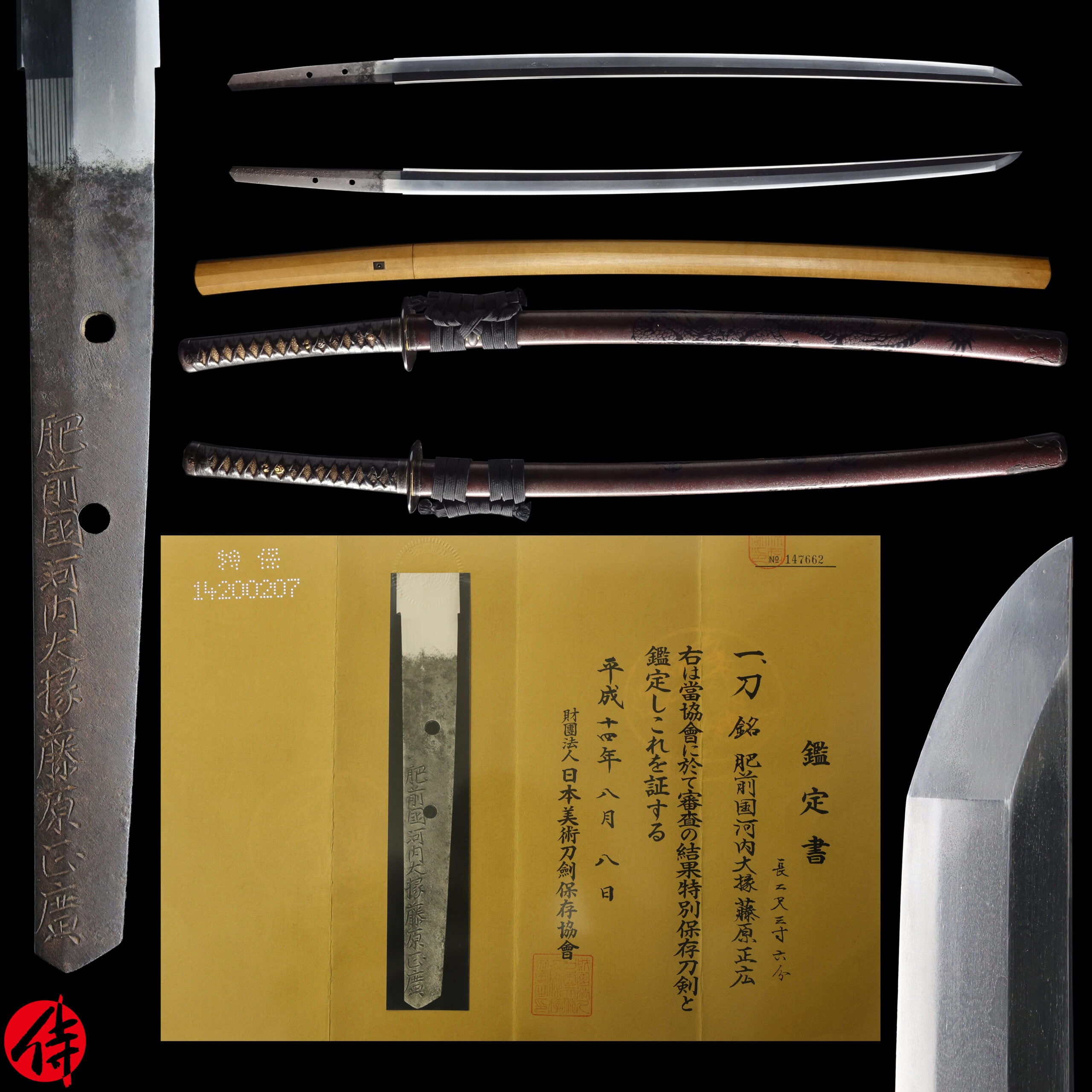
説明
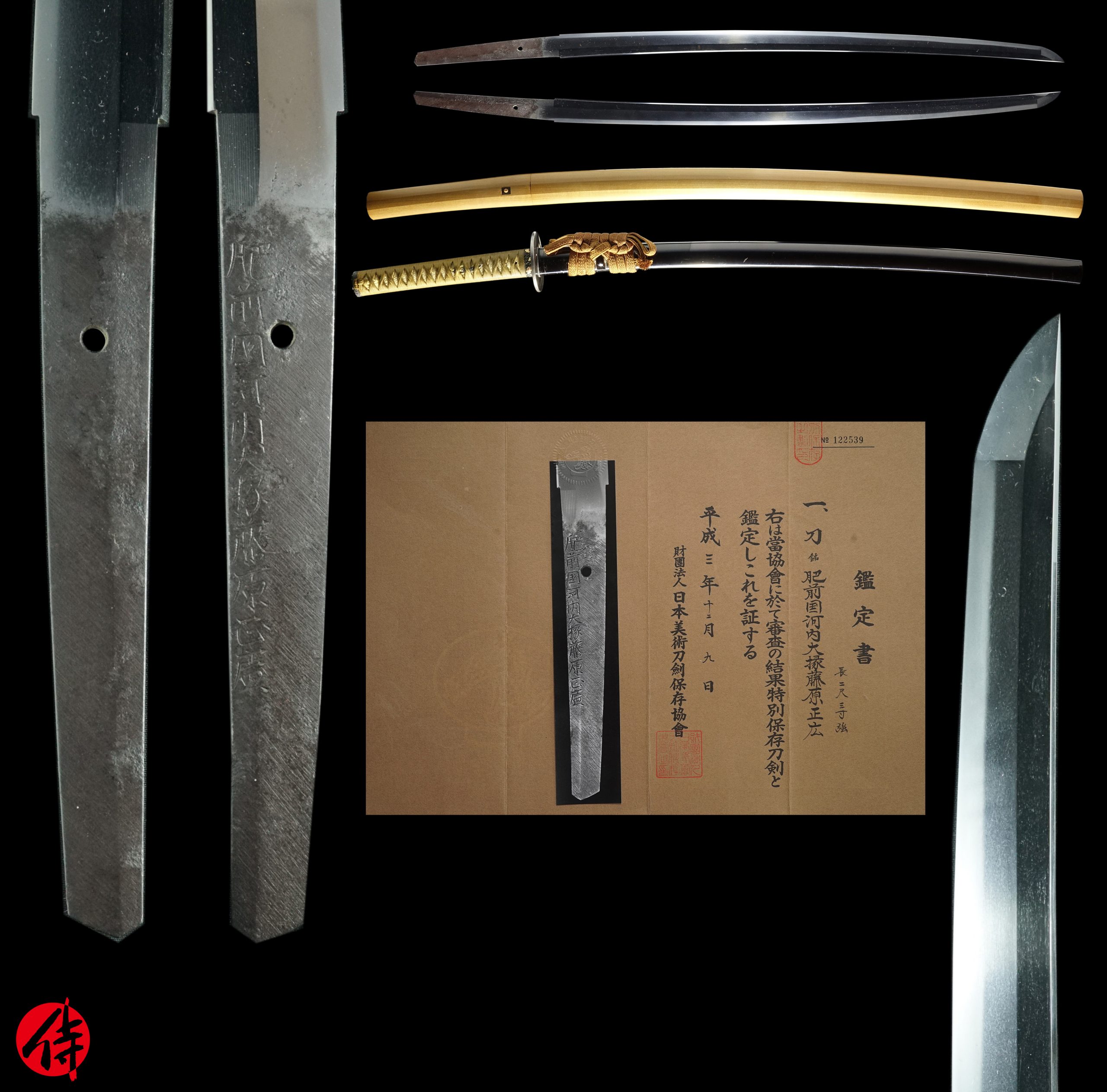
Antique Japanese Sword Katana Signed by Masahiro with NBTHK
Tokubetsu Hozon
Certificate
【Description】
Kawachi Daijyo Fujiwara Masahiro(河内大掾藤原正広) is a renowned swordsmith from Hizen province. (today’s Saga prefecture).
He was the grandson of Tadayoshi, the founder of Tadayoshi school in Hizen province. At the beginning of his career, Masahiro signed as Masanaga and then changed it to Masahiro in 1625 A.D(the second year of Kanei).
He was especially highly regarded among the Nabeshima clan, a powerful feudal family in Hizen province. Nabeshima Katsushige is the one who ordered Masahiro to change his maker’s name. Masahiro was selected as Okakae Kaji for Nabeshima clan, meaning he was exclusively forging swords for the feudal family. It was quite honorable for any swordsmiths to be an Okakae Kaji. It is said that Masahiro’s forging technique was so great that he sometimes forged swords on behalf of Tadayoshi.
The swords forged in Hizen province are known as Hizen To, famous for its beautiful Jigane. (The steel of a constructed blade)
This sword has a Tokubetsu Hozon certificate issued by NBTHK. This authentication paper was only given to Japanese swords, especially worth preserving by Nihon Bijutsu Touken Hozon Kyokai(the Society for the Preservation of the Japan Art Sword). This blade is in excellent condition and comes with a beautiful set of sword mountings.
【 Blade】
Cutting Edge Length(Nagasa)
:
69.8
c
m(27.5 inches)
Curvature(Sori)
:
1.2
cm(0.47 inches)
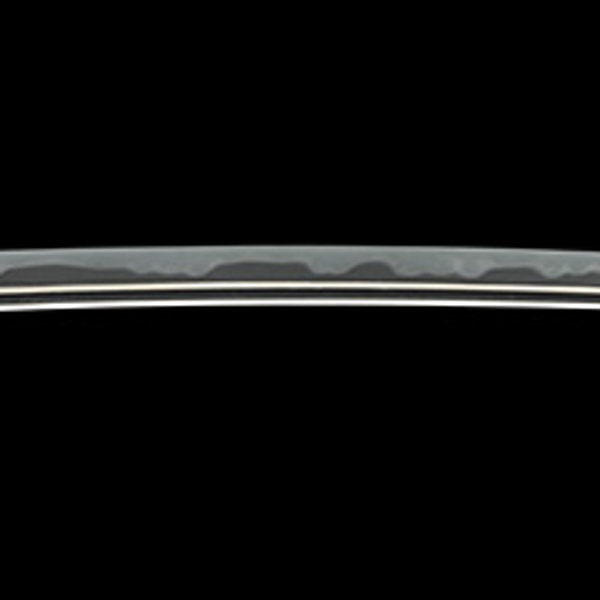
Hamon
:
The crystalline structure which forms along the cutting edge of a blade as a result of the hardening process
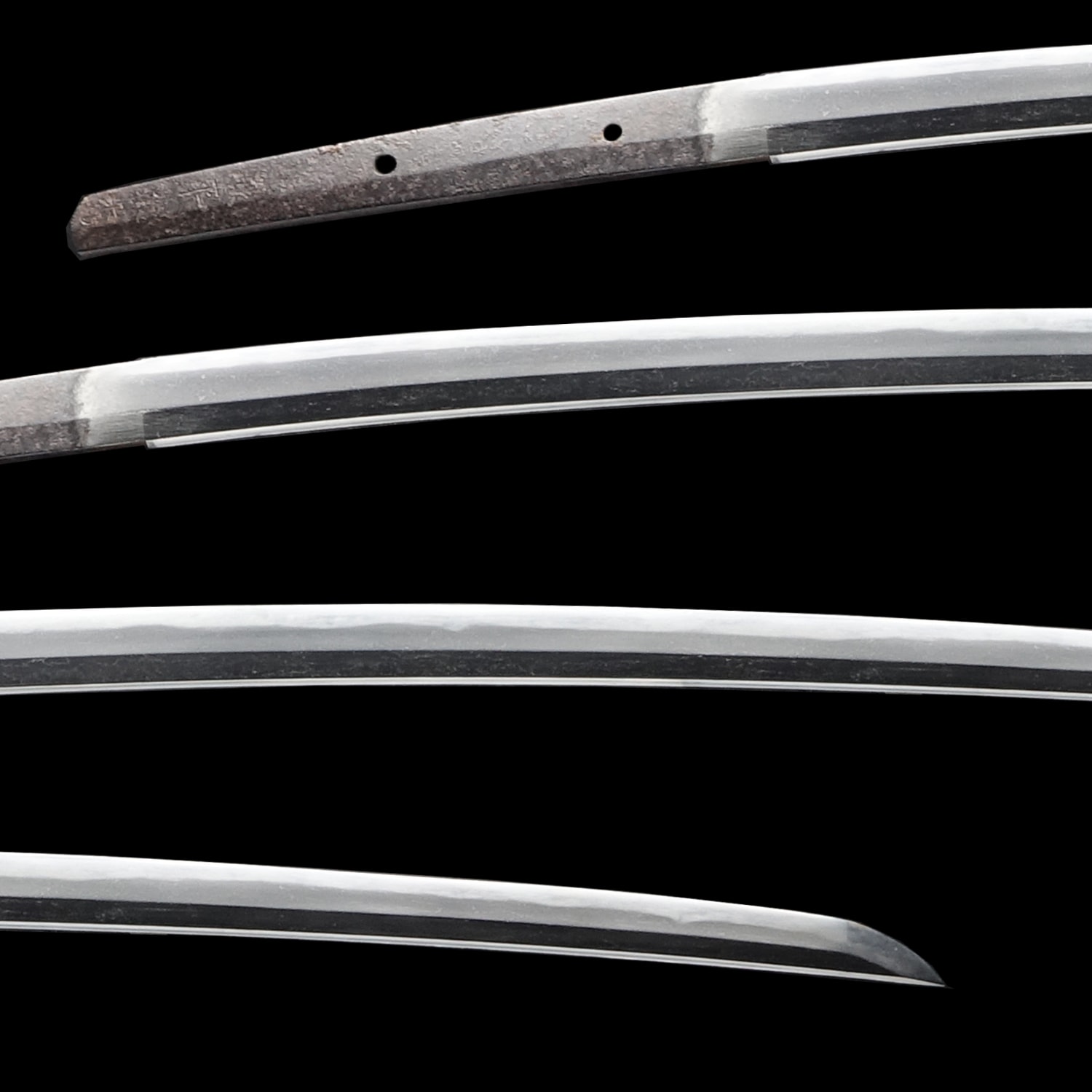
Jimon(Jihada)
:
visible steel surface pattern created by folding and hammering during forging process
Nakago
:
It was signed by Hizen Koku Kawachi Daijyo Fujiwara Masahiro.
Japanese swordsmiths left the black rust on the tang because it prevents red rust while the tang is in its handle. And the discoloration of the tang was created over time, and it is a great indicator for a Japanese sword specialist to estimate when the sword was forged.
Fuchi-Kashira
:
A pair of matching sword fittings that cover the upper and bottom parts of its sword hilt. Gold inlay was applied on them.
This Fuchi Kashira is decorated with flowers and Karakusa patterns. Small fruits that look like Hozuki (physalis alkekengi, Japanese-lantern) are also seen. Karakusa is a kind of climbing plant. As ivy has vitality and thrives strongly, this plant pattern represents prosperity and longevity. These flowers might be peonies. Peony represents happiness, wealth, nobleness, and gorgeousness. This flower pattern has been treated as a kind of good-omen motifs, which becomes the sign of a plentiful harvest. Peony is called “Botan” in Japanese. When we write this flower’s name in Japanese, its second letter has the meaning: medicine of mountain hermit that will give us the eternal youth. Based on the meaning of this letter, the peony pattern symbolizes eternal youth and longevity.
Tsuka and Menuki
:
Tsuka is the handle of the Japanese sword and Menuki is its decoration.
Tsuka is coiled with Hishi-Maki technique, which is a general way to cover the Tsuka.
The bow and arrows are designed for this Menuki. Arrow was once the symbol of Samurai. They appreciated using this motif for their family crests. According to a theory, it is based on the spirits of Shobu (尚武), the idea that values martial arts or valor. We have another word “Shobu,” but it is written as “勝負.” Based on this common pronunciation of these two words, the arrow might have been regarded as the symbol of battles. Also, people consider arrows will exorcise evil spirits and protect them; therefore, this item has been used for various ceremonies and rites in Japan.
Tsuba and Habaki
:
Tsuba is the handguard for the Japanese Sword and Habaki is the equipment to make the blade not touch its scabbard inside.It prevents the blade from getting rusty and chipped.
Iron Tsuba with a Kozuka hole. Its Mimi (edge of Tsuba) is covered with Fukurin; tha