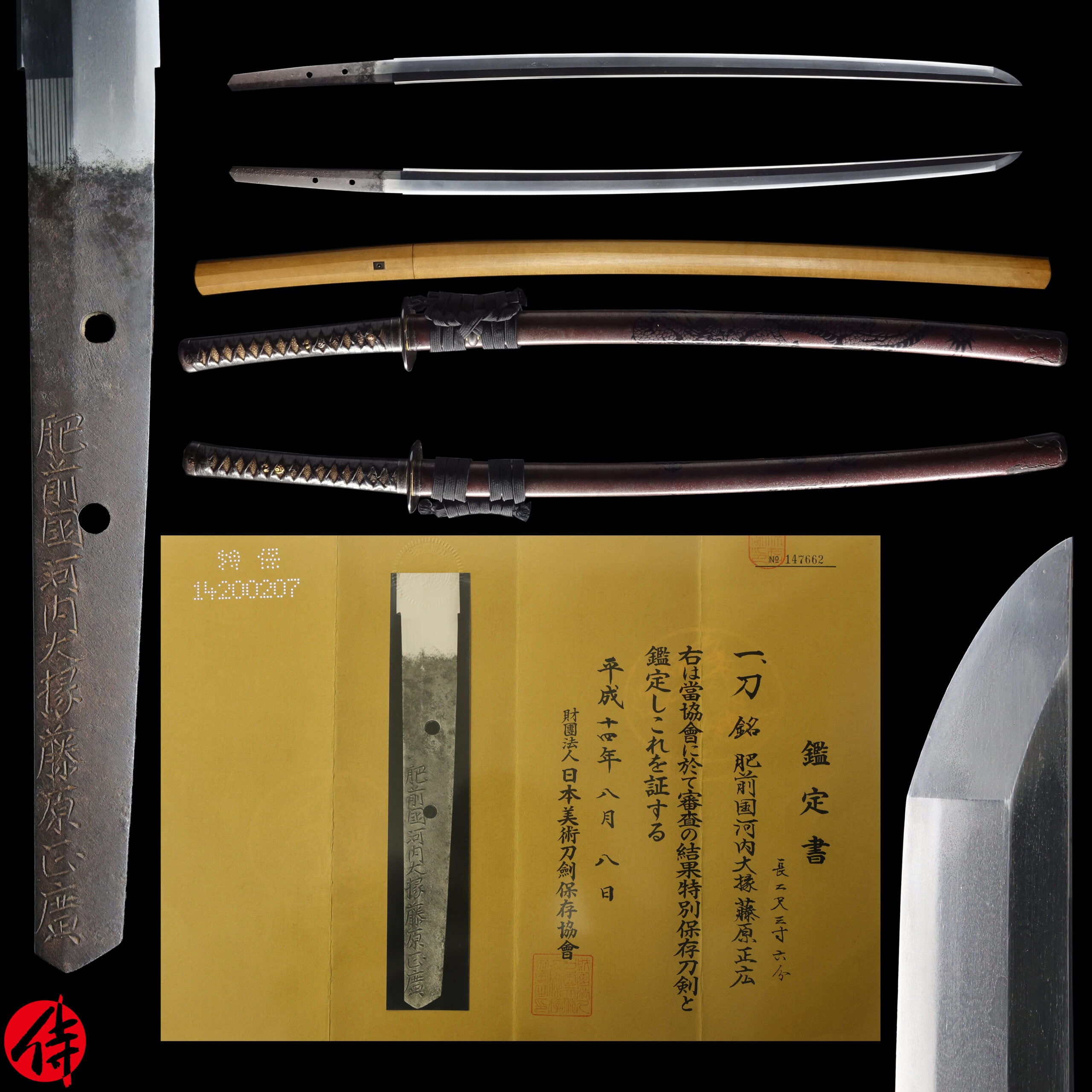
説明
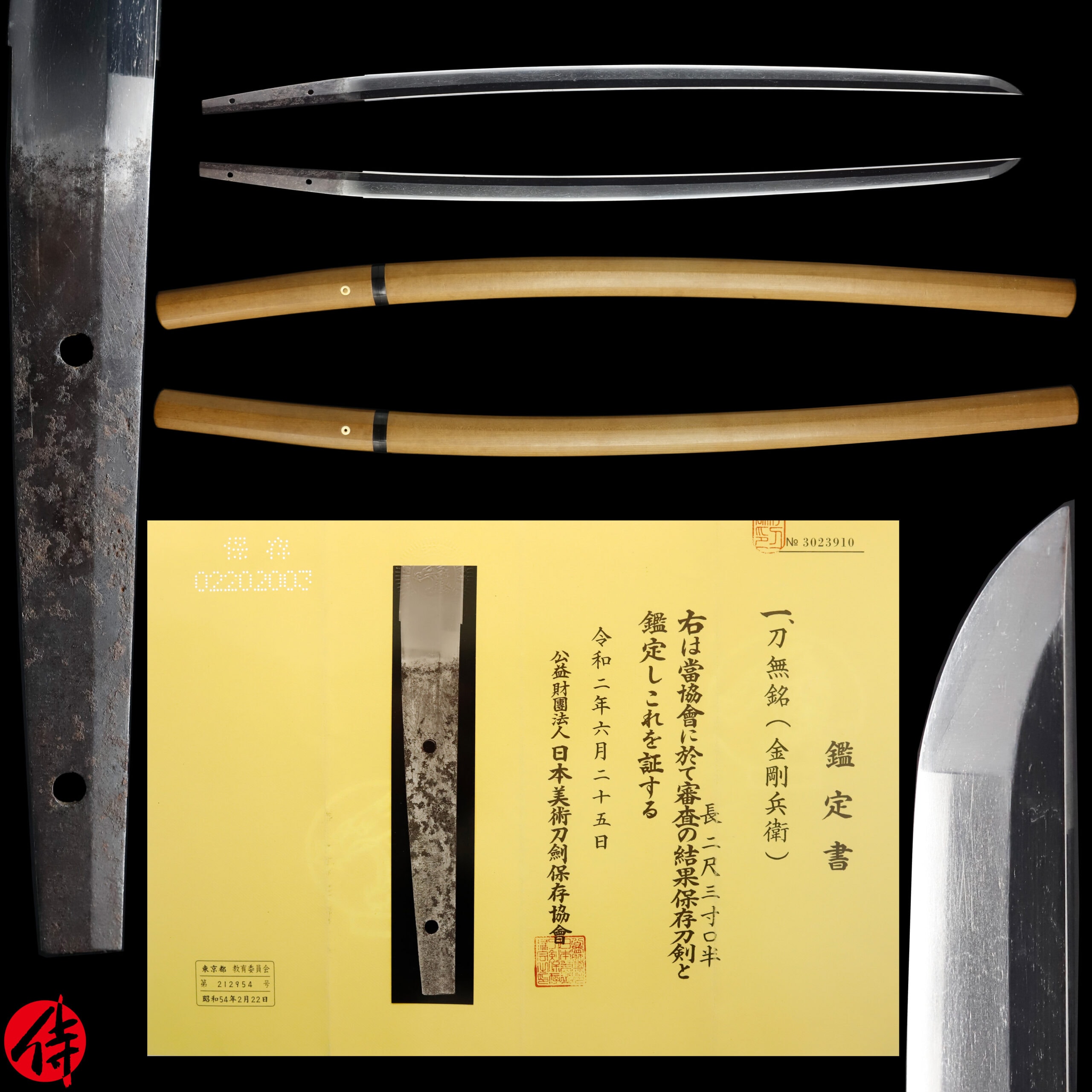
Antique Japanese Sword Katana attributed to Kongo Hyoue with NBTHK
Hozon
Certificate
【Description】
This blade is attributed to Kongo Hyoue (金剛兵衛) , which is the name of the school, being especially active during the late Muromachi period (Early-Mid 16th century) in Chikuzen province (Today’s Fukuoka prefecture).
Kongo Hyoue (金剛兵衛) was a prestigious school founded by Kongo Hyoue Morikuni during the late Kamakura period (around 1278). It is said that Kongo Hyoue had strong relationship with Sairen school., one of the most well-known schools in the region. There were quite a few renowned swordsmiths who were from this school. They resided in Urayama, where Kamado shrine, also known as Kongo Houman, was located. All the swordsmiths who belonged to Kongo Hyoue school used Mori (盛) as their maker’s name, such as Moritsugu. The Nakago (tang) they created has a distinctive shape called Sotoba (卒塔婆) while this blade doesn’t have this characteristic due to Suriage (shorting the blade).
Kongo Hyoue has a strong relationship with Buddhism, as well. Those who belonged to Kongo Hyoue school exclusively forged swords for Reizan Houman Zan, a politically and militarily strong Buddhist organization at one point. Most
When this blade was forged, Japan was in the warring state called Sengoku Jidai where there were so many rivalry and wars between regional feudal lords. The length of this blade is close to 70 cm long and must have been easy for its owner to handle it back then. It would be nice to have a piece that was forged in the warring state period.
This blade is appraised as a
Hozon Touken
(保存刀剣) issued by NBTHK (Nihon Bijutsu Touken Hozon Kyokai: 日本美術刀剣保存協会). This authentication paper was only given to authentic Japanese swords, well preserved and high quality with artistic value.
*Please keep in mind that there are a couple of minor Kitae Kizu on this blade. If you like to see the detailed condition, please feel free to contact us.
【Blade】
Cutting Edge Length (Nagasa)
:
69.9 cm ( 27.5 inches)
Curvature (Sori)
:
1.1
cm (0. 43 inches)
Hamon
:
The crystalline structure which forms along the cutting edge of a blade as a result of the hardening process.
Jimon (Jihada)
:
Visible steel surface pattern created by folding and hammering during forging process.
Nakago
:
Nakago is the tang of the Japanese sword.
Japanese swordsmiths left the black rust on the tang because it prevents red rust while the tang is in its handle. And the discoloration of the tang was created over time, and it is a great indicator for a Japanese sword specialist to estimate when the sword was forged.
Habaki
:
Habaki is the equipment to make the blade not touch its scabbard inside. It prevents the blade from getting rusty and chipped.
Authentication Paper
:
NBTHK Hozon Certificate for the blade (No.3023910)
NBTHK
, also known as Nihon Bijutsu Touken Hozon Kyokai (the Society for the Preservation of the Japan Art Sword), is one of the oldest Japanese sword appraising organizations in modern-day Japan. They authenticated the blade on June 25th in the 2nd year of Reiwa (2020). They appraised it as Hozon Touken, the blade worth preserving for Japanese society. The purchaser will receive this original certificate as well. We can also translate what is written into English and make a
PDF file
for your record if you request.
Registration Number
:
Tokyo 212954
The Board of Education in Tokyo prefecture issued a registration paper for this sword. It is called Jyu Token Rui Torokusho (銃刀剣類登録証). Bunkacho (The Agency for Cultural Affairs) acknowledges a Japanese sword with this paper as a work of art.
The sword needs to be traditionally hand-forged and made of Tamahagane carbon steel to be registered in the system. With this paper, its owner in Japan can legally own an authentic Japanese sword. Based on this registration number, we will apply for its export permit.
This paper will need to be returned to the board of education when the sword is being shipped abroad, but you can receive