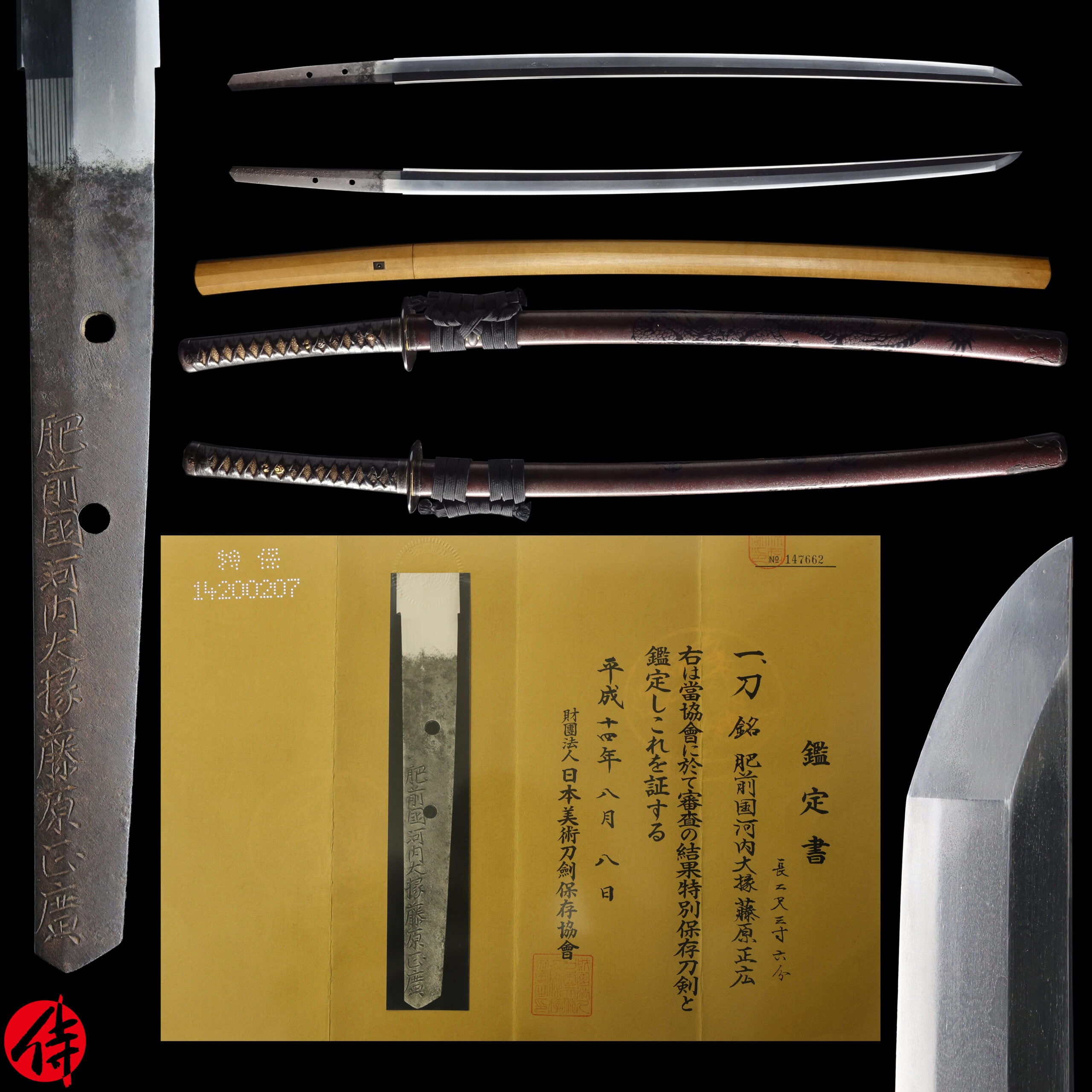
説明
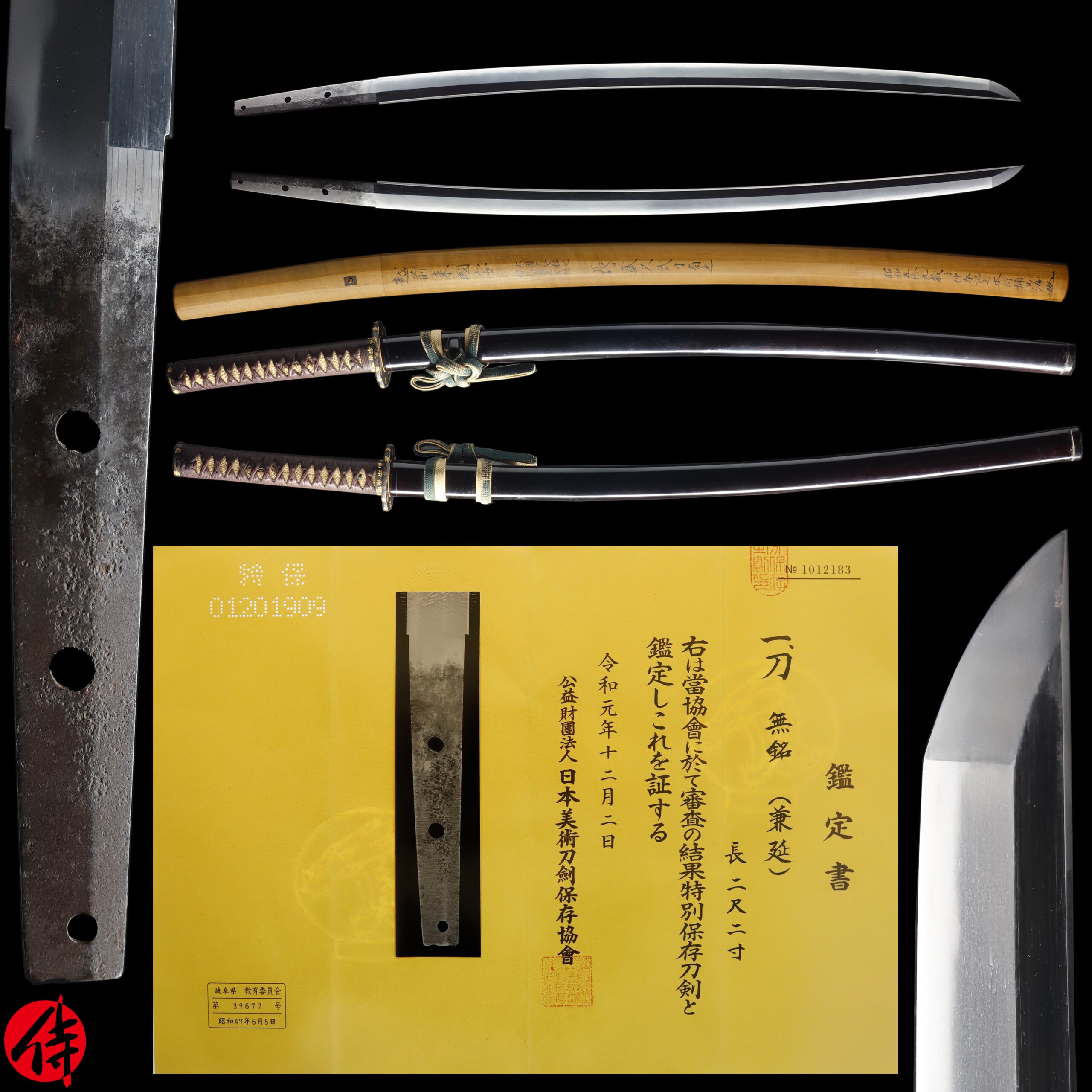
Antique Japanese Sword Katana attributed to Kanenobu with
Tokubetsu Hozon
Certificate
【Description】
This blade is attributed to Kanenobu (兼延), active during the end of the Nanbokucho-early Muromachi period (Late 14th-early 15th century) in Mino province (today’s Gifu prefecture). He belonged to Naoe Shizu (直江志津) school, one of the most prestigious schools in this region.
During the end of the Kamakura period (early 14th century), a swordsmith named Kaneuji moved from Yamato province (today’s Nara prefecture) to Shizu village in Mino province and founded the school. In the Nanbokucho period, his son and apprentices, including Kanetomo, Kanetoshi, and Kanenobu, moved the school to Naoe village in Mino province. Those who belonged to this school were called Naoe Shizu swordsmiths based on where they lived.
The maker’s name, Kanenobu, lasted a few generations, and the first-gen Kanenobu was the second son of the Kaneuji, the founder of the school, being active during the mid-Nanbokucho era (1358-). And the second generation was active during the end of the Nanbokucho period (1390-). We believe the attribution of this blade was given to the late-gen Kanenobu.
The swordsmiths who resided in Mino province developed a sword-forging tradition called MINO-DEN. Its characteristic is the TOGARI(Pointed shapes protruding from the Hamon ) in a classic straight line and random temper line with some white Utsuri. MINO-DEN originated from YAMATO-DEN in the late KAMAKURA period(1280-1330). It flourished in the MUROMACHI period(1333-1573) and continued until the EDO period(1603-1868).
MINO-DEN exceedingly prospered during Sengoku Jidai(Warring State period) due to the high demand for weapons. And the location of Mino province beat others. Akechi Mitsuhide controlled Mino province, Nobunaga Oda ruled Owari province, and Tokugawa Ieyasu was the lord of Suruga (Neighboring areas). There was high demand from those powerful feudal lords and their retainers. Furthermore, many wars occurred between the Kanto region and the Kyoto area. Mino was located in the middle, making feudal lords feel it was convenient to order swords from MINO-DEN. The blades forged in MINO provinces also had a reputation for their practical design and sharpness. Many feudal lords demanded swords forged in the Mino province.
It is appraised as a
Tokubetsu Hozon Token
(特別保存刀剣) issued by NBTHK(Nihon Bijutsu Touken Hozon Kyokai:日本美術刀剣保存協会). This authentication paper was only given to authentic Japanese swords, especially well preserved and high quality with artistic value.
*Please keep in mind that there is a tiny black rust on the tip of this blade. If you like to see the detailed condition, please feel free to contact us.
【 Blade】
Cutting Edge Length(Nagasa)
:
66.8 cm (26.3 inches)
Curvature(Sori)
:
1.6 cm (0.63 inches)
Hamon
:
The crystalline structure which forms along the cutting edge of a blade as a result of the hardening process
Jimon(Jihada)
:
visible steel surface pattern created by folding and hammering during forging process
Nakago
:
Nakago is the tang of the Japanese sword.
Japanese swordsmiths left the black rust on the tang because it prevents red rust while the tang is in its handle. And the discoloration of the tang was created over time, and it is a great indicator for a Japanese sword specialist to estimate when the sword was forged.
Koshirae:
Koshirae is the mounting of the Japanese sword. There are several parts that consist of Koshirae such as Saya(Scabbard), Tsuka(Handle), Tsuba(Handguard).
All of the sword mountings of this Katana Koshirae are decorated with the common motif: the Gosan-no-Kiri Mon (五三の桐紋). It comes from the Kiri (桐, paulownia) pattern, and the Gosan-no-Kiri Mon is a popular and famous design for this flower pattern. Golden paint is applied to each crest part, and this coloring makes an elegant color contrast of black and gold, expressing the luxurious appearance of each metal fittings.
The Kiri (桐) pattern is generally composed of three stan