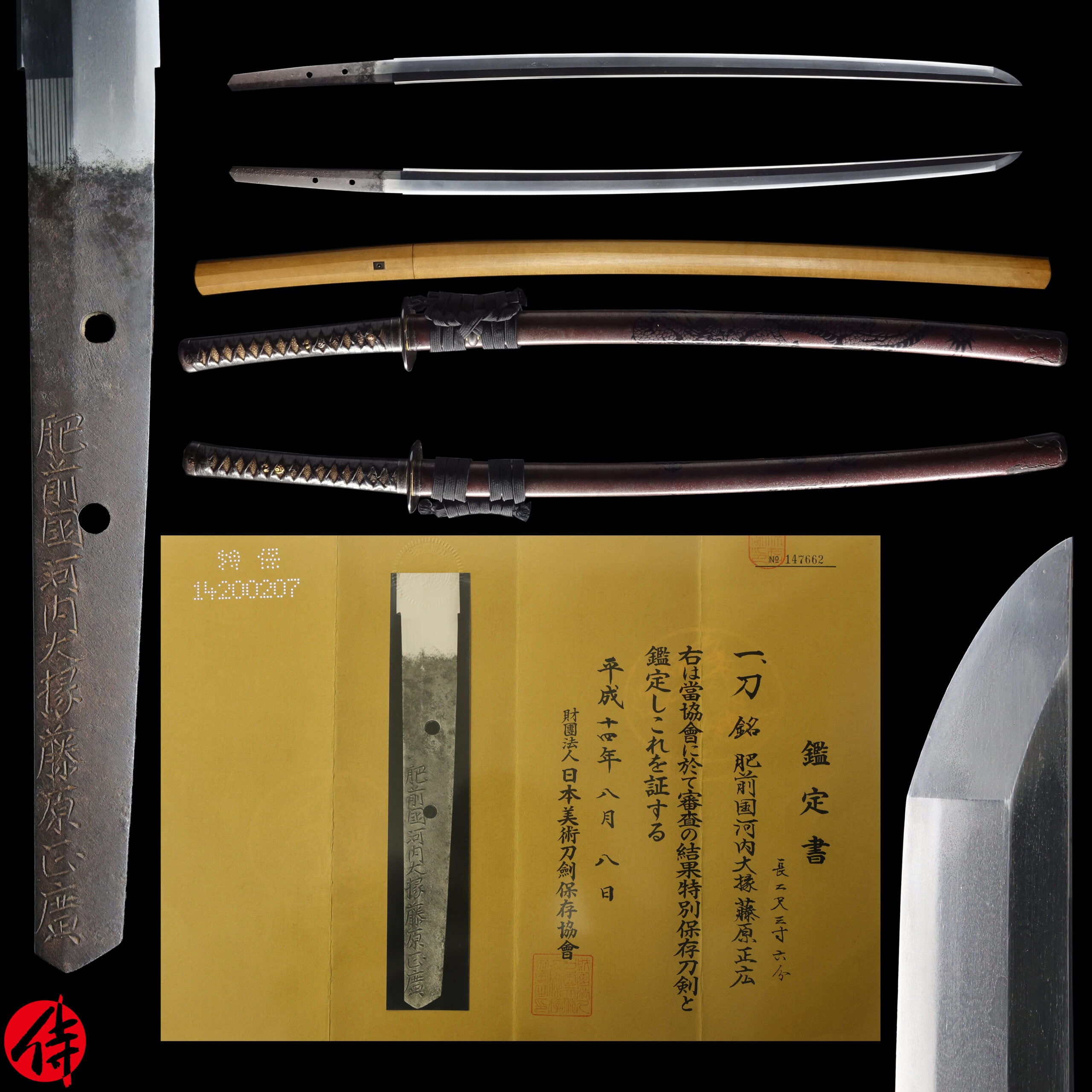
説明
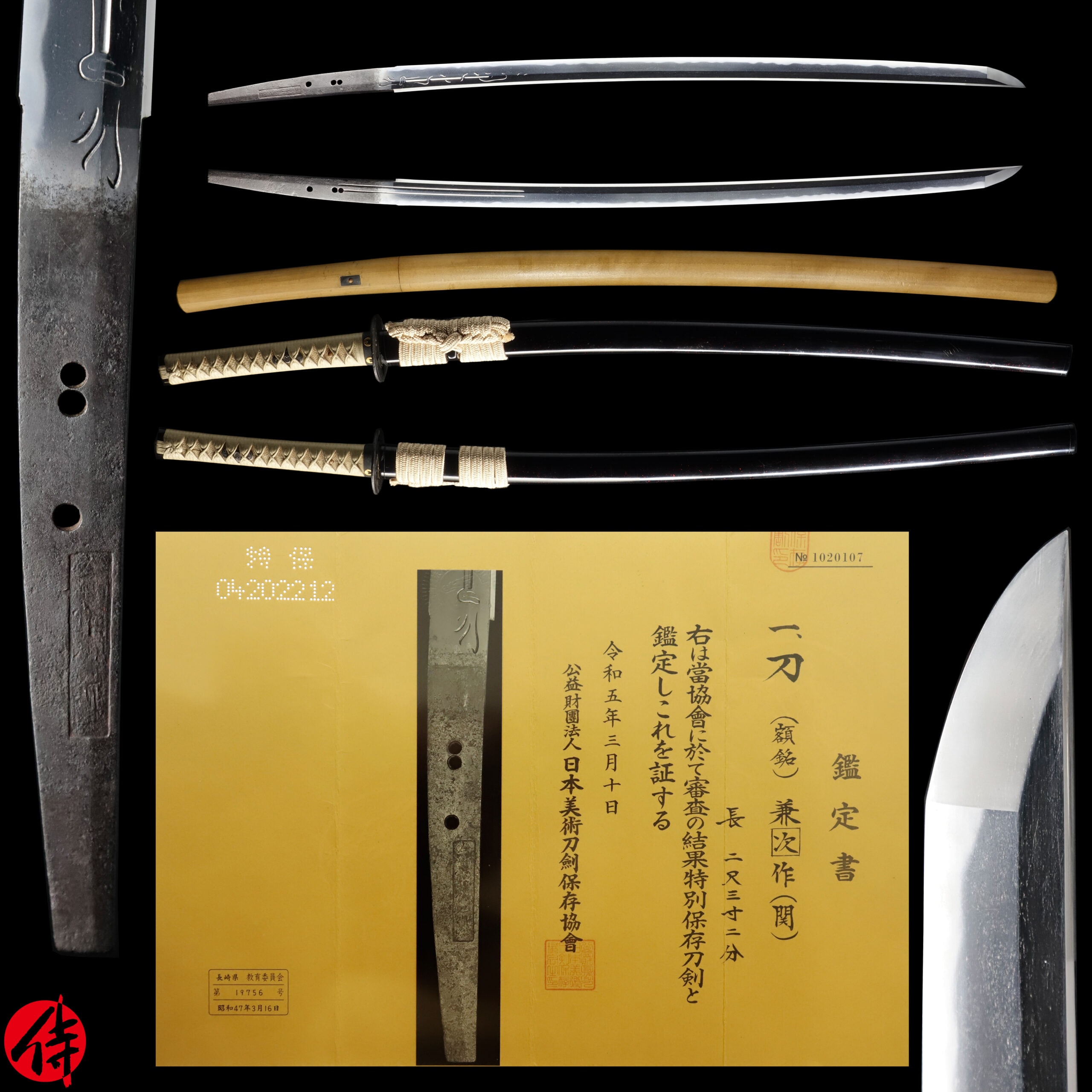
Antique Japanese Sword Katana Gaku Mei Kanetsugu with
Tokubetsu Hozon
Certificate
【Description】
Summary
This blade has a Gaku Mei, also known as Tanzaku Mei of Kanetsugu. This Mei is a kind of signature that was cut from the original tang when the blade was shortened (Suriage). Instead of just cutting the signature part of the blade, it was embedded in the tang. It was named after a Japanese strip of paper (Tanzaku) or Gaku because the shape of the signature resembles it. While this signature is not very clear, based on the characteristic of the blade and other factors, NBTHK attributes it to the work of Kanetsugu.
The maker’s name, Kanetsugu, lasted a few generations from the Nanbokucho-Muromachi period. NBTHK explained to us that this blade was made by a late gen Kanetsugu in the late Muromachi period (early-mid 16th century), based on its characteristic. He resided in Seki city, located in Mino province (Today’s Gifu prefecture). In Mino province, Seki city was the most active one in sword-forging. The first-gen Kanetsugu was an apprentice of the first-gen Kaneuji, who is known as one of Masamune Jittesu (正宗住哲). Kanetsugu belonged to Naoe Shizu school in Mino province.
The swordsmiths of Mino province, with their unwavering dedication and unparalleled craftsmanship, developed a unique sword-forging tradition known as MINO-DEN. This tradition was characterized by the TOGARI(Pointed shapes protruding from the Hamon ) in a classic straight line and a random temper line with some white Utsuri. MINO-DEN, with its roots in YAMATO-DEN in the late KAMAKURA period(1280-1330), flourished during the Nanbokucho-Muromachi period(1333-1573) and continued its legacy until the Edo period(1603-1868). The evolution and endurance of MINO-DEN stand as a testament to the skill and artistry of these swordsmiths.
MINO-DEN especially prospered during Sengoku Jidai (Warring State period) due to the high demand for weapons. And the location of Mino province beat others. Akechi Mitsuhide controlled Mino province, Nobunaga Oda ruled Owari province, and Tokugawa Ieyasu was the lord of Suruga (Neighboring areas). There was high demand from those powerful feudal lords and their retainers. Furthermore, so many wars occurred between the Kanto region and the Kyoto area. Mino was located in the middle, making feudal lords feel it was convenient to order swords from MINO-DEN. The blades forged in MINO provinces also had a reputation for their practical design and sharpness. Many feudal lords demanded swords forged in the Mino province.
Horimono (Engraving)
On one side, Kusa Kurikara-Ken is depicted. Kurikara is the sword that Fudo Myo-O (不動明王, acalanātha) holds with his right hand. Fudo Myo-O is one of the objects of worship in Buddhism. According to a theory, it is the incarnation of Dainichi Nyorai (大日如来, Mahāvairocana, the principal image of esoteric Buddhism). Kurikara-ken was named after its appearance that Kurikara Ryu-O (倶利伽羅龍王, dragon) is winding around the sword. It is believed Kurikara-Ken could cut off worldly desires: Sandoku (三毒). Sandoku is the three fundamental human desires; Ton (貪, greed), Jin (瞋, anger, grudge), Chi (癡, delusion, complaint). Kusakurikara is similar kind of the double edged blade.
It is appraised as a
Tokubetsu Hozon Token
(特別保存刀剣) issued by NBTHK(Nihon Bijutsu Touken Hozon Kyokai:日本美術刀剣保存協会). This authentication paper was only given to authentic Japanese swords, especially well preserved and high quality with artistic value.
*Please keep in mind that there are a couple of Kitae Kizu on this blade. If you like to know the detailed condition, please feel free to contact us.
【 Blade】
Cutting Edge Length(Nagasa)
:
70.3 cm (27.7 inches)
Curvature(Sori)
:
1.2 cm (0.47 inches)
Hamon
:
The crystalline structure which forms along the cutting edge of a blade as a result of the hardening process
Jimon(Jihada)
:
visible steel surface pattern created by folding and hammering during forging process
Kissaki
:
Kissaki is the tip of the Jap