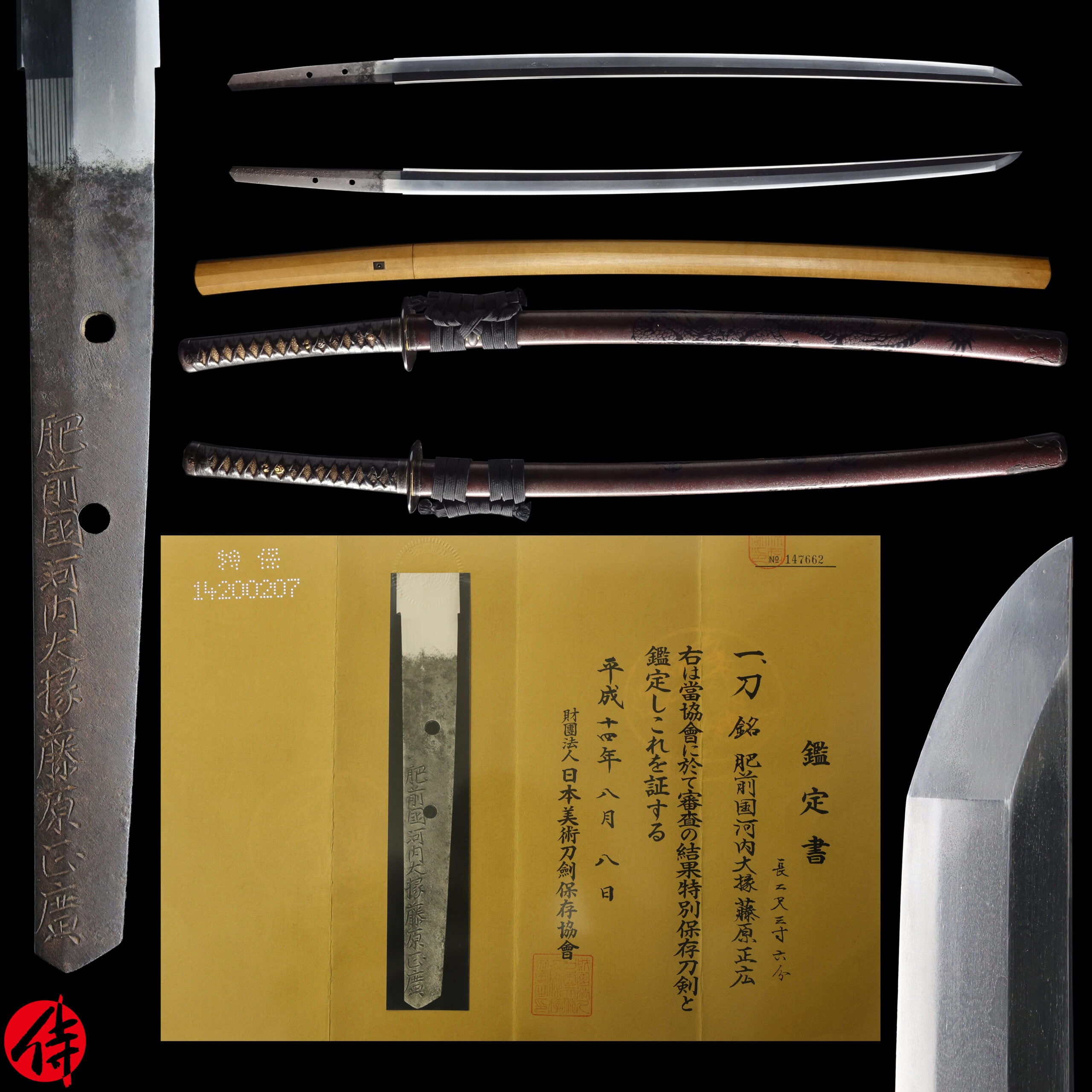
説明
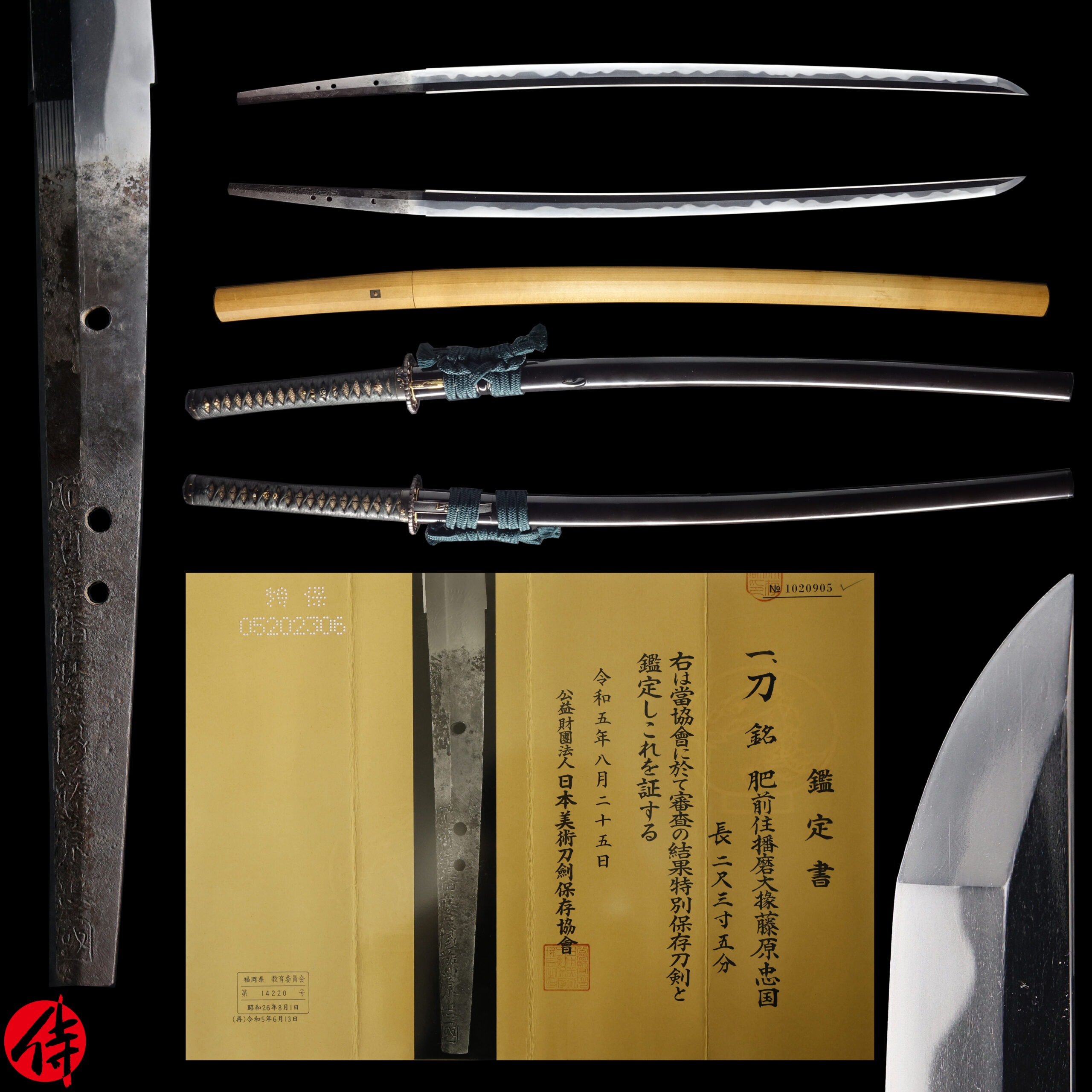
Antique Japanese Sword Katana Signed by Fujiwara Tadakuni with NBTHK
Tokubetsu
Hozon
Certificate
【Description】
This blade was signed by Hizen Jyu Harima Daijyo Fujiwara Tadakuni (肥前住播磨大掾藤原忠国). The maker’s name Tadakuni lasted three generations, and the first generation forged it, judging from the signature. The first-gen Tadakuni was the second son of Hirosada, an apprentice of the first-gen Tadayoshi, one of the most famous swordsmiths during the early Edo period. His older brother was Kunihiro (国広). Tadakuni, Hirosada (his father), and Kunihiro (his older brother) were all students of the first-gen Tadayoshi.
The first-gen Tadakuni was born in the 9th year of the Keicho era (1604). His birth name was Hashimoto Rokuro Zaemon (橋本六郎左衛門). He was especially active in sword-forging during the Keian-Manji era (1648-1661: Early Edo Period).
Tadakuni originally signed Hironori (広則) when he started his career. Then, he changed it to Tadakuni when he received an official Harima Daijyo (播磨大掾) rank in the 11th year of the Kanei era (1634) when he was 31 years old. Later on, he was promoted to Harima no Kami (播磨守). The emperor gave the title of Daijyo and Kami to those who were excellent at sword-forging.
During the Shohou era (1644-1648), he started to serve Ogi clan, a branch of Nabeshima clan, which was the headquarters of the Saga domain during the Edo period. The head of the Ogi clan was Nabeshima Motoshige, the son of Nabeshima Katsushige, the feudal lord of Saga domain. It is said that Motoshige was also a master of various sorts of martial arts, including swordsmanship. We assume there was much demand among high-class Samurai to order swords forged by Tadakuni because this clan actively pursued martial arts.
He kept forging swords for the Ogi clan for more than 40 years, and he retired and passed his title and school to his son around 1676-1677. There was a record of him forging a blade in collaboration with his son after he officially retired. He died at the age of 88 in the 4th year of the Genroku era (1691).
Fujiwara Tadakuni and other swordsmiths in the Hizen province worked under the auspices of Nabeshima clan. The swordsmiths in Hizen province were able to produce beautiful Jigane-patterned blades, also known as Hizen To, using and mixing carbon steel made in Netherland.
You can see the beautiful Jigane, which is famous for blades made in Hizen province. Swords forged by Tadakuni are also renowned among Japanese sword collectors because of his exquisite craftsmanship and history.
Hizen Province
Fujiwara Tadakuni and other swordsmiths in the Hizen province worked under the auspices of Nabeshima clan. The swordsmiths in Hizen province were able to produce beautiful Jigane-patterned blades, also known as Hizen To, using and mixing carbon steel made in Netherland.
You can see the beautiful Jigane, which is famous for blades made in Hizen province. Swords forged by Tadakuni are also renowned among Japanese sword collectors because of his exquisite craftsmanship and history.
The first-gen Tadayoshi (His master)
The first-gen Tadayoshi was born and raised in the Saga domain. In 1596, under the domain’s order, he went to Kyoto to learn the sword-forging technique from Umetada Myojyu (埋忠明寿), one of the greatest swordsmiths in the early Edo period. He improved his craftsmanship and returned to the Saga domain two years later (1598). The first head of the Nabeshima clan, Nabeshima Katsushige, appreciated the work of the first-gen Tadayoshi very much. Then, Katsushige appointed him as his Okakaekaji, a swordsmith who exclusively forged swords for a specific domain or clan. And Tadayoshi started to stay near Saga castle, which is the headquarter of the Nabeshima clan. And, he founded Hizen Tadayoshi school, which trained more than 100 swordsmiths during the Edo period. Tadakuni is one of them.
It is appraised as a
Tokubetsu Hozon Token
(特別保存刀剣) issued by NBTHK (Nihon Bijutsu Touken Hozon Kyokai: 日本美術刀剣保存協会). This authentication paper wa