説明
Skip to content
ITEM# UJKA359 –
Catalogue 33
– Sold
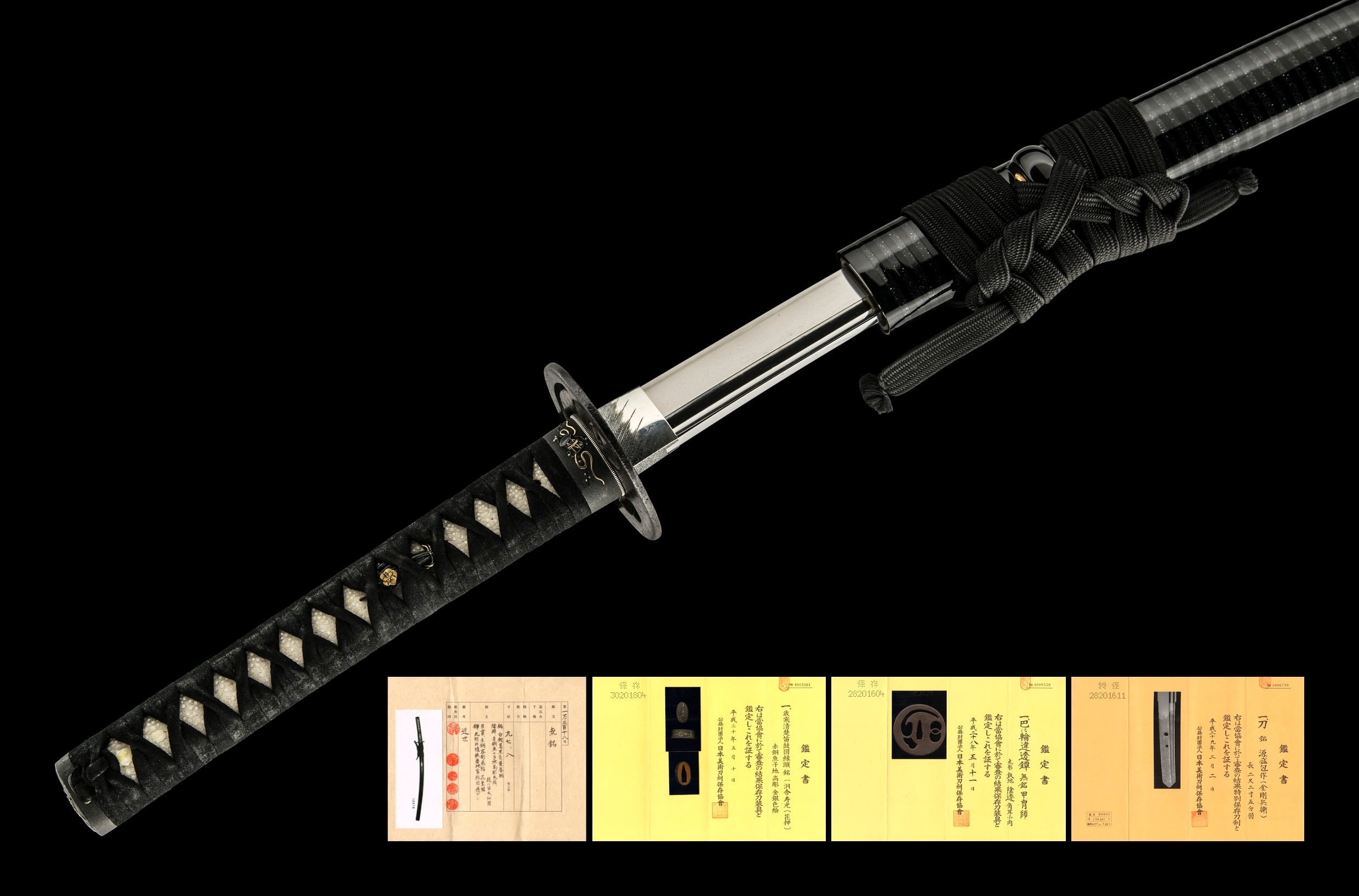
A Morikane Katana
(源盛包作)
Morikane was a swordsmith of the *Kongôbyôe school* in Chikuzen province – the same warrior-monk lineage, rooted in Fukuoka on Kyushu island, that produced blades for the samurai who repelled the Mongol invasions of the Kamakura period. The school’s founder Moritaka and his successors – Moritoshi, Morikane, Moriyoshi, Morikuni – all carried the “Mori” prefix and shared an approach that was conservative, highly functional, and shaped by the Yamato and Yamashiro traditions. This quick and curvy katana was signed by the first-generation Morikane, working during the warring late Muromachi period, circa the Eiroku era (1558-1570).
The blade has a nagasa of 68.5cm with a pronounced 2.4cm sori that gives it real speed. The *jihada* is a fine mix of mokume and itame meeting masame-hada, enriched with ji-nie, abundant swirling *chikei*, and a subtle *shirake utsuri*. A full-length *bo-hi* (groove) runs the length of the blade, lightening it further. The *hamon* is a precise beam of *hoso-suguha*, held with tight nioguchi – the hallmark expression of the Kongôbyôe tradition. The *ubu-nakago* (original, unaltered tang) is signed 源盛包作 – *Minamoto Morikane saku* – confirming the smith’s family name of Minamoto. The nakago-jiri is cut in the distinctive *sotoba* shape, referencing the Buddhist tomb plaques used in Japanese burial grounds.
A superb set of *uchigatana-koshirae* was built for the sword using antique fittings. The *saya* is lacquered in *aoi-gai fuemaki* technique – glossy black with tiny particles of blue shell embedded in symmetrical flute-like stripes, evoking the traditional Japanese *fue* (flute). The *fuchi-kashira* complements this theme beautifully: signed by *Ichidôsha Toshimitsu* of the Edo period, it depicts a drum, flute, and narcissus rendered in shakudô with nanako ground and gold and silver relief accents, certified NBTHK Hozon. The iron *tomoe* tsuba was crafted by an armour-