NihontoWatch MonNihontoWatchBETA
MarketEncyclopedia
NihontoWatch Mon

NihontoWatchBETA

Market
Encyclopedia
Overview·Kantei·Designations·Provenance·Blade Forms·Signatures·School
OverviewKanteiDesignationsProvenanceBlade FormsSignaturesSchool
  1. Schools
  2. Soshu
  3. Sōshū
  4. Tametsugu

Soshu Tametsugu

爲繼

Jūyō
Vol. 23, No. 103 · Katana

Soshu Tametsugu

爲繼

76 ranked works

ProvinceMinoErac. 1345–1350PeriodNanbokuchōSchoolSoshuTraditionSoshu-denTypeSwordsmithCodeTAM155
1Jūyō Bijutsuhin
75Jūyō Tōken

Overview

Tametsugu signed his blades Noshu-ju Fujiwara Tametsugu, and that inscription is the key to him. He is transmitted as a pupil of Go Norishige of Gofuku-go in , in some accounts a son of Go Yoshihiro, who carried the tradition out of the Hokurikudo and settled in . The published sources are careful with the link: among his extant works there are signatures naming both and , the published commentary noting that "there are inscriptions for both and " (越前と美濃の両方の銘文がある), while no example at all reads as resident in , the judges observing that "there is none signed -ju" (越中住ときったものはない). Because his dated pieces fall in the Joji and years of the later , two generations below Norishige's late- work, the swordbooks treat the Norishige discipleship as a manner received across a generation rather than a bond made at one forge, and find a direct link to Norishige, or to Yoshihiro, hard to sustain on chronology. He is best understood as the tradition carried north and inland, a Norishige hand resettled among the smiths of .

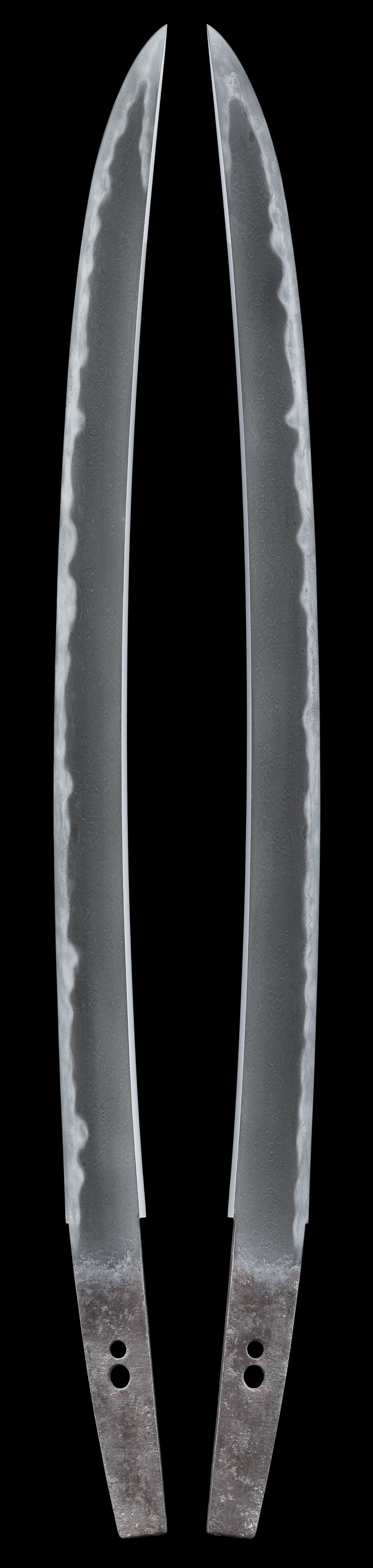
His characteristic manner is the one the judges name outright: a Norishige-style forging crossed with a temper. The published commentary states it plainly, that his work shows "a Norishige-style forging on which is tempered a -style and pointed , displaying a manner of its own" (則重風の鍛に美濃風の互の目尖り刃を焼いて一種の作風を示している). Over a standing he sets a mixed with into which the pointed of are folded, the strong and deep, and above all the run with a frequency that is his signature, drawn out long with within them. The does not blaze; it tends to subside, a quiet, restrained line, and the steel beneath it darkens. This combination, the wet Norishige given the sharp tooth and laid over a dark, -laden , is what a Tametsugu reads as on sight.

The is the constant. It is , frequently mixed with and large grain and flowing toward in places, the grain standing and at times opening, with thick and entering, and a steel of distinctly northern cast that darkens in tone. The published sources give as the common thread of his authenticated work an "that stands and darkens" (板目が肌立って黒ずみ), a -based temper whose subsides, and, as a negative tell, the fact that "there is no " (直刃はない) among the mainstream pieces. Over that the is most often a shallow carrying and , with and , and at the edge on the more active blades; the runs with frequent , turning in a or, on the many shortened , finishing in a sweep.

His record divides cleanly into two registers. The great body of it is the , unsigned attributed to him from style, broad blades with extended or large , on which the Norishige character is clearest. Against these stand the rare signed and dated pieces, exceedingly few, headed by an -dated that is a prewar Bijutsuhin, with a dated 7 (1374) and an cut Fujiwara Tametsugu . The published sources draw the contrast within his own work, noting that the flavor runs the stronger in the signed pieces while the Norishige manner shows more clearly in the attributions, and adding the candid judgment that the signed work can run somewhat coarse while "among the unsigned attributions there are, on the contrary, examples of quite good workmanship" (無銘極めのものには、なかなかよい出来のものがあり).

What sets him apart is read off his own blades, not borrowed from his master. His is the larger, more billowing , and the published commentary distinguishes him from the other hands by it directly, holding that his work "differs in manner from and Kaneshige" (志津、金重とは異っている). Beside Norishige himself the difference is one of degree and clarity: his does not stand as strongly and his are the fewer, the judges remarking on one blade that "the are less conspicuous than in his master Norishige" (師則重程地景が目立たない), and his steel darkens where the masters' is bright. The breadth of his manner reaches occasionally into other idioms, one shortened judged "workmanship in the Yamato Shikkake manner" (大和尻懸風の出来), a reminder that the provincial - he practiced absorbed more than a single line.

For the collector Tametsugu is a name encountered almost entirely through attribution. He has no National Treasures and no Important Cultural Properties; his record runs instead through the prewar Bijutsuhin and a long roll of blades across many sessions, the signed and dated pieces, the documentary core of the name, being the rarest of all. The published sources hold those few signed works to be of exceptionally high value precisely because so little survives, and longer signed examples are scarcer still. Owner records are thin: a pair of his blades is preserved at Atsuta Jingu, the passed through the prewar collection of Akaboshi Tetsuma, and most current whereabouts go unrecorded. The attributed to him do reach the market from time to time, a -Tametsugu appearing among - blades with some regularity, but a signed and dated Noshu-ju Fujiwara Tametsugu is a different order of thing, the document that fixes the name, and a privately held example is among the more uncommon encounters in the field. One such the published commentary calls outright "a quintessential example of Tametsugu's work" (為継の典型的な一刀), which is the best a collector can realistically hope to meet.
Kantei

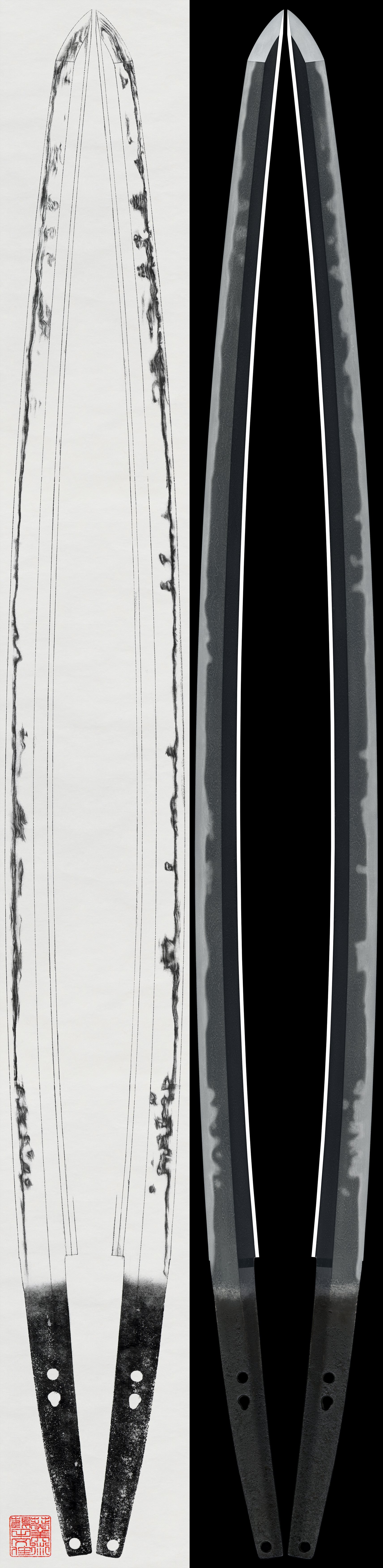
one Mino Soshu-den hand read in two registers: the o-suriage mumei katana that carries a Norishige-style notare-and-gunome with Mino togariba over a dark, ji-nie-laden standing itame, set beside the rare signed and Oan-dated pieces on which the province and chronology of the name rest and the Norishige-discipleship question turns

Tametsugu is a Nanbokucho smith transmitted as a pupil of Etchu Norishige who carried the Soshu tradition out of the Hokurikudo and into Mino, where he settled and signed Noshu-ju Fujiwara Tametsugu. His own inscriptions fix that course: there are no works at all signed as resident in Etchu, while the signed pieces read Mino and bear Joji and Oan dates, so the published sources accept the Norishige discipleship as a manner received rather than a literal master-pupil bond across a single lifetime, the later swordbooks calling a direct link to Norishige and to Go Yoshihiro hard to sustain on chronology. The great body of his record is the o-suriage mumei katana attributed to him from style alone. Across it his hand is a standing itame mixed with mokume, the grain darkening, ji-nie thick and chikei entering, over which he sets a notare mixed with gunome and pointed togariba, the nie strong, sunagashi running with particular frequency and kinsuji within, the nioiguchi tending to subside. The judges name the combination as his individual character, a Norishige-like forging carrying a Mino-flavored gunome-and-togari temper, and they distinguish him from Shizu and Kaneshige by the larger, billowing notare-midare he favors, while noting that his hada does not stand as strongly as Norishige's and his chikei are the fewer. The rare signed and dated pieces, headed by an Oan-dated tanto that is a prewar Juyo Bijutsuhin, are the documentary core on which his province and period rest.

Diagnostic discriminators

unique vs Sagami homeland Soshu-den (no Mino togariba)

unique vs Sagami homeland Soshu-den (bright, clear nioiguchi)

Observation by phase

The o-suriage mumei katana (the Norishige-and-Mino mainstream)

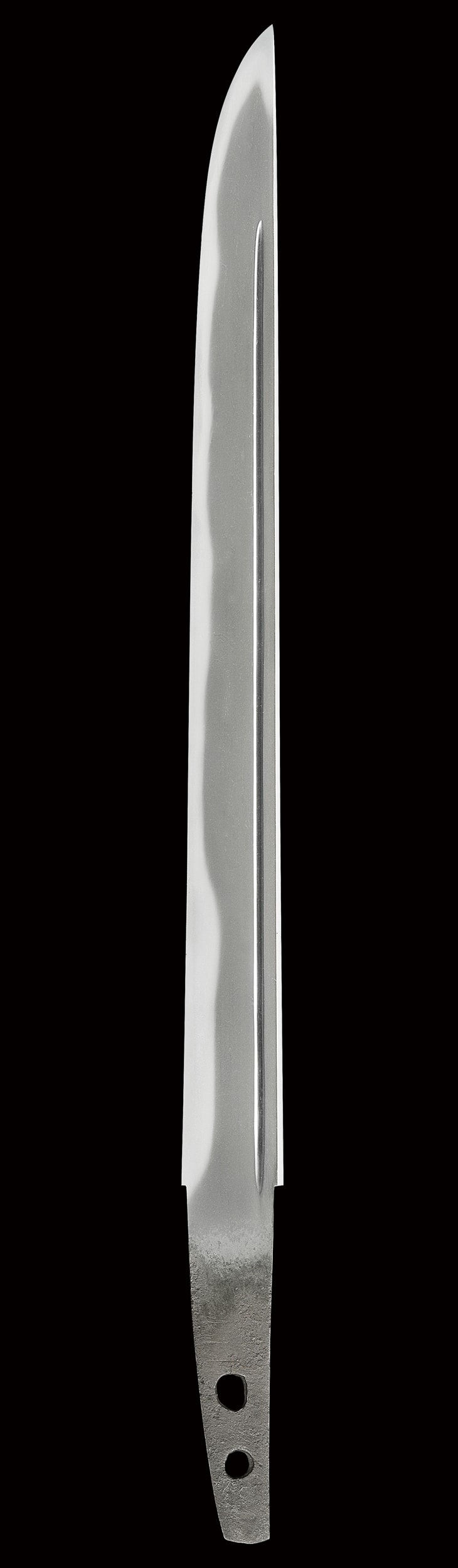
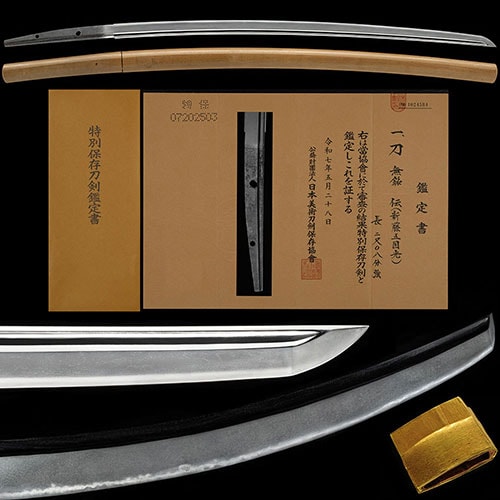
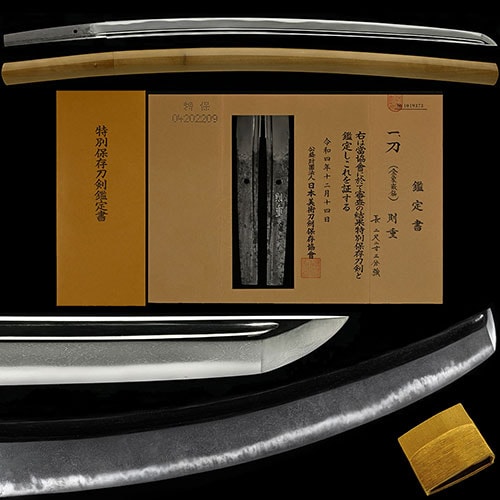
The great body of his record is the greatly shortened, unsigned katana attributed to him from style. These are shinogi-zukuri with iori-mune, wide in body with the sori shallowed by shortening, the kissaki a chu-kissaki at times extended or an o-kissaki, the Nanbokucho build. The ground is itame, often mixed with mokume and large grain and flowing toward masame in places, standing out, with thick ji-nie, well-entering chikei, and a steel of dark, northern cast. Over it the temper is a notare mixed with gunome and pointed togariba, the nie strong and deep, sunagashi running with particular frequency, kinsuji entering, with ashi and yo, and at times tobiyaki and yubashiri along the habuchi, the nioiguchi inclining to subside. The boshi runs midare-komi with frequent hakikake, turning in a ko-maru or finishing in a yakizume sweep, the point at times pointed. The judges affirm these as Tametsugu from the activity of the ji and ha, calling the manner Norishige-like with a Mino flavor, and naming as the common thread of his authenticated mumei work an itame that rises and darkens, a nie-based temper with a subdued nioiguchi, and the absence of pure suguha. They set him apart from Shizu and Kaneshige by the larger, billowing notare-midare he favors.

Sugata 姿
Jigane 地鉄
Hamon 刃文
Bōshi 帽子

The signed, Oan-dated pieces (the documentary core)

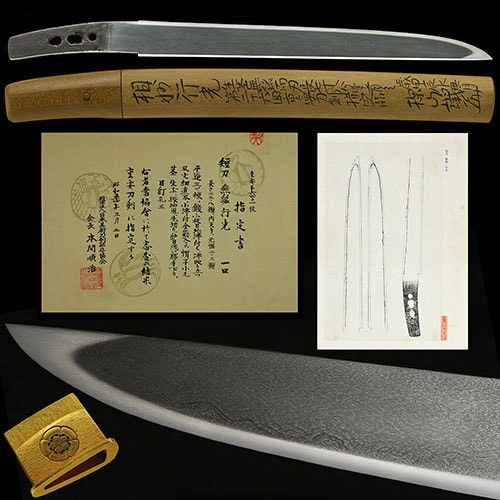
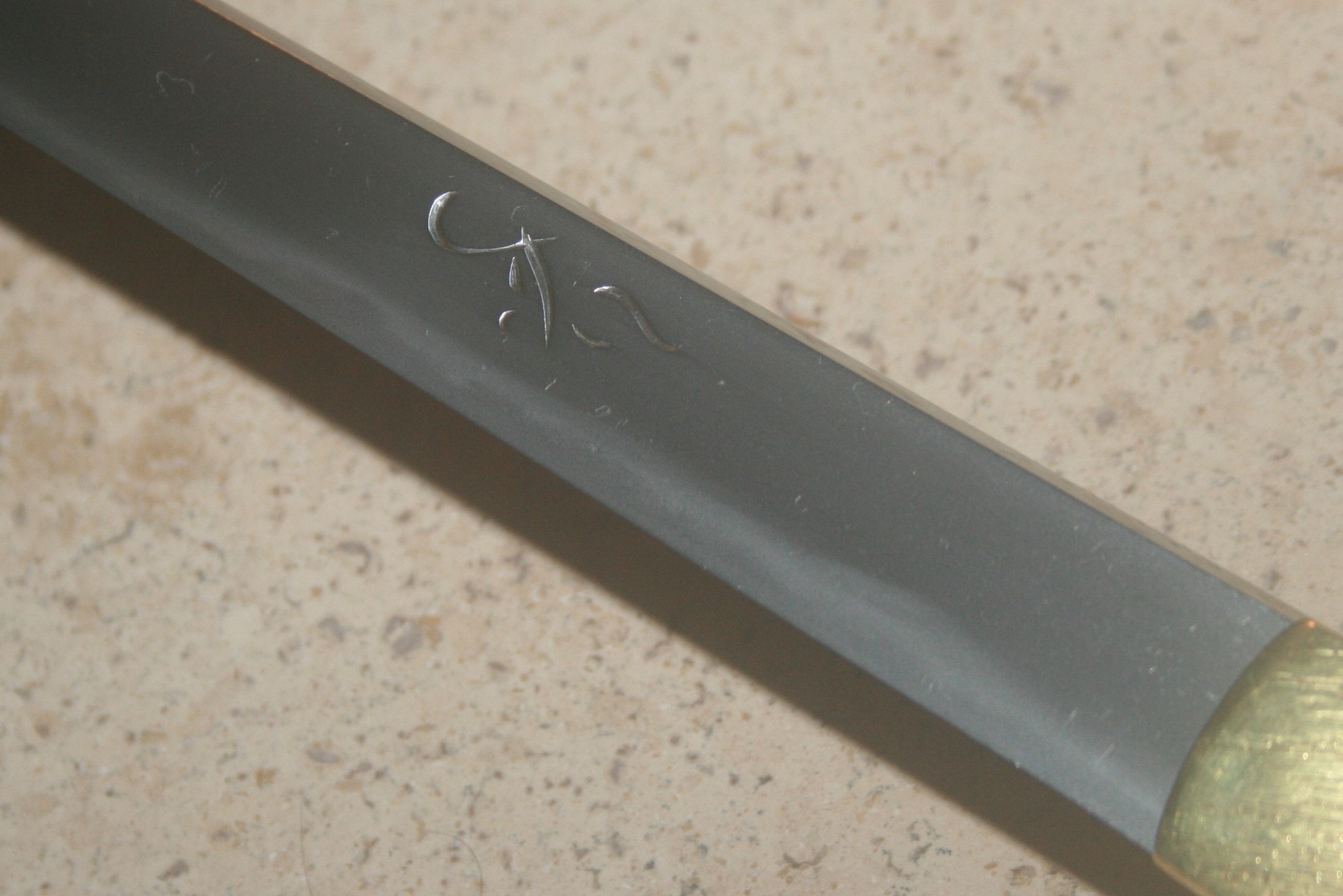
His signed works are exceedingly few, headed by an Oan-dated tanto that stands a prewar Juyo Bijutsuhin and including a shobu-zukuri naginata-naoshi tachi dated Oan 7 (1374) and an ubu tachi cut Fujiwara Tametsugu saku. The signatures read Noshu-ju Fujiwara Tametsugu, Noshu Fujiwara Tametsugu, Fujiwara Tametsugu saku, and the two-character Tametsugu, cut with a fine chisel; none reads Etchu-ju, and the dates are Joji and Oan, so these pieces fix his province as Mino and his period as the latter Nanbokucho. Over an itame mixed with mokume, standing slightly and at times flowing, with ji-nie and a darkening steel, he tempers a notare and gunome with the Mino pointed togariba, with ashi, sunagashi and somewhat coarse nie, the boshi midare-komi or running straight to a ko-maru with hakikake, and finishing yakizume on the converted naginata point. On the signed tanto the published sources read a large midare with abundant nie and note that the Mino flavor runs stronger in his signed work than in his mumei attributions. The judges hold these rare dated pieces to be of high documentary value for the study of the name.

Sugata 姿
Jigane 地鉄
Hamon 刃文
Bōshi 帽子
Scholarship

The published sources transmit Tametsugu as a pupil of Etchu Norishige who moved to Mino, but caution that the master-disciple link cannot be literal: his signatures read Joji and Oan while Norishige's dated work falls in the late Kamakura, so a direct bond with Norishige, and the account making him a son of Go Yoshihiro, are difficult to accept on chronology. The natural reading is an indirect inheritance of the Norishige manner across a generation or two.

The judges name his individual character as a Norishige-like forging carrying a Mino-flavored pointed gunome, and observe that the Mino flavor runs stronger in his signed work while the Norishige character is clearer in the mumei attributions. They give as the common thread of his authenticated mumei katana an itame that rises and darkens, a nie-based temper with a subdued nioiguchi, and the absence of pure suguha, and distinguish him from Shizu and Kaneshige by his larger, billowing notare-midare.

Designations

Kokuhō—
Jūyō Bunkazai—
Jūyō Bijutsuhin1
Gyobutsu—
Tokubetsu Jūyō—
Jūyō Tōken75

Elite Standing

0.18 across 76 designated works

Top 12% among smiths

Provenance

1 documented provenance across certified works by Tametsugu

Provenance Standing

0 works held in elite collections across 1 documented provenances

Top 47% among smiths

Raw score: 2.00 / 10

Blade Forms

Distribution across 76 ranked works

Signatures

Signature types across 76 ranked works

Currently Available

Soshu School

Other artisans of the Soshu school

  1. 1.Masamune正宗1 for sale87designated
  2. 2.Sadamune貞宗87designated
  3. 3.Akihiro秋廣28designated
  4. 4.Go Yoshihiro義弘2 for sale55designated
  5. 5.Kunimitsu國光4 for sale72designated
  6. 6.Hiromitsu廣光1 for sale45designated
  7. 7.Norishige則重8 for sale132designated
  8. 8.Yukimitsu行光4 for sale151designated
  9. 9.Takagi Sadamune高木貞宗1 for sale40designated
  10. 10.Kunihiro國廣15designated
  11. 11.Daishinbo大進房3designated
  12. 12.Akiyoshi秋義2designated