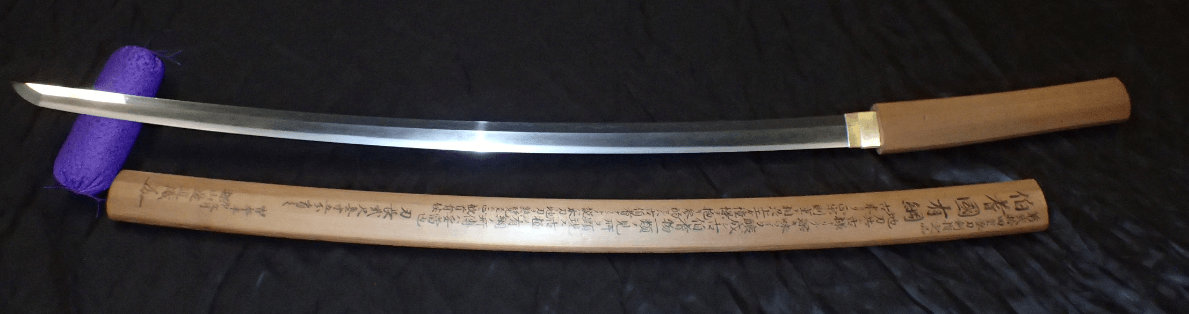
Sanekage (真景) belongs to the Ko-Hoki group of swordsmiths centered in Hoki Province, a lineage that traces its origins to the celebrated Yasutsuna. According to traditional accounts, Sanekage studied under Ohara Sanemori, a smith said to have been Yasutsuna's son, and is placed around the Genryaku era (1184--1185), though some scholarship has advanced the view that his activity may date somewhat earlier. Together with related smiths such as Aritsuna, Sadatsuna, Yasuie, and Masakage, these craftsmen are collectively referred to as Ko-Hoki, a group that flourished from the latter part of the period into the early period. Extant works bearing Sanekage's signature are extremely rare, making each surviving blade of considerable documentary importance.
In broad terms, the Ko-Hoki style features a predominantly small temper that superficially resembles contemporaneous work; however, upon closer inspection, the forging reveals a large-pattern with standing grain, mixed with and mottled effects in the that lend a distinctly darker tone. The tempered edge tends toward a somewhat blurred, moist-looking with a conspicuously textured , and and frequently provide the decisive highlights. The is strong throughout, producing a dense, rich surface character. Small and small stand out within the pattern, and at the base of the temper line is also encountered -- features that distinguish Ko-Hoki work from and impart a stronger rustic, provincial character.
Within this group, Sanekage's surviving work displays a particularly archaic quality. His and , when compared even with Yasutsuna, appear rather more old-fashioned and rustic, accepted by scholars as provincial work clearly differing from traditions such as . This pronounced archaism, combined with the exceptional rarity of signed examples, renders Sanekage an important figure for understanding the earliest phase of organized swordsmithing in the San'in region of Japan.